
The written record
Read the transcript
Read along with the recording · About 30 min to read
Get this and get it straight. Crime is a sucker's road. Those who travel it wind up in the gutter, the prison, or the grave. This time a car hop knocked me down a flight of stairs. An honest woman was strangled by a green silk sash. And a simpering dandy was shot to death. All because of a run-of-the-mill accident 500 miles away. It happened like this.
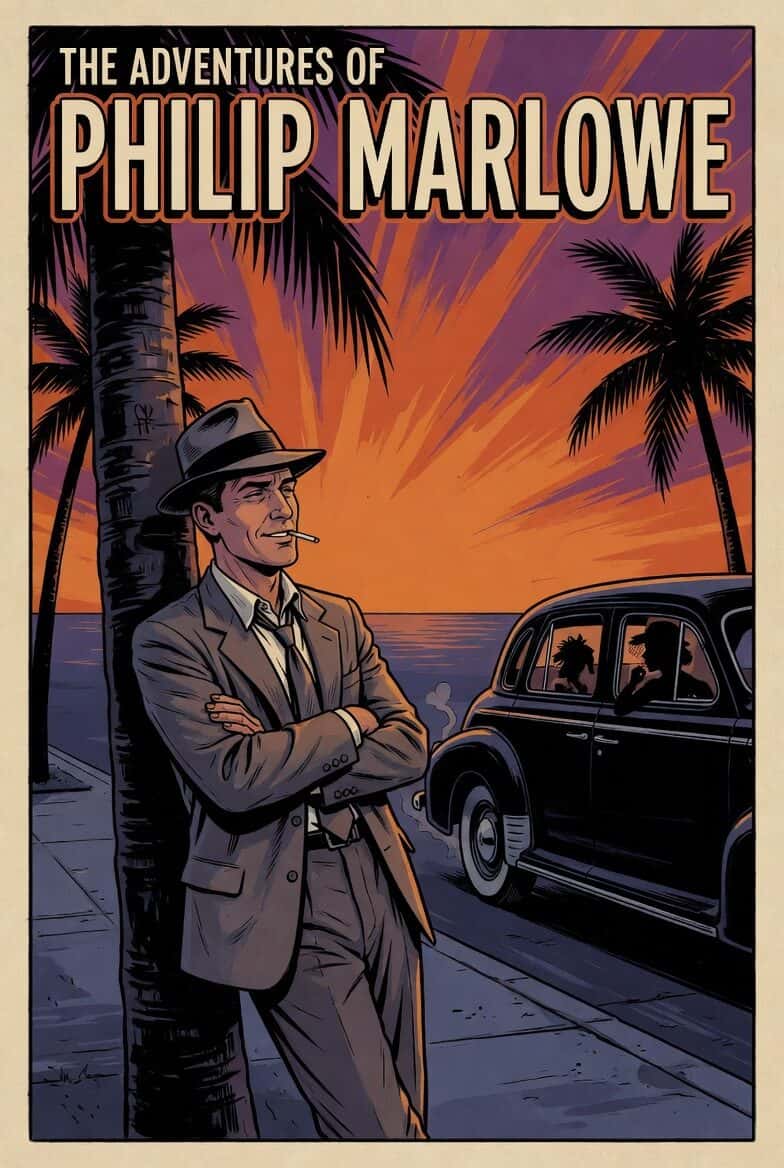
From the pen of Raymond Chandler, outstanding author of crime fiction, comes his most famous character in The Adventures of Philip Marlowe. Now with Gerald Mohr, star of Philip Marlowe, we bring you tonight's exciting story, The Vital Statistic.
On the contrary, it's business, like keeping my own nose clean. I'm a private detective, but I didn't issue any invitation for you to jump into my car.
A private detective? Yeah, who's chasing you, baby, the law? You can tell me out here on the street or inside over a drink.
I'll take the drink, I need it. Maybe I need you too, this might be a break. I'm Mrs. Terry LaBar, and you're, um...
Marlowe, Philip Marlowe.
Who are you running from, Mrs. LaBar?
A woman in slacks. I don't know who she is or why she's following me, but every time I look back, she's there, this is the second day.
Booth? Yeah, sure. Say, look, why haven't you talked it over with your local policeman?
Are you working for me, private detective?
That all depends.
All right. I'm a merchant, Chinese silks, not a little shop for 6% profit, but wholesale, quick with cash at 40%.
Uh-huh, so what's the point?
No police. All it takes is a rumor of police and I'll have doors closed on me from Seattle to Mexico.
Good evening, may I get you something?
A martini, please.
Make it two, waiter.
Yes, sir, right away.
This gets us back to the woman in slacks, huh?
Yeah. Well, here, Marlowe, 50 and 50, $100. I want you to locate that woman, find out who she is and why she's after me, will you?
Not without a few more facts. For instance, could she have some connection with your business?
No. I have two men working with me, a strong one named Harlan Casey, who sees that my cash gets safely to where it's going, and a smart one named Joe Temple, who knows what to buy with it. She doesn't belong to either of them.
Oh, you're sure?
Positive. Casey hates all women, even me, I think.
Mm-hmm. And Joe Temple, well, Joe's a wonderful guy.
You hint like a woman falling in love with a fellow named Joe Temple. Care to talk about it further?
Why not? Temple and Casey have been in San Francisco all week on a deal. A big deal that'll make or break us. Every cent I have is tied up in it.
Oh. Well, what about you and Joe Temple?
Yeah. Well, perhaps this will explain. I planned to go away this weekend, but I changed my mind because I didn't want to miss his letters. I know it sounds funny, but it's true.
Those must be some letters.
They are. Like the one I got this morning. It's half business, all right. Complete account of how hard he and Casey worked for me yesterday in San Francisco. But the rest of it is to me, personally.
I don't want to sound old-fashioned, Mrs. LaBar, but what about... My husband?
Yeah, yeah. That was a mistake I couldn't live with. One thing I can't stand, Marlowe, was being lied to. It leaves me vindictive. I'm suing for divorce right now. Vince LaBar is a human leech, as cold and spineless and parasitic as the real thing.
Okay, but why would your hating your husband put a woman in slacks on your trail?
I don't know.
All right, Terry, I'll worry about that, too. Any idea where I can start?
Just one. I pulled a switch on her yesterday, Marlowe, for about an hour. I trailed her to the corner of Wilshire and La Cienega, then lost her in traffic. There are several dancing schools around there. Is that worth anything?
Maybe. What kind of car was she driving?
We were both walking. She's tall and brunette, and I've seen toads with nicer eyes.
Not enough. Can't guarantee anything.
I'll keep my fingers crossed, Marlowe. Here, take the hundred.
Oh. Do what you can to report to me at my place, 204 Beachwood Circle. Okay?
Pardon, sir, your drinks. Two martinis.
Oh, thanks. Here.
Thank you, sir.
To your success, private detective.
To your health, silk merchant.
Drink hearty.
Slugging it down was no way to treat a good dry martini. But I figured it was time I was on my way.
I drove out to Wilshire and La Cienega and slowed down enough to look at all four corners. There was a drugstore. There was a special on garbage cans. A drive-in called Scotty's, a branch of the Bank of Los Angeles, and a flying red horse over a Mobil gas station. I drove on again when I spotted a pair of black slacks going into a dancing studio a half block down. It looked like a lead.
After two hours of staring at knobby knees and shorts and bulging hips and bloomers, all knocking themselves out for a mythical, cleavage-lighted future, I was finally convinced that it was a dead end. Now I got back into my car and headed up into the hills for Beachwood Circle and the slim hope that Terry could give me something more to go on.
Her house at 204 was low and dainty and half-hidden behind the tough, slender grace of a bamboo grove. The walk was guarded by a white marble lion of Korea and the front door, when I finally found it, turned out to be a sliding panel in a wall of oriental latticework. As the door slid open, I was looking down the barrel of a snub-nosed pistol held very steady in the hands of a hard-eyed brunette in a pair of black slacks.
You've been looking high and low for me, haven't you, peeper?
Ever since you left that dame.
I might have been. You're not the brightest character in the world, in spite of what you and your friends think. I spotted your car when she got in. It wasn't too tough to tag.
Where's Terry?
Sleeping off a hangover from better days. Skip the chatter. Where is she?
Come on in and look. And that's no suggestion, sailor. It's an order. Move. Over there to the top of the stairs.
Sure, sure.
That's a good snub, boy. You're late, you know. I got what I came for, and now I'm in a hurry. Turn around.
Look, sister.
Shut up! I had me last night...
There were ten stairs down to the basement. And with a shove reinforced by the .45, I hit all but the first three. By the time I worked all the kinks out and was back upstairs again, she was gone.
I started through the house, then slowly from one room to another, turning on lights as I went, looking for what I knew was going to be a very sick client. When I got as far as the study, where somebody had gone through the desk drawers with what must have been a snowplow, and I still hadn't found Terry, I got that numb feeling in my stomach. I started. I opened out a side door that opened into the patio. But then I heard a whistle from the front walk. I cut back through the house instead and waited near the door.
Terry! Hey, Terry! Can I come in? It's little Joe, the Frisco kid. What happened to your weekend trip, honey?
Who are you? What do you want?
Hiya, Temple. How do you know me?
Mrs. LaBar hired me today just after she canceled her weekend. She gave me a rundown.
She hired you? What do you mean?
I'm a private detective named Marlowe.
Why would she hire you?
Well, she was being followed by a brunette in slacks. She didn't like it, and that's all the information you're gonna get, so relax.
You say Terry isn't here? Isn't home?
Not so far, no. Come on back here to the study, Temple. I want you to look at something. Somebody's gone through the desk in an awful hurry.
Yeah, yeah, I see what you mean. Maybe you know something about what's missing, huh? You and Mrs. LaBar were fairly close, from what I'm told.
The letters. The letters are gone. Terry kept my letters in this bottom drawer.
Ah. By the way, Temple, where's your sidekick, Harlan Casey?
Oh, I don't know. We... We both left San Francisco yesterday. He hates to fly, so I assume he took a train. He ought to be here in L.A. now.
Well, you don't think Casey's mixed up in this, do you?
I don't know. It could be. Vince LaBar. That's who it was that got those letters. It was Vince LaBar. They were really love letters. The business part was nothing. And LaBar is the dog-in-the-manger kind of guy who wants everyone to be unhappy if he...
That fits. That fits, Temple. With a smart lawyer, your letters to Terry become grade-A material for a counter suit for divorce. Sure. He could make it stick and also get a fat settlement out of community property laws. Now, listen, here's what you've got...
Marlowe. Marlowe, it's... It's Terry.
Terry! Temple, wait!
Terry. Look at her, Marlowe. Look at her. Dead.
Marlowe, Matthews, there's a dead one out here. A woman. You got a pencil?
Always. Go ahead.
I'm at 204 Beachwood Circle. The woman was a client. She was strangled with a green silk sash in my loungy pajamas, Matthews, sometime within the last, I'd say, hour. Yeah. Her name was Terry LaBar.
Hey, wait a minute, Marlowe. Terry LaBar. Wait a minute, Marlowe. Let me go.
So? A traffic accident was... Wait a minute, wait a minute. Uh, Temple, do you know anything about a man named Jess Freeman? He was killed in Oregon today in a traffic accident and had one of Terry's cards on him.
Freeman? Yeah. No. No, I don't remember him. No dice, Matthews. Who are you talking to?
Joe Temple, one of Terry LaBar's associates. He's here. Ever heard of Jess Freeman?
Yeah. Maybe a brunette in slacks. I think I know where to find her.
Well, you sit on it till we get there, Marlowe. I'll be right out.
Wait a minute, Lieutenant. What?
Look, right now it's only a hunch, but if I move fast and quiet, I might be able to develop it into something worthwhile, okay?
Uh, keep in touch, Phil.
Yeah, yeah. I still can't believe it about Terry, Marlowe. Now, look, look. Why don't you just go home and take it easy? I'll tell Lieutenant Matthews where he can find you, huh?
Thanks. Uh, 1310 Marlborough Drive.
Right. Now, tell me, you know where Vince LaBar lives?
Yeah, yeah. The Laverne Apartments on Rossmoor. He's got a suite on the top floor, 7A.
7A. And, uh, if it's any help, he drives a new green Nash sedan.
But I thought you said that it was that brunette who...
I did, I did. And if Vince LaBar can't lead me to the lady in long pants, I'll eat my shirt. What's more, Matthews will see to it personally.
Yes, what do you want?
Some quiet conversation with Vince LaBar. I'm Philip Marlowe, private detective.
Oh, how exciting. Had I known you were coming, I'd have baked a cake.
Oh, you're breaking me up. I was hired by your wife tonight. Get out of here.
Your wife is dead, LaBar. She was murdered.
Dead? Terry murdered?
Yeah. Now, if you don't mind, I'll come in, huh?
She was killed because of a packet of linoleum. Letters, LaBar.
Oh, no.
The kind that are a cinch to cause a big stir in anybody's divorce court. Stir big enough to swing a counter suit in your favor.
I don't know what you're talking about.
Letters, letters, letters. Joe Temple's letters to Terry, the ones you arranged to have stolen tonight.
Oh, you must be crazy. Her death wasn't part of the plan, LaBar. That was one of those bum deals. A robbery that got out of hand, wound up as a murder.
Oh, no, I...
Now, where is she, LaBar? Who's the brunette in slacks, and where do I find her?
You get out of here, or I'll have the police help you.
Oh, shut up. You not only steal letters, but ashtrays, too, huh? Like this coy little number here from Dog House. He's got his drive-in there on Wilshire and La Cienega.
Okay, LaBar, that's all. Stand still.
Oh, now a gun, huh? They say you're yellow, LaBar, but you're not. You're just stupid.
There's a terrace outside those doors, Marlowe. Those with the iron grill. Go on out there. Go on!
I don't think Terry's dead, and I don't think she hired you. I think you're working for that lousy, louse Joe Temple, and if so, he'll need a battalion of private detectives before I'm through.
You're through right now, LaBar. You're too dumb to say it. Go on. Clear over to the rail.
Temple had to get those letters back, right? Yeah, yeah. And the last one in particular, because in the last one, this is the way it's got to figure. In the last one, he must have mentioned something about Empire, Oregon, and about Harlan Casey. He didn't know Terry had a secretary named Jess Freeman. And when Terry told me that Freeman had been killed in a traffic accident in Empire, Oregon, Temple must have figured that Terry was on to him. That she was deliberately feeding me the name of the town where Casey had been killed, to tip me off. So he had to kill her, and fast, before she could tell me any more. And then he had to get those letters back, to make sure there was nothing in them that would connect him with Casey or Empire.
But why kill Vince LeBar, Marlowe? Why not just let the law take care of him?
Because Temple was in too deep by then, Matthews. He'd already killed once. And Vince was dangerous. Vince knew about the letters, knew what was in them, or might know. And Vince was the violent type, the kind who might talk too much if the police got hold of him. Temple couldn't take that chance. So he set himself up as the innocent victim, let Vince come after him, and then shot him in "self-defense." Neat, tidy, and it got rid of two problems at once.
But you said you can't prove any of this.
I can't prove he killed Terry, no. But I can prove he lied about Empire, Oregon. I never mentioned that name to him, yet he knew it. He knew it because he'd been there, because that's where Harlan Casey died. And that's where the whole thing started to unravel for him.
Matthews puffed on his pipe, his eyes narrowed against the smoke. He looked tired, the way cops always look when they're working overtime on a case that should have been simple and wasn't.
All right, Phil. Let's say you're right. What do we do about it?
We lean on him, Matthews. We lean hard. We tell him we know about Empire, about Casey, about the whole setup. We tell him Rose Facetta is talking, that she's willing to trade what she knows for a break on the Terry LeBar killing. We bluff him, and we keep bluffing until he cracks. Because he will crack, Matthews. Guys like Temple always crack. They've got too much imagination, too much guilt. They can't stand the pressure.
And if he doesn't crack?
Then we charge him with Vince LeBar's killing and let the DA's office work on him. Self-defense or not, there'll be enough questions raised to keep him busy for a while. And while he's busy, we dig. We dig into Empire, Oregon, into Harlan Casey's background, into everything Temple's ever done. There's always something, Matthews. Always a loose thread. We just have to find it.
Matthews knocked out his pipe against the edge of his desk, a sharp, decisive sound in the quiet room.
You're a hard man, Marlowe.
I'm a careful man, Lieutenant. There's a difference.
Yeah. Yeah, I suppose there is. All right, we'll try it your way. But if this blows up in our faces, it's your face, not mine.
Fair enough.
I got up and started for the door, then turned back.
One more thing, Matthews. Don't mention my name to Temple when you talk to him. Let him think I'm still out there, still digging, still one step behind him. The uncertainty will eat at him. It always does.
Matthews grunted something that might have been agreement and reached for his phone. I went out through the glossy corridor, past the desk sergeant who didn't look up from his crossword puzzle, and into the night.
The air was cool and smelled of distant rain, or maybe that was just the city, always promising something it never delivered. I walked to my car, thinking about Joe Temple and Terry LeBar and all the people who get caught in the machinery of other people's greed. Temple had wanted something simple enough—money, probably, or power, or just the thrill of beating the system. And Terry LeBar had wanted out of a marriage that had gone sour. And Rose Facetta had wanted Vince, or what Vince represented. And Vince had wanted revenge, or satisfaction, or just the last word.
And me? What did I want?
I wanted the truth, I supposed. Or as much of it as ever comes out in cases like this. I wanted to walk away clean, with my fee and my self-respect intact. I wanted to believe that the work meant something, that somewhere down the line, somebody was better off because Philip Marlowe had been on the job.
Maybe that was asking too much. Maybe it was always asking too much.
I got in my car and started the engine. There was a diner down on Wilshire where the coffee was hot and the waitresses didn't ask questions. I'd go there, sit in a corner booth, and wait for Matthews to call. Whatever happened with Temple, it would happen tonight. Guys like Temple didn't have the stamina for a long siege. They'd built their lives on quick moves and fast escapes, and when the exits were blocked, they came apart fast.
The radio hummed with static as I drove, occasional fragments of music or voices cutting through the noise like memories half-remembered. I turned it off and listened to the city instead, the tires on wet pavement, the distant wail of a siren, the soft rhythm of my own breathing.
This was my town, for better or worse. I'd seen it at its best and its worst, and most of the time somewhere in between. I'd seen people do terrible things for love or money or just because the opportunity was there. I'd seen the innocent suffer and the guilty prosper and the whole machinery of justice grind on, slow and imperfect and sometimes downright cruel.
But I'd also seen moments of grace, small and unexpected, a stranger's kindness, a cop's stubborn integrity, a victim's quiet courage. Those were the moments that kept me going, that made the long nights and the cheap coffee and the constant suspicion worth enduring.
The diner was half-empty when I got there, a few night owls nursing cups of coffee at the counter, a couple in a back booth holding hands across the table like they were afraid to let go. I took my usual corner, ordered coffee and a piece of pie I didn't want, and settled in to wait.
The waitress was new, young, with tired eyes and a practiced smile. She brought my coffee without asking if I wanted cream, which meant she'd been watching me, or someone had told her about the private detective who came in sometimes and sat for hours over cold coffee.
I tipped her too much and opened the newspaper someone had left behind, scanning headlines I didn't care about, stories of politics and scandal and the endless small disasters that make up the daily news. It was all distraction, something to do with my hands and eyes while my mind worked over the case, fitting pieces together, looking for the pattern that would make everything clear.
Empire, Oregon. Harlan Casey. Jess Freeman. The names circled in my head like birds of prey, waiting to descend. There was something there, something I was missing, some connection that would tie everything together and give me the leverage I needed.
But it wouldn't come. Not yet. These things never came when you called them. They arrived in their own time, in the small hours of the morning when you were too tired to think straight, or in the middle of a conversation about something else entirely, or in dreams that dissolved when you tried to hold them.
I finished my coffee and ordered another cup, watching the door, watching the clock, watching the night wear on toward morning. The couple in the back booth left, arms around each other, and were replaced by a solitary man in a wrinkled suit who ordered whiskey and drank it like medicine.
The radio behind the counter played soft music, something with strings and a muted trumpet, the kind of music that makes you think of rain on windows and women you've lost. I let it wash over me, not fighting it, not holding on, just letting it be what it was.
And then the phone rang.
The waitress answered, listened, looked over at me. "Mr. Marlowe? For you."
I took the call at the counter, my back to the room, my voice low.
"Marlowe."
"Matthews. It worked, Phil. He cracked. He wants to talk, but only to you. Says he won't say a word to anyone else."
I felt the familiar tightening in my chest, the adrenaline starting to flow. The end of the case, or the beginning of the end. The moment when everything would come together or fall apart.
"Where?"
"Here. Homicide. Now. He's waiting."
"I'm on my way."
I hung up, dropped money on the counter, and went out into the night. The rain that had been threatening all evening had started, a fine mist that coated the windshield and made the streetlights blur and run like watercolors.
I drove carefully, not rushing, giving myself time to think, to prepare. Temple would be desperate now, dangerous in the way that cornered animals are dangerous. He'd try to bargain, to trade what he knew for some kind of deal, some leniency that Matthews would pretend to offer and never deliver.
And I'd have to play my part, the sympathetic ear, the one man who understood, who might help if Temple would just tell the truth. It was a role I'd played before, too many times, and I never liked it. There was something dirty about it, something that left a stain even when it worked.
But it was part of the job, part of the price you paid for walking in the shadows. You couldn't stay clean in this business. You could only try not to get too dirty, to wash off what you could and live with what you couldn't.
Police headquarters was quiet at this hour, the corridors dimmed, the bustle of the day reduced to a skeleton crew of night workers and the occasional prisoner being brought in. I found Matthews waiting outside the interrogation room, his pipe dead in his hand, his face lined with fatigue and something else—anticipation, maybe, or just the satisfaction of a hunter who knows the prey is finally cornered.
"He's in there, Phil. Been waiting for you. You want me to sit in?"
"No. Let me talk to him alone first. If he opens up, you can come in later for the formal statement."
Matthews nodded, unsurprised. He knew how I worked, knew that sometimes the private conversation got results that the official interrogation never would.
"Your funeral," he said, but without malice. "I'll be right here."
I went in.
Temple was sitting at the plain wooden table, his hands clasped in front of him, his eyes fixed on some point in the middle distance. He looked smaller than I remembered, diminished by defeat, the sharp edges of his confidence worn smooth by fear.
He looked up when I came in, and I saw something flicker in his eyes—hope, or its last ember, struggling against the wind.
"Marlowe. I knew you'd come."
"Hello, Temple. You wanted to talk."
"Yes. Yes, I... I need to explain. You don't understand how it was. You don't understand what she was doing to me, what they were all doing to me."
I pulled out the chair across from him and sat down, making no sound, giving nothing away.
"Tell me, Temple. Tell me everything."
And he did. It came out in a rush at first, the words tumbling over each other, then slowing, becoming more measured as he found the rhythm of confession. The affair with Terry LeBar that had turned sour, the discovery that she was playing him against her husband, using him for her own purposes. The partnership with Harlan Casey, the scheme to get out with something to show for it all. Casey's death in Empire, Oregon, the traffic accident that wasn't entirely accidental. And finally, the desperate need to get the letters back, to destroy the evidence that could tie him to everything.
"I didn't mean to kill her, Marlowe. You have to believe that. I just wanted the letters. But she wouldn't give them up, and then she told me about Empire, about how she knew, how she'd known all along. And I... I lost control. It just happened."
"And Vince?"
"Vince was going to kill me. Or have me killed. He knew too, or guessed enough. I couldn't let him... I had to protect myself."
"So you set him up. Let him come after you, then shot him."
Temple's hands were shaking now, the clasped fingers white with pressure.
"Yes. Yes, I set him up. But it was self-defense, really. He would have killed me. He was crazy with jealousy, with hate. You saw how he was."
I saw. I saw a lot of things, sitting across from this broken man with his excuses and his justifications. I saw the familiar pattern, the slow slide from one small compromise to the next, each one easier than the last, until you were so far from where you started that you couldn't even see the shore anymore.
"There's one thing I don't understand, Temple. Rose Facetta. Where does she fit in?"
Temple laughed, a harsh, broken sound.
"Rose? Rose was Vince's girl, not mine. She did what he told her, including knocking out Terry to get the letters. She didn't know about the killing, didn't know I'd... She thought Vince was going to use the letters in the divorce, that was all. She was stupid, really. Stupid and greedy and in love with a man who didn't care about anything but his own revenge."
"And now?"
"Now?" Temple spread his hands, a gesture of helplessness, of surrender. "Now I want to make a deal, Marlowe. I know things, things that could help the police. Other cases, other people. I want to trade, to get some kind of... some kind of break."
I stood up, pushing back the chair, looking down at him with something that wasn't quite pity and wasn't quite contempt.
"I'll tell Matthews you're ready to talk officially, Temple. The rest is up to him, and the DA. I don't make deals."
I went to the door, then turned back.
"One more thing. That name you used, when you were talking about Empire. You said Terry told you she knew about Empire. But she didn't, Temple. I never told her the name of the town. I never mentioned it to anyone except Matthews. You knew about Empire because you'd been there, because that's where you killed Harlan Casey. Just like you killed Terry. Just like you killed Vince LeBar."
Temple's face went white, then gray, the last of his defenses crumbling.
"No. No, I..."
"You wanted to confess, Temple. This is what confession sounds like. It doesn't bargain, and it doesn't make excuses. It just tells the truth, all of it, and lets the chips fall."
I went out, closing the door behind me, leaving him to whatever remained of his conscience, whatever fragment of the man he might once have been.
Matthews looked up from his pipe, one eyebrow raised.
"Well?"
"He's ready for you, Lieutenant. He's got a lot to say."
Matthews nodded, knocked out his pipe, and went in. I stood in the corridor for a moment, listening to the murmur of voices through the door, then turned and walked away.
The rain had stopped, or maybe I'd just stopped noticing it. The sky was lightening in the east, the first gray promise of dawn. Another night over, another case closed, another small piece of the darkness pushed back.
I drove home through the empty streets, past the closed shops and the sleeping houses, past the all-night diners and the early-morning trucks starting their rounds. The city was waking up, or going to sleep, depending on where you stood. It was all a matter of perspective, of which side of the clock you lived on.
My apartment was cold and quiet, the way I always left it. I poured a drink I didn't need and sat by the window, watching the light grow stronger, watching the world come back to life.
Somewhere out there, other cases were waiting, other clients with their troubles and their secrets and their desperate needs. And I'd take them on, one by one, because that was what I did, what I'd chosen to do, what I was good at.
But for now, for this small hour between night and day, I just sat and watched and let myself be still. The drink went untouched, warming in my hand. The city moved on without me, as it always had, as it always would.
And Philip Marlowe, private detective, sat alone with his thoughts and his memories and the faint, persistent hope that tomorrow might be different, might be better, might bring something worth waking up for.
The light grew stronger, filling the room, pushing back the shadows. And somewhere in the distance, a radio was playing, the soft strains of a song I almost recognized, a melody from another time, another place, another life.
I finished my drink and got up, moving toward the bed, toward sleep, toward whatever dreams might come. The case was closed. The vital statistic, the one that mattered, was that I was still standing, still walking, still able to look myself in the mirror and not flinch.
It wasn't much, maybe. But in my line of work, it was enough. It had to be enough.
Because tomorrow, there'd be another case, another client, another walk through the darkness. And I'd take it, because that was the job, because that was who I was.
Philip Marlowe. Private detective. Still on the case, still asking questions, still looking for answers in a world that didn't always want to give them up.
And that, in the end, was the only vital statistic that mattered.
He had lied to Terry about being in San Francisco with Casey yesterday, when actually Casey was in Empire, Oregon. Yeah, when Casey was killed up there, the fact was bound to come out.
Yeah, it's a good reason... Matthews, will you let me finish, please?
All right, finish.
Temple knew Terry would find out. He knew that she couldn't stand a liar and a partner who'd double-cross her. Temple knew that she'd get him and ruin him if it took her the rest of her life. So he came back to get the letter before she could read it, but she hadn't left town as planned. Ironically enough... Because she didn't want to miss one of his letters.
Yeah, but look, I'm a policeman, Phil. I've got to have facts.
All right, all right. You're the policeman. You've got labs and technicians. You'll get the facts. And I'll bet you it figures just like I say.
Okay, Phil, okay.
And another thing, Matthews.
What?
When you talk to Temple, who's holding the packet of letters now like a real good boy...
Yeah?
You'll find the last one missing. It'll be in his pocket. I'll bet you on that.
Well, that ought to do it, Lieutenant.
Yeah, with one exception, Phil.
Huh?
How did Temple maneuver all this? Getting the letters from Rose Facetta, then setting up that self-defense deal.
I don't know. But my guess is that Vince got the letters from Rose just before I arrived at her place. But when he got into his car...
Oh, yeah, yeah, yeah, yeah. Temple was waiting, slugged him, drove back to his own house, dropped the body in the living room, shot him when he heard you coming.
Something like that, Matthews.
Uh-huh, uh-huh. See if you can't get it out that way.
Yeah, well, don't worry, Phil. If it's true, we'll get it out.
It'll be true.
Oh, uh, now would you ask Mr. Temple to come in, please, Mr. Mullen?
I'll be glad to, Lieutenant. Uh, say, Temple, Lieutenant would like to see you.
All right, Marlowe. I think I can speak coherently now.
Good, good. They like to get the facts straight in there. Go ahead.
Yes, of course. Good night, Marlowe, and thanks for your help.
Oh, good evening, Mr. Temple. Sit down and start talking.
When I got into my car, the new day was starting to push the black out of the sky. And the early morning air smelled fresh and clean. Yeah, the whole night had been confused and complicated. But I knew that by the time Matthews had finished with Temple, there'd be no questions left unanswered. That would be great, wouldn't it? If everything could be that way, no questions left unanswered.
The Adventures of Philip Marlowe, bringing you Raymond Chandler's most famous character, star Gerald Mohr, are produced and directed by Norman Macdonnell and are written for radio by Robert Mitchell and Gene Levitt. Gerald Mohr may currently be seen starring in Republic's The Blonde Bandit. Featured in the cast were Charlotte Lawrence, Elliot Lewis, Doris Singleton, Georgia Ellis, Bill Lally, and Hugh Thomas. Detective Lieutenant Matthews is played by Larry Dobkin. The special music is composed and conducted by Richard Aurandt. Be sure and be with us again next week when Philip Marlowe says...
This time a bride-to-be, a corpse in a plush bungalow and a southern drawl behind a gun all had one thing in common. They moved through the same deep shadow.
Remember, you'll find George Burns and Gracie Allen and their good friend Bill Goodwin here on most of these same CBS stations every Wednesday night in the half hour following the Bing Crosby Show. This is Roy Rowan speaking. Now stay tuned for Pursuit, which follows immediately. This is CBS, where Burns and Allen are heard every Wednesday night. The Columbia Broadcasting System.