
The written record
Read the transcript
Read along with the recording · About 25 min to read
Most Saturdays at this time, we spend an exciting half hour of adventure and action with America's public hero number one, Hopalong Cassidy. Well, even two-fisted cowboys take summer vacations when they can, and Hoppy is no exception. Hopalong and Topper will be back with us, riding the CBS air trails again, ten weeks from tonight, September 22nd.
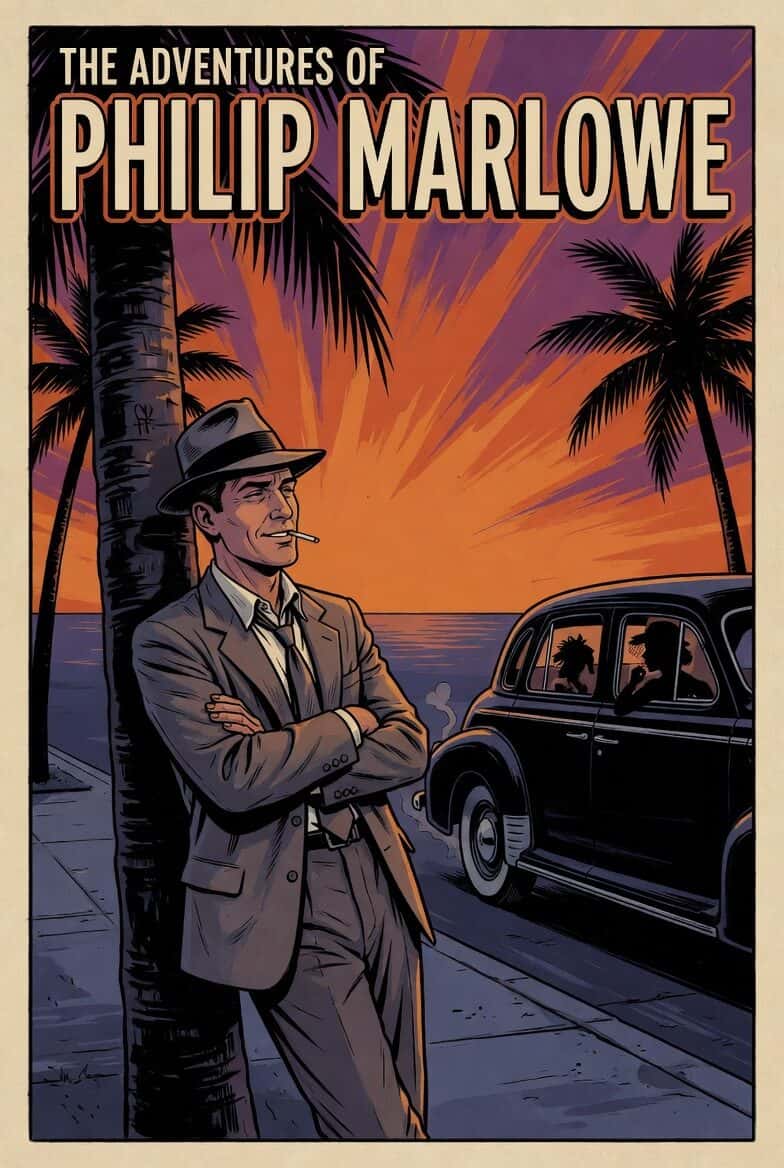
Get this and get it straight. Crime is a sucker's road, and those who travel it wind up in the gutter or the prison or the grave. There's no other end, but they never learn. From the pen of Raymond Chandler, outstanding author of crime fiction, comes his most famous character in The Adventures of Philip Marlowe. Now, with Gerald Mohr, starred as Philip Marlowe, we bring you tonight's exciting story, The Dear Dead Days.
I stood at the window and looked down at the Saturday morning traffic. A thousand inchworms playing follow the leader to the beach, to the mountains, to Aunt Millie's, to any place. I had time, a book, there was food in the refrigerator and a coffee cup in my hand. Across the room there was an easy chair, cigarettes on the table beside it. The clock said it was 9:15. I hadn't shaved and I wasn't going to. It was Saturday all day, and it was mine.
Ah, let's see, see, where was I? Oh, you hear this?
She was the most breathtaking thing you'd ever seen. She'd lay back on the divan, stretched, smiled languidly up at it. Oh, no. Okay, okay.
Hello.
Mr. Philip Marlowe?
Speaking.
You don't know me, Mr. Marlowe. My name is Phoebe Cardwell. Mrs. Phoebe Cardwell.
Yeah?
Well, I thought perhaps the name would mean something to you.
Cardwell? No, I'm afraid not.
Well, no matter. You do help people, don't you? I mean, if someone is missing, you find them?
Well, sometimes, Mrs. Cardwell. It all depends. Have you checked the police?
Oh, no. Oh, dear, no, I wouldn't think of that.
Oh?
You see, it's Stevens, my chauffeur. Oh, well, now, I mustn't mislead you. Strictly speaking, he is not my chauffeur. But strictly speaking, he is missing. Yes, at least he seems to be. And I don't trust phones entirely, Mr. Marlowe. I couldn't even have called you except Matilda went to her friends. And I do need your help.
Yeah, I see. Well...
If you could come out right away, it's most important to me. I live in Venice, Mr. Marlowe. If you drive down Sepulveda to Washington Boulevard...
Well, what do you do? Maybe I thought about my grandmother. Maybe I thought of 25 bucks a day. I don't know. Whatever it was, I joined the inchworm anonymity that was the traffic line to the beach cities.
Now, Venice is not a spot to which I normally gravitate, but there was something in Mrs. Phoebe Cardwell's distinguished old voice that told me this was not a Saturday for normalcy. The house was what used to be called a bungalow, and the ramrod little figure waiting for me in the doorway was what used to be called beautiful. Phoebe Cardwell, for all her 75 years, had worn well and, uh, knew it.
It's just possible that I didn't make myself entirely clear on the phone, Mr. Marlowe, about Stevens.
Well, he's your chauffeur, and he's missing, huh?
He was my chauffeur. It seems like a very long time ago since I've seen him. You see, after Horace died in 1948... Uh, Horace was my husband. Oh. You see, after Horace died, Stevens stayed on to drive for the family who took our house. Oh, he did this with my blessing, of course. Horace, rest him, left me very little, really. I say this with no malice, Mr. Marlowe, merely to point out that for me to retain Stevens was quite out of the question.
Yeah, yeah, I suppose so.
So I moved in with my younger sister, Matilda. She's visiting a friend at the moment. I wouldn't want Matilda to share my concern over Stevens, and I'm sure you'll respect that.
Oh, of course, Mrs. Cardwell. Thank you.
Now, look, so far as you know, is Stevens still driving for the family who took your house?
Oh, I'm sure he is. He must be. It's just that, well, on Thursdays, his day off, he always brought the limousine over to take me for rides and run my little errands. Oh, understand now, the Brants are fully aware of this. That's the family he works for. Who have my home in Pasadena. And Stevens hasn't been to see you in some time.
In weeks, and not a word, you understand. I, uh, I find it difficult to tell you precisely how I feel about it. How do I feel about this, Mr. Marlowe? Stevens is like a son to me. Perhaps he's ill or troubled. Oh, I'd want to know that. I might be able to help.
You phoned, I suppose?
Oh, I'm embarrassed to say how many times. But no answer, none at all. Oh, oh, I have a writing desk in my room, Mr. Marlowe. I'll write the Pasadena address and phone number for you. My number, too. Oh, I shan't be a moment now.
I'd seen the ring when I first sat down opposite her. First, because it was big, almost massive, on a tiny right hand. Then, because it didn't fit the rest of the lavender and old lace picture that she presented. A mass of jade and gold carved with oriental figures. A foreboding thing that reeked quality of its kind and value. After she left, the vases jumped out at me from the mantel. Small, gold, and jade again. And as incongruously out of place as Phoebe Cardwell and Sister Matilda's bungalow.
Now, that didn't take long, did it?
Oh, not long at all. Oh, I like you, Mr. Marlowe. Oh, you'll find Stevens for me, I know.
Well, I hope so, Mrs. Cardwell. And if I do, what'll I tell him?
That I want to see him or hear from him. Stevens will understand.
Yeah, well, I, uh...
Oh, dear, that's Matilda.
Phoebe? Phoebe, I'm home, dearie.
So, so I see, my dear. Mr. Marlowe, may I present my sister, Miss Reed?
Miss Reed? With an eye like Wallace Reid.
I'm sure Mr. Marlowe...
Oh, but maybe you don't remember Wallace Reid. Maybe you don't remember Wallace Reid. Well, I tell you, I...
Matilda dabbled in theatricals at one time, Mr. Marlowe.
Dabbled in theatricals? I was in pictures in the golden era, Mr. Marlowe, when silence was golden.
Oh, that Wallace Reid, yeah.
Mr. Marlowe's in insurance, my dear, and some younger than we are. Did you see The Covered Wagon? Ernest Torrance, I had a big scene with him on the prairie, right by one of the wagon wheels.
No, not first run. I'm waiting for it to come to my neighborhood theater.
Matilda was a doll. Real live kewpie doll. But her role in this thing was strictly comedy relief. The drama, if there was any, was Phoebe Cardwell, a missing chauffeur that wasn't hers anymore, and the glaring memory of jade and gold that didn't seem to fit anywhere.
Well, I missed the house on Orange Grove Avenue by two numbers, parked the car, and walked back. The old Cardwell place was set well back from the street, and its solid red brick looked big, important, and empty.
Nobody home.
Hmm?
Nobody home. Nobody home.
At first I thought there were three honey-colored Afghans on the lawn next door. But the one in the middle was talking to me. And as I walked closer, I could see she was by far the prettiest. And undoubtedly something more than man's best friend.
The Brants are at Emerald Bay for the summer. I thought I'd told everyone.
Yeah, well, I'm the one who forgot to ask you. My name's Marlowe.
I'm Kip Harcourt. Margaret, really. Kip's for the reserve section.
Hello, Kip.
I've never seen you before.
Yeah. Yeah, well, believe me, I'm sorry.
I believe you, Marlowe. I got a first name. I like Marlowe.
Oh. Forget about the Brants. Come on and play on this side of the hedge.
I don't know the Pasadena rules.
Same as Texas.
Yeah. Looks like we're going to have to move over. I'll give Stevens a raise for this.
Thought you said nobody was home.
Stevens doesn't count.
He does with me.
Don't move. I want to remember you like this always.
You'll be back, Marlowe?
This you know.
Hey, hey, Stevens. Stevens, wait a minute. I'd like to see you.
Yes, sir?
I'd like to talk to you about Mrs. Cardwell.
Is something wrong, sir?
Oh, no, no. She's fine. I'm Philip Marlowe, Stevens. Is there some place we can have a visit?
They're upstairs over the garage in my quarters, sir. Come along.
Mrs. Cardwell isn't ailing, she says.
Oh, no. Looked fine when I left her less than an hour ago.
Oh, I'm glad to hear that. Here we are. Come inside, sir.
Hey, nice place you've got here, Stevens.
It's a bit stuffy in here, I'm afraid. I've been closed up a few days.
Now, sit down, sir.
Thanks. Say, Stevens, Mrs. Cardwell misses you, and you can drop the sir with me. Marlowe will do.
I'll try, sir, Mr. Marlowe. But I have it of 20 years or so, you know.
Sure. Now, Mrs. Cardwell misses me? Is that what you've come to tell me?
Well, that's about all she told me, Stevens. I understand you skipped a few of your regular Thursday visits with her, and, well, she's concerned about you.
Well, I must say that's generous of her. Of course, it's not been a few visits at all, Mr. Marlowe. I've missed the last two Thursdays, and for a quite legitimate reason. My employers, the Brants, have opened their Emerald Bay place.
Yeah, so Kip told me. Miss Harcourt, I mean.
Mrs. Harcourt, sir.
Oh, really? That's too bad.
Is it, sir?
Yeah, yeah. Well, look, Mrs. Cardwell seems like a nice old lady. You know what you mean to her. It's not just you she misses, you understand? It's a way of life. Something she was part of and enjoyed. Status, I think they call it. You know, it can be pretty important, Stevens.
I understand that, sir.
Sure you do. You'll give her a break, I know. Call her now that you're back in town. You know, keep in touch, huh?
Yes, I... Oh, excuse me.
Sure.
Don't leave, sir, please. There's something I'd like to ask you.
Stevens seemed like a right guy. Anyway, I was wondering about Kip. Mrs. Harcourt. I had her figured all right, but not for married.
Right. I dismissed her to the back of my mind and started casing Stevens' little palace. It was nice enough in the brown-to-gray motif, neat, tidy, like Stevens, except for a bunch of packing boxes grouped in the corner behind the divan. And on top of them, three items that stopped me cold. A large bowl, a smaller one, and a long oblong box. All a mass of jade and gold carved with Oriental figures.
You admire Oriental art, Mr. Marlowe?
Not specially. Do you, Stevens?
Not specially, sir.
You, uh, you said you'd like to ask me something.
Yes, and, uh, if I may, sir, I'd appreciate a straight answer.
All my answers are straight, Stevens. It's my questions that get tricky.
I'll remember that, sir. Are you certain you've told me everything Mrs. Cardwell said about me?
Very certain.
Does it strike you as odd, sir, that she'd hire a man of your particular capabilities to deliver the simple message that she misses me?
Matter of fact, it does, Stevens. It does.
Strikes me as very odd.
I couldn't tell Stevens anymore because I didn't know anymore. It was my turn to ask questions, but I didn't have any yet. I was closing in on a pretty good one as I started down the drive again, but it got lost in the shuffle.
I knew you'd be back, Marlowe.
Hmm. You always arrive unannounced, don't you, Mrs. Harcourt?
Henry's in Balboa. You're here. Henry's out of his mind.
Don't you want a drink or something?
Yes, Kip. There is something I want.
Well, come on.
At the moment, a telephone.
Come on, anyway. You know, Marlowe, you're an odd one.
Yeah, everybody says so, yeah.
You're really coming into the house to use the phone, aren't you?
Well, like I said, I'm an odd one. Where is it?
To the right in the library.
Thanks.
Are you a friend of Stevens?
Why?
Because you're not a friend of the Brants.
Yeah, well, I'm really a friend of Mrs. Cardwell's.
Phoebe's? Why didn't you say so?
Would it have mattered?
Well, little. I lived next door to Phoebe and Horace for years.
Here?
Here. It's my house. Henry. He married my money.
Poor Phoebe. Horace didn't leave her a thing. No one understood it.
Leans against the estate as big as a house. Big as the Cardwell house? That's how the Brants got it.
Mm-mm.
Is she still interested in art, or do you know?
Oh, I think so. Only maybe not such a big scale. Beautiful wing she donated to the museum.
I guess she never gets over here anymore.
No, not much. Say, you know, I forgot the name of that museum. She mentioned it.
Live Oak Museum on California Street.
Oh, yeah, yeah. I liked Phoebe. Tell her Kip says hi when you see her.
Yeah, I will. You still want to use the phone, Milo?
I, uh, used the phone. I called Phoebe Cardwell, explained Stephen's absence, and gave her Kip's best. And the case was closed. All I had to do was wait for a check. But all of a sudden, I didn't feel very good about any of it. It was like a hangover. You know, I felt something should make sense, but nothing did. The jade and gold at Phoebe's, the stuff in Stephen's quarters that looked just like it. Was it hers? Did she give it to him? Did he take it? Questions I had, but no answers.
I stood there at the window in Kip's library and watched a car pull to a stop in front of the old Cardwell place. Watched a thick little man get out and start to walk up the gravel driveway. I wasn't sure until he walked right past the library window. Then I knew I had the beginnings of all the answers. The thick little man was Fritzi Ott, one of the better fences around town. And he was on his way to see Stevens.
A minute later, the Kip told me of empty servants' quarters over her garage. Another minute later, and I was there. The two garages weren't six feet apart, and there was lots to hear if you listened. I listened.
But look, Stevie boy, you don't have it all. It's not quite the point now. Can you dispose of it?
I don't know. Two things, Stevie boy. One, collection's a tough defense. Real tough. Two, this isn't the whole deal.
I don't understand.
This isn't the whole deal. Some piece is missing. I've seen pictures of the Sing Woo collection. Some pieces are missing. Two vases and a ring, to be exact.
Yeah, you're right. You got them?
Well, not exactly. I might be able to get them.
Look, I'm trying to tell you, Stevie boy. One, I'm not even sure I can fence the whole collection. But two, I ain't got a prayer of doing it if it's incomplete. Are you with me there? Do you understand that?
Yes, yes, I understand it. It might take time to obtain the other pieces.
Then you better spend some time, Stevie boy, or we got no arrangement whatsoever. I tell you, I'll nose around, see what's the best deal I can get, providing you deliver the full treatment. You see what you can do about getting it. And we'll meet here tomorrow at noon.
But I really don't think I—
Oh, never mind. I've got to have the money. All right. Tomorrow at noon.
You didn't have to hang any signs on it. It was all there, or most of it was. The Sing Woo collection meant very little to me. But it meant money to Stevens and Fritzi Ott. I had an idea it meant something else again to Phoebe Cardwell. And I had another idea. The live oak. The live oak. The live oak museum on California Street and the wing that Phoebe had donated to it.
I couldn't risk the delay of a Texas rules bout with Kip, so I skirted the house and ran through the dust to my car. Five minutes later, I stood in front of the words, Live Oak Museum. Percival Wallace, director, open to visitors nine to five weekdays, nine to twelve Saturdays, twelve to five Sunday afternoon. Oh, nuts.
Not interested in our day, Mr. Marlowe. We've done that bit, Stevens.
My answer was not specially. I disliked dissuading you in this manner, sir. But I'm a quite accurate shot.
You know, I believe that, Stevens. If I can't persuade you with this warning, I'll not hesitate to use this gun. I'll not hesitate at all, sir.
In just a moment, we will return to the second act of Philip Marlowe. But first, now that vacation time is here, our streets and highways are more crowded than ever. Don't take chances. Obey the traffic rules and drive carefully. The life you save may be your own. And now with our star, Gerald Mohr, the second act of Philip Marlowe and tonight's story, The Dear Dead Days.
Stevens had a dominant personality for a chauffeur. He could give orders as well as take them. And I'm not a man who's at his best staring down the nose of an automatic. Now, we told each other a very proper good evening, and he left me with my thoughts, which were several and urgent. I bundled them together and headed for the Times office in downtown L.A.
Hey, note, there's just one thing mustier than an old newspaper file. It's the man who files it.
1948 was a big year, news-wise, Philip. The files are heavy.
Well, how was it obituary-wise, Belden? That should lighten it.
Uh-huh. Local, national, or international?
Local, Pasadena.
Name, address?
Horace Cardwell, Orange Grove Avenue.
Uh-huh. Cardwell, Horace. That's it, that's it. January 30, 1948. Page one, part two. That's a good spot.
Page one, part two. Best local, all but spot in the paper. Oh, I'll bet Horace was proud like anything. Oh. Let's see here. Candy. Oh, here it is, here it is. Uh-huh. Mr. Cardwell is survived by his wife, Phoebe Reed Cardwell, at home. Period. Nothing.
Hey, Belden, you got one for her?
Her? Phoebe Cardwell. When's she go?
She hasn't. She somebody?
She somebody. Cardwell, Mrs. Horace, parenthesis, Phoebe Reed, close parenthesis, triad, Belden.
Uh. All right. She could be more. She'll never make part two, page one at this rate.
Yeah, that's too bad, but read it anyway, huh?
Born Waterloo, Iowa, June 7, 1876. She's Gemini, Philip. That's wonderful. Will you just read?
Oh, yeah. Okay. Married Horace Cardwell, so-and-so, so-and-so, moved to California. She was, well, so-and-so, so-and-so, so-and-so. Chairman of Art and Culture Committee. Live Oak Museum, Pasadena. That's it. Go ahead. Traveled extensively all over the world. Brought back many valuable paintings and objects, the art.
Yeah, that's reasonable.
Mm-hmm. To the museum, most famous of which is Sing Woo Collection of Jade. And, uh, well, that's about it, Philip.
I love you, Belden. Thanks.
So, Phoebe had brought the Sing Woo Jade Collection to Live Oak Museum in the first place. Now, she had some of it. Stevens had more. And Fritzi Ott was even now nosing around for a taker. Where did that leave the museum? Nowhere, so far as I knew. Except closed till noon tomorrow, Sunday. And noon tomorrow, Sunday, would be too late. Fritzi and Stevens would be together by that time.
Note. Percival Wallace is a quiet little man who doesn't like to talk to private eyes about museum business at home or anywhere.
The museum has operated for 30 years, Mr. Marlowe, and not one shred of notoriety. Not one shred.
Well, I think we can keep the record clean, Mr. Wallace. All I want to know is when the Sing Woo Collection was stolen from the museum.
I didn't say it was stolen. I said we no longer had it.
Okay, you no longer have it. How long have you no longer had it?
Well, it was, uh, since, uh, Christmas week, 1947.
Would you notify the police?
Certainly not. Why?
Mr. Marlowe, I tried to tell you, not one shred of notoriety in 30 years.
Yeah, but it's a valuable collection, and it's missing.
The Board of Directors did subscribe to a reward, Mr. Marlowe. Only a fraction of the... Sing Woo's real worth, of course, a mere $20,000. But, of course, this was done very quietly. Very quietly.
So quietly, nobody knows about it. All right, tell me, did Mrs. Cardwell contribute to the reward?
I don't recall. And you wouldn't say if she did. Thanks, Mr. Wallace, you're just downright bully.
I got to Phoebe Cardwell's small bungalow in Venice in time to see a liveried limousine pull away from the curb. A few minutes after it got lost with the rest of the inchworms, they light up again. It was a good night, Variety. Mrs. Cardwell ushered me into the living room. When she turned on the lights, everything in the room jumped out at me again. The pink dogs, the blue cats, the souvenir pillows. But the most notable things in the room were the jade and gold vases that were gone from the mantle, and the jade and gold ring that was missing from Phoebe Cardwell's old hand.
This is delightful, Mr. Marlowe, genuinely delightful.
Yeah, well, I was afraid it might be a little too late to call.
Oh, ordinarily, yes, but not tonight. Why, you just missed him. Stevens, he came back and took me for a drive. I just this minute got home.
Oh, that's fine. Oh, thanks to you, Mr. Marlowe. I'm so grateful. He hadn't forgotten about me, you know. No, he'd been busy.
Oh, sure, yeah, I bet he has. Oh, I'm embarrassed not to have mentioned it sooner, but I have your money for you, your fee.
Oh, there's no hurry, honey. In fact, I've done so little that I—
No, no, no, no, I won't hear of that. I'll pay you in full, of course. All right. Say, this morning I was admiring your ring and the vases on the mantel. Were you indeed?
Yeah. Well, I'm glad. They're quite nice, you know.
Yes, they were. Did you give them to Stevens, Mrs. Cardwell?
I beg your pardon?
Did you give them to Stevens?
Why, really, Mr. Marlowe, you surprise me. That is none of your affair, you know. I'm a curious fellow. I secured your services to perform a specific task. You've done that. I certainly do not intend to discuss Stevens or anything pertaining to him with you, Mr. Marlowe.
All right, we'll leave it that way, huh? I'm not a weirdo. I'm not a weird of any of this to Matilda now.
Phoebe, dear, oh, Mr. Marlowe again.
Yeah, I was just leaving. I told the girls at the club all about you, and I am right, aren't I? You are Julia Marlowe's son.
Julia Marlowe, I—
The actress, she played Barbara Fritchie for years.
She did, well, I'm sorry, but there are no Fritchies in our families for years, either side.
Really, Matilda, Mr. Marlowe's busy. He was just leaving.
Yes, wasn't I? Philip Fritchie Marlowe.
Oh. Oh, it would have been a beautiful name.
The lights in Kip Harcourt's house were off when I got back to Pasadena. Those in Stevens' quarters above the garage were still on. It was better that way. I wasn't worried about Stevens' automatic anymore. There was a very good chance he wouldn't use it.
Hey, Stevens, it's Marlowe. Open up.
Apparently, I didn't make myself clear, Mr. Marlowe, sir. If you still want to try your aim when I finish talking, I'll be a willing target. Come in, sir.
It's almost midnight. You're meeting Fritzi at noon tomorrow. We're going to have to work fast.
I warned you to stay out of it, Mr. Marlowe.
Now, listen, Stevens, hear this. I know about a lot of it, and I got some good guesses on the rest. Let's make a deal. I'll tell you what I know and what I guess. If I'm right, you can get in touch with Fritzi tonight.
And if you're wrong?
Well, if I'm wrong, one of us deserves to be killed.
Go ahead, sir.
Okay. Horace Cardwell was a wealthy man, a very wealthy man. He was a good businessman, and he loved his wife very much.
That's right, sir.
When he died, there was almost no money. A small amount, maybe, for Phoebe, but the house, everything in it, the cars, everything went to pay off debts, liens against the estate.
What else do you know?
That Phoebe Cardwell contributed a wing to the Live Oak Museum. That she brought our treasures from all over the world to put in it, including the Sing Woo Jade collection. That the collection's been missing from the Cardwell wing since Christmas, 1947. Horace died of a cerebral hemorrhage in January 1948. And nobody wants to talk about who took the collection. Least of all, the people at the Live Oak Museum.
And, uh, what do you guess from all this, sir?
That a man, even a very wealthy man, can run out of money. Especially if he has a wife who's a wonderful woman with an eye and a hand for expensive art treasures. Phoebe's sick, Stevens. Kleptomania's the humus.
I know, sir. It's been such a well-guarded secret. It took all Mr. Horace had to pay for the things she... She took people to watch her, keep track of her.
You know her, sir. He couldn't bear to get help for her. Psychiatric help. Now, she needs money. Just to live on. She has so little, and...
You love her very much, don't you?
Yes. Yes, I do.
Well, she can't have too many more years, Stevens. And $20,000 is a lot of money.
$20,000, Mr. Horace?
Now, look, Stevens. You call it a well-guarded secret. Believe me, it was and it is. Even those of you who've been protecting Phoebe all these years haven't leveled with each other. How she moved the collection out of there, I'll never know. But the museum's had a $20,000 reward for its return for several years.
Well, I... I didn't know that, sir.
I know you didn't. And it suddenly dawns on me that Phoebe's been handing you the Sing Wu collection bit by bit, ever since she, uh, well, came by it. Maybe an appreciation for your years of faithful service, huh?
Well, she... she said it might come in handy, sir, if I ever needed money. If I needed money.
Mr. Marlowe.
Yeah, I know, Stevens. Hey, you got a conflict tomorrow. You can't be here meeting Fritzie and be at the Live Oak Museum when it opens at noon, too.
Well, I... I'll call Fritzie. I'll tell him our arrangement is off.
And, Stevens, can't you just see Percival Wallace's face tomorrow when he eyes the Sing Wu collection again?
Footnote to a happy ending. By 12:30 Sunday afternoon, the museum had the collection. Stevens had a certified check for $20,000, and we had an understanding. That Phoebe Cardwell would suddenly discover that Horace had left us some money after all. $20,000 in a checking account that had somehow been overlooked till now.
Oh, well. The rest of Sunday was all mine. And I stood at my window and looked down on a thousand inchworms playing Follow the Leader. Back from the beach, the mountains, from Aunt Millie's, from anywhere. All kinds of people. Nice people. Not so nice people. Dames like Kip, whose husbands took trips. Sweet, harmless old ladies. Heh. Who took collections. Ha ha ha. Oh, well.
Where's that book? Oh, yeah. Now, where was I? Oh, yeah, here it is. She was the most breathtaking thing he'd ever seen. She lay back on the divan, stretched, and smiled languorously up at me. The End. The End. The End. The End. The End. The End. The End.
Be sure to listen again next week at the same time when Philip Marlowe says... This time a pair of green eyes held a promise. A house on Bedford Drive held a murder. A Malibu motel held a secret. And I almost held the sack. Songbird Evelyn Knight, a favorite CBS singing star, helps out vocally on the Mario Lanza Show tomorrow evening on most of these same CBS stations. Stay tuned now for Gangbusters which follows immediately over most of these same CBS stations. Roy Rowan speaking. This is CBS, the Columbia Broadcasting System.