
The written record
Read the transcript
Read along with the recording · About 19 min to read
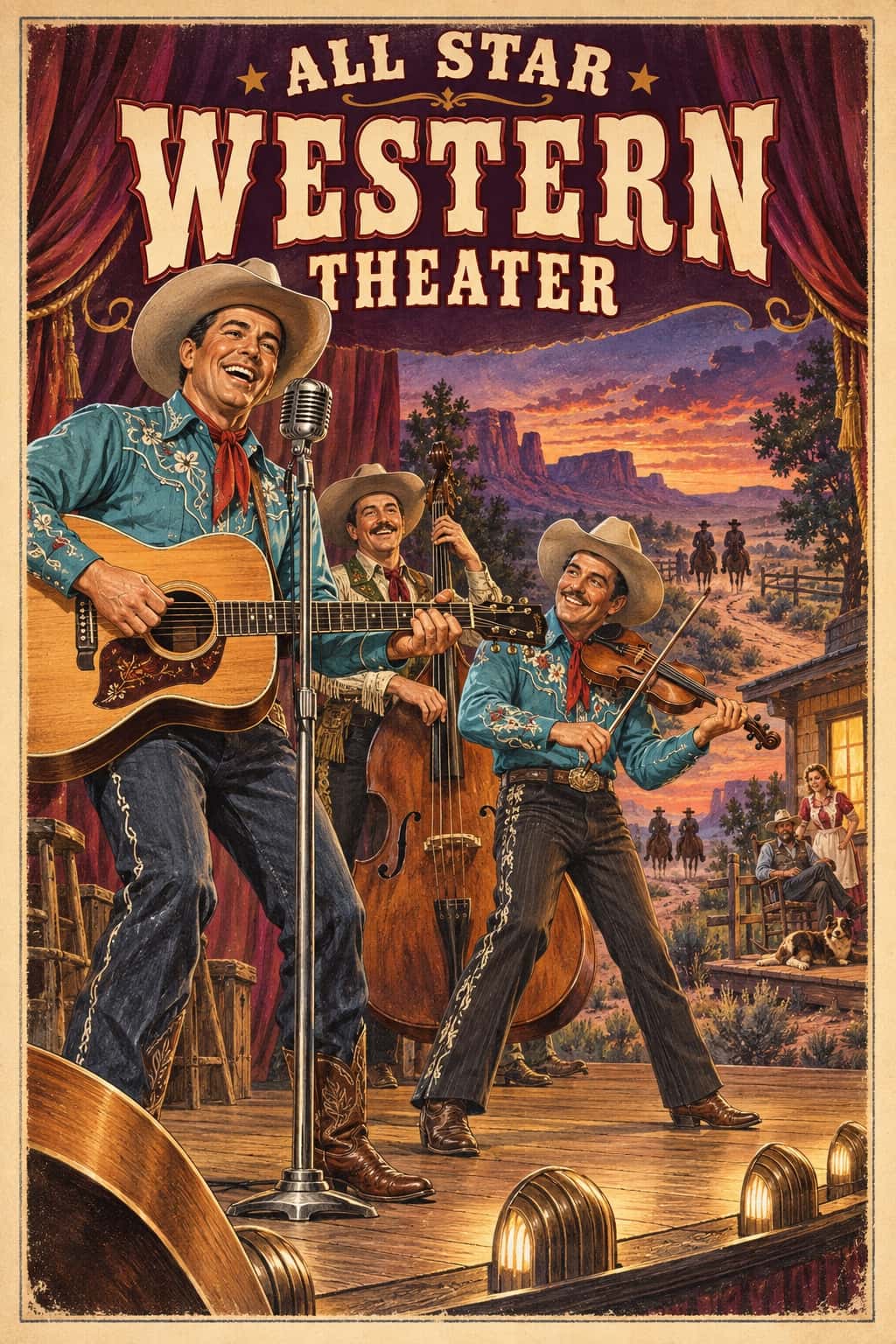
Bakers of Weber's Bread presents your all-star Western Theater. Yes, it's your all-star Western Theater, brought to you by the bakers of Weber's Bread, featuring four willing and the riders of the Purple Sage, Colleen Summers, Weber's grand host, Monty Montana, and his special guest, Western Pictures' hard-riding, straight-shooting, cowboy singing star, Tex Ritter, in the title role of our Western Theater production of Billy the Kid. My name is Cotton Seed Clark, and here are the Riders of the Purple Sage. Yippee-yay, yippee-oh, in this day, home we go. For a cowboy has to sing, and a cowboy has to yell. Or his heart would break inside of him, at the gate of the home corral. When his new day is born, I go riding. Yippee-yay, yippee-oh, I roll. Yippee-oh, till the sun in the hills goes hiding. Yippee-yay, yippee-oh.
Yippee-yay! Yippee-yay! In the tradition of the Old West, hospitality plays a mighty important part. Yes, Western hospitality is world famous. Certainly a part of that Western hospitality is the fine meals served to all who come to visit, friend and stranger alike. And of all the good food served, Good bread plays its important part. Through Western hospitality is still with us. And so that you can be sure you're serving your guests one of the finest of all Western food products, see to it that you have plenty of good Weber's bread on hand at all times. Then you'll be prepared to serve your guests expected or unexpected sandwiches you can be sure are good. Weber's are proud of their position as bread leaders in the West. Good Weber's bread. And here is something that's mighty good for a heavy heart.
The grandest of all heart song singers, Miss Colleen Summers, with Someone Won Your Heart, Little Dolly. Rogers, who once said, Never met a man I didn't like. We're going to take the words of that fine gesture of a great man and give it another meaning. Friends and neighbors, one of the greatest cowboys of all time, Marty Montana. Howdy, ladies and gentlemen, and boys and girls, and cotton seed. It makes me feel pretty good to have you say such nice things about me. Well, Marty, all the folks who know you know that I'm dead right. And I also know that's why the folks at Weber's are proud to have you represent them. But I'm not trying to embarrass you before all of these folks, so suppose you just break down and tell everybody what the All-Star Western Theater has in store for them today. Three things, Cotton Seed. One is the story of the Old West, the life of that notorious bad man, Billy the Kid. And number two is...
That great star of Western pictures and my mighty good friend, Tex Ritter. And here he is in person. Hello, Monty, ladies and gentlemen. Well, Tex, I guess... Just a minute, Monty. You're kind of rushing me, boy. Yeah, how's that? I said, howdy, ladies and gentlemen. You didn't give me time to say hello to the boys and girls. For that, Tex, I owe you a real apology. If it wasn't for the boys and girls, us Western folks wouldn't be in business. You're right there, Tex. They've been mighty good to me, too. Besides, they eat a lot of Weber's bread. Would you mind saying that again? You heard me. Now, suppose we get into our story of Billy the Kid. Mighty fine. Just a minute, Marty. You're overlooking something. You said you had three things in store for the folks. So, what about number three? I was coming to that, and it's a surprise for you, Tex, as well as for the folks listening. A good friend of ours dropped in to give us a hand with our story of Billy the Kid.
Another great favorite of the western stream, Dennis Moore. Hello, folks. How are you, Tex? Now, anything can happen. Don't start on me, Tex, or I'll tell the folks how I whipped you in that last picture we made together. Dennis, you and Tex kind of let up on each other now, and we'll get on with our story. And before we tell this tale of a bad man, Monty, I'd like to ask all the boys and girls listening to give a lot of thought to something that we should all remember. But I think I'll save that until after our story's over. Perhaps it'll have more meaning then. And here he is, folks, Tex Ritter as Billy the Kid, with his sidekick Dennis Moore as Pat Garrett. Cotton Seeds, Supposed News, take over the scene. The story of Billy the Kid is that of a boy whose opportunities in early life were far removed from the career he followed, that of a ruthless killer. Although from poor parents, his youth was like that of any normal, law-abiding boy of the early 1870s.
It was his closest friend and pal, Pat Garrett, who taught this future bad man of the West how to handle six guns with the deadly accuracy of the truest arrow. To ride like the wind and to defend himself against physical encounter. Hour upon hour, the kid would practice a quick draw of his guns. His aim became almost perfect. It might be said that the crime career of Billy the Kid just happened. For his first killing was truly committed on the spur of the moment. Pat Garrett seemed to sense that Billy was destined to stray from the life he led as a youth. The kid was a little too boastful of his ability with a gun. It was a fall day in 1878 that his lifelong friend, Pat Garrett, suggested that the two of them ride into the county seat town of White Oaks, New Mexico and apply to Sheriff Brady for jobs as deputy sheriff to assist in keeping law and order in Lincoln County. With a lack of anything else to do, the kid submitted to Garrett's suggestion.
and together they rode for White Oaks. As they reached Twin Forks Road, Garrett could see that something was troubling the kid. What's on your mind, Billy? You haven't had much to say. Ah, nothing. I was just thinking. You're not figuring on backing out of this deputy job, are you? Eh, looks like this, Pat. I got a little business over the Pete Maxwell spread. You ride in to see the sheriff. Tell him I'll drop by tomorrow. What's over to Pete Maxwell's that you're so interested in, other than his daughter? What's over to Maxwell's that's interesting, other than his daughter? Look, Billy, I don't want to tell you what to do, but I wish you'd string along with me. The county needs good deputies. Now listen, Pat. To be honest about it, I don't want to be no deputy. That ain't my idea of making an easy living. Making a living ain't supposed to be easy, Billy. Well, don't make sense.
You mean making an honest living don't make sense? This day and time, a man's life is as good as his draw. And I'm about the fastest in these parts. That's why you'd make a mighty good peace officer, Billy. Yeah? Then tell me why I should be working for the sheriff when I know more than he does. He should be working for me. You've got the wrong idea, Billy. If you keep on thinking that way, them guns of yours might get you in a whole pack of trouble someday. I'll be the judge of how to handle my guns. Right now, I'm taking the left fork for Pete Maxwell's spread. I wish you'd change your mind. Sorry, Pat, but we don't think alike. I'll see you later. That was Billy the Kid's first outright admission of a wayward leaning. Billy and Maxwell's daughter seemed to hit it off pretty well together. But during the next two or three weeks, he paid steady court to her.
It was rather late one night when the kid left Maxwell's place and rode into White Oaks, apparently to pass the time of night at Peg Martin's palace. He dismounted and strolled through the batwing doors up to the bar. Not being a drinking man, he ordered his favorite. A rough, unshaven gun slick was standing to his left. What was that you ordered, son? That's for ready. You must be the teetotaling hombre they called Billy the Kid. That's right.
I hear tell you're mighty handy with your shooting irons. That's right. I hear tell you're paying steady court to Pete Maxwell's daughter. That's right. And I hear tell she's teaching you how to crochet. Yeah. You know, that little Maxwell silly is a mighty pretty girl. I wonder how she'd feel if a real man was to call on her. Partner, I don't know who you are or where you're... come from, but I got a feeling you ain't going back. What do you mean by that, punk? I mean you'd better start drawing, because I'm going to put a hole right through your heart. Why, you little... I hear tell you ain't going to be heard from no more. Well, I saw that. I might also add that you handle yourself mighty smooth-like. I can take care of myself. I'd like to have a little talk with you. My name is John Chisholm. Oh, yeah.
I heard of you. How about riding over to my friend in the morning? I got a proposition that might interest a man like you. Okay. I'll ride over. John Chisholm and his partner, Alec McSwain, were determined to establish a monopoly of a stock-grazing business and make themselves the cattle kings of the Pecos Valley. It was a dangerous business, and trouble between the ranchers was a daily occurrence. The smaller band also got together. Men who had important cattle interests. and were anxious to defend them. Both sides were prepared for what was destined to become a deadly conflict. Chisholm lost no time in hiring the kid that next morning. He liked the kid's daredevil ways, his cool manner, and his deadly marksmanship, all combined with what seemed to be an absolute delight in murder. Within a short period of time after his deal with Chisholm, the kid added three more notches to his gun, that of his own companion, Joe McCleskey, and two ranchers of the opposing forces, Billy Martin and Frank Baker.
The news of the killing spread fast, reaching the ears of Sheriff Brady and his deputy, George Heinemann. Now, the kid was a hunted man. Early one Thursday morning, Sheriff Brady and Heinemann rode for the home of the kid. Knowing of his record of cold-blooded killings, they fully recognized the fact that their chances of coming back alive were hardly even. I don't like this, Brady. You're not afraid, are you, George? No, not exactly. You know, we've been on some mighty tough manhunts before, and so far we've always been on the winning side. But somehow or other, I got a feeling we won't come out of this in a lie. As the sheriff and Heinman approached the kid's spread, little did they realize that they were in the focus of a powerful set of binoculars in the hands of Billy the Kid. What do you see, kid? Who are they? The law. Two of them. On horseback. One of them's crazy. What's he gonna do?
What am I going to do? Either me or them two gunmen are going to die. The kid then stepped inside the barn from view and placed himself in readiness. Fifteen minutes had elapsed when Brady and Heinemann rode up and approached the kid, Pinchman, who was leaning against the corral gate next to the barn. Oh, boy. Howdy, stranger. I'm Sheriff Brady. How are you, Sheriff? What's up? We're looking to fill in the kid. Did you know where he is? No, I ain't seen him, Sheriff. What do you want him for? You know what we want him for. Cold-blooded murder. Here I am, Sheriff. Start drawing. When the smoke cleared, Brady and Heinemann lay dead. Billy the Kid's bold defiance of the law, the reign of terror and bloodshed spread far and wide. He formed a band of gunmen and for two years following the killing of Brady and Heinemann, terrorized the country. Always cool, always the dashing desperado. He seemed to bear a charmed existence.
A hundred bullets fed towards him, but not one reached its mark. He had now brought his known death toll to 11. It was early July 1881, two years after the killing of Frady and Heinemann, that a deputy United States Marshal arrived in White Oaks, sent by the government to capture Billy the Kid, dead or alive. This man was Pat Garrett. Yes, the same Pat Garrett that was the boyhood pal of Billy the Kid. Meanwhile, with posse searching far and wide for him, The kid decided his best move was to hide where his pursuers would least expect to find him, in the home of his old friend, Pete Maxwell. Although this did not please Maxwell in the least, he agreed with his daughter, Mary, to allow the kid a couple of days to be here. Billy, it's mighty risky us keeping you and hiding here. They'd never think of looking for me here, Pete. But, Daddy, you can't turn them out. All right, Billy, but I'm doing this because of Mary.
Not with my better judgment. I'll move on in a couple of days, but I've got to get some rest before I cry. The finger of fate was now at work, and the next night the new marshal, Pat Garrett, made a friendly call at the Maxwell Ranch to renew old acquaintances. Not in the least expecting that he was walking into the very hiding place of Billy the Kid, his boyhood pal. Someone's at the door. More than likely old Jim Matthews from the next three months.
Hello, Pete. Hi, Pat. Garrett. What are you doing in these thoughts? On official business for Uncle Sam. But I figured a little social visit would be in order tonight. How are you, Mary? Fine, fine, Pat. I'm glad to see you. Garrett, sit down, Pat. Sit down. Tell me about this official business of yours. Well, Pete, the boss man sent me down to get Billy. To get Billy? That's right, Mary. Of course, I know that you were mighty fond of him once. Pat. How could you do such a thing? Billy was your best friend. Was is right, Pete. But Billy turned out to be a heartless, cold-blooded killer. And I've got a job to do. Then you'd better get to doing it, Pat. Billy. Now, look, boy. Let's not have no gunplay in here. Pat, you can't. Pete, you and Mary stand back and be quiet. And Pat's got some business to settle. I reckon you know why I'm here, Billy. Yeah, I heard. But don't draw on me, Pat.
You've made quite a name for yourself since I left this country. That's right. So have you. I think I'm a little prouder of my name than you are of yours. Now, now, now, look, boys. You old friends. Let's settle this thing peaceable-like. That's up to Pat. I was sent here to get you, Billy. And I aim to do it. How you gonna do it? Dead or alive. And you can make it mighty easy on everybody by coming along peaceable. Pat? I hate to kill you, but if you so much as bat an eyelash at your gun, you're a dead man. You're forgetting who taught you how to draw that quick. And you're forgetting that I never missed my mark. I'm not overlooking a thing. You still thinking about drawing on me? Right now, Billy, I'm thinking about that morning when you and me headed down to town to become deputy sheriff. We came to a fork in the road. Remember? Yeah.
I took the left fork. And I took the right fork. Let's ride in together this time, Billy. It'll be a lot easier that way. I reckon you'd better draw, Pat. This is the crossroad again. That's right. And I'm still taking the right road. Sorry, Billy, but I had to do it. I reckon you've done me in, Pat. This had to come someday. Oh, I guess so, but I hate... I hate that it had to be you that did it. You beat me to the draw and fired first. I've never known you to miss your man before. Didn't see you, Pat. Didn't see me? Something crazy happened. Just as I... Just as I reached for my gun, I saw a fork in the road. And I... I fired in the wrong place. Well, Tex, we want to thank you for appearing on Weber's All-Star Theater.
And to you, Dennis Moore, for dropping in to give your old friend a helping hand. It was a real pleasure, Marty. And now take that special thought to the boys and girls you mentioned just before our story. Boys and girls, it's an old, old story, but one I hope you will all remember as you grow up. In all history, never has it been known that crime has a reward other than hardships and suffering to oneself and to other people. Remember the story of... Billy, that's it. Thank you, Tex Ritter. And now here once more is Cotton Seed Clark. Well, folks, I know you're all expecting a song from Tex Ritter, so we're going to hold him over long enough for just that. The title of his song seems to kind of fit the moral of our story today. But it so happens that it's the number one hit song of the nation on phonograph record by Tex Ritter himself. And here he is to sing for you, You Will Have to Pay. Have to pay for your health.
Today, you'll be living all along. In the vows you broke, unkind words you spoke. You'll recall them when I'm gone. It was good to you, and you know it's right to please every way. You walked on my heart, broke it all apart.
You'll have to pay You will have to pay For your yesterday It will all come home to you You'll pay for your sin Time and time again I won't even pity you It's good to you And you might try to please every way
My heart broke it all apart. Someday you'll have to pay. So long to you, text writer. Come back and visit with us again real soon. Been a mighty nice cotton seed, Marty. So long, folks. So long, text. And now here's another word from our friend Ed Chandler. Friends in the days of Pony Express and the Wells Fargo stagecoach, the watchword of the day was dependability. Cross-country travelers could depend on the old stagecoach arriving at its destination. The United States Mail Service, in great measure, depended on the Pony Express. Yes, dependability was and is a fine characteristic of any service or product. And I'd like to tell you a little bit about the dependability of Weber's bread. When you serve Weber's good bread, you can always depend on its flavor, texture, and freshness. It's uniformly and scientifically baked at the finest ingredients to assure that dependability. To say it simply, Weber's bread.
is always good bread. Yes, Weber's bread is always good bread. And here once more is America's great western singing stars, Boy Willing and the Riders of the Purple Sage, Al Flowy and Jimmy Dean are heading down Santa Fe way. Riding down to Santa Fe, just beyond the mountains and across the way. See that sun hang low in the west. Oh, the land I'm loving the best. Here we go, my old fellow. You know, folks, people in different parts of the country have different ideas about his life and his habits. But folks who really know him can vouch for one thing. A cowboy has religion. Perhaps he doesn't show it outwardly, but you can bet your bottom dollar he keeps in mighty close touch with his boss in the sky. Religion comes natural with him. Riding range at night under a full moon flanked by millions of stars? Well, a fella can't help but think. And then, sudden like, he finds himself talking with somebody that understands him as no one else does. For the blue horizon.
Where the mountains meet the sky. I'll saddle up my faithful pinto. And bid the boys goodbye. I'll say so long to mom and dad. And tell sister not to cry. Cause I'm heading for the blue horizon. Where the mountains meet the sky. The makers of Weber's Bread have presented your all-star Western theater with Boy Willing and the writers of The Purple Sage, Colleen Summers, Western host Marty Montana, and his special guests, Twitter and Dennis Moore. Next week, Marty's guest will be Johnny Mac Brown, famous star of Western pictures and the story of Wild Bill Hickok. The writers of The Purple Sage appeared through the courtesy of Republic Pictures. Until next week's end, this is Cotton Seed Clark.
reminding you to get Weber's bread next time. You'll never have to be reminded again. Weber's bread is good, and it's good for you. This is a V-Bear production.