
The written record
Read the transcript
Read along with the recording · About 24 min to read
"Familiar? I am conversant."
"Then you know that Sampson and a songwriter named Mervyn Marlowe are fighting a lawsuit over a song called Sugarloaf Mama."
"To my sorrow, yes. A ditty unworthy of either plaintiff. The melody lacks invention. The lyric is doggerel."
"You're a critic too?"
"Alas, I was once accounted something of a composer myself. In Vienna, before the war."
"Which war?"
"One of them. They tend to run together at my age. I was a protégé of Mahler's."
"That so? What happened?"
"The mare went down. The market, you understand. I was caught in a short squeeze and lost everything. My holdings, my villa in Grinzing, my self-respect. I came to this country to begin again, but the New World has no use for the old music. Only this—this Sugarloaf Mama."
"About that song. Did Sampson write it?"
"He affixed his name to it, certainly. Whether he composed it is another matter. The creative spark, it is not in him. He is a merchant, not an artist."
"What about Marlowe? Could he have written it?"
"Marlowe?" The old man laughed, a dry, rustling sound. "He has the fever, that one. He lives for music, breathes it, suffers for it. But talent? A spark, perhaps, but undisciplined. He might have conceived such a melody in a moment of inspiration. Or he might have stolen it from somewhere else. Who can say?"
"Did you ever see an unsolicited manuscript from Marlowe in Sampson's office? A song submitted and returned unopened?"
Le Maire's eyes shifted away. "I clean offices, Mr. Craig. I do not read mail."
"But you could have seen such a package. Sitting on a desk, perhaps. Or in the wastebasket."
"The wastebasket." He repeated the words carefully. "Yes, I empty wastebaskets. Many things pass through my hands. Crumpled paper, broken dreams."
"And?"
"And nothing. I have said too much already. The mare is down today, Mr. Craig. I am not myself. You will excuse me."
I left him there, his face buried in a towel that had seen better decades. The old man knew something, but he wasn't selling. Not yet.
I found a phone booth that smelled of last night's beer and called the garage that serviced the brown and white taxi company.
"Yeah?"
"This is Barry Craig. I'm trying to locate one of your cabs. Picked up a fare around midnight last night, West Side Pier area. Driver was heavyset, meat-faced, jowls like a basset hound."
"What's it to you?"
"Twenty dollars to your memory."
"Make it thirty."
"Twenty now, ten if your memory's worth it."
"Alright, alright. That'd be Louie Karger. Drives the night shift when he's not in the lockup. What'd he do?"
"Borrowed a passenger without permission. Where do I find Louie?"
"Try the corner of 52nd and 10th. There's a diner there, the Red Hen. He eats his breakfast about now, if he ain't sleeping it off somewhere."
The Red Hen was a chrome and grease monument to indigestion. I found Louie Karger in the last booth, working on a stack of pancakes that could have fed a family of four. He looked up when I slid in across from him, and his jaw stopped chewing long enough to recognize trouble.
"You."
"Me. Finish your breakfast, Louie. I want you healthy when I ask about the girl."
"Girl? What girl?"
"Susan Lane. Blonde, blue eyes, five feet two. The one you snatched out of my cab last night."
"I don't know what you're talking about."
"Sure you do. You also put a gun in my ribs and a lump on my head. I'm sensitive about both."
Louie pushed his plate away. "Look, mister, I was hired to do a job. I did it. That's all."
"Who hired you?"
"Some guy. He didn't give me his life story."
"Description."
"Average. Medium height, medium build. Wore a hat pulled down, a scarf up to here." He drew a line across his nose. "Paid in cash. Fifty down, fifty when I delivered."
"Delivered where?"
"Garage on 118th Street. Number 14. He was waiting there with a car. I put the girl in, he drove off. That's the last I saw."
"And you didn't think to follow? Curiosity? Professional pride?"
"I'm a hackie, not a detective. I did what I was paid for."
I left Louie to his cooling pancakes and caught a cab uptown. 118th Street was a block of forgotten warehouses and automotive ghosts. Number 14 had a door that opened to the touch and an interior that smelled of motor oil and something else. Something wrong.
I found it in the back room. A scarf, blonde hair caught in the weave. A button torn from a dress. And blood. Not much, but enough.
"You're trespassing."
I turned. A kid, sixteen maybe, with the hungry eyes of a street survivor.
"Who are you?"
"Name's Tommy. I sweep up here sometimes. You a cop?"
"Private. Looking for the girl who lost this button."
"Blonde, pretty?"
"You saw her?"
"Saw a guy bring her in last night. She was fighting, scratching. He had to carry her. Then another guy came, tall, thin, nervous type. They talked, then they all left in a big black Packard."
"Which way?"
"North. Toward the bridge."
"Description of the second man."
"Like I said, tall, thin. Wore glasses. Kept rubbing his hands together like they were cold. Or like he was washing them."
Mervyn Marlowe. The description fit. But why would Marlowe kidnap a witness against him, then bring in an accomplice? And why the blood?
I found a phone and called Trav Rogers.
"Lieutenant, this is Barry. I'm at 118th Street, garage number 14. Send a lab crew. There's blood here, blonde hair, signs of a struggle."
"Whose blood?"
"Don't know yet. But Susan Lane was here, and she didn't leave willingly."
"Barry, we picked up a cab driver an hour ago. Louie Karger. He was found in an alley off 52nd Street, two bullets in his head. Your breakfast date just became a permanent engagement."
I held the phone tighter. "Who got to him, Trav?"
"Professional job. No witnesses, no shells. Someone didn't want him talking anymore."
"He talked to me."
"Then maybe someone doesn't want you talking either. Watch your back, Barry."
I hung up and looked at the empty garage. Two dead ends, one maybe dead girl, and a songwriter who might be a killer or might be a victim himself. The case file was getting complicated, and I was no closer to page one's answer: who pulled me in, and why.
Father Neptune, I thought. The old man of the sea. He throws you a mermaid, but he doesn't tell you she's already caught in someone else's net.
I went to find Mervyn Marlowe's garret.
3601 First Avenue was a building that made Sampson's office look like the Waldorf. Six floors of cold water flats, shared toilets, and dreams that hadn't made it downtown. Marlowe's was on the top, accessible by stairs that groaned like a wounded animal.
I knocked. No answer. I knocked again, harder.
"Mr. Marlowe? Barry Craig. I'd like to talk about Sugarloaf Mama."
Silence. Then a shuffling, a chain being drawn back. The door opened six inches on a security bolt, and an eye appeared. Red-rimmed, desperate, the eye of a man who hadn't slept in days.
"Go away. I have nothing to say."
"About the lawsuit? About Susan Lane?"
The eye widened. "Susan? What about Susan?"
"She's missing. Kidnapped. Possibly dead. And your name keeps coming up, Mr. Marlowe."
The door closed, the chain rattled, then opened fully. Mervyn Marlowe stood there, tall and thin as described, glasses slipping down his nose, hands rubbing together in that perpetual washing motion.
"Come in. Please. Quickly."
The garret was one room serving as everything. Bed in the corner, hot plate, a piano that dominated the space like a wounded elephant. Sheet music everywhere, scattered, crumpled, pinned to walls with desperate hope.
"Sit if you can find a chair. I—I wasn't expecting visitors."
"I'll stand. When did you last see Susan Lane?"
"See her? Never. I don't know her. I've never met her."
"She's Sampson's stenographer. She's testifying that your manuscript was never opened. That Sampson never stole your song."
"Then she's lying. Or Sampson's made her lie. I submitted Sugarloaf Mama to him six months ago. Registered mail, return receipt requested. I have the receipt."
"But you never saw Sampson open it? Never got a response?"
"No. Nothing. Then three months later, the song appears with his name on it. My melody, my lyrics, his theft."
"And you decided to kill him?"
Marlowe's hands stopped rubbing. "Kill him? I—I went to confront him, yes. Yesterday. I was angry, desperate. I've been living on borrowed money, on hope. He laughed at me. Said prove it, sue me, see who wins. I had a gun, I admit it. I waved it, I threatened. But I couldn't shoot him. I can't even kill cockroaches in this place."
"Two shots were fired in Sampson's office. He was wounded."
"Not by me. I threw the gun at him and ran. Someone else must have come after, someone who wanted him dead and me blamed for it."
"Convenient story."
"True story." Marlowe sat at the piano, his fingers finding keys without conscious thought. A few bars of Sugarloaf Mama filled the room, played with a tenderness that belied the song's commercial nature. "This is mine, Mr. Craig. Every note, every word. I wrote it for a girl who left me, who said I'd never amount to anything. It was going to prove her wrong. Instead, it proved Sampson right about people like me. We're nothing. We have nothing. They take everything."
I listened to the melody, watched his hands. The playing was skilled, emotional, the work of a real musician. But that didn't make him innocent. Or guilty.
"Where were you last night, around midnight?"
"Here. Working. I haven't left this room in thirty-six hours."
"Can anyone verify that?"
"The walls are thin. Ask my neighbors. They'll tell you I haven't stopped playing."
I made a note to check. "One more thing. The man who hired Louie Karger to kidnap Susan Lane. Tall, thin, nervous, glasses. Sounds like you, Marlowe."
"Sounds like half the men in this building. I'm a type, Mr. Craig. The starving artist, the failed composer. You can find us in any garret in the city. But I'm not a killer. I'm not a kidnapper. I'm just a man who wrote a song and watched someone else take it."
I left him playing, the melody following me down the stairs. At the street, I looked up at his window. He was still there, a silhouette against the light, hands moving over keys that were his only truth.
I needed to find Susan Lane. Alive or dead, she was the key. And I needed to find who was using Marlowe as a puppet, or who was using his grievance as cover for their own crime.
The phone in my pocket rang, startling me. I found a booth and answered.
"Barry Craig."
"Mr. Craig, this is Le Maire. The janitor. You asked me questions today. I have decided to answer them more fully."
"Go ahead."
"The unsolicited manuscript. I did see it. In Sampson's wastebasket, the morning after it was supposedly returned unopened. Crumpled, torn, but the name was visible. Mervyn Marlowe. Sampson had opened it. Had read it. Had thrown it away to conceal that fact."
"Why didn't you say this before?"
"Fear, Mr. Craig. Sampson pays my wages, such as they are. But now—now I have heard that Susan Lane is missing. She is a good girl, kind to an old man. If my silence harms her, I cannot live with that. Also, the mare is up today. I feel courageous."
"Le Maire, did you see anyone else in Sampson's office that day? Anyone who might have known about the manuscript?"
A pause, the sound of breathing. "There was someone. A partner of Sampson's, though he is not known as such publicly. A man named Vance. Harold Vance. He came often, talked with Sampson behind closed doors. That day, he left just before I found the manuscript. He looked—satisfied."
Harold Vance. The name meant nothing to me, but it would to Trav Rogers. I called him from the same booth.
"Trav, I need everything you have on Harold Vance. Music business, maybe silent partner to Eli Sampson."
"Vance? He's got a sheet longer than your arm. Fraud, conspiracy, suspicion of murder in Chicago five years back. Never convicted, always slippery. What about him?"
"He may be the one pulling strings. Sampson gets the public glory, Vance gets the hidden profits. And when Marlowe threatens the golden goose, Vance finds ways to handle it."
"Handle it how?"
"Kidnapping a witness. Maybe murdering a cab driver. Maybe planning to murder Sampson himself and blame Marlowe for everything."
"That's a lot of maybes, Barry."
"Then help me prove them. Put a tail on Vance. And check Marlowe's alibi for last night. I'm going to find Susan Lane."
"Where?"
"Wherever Vance has hidden her. I'm going to start with his last known address."
Trav gave me an apartment building on Central Park West, the kind with doormen who looked through you and elevators that whispered money. I didn't use the front entrance. The service door was more informative, and the service elevator went to the same floors.
Vance's apartment was the penthouse. I found the service stairs and climbed, my legs remembering Louie Karger's cab, the pier, the river. Father Neptune was working me hard for my gratis case.
At the penthouse door, I listened. Voices inside, one raised in anger, one pleading. The pleading voice was female.
I didn't knock. The door was good but not great, and my shoulder was motivated. It gave on the second try, and I found myself in a living room that screamed decorator and whispered tasteless wealth.
Susan Lane was on the sofa, hands tied, a gag in her mouth. Standing over her was a tall man with expensive tailoring and eyes that had priced everything in the room, including the girl.
"Mr. Craig. I expected you eventually. You're persistent, if not intelligent."
"Vance, I presume. You're under arrest for kidnapping. The police are on their way."
"Lie. You're alone, or you wouldn't have broken down the door. And by the time anyone arrives, you'll be dead, the girl will be dead, and Mervyn Marlowe will be found with the murder weapon, driven to suicide by guilt. A neat package."
He had a gun, of course. They always do. But he was talking, and talkers make mistakes. I edged closer, feigning interest in his plan.
"Marlowe's the fall guy? What about Sampson?"
"Sampson was useful until he got greedy. Wanted his name on the song, public credit, a bigger share. I arranged for Marlowe to frighten him, but the fool couldn't even shoot straight. So I'll finish it. Sampson dies tonight, in his hospital bed. Another victim of Marlowe's rage."
"And Sugarloaf Mama?"
"Goes to Sampson's estate, which I control. Or to me directly, if I can manage it. A hundred thousand in sheet music, twice that in royalties. Worth a few lives, don't you think?"
"Not to me."
I moved. Not fast enough to beat a bullet, but fast enough to spoil his aim. The shot went wide, splintering a bad painting. My shoulder caught his ribs, and we went down together, rolling across carpet that cost more than my office rent.
He was soft, out of condition, but desperate. We fought for the gun, his finger on the trigger, mine on his wrist. A shot, another, the smell of cordite. Then his strength failed, or mine prevailed, and the gun was in my hand, pointed at his suddenly pale face.
"Finished, Vance."
The door burst open, Trav Rogers leading uniforms. He looked at me, at Vance, at Susan Lane struggling with her bonds.
"Barry, you couldn't wait five minutes? We were right behind you."
"I got impatient. Untie the girl, Trav. And send someone to Sampson's hospital. Vance has plans for him."
Susan Lane was free, rubbing her wrists, her eyes finding mine. "You came. I knew you would."
"Professional obligation. Also, you still have my ring."
She laughed, shaky but real. "The cheap Mexican diamond?"
"I'll want it back. Evidence."
"Of what?"
"That Father Neptune doesn't always throw fish. Sometimes he throws mermaids. And sometimes they lead you to the truth."
Vance was led out, still protesting, still scheming. Trav took my statement, promised to check on Marlowe's alibi, to charge Louie Karger's real killer—Vance's man, the professional who had cleaned up loose ends.
I went back to my office, the case file open on my desk. Number 113. Father Neptune, old man sea. I wrote the outcome: resolved, with assistance from unexpected sources. The principal actors: Susan Lane, victim and witness. Mervyn Marlowe, wronged composer. Eli Sampson, greedy puppet. Harold Vance, puppeteer and would-be murderer.
And Barry Craig, confidential investigator, who kept a file for posterity, for grandchildren, for the little man inside who needed to know that hustle counted for something.
I closed the file. Outside, the river moved on, dark and indifferent. Father Neptune was fishing again, somewhere. I hoped his next catch would keep her feet dry.
This is Barry Craig, signing off. Until next time, keep your welcome mat out. You never know who might drop in.
The National Broadcasting Company has presented William Gargan as Barry Craig, confidential investigator. This is NBC, the National Broadcasting Company.
I am. After a fashion, that is.
And after a fashion. Also familiar with the contents? Of the desk? Do I detect an innuendo that I snoop?
You detect.
Base and reprehensible slander, my boy. As of this moment, consider our discussion terminated.
This gun. Have you ever seen it before? You've seen it in Sampson's office, maybe?
Okay, so we're going to play close mouth. Is this your locker? I asked, is this your locker?
It is.
Open it.
Why?
I want to total up the stamps. The scotch. Clips. Rubber bands.
Your day haul, a man. You dare accuse me of the pettiest of thievery?
Yeah, I dare.
You see, I placed your odd kisser where I've seen it before, that is. The South of France, was it? The Rogues Gallery, it was. Weldon Le Maire, and it's the Baron. And what snatching ladies' handbags, if not petty thievery?
Shh. Not so loud. I lose face with the building management. Tell me what I want to know.
Yes. I have seen this precise pistol before.
Where?
In Mr. Sampson's desk drawer. The, uh, bottom left drawer if my memory serves.
Ah, you've cost me a pretty piece of change.
Hmm, a blackmail you could have wrung out of Sampson.
So it's Sampson's own gun, huh? The old reprobate shot himself?
The old reprobate sure did.
Visiting the run-down garret the songwriter Mervyn Marlowe lived in, I got a smell of trouble even before I asked in.
Who's there?
I didn't need x-ray vision to know a crackpot song. The songwriter on the other side of the door was healed with a gun.
Who's there?
I want to talk to you, Marlowe.
The door's unlocked. Come in.
Come in, and nod hello to a gun. An old familiar situation. I came in, but with a bang. Marlowe was out cold with his fingers coiled around a gun. A gun I relieved him of. He came to, cursing himself.
Stand away from the door the next time you invite a fly into the web, sucker. You dirty noob. You won't make out. When you find it monotonous, tell me. Samson used his own gun on himself. You'll know that. I don't go for a gag as obvious as Samson's frame. Now get up, behave, and fill in the facts. Samson asked me to call on him for a talk. We had an argument. Samson said if I didn't drop my lawsuit, he'd scandalize me as a mad dog murderer. I socked him one on the jaw, and Samson grabbed a gun out of a desk drawer.
And?
He said he'd frame me if I didn't sign papers swearing my claims to Sugarloaf Mama were a fraud. He said he'd swear the gun was mine and that I'd come into custody. He said I'd kill him, that he'd overpowered me and seized the gun after I'd fired at him. When I ran out, Samson fired two shots, not at me. At himself. He gave himself a flesh wound.
Yeah, that's Samson all over. Anything for a buck. A hundred thousand bucks. Money belonging to me. He stole my song.
You'll have your day in court.
Yeah, with Samson's lying stenographer perjuring himself with a boss. Now that we're down to her, where is she?
Where is she? What are you talking about?
Susan Lane was kidnapped.
Now what?
Frame up. You and Samson are the interested parties. If she was for Samson, she was against you.
So?
So only you'd have a motive in shutting off her testimony, it would appear. If you arranged the snatch, Marlowe, you're a sucker. Get out from under while you can.
Ring off. I had nothing to do with it.
How about an attempt on her life on the docks?
Nope.
You're incapable of it?
I'm capable of it, but I didn't do it.
You want a hat?
Sure, why?
Get it. I'm taking you to headquarters.
What for?
You'll only land on the floor again. They'll protect you against yourself. That wild gleam in your eye belongs under temporary lock and key. I spent years writing a song, picking my brains, days, nights, starving in this filthy, infested hole. So that swindler Samson...
That's just what I mean. The fire night you're cooking at, you've got to explode. If you're really innocent of anything so far, I want to keep you that way. Walk in front of me.
At police headquarters, Lieutenant Trev Rogers had sensational news.
Susan Lane. We think we found a...
Where?
A shack up near Gun Hill Road, overlooking the railroad yard.
But how?
Let's go get her, shall we? I'll tell you how another time.
It was Susan Lane on the attic floor of a seedy-looking frame dwelling. Trust hand and foot and dead to the world.
She's asleep. Here's how we were tipped to a whereabouts. The telephone? The receiver's off the hook. The girl squirmed enough to roll against it and knock the receiver off. The operator became suspicious and called police?
Right. Help me untie her, Trev. I've got a pocket knife. Hey, Susan. Susan, wake up.
Huh?
Susan, it's me, Barry.
Oh, she seems dopey. An overdose of sedatives, I'd say. She had the pupils of her eyes dilated. Somebody figured that to sleep she couldn't make a disturbance.
In the arms of the law, baby. I've never seen you this romantic, Craig. I've always had a soft spot for struggling stenographers.
Let's all ride downtown now, huh?
Riding downtown on the West Side Highway with Trev Rogers thumbing his nose at speed laws, Susan came around to 100%.
I'm sure she's got a good sense of herself to meet against me contentedly, purring like a kitten. I feel so good.
You're making Trev's bachelorhood an awful load to bear.
Hand-holding will only get your palms sweating, Don Juan. Suppose we talk about the case, Craig.
You talk. Samson and Marlowe, one of them hired the kidnapper. What could Samson's motive be? The same motive he had in shooting himself. Brayman discredited Marlowe in advance of their trial over that song.
Possibility. But you don't buy it.
Not right away. Oh, uh, take that exit and pull up to Pier 41.
What for?
It's the pier where the case began.
Began for me.
Some clue you missed there?
Uh, reconstruct the crime. Isn't that standard approved routine?
All right, Brayman. Pier 41.
Susan. Uh, yes? Follow me. I'll need your help.
All right.
It, uh, began about here. I heard a cry for help. Uh, is this about where you were when a masked somebody threw you into the river?
Well, yes, I think so.
Good. Now, let's reenact it. Stand facing the river.
Uh, yes.
I'm the masked mister. I steal up behind you, grab a hold. Don't be pickless. I hoist you into the air, so... Oh, no!
Hey, Craig, do you have to be that realistic?
Yeah, I have to be. How else can I heave a cute little bundle like Susan into the drink?
Craig, you maniac, you can't swim.
Oh, can't she? But you saved her life in the first place.
Yeah, that's what she wanted me to think. That was the hook, and I swallowed it.
She can't swim, huh? Look at that Australian crawl. She swims like a fish.
Yeah, good old will to self-preservation. I was counting on that to convict her.
What was her game?
Dramatize herself. Big. Make out her life was being attempted. To bleed Samson for a big slice of those song profits. More than she's already got.
Already got?
When she climbs back on the pier, I gander at a hunk of so-called Mexican jewelry she's wearing. Appraise the ring at Tiffany and find out what a bonanza stenography can be for a smart girl.
Samson gave her the ring?
A down payment for her perjury.
But if the blackmail was set up so good, why embellish it with phony attempts on her life and the kidnapping?
Fear, fear that Marlowe could gun for her for lying for Samson. Ditto Samson to keep her from telling the truth. The truth being that Marlowe wrote Sugarloaf Mama.
So?
So by making herself a police problem, or my problem that is, she's scared Samson and Marlowe from Derry to Hamlet.
Clever. Here she comes.
Oh, hello, baby. Oh, that was contemptible of you, Barry. A flaw in my character. So sorry. Just by the way, who was the atrocious kidnapper?
My brother.
Why, I'm cold. Where do you suggest we go?
You, please?
No, it really wouldn't be proper this time. I'd be pinched for sequestering police property.
Case solved. Only Trev Rogers didn't let me just walk away from it. At his insistence, I had to drag down to headquarters to hunt and peck the way of the typewriter.
How's your detailed police report coming along, Barry?
I'll be a month at it the way I type.
Hmm, sad. Why are we so suddenly, uh, so, uh, so clerical?
Regulation. Section 6, paragraph 4, governing confidential operatives. State. Spare me.
But why in such a confounded hurry? Why right away tonight?
I've got flight tickets to St. Nick's. Susan Lane's under arrest. Thanks to you. I can't just book her, not without a precise stipulation of charges.
Then get me a competent typist.
Sorry, they've all gone home. Patience, Barry. Just put one word after another.
Hmm. Or less for a case I worked without a fee yet.
Oh, by the way.
What?
Speaking of fees, the fact is, Miss Lane was, uh, uh, sporting enough to worry about that.
Are you kidding?
No, no, I'm not. She said you were working for her, even though it did boomerang for her. She hates to see you go empty-handed, she says. Sweet of her, isn't it?
Lacking fun, she gave you her dearest possession, her finest jewel, this, this ring.
Hey. Why, Trev, the rocks were five Gs at the capetti.
I'm sure. And now, if you'll hand it back.
Hand it back? What for?
Regulations governing extorted property.
Mm-hmm. The girl, unfortunately, came by the ring dishonorably.
Huh. You kill yourself. Good night, folks. See you next week.
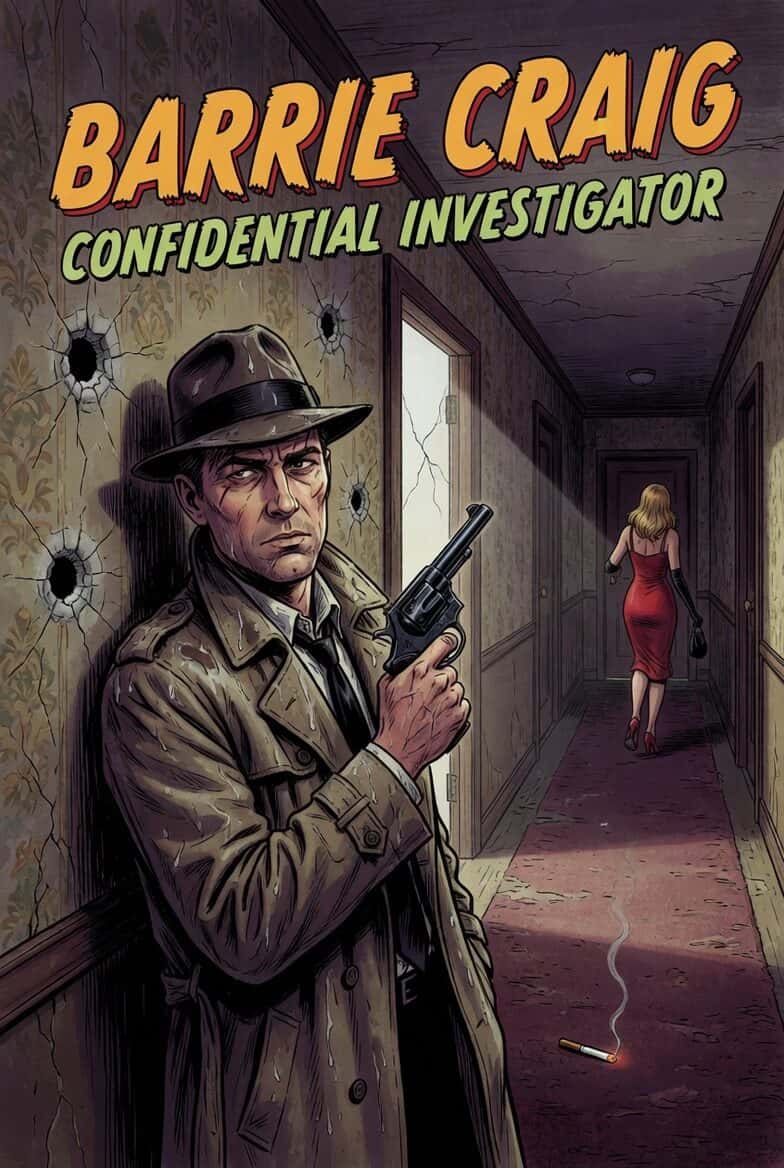
You have been listening to William Gargan in another exciting transcribed mystery drama from the adventures of Barrie Craig, Confidential Investigator. Tonight's story, Song of Death, was written by John Roeburt. Next week, it's the strange story titled Death of a Private Eye, about which Barrie Craig has this to say.
Next week, I'm hired to help a man pay a visit. But discover instead that my client has a visitor first. That visitor being death. See you next week, folks.
Susan was Amzie Strickland. Barrie Craig, starring William Gargan, was under the direction of Hyman Brown. This is Don Pardo speaking. Now enjoy Meredith Willson's Music Room on NBC.