
The written record
Read the transcript
Read along with the recording · About 21 min to read
She's a lovely girl.
You wouldn't hire?
No. She came to me. I couldn't use her. She's a liar. I don't like liars. I dropped her.
I see. And then you came to me.
I came to you because I want to know what her act is. Who's she working with? What's she after?
Why should I tell you?
Because you know. And because I'm going to find out anyway. It'll save time.
You're very confident, Mr. Craig.
I've been in the business a while.
Yes. I've heard of you. Barry Craig. You have a reputation for being clever. And honest. Two very dangerous qualities in our profession.
I didn't know we were in the same profession.
We're not. But we both deal in information. And information is valuable. Sometimes it's worth more than money.
What's Mona Walsh's information worth?
Harold smiled. It wasn't a pleasant smile. It was the kind of smile a cat gives a mouse just before the pounce. He walked over to the Renoir and looked at it for a long moment.
You noticed the painting?
I noticed.
A genuine Renoir. Worth about forty thousand dollars. I bought it with the profits from my first big deal. A shipment of Canadian whiskey during Prohibition. Do you know why I bought it?
Because you like beautiful things?
Because it reminds me of what I was. And what I've become. The girl in the painting, brushing her hair, innocent, unaware of what's outside her window. I was like that once. So was Mona Walsh. So, I suspect, were you.
What's your point?
My point is that innocence doesn't last. It gets corrupted. By money, by power, by fear. Mona Walsh was innocent once. Then she married Ted Walsh. Now she's something else. Something harder. Something desperate.
Desperate enough to hire me to protect her from a husband she's afraid of?
Desperate enough to hire you for something else entirely.
What else?
Harold turned away from the painting and looked at me. His eyes were cold and calculating, the eyes of a man who had bought and sold lives and never lost sleep over it.
Ted Walsh didn't rob that bank alone. He had a partner. A man who planned the job, who got the inside information, who made it possible. That partner was supposed to get half the money. Thirty thousand dollars. But Ted Walsh double-crossed him. Took it all and ran.
Who was the partner?
Does it matter?
It matters to me.
It was me, Mr. Craig. I was the partner. I planned that job for six months. I put my people in place, I got the guard's schedule, I timed everything to the second. And Ted Walsh walked out with sixty thousand dollars and left me with nothing but expenses.
So you want the money back.
I want more than the money back. I want Ted Walsh. And Mona Walsh knows where he is.
That's why she came to you?
She came to me first. She offered to sell me Ted's location for fifty thousand dollars. I told her I'd think about it. Then she went to you. Why? Because she needed insurance. She needed someone to protect her from Ted, yes, but also from me. And from the police. Because Mona Walsh isn't just Ted's wife. She's his accomplice. She was in on the bank job from the beginning.
I sat there and let it sink in. The blonde in the shiny car with the gun in her bag. The frightened wife afraid of her murderous husband. The convenient doorway and the waiting game. It all fit together like a jigsaw puzzle with one piece missing.
Why tell me all this?
Because you're going to help me find Ted Walsh. And Mona Walsh. And the sixty thousand dollars.
Why would I do that?
Because if you don't, I'll tell the police that Barry Craig, Confidential Investigator, was harboring a wanted fugitive. That you knew who Mona Walsh was and what she'd done and you helped her anyway. Your reputation won't survive that, Mr. Craig. Your business won't survive it.
You play rough, Harold.
I play to win. I've always played to win.
I stood up and looked at the Renoir one more time. The girl brushing her hair, innocent, unaware. I wondered what she'd look like with a gun in her hand and thirty thousand dollars in her suitcase.
I'll find them. But not for you. For the guard Ted Walsh killed. And for whatever's left of the girl in that painting.
Harold laughed. It was a dry, humorless sound, like leaves scraping against a window.
Sentiment, Mr. Craig? I didn't think you had it in you.
Everybody's got something, Harold. Even you. Maybe especially you.
I walked out past Bogan, who was still holding his gun like a security blanket. The night air felt clean after Harold's oak-paneled room. I took a deep breath and started walking.
I had two choices. I could find Mona Walsh and warn her that Harold was closing in. Or I could find Ted Walsh first and turn him over to the police before Harold could get to him. Either way, I was running out of time.
I went back to the drugstore phone.
Barry Craig here.
Craig? Where have you been? I've been trying to reach you.
Lieutenant Travis. Working late?
Always. Listen, we got a tip on Ted Walsh. He's in the city. We think he's holed up in a hotel on West 47th. The Merrick.
Who gave you the tip?
Anonymous. Female voice. Sounded scared.
Mona Walsh. Playing both ends against the middle, or trying to get Ted out of the way before Harold found him.
I'm on my way, Trav. Don't move in until I get there.
Why should I wait for you?
Because I know something you don't. And because if you go in there now, you'll get a dead Ted Walsh and no witnesses. Give me an hour.
A long pause. Then Travis sighed, the sound of a tired cop who'd learned to trust hunches.
One hour. Then we go in with or without you.
I hung up and ran for a cab. The Merrick Hotel was a faded glory of the twenties, now renting rooms by the week to people who didn't ask questions and didn't answer them. I found the desk clerk dozing over a racing form.
Ted Walsh. What room?
Who wants to know?
Barry Craig. And if you don't tell me, the cops will be here in an hour asking the same question. They won't be as polite.
The clerk looked at me with the resigned eyes of a man who'd seen too many midnight visitors.
Room 412. But he ain't there. Left about an hour ago. With a dame. Blonde.
Mona Walsh. They'd made up, or she'd found him first. Either way, they were gone. And I had maybe fifty minutes to find them before Travis and his boys turned the Merrick inside out.
I checked the room. Fast and thorough. Two suitcases, one half-packed. A woman's scarf on the chair. And on the dresser, a train timetable. Circled in red pencil: the 11:15 to Chicago. Leaving Grand Central in forty minutes.
I ran.
Grand Central at night is a cathedral of departure, all echoes and announcements and people rushing toward somewhere else. I found the gate for the Chicago train and worked my way through the crowd, looking for a blonde and a man who'd killed for sixty thousand dollars.
I saw them at the far end of the platform. Mona Walsh, still beautiful, still frightened, still holding that bag with the gun in it. And Ted Walsh, a small man with nervous hands and the eyes of a cornered animal. He had his arm around her waist, propelling her toward the open door of a Pullman.
Ted Walsh!
He spun, pushing Mona behind him, his hand going inside his jacket. I had my gun out, but the crowd was too thick, too many innocent people between us.
Don't be stupid, Ted. The cops are ten minutes behind me. You can't get on that train.
I can get on any train I want.
Not this one. Harold knows about the Merrick. He knows about the money. And he's got people watching every station in the city.
Harold? Ted Walsh's face went gray. That double-crossing...
He says you double-crossed him first. Thirty thousand dollars' worth. He's not a forgiving man, Ted.
Mona stepped out from behind him. Her face was different now, harder, the innocence Harold had talked about burned away by fear and greed.
Barry Craig. I thought you quit.
I un-quit. It's a bad habit. Mrs. Walsh, or whatever your name really is, step away from him. The police just want Ted. You can still get out of this.
She laughed. It was an ugly sound, nothing like the frightened woman in the shiny car.
You think I'd go back to nothing? To some two-bit job and a cheap apartment? Ted's got sixty thousand dollars. We're going to South America. We're going to live like royalty.
Not with Harold on your trail. And not with the police. Mona, I'm giving you one chance. Walk away now.
Ted's hand came out of his jacket with a gun. Small, snub-nosed, deadly at close range. He pointed it at my chest, his hand shaking.
Get out of here, Craig. This is my train. My money. My life.
It's not your life anymore, Ted. It stopped being your life when you killed that guard.
The shot came from behind me. I spun, but I already knew. Bogan, Harold's errand boy, pushing through the crowd with a silenced pistol. Ted Walsh crumpled, the gun falling from his hand, the sixty thousand dollars in his pocket suddenly worth exactly nothing.
Mona screamed. Not a scream of grief, but of rage, of calculation destroyed. She had her bag open, her own gun out, but Bogan was faster. He grabbed her arm, twisted, and the gun fell to the platform.
Mr. Harold wants to see you, Mrs. Walsh. And he wants his thirty thousand dollars.
The crowd was scattering, screaming, the natural chaos of violence in a public place. I saw Travis and two uniformed cops pushing through from the gate, too late for Ted Walsh, maybe in time for Mona.
Bogan had her by the arm, dragging her toward the exit. I stepped in front of him.
Let her go, Bogan. The cops are here. You want to explain a dead man and a kidnapped woman?
Mr. Harold's orders.
Mr. Harold's going to have a long talk with the district attorney if you don't drop that gun and step back.
Bogan hesitated. He was crude, impulsive, but not stupid. He saw the cops, saw the situation, saw his own narrow escape disappearing. He dropped Mona's arm and backed away, melting into the crowd.
I caught Mona as she stumbled. Her face was blank, shocked, all the schemes and calculations finally run out.
It's over, Mona. Whatever you were running from, whatever you were running to. It's over.
She looked at me with empty eyes. You would have helped me. Back at the house. If I'd been what I pretended to be.
If you'd been what you pretended to be, you wouldn't have needed help.
Travis reached us, panting, his gun out and useless.
Craig! What happened? Who's the dead man?
Ted Walsh. And this is Mrs. Walsh. She'll tell you everything. Won't you, Mona?
She looked at Ted's body, at the spreading stain on the platform, at the train that would never take her to South America. Then she looked at me, and for a moment I saw something like the girl in Harold's Renoir, innocent, unaware, before the world taught her otherwise.
Yes. I'll tell you everything. What does it matter now?
I left her with Travis and walked back through Grand Central, past the gates and the announcements and the people rushing toward somewhere else. Outside, the night was still beautiful, still full of shadows creeping along Madison Avenue.
Jake was asleep in the elevator when I got back to my building. I didn't wake him. A night elevator man needs his sleep. And I needed to think about the work a man does, and the marks it leaves on him.
A confidential investigator looks like me. Tired, a little battered, still standing. Still believing that somewhere in the city, there's someone who actually needs help, who isn't playing an angle, who isn't carrying a gun in her bag.
Maybe tomorrow I'd find that person. Maybe tomorrow I'd fool a burglar into thinking I had something worth stealing. Maybe tomorrow the shadows would creep a little slower, and the night would be a little less full of people running from what they'd become.
But that was tomorrow. Tonight, I unlocked my office door, sat down at my desk, and waited for the phone to ring.
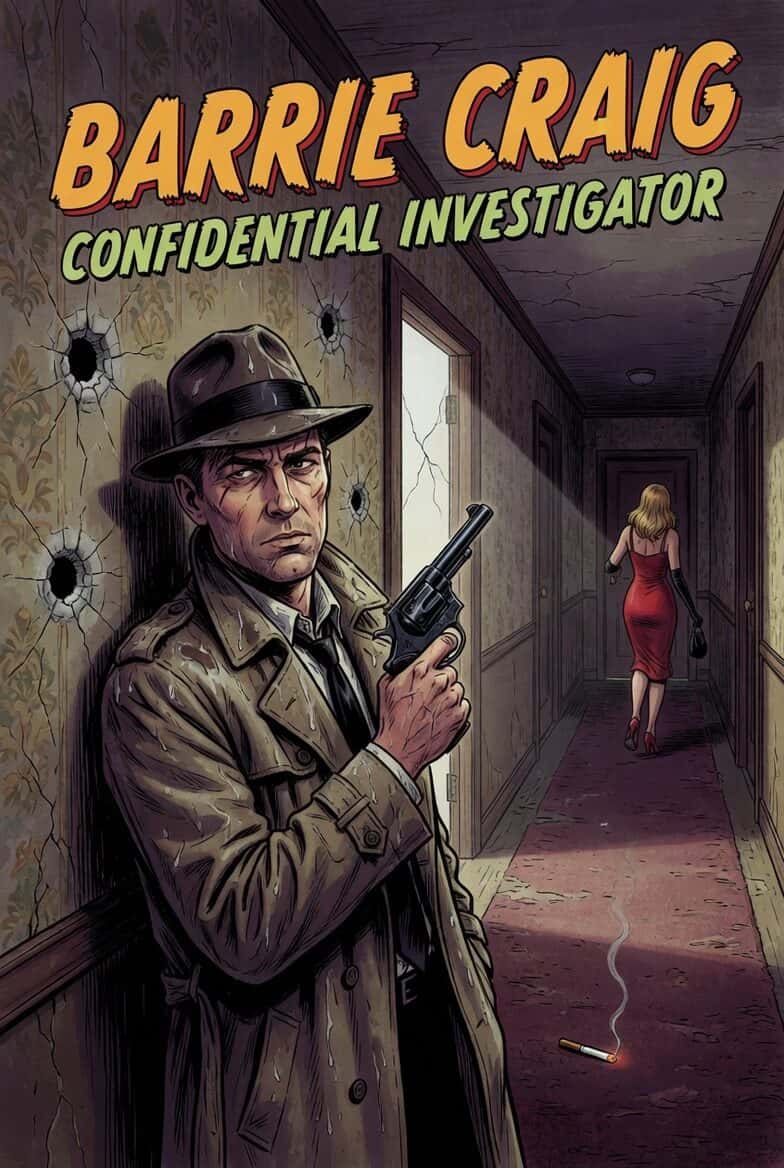
Because that's what Barry Craig, Confidential Investigator, does. He waits. He watches. And when someone needs him, or says they need him, or thinks they can use him, he answers.
And sometimes, just sometimes, he actually helps.
This is the United States Armed Forces Radio Service, the voice of information and education. This program came to you transcribed from the NBC network. William Gargan may soon be seen in the new Universal-International picture, "The Bribe." This is the AFRS, signing off.
She lied to me. Sad. She wanted me to protect her against her husband. She'd heard he was here in New York. She didn't tell me who told her.
Why?
I really couldn't say. She wanted me to stake out in front of her house. So when Walsh got there, I'd take him. But, Harold, um, how would Ted Walsh have found her house?
She wouldn't have told him, not if she was really afraid of him.
"Isn't all this Mona Walsh's problem?"
"No. Ted Walsh alive gets half of the $60,000. Because Ted Walsh dead gets a mouthful of dust in Potter's Field."
"I'll picture it."
"See, problem is, how to kill Ted Walsh without annoying the police. The answer is, hire a private detective, let Ted Walsh know where his lovely wife is, and he heads for her. The private detective kills him. All nice and legal."
"I suppose it would be..."
"Harold, you picked me to kill Ted Walsh for you."
"You're ruining my time."
"Sorry, I have trouble with my temper sometimes. I don't like being a hired gun, Harold."
"You turned the job down, didn't you? What more do you want?"
"I don't know. Maybe I'm worried because a liar is so lovely."
I got out of there. I could have gone to lots of other places after that, but I didn't. I went back to my office and sat. I didn't have any doubts. Harold had set up Mona Walsh as a decoy. When I cried quits, one of his men moved in to protect her. Harold wanted Ted Walsh dead so he could hold on to all of the $60,000. And maybe Mona Walsh, too. It was an idea I didn't enjoy. I stopped having it.
I was waiting without knowing what I was waiting for. I thought it might be nice if I had a Renoir to hang next to the dusty license on the wall. Then I thought of the people and the motives that kept me in business. I decided the Renoir wouldn't fit. The hours dragged by and I stopped kidding myself. Nobody phoned. Nobody would phone. I'd get up and go home and go to sleep. I got up, but I didn't go home.
The street in front of Mona Walsh's house was empty and cold. The lights in Mona Walsh's house were out. And the boy in the alley wasn't there anymore. I was wrong. I hadn't gone deep enough. The alley closed in on me and then I found him. He was propped up against the wall, his legs straight out before him, his head slumped down over his chest. He might have been brooding about the blood that had poured out of that chest if he hadn't been so completely dead.
I left him there. He'd keep. He'd been dead some of the while. Somebody had shot him. It got past him into Mona Walsh's house. The lock on Mona Walsh's front door was in fine shape, except that the door wasn't locked. The living room was the way I'd remembered it. I went into the bedroom.
She had fallen back across the bed. The stain on the front of her dress hadn't been heard. It was the dressmaker's idea.
"Hello, Mrs. Walsh. I thought... I thought... I hoped maybe I'd see you again. Hold it. Emergency. An ambulance. 435 Ash. Gunshot warning. Make it quick."
"Yeah. Mr. Craig?"
"Better not talk."
"Why? There'll be a doctor here in a couple of minutes. You've seen people like this before."
"I should be dead."
"Will you stop talking?"
"No, I won't. What do you want me to do? I think about what my life has been. I shouldn't have married Ted. Now, you don't have to make..."
"I'm not making excuses. Only things happen. You lie about them. Even to yourself. Now, I don't have to lie anymore."
"Once the doctor gets here, you..."
"Oh, please. It's all going so fast. Now, goodnight. When I was a little girl, I thought..."
Doctor was a little late. The police arrived. It was May 12th. It was May 12th. We heard noises and were very busy. Mona Walsh didn't pay attention to any of them.
"Barry?"
"Yes, Lieutenant."
"We haven't been able to get a thing. A couple of the neighbors heard the shots but thought they were a car backfiring. That happens. Which gives us the time Mrs. Walsh and the character in the alley were killed. An hour and ten minutes ago. Does knowing that make you feel any better?"
"With all the deaths you've seen, Barry, you ought to be a little more callous about new ones."
"Maybe I don't try hard enough."
"Stay the way you are. It's better. Otherwise, you lose humanity. None of us can afford that."
"Did they teach you that in college?"
"It's not taught anywhere. It's something you either know or don't know. Our policeman isn't supposed to give lectures, though, so... Ted Walsh is out in the open now. He must have holed up for the last couple of weeks, but... We know he's in New York now. We'll get him."
"Yeah. Mind if I get out now?"
"No. Where are you going? We could, uh... kill a few beers after I'm through here."
"Thanks, but not tonight, Trev. Because, you see, I... I won't be through for maybe, uh, longer than that."
I wasn't holding out on Trev. I had to be sure. There was only one place I could think of that might help. If I were Ted Walsh, I'd go visit Harold. I wasn't Ted Walsh, but I went to visit him anyway. I always enjoyed driving. It was a nice night for it. The only thing wrong was, uh... the red stain on a girl's dress.
There was a car parked outside Harold's house. It started pulling away as I came up. I didn't try to figure out anything subtle. I just cut my wheel right into it. Both cars stopped quick. I was out of mine before Bogan could quite make it. But he made it out of his car.
"Hello, Bogan. Why don't you watch where you're driving?"
"Yeah, me. Oh, you don't want the gun, but I do."
"You'll wake the neighbors."
"Thanks for the gun. Yeah. Hey, warm. And it's been fired. Within very recent history. Now, listen. Let's see if there's anything else in your car, huh? No. Nothing that moves. Bogan?"
"Yeah."
"I can't take the time to deliver you. So I'll have to put you on deposit for a little while."
He'd keep. I thought Mr. Harold might still be at home. Worrying about his car, maybe.
"Bogan, what... Oh, Craig. We'll go inside."
"Now, look here. I've got Bogan's gun."
"All right. What do you want?"
"Your car's in a bad way."
"That crash?"
"Yeah, I'm a careless driver. Was Bogan hurt?"
"He lived. I'm going to call a doctor for him."
"No. Now, look here. This is perfectly..."
"You're nervous. I haven't anything further to say to you, Craig."
"One man's opinion. Yours. I don't share it."
"You must have looked into the car."
"I did."
"Well, that can be explained easily."
"Explain it easily."
"You saw Ted Walsh's body in the back of the car. He was a killer. He apparently... I thought his wife and I had been a little too friendly."
"Had you?"
"Well, you know how it is, Craig."
"I don't know."
"Well, anyway, he came here. Threatened to kill me, so... Well, Bogan beat him to it, that's all. It was a case of self-defense. It would stand up at any court."
"Sure. Well, there's no reason to lose your head."
"I haven't lost it. Where was Bogan delivering the body? To the aquarium?"
"Well, you see, Bogan's record isn't too good. He was afraid the police might not readily accept a plea of self-defense. He wanted... He wanted to dispose of the body. I... Well, I tried to dissuade him, but... I failed. As a matter of fact, I was just about to notify the police myself."
"Oh, I'm sure you were. I think you'll find the bullets in Ted Walsh's body came from Bogan's gun."
"I don't doubt it."
"Well, then, that sort of leaves me out of it, doesn't it?"
"How about the bullets in the body of the boy who served as guard, Mona Walsh? How about the bullets in Mona Walsh's body?"
"They're dead?"
"They're dead."
"Oh, that's terrible."
"Sure. Ted must have got to them. He had a gun. The bullets in those bodies would have come from his gun."
"His gun? Don't you mean the gun you planted on him?"
Harold looked a little sick. His face matched the way I felt. For a minute, I wished I'd developed those calluses Trev mentioned. Then I forgot about it. Mr. Harold retreated behind his desk.
"Planted on him? Ted Walsh came here before he went to visit his wife for his share of the bank money. Walsh died here. Bogan saw to that. But you still didn't own all of that $60,000."
"What? What? What? What? What? What?"
"Walsh might be considered to have a claim on half of it. So you decided to wipe out that claim."
"You're... you're dreaming."
"You had it figured for a house. You had to take care of the boy in the alley. Walsh would have had to in order to get to Mona. You took care of him. Then you went into the house and ended the partnership between you and Mona Walsh."
"No."
"Yeah. You came back here, planted the gun you'd used on Ted Walsh. Bogan would dump his body where it wouldn't be found for a while. That way, no medical examiner could tell that Walsh had died before his wife."
"That... that's very clever. You've got nothing to prove it with. This Ted Walsh's body examination now will show he died before Mona did. A good lawyer could..."
"I've got something else. Something that told me Ted Walsh hadn't killed his wife before I even came here."
"What's that?"
"An unlocked door."
"I don't know what that means."
"Mona Walsh's door was unlocked when I got to her house. The lock hadn't been tampered with, which meant Mona had opened that door. But she wouldn't have opened it to her husband. She was afraid of him. She'd have opened it for you, Harold."
"I..."
"You've been fumbling in that desk drawer long enough. Bring the gun up. Maybe you'll beat me to the shot, huh?"
"I... I don't want to get involved."
"You're involved. There's nothing left except maybe a chance to take me."
"Well... Okay, Harold. You're better, much better at killing women. Let's go tell some cops about it, huh?"
You've been listening to William Gargan in another exciting transcribed mystery drama from The Adventures of Barrie Craig, Confidential Investigator. Tonight's story, The Long Way Home, was written by Lou Vittes. Next week, it's the strange story titled Dead Reckoning, about which Barrie Craig has this to say.
Next week, matter triumphs over mind when a corpse with no head for figures starts pitching his weight around with yours truly playing catch. Good night, folks. See you next week.
Featured in the role of Mona was Barbara Weeks. Barrie Craig, starring William Gargan, was under the direction of Hyman Brown. This is Don Pardo speaking.