
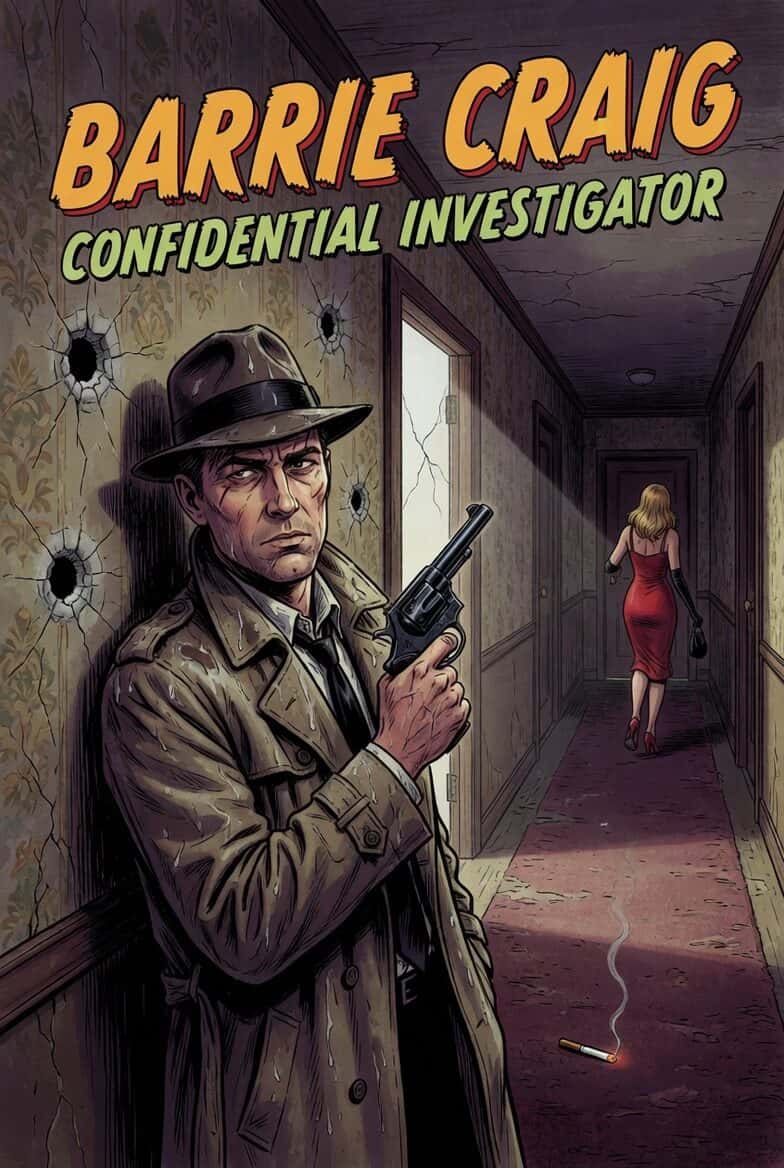
The written record
Read the transcript
Read along with the recording · About 27 min to read
Of course.
I followed him to a hotel on 44th Street. He went in, and I waited. After a while, he came out again, and I followed him some more. He led me to a bar, and from there to another hotel. I was beginning to think he was trying to lose me, or that he had a very active social life, when he finally went into a building and stayed there. It was an apartment house on West End Avenue. I waited across the street for nearly two hours. Then a woman came out. She looked around carefully, and then walked quickly to the corner and got into a taxi. I got the number of the taxi and went home. The next morning, I found out whose apartment it was. It belonged to a man named Arthur G. Leland. I also found out who the woman was. Her name was Lola Leland. She was his wife.
I spent the rest of the day finding out about Arthur G. Leland. He was a broker, like Baker, but apparently an honest one. He had been in partnership with Baker some years before, and the partnership had ended badly. There had been a lawsuit, which Leland lost, and he had been bitter about it ever since. He was about fifty, well-to-do, and lived quietly with his wife in the apartment on West End Avenue. He had no police record. He was, in fact, a very respectable citizen.
That evening, I went back to West End Avenue and watched the building. At about nine o'clock, a man came out. I couldn't see his face clearly, but he was about the right size for Leland, and he walked in the direction of the subway. I followed him. He went to a movie theater on Broadway and sat through two feature pictures, a newsreel, and a cartoon. Then he went to an all-night restaurant and had a cup of coffee. At two in the morning, he went back to his apartment. I went home and went to bed.
The next day, I called on Mrs. Leland. I told her I was an insurance investigator, checking on a claim. She was a small, dark woman, very nervous. She kept looking at the door while we talked.
What kind of claim, Mr. Craig?
A life insurance claim. Your husband took out a policy some years ago. We're just verifying the beneficiaries.
I see. Well, I'm the beneficiary, of course. And my brother, Ralph. Ralph Madden.
Your brother lives here in New York?
No, in Philadelphia. He's a doctor. A heart specialist, as a matter of fact.
I see. And your husband is in good health?
Yes, quite good. Why do you ask?
Routine question, Mrs. Leland. We have to check these things.
Of course.
I left her and went to see Hanson again. I found him in his office, looking more spatted and gardenia'd than ever, but not quite so jaunty.
Mr. Craig. What can I do for you?
Tell me about Leland.
Leland? Arthur Leland? What about him?
He was Baker's partner once. Then they had a fight. What was it about?
Oh, that. Yes, Baker cheated him. Quite flagrantly. Leland sued and lost. The judge was rather favorable to Baker, I understand. It was all quite legal, but not very ethical.
Did Baker ever cheat you, Hanson?
Me? Well, that's hardly relevant, is it?
It might be. Did he?
There were certain irregularities in our accounts. I preferred not to make an issue of them.
Because you were cheating him too?
Really, Mr. Craig.
Never mind. What about Tommy? Did Baker cheat him?
Tommy? Tommy was a mere employee. He wouldn't have had the intelligence to cheat anyone, even if he'd had the opportunity.
But he was implicated in Baker's swindling. You told me that yourself.
Did I? Well, perhaps I exaggerated. Tommy was a very minor figure.
And Sandra? Was she cheated too?
Sandra? She was Baker's niece. She inherited everything he had. Hardly a case for complaint.
Unless she knew how he got it.
What do you mean?
Nothing. Just thinking out loud.
I left Hanson and went to see Sandra. She was in Baker's house, or rather her house now, packing things up.
Oh, it's you again. The man who looks for people with deep voices.
Any around?
Not today. Unless you count the iceman. He has a very basso profundo.
I'll remember that. Miss Sandra, did your uncle ever cheat you?
Cheat me? How could he? I didn't have anything to cheat me of.
But you knew how he made his money. You knew he was a crook.
Certainly. I told you so myself. What of it?
Did it bother you?
Should it have? He was good to me. He gave me everything I wanted.
Including a bad conscience?
I don't have a conscience, Mr. Craig. It's a family trait. Like Uncle's crookedness. Or my charming frankness.
I see. Did you know Arthur Leland?
Leland? Oh, the partner. Yes, I met him once or twice. A very dull man. He disapproved of Uncle. And of me, I imagine.
He had reason to disapprove of your uncle.
Perhaps. But that was years ago. Water under the bridge.
Or poison under the bridge. Depending on how you look at it.
What do you mean?
Nothing. Just thinking out loud again.
I went back to my office and sat there for a long time, thinking. I had three suspects, or four if I counted Leland. I had a murder method that left no trace. I had a midnight visitor who might or might not be a novelist. And I had a feeling that I was missing something obvious, something that was right in front of me if I could only see it.
The phone rang. It was Mrs. Leland.
Mr. Craig? I mean, Mr. Insurance Investigator? I must see you. It's about my husband.
What about him, Mrs. Leland?
He's going to be murdered. Just like Mr. Baker. I know it.
Why do you think so?
He's been acting strangely. He's nervous, he doesn't sleep. And he's been reading medical books. Books about heart disease.
Where are you now, Mrs. Leland?
At home. But I'm afraid to stay here. Can I come to your office?
Of course. Come right away.
She arrived in less than half an hour, more nervous than before, twisting her gloves in her hands.
Mr. Craig, I lied to you this morning. My husband isn't in good health. He has a heart condition. Not serious, but he takes medicine for it. Capsules.
I see.
And he's been acting so strangely. He goes out at night, he won't tell me where. And he came home last night with a book about heart disease. He tried to hide it from me, but I found it.
When did he buy this book?
I don't know. But I think it was recently. Mr. Craig, I'm afraid he's planning something. Something terrible. Baker died of heart disease, didn't he? And now my husband is studying heart disease, and he hates Baker, he always hated him. I'm afraid he's going to kill someone. Or kill himself.
Why would he kill himself?
Because of what Baker did to him. Because of the lawsuit. He's never gotten over it. And now, with this heart condition, he might think he hasn't long to live anyway. He might think he has nothing to lose.
I tried to calm her down, but I didn't succeed very well. She left eventually, still twisting her gloves, still looking at the door. I sat there some more, thinking about what she'd told me. It fit. It all fit. Leland had motive, opportunity, and now I knew he had the method. The book on heart disease, the capsules, the hatred of Baker. It was all there.
But something bothered me. Something about the way Mrs. Leland had told her story. The way she'd looked at the door. The way she'd mentioned her brother, the heart specialist. And something else. Something about voices.
I went back to West End Avenue that night. I watched the building. At about ten o'clock, a man came out. I followed him. He went to a drugstore and made a phone call. I couldn't hear what he said. Then he went back to his apartment. I waited some more. At midnight, another man came out. This one was different. He walked quickly, looking back over his shoulder. I followed him to a subway station, then lost him in the crowd.
I went back to the apartment house and looked at the names on the mailboxes. Leland, Apartment 4B. And next to it, Madden, Apartment 4C. Ralph Madden. Mrs. Leland's brother. The heart specialist.
I went home and called a friend in Philadelphia. He checked for me. Dr. Ralph Madden was indeed a heart specialist. He had an office in Philadelphia, but he also kept an apartment in New York. At the same address as his sister. Convenient.
The next morning, I went to see Madden. I caught him just as he was leaving for his office. He was a tall man, thin, with a nervous manner and a voice that was neither deep nor remarkable.
Dr. Madden? I'm Barrie Craig. I'd like to talk to you about your brother-in-law.
Leland? What about him?
His health. His heart condition.
What do you know about his heart condition?
Only that he has one. And that he takes capsules for it.
Who told you that?
His wife. Your sister.
She shouldn't have. It's confidential.
I'm making it my business, Doctor. Just as I made Baker's death my business.
Baker? What do you mean?
I think you know what I mean. I think you knew Baker too. Not just as your brother-in-law's former partner, but as a patient.
A patient? That's absurd.
Is it? Baker had heart disease. He took capsules. Someone who knew about heart disease, someone who had access to medical information, could have figured out how to kill him without leaving a trace. Someone like you, Doctor.
You're insane.
Possibly. But I'm also persistent. And I'm going to find out who killed Baker, and who killed Tommy. Even if I have to dig into every heart specialist in the country to do it.
He slammed the door in my face. I stood there for a moment, then went down to the street. I was close now. I could feel it. But I still didn't have enough. I needed something concrete, something that would tie it all together.
I went to see Hanson again. He was in his office, looking even less jaunty than before.
Mr. Craig. I was just going to call you.
Oh? Why?
Because I've remembered something. About that voice you described. The deep voice.
Yes?
I heard it again. Last night. At the Kent Club.
The Kent Club? That's where you called me from.
Yes. I was there, and I overheard a man talking. He had that voice. That deep, rasping voice. He was talking to someone on the phone. He said, "Craig knows too much. We have to stop him."
Stop me? How?
I don't know. But I thought you should be warned.
Thanks. Did you see this man? Did you get a look at him?
No. He was in a phone booth. I only heard his voice.
I see. Well, thanks for the warning, Hanson. I'll be careful.
I left him and went back to my office. I sat there, thinking about what he'd told me. Someone was planning to stop me. Someone with a deep voice. The same someone who'd come to my apartment that first night? Or someone else?
The phone rang. It was Sandra.
Mr. Craig? I must see you. It's important.
What is it, Miss Sandra?
Not over the phone. Can you come here? To the house?
I'll be right there.
She was waiting for me in the living room, looking more serious than I'd seen her before.
Mr. Craig, I've been thinking. About what you said. About Uncle being murdered.
Yes?
I think you may be right. And I think I know who did it.
Who?
Hanson.
Hanson? Why?
Because he was the only one who really knew about Uncle's heart condition. Uncle used to joke about it. He'd say, "Hanson knows more about my heart than I do." And Hanson was always fussing about Uncle's medicine. Making sure he took it. Once, I remember, Uncle dropped a capsule and Hanson nearly had a fit. He made Uncle take another one.
When was this?
About a week before Uncle died.
I see. Anything else?
Yes. I found something. In Hanson's desk. When he was out yesterday. I shouldn't have been looking, but I was curious.
What did you find?
A bottle of capsules. Heart medicine. With Uncle's name on it. But they were empty. The medicine had been poured out.
Empty capsules?
Yes. And there was something else. A book. A medical book. About heart disease.
I see. Why are you telling me this now?
Because I'm afraid, Mr. Craig. Afraid of Hanson. He knows I was in his desk. He said something this morning. Something about accidents happening to people who were too curious.
Did he now?
Yes. And his voice... it was different. Deeper. Almost like the voice you described.
I left Sandra and went to find Hanson. He wasn't in his office. He wasn't at home. I checked the Kent Club, but no one had seen him. I went back to my office and waited. At about six o'clock, the phone rang.
Craig?
Speaking.
This is the voice you've been looking for. The deep voice.
Who is this?
That doesn't matter. What matters is that you stop looking. Stop asking questions. Forget about Baker. Forget about Tommy. Or you'll be sorry.
Is that a threat?
A promise. Goodbye, Craig.
The line went dead. I sat there, holding the phone, listening to the dial tone. Then I hung up and called the police. I told them what I had, which wasn't much. They said they'd look into it. I didn't expect much from them.
That night, I went back to Baker's house. I wanted to talk to Sandra again, to find out more about what she'd seen in Hanson's desk. But when I got there, the house was dark. I rang the bell. No answer. I tried the door. It was unlocked. I went in.
Sandra? Miss Sandra?
No answer. I went through the house, turning on lights. In the living room, I found her. She was lying on the sofa, very still. Too still. I went to her. She was dead. There was no mark on her. No sign of violence. But she was dead.
I called the police. They came, looked around, asked questions. The medical examiner came. He examined Sandra. Then he came to me.
Mr. Craig? You knew this woman?
Yes.
Did you know she had a heart condition?
A heart condition? No. She never mentioned it.
She had one. A serious one. She took medicine for it. Capsules.
I see.
She died of heart failure. Natural causes, apparently. Though we'll have to do an autopsy to be sure.
Of course.
I stood there, looking at Sandra's body, thinking about what the medical examiner had said. Another heart condition. Another death from heart failure. Another set of capsules. It was the same pattern. The same method. But who? Hanson? Or someone else?
The police finished their questions and left. I stayed in the house, looking around. In Sandra's room, I found her medicine. Capsules, in a bottle with her name on it. I took one out and looked at it. It looked ordinary enough. But I wondered.
I took the capsule to a pharmacist I knew. He opened it and analyzed the contents. It was heart medicine, all right. The real thing. No water substitute. So Sandra's death was natural, after all. Or was it?
I went back to my office and sat there, trying to think it through. Three people dead. Baker, Tommy, Sandra. All connected to the same case. All dying of heart failure. But Sandra's medicine was genuine. So her death was natural. A coincidence. Or was it?
The phone rang. It was Mrs. Leland again.
Mr. Craig? My husband... he's dead.
Dead? How?
Heart failure. He was found in his apartment. The doctor said... he said it was natural. But I don't believe it. I don't believe it was natural.
Where are you now, Mrs. Leland?
At my brother's apartment. I'm afraid to stay in my own. Please, Mr. Craig. Come here. I need to talk to you.
I went. She was in Madden's apartment, looking more nervous than ever, twisting her gloves.
Mrs. Leland, I'm sorry about your husband. But the doctor said it was natural causes.
I know what he said. But Arthur was careful about his medicine. He always took it. He never missed. And he was feeling better lately. Much better.
When did you last see him?
Yesterday evening. He went out. He said he had business. He didn't come back. I went to his apartment this morning, and... and I found him.
I see. And you came here?
Yes. I was afraid. Afraid to stay there alone.
Of course.
Mr. Craig, I think my brother knows something. About Arthur's death. He's been acting strangely too.
Your brother? Dr. Madden?
Yes. He came in just before I called you. He looked... guilty. As if he knew something.
Where is he now?
In his room. He said he had to think.
I went to Madden's door and knocked. No answer. I knocked again, louder. Still no answer. I tried the door. It was locked.
Mrs. Leland, do you have a key?
No. But there's another way. Through the bathroom.
Show me.
She showed me. I went through the bathroom into Madden's room. He was there, sitting in a chair. Dead. A gun in his hand. A suicide note on the desk.
"I can't go on. The deaths are too many. Baker, Tommy, Sandra, Leland. I killed them all. I couldn't help myself. Forgive me. Ralph Madden."
I stood there, looking at the body, the gun, the note. It was all wrapped up. Neatly, conveniently. Madden had confessed to everything. The case was closed.
But I wasn't satisfied. Something was wrong. Something about the note. About the gun. About the whole setup. I read the note again. "Baker, Tommy, Sandra, Leland." Four names. But Sandra's death was natural. Her medicine was genuine. Why would Madden confess to killing her if he didn't?
Unless he didn't write the note. Unless someone else wrote it, someone who didn't know that Sandra's medicine was genuine. Someone who thought all four deaths were murders, because they'd planned them all.
I went back to Mrs. Leland. She was sitting where I'd left her, still twisting her gloves.
Mrs. Leland, your brother didn't write that note.
What? What do you mean?
I mean he's been murdered. Just like the others. And you're the murderer.
She stopped twisting her gloves. She looked at me. Her face changed.
That's absurd. Why would I kill my own brother?
To stop him from talking. To close the case. To make it look like suicide. Just like you made Tommy's death look like suicide.
Tommy? I didn't kill Tommy.
No? Who wrote the suicide note, then? Tommy? A man who couldn't even get his own title straight? "I'm Mr. Baker's former secretary. No. I'm the former Mr. Baker's secretary." That man wrote a coherent suicide note?
She stood up. She was very small, but suddenly she seemed larger.
You're very clever, Mr. Craig. Too clever.
And you're very good at voices, Mrs. Leland. Or should I say, at changing your voice. That deep, rasping voice. The one that came to my apartment. The one that called me on the phone. That was you, wasn't it?
She smiled. It wasn't a pleasant smile.
Yes. It was me. I've always had a talent for voices. I used to entertain Arthur with my imitations. He found them amusing.
I'm sure he did. Right up to the end.
You don't understand, Mr. Craig. You can't understand. Arthur ruined my brother. Ralph was a good doctor, a brilliant man. But he got involved with Baker, with Arthur's schemes. He lost his license. He lost everything. And Arthur... Arthur just went on. Making money, cheating people, living happily. It wasn't fair.
So you decided to even the score.
I decided to punish them. Baker, who started it all. Tommy, who helped him. Sandra, who knew and didn't care. And Arthur... Arthur, who betrayed my brother.
But Sandra's medicine was genuine. She died naturally.
For a moment, she looked confused. Then she laughed.
Was it? Are you sure? Perhaps your pharmacist made a mistake. Or perhaps... perhaps I made a mistake. I thought I'd switched all the capsules. Maybe I missed one. Or maybe...
Or maybe you didn't kill her at all. Maybe her death really was natural. But you couldn't resist taking credit for it. Even in your brother's fake suicide note.
She stopped laughing. She looked at me, and for the first time, she looked frightened.
What are you going to do?
I'm going to call the police. And you're going to tell them everything. How you stole the medical books, how you learned about heart disease, how you switched the capsules. How you killed Baker and Tommy and your own husband. And how you tried to frame your brother.
She sat down suddenly, all the strength going out of her.
He would have understood. Ralph would have understood. He wanted revenge too. He just didn't have the courage.
Maybe. But he didn't deserve to die for your courage.
I called the police. They came, took her away. The case was really closed this time. Four deaths, one murderer. And a lesson, if you like, about the dangers of being too friendly with murderers. Or about looking under your bed at night. Though in this case, the murderer came through the window, not from under the bed.
I went home and went to sleep. I didn't look under the bed. I was too tired. And besides, I knew there was no one there. The murderer was in jail, where she belonged.
But I made a mental note. Next time someone came through my window in the middle of the night, I'd ask for identification first. A novelist's card, perhaps. Or a murderer's. Though the way things had been going, it was hard to tell the difference.
This is Barrie Craig speaking. The case of the unsolvable crime was solved, after all. Not by book reviewers, but by a confidential investigator who refused to believe in coincidence. And who learned, once again, that it never pays to be friendly with murderers. Give them an inch, and they'll take a yard. Usually rope, tied around your throat and attached to the nearest rafters. Or, in this case, a capsule of water, instead of medicine, and a heart that stopped beating because no one cared enough to keep it going.
Good night.
Me? I'm grabbing at straws. Anything at the moment is worth trying. That voice did sound like your description. Baker belonged to the club, too. It's a possibility.
Hanson, Sandra told me you'd been stealing money from Baker.
I don't think I care for that kind of conversation.
I'm not making conversation. I'm asking questions. Was she telling the truth?
What difference does it make?
If Baker was murdered, it might make a lot of difference.
You say if Baker was murdered. Aren't you sure?
We'll know better, won't we, when we meet this man whose voice you overheard.
Yes, we'll know better. The only thing is, suppose something happens to him? Hey, are we still in the United States? We've been traveling for hours.
Apparently, he lives farther out than we realized.
Shouldn't be much farther. Craig, mind if I ask you something?
Go ahead.
It's about Tommy. Tommy, I can see him committing suicide all right. He never impressed me as being much of anything. But somehow, I can't see him murdering Baker.
People rarely kill other people in front of witnesses.
That's not what I meant. Craig, are you sure Baker was murdered?
No. But you said before...
I said I suspected it. That's something else. However, I am sure of one thing.
What's that?
I'm sure Tommy... Yes?
Was murdered.
I was never a Boy Scout, so I don't know very much about direction in the country. But I was surprised at where I wound up. Where the car wound up was a bumpy dirt road in a very secluded hunk of landscape.
Well, that must be the house up ahead.
Yes, and the house is dark. Probably took him less time to get here. Must have gone to bed.
Probably. There's a mailbox. House number on it.
Yes, this is it.
Well, let's go visit. Craig, do you think he'll recognize you?
Sure. I couldn't see him, but he saw me clearly enough.
That's not so good. Are you armed?
In case he tries anything?
No, but maybe he won't try anything. Suppose he refuses to say anything, to speak at all, when he sees you.
That'll answer our question just as well, won't it?
I suppose so. Shall I ring?
Sure.
Well, that would be warning him, though, wouldn't it? Suppose he hears the doorbell, looks out, sees you. He might run away.
He might. Look, why don't I go around to the back? Then in case he tries to run...
That's a good idea. You do that.
All right. And be careful.
Sure, I'll be very careful.
The moon picked out the door. It glinted on the metal doorbell. I pushed it. It was a nice night. Not too warm, not too cold. However, a guy named Craig was cold. Walking into a dark house with somebody waiting on the other side of a door could have its unpleasant aspects. Nobody answered the doorbell. I hadn't expected anyone to. So I tried the handle. It was very dark inside. I pulled out a book of matches and hesitated. In the darkness, when you strike a match, you make a very nice target. I wasn't sure I liked the idea. On the other hand, I needed a little more action. It would settle things. I lit a match. There was a light switch on the wall, and I flipped it on. Then I walked into the parlor. There wasn't much more to the house than that. Parlor, bedroom, kitchen, and that was all. The bedroom door was open, and no one was in there. The kitchen door was shut, but no light leaked out from under the door. Offhand, you'd have said nobody was home. And maybe nobody was. So I sat down near the table. There was a lamp that was the room's only illumination. Somebody made noises in the kitchen. Could have been mice. It could have been the mystery man with the deep voice, or it could have been a high wind that was slowly swinging the kitchen door open. I decided, whatever it was, that I didn't want the lamp to glare in its eyes. So I turned off the lamp and quietly shifted from my position next to the lamp to the other side of the room. That evened matters up. It was dark in the kitchen. It was dark in the parlor. Nobody could see anybody. My unlit friend shifted slightly, and I began to get bored. So I grabbed what felt like an ashtray and threw it against the wall on the opposite side of the room. The little stranger didn't like ashtrays. He tried to shoot the one I threw, but the gun flash gave his position away.
I know where you are. My gun's pointing at where you are, so drop yours.
It didn't work. I hadn't expected it to, which is why I moved fast after speaking. I figured he still had three more bullets. Any one of which hitting me could be painful, so...
Drop the pop gun, huh? All right. Thanks. We can use a little electricity now. Hello, Hanson.
Craig. My, you're bleeding. Your arm?
Yes, I... I didn't know it was you.
Who'd you think it was?
I... Well, I waited outside for a while. Nothing happened, so I came in. And then when you didn't recognize my voice in the dark, you started shooting at me, huh?
That's right.
Thinking I was the owner of this house?
Of course. But, Hanson, how could you think that when you yourself own this house?
What?
But I don't understand. You're not very subtle. When you asked me if I was armed before we got into the house...
You said you weren't.
Of course. You see, I knew you were going to try to kill me.
But how did you know that?
Because you overheard the man with the deep voice.
Well, what was wrong with that?
You couldn't have heard him. You see, Hanson, the man with the deep voice is dead.
The police were glad to get Hanson, especially after I pointed out to them that Tommy's suicide note was a fake. They couldn't have known that, but I did. As I told Sandra, first about the note, you see, it said, the police suspect Baker was murdered. But the police suspected nothing of the sort.
You did, though.
Yes, but the only one I told was Hanson. And Hanson himself assured me he never spoke to Tommy. Therefore...
Hanson? Hanson killed Tommy after making him write the note?
Right. But, Barrie, what about the man who spoke to you in the middle of the night?
He wasn't Hanson.
No. Well, he couldn't have been Tommy.
No. Well, then who was he?
Sandra, there were three people involved in Baker's possible murder, we thought. You, Hanson, and Tommy.
That's so.
We were wrong. There were four people involved.
Four? Who's the fourth?
The murderer. Baker himself.
Oh. Then we asked, why did the man come to me in the first place?
Well, he said to make sure his method of murdering somebody would never be detected.
Yeah, that's what he said. But in coming to me, didn't he make sure of the very opposite? Wasn't he making sure that it would be detected?
Barrie, you're very, very brilliant.
Oh, wait a minute. Now, Baker knew he was going to jail. He also knew that very probably Hanson would try to murder him. He didn't care very much. He was an old man and a sick one. But he did want to make sure his... his murderer would be punished.
That's funny. What is?
If Hanson hadn't tried to make doubly sure he was safe, he probably would be safe. I doubt whether there'd have been enough evidence to convict him of your uncle's murder. But he'll hang for Tommy.
You've been listening to William Gargan in another exciting transcribed mystery drama from the adventures of Barrie Craig, confidential investigator. Tonight's story, Visitor at Midnight, was written by Louis Vittes. The National Broadcasting Company has just brought you an NBC Radio Network production with William Gargan starring as Barrie Craig, confidential investigator, directed by Andrew C. Love. Our cast included Ken Christie, Kay Stewart, Jack Carroll, Byron Kane, and Jack Kruschen. Convicts tell their true-life stories on The Loser tonight over most NBC radio stations. The Loser.