
The written record
Read the transcript
Read along with the recording · About 18 min to read
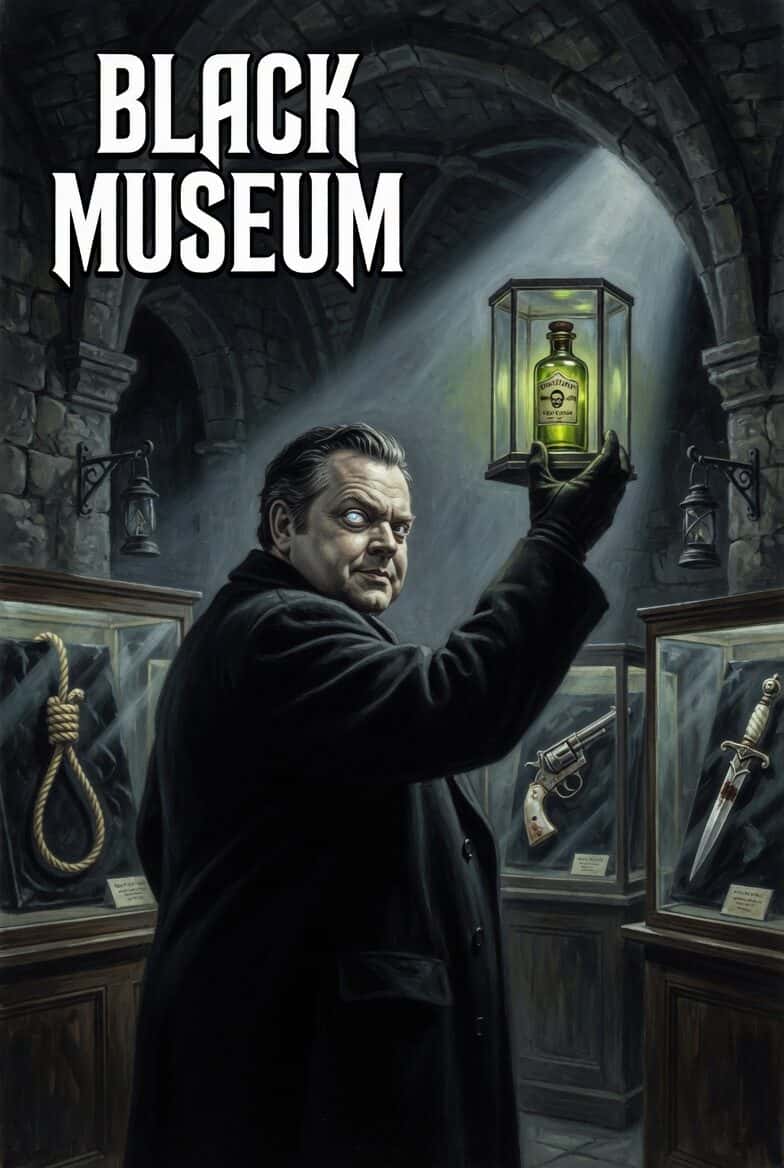
This is Orson Welles, speaking from London. The Black Museum, a repository of death. Here in the grim stone structure on the Thames, which houses Scotland Yard, is a warehouse of homicide, where everyday objects, a piece of wire, a chemist's flask, a silver shilling, all are touched by murder.
Here's a bathtub. Familiar objects. This is an old-fashioned one, a ball and claw-footed bathtub without plumbing connections. It was kinder, for others and mothers knew about. Into this they poured the Saturday night water by hand. Some liked it cool, others liked it hot.
"There we are, dear. Is that hot enough?"
"If you think so, darling."
"Oh, you're the sweetest. I wonder how I had the luck to marry you."
"Part of my job, dear, taking care of you. And one day soon, we shall have a tub with taps. One of the new ones. You'll see."
And today, the bathtub can be found in the Black Museum. The annals of the Criminal Investigation Department of the London Police. We bring you the dramatic stories of the crimes recorded by the objects in Scotland Yard's gallery of death. The Black Museum.
In just a moment, you will hear The Black Museum, starring Orson Welles.
Black Museum, starring Orson Welles.
...archers in a military cemetery, the white cards of the black printing line, the silent shows, the cabinets. The crowded floor, each card identifying a means to murder.
...beautiful ringing crystal, yet in that sound, was terror. In this glass was poison, the roar of writhing death.
This is an even comical basis for a thousand jokes. Foundation for Laughter, circa 1910. No plumbing attached, of course. One poured the water in from buckets and pitchers. Truly an effort, the use of such a tub as this. Definitely a matter for an interior, not for an exterior. Certainly not for a garden like this, where in the peaceful year of 1910, Edward Jones read aloud to his wife, Evelyn.
"Friendship is constant in all other things, save in the office and affairs of love. Therefore, all hearts in love use their own terms. Let every eye negotiate for itself, and trust no agent. For beauty is a witch against whose charms faith melteth into blood. This is an accident of hourly proof, which I mistrusted not."
"Hmm. That's Shakespeare's Much Ado About Nothing, my dear. Like it?"
"You read so well, Eddie, darling. So well."
"I do like it here, Evelyn. I wish nothing ever interrupted us."
"But, as the bard said, the world is too much with us."
"You make that sound as if you were going off on another trip. Are you, darling?"
"I'm afraid so. That case for Mr. Carter, the Ming Dynasty cherry water bottle, remember? I've heard of one. One up north."
"Oh, dear, I wish I could run an antique shop without these interminable trips. But I suppose there's nothing for it."
Too bad. Poor Eddie, poor Evelyn, separated so often and for such long periods. But business is business, and a living must be made. Eddie bids his wife a fond farewell and proceeds on his way to a middle-sized city. And there he walks the street, enjoying the sunshine and the crowd, when suddenly...
"Oh, at last, after all these months... Oh, Eddie! Wait!"
"What?"
"Anne! Oh, my darling. Oh, Eddie. Oh, it's been so long and no word. I thought I... I thought you might be dead."
"Of course not, darling, like the bad penny. Why, I was hoping against hope I'd find you any minute. I went back to our place, but you're gone. A new landlady, no information. But what happened, darling? You never wrote. I waited and waited."
"Yes, I... It was an accident, darling. Blow on the head. Amnesia. Only a few days ago, I came back to myself."
"Oh, oh, my poor darling."
"No matter, darling, Annie. We are back together. Once again, we are husband and wife."
So that's the little game, is it? A wife in every city, is it? Well, now, Mr. Edward Jones, what's the idea? What can this get you, besides a heap of trouble and stiff prison sentence? What can it get you?
"There we are, Anne, my dear. I've signed mine, now you sign yours. You see? Ladies are first, except... Except in getting off trolley cars, or signing wills."
"Oh, Eddie, you are sweet."
"There we are. Now, oh, heaven forbid, anything happens to you, all you have is mine. And vice versa, if anything should happen to me."
"Heaven forbid, Anne, my dear."
Well, apparently, it can get you plenty. If your wife has plenty. And Anne was, well, decently off with a needy income from her father's estate, although she's not allowed to touch the principal. However, there was a proviso concerning her husband's rights, if and when.
"I'm horribly upset about it, Doctor. Here she is, apparently in perfect health. She has an awful fit, and all she remembers about it is a slight headache. She's my wife, Doctor."
"These things happen, Mr. Jameson, I can assure you."
Oh. So Eddie Jones is Eddie Jameson, hereabouts. That's interesting.
"Nothing. I found absolutely nothing physiologically wrong with Mrs. Jameson. She's in perfect physical health, now then."
"But how can I be Doctor, when I have these terrible fits?"
"Well, such things even we Doctors don't know yet, my dear. Such as the reaction of the human mind to great stress. And you've been through such stress, with Mr. Jameson missing so long."
"But what can we do about it, Dr. Margitson?"
"Oh, just rest, relaxation, quiet, peace. Most important, relaxation. Now, I'll prescribe a mild sedative, each night before sleeping."
He's so simple, so easy. So diabolical. And so considerate.
"No, Anne, darling, you mustn't even fetch your own bathwater. There we are. Almost full. And nice and warm. Just right to relax in, just as the Doctor ordered."
"Oh, Eddie. I don't know why you do all this for me. I don't do half as much for you."
"You do, darling, just by being. You know that, don't you? No, I say it a hundred times a day. Eddie, you're sweet."
"All right, my dear. Now, step in. I'll help you. Take care. The water may be hot, and the tub may be slippery. There we are, dear. That hot enough?"
"If you think so, darling."
"Oh, you're the sweetest. Oh, I wonder how I had the luck to marry you."
"Part of my job, dear, taking care of you. And one day soon, we shall have a tub with taps, one of the new ones. You'll see."
Ready to sit down, darling?
Quite a pair of lovebirds, Anne and Eddie Jameson Jones. No wonder the poor fellow could hardly contain himself some thirty minutes later.
"I went out for a minute to make the tea. Doctor, how could she go so quickly?"
"It is strange, but certainly an accident. I barely turned my back. Just put some water in the tea kettle. And when I returned, there she was, floating face down in the water. Doctor, can't you help her?"
"Calm yourself, my boy. Your wife is past health now."
Such tragedy, such tears. And a will by which Eddie came into something over 800 pounds. In 1910, that was a fair amount of money. Enough for a man to live on with his wife for quite some time. While he read Shakespeare aloud in a quiet garden.
"Shall I compare thee to a summer's day? Thou art more lovely and more temperate. Rough winds do shake the darling buds of May. And summer's lease hath all too short a date."
"Hmm, Evelyn, how you stand for me. You stand for me for all my absences. I hardly know."
"I suppose I love you, dear. You are nice. And you're a good provider. So, until you come back, I'm always content to wait. Go on. Read some more, darling."
"Yes. Yes, of course. Nor shall death brag thou wander'st in his shade, when in eternal lines to time thou growest. So long as men can breathe, or eyes can see."
Nor shall death brag. Where were his thoughts? To Trip? On the story he would invent? And which story? To which woman? His ever faithful Evelyn? Or young Libby whom he took to wife some two months later?
"So this is the bride, Mr. Jameson?"
"This is Mrs. Jameson. Isn't she lovely?"
"Oh, Eddie, stop it. We're only married a few hours, and you're embarrassing me already."
"My deepest apologies, darling. Are our quarters ready?"
"Oh, they certainly are. I'll have my boy help you with the bags. It's not every night we have a bride and groom in this house, you know."
"No, not every night."
This promise to be eventful indeed. Particularly if you knew Eddie, Jameson, Jones.
"Oh, Mrs. Brundy."
"Yes, Mr. Jameson?"
"I hate to bother you, but could we have enough hot water for a warm bath? My wife hasn't been well. Some kind of spell, almost a fit. Took her to a doctor yesterday."
"Oh, dear. And so young she is."
"Nothing serious. Just needs relaxation. That's what the doctor said. She insisted on going through with the wedding, even though I thought it might be better to postpone it. So, a good warm bath. Nothing quite so relaxing, is there?"
"I'll set the fire going right away. You shall have all..."
Ah, yes. Da capo. Repeat the theme, this time with a variation. And the variation was a bag of tomatoes.
"Oh, Mr. Jameson. I didn't hear you go out."
"I just ran out while my wife was in the tub. Picked up some tomatoes. Fried tomatoes are her favorite dish. And I thought, well, tonight of all nights, she ought to have them. If you don't mind fixing them, Mrs. Brunby."
"It'll be a pleasure, Mr. Jameson. I'll have them ready with your dinner. Never fear."
"It's me, Libby, darling. I'm back. Libby! Libby, are you there? Mrs. Brunby! Help! My wife! My wife is floating face down in the tub! She's dead! My wife is dead!"
And today, you can see that same bathtub in the Black Museum.
In just a moment, we will continue with the Black Museum starring Orson Welles.
We continue with the Black Museum starring Orson Welles.
Yes, the girl was dead. Floating in the bathtub, face down. Just as Anne before her. And Eddie? He was stricken. Heartbroken as a bridegroom ought to be.
"Poor Libby. To die alone like that on her wedding night. So good. So sweet. So eager for life. And so in love with me. Even insured her life for me just before we married. As if she had a premonition almost."
750 pounds insurance is a comfortable sum. A man and his wife can live in their garden quite decently with a sum like that for quite a few months. In 1910. But it seems one can grow a trifle bored. Even with a garden. On Shakespeare.
"How do you feel now, dear?"
"A slight headache, that's all. It'll go away."
"Evelyn, you've got to go back to the doctor or find a new doctor. A slight headache, that's how your fit started yesterday."
No, he's not trying the same thing again. Well, he seems to be. Of course, he's had two quite successfully accidental deaths in his life so far. Perhaps a third. But that's not possible. Or is it?
"Almost ready, Evelyn. In a minute, dear. Better come while the water's hot. You know what the doctor said about relaxing? Hurry now, darling. It's steaming, but not too hot. All ready, dear?"
"All right, dear. There's not that much hurry."
"Oh, dear. Who's that now? Wait for me, darling. I'll help you get in. The tub may be slippery. One day we'll have a modern tub with taps and hot and cold running water. You'll see. Now, don't try to get in without me."
"All right, dear. I'll wait for you."
"Yes?"
"Are you Edward Jones?"
"I am."
"We're police officers from Scotland Yard. We have a warrant for your arrest. The charge is murder. I must warn you that anything you say will be taken down in writing and used in evidence. Please come quietly."
No, Evelyn Jones never took that bath. She never had another fit. Though she sat in the courtroom for the entire trial. The trial of the Crown versus Edward Jones. Also known as Edward Jemison.
May it please your Lordship, gentlemen of the jury. This is a peculiar case. No one saw this man commit the crime of which he stands accused. Yet every circumstance, every bit of evidence points to the fact that this man stands justly accused and deserves proper punishment. Now, in the course of this trial, you will hear many things about love, about coincidence, about accidental...
Oh, yes. They heard many things, that jury, sitting so stiff and serious-minded in its box. Not the least was the opening of the famous defense counsel who held a brief for Edward Jones, also known as Jemison.
"Nor will we deny that this man may have married bigamously."
But he did love these poor women, and it was a far, far better thing he did in marrying them than to lead them astray and then leave them alone with remorse, as so many men have done before him. We deny that my client killed these poor women. We claim only that he was the victim of a set of circumstances and the interference of a busybody. Yes, a male busybody...
A male busybody? Well, perhaps. But how could a policeman in the proper course of his duty fail to check on so obvious a coincidence? Yes, sir. We had a letter at Scotland Yard from a Mr. John Curtis. What were the contents of that letter, Sergeant? Mr. Curtis had noticed a brief announcement in the newspapers regarding the death of a young woman, a bride, by drowning in the bath tub. He wished to call our attention to a similar accident some time before. In both cases, the name was Jemison. You saw this letter yourself? I did. Is this the same letter? It is, sir. I offer this letter in evidence, Your Lordship, as Crown Exhibit A.
It went on like that, slowly, carefully. It kept plugging all the holes as they went along. The details of a routine police investigation which suddenly had become a little more than routine.
Sergeant Mason, when you visited the scene of the first drowning, what did you learn? That the man known as Jemison had mentioned two wills. One by himself in favour of his wife, one by his wife in favour of himself. We checked the files of the probate court. The latter had been probated. We called on the lawyer involved. He had a copy of the other will. The man known as Jemison... The police had it quite a bit.
And when you visited the scene of the second drowning, Sergeant? We learned that the man known as Jemison had mentioned an insurance policy in his own favour. We inquired of all the insurance companies and found the records. He had received some 750 pounds following the death of the young...
The first point established. Motive. Money. Over 800 from Ann, 750 from Libby. Almost 2,000 pounds in all. That's a substantial motive.
The questioning of Sergeant Mason went on. It was a matter of tracing this man, Jemison. What did you do? Just routine, sir. We checked the mailing address of the insurance company and found it to be the same as the house where the second woman had died. There, we discovered a forwarding address. A postal box. We covered that box. I watched it myself, sir. And when this man known as Jemison came to open it, I followed him. He went first to an antique shop, then to his home. Having located him, I made some quiet inquiries and learned that he was known as Edward Jones. Now that evening, having communicated with Inspector Wilson at the yard and received a proper warrant, we placed him under arrest.
Very good, Sergeant. Now then, when you called upon Edward Jones, what did you find? The woman who claimed to be his proper wife was waiting upstairs, sir, for him to help her into a hot bath.
One further question, Sergeant. Is the man you arrested in this courtroom now? Yes, sir. He is the prisoner at the dock.
Thank you, Sergeant. Thank you very much.
Oh, they've been very thorough, all right. They had almost everything. They called Dr. Margitson, for instance.
Dr. Margitson, when you first saw Ann Jemison, what was her complaint? That she'd been having fits and not remembering them. Did she tell you this herself? No, her husband did. He was quite insistent on it. Did you find any symptoms of illness, sir? I examined the woman very thoroughly. I found nothing. But that situation is not uncommon in certain types of epilepsy. Now then, Doctor, when you were called to the house on the evening of June the 3rd last, what did you find? The woman I had examined was floating face down in the warm bath and quite dead. The husband was extremely hysterical. I treated him for shock. Did you sign this death certificate? Yes, that's my signature. What is certified as the cause of death? Accidental drowning. We offer this certificate in evidence as Crown Exhibit B.
They had the landlady who knew Libby Jemison, too. She testified, simply. Oh, yes, sir. He moaned about the insurance policy. Cried all night, he did.
Bit by bit, piece by piece, motive, opportunity, proof of death by drowning, medical evidence. But one great piece of the puzzle remained.
As the distinguished counsel for the defence asked, where is the proof that these two regrettable deaths were anything more than coincidental accidents? Where is the witness who saw my client hold these poor women under the water, or administer sedatives which caused them to faint in the water, or in any way contribute directly to their miserable death? There was no witness.
But there was a Scotland Yard inspector with a demonstrable theory.
If it please your Lordship, three bath tubs have been entered in evidence as Crown Exhibits C, D and E. Inspector Maurice Wilson of Scotland Yard has a theory which he wishes to demonstrate as a witness. And he requires the assistance of an expert. Millard...
The inspector took the stand, was sworn in. Then, to the amusement of the spectators, a young lady in bathing dress, testified to as an expert swimmer, was introduced to the proceedings. One of the tubs was filled with water, warm water. At this point, the prosecutor stated, for the assurance of the court, we have a doctor in attendance. Now then, Inspector, if you please, you may leave the witness box and proceed with your demonstration.
Thank you, sir. It is our considered theory that the murders were committed as follows. You will remember that in each case the prisoner reported he found his wife floating face down. It is reasonable to assume that had the women fainted while sitting or lying in the tubs, they would have been found floating face up. With this in mind, it occurred to us that with the prisoner's insistence on helping his wife into the tub, the procedure was something like this. May I, young lady? Of course, Inspector. Notice she is standing in the water. Now, prepare to sit down, please. Observe that she bends forward, grasps the side of the bath tub. I seize her ankles thus, and she falls forward on her face. Doctor, please, Inspector. The girl's unconscious. Get her out. Her lungs fill, and she drowns.
Some hours later, the jury reported. We have reached a verdict, my lud. We find the prisoner guilty of willful and premeditated murder.
Well, that same bathtub is where you'd expect to find it today, in the Black Museum. Orson Welles will be back with you in just a moment.
Orson is Orson Welles. In spite of his common name, was an uncommon man. Some said he was quite mad. His own defense counsel stated later that when Eddie looked at him with his piercing stare, he felt as if the prisoner were trying to hypnotize him. This, of course, we'll never know. We can only wonder if those poor women were truly hypnotized by Eddie's eyes, or merely by his charm and personality. In any case, one woman did not succumb to that charm for long. She was Eddie's real wife, the predecessor of Evelyn. This woman was swindled by Eddie, but found him out and sent him to prison for two years. Eddie swore to kill her. She fled to Canada when Eddie left prison that time. But she came back to England and was in the court the day Eddie Jones was sentenced to hang.
And now, until we meet next time, until we meet in the same place, and I tell you another story about the Black Museum, I remain, as always, obediently yours.