
The written record
Read the transcript
Read along with the recording · About 18 min to read
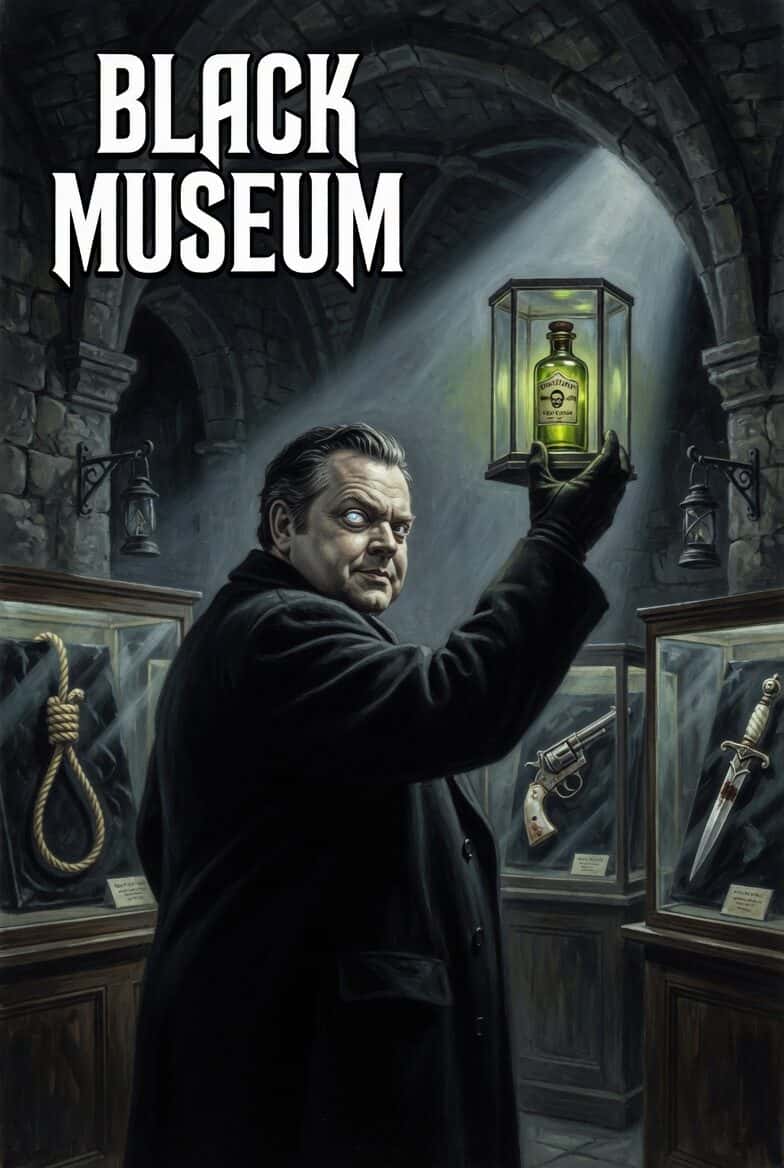
Black Museum, Scotland Yard's museum of murder. Here in the grim stone structure on the Thames, which houses Scotland Yard, is a warehouse of homicide, where everyday objects, things like a packet of matches, a coffee pot, a paring knife, are touched by murder. Now here is a pint bottle labeled Meat Juice. Perhaps you've seen one of these. Your grandmother certainly saw one. In fact, when you were a child, you may have been fed meat juice for the iron and strength it contained from just such a small glass bottle. Yet here it is, in the midst of all the other relics of death.
Well, Inspector, what do you think?
Mr. Heron, we did our best. The little bit of white sediment at the bottom of the bottle, see it there still? You know what that is?
Yes, arsenic. And to me, at least, the means of murdering my brother.
Well, today, that bottle of meat juice can be seen in the Black Museum. In the channels of the Criminal Investigation Department of the London Police, we bring you the dramatic stories of the crimes recorded by the objects in Scotland Yard's gallery of death, the Black Museum. In just a moment, you will hear the Black Museum starring Orson Welles.
A lady's handbag. A very pretty lady, he was an inspector. An escaped tendril of soft brown hair, but what she saw reflected was not merely disordered beauty. She saw murder strike.
Ah, yes, here it is. The bottle labeled meat juice. Sleet, archaic type of writing on this label replete with flourishes and shading. No prosaic typing. Handwritten by an expert penman. Then this was only natural in the 1890s when this bottle became the focus of an odd, even a very disturbing situation.
Of course, on the surface, the Hammond family, cool England, 1892, displayed no evil, always happiness.
Shall we drink to the great event? Shall we?
Of course, dear. Oh, forgive me, Bob. What event?
There you have it, my dear. My own brother doesn't remember our wedding anniversary.
Your anniversary, old man? Which one?
Our eighth, Arthur. Eight years of happiness. Not to mention six years of our son. And, Arthur, you forgot.
Perhaps because I wasn't at the wedding.
That's right. Robert met me and we were engaged. In America. But we were married here at my aunt's home.
Exactly. While I was in America myself. Well, with all that straightened out, shall we toast the occasion? After all, how many times...
A pleasant family gathering on a pleasant family occasion. Nothing evil on the surface. Of course, undercurrents do show themselves occasionally.
Almost three o'clock. The time I took my medicine.
Yes, dear. Which one is it this time? The liquid or the tablets?
I took the liquid at two. That means the tablets now, dear. Oh, you have no idea, Arthur, what it means at my age to be tied to medicine bottles. How Ruth stands me, I really don't know.
You're a hypochondriac, Robert. That's the truth.
No laughing matter. These sedatives, well, I learned all about them when I was in America last. One contains arsenic. The other has strychnine in it.
Oh, now you are joking.
I'm not. In very small quantities, but poison nevertheless.
Here are your tablets in the water, dear.
Thank you. Thank you for everything, Ruth. It's not easy, I know, for a girl to be married to a man twice her age.
Don't be ridiculous, Robert. I'm very happy. And so would you be if you let yourself. Honestly, Arthur, sometimes I think your brother is super...
Do you detect the undercurrents? The constant harping by a 50-year-old husband on the fact that his wife is not yet 30? All the evil is there, deep down underground. But it's there. One would hardly say it came to the surface in an incident such as this.
Writing someone, my dear?
Just a note to the Plaza Hotel in London.
The Plaza? London?
There. I had word this morning. Aunt Rose is very ill, and there's no one to stay with her. You've been out all day, so I've written to reserve rooms to save time before I told you.
Yes, of course, you ought to go. Dottie can watch over David, I suppose.
Dottie is a jewel. She's a jewel among servants, dear. Of course she can. Excellent. I saw Dr. Hubert today, my dear. He's not at all satisfied with my condition. However, we shall see. He's given me another...
Evil to him who evil thinks. Perhaps. Still, the greeting between aunt and niece at the Plaza Hotel in London was something to think about.
Darling!
Darling. Oh, my darling. It's been so long.
Too long, my beloved, too long. But now, my sweet, three whole days together. Three glorious days.
Oh, John.
An interesting aunt, wouldn't you say, particularly when a young wife is half her husband's age.
Now, there were some things which Ruth Hammond had in common with her husband. One was a love of horses and horse racing. It followed then that when the time for the Grand National arrived, Robert pulled himself together and took his wife to the world-famous race. And there an incident took place relevant to this story.
It's wonderful, Robert, just wonderful.
I'm glad you're enjoying yourself, my dear.
Hello, Ruth. Imagine running into you here.
John. John.
The gentleman seems to know you, my dear.
I'm... I'm sorry. Mr. John Browning. My husband.
How do you do?
Well, thank you. And you?
As well as can be expected.
John's an old friend of mine, Robert. Aren't you, John?
Yes, I think I can say I am.
Won't you join us? There's plenty of room in our... In our box. And I'm sure we'll be happy to have you.
A casual meeting, a simple introduction, a gesture of hospitality. But who would expect a circumspect young woman to cast caution and good behavior to the wind?
Dottie! Dottie!
Yes, sir, Mr. Hammond. Right here, sir. Where were you?
I was upstairs, sir, with Master David.
Is Mrs. with you?
I left her at the racetrack.
Oh, will she be along soon, sir? I mean, sir...
I don't care what you mean or what she does.
Robert! Robert, can you ever forgive me?
If you must make an exhibition of yourself, Ruth, must it be in public? Is that all you care about? Your public pride? I ought to bar you from my bed and board forever. If it went for my son, I would.
Robert, please, please forgive me. I'll never act like that again. John Browning is out of my life. Truly, he is.
Very well. We shall see.
Dottie!
Yes, sir?
Forget what you've seen here. Understand? Forget it all.
And now it is the husband's turn to visit London. Robert Hammond went to the city to see a specialist about his nerves, about the pains he believed came from his liver. From the specialist, he went directly to a chemist's shop.
I'd like this prescription filled, please.
Very good, sir. Thank you, sir. Can you make it up quickly?
Let me see, sir. Yes. Yes, I can, sir. But, Hammond, you'll have to sign a receipt for this paper. It contains strychnine, sir.
The wife, too, was visiting a chemist. A chemist in Liverpool.
Anything else, ma'am?
No, I think that completes the list. Oh, no, I'd almost forgotten. Fly papers. You do have fly papers, don't you?
Yes, ma'am. Any particular brand?
No, but I prefer the strongest you have. I hate to see anything linger longer than necessary.
If Hammond took her purchases with her, oh, she rang for the maid.
Did you want me, ma'am?
Yes. Is there any hot water on the stove?
Oh, yes, ma'am. Cocoa skips a kettle boiling.
Very well, Dottie. I want the kettle and the dishpan. I have to soak some flypaper.
Whatever for, ma'am?
A druggist, or a chemist, you'd call him, in America showed me how to obtain the arsenic from flypaper. It's part of a preparation to keep the complexion fresh. And my skin is none too good these days, Dottie. Fetch the kettle and the dishpan, will you please?
Thank you. Thank you.
Perhaps nothing more would have been thought about that, about the quarrel in the hall, if another event had not occurred almost immediately. Robert Hammond fell ill. Not merely the imaginary illness of the hypochondriac, but an actual illness. Dr. Hubert was called. He made his examination. Then?
May I see you a moment, Mrs. Hammond?
Of course, Doctor.
I must admit I'm puzzled by Mr. Hammond's symptoms. His heart seems strong enough. He complains of chest pain. And this constant retching, you know. I'm worried, Mrs. Hammond.
Have you no diagnosis?
I'd prefer a consultation, if you don't mind.
Of course, Doctor. Whatever you think best. Robert's never been like this.
A consultation. The learned doctors probed and listened and probed again. Dr. Hubert still died then and waited. Outside the sick room, Dr. Davis addressed himself to the problem.
I don't like it, Hubert. All that retching. It's the prime symptom of arsenical disease.
The man's been dosing himself with arsenical medicines for years. I know those compounds. The amount of arsenic is minute.
Hubert, who is nursing him?
His wife, of course. With some help from the maid.
I want a registered nurse in there. And no one else.
You don't suspect anything, do you, Davis?
I want to prevent suspicion if I can. Get a nurse in there as soon as possible. Meanwhile, we will prescribe tonics. Meat juices and that sort of thing. And I want to know what's going on. And that sort of thing. And I want the bottles watched. Night and day. The medicine, the patient, the nurse. All that's in the sick room. Everything and everyone else outside. Including the lovely wife.
Yes, including the lovely wife.
And today, a bottle of meat juice can be seen in the Black Museum.
In just a moment, we will continue with the Black Museum starring Orson Welles.
We continue with the Black Museum starring Orson Welles. In 1892, a man might die slowly for unexplained reasons without benefit of laboratory tests, gastrointestinal examinations, or any of the aids to life and living which grace our times 60 years later. The doctors in 1892 did their level best. They used their knowledge well. If it came to placing a nurse in charge, denying a wife access to the sick room, or merely ordering concentrated meat juices or tonic, they performed their functions according to the time in which they lived. Thus it came about that Robert Hammond suffered in his bed, Ruth Hammond was ordered from his room, and his brother Arthur came to stay in that tense, foreboding household.
Yes, Dotty?
Oh, it's the mistress, sir. She asked me, please, to mail this letter.
That letter's open.
Oh, please, sir, if I can explain. Well, get on with it. Well, I was taking it to the post box, sir. I dropped it, and the envelope was dirty. You can see the mud, sir.
Yes, I see, but what else?
I wanted to change the envelope, sir. I steamed it open. I couldn't help but read the beginning, sir.
Thank you, pardon me. Oh, Mr. Arthur, I'm so afraid for the masters.
Let me see. Address to Mr. John Browning. Is it necessary to add more? To report the contents of that poor, indiscreet love letter? I doubt it. The letter read and then put away, Arthur Hammond strode to his brother's room, called the nurse aside.
I want you to keep special watch, very special watch, nurse, and under no circumstances permit Mrs. Hammond anywhere near these medicines.
Very well, sir.
But even a nurse must rest, and to an hour off each day, this nurse was replaced by Dottie, the Hammond's maid.
Oh, Mrs. Hammond.
Oh, the doctor says you're not to come in here.
Please don't be ridiculous, Dottie. Is that you, Ruthie?
Please come here.
Of course, my dear. Have they been keeping you away from me?
Oh, please, ma'am.
Are these all your medicines, Robert?
Yes, dear. Most of them are. Most of them are filthy tasting.
Poor Robert.
Oh, ma'am, you're not supposed to touch this meat juice.
Can't be bad, Robert. Mmm, it certainly smells good, like good, rare steak. Mmm, I wouldn't mind taking it myself. But all these other pills and...
Wouldn't you mind taking it yourself, Mrs. Hammond? I wonder now.
Then I'm not alone in that. Brother Arthur wondered, too. And he worried. Particularly when he found you alone in the pantry washing medicine bottles.
Why, Ruth, washing bottles? Isn't that Dottie's work?
This at least I can do for my husband, even though I'm not allowed to see him.
But you did see him yesterday.
And if I did, who has a better right?
I'm not speaking of rights, Ruth. I'm speaking of wrongs.
If you have something of which you wish to accuse me, why don't you?
I may. You see, I had the meat juice you handled yesterday analyzed.
I see. I see. You did?
It contained arsenic.
And you insinuate I put it there?
I do.
I did put something in that bottle Robert asked me to. Some powder he had in a small box. He told me it always gave him relief. And the doctors had forbidden it.
I see. They forbade it. Well, my dear sister-in-law, we shall see what we shall see.
They saw soon enough. Twenty-four hours later, a weeping Dottie told Brother Arthur.
Oh, the master's dead. Over again. Oh, no time to call anybody, not even you, sir.
Dr. Hubert stated, "I personally will not certify this death until there has been a post-mortem by Dr. Davis."
And Dr. Davis reported. "Death was due to aggravated inflammation of the internal organs. The body contained something less than half a grain of arsenic. I recommend an immediate investigation by the police."
Enter Inspector Adams of the CID.
What's your opinion, Dr. Hubert, as an expert on this case?
It will be very difficult to have an opinion, Inspector. You see, Mr. Hammond was a true hypochondriac. Always dosing himself with patent medicines, all kinds of prescriptions.
But the man's dead.
And added to the difficulty is that there seems no really natural cause for his passing.
Thank you, Doctor.
Not at all, Inspector. Anything I can do to help.
From the doctor's office, the Inspector made his way to the House of Mourning. There, his first object of inquiry was Arthur Hammond.
So you are suspicious of the cause of death.
Wouldn't you be, Inspector?
I need more facts in my possession. There are such things as libel laws, sir, and charges of false arrest.
Perhaps you'd be interested in this, Inspector.
And? What is it?
A letter written by the widow to her London paramour. And discovered quite by accident.
Thank you. Anything else, Mr. Hammond, which you think might be of any...
There were several things which Brother Arthur brought to the attention of the Inspector. And these, in turn, brought Dottie into the presence of the man from the yard.
Now, there's no need to be frightened, girl. What's all this about your mistress and a bottle of meat juice?
I saw her, sir. I saw her slip something in the bottle. I kept the bottle. Here it is, sir.
Did anyone else? Did anyone else touch this bottle besides Mrs. Hammond?
Only Nurse, sir. She guarded the medicines proper, she did. Much better than I could.
I see. Then you are prepared to swear that no one touched the bottle before or after Mrs. Hammond except the Nurse.
Yes, sir. I am.
Oh, swear, sir? You mean in a trial like, Inspector?
Yes, my girl. Oh, hadn't you thought of it before the police came in?
Well, and we do know that we were ordered to be here in search of the old house. I don't think she either, Mr. Hammond, of course.
Yes.
Inspector Adams gave his instructions. Sergeant, call at the Hammond house search. Here's a warrant. Get to work.
The sergeant took a crew and did go to work. Every nook and cranny of the old house was searched. Closet walls were sounded in search of secret panels. Hearthstones were pried loose. Even the coal bin was emptied.
Sergeant Hall reported back to the Inspector.
Here it is, sir. Arsenic. All over the place.
The charge is willful murder.
It was a celebrated trial. The courtroom in Liverpool was packed with the curious, the cruel, and the very, very few who found some sympathy in their feelings. The newspapers enjoyed their traditional field day with the lurid, scandalous details of the story. The really pertinent details of the case were few, however, simple and contradictory. Arsenic was found in the possession of the prisoner. She did not deny it was hers.
Dr. Davis testified concerning the post-mortem.
I found a little less than half a grain of arsenic in the body.
Yes, doctor, but would you say that this poison was the cause of death?
I would.
Then the contradiction set in. Asked the same question Dr. Hubert replied.
No, I would not say so, and certainly not in the case of this patient.
Ah, and why not?
Mr. Hammond had a custom. He was accustomed over the years to taking arsenic in small quantities. He was used to it.
The prosecution countered this with a Liverpool chemist who Mrs. Hammond had visited while her husband was in London.
She came in that morning with a list. The flypaper was not on the list.
The chemist had no idea what Ruth Hammond had wanted with the flypaper. However, Dottie did.
Yes, sir. She boiled the arsenic out of the flypaper.
Boiled it out? Whatever for?
She said to make something for a complexion. She told me she'd heard about it in America, sir.
And did you, Dottie, ever see her use such a preparation?
No, sir. I never did.
And the defense? Well, in 1892, the accused did not testify in self-defense. The accused was permitted, however, to make a statement under oath.
My Lord Justice, with your permission, my Lord, three things. I did soak the flypapers for the arsenic they contained. I made a cosmetic preparation from it, which I learned about from Dr. Henry Maysfield in Brooklyn, New York, when I lived there. I did put powder into my husband's medicine. He asked me to. It was a preparation he brought back from London, which had helped him many times before, but which his doctors here refused to give him. Finally, my Lord, I wish to state that for the sake of our son, for David's sake, my husband and I have... I had a complete reconciliation. And on the day before his death, I made a full confession of the terrible wrong I had done him.
The jury retired. The court waited. The prisoner waited. The crowds waited.
...of the jury room. The bailiff opened. The twelve good men and true filed back in the jury box. The judge's gavel rapped.
Rise and face the prisoner.
He intoned the traditional question.
Gentlemen of the jury, have you reached a verdict?
And what is your verdict?
We find the prisoner guilty of premeditated murder.
And today, the bottle of meat juice, the decisive clue in this case, is still to be found in the Black Museum.
Orson Welles will be back with you in just a moment.
Despite the fact that public sentiment was so much against her at the start of the trial, it changed quite drastically once she had been sentenced to hanging. Letters, telegrams poured into the Home Office and to the London Times, and a reprieve was granted. And after many long years in prison, Ruth Hammond was released. She returned to America to die there, forever silent about the crime for which she had been punished. The judge himself, when asked concerning her guilt or innocence, replied only, "I never did express an opinion."
And now, until next time, until we meet here in the Black Museum for another story, I remain as always, obediently yours.
Starring Orson Welles, is presented by arrangement with Metro-Goldwyn-Mayer Radio Attraction. The program is written by Ira Marion, with original music composed and conducted by Sidney Torch. Produced by Harry Alan Towers.