
The written record
Read the transcript
Read along with the recording · About 19 min to read
This is Orson Welles, speaking from London. Here in the grim stone structure on the Thames, which houses Scotland Yard, is a warehouse of homicide. For everyday objects, a woman's purse, a man's glove, a child's shoe, all are touched by murder.
Made to fit an army rifle, made for a killer, for striking unseen and unheard, in the dark perhaps. Interesting little instrument, a scientific gadget to absorb sound, to change a sharp, cracking report. I suppose I'm being rather subjective about this, Sergeant, but I find myself hating that silencer.
Yes, I understand how you feel, Inspector. A silencer, well, it's filthy, if you ask me. It's something like a rattlesnake.
No, Sergeant, your simile's wrong. A rattlesnake gives warning before he strikes. He plays fair.
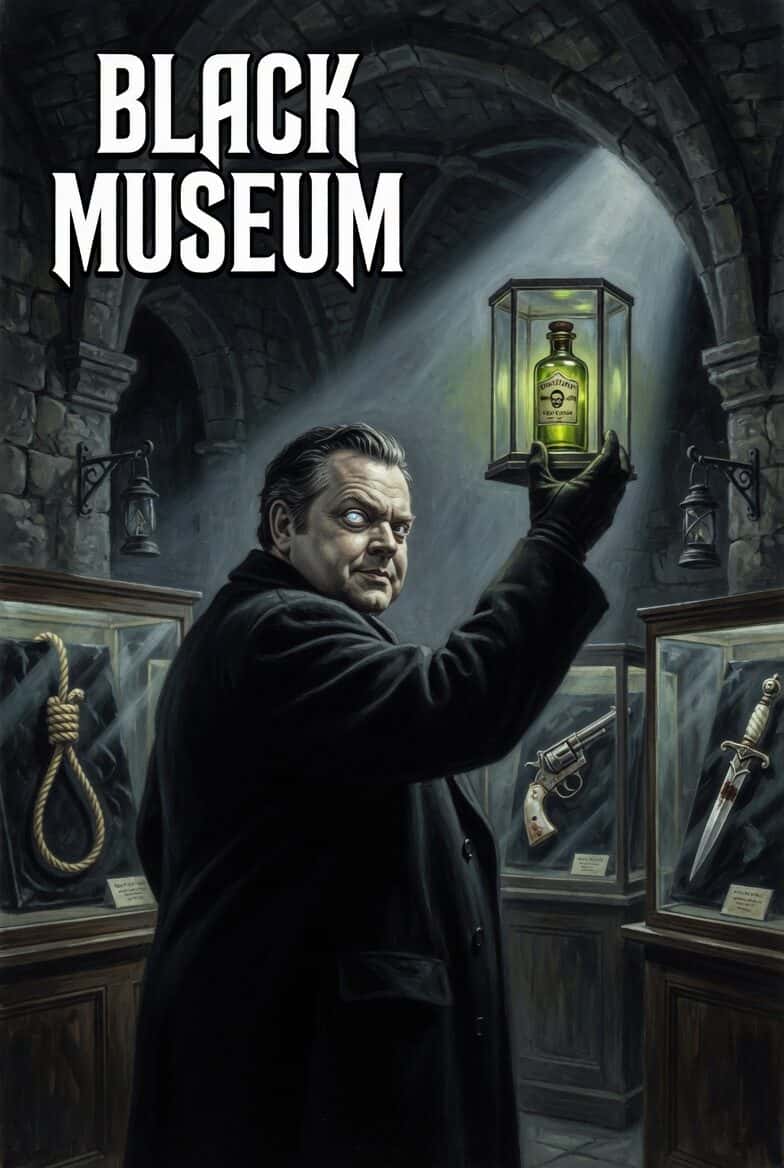
Today, that silencer can be seen here in the Black Museum. From the annals of the Criminal Investigation Department of the London Police, we bring you the dramatic stories of the crimes recorded by the objects in Scotland Yard's gallery of death, the Black Museum.
In just a moment, you will hear the Black Museum starring Orson Welles. The Black Museum starring Orson Welles. Black Museum. Scotland Yard's museum of murder. Ice death. Silent death in many guises. The long history of a great number of very murderous deeds. On the shelves, on the tables, in the very air itself.
This elephant gun here. This was once used for hunting by a sportsman bred in the very best traditions. Later used to shoot a friend in the back. Ah, here we are, a silencer. Metal tubes within tubes. Small and stubby. Designed to swallow sound. It was a weapon, too, of course, but no one thought of it as a weapon. The silencer.
The night Herbert and Josie Martin returned from a party to their new home in the equally new residential development in the suburbs of London.
Oh, it was a fine party, Josie, but I don't mind telling you I'm dead for sleep.
Oh, yes. Oh, I like the new neighbors, but business days are no time for housewarmings. At the rate these new houses are renting, we'll be going to house parties for weeks on end. Might as well make up our minds to it.
A man and his wife, tired in a pleasant sort of way, pleased at meeting their new neighbors and preparing for a new life. No, not at all quiet, nice people in a new home, nothing spectacular. No hint of headlines.
Sure the doors are locked, Herbert?
Mm-hmm, yes.
Oh, dear, please pull down the blind, because if it blows up during the night, it'll flap against the window and wake us, like last night.
Oh, all right. If you didn't insist on opening the windows from the top, Josie, the blinds wouldn't blow.
Herbert! Herbert, what is it? Herbert! What is it? What's taken you? Oh! Oh!
A man reaches up to pull down a window blind. The lighted lamp is behind him, but it stars the windowpane. The man is dead.
A short while later, a telephone rings in an office in Scotland Yard.
Inspector Foster here.
Uh, Sergeant Williams speaking, sir. There's a call come through from Hempstead Oval. Uh, Herbert Martin, shot as he was pulling down the blind in his bedroom.
Anyone with him?
Uh, his wife, sir.
Any other witnesses?
No, sir, not at the moment.
Very well, Williams. Bring a car around. And then we'll have a look at the situation.
I realize this has been a terrible shock, Mrs. Martin, but we need your help at once.
Oh, anything, Inspector, anything at all.
Did your husband have any enemies that you know of?
Oh, no, no one, no one.
Any trouble in his business?
No, nothing, no.
What was his business?
Insurance. Accident, mostly. It was going on so well, that's how we could afford to move out here.
Then you've only come here recently.
Three months ago. We, we were one of the first tenants. It seemed such a nice place. Everything so new.
Questions, and more questions. But there was obviously nothing Mrs. Martin could tell the Inspector. All she knew was what she'd seen. One point puzzled him. The Inspector came back to it several times.
And you're certain, Mrs. Martin, that you heard no shot?
Oh, nothing. Just, just the sort of noise of the glass, and then, I would call it.
Well, it's possible, sir, at extreme range. The sound of a shot might have followed the arrival of the bullet.
Mrs. Martin?
No. No, I'm sure. I'd have noticed. I thought it may have seemed so strange. There wasn't any sound. Just the hole in the window, and my husband sort of crumpling up and falling.
Well, that's not much to go on. Perhaps the bullet will tell us something. Meanwhile, we'll do our best, Mrs. Martin. We'll try to do our best.
There was very little for the police to start on. The close scrutiny of Herbert Martin's life brought nothing to light. Martin's manner of living, the conduct of his business were exemplary. His friends, his business associates, his new neighbors, all had nothing but praise for Herbert Martin. Death had come out of the dark. This alone was ground for speculation, particularly among the neighbors. Sidney and Elizabeth Davis, brother and sister, were no exceptions.
I can't help but think, Sidney. It's so peaceful here. And that poor man, barely in his grave.
Well, it is pleasant. Well, it would be, if only.
Do you suppose his poor wife will keep the house now?
I doubt it. But perhaps have you offered to help her, Elizabeth?
Well, I have. It would take her quite a while to make up her mind.
I see.
You see, she's all alone, poor soul. Sidney, I can't help but wonder, you know...
What is it, Elizabeth?
I have the strangest twinge.
What?
Elizabeth! Help me!
Come to Hampstead Oval once again.
And you're absolutely sure you heard no shot, Mr. Davis?
Absolutely, Inspector. One moment, my sister was speaking to me about Mrs. Martin. The next moment, she was dying in my arms. There's no sound and only the blood.
I see. Mr. Davis, do you know the people who live in this development?
Nearly all of them. We... Well, we felt rather like pioneers, I suppose, with the development being so new. We all became friendly.
And perhaps you can tell me, are there any ex-servicemen living here?
Yes, there are two. Nice chaps. Wives and children, you know.
May I ask why you inquire?
Because the bullet which killed Mr. Martin came from an army-issue rifle, and I suspect the same thing will be found true in your sister's case. If it is true, we'll have that much at least to go on.
More, the markings on both bullets were identical. The same weapon had been used.
Inspector Foster said it was the same weapon that killed Mrs. Martin.
Oh, one moment, Detective Sergeant Williams visiting.
Yes?
Are you Thomas Larkin?
I am.
Oh, excuse me, sir, I am Detective Sergeant Williams, CID, here are my credentials.
Oh, come in, Sergeant. Will you come into the living room?
I'll only keep you a moment, Mr. Larkin. I want to speak about the Martin and Davis murders.
Yes, yes, of course.
Do you happen to have a rifle in your possession, sir?
No, I gave all that up when I was discharged. If I never see a weapon again, it will be too soon.
Thompson. Vermilion.
I believe your husband is an ex-serviceman, Mrs. Goodson.
Yes, he is. Five years of service, Eighth Army, under General Montgomery.
I see. Now, tell me, did he by any chance retain any weapon when he left the service?
No.
Is there any weapon in your house that you know of?
Yes. A Webley.
Oh, really? Well, frankly, my husband insists we keep it. And he's got a license for it, but it frightens me half to death just to have it in the house. What with the children around and all. Oh, Sergeant, are all of us in danger here?
Oh, you needn't worry.
Don't you have any idea who or what may be behind these dreadful shootings?
Nothing, sir. I drew a complete blank.
I rather thought you would. Incidentally, pathology found the Davis bullet and ballistics report. It's identical with the one they recovered from Martin's body.
Well, whoever he is, he's a fabulous shot, sir. And he uses a silencer. That's the only explanation I have for the absence of sound.
Not very much to go on.
Inspector Foster here.
This is Mrs. Thomas Larkin, Inspector. My husband and I live on Hempstead Oval.
Yes, Mrs. Larkin, I know. What can I do for you?
Well, Mr. Larkin and I have called a meeting at our house for this evening. We hoped you and Sergeant Williams could be with us.
What's the purpose of your meeting, ma'am?
Oh, the entire development is living in fear, Inspector. We want to try to find... We want to find some way to protect ourselves. We thought you might have some advice to offer.
I'm somewhat doubtful about the advice, Mrs. Larkin. But Sergeant Williams and I will be at your meeting. Have you set a time for it as yet?
They came that evening to the Larkin living room. Inspector Foster waited in the hallway with the Larkins.
Is everyone here, Mr. Larkin?
I think so, sir. Mr. Mundin said he'd be over. His wife wanted to stay with our little boy.
Well, he's the only one missing, then.
Yes, that's right.
How did you reach these people?
By telephone.
By telephone? It's not much trouble to do that. We're all on party lines.
I see.
Someone's at the back door, Tom.
Must be Mundin. I'll get it.
If you'll excuse me, Mrs. Larkin.
Yes, of course. Go ahead, Inspector.
Funny, coming to the back door. I told his wife particularly about the front door and the precaution.
No matter. At least I don't believe it will matter.
Here we are. Hello, Mundin. Glad you could make it.
Sorry I'm late, Larkin. I rather thought the back way would present less opportunity for this unknown marksman to...
Mundin! Good grief!
Mundin!
Mundin!
Stop that door, Larkin. You're a perfect target yourself, standing there.
Today, that silencer can be seen here in the Black Museum. In just a moment, we will continue with the Black Museum starring Orson Welles.
We continue with the Black Museum starring Orson Welles.
Neighbor Mundin was dead. Rifle bullet neatly placed in the back of his head. The silent marksman was another... I don't know the story entirely. Who he was, where he was, why he struck were the unanswered questions which Inspector Foster had to face as he stood before the terror-stricken residents of Hempstead Oval.
All I can say is that the police are doing anything and everything to find this killer.
And in the meantime, Inspector?
I'll answer that. In the meantime, we can all be picked off as my sister was, or Martin, or Mundin.
Yes, he's right, Inspector. I, for one, won't leave my children open to the risk of being orphaned or worse.
No. Oh, no. Moving away, giving up your homes, won't find a murderer. I'm asking you, all of you, to do something quite difficult under present circumstances. I want you to stay here for another few days. Be patient. Remain indoors at night. Stay away from doors and windows. If it's possible to find him, and that is always possible, we'll do it. I promise you this, that the entire machinery of the London...
They watched him, the good neighbors of Hempstead Oval, with doubt and fear in their eyes. What they did is... Inspector Foster asked. They stayed in their homes and waited.
The welcome light of morning found the Inspector and his sergeant, Tom Larkin, in the kitchen of his home.
You're about the same height as Mundin, aren't you, Larkin?
Just about.
Good. Sergeant?
Yes, sir?
Set up the transit here, where Mundin was standing when he was hit, and adjust its height to Mr. Larkin's.
Very good, sir.
A surveyor's transit in my kitchen? I don't understand, Inspector.
You will shortly.
Almost ready, Sergeant?
Yes.
The men worked quickly, methodically. The transit was set up. The lens was... Telescope facing the open back door. Inspector Foster adjusted the eyepiece, and then slowly scanned from lintel to lintel through the open doorway. Back he moved the instrument, adjusting it vertically as well as horizontally, turning the brass thumbscrew carefully, precisely.
Stepped away from the transit. That seems to be the best possibility, Sergeant. See for yourself.
Thank you, sir. Yes, it lines up well. The angle seems to be about right.
Shall we have a look at it?
Yes. Care to come with us, Larkin?
Yes. Oh, there's a tree out there with a clear line of fire right through your back door. The distance seems to be about 500 yards.
So that's what the transit was for.
Exactly. Let's go, shall we? Too bad it's been so dry lately. There might have been footprints.
Marks on the tree trunk, sir.
Where?
Here. Here. Look. Edges are scraping on this bark, sir. As if someone in heavy boots had climbed the tree. And it's recent, too.
Here for a boot stop, Sergeant?
Yes, sir.
All right, then. There are more marks up here.
Is there?
Quite a... uncomfortable perch. Hello. The limb forks here. Scratches on the bark. Could have been a rifle rested here.
Very good. Come on down, Sergeant.
Right. Inspector, I may have found something over here, under this branch.
Don't touch anything, Larkin.
Right here, look. In the weeds. Looks like a rifle cartridge to me. Brass. The sun caught it.
Good man. Good eyesight. Take care of that, Sergeant.
Yes, sir. Once we find the rifle and its owner, that bit of brass may well send him up 13 steps early one morning.
Starting from nothing. The facts were coming together, one by one. In the quiet office at the yard.
The boot marks on the tree trunk, Sergeant, they were rather close to the ground. I noticed your first jump was at least two feet higher.
Yes, but I wasn't carrying a rifle, sir.
No, but a man of average weight in good condition would have made markings closer to yours. I'd say this fellow was either very heavy or not exactly young.
Oh. Past middle age, at least.
The beginnings of a description. Either military or hunting experience to be able to shoot like that at night. The beginnings of a background. Whoever it was must have lived in that area for some time to know the position of that tree in relation to Larkin's back door. Start a quiet house-to-house check, Williams.
Very good, sir.
Have the men watch for anyone who fits these points.
Yes, sir.
Then find me a detailed ordinance map of Hempstead Oval. The builder or the renting agent will have one. We've found one sniper's perch. I'm curious. How about the other?
Interesting layout, architecturally. Caught into the contour of the land. The main line of the houses seems to curve around this rise just off centre. It must have been quite a place in the old days.
Oh?
Oh, there's a building, tell me. An estate sold for taxes. Family named, uh, what was it? Waldman. Old line. The grant went back nearly to the first Queen Elizabeth.
History. Fascinating. Any more?
Yes, quite a talkative fellow. Seems the land was sold on condition that the sole survivor of the family be given a house rent-free for the rest of his life.
And this person is still there?
Seems to be. He's an elderly gentleman. Keeps very much to himself. This is his house here, on the end of the main line.
I see. Now then, this would be the Martin place and this the Davis.
Yes, that's right, sir. The Martin bedroom and the Davis porch face the same way along that curve of the hill.
Yes, that's it. It seems they didn't originally intend to build on the hill, but they've started a new house right here. The fellow sketched it in for me. The demand's been very high. I wouldn't mind living there myself. After we get this killer, eh, Sergeant?
Oh, yes, sir, after.
Pass me that ruler, will you? All right. Thank you. See here, Williams. The Martin window and the Davis porch are in direct clear line with the new building.
Hmm. I wonder now. I assume the contractor isn't working his men at night.
Hmm. I wonder now.
This is the top floor, Inspector. Hard wood isn't in here, but that floor will take your weight. That's the dormer window you asked about.
Look around, will you, Sergeant?
Very good, sir. About the progress of this building.
Yes, sir.
How long has this top floor been in this half-finished state?
About a fortnight, sir. Glazing is due end of this week. Carpenters will get the flooring right after that.
Anyone here at night?
Yes, there's a watchman for the old development. One of his stations is just across the street.
Across the road. You can see it through the window. There.
I see. I have them, sir. Here. They were lying along the wall under the window.
Now, oh, do this. Ten penny nails in the window sill. Someone will catch it for this.
No doubt someone will. Someone put those nails in to help steady a rifle. The same someone who left those two brass cartridge cases behind him.
How do you catch a killer who strikes silently in the darkness? Are you mad? It's his craftiness. Perhaps you say to Tom Larkin. It may be dangerous, Larkin. Will you cooperate?
Oh, I've been under fire before.
No, Inspector.
Very well. Now then, I believe someone told me the telephones hereabouts are on party line.
A telephone call is made on the party line.
I want to talk to you, Goodson, about this killer. I think I know who it is. I'll walk over in a half hour with a friend of mine, and I'm picking up Sid Davis on the way.
No mention, of course, that the friend is Sergeant Williams C.I.D., who will walk alongside him. Alongside Tom Larkin, staying between him and the new house on the hill. No mention of the Inspector crouched on the hillside in the dark shadow of the half-built house.
Sir, you are certain the men know the orders, Mason?
Yes, sir. Leave anyone into the cordon, but no one gets out, except the watchman.
Very good. Now, let's see. Yes. Time Williams and Larkin were starting the walk. Let me have the glasses, Mason.
Through the night glasses, the Inspector watched. Just half a mile away, two men left the Larkin house. Started slowly along. Not a sound, no. And suspecting, moved through the line of police.
Didn't Inspector. Come along, Mason. He's gone into the house. Into the empty building. Empty, except for a kind of the unpainted banister. And the clean smell of new wood. Suddenly, the footsteps ahead stop. Vector and his companion pause at the head of the stairway. This window shows the night sky, bright with stars. Black shadow kneels at the sill. Places a long, heavy object between the two tent and the nails.
All right, Mason. Take him.
I said, no! Please, don't take me. No, I have a right here. Better than anyone. I, I have a right.
You're being taken in charge for murder. But... I must warn you that anything you say may be taken down in writing.
Never mind, Mason. He doesn't understand.
Yes, sir.
You're Philip Waldman, aren't you?
I am. Who are you? You seem to be a gentleman.
My name is Foster. Why are you here in this empty building, Mr. Waldman?
I have a right. This, this is my land. My family's land. They told me when I sold it for the money, I could go on living here. I built houses, brought strangers. I'm driving them out. I'm hunting them out. As I hunted in Africa. I knew you were a boy. But no right. I came to live on my land. Trespassers, there's a law.
There's a law, too, Mr. Waldman, about rifles like this. And silencers.
Silencers. I'm a good shot. I come off like quail. And with a silencer. Supposed to spoil the accuracy of a rifle. But not mine. I'm good. Won trophies when I was younger. I never knew. I never knew.
All right, take him downstairs.
You were an excellent shot, Mr. Waldman. Even with a silencer. And today, that silencer can be seen here in the Black Museum. Orson Welles will be back with you in just a moment.
Orson Welles. True. I know, of course, that in many countries, men have loved their land to the point of desperation. Waldman loved his to the point of madness and murder. Rifle belonged to his grandson, a veteran living far away in Canada. Where the old man bought the silencer was never learned. The secret of that went with Philip Waldman to the place where his bitter, lonely life drew to its close. The silencer itself remains in its usual place in the Black Museum. We'll meet next time. I'll tell you another story. About the Black Museum, I remain, as always, obediently yours.