
The written record
Read the transcript
Read along with the recording · About 19 min to read
This is Orson Welles, speaking from London. Here in the grim stone structure on the Thames, which houses Scotland Yard, is a warehouse of souvenirs. Where everyday objects, a candlestick, a china doll, a broom, all are touched by murder. Now take this button, this brass button, the symbol of a barracks parade ground. But this was not found on any parade ground.
This is interesting, sir, a brass button.
Very interesting, Sergeant. It's from an army uniform.
Today that button can be seen in the Black Museum. From the annals of the Criminal Investigation Department of the London Police, we bring you the drumming. Dramatic stories of the crimes recorded by the objects in Scotland Yard's gallery of death. The Black Museum.
In just a moment, you will hear The Black Museum, starring Orson Welles. The Black Museum, starring Orson Welles.
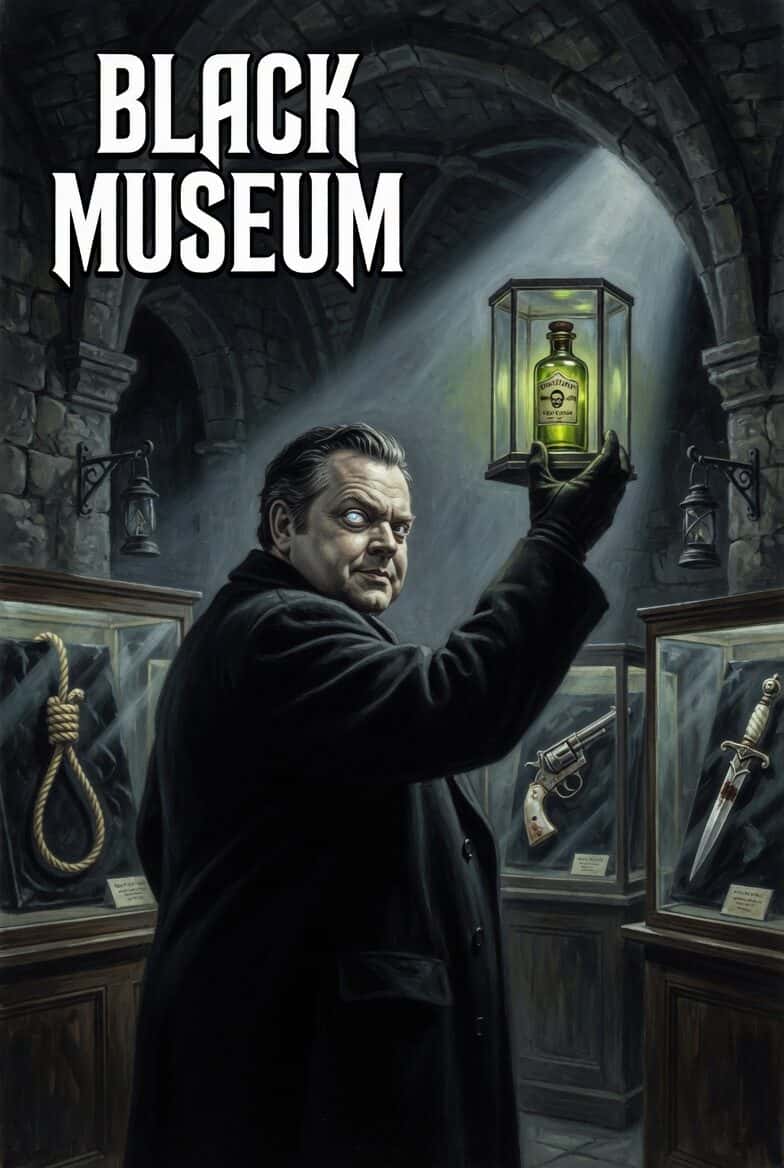
Well, here we are in the Black Museum, Scotland Yard's museum of murder. Shelf upon shelf of curious and repellent objects. The urge to kill illustrated in many, many ways. Here lies death. Here, in the echoing stillnesses of the long room, one stands and looks at violence. Expressed by the exhibits that line the shelves, the tables, and the walls. Repellent they may be, but by reason of their association only for most of these tokens of murder, are very ordinary objects.
It's a medicine bottle. The drug it contained was beneficial. In small doses. But since a woman was forced to drink the whole contents and died shortly after, the jury called it murder. Here's a kitchen knife. No household is without one. But this knife was not used solely for kitchen tasks. It was found embedded in a man's heart.
Ah, here we are, the brass button. It is, it's an innocuous, ordinary brass button. This was found near the dead body of a woman. But come back with me to the beginning of this story. To a day... Some years ago, on the common, outside the Kentish village of Wayfield, a girl was sitting beneath a tree, busily sketching. She was too engrossed to hear the approach of a young soldier, until he spoke.
Hello?
Hello. Sorry. Did I frighten you?
A little. I didn't hear you coming.
Oh, I made enough row. You're so busy with whatever you're doing. What are you doing?
Sketching.
Can I see?
You'll probably laugh.
No, I won't. Show me.
Hmm. That's very good.
I don't really think so.
Well, it's fine. You must be the one they call the Swamp Girl.
That's what they call me in the village. Poor, routine, dull people.
You don't like routine ways of living, do you? From what I've heard, you're something of a rebel.
Am I? Hmm. You seem to know a lot about me.
Oh, I've heard things.
What kind of things?
About how you live in an old shanty at the edge of the swamp, how you roam the common and sketch and paint.
You're well informed.
People talk about you sometimes. I was interested.
And so you came down to see for yourself. What's the matter? Couldn't you find a girl in town?
Don't say that. I wanted to meet you. To talk to you.
And now that you have, will you please go away and let me work?
Oh, you can work any time. I'll go away soon. If you're nice to me.
Go now.
What's the matter?
I've no intention of being nice to you, whatever you may think. Come on. Get away. When you found out so much about me, you might have also found out that I'm not interested in men. Least of all, soldiers.
That's not very kind. Come here.
No. Go away.
Come here.
No. Please, please don't hurt me. Please. No.
A woman screamed and cried for help on the Wayfield Common. But there was no one within a mile to hear her screams.
Two days later, in the post office at Wayfield, a letter was returned by the postmistress.
Mrs. Riley?
Yes, Jimmy?
That registered letter you sent me out with, there was nobody about to sign for it. It wasn't the swamp girl at home.
No, ma'am. I called out Miss Morgan, but there wasn't any answer.
All right. You can deliver it tomorrow.
Yes, ma'am.
Her name was Jeanette Morgan. The people of the town called her the swamp girl. Because of her vagrant, strange way of living. The next day, Jimmy, the postal messenger, rode out on his bike to deliver the registered letter. But once again, the swamp girl was not at home. Then, on the way back, taking a shortcut, Jimmy found her.
Miss Morgan!
Jimmy saw only her legs at first protruding from a bush which had been meant to hide her. At first, he thought she was asleep. He didn't think so for long.
She... She... She's dead. I've got to get the police.
Murder transforms a little village like Wayfield. All work ceases. The people gather in small groups in the streets to talk about it.
Here. Have you heard the news? There's been a murder.
Aye? A murder?
Yes. Out on the common.
Who?
The swamp girl. They found her body.
I was rather afraid that poor girl would come to grief. Sooner or later.
Well, Vicar, you know how it is these days. No parental authority.
Ah, more's the pity. Be that as it may, the man who did it must be found.
You know, Bert, if young Jimmy Miles hadn't come upon that body like he did, it might have lain there hidden for months, even years.
I wonder how it happened.
Well, now, the way I see it is this.
Now, in the bar of the local, they sipped their beer and discussed the sensation. Jimmy became something of a hero. He'd found the body, and even now is being questioned by the London detectives from Scotland Yard.
Er, this is, er, Jimmy Miles, sir.
Hello, Jimmy. You found the body, I understand.
Yes, Inspector Gallico.
Was she really murdered, sir?
That's what we must find out. And you can help us.
Oh, really? How?
I believe you rode out to her shanty at the edge of the swamp to deliver a registered letter to Miss Morgan.
Yes, that's right, sir. She used to get a registered letter every month. I always took them out. And she had to sign for them, of course.
Oh, yes. Then you got to know her, I suppose.
Well, don't tell the postmistress, but sometimes I did stay and talk for a while.
And what was she like?
Oh, she was nice, really friendly. People said she was a bit peculiar, but I never thought so. And she could draw, sir.
Now, think carefully, Jimmy. Jimmy, did you ever see her with anyone? Man? Or woman?
Oh, never, Inspector. She had no friends around here. She once told me so.
No friends, I see. Now, about this registered letter. Was that the first time you had taken it out?
Oh, no, sir. I went out the previous day, on Monday. But she wasn't there.
Did you call out?
Yes, and I went round the common, to the place where she used to go and sketch. I knew most of them. And she wasn't anywhere about?
Oh, nowhere at all.
What time of the day was this?
Well, I just left the post office just on ten. About half an hour's ride.
Oh, you were out there by ten-thirty.
Hmm. All right, Jimmy. Thank you very much.
Is that all, Inspector Gallico?
That's all for the moment. You've been very helpful.
A lucky witness, young Jimmy Miles. A break for Inspector Gallico early in the case. For with the evidence of the police surgeon, certain facts could be established.
What's your verdict on the post-mortem, Doctor?
Well, the cause of death didn't give us any trouble, Inspector. She was strangled.
What about the time of death?
Hmm. That's not so easy. I'd say she died forty-eight hours ago, at least.
Wait a minute. That means before noon on Monday.
It ties in, Doctor. Good. But at what time before noon, I would not care to predict. The contents of the stomach indicate she'd had breakfast. And sometime between breakfast and noon, she met her death. And she was nowhere about ten-thirty when the postal boy brought her her letter.
What about that letter, Sergeant?
Uh, I have it here, sir.
Who is it from?
It's from, uh, Mrs. Morgan of Tunbridge Wells, her mother. Money, I suppose.
Uh, ten pounds, eh? And a plea to come home and live a normal life. Poor Mrs. Morgan. Her daughter couldn't even die a normal death.
The pattern of the crime begins to make itself clear. The victim's identity is known. The approximate time and the cause of death is known. Now the hunt will begin. The murder will begin for the killer.
Here is a police message. The body of a woman named Jeanette Morgan has been discovered on Wayfield Common. Evidence suggests that she met her death by strangulation sometime before noon on October the 19th. Any person who was in the vicinity of Wayfield Common on that day, or can give any information, should communicate with the nearest police station in order to assist in the search for the murderer. And in this, the police will be aided by a brass button. That's it. That same brass button that today can be found in the Black Museum.
In just a moment we will continue with the Black Museum, starring Orson Welles.
And now we continue with the Black Museum, starring Orson Welles.
To a small cottage in Tunbridge Wells, now, go the detectives from Scotland Yard to a house with the blinds drawn, where a thin, bitter woman answers their questions in a strangely lifeless voice.
Yes, I knew. I knew it was Jeanette when I saw the newspapers.
Why didn't you get in touch with us, ma'am?
I knew you'd get in touch with me if you wanted me. Besides, what business is it of mine?
But she was your daughter.
Was she? Jeanette's younger sister lives here with me. Works at a shop nearby. She's my daughter. Yes, I see what you mean. I warned her. I told her it had come to no good end, living that strange and unnatural kind of way.
Mrs. Morgan, we won't trouble you any longer, but could you tell us, did your daughter have any close men friends?
Men friends? Yes. Jeanette? I wish she had. But a boyfriend would have been too ordinary for her. She had to be different. She had to be the swamp girl. I'm sorry. Why did it have to happen to her? To me? Why? Why? Why?
Good evening.
Good evening, Vicar. I'm from the police.
The police? I don't recognize you.
No, sir. You see, I'm not from the local police. I'm from London. And I'm down here in connection with the murder.
Oh, yes. Terrible, yes. But how can I help you?
Well, you can help a good deal. Yes, sir. You see, the local police are pretty shorthanded, and Inspector Gallico has decided that our next move should be to make a very thorough search of the common, particularly round about where the body was found.
Oh, I see. And I suppose you want some help from my parishioners.
Yes, sir. That's roughly the idea.
Very well, then. We'll help you in every way we can. You can depend upon us.
All right, sergeant. Let's get on with the search. You take Martin. Then work in from the road. I'll take Rogers and work in from the fieldside. I'll meet you by the ditch.
Yes, that'll be all right, sir.
Here's a sketch, sir. It's a pencil drawing. Look at that view across there, I'd say, sir.
Yes, it is. Unfinished, too. She might have been working on it. What else have you got there?
This is interesting, sir. It's a brass button.
Very interesting, sergeant. It's from an army. It's a uniform.
Where's the nearest camp to Wayfield?
I believe there's one across the river, sir, about two miles away.
Inspector Gallico left his sergeant in charge of searching the common and went to the army camp to enlist the help and cooperation of the commanding officer.
Gentlemen, to see you, sir. From Scotland Yard.
Oh, ask him to come in, will you, captain?
Yes, sir. Will you come through, please? Thank you.
Major Curtis, I'm Inspector Gallico from Scotland Yard.
How do you do, inspector? Sit down, won't you?
Oh, no. How can I help you, inspector?
I'm here to investigate the murder of Jeanette Morgan.
Oh, the swamp girl mystery. Yes. Yes, tragic business.
Major, not far from where the body was left, we found this. An army button.
That's why I'm here.
I see. Well, I'd be glad to assist in any way I can, but permit me to hope that it wasn't any one of my men.
How many men are there in camp here, major?
Well, at the present time, our unit's strength is 120. We're an engineer section, as you may know.
One hundred and twenty men, eh? Mm-hmm. I wondered if any of them has a button missing from his tunic.
Well, if you wish, I'll order an immediate inspection.
Not yet, sir. You can assist me in another way first.
Oh? How, Inspector?
Well, I want a list of all those absent from camp on Monday morning.
Oh, that should be easy. There's no leave on any week morning. If anyone was away from camp, it must have been for a special reason. Anyone at all. Between the hours of seven in the morning and one o'clock.
Well, the adjutant can help us, though. Well, I'll get him to make out a list of all those away from camp on Monday morning immediately.
The commanding officer was away a short time, and on his return, he brought with him a piece of paper containing a list of names. He gave it to the London detective.
Yes, there you are, Inspector. Five men were away from camp during the time you asked about.
Mm. Sergeant Willis. A Company.
Yes, he's our caterer at the present time. We're understaffed, of course. Sergeant Willis and Private Fields were in town with a provision truck.
They were together?
Yes. We could always check that with one or the other. I don't think I'm very interested in those two.
Oh? What about Private Liston, B Company?
Oh, he's the unit driver. I, uh, I sent him into town shortly before noon. Ahem. On a private errand.
Shortly before noon, hmm? Ahem. Well, that leaves two. Corporal Paul Ferris?
Oh, he's our mailman. He leaves every morning at eight o'clock and drives the mail truck in to pick up the unit mail bag.
From the Wayfield post office, I suppose.
Yes.
What time does he generally return?
Oh, sometimes by nine. Oh. Occasions, he has to wait for registered mail, you know. I've even known him to be held up as late as eleven or even eleven-thirty.
Would anyone know what time he returned on Monday?
I'll find that out for you. Now, this last man, Private Williams, A Company.
Yes, if you ask me, he might be your man, Inspector.
Oh, why, sir?
Because he was absent without leave. Nine hundred hours on Monday morning until fourteen hundred hours.
Nine till two?
Yes. That's interesting. I'd better see him. And the postal chappy. I'll have them paraded.
He's been raided. Corporal Ferris, Private Williams, this is Inspector Gallagher from Scotland Yard. He has some questions to ask you both.
Thank you, sir. Corporal Ferris, we'll take you first.
Yes, Inspector.
What time did you leave camp last Monday morning on your mail run?
At eight hundred hours, sir.
And what time did you return?
Well, I, uh... If I remember correctly, the mail was brought around rather late that morning, Corporal.
Yes, sir. I was just about to explain to the Inspector. I had to wait for several registered letters.
What time did you actually return?
Uh, shortly before eleven hundred hours, sir.
Thank you, Corporal. Now, Private Williams, um, you were absent without leave throughout Monday morning.
Yes, sir.
Are you able to give a satisfactory account of your whereabouts?
I'd, uh, prefer not to, sir.
Private Williams has consistently refused any explanation of his conduct, Inspector.
Oh, that's rather unwise, Williams. If you have an alibi, you'll need it. This is an investigation. This is an investigation into murder.
Murder? I didn't do no murder. I was with me girl in Wayfield.
Ah. What's her name?
Hey, Susie Walker, Nine Eyes Street. You ask her if I wasn't there. Oh, I didn't want to get her into any trouble, you understand? That's all. But murder? Oh, I don't know nothing about the girl who was killed. Honest, I don't.
Well, we'll check your statement, Williams. I've finished with them now, sir. Corporal Ferris, Private Williams, dismiss.
Inspector Gallagher drove into Wayfield to No. 9 High Street.
Oh, no. Susie wasn't out with him that day. I remember it distinctly. She went over to see her girlfriend at Kenbury. Well, you can ask her yourself.
Susie Walker was a small, frightened girl. The counterpart of Private Williams.
Oh, Inspector, I hope he hasn't done anything wrong up at the camp in not telling them where he was. Oh, that'd be terrible. He wouldn't tell a lie. Why, I know that. I'm sure of it. You see, we'd had a quarrel, and he wanted to see me. I didn't dare let Mother know, so I made up a story about it.
She confirmed his alibi. And Gallagher went next to the post office to interview Mrs. Riley.
Just one inquiry I'd like to make, Mrs. Riley.
Oh, anything at all, Inspector. Anything to think of that poor girl and my Jimmy Miles finding a body.
Mrs. Riley. Do you recall offhand whether you had any registered mail for the army unit on Monday?
Hmm, registered mail on Monday. Well, I couldn't remember offhand, Inspector, but I'll have it here in the book. Wait a minute, and I'll look it up. No. No, there was nothing on Monday. There hasn't been a registered letter for the army since last week.
Then the postal corporal wouldn't have been delayed on Monday morning.
Oh, not him. He was in for his mailbag. Quick as you like. Didn't even stop for a chat. I remember that now.
What time would he have left here, Mrs. Riley? Can you give me any idea?
I can give it to you right on the dot. It's come back to me quite plainly. We open at 8:30. Corporal Ferris was here waiting when I arrived to open up.
8:30. And he didn't stay?
No, not more than a few minutes.
The Inspector picked up Sergeant Worthington, and together they drove back to the army camp. A few orders from the commanding officer and Corporal Ferris was paraded once more, and his gear searched. At the bottom of his kit bag, they found what they were looking for.
Here we are, sir. A battle jacket with one button missing.
And it matches, Sergeant.
Oh, Ferris, what have you got to say about this?
Crazy, sir. I didn't know anything about it.
She was sketching, wasn't she, Ferris? No pencil drawing of you, isn't that so?
You're bluffing. She didn't do any drawing of me. It was a landscape scene.
A landscape scene, yes, so it was. And that fact has never been mentioned in any of the papers. Only the sergeant and I knew that, Ferris. And the killer.
Paul Ferris was taken into custody, charged with the murder of Jeanette Morgan, the swamp girl.
In court!
Ladies and gentlemen of the jury, you have heard the facts in this case, as related by the witnesses which have been called, both by the defense and the prosecution. The prisoner stands before you accused of the crime of murder. A particularly brutal murder. A murder without motive. But lack of motive is not necessarily a defense. It is for you to decide whether the facts which you have learned during this case, not only the words spoken by the witnesses, but the mute testimony of the material objects placed before you, justify your verdict, which must be beyond all reasonable doubt. The brass button and a slip of the tongue led to his downfall. Today that brass button occupies a place of honor in the Black Museum.
Orson Welles will be back with you in just a moment. Now here in person is Orson Welles.
The picture was completed when the tracks of a vehicle were found some 50 yards away from the scene of the crime. The tracks were identified as those of the mail truck of which the driver had been Corporal Paul Ferris. The defense did their utmost to prove insanity, but the jury were in little doubt that the man was sane and that his advances repulsed and strangled the swamp girl to death. They took 17 minutes to find him guilty and the brass button which had led to his arrest was Exhibit A on the courtroom table from where at the end of the trial and the pronouncement of the inevitable death sentence, it was taken to its present resting place in the Black Museum.
And now until we meet next time in the same place and I tell you another story about the Black Museum, I remain as always obediently yours.
The Black Museum starring Orson Welles, is presented by arrangement with Metro-Goldwyn-Mayer Radio Attraction. The program is written by Creswick Jenkinson with music composed and conducted by Sidney Torch. Produced by Harry Alan Towers.