
The written record
Read the transcript
Read along with the recording · About 18 min to read
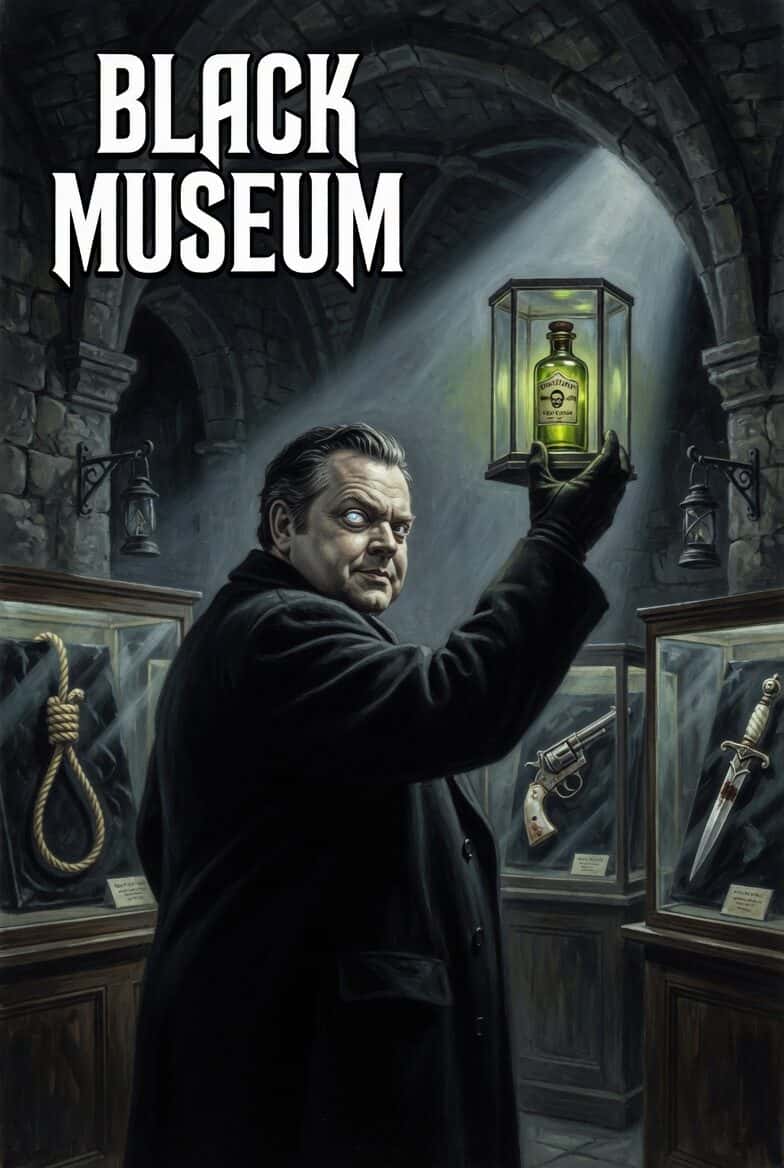
This is Orson Welles, speaking from London. The Black Museum, a repository of death. Yes, here in the grim stone structure on the Thames, which houses Scotland Yard, is a warehouse of homicide, where everyday objects, a man's necktie, a woman's glove, a boy's school cap, all are touched by murder. Now here's a champagne glass. That's a familiar object, long stem, delicate curve, shining crystal. This fragile object belongs to New Year's Eve, to weddings and anniversaries.
Funny about things like this, Sergeant?
Funny, sir? I'd say that one was loaded.
I meant funny in a philosophical sense, Sergeant. Funny how human beings can take an article meant for happiness and use it for tragedy. Now anyway, that champagne glass can be found today in the Black Museum. From the annals of the criminal, the National Investigation Department of the London Police, we bring you the dramatic stories of the crimes recorded by the objects in Scotland Yard's gallery of death, the Black Museum.
Black Museum. This museum of murder. This place echoes with violent death. Voices are hollow here. Whether the hollowness is caused by the high-vaulted ceilings or by the reaction of the human mind to the atmosphere of this room, the effect is the same. Everybody who comes here, learns a sense of fear. It's natural because here lies death. Death, cruel, unnecessary, vengeful, greedy. Still the kind of death brought by one man or one woman on another. This is a record to be studied, not merely by criminologists, but every student of man's inhumanity to man.
Here's an iron skillet. It's heavy in your hand, the kind of kitchen utensil your grandmother used. Well balanced, quite suitable for frying eggs or veal chops or for bashing a skull, perhaps. There's little doubt. There's no doubt. There's no doubt. There's no doubt. It's the use which brought this particular skillet here.
And here's the champagne glass. It's well designed, graceful. You could place it with a companion on a silver tray, as Colonel Harry Reed did. You could pop a cork and then fill the glasses, as Harry Reed did. And you might say, as the dapper colonel did, "To you, my dear Elizabeth, to your return and your complete recovery."
"I wish I could drink to that wholeheartedly. Really, I do."
"Well, why not? Why not, my dear? You've been released, you're..."
"That's it, exactly. I've been released. Not merely sent home from a hospital, so to speak. After all, the hospital I was in had bars in the windows."
"Oh, I insist, my dear, that you touch glasses with me and drink it once."
"That's no way to talk."
"But, Harry, I..."
"Ah, then no buts, Elizabeth. Many people have had nerve breakdowns and the vast majority of them have recovered."
"Very well, Harry, dear. But not to me, to you, the most patient of husbands in the world."
So they drank the champagne, and all was well. It was very pleasant, very relaxing. The world is always too much with us, and the colonel finally had to say, "Now, you rest until dinner, Elizabeth. I've a brief appointment. I won't be long." And the colonel kissed his wife, and the colonel went off to his appointment.
"It's six months now, Reed. One way or the other, the matter ought to be settled."
"I assure you, Davis, there's nothing to worry about. These things take time."
"There's been plenty of time. Look, Reed. If you don't want to complete the deal, return the 500 pounds."
"But it's not up to me. My client..."
"Your client indicated willingness to dispose of the property. My client paid the deposit in good faith. We considered a binder on the contract. We waited six months."
"Your 500 pounds is quite safe, Davis. You can reassure your client. And on my side, we'll go through with the deal as soon as everything is clear."
"Well, I certainly hope so. My people want to take possession."
"And they shall. They shall indeed. And soon. Meanwhile, there's no reason for misunderstanding between us, is there? After all, we live in the..."
"Same small town. We see each other constantly."
"You know, John, I've often wondered why we don't see more of each other. Socially, that is."
Rather a changeable fellow, the colonel, isn't he? There were other changes ahead. More serious ones. They first came to somewhat public notice the night our colonel called Dr. Ashley to his home.
"Ah, Dr. Ashley. Good of you to come so quickly. Made it sound rather urgent, colonel. Is it really serious?"
"Yes, sir. I'm afraid, doctor. Really afraid. It's my wife."
"Has she broken down again?"
"No. She complains of terrible pain in her abdomen. I'd better see her at once."
"Yes, this way, please."
"If you can, doctor."
"Yes?"
"She seems to me to be as much frightened as she is in pain."
"Oh? What exactly do you mean by that?"
"Frightened that, well, that her pain is in her imagination."
"I see. Oh, very well. I'll bear that in mind, colonel. Ah, in here. If you'll wait outside, colonel, please."
"Oh, must I, doctor?"
"I prefer it."
"Very well. Now then, Mrs. Reed. Can you hear me, Mrs. Reed?"
The good colonel waited outside the door. Up and down, back and forth, he paced. Almost as if he were once again on guard duty. Grim-faced, tense.
"You'd better come in, colonel. Quick."
"Doctor. Is she..."
"I'm afraid so. I've done everything I can."
Moments later, Elizabeth Reed was at rest. Tears streamed down the colonel's cheeks. But he was silent. There seemed nothing to say. The doctor led him away and told him gently. It was acute gastritis. And her heart. You'll want the minister, I assume, and the mortician. I'll send the certificate over. Natural causes.
It was a well-attended funeral. The flowers were piled high in tribute to the colonel's position in the town, as well as to the memory of his wife. And then the colonel resumed his life. Somewhat more lonely, but still active. Bearing himself in military fashion as he went about his small real estate business. And time drifted by. One month to... And then...
One day on the main street.
"Good morning, colonel."
"Ah, Davis. Good to see you. I've hesitated discussing this. Your recent bereavement and so on. But don't you think we need to close our deal, Reed?"
"Oh, yes. Yes, of course. I, um... Well, that is, I'm rather by myself these days. Would you care to join me for tea or... Get something stronger one afternoon?"
"You say when, Reed. I'll be glad to."
"Excellent. Then, uh, should we say tomorrow? Five-ish?"
"Why not? Your place or mine?"
"Oh, mine, of course. Delighted to have you."
"Have a scone, old man. Really excellent. My housekeeper has quite the touch."
"Thank you. I will."
Almost as if we were a pair of elderly ladies. Tea and scones. Two gentlemen, somewhat past middle age, enjoying tea and scones and making ready to discuss business. In fact, they did discuss business. A 500-pound deposit and the pending deal. And John Davis went home quite satisfied.
John Davis went home and a little later called Dr. Ashley.
"I don't understand it, Doctor. My stomach's like cast iron. Always has been. Now, suddenly, this."
"None of us are quite as young as we used to be. Even cast iron can wear thin with use. Eat anything out of the ordinary, John? Today? Yesterday?"
"No, no, nothing. Had some scones for tea. The butter may have been a bit rancid, but tasted perfectly fresh. Oh, but Colonel Reed's. Eh? Reed's? Yes, that's why. We had a little business to discuss. He asked me over. Seems quite lonely since his wife passed on, so I went, mostly to keep him company."
"Nice of you. Well, just take the prescription I'm leaving you. Rest a day or two. You'll be all right."
"What's wrong, Doctor?"
"Oh, nothing. Just a quirk of memory."
"Oh? How so?"
"Your symptoms and Mrs. Reed's rather the same. Nothing serious about it, just odd that we should have two similar cases in such close juxtaposition. A town like this, a doctor gets to know most of the illness."
As the doctor said, nothing serious. Just an interesting coincidence. And in the day or so, John Davis was up and about. Aside from a slight tenderness in his abdomen, he felt no after effects. All was well. Everyone was his courteous self, including Colonel Reed.
"Well, now, candy. And from the Colonel. How decent of him. Here it is, Doctor. The same wrappings it came in. Nice looking box."
"Don't you care for candy, John? You haven't eaten much."
"As a matter of fact, I don't. I did offer a piece to the charwoman at the office. You see, one's missing. The charwoman, eh? Is that the way you treat a gift?"
"With the hope you are sufficiently recovered to enjoy this, Harry Reed." Rather decent of him, that's what I thought. Until the charwoman was taken with pains and retching an hour after she ate the candy.
"Are you suggesting anything, John?"
"That would be slanderous at this stage, wouldn't it? There's nothing to it, John. There couldn't be. The Colonel... Well, I inquired at the probate office. He did rather well following his wife's death and her will, you know. He never had any money of his own to speak of. Former military men rarely do."
"Yes, it might be interesting. I've done practically no laboratory work of my own for some time. But I have a little equipment. Shall I try my hand at a bit of chemical analysis, John? I'm curious about the contents of that box of candy."
"You seem to be as well as I."
The Doctor was methodical, to say the least. He took his time setting up his equipment, preparing reagents, making ready for his private little tests. Meanwhile, John Davis ran into his friend the Colonel on the street.
"John, good to see you. How are you, Harry? You're looking fit."
"Well, I try to keep that way. Care to join me for another attack of indigestion, old man?"
Well, today, the champagne glass we've been talking about can be seen, as you might expect, among the other exhibits.
The Colonel and John Davis parted quite amicably on the street. Davis watched the smart military walk, the ramrod straight back, as the Colonel paraded into his office. Under his hat.
The next afternoon, a telephone rang in John Davis' office.
"Yes? Oh, is that you, John? This is Harry here."
"Harry? Oh, yes, yes, of course. How are you?"
"Very well. And you?"
"Quite well. No trace. How about this evening?"
"Oh, sorry, I can't this evening. But perhaps in a day or so."
"Oh, too bad. Oh, I'll be speaking to you. Goodbye."
"Bye."
I sent a previous appointment for Dr. Ashley in his makeshift laboratory.
"This little operation here is the Marsh."
"Oh?"
"For arsenic. Interesting."
"Yes, isn't it? Particularly since I found that every piece of candy in your gift box had arsenic in it."
"Good Lord!"
"Quite a lot of jambas. It usually fails to pass through the human system. It accumulates, and bit by bit, the fatal dose is built up until one day the victim dies."
Dr. Ashley explained all this to John Davis. Finally, John grasped the significance of the facts.
"Each piece of candy would never bother the ordinary stomach or the... cast iron type, such as you both did you have. Most people could eat a piece or two. Indeed. You had eaten most of the candy yourself. Well, you follow me, I gather?"
"Follow you? Doctor, I'm a step ahead of you. But exactly what that step is, I'm not sure. I think we need expert help."
"The local constable?"
"I said expert help."
"Where from?"
"The CID. Scotland Yard."
It was a clear, cogent letter reciting the situation as Dr. Ashley and John Davis knew it. It was addressed to the Home Secretary, a gentleman in the British government responsible for the police force in general. In due course, the letter reached the desk of Inspector Charles in Scotland Yard. Following the set routine, Inspector Charles showed the communication to his immediate assistant, Detective Sergeant Hatch.
"Well, nothing else for it. You and I will have to take a small trip to the country."
"Frankly, I won't mind. I can use a touch of country air after all."
They came into the quiet town unobtrusively. Two men on a walking tour, vacationists. They put up at the inn. Toward sundown, they strolled about the town quite casually. They turned in at the gate with this little sign announcing that Dr. Ashley had his dispensary there, at his office.
Now then, Doctor, perhaps you'd let Sergeant Hatch and I have it from the beginning.
Well, my entrance into the situation came shortly after Mrs. Reed returned from the, uh, sanitarium.
She'd been ill?
Mentally ill.
Nervous breakdown?
Rather more than that. She'd been certified insane. She was discharged as being quite stable once again.
And you? You were called in?
In my professional capacity. I found her past help. Acute gastritis. Or so it seemed at the time.
But it doesn't seem so now?
You understand, Inspector, I have no facts. At least not on that side. I merely analysed the box of candy received by John Davis shortly after he'd been taken ill.
Doctor, would this Colonel Reed benefit from Mr... from Mr. Davis's death?
There'd been something about a real estate and a deposit pay. Quite a large sum, I believe. Mr. Davis can give you the details.
One final question, sir. Who had Mrs. Reed committed to the, uh, institution in the first instance?
Why, I believe the husband did. But the records will be available to you, of course.
Of course. Oh, thank you, Doctor. If we need you...
By the time they left the doctor's office, Inspector Charles and Sergeant Hatch felt they'd heard an interesting and circumstantial story. Their next stop, actually, was John Davis's home.
You've no idea, gentlemen, what a relief it is to have police officers of your calibre on the job.
Thank you. About the candy and the card on the box, do you have any definite... reason to believe the Colonel wants you, well, out of the way?
There's the matter of 500 pounds he either will not or cannot explain. And, um, Dr. Ashley mentioned Mrs. Reed's will.
Yes, curious about that. There was one will made out entirely in favour of her children by her first marriage. The will which was accepted and executed was in the Colonel's handwriting, but signed by Mrs. Reed and produced subsequent to her death.
You find that interesting, I take it, Sergeant?
I expect you do as well, sir. Good, Mr. Davis. Do you think it might be possible to exhume Mrs. Reed's body without the matter becoming common knowledge in the whole town?
The men from Scotland Yard accomplished the almost impossible. Armed with the proper papers, cross tools and dark lanterns, they supervised the removal of the body at night with no one the wiser except the necessary officials. This feat completed, they waited quite... quite patiently. The government analyst was called in. The report was brief. Inspector Charles read it to Dr. Ashley.
Examination reveals the presence of four grains of arsenic, more than a fatal dose, and the largest amount of the poison I have ever found in human remains.
Well, that's it, Doctor. And I didn't recognize the symptoms. Acute gastritis, I call it.
Why should you have recognized them, sir? I dare say murder of any kind is hardly a common occurrence in your practice.
Well, Sergeant, since our warrant is all in order, it begins to appear the search of Colonel Reed's premises may be next on the agenda.
Now the pretense of the walking tour was completely discarded. It was Saturday, and the sleepy little village was just about bestirring itself. The inspector and the sergeant walked for short. It was from the inn to Colonel Reed's place of business, almost directly opposite Davis's office.
The sergeant tried the door.
Not locked, sir.
A locked door in these parts would arise more suspicion than not. Let's go in, shall we?
One file cabinet, one desk, telephone, chair for visitors. Can't do much of a business.
I dare say not. Let's get to it.
The search was quite thorough. The desk was emptied of its contents. These were replaced in an orderly fashion.
Nothing extraordinary here, sir. What do you make of this, sir?
Champagne glass. Rear of the file cabinet.
Todd?
Shall I hold it aside, sir?
Yes, you may as well. Interesting, the trace of sediment. Apparently it was never washed, not that it was used the last time. Anything else in there, Sergeant?
No, what's going on in here? Can I read?
Yes, more to the point for you to identify yourselves and your business here, if any.
Inspector Charles, C.I.D. My identity card. This is Sergeant Hatch.
I see. I assume you have a warrant for this search?
We do. Right here, General.
Ah, very well. Go on with your work.
May I ask why you were keeping the champagne glass in the file cabinet?
A memento to my poor wife. We drank from it. Oh, that is, she did, about a week before she... passed away.
A nice gesture, if I may say so. And still with a trace of the sediment at the bottom. Careful, sir. It would be a pity to have the glass break after all this time.
Oh, sorry. Awkward of me to brush against it like that.
Yes, wasn't it? All right, Sergeant, you can open the desk drawer the Colonel just closed and see what he put in it.
But you said you'd finish...
Your pardon, Colonel. But I've had quite enough of this.
These paper packets weren't in here a few minutes ago, Inspector.
How many?
I wouldn't have...
Twenty of them, sir. I'll take one. Thank you. White powder. Well? This wouldn't be arsenic, would it, Colonel?
It not only would be, it is.
Really? Well, as you can see, I'm wearing my gardening coat. Ordinarily, I do not come into the office on Saturday. But something came up. I'd been planning an experiment in my garden. Hence the arsenic.
A garden, an experiment? With twenty packets of arsenic?
Yes. My lawn is plagued with dandelions, roughly two dozen of them. I plan to drill a small hole at the root of each weed, pour in the arsenic in each of those packets, and kill each dandelion individually, rather than take the chance of ruining the whole lawn.
Sorry, Colonel. It's a good story, but rather far-fetched. Particularly since you tried to rid yourself of the packets before we searched your person. And particularly since the charge pending is willful murder of your wife by arsenical poisoning.
But this is ridiculous. Someone is...
Sergeant! Keep that champagne glass safe before Colonel Reed succeeds in smashing it.
Yes, sir.
Colonel Reed, you are under arrest. The charge is murder. I must warn you that anything you may mistake...
I will not stand! No, no, no, Sergeant! I'll be acquitted. You'll see, and then I'll have to leave here. A trial? That will make...
That's quite enough, Colonel. You've made several mistakes, not the least of which was your attempt on John Davis. And your preservation of this glass. A sentimental gesture, but rather silly. My bet is the sediment in it will turn out to be arsenic. You must have been very sure of yourself, Colonel, to leave this glass unwashed. Very sure of yourself, indeed. Bring him along, Sergeant. I think he'll come quietly now.
And today, that champagne glass can be seen in the Black Museum.
Orson Welles will be back with you in just a moment.
There was no doubt about one facet of Colonel Reed's character. He was a man of great pride. His behavior at the trial was exemplary. His daring military. He repeated his story of the separate packets of arsenic for separate dandelions, and he sounded as if he'd made a good case of it. At least for himself. But not, as it turned out, for the jury. Colonel Reed accepted his sentence as if it were an order from a superior officer. And one morning, at the traditional time of 8 o'clock, Colonel Reed marched to the scaffold as if he were on parade.
And as for the champagne glass, now it remains in its customary place, as I told you, in Scotland Yard. And now, until we meet next time, in the same place, and I tell you another story about the Black Museum, I remain, as always, obediently yours.