
The written record
Read the transcript
Read along with the recording · About 20 min to read
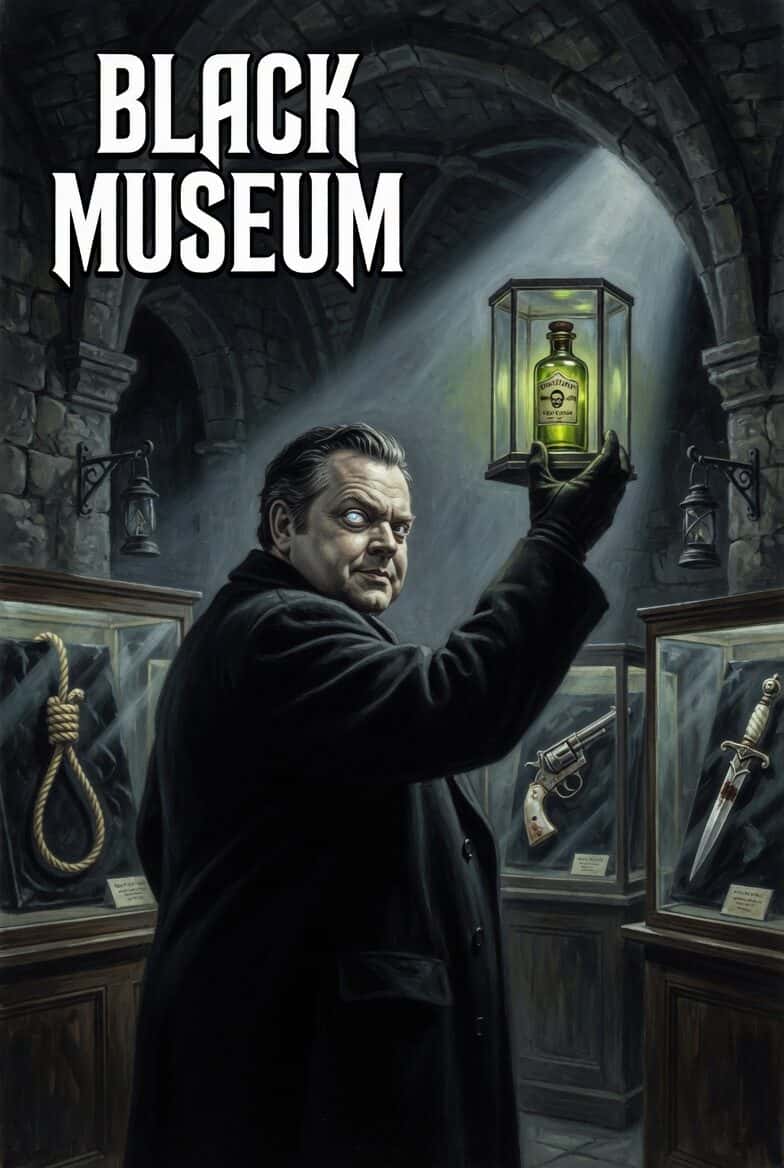
This is Orson Welles speaking from London, the Black Museum. Here in the grim stone structure on the Thames, which houses Scotland Yard, is a warehouse of homicide. Where everyday objects, a picture frame, a coat hanger, a file folder, a baby buggy, all are touched by murder.
Now here's a hammerhead, made of cast steel, well shaped, extremely familiar, the front end blunt, solid, designed for driving nails, the clawed prongs at the rear for pulling nails, very practical, very, very, very familiar, and so very, very, very lethal.
Odd one this, wasn't it, Inspector?
Just a little extra patience, a little extra routine work, Cross? That's one way to look at it, sir. I prefer to remember it as the case. A case which began with almost two dozen disappearances, and wound up with one killer, who used a hammer with purpose.
Well today, that hammerhead can be seen, here in the Black Museum.
From the annals of the Criminal Investigation Department of the London Police, we bring you the dramatic stories of the crimes recorded by the objects in Scotland Yard's gallery of death, the Black Museum. In just a moment, you will hear, The Black Museum. The Black Museum, starring Orson Welles. Now, The Black Museum, starring Orson Welles.
Well here we are, in the Black Museum, Scotland Yard's museum of murder. Beyond these walls, the Thames seethes with a calmness which is life to London. Within these walls, where some of the river's dampness exudes from vaulted stone, there is quiet, very sinister quiet. The kind of quiet that is the quiet of the world. The kind of silence which inevitably surrounds objects, touched by horror and fear. As here lies death, behind glass doors, peaceful inanimate objects, on deal tables. The authorities have provided suitable identification in labels and neatly lettered cards. The motives, actions, and the reasons why these objects rest here now, were all provided by murderers.
Here's a calendar. The usual twelve page printed piece with a picture of a pretty girl to decorate it. The holidays are marked as usual in red. One other day is marked as well, a day and date of a murder. Strangely, that red circle led to capture and conviction, of course too, execution.
Now here we are, here's the hammerhead I told you about. It's an efficient tool, this hammerhead, type used by generations of carpenters, by millions everywhere for work around the house. Hardly a home is without one, and one would expect that a story involving such a tool would begin in somebody's home. On the contrary, this tale begins in the direct antithesis to a home, begins in a London Railroad station.
Let me have my bag, will you?
Yes, sir. Your check, please.
Right you are. Thank you, sir. Here it is, sir.
Hey, that's not my bag, mine's a Gladstone.
I'm sorry, sir. Just let me see the checks.
Oh. What's wrong? Are you sick?
No, no, sir. It's just my hand.
Well, cut yourself, that's blood.
Yes, I know, but it's not a cut, say. It's from the bag.
Well, open it, man. Don't stand there.
Yes, sir. It... It doesn't seem like much of a lock on it, sir.
Oh. What does... What does one do now, sir?
When you find part of a body in a valise, you call the police, of course. What else?
Yes, sir. Oh, please wait, yes, sir, I'll call them. Yes, call the police. Start the wheels moving, the wheels of police routine, which grinds slowly but inevitably toward discovery.
In this particular situation, the call led eventually to the office of Inspector Church at the yard.
...Cross, the contents of that valise at Charing Cross belong to a torso found in Brighton. Another one in Brighton?
Yes, sir. Number 23, 23 girls missing, just unreported.
Photos available, sir?
In most cases. Here's the assembled composite of the latest.
Hmm, pretty little thing to wind up so widely separated as London and Brighton. Here's the set-up for now. I'm assigning a man individually to each case. Identify any found bodies, trace the known missing. I'm taking Daisy Baker, myself. You'll take over here, and all the information will channel through you.
Very well, sir. Why, the Baker girl for yourself, sir?
Oh, she is, or was, the common-law wife of Jamie Marsden.
That one! Remember him?
Oh, picked him up on his first conviction meself. Rather a long record, hasn't he, sir?
Oh, petty crimes, short sentences. In any case, the Baker woman's been reported missing by her sister. It might be worth a trip to see the sister. Name is Crandall, Ruth Crandall. Before I drop in at Marsden, I think I'll visit the lady and...
A routine call to inquire the reasons for a woman's worry about her missing sister. Inspector Church found Ruth Crandall at home.
So, when I planned to go down to stay with Daisy, well, to see her anyway, and the wire came... Well, you see how it is, Inspector?
May I see the wire, Mrs. Crandall?
Yes, I have it just here, in the desk. Yes, here it is.
I see. Going abroad. Good job. Sails Sunday. Well, right. Well, it doesn't tell us very much, does it? I tried to call. Her husband... Well, he wasn't very cooperative. He said she'd up to... Packed her things and told him she was bound for Paris, for a dancing job.
Oh, Miss Baker is a dancer?
That's how it was, she was living in Bright... She was in some show down there.
And you feel something is wrong?
Definitely. I don't know exactly why, but... Well, you see, the wire doesn't even say love. And that makes it seem strange too, doesn't it, Inspector?
Perhaps, Mrs. Crandall. And you've no other information, nothing you can put your finger on?
No. Except, of course, that I haven't heard from Daisy since the wire came.
I'm puzzled. None of it felt right, none of it conformed at all to the usual pattern. Ruth Crandall had nothing factual to go on, and a woman's instinct is never evidence on which to base an arrest or a conviction. Still, the Inspector took the train to Brighton and called on Jamie Marsden at 35 Park Row.
Yes?
You remember me, Marsden?
Ah, copper, ain't you?
Yes, Chief Inspector Church, CID.
Well, come in, Inspector. I don't suppose this is a social visit?
No. I'm a bit busy for that sort of thing.
Oh, well, sit down anyway, Inspector. Just a few questions?
Well, go ahead.
I hear you married since we last met?
Yes, I did. Nice girl. She home?
Well, um, no, as a matter of fact, she's, uh, she's gone off to Paris. Her job is a dancer over there.
So her sister told me.
Yeah, well, she wired her sister. Nothing much my sister-in-law would want to see me about, so, uh, well, there wasn't much sense in her coming all the way down to Brighton when Daisy wasn't here.
I assume you have your wife's address.
Uh... Well, uh, no, Inspector.
Oh?
We had a bit of a dust-up before Daisy left. She, uh, flounced out of here all kind of mad, as you might say.
Mrs. Crandall know this?
No. Mrs. Crandall don't take to the likes of me, so I saw no reason to tell anything she didn't have to know. Daisy wants to reach her. She knows where.
Well, that's it, I suppose. You'll be here if I want to see you again, Marsden?
I'm moving. Three rooms is a bit large for me, seeing as I was on my own these days. The, uh, new place is at, uh, Maitland Street, uh, number 26. It's a good bit cheaper. More suited to my means.
A check of the habitual haunts and acquaintances of Daisy Baker drew another blank. Some had heard she'd gone off to Paris. No one knew where. Meanwhile, reports on other missing girls were equally discouraging.
That's the lot, eh, Cross?
That's the lot, sir. Oh, and another missing one reported makes an even two dozen, sir.
Have they tried the picture of the girl we found in Charing Cross on this new report?
Not the same girl, sir.
Too bad. No luck with Marsden, I presume?
No luck at all. Edge is not a fella, that one.
Yes, he ought to be. He's much too familiar with us, and he knows it. Well, there's no help for it. It'll have to be a house-to-house search.
The usual district, Inspector?
All of Brighton.
Rather a large order, Inspector.
Finding fourteen missing girls and identifying six of ten bodies is quite an order, Cross. There's no help for it. It'll have to be done. Chances are we'll have to lend Brighton...
A hard, dull slogging of police routine. Divide a city into sections. Assign groups of detectives in pairs. To each section, then walk from house to house, from cellar to attic, pausing for the questions, questions, questions. Try to locate someone who has seen something, who may know one of the missing persons by sight. Try. Keep trying.
Well, there was nothing there. It's jobs like this, Inspector, that make me wonder why I wanted to be a policeman.
It's jobs like this, sure, that make good policemen out of ambitious young men. Well, next address?
Twenty-six Maitland.
I expect Jamie Marsden won't be looking for me this quickly.
Marsden? Who's that?
Oh, petty criminal. His wife was reported missing by a sister. Turned out she'd gone off to a job in Paris and a half.
Knock on the door, Shaw, will you?
Yes.
A sordid kind of story. Even a touch of the dope racket in it.
Yes?
My credentials. CID. Also a search warrant.
Well, you meant it certainly didn't waste any time. Please come in.
Waste any time? I'll call the police. I'll call the police. I'll call the police. I'll call the police. I'll call the police. I'll call the police. I'll call the police. I'll call the police. I'll call the police about five minutes ago. They said they'd send someone over.
Are you the landlord?
I am, Inspector.
Well, we're here on the matter of our own. However, what's the trouble?
Notice anything, sir?
I do. How about you, Shaw?
Yes, sir. I do. It's from this room. The tenant is out this now. Left his door locked. Name of Marsden.
Well, is that so? Just as well we have the search warrant. Try your shoulder on that door, Shaw.
Yes, sir. We've never had anything like this before, sir.
Well, nothing much here unless it's on the walls. There's a trunk in the closet, sir. Drag it out. Cut those cords.
Yes, sir. Good Lord. May I stay outside, Inspector?
Yes, of course. No wonder Marsden isn't home. Well, Daisy Baker didn't go to Paris after all. Took quite a beating, didn't she? Looks like a blunt instrument did the job. Call headquarters, Shaw. Pick up order for Jamie Marsden.
And today, that hammerhead... ...can be seen here in the Black Museum.
In just a moment, we will continue with the Black Museum starring Orson Welles.
And now we continue with the Black Museum starring Orson Welles.
The wires were alive with the search for Jamie Marsden. Somewhere in England, the little petty thief was hiding. And sometime he would be found. According to Chief Inspector Church, the man almost undoubtedly killed Daisy Baker. And there's no question that he had a body in that trunk moving it with him. An inquiry into the whereabouts of missing girls had blossomed into a full hunt for a murderer.
The premises at 26 Maitland Street, Brighton were given a thorough going over. Detective Shaw reported...
Nothing, sir. Not a trace of anything except that trunk in the body.
To which Inspector Church replied...
Very well. Now give the same treatment to 35 Park Road.
There, the young detective reported...
In the backyard, sir, in a pile of junk, we found a hammerhead. It's been given to pathology, Inspector. There are stains on it. They might be blood, sir.
And, as Inspector Church said to his deputy, Inspector Cross, some 48 hours later...
Pathology report, Cross. That hammerhead did the job. The stains are blood and the type conforms.
Good enough, sir.
Not quite good enough. The handle is gone. There's no proof who used the hammer.
And pathology report, Cross. That hammerhead did the job. The stains are blood and the type conforms. Pathology also reports that the autopsy shows enough morphine in the Baker woman's body to establish unconsciousness before death, if not death itself.
Any record of dope handling in Marsden dossier, sir?
Nope. We haven't been able to tie him into that yet. Well, we'll see after we find the gentleman in question.
Meanwhile, have them get me Brighton on the wire. I have a routine job for Detective Shaw. Too many loose ends in this one.
The call was made to Detective Shaw in Brighton. Armed with a postcard, a file number, and a hand-lettered menu, Detective Shaw invaded a certain telegraph office in Brighton.
Yes, sir. I'm always glad to cooperate with the police, sir.
Can you find me the original of this wire?
I think so, sir. Just a moment, please. This is it, I assume, sir. It has the same file number.
Yes, that's it. Going abroad. Good job. Thank you very much. Now, if you'll just let me compare the writing on the blank with these samples I have with me...
Detective Shaw noted his comparisons and went to the telephone. A few moments later, he'd put a call through to Inspector Church at the Yard.
Go ahead, Shaw. What have you got?
They had the original, sir. I compared it with the postcard with the baker woman's writing on it. I'm no expert, sir, but it's obvious the two writings are absolutely different.
That's that, then.
I had a specimen of Marsden's writing, too, sir.
Where did you get that?
From a restaurant where the man worked for a while as a waiter. The menus there are handwritten. It was part of his job to write them out.
Good man.
There's no question about it, sir. Marsden wrote that. And signed the baker woman's name to it.
Another link in the chain rapidly forging itself around Jamie Marsden. But still, no Jamie Marsden. Every policeman in England's carrying the man's picture and descriptions up. How long is it going to take to bring the picture and the man together?
Not too long, Inspector. In fact, within 24 hours.
Here, you. Just a minute.
You want me, Constable?
Stand over there, in the streetlight. There you are. No weapons?
Now, why should I be carrying a weapon, Constable? I'm just an ordinary citizen.
Let's have a close look at you. Yes, I'm sure of it. You'll have to come along to the station house. You're being taken in charge.
What for?
You're Jamie Marsden, unless I miss my guess by a mile. Don't you know there's an all stations broadcast out for you? You're the most wanted man in England this minute.
That was in Manchester. Very shortly thereafter, Jamie Marsden faced Inspector Church and Deputy Inspector Cross in their office at the Yard.
All right, Marsden. Let's hear it. All of it.
I didn't kill her, Inspector. I didn't kill her.
But you knew she was dead.
What? If you mean, did I put her in the trunk? I did. But you didn't kill her.
No, sir. You've got to believe that.
Apparently, you seem to understand that it's somewhat difficult to believe.
Well, that was the whole thing from the beginning.
All right. Let's go back to the beginning.
Well, me and Daisy got together down in Brighton about a year ago.
How?
Oh. She was dancing in a coot show, and I was barking a booth a little way up the sidewalk. Well, sort of got into the habit of meeting her after closing time. Then, well, we reckon that two can live as cheaply as one. So, well, we put in together and started housekeeping.
Were you pushing any of the stuff her way?
I didn't know she was on the stuff. No, not for months. Inspector, you've got to believe it.
Yes, it seems that a lot of things we've got to believe.
You heard Cross, Marsden. I am, shall I say, skeptical, too. Keep talking.
I'm honest with you, sir. I am. Keep talking.
Well. Daisy's sister came to visit. We didn't get along. If I'd have killed anyone, it'd have been that sister. What she came for, except to be nasty and snoop, I don't know.
Back to the story, Marsden.
Yeah. Yeah. All right, sir. Well, like I was saying, we got together and everything was fine. Oh, we had a couple of fights, but, oh, nothing much. Then Daisy said as our sister was coming down again, I got real mad. I slammed the door.
You didn't slam Daisy.
I may have cuffed her a bit, sir. Nothing serious. Anyways, I went out and I stayed out for a couple of hours. I come back and the place was awful quiet. And I thought, well, maybe Daisy had gone out or taken a shot or two or something. I walked into the bedroom.
That was at 35, where we had the three rooms.
You walked into the bedroom and let her have it, right, Marsden?
No, sir, wrong. She had it. Oh, it was awful, Inspector. She was real bashed up, she was.
Why didn't you call the police?
Me? With my record? Who'd have believed I didn't do it? You don't believe me now. I never killed nobody, just been put away for small things. But I got a record. Nobody had listened, I reckon. So I got real scared. I did the first thing that hit my head.
Which was, Marsden?
I got an old trunk and I stuffed her in it. And then I took the sheets and all down to the cellar and I stuffed them in the furnace. Well, the rest you know, Inspector. And that's the truth, so help me.
What did you do with the hammer, Marsden?
Hammer? Oh, what hammer, Inspector?
The one you bashed her with, Marsden. The hammer that killed her.
I don't know about no hammer. I didn't kill her, nor that. Nobody. I didn't kill her, Inspector, and that's the truth.
They worked on Jamie Marsden for three days. They tried every trick, every question they could think of, but no one could shake his denial. Jamie Marsden insisted he had not killed Daisy Baker, and that was that.
Weary and exhausted, Chief Inspector Church faced his deputy.
You know, Cross, I am almost beginning to believe Marsden myself. If he did kill her, it's completely out of the pattern. His kind of crime. A criminal almost never kills.
I know, but somebody killed her. Even granting Marsden's story, somebody killed her.
Well, then, where do we go from here, sir?
Well, we do doubt there were or had been other men in this woman's life.
Have you any doubt about it, sir?
Do you suppose the sister would have any ideas?
Well, it's a place to start in any case.
Check. Then let's get on with it, Cross, and ask the Brighton police to work in that angle.
The sister, Ruth Crandall, a place to start on a new angle at any rate. The two CID men paid their second visit to Mrs. Crandall.
I suppose, Inspector, you've come to ask me to testify at Marsden's trial. Nasty little man.
As a matter of fact, we haven't. We don't have enough evidence yet to send Marsden to trial. We're booked on suspicion, that's all.
Not enough evidence? Hardly seems possible. The papers were full of it.
The newspapers aren't the police, ma'am.
Of course not, Mr. Cross. But after all, he did keep my sister's body with him. He did run away.
I know, Mrs. Crandall, but there's been no weapon that relates to Marsden.
No weapon? The hammerhead? Well, after all, that's a weapon.
Did you say a hammerhead?
Mrs. Crandall, we came here to ask you about another man in your sister's life. Have you any ideas?
I know this much, Inspector, that my sister was no better than her reputation. Heaven knows I tried. All my life I tried. When my husband died, I offered her a home even. No, she persisted in the disgraceful kind of life she was leading. She even boasted to me once that she liked it. As for knowing the kind of men she went around with, really, Inspector, you see how I live. How would I know anything about things like that?
I see. Well, Mrs. Crandall, if you think of anything which may be of help, we'll appreciate your letting us know.
Two men with a purpose left the neat suburban residence of Daisy Baker's sister. Shortly after their return to Scotland Yard, the teletypes, the telephones were all busy. Reports were swift in coming in.
Here's word from the hardware store, sir. A hammer was bought. The janitor at 35 Park Road did see someone that day. They found a taxi driver in Brighton who remembers. One of the neighbors places the date exactly. Says she remembers the house was empty because a little boy was ill and she wanted to borrow something. Here's the final touch. Local bus driver remembers the trip from out there to the railroad station.
The final touch. And once again, two men from the CID went visiting.
We've traced your movements all that day, Mrs. Crandall. Your neighbor remembers your house was shut up. The bus driver remembers how you asked if you'd reached the station on time. A taxi driver in Brighton remembers taking you to 35 Park Road. The janitor saw you there. And the hardware dealer right around the corner from here has a record of his sale of a hammer. To you.
You shouldn't have mentioned that hammer, Mrs. Crandall. We never told the newspapers about finding it in the backyard at Brighton.
I was right. She wasn't fit to live. Everyone pitied me on account of my sister. They looked down on me. I never felt better in my life than when I hit her and hit her and then broke the handle off the hammer and burned it in that furnace at that awful house. If only I'd been a little more careful. Then you'd have had to have tried that Marsden fellow. You'd have had to have hung him.
Perhaps. Now then, Mrs. Crandall, are you ready to come quietly?
And today, that hammerhead can be seen here in the Black Museum. Orson Welles will be back with you in just a moment.
Now, here in person is Orson Welles. In due course, Henrietta Crandall paid the usual penalty for premeditated homicide. The purchase of the hammer was sufficient evidence of the intent to kill. As for Jamie Marsden, product of the London slums of bad company and evil ways, Jamie went free. But not for long. Six months had barely passed before Marsden was picked up for possession of a deadly weapon and sentenced to serve 90 days for simple theft.
And as for the hammerhead, well, here it is in its usual place in the Black Museum. So until next time, until another story about this same place, I remain as always obediently yours.