
The written record
Read the transcript
Read along with the recording · About 19 min to read
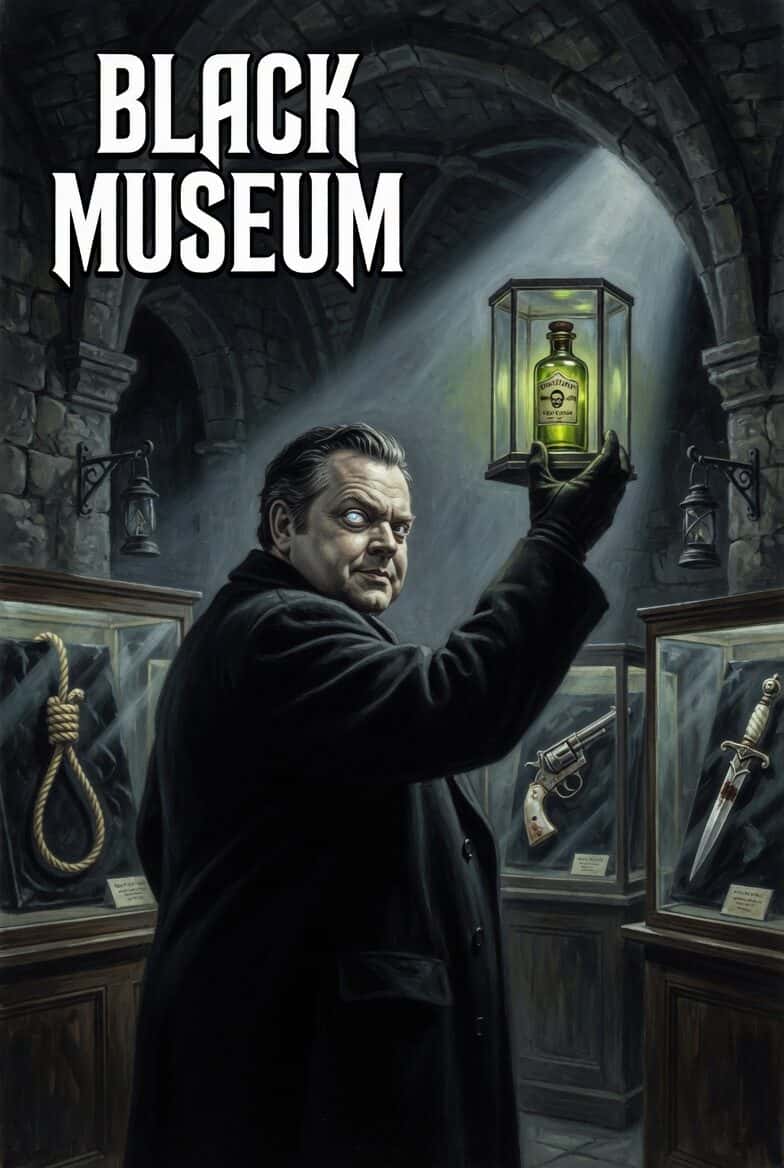
This is Orson Welles, speaking from London. From the Black Museum, a repository of death. Here in the grim stone structure on the Thames, which houses Scotland Yard, is a warehouse of homicide, where everyday objects, a piece of carbon paper, a tin ashtray, a broken teacup, all are touched by murder.
Now here's a woman's powder puff, faded pink. We'll open the glass case and take it out. There you are, sir. Perhaps madame would like to take it. Ah, you draw back. The lace is pitiful and torn. Across the puff itself is an ugly stain. Once it was dark red, but its progress through the biological laboratory has left it bleached and pitted, where small areas have been teased out and examined under the microscope. This sample belongs to blood group three. Are you sure? White. Group one is here as well. Blood groups one and three. That means there were two victims. Yes, the faded pink powder puff was used to gag two victims before they were brutally murdered. That's why it can be seen today in the Black Museum.
From the annals of the Criminal Investigation Department of the London Police, we bring you the dramatic stories of the crimes recorded by the objects in the Black Museum. In Scotland Yard's gallery of death, the Black Museum.
In just a moment, you will hear the Black Museum starring Orson Welles. The Black Museum starring Orson Welles. In the Black Museum.
Yes, beyond these stone walls, London throbs and is alive. But within these rooms, there's silence and death. It's very quiet. Under the frieze of death masks, the masks of criminals of bygone days, suspended grimly under the ceiling, we pass slowly along the rows of murder exhibits, not always frightening in themselves, but terrifying when considered in relation to their history. There's a matchbox. Here's a nail file. Each exhibit marked with the names of the killer and the victim. But our objective now is the powder puff. As it lies on the palm of my hand, let's turn back the clock and meet the man who used it for a grim purpose. His name, Richard William Hyson. The time, dawn on the morning of Friday, October the 18th, 1946. The place, Pentonville Prison.
This is it.
Is it, boys? Take it easy, Hyson. You've got about a couple of hours.
Give me a cigarette.
Oh, thanks. You're too kind. Oh, this is 20 days we've had in here, isn't it?
Yes, 20 days.
You won't forget me, will you?
No, we won't forget you.
Before I go, you must remind me to compliment the management. The food's been excellent. I can thoroughly recommend it to future guests. I've only one complaint.
What's that, Hyson?
The execution shed is too close. I'm sure I could hear the hangman practicing with the sandbag last night.
Nonsense. Here, have a wash.
After I've finished my cigarette.
All right, all right. No hurry. No hurry. Two hours. Two hours to go. Two hours in which to reminisce. I think I was right not to see my mother and father.
They wanted to see you.
Oh, that's because they remembered me as I was. Big, blonde, and handsome. But they never really knew me. I nearly killed a girl when I was 16.
Did you?
Yes. It was at a kid's party. After playing postman's knock, we got tired of that. And I suggested we should play... The popular parlor game of... Murder. Somebody commits a crime in the dark, and the rest of the party are supposed to discover the culprit. Young Richard Hyson entered into the spirit of the thing with zest.
Jean, you come with me. Let's go upstairs.
What shall we do?
Oh, never mind. I'll tell you. Let's go up while nobody's looking. Come on. Here's a box room. Let's go in.
No, I'd rather not. Let's hide here.
In you come.
No, dear. Don't be afraid. It's only a game. I'm putting this handkerchief in your mouth.
Let me go.
Now I'm squeezing your throat. Shut up!
Jean! Where are you? Oh, there you are. Where... My dick. Jean, what's happened?
You killed her!
It was fortunate for young Dick Hyson the girl was not dead. But she was hurt and badly frightened. The warders in the death cell listen to Hyson's prelude to murder in silence. But perhaps their eyes betrayed their emotions.
You're shocked, aren't you? Oh, give me the towel, will you? Oh, thank you so much. You make a good batman. Have you been in the services?
I was in the Navy.
Oh, interesting. That was the only service I was never in. I began in the Air Force.
Oh, so I believe. I'd better start dressing now.
I enlisted as a pilot. Fighter pilot. They gave me a commission, of course.
Of course. Here's your tie.
Oh, thank God. I had only one complaint about the Air Force.
Yeah? What was that?
The pay. So I volunteered to take over the mess funds. That helped. So did the uniform.
You'd better put on a clean collar.
I'm allowed a collar, am I?
That uniform certainly pulled him in.
Pulled who in?
Who do you think? Remember the case of the Air Force girl found in the burnt-out car in Suffolk?
So you were responsible for that, were you? How did it happen?
Now you're interested. Listen, boys, come on, gather round. I'll tell you about it before it's too late.
Richard Hyson could never bear to be anything but the centre of attraction. He could never tolerate a disinterested audience. Even in his last hours, he had to hold his listeners. But how much of the truth he told will never be known. Nevertheless, a pretty girl of 21 had been found dead in a car close by.
Looking after the mess funds. Five or six years previously. And he told his warders how he had stopped her on a lonely road. While she was driving a staff car.
Want a lift?
Oh, that's very nice of you. I'm going into Ipswich.
Oh, so am I. Jump in.
What's your name?
Parker, sir.
And your first name?
Joyce, sir.
I'm Richard Hyson. And you can call me Dick. And drop the sir.
Um, I think I've met you before.
Oh, I've seen you, too. At the commandant's.
Yes. Yes, it might have been.
Well, it was. I've been thinking about you ever since, Joyce.
Oh, I don't believe a word of it, Mr. Hyson. Dick.
Look out. Watch that bend.
Oh, I'm sorry.
Oh, never mind, sweetheart. I've got nerves of steel. But I'd be happier if you'd let me take over.
Yes, perhaps it would be a good idea. Thanks. Oh, don't bother to get out. I'll get out my side.
Well, I must say, it is nice to be driven for a change.
Good. What are your plans after you've dropped the car into workshop?
As a matter of fact, I'm feeling rather good today. You see, it's my birthday and my mum sent me a very nice present this morning.
Well, many happy returns. How old are you?
Twenty-one.
Congratulations. She's 21 today. Twenty-one. What is your name? Eric. Eric. Eric. Eric. Harry. Harry is the name. Yes. Yes. You're the most important person in the world. Yes. The greatest. Yes. Won't you, perhaps, help me out now?
Sure, I'll help you out. Bob. What did they send you?
Money.
Oh, that's always the most sensible gift.
Yes, it is, isn't it? I say, are we on the right road?
Yeah, I think so. Hey, we're not, you know. We're right off the road now. Hey, stop. Hey, I thought you were supposed to be a good driver.
So I am. Come here.
No, you've made a mistake. I'm not that sort of a girl. Let me go.
Yeah, you would, would you? You're mad. Where's the money?
Oh, here. Here, take it. Now let me go, please.
Oh, no. Please let me go. I promise I won't tell.
Hyson had no intention of giving his unfortunate victim the opportunity to tell. He had exceptionally large, powerful hands, his fingers being an inch across the joints. There is no doubt that poor Joyce Parker was helpless in his grip. And when it was all over, he put her behind the steering wheel, started the car, and set fire to it. When the flames had a hold, he jumped off the running board from where he'd been steering, and the blazing car, together with itself, and his pathetic little passenger, plunged on until it crashed over the edge of a gravel pit. The crime had every appearance of being an accident. And Richard Hyson went to the pictures alone that night, all expenses paid. He hadn't yet left behind any vital clues, such as might be seen today in the Black Museum.
In just a moment, we will continue with the Black Museum, starring Orson Welles.
Now we continue with the Black Museum. Now we continue with the Black Museum. Now we continue with the Black Museum. Now we continue with the Black Museum. Now we continue with the Black Museum, starring Orson Welles.
We return to number two death cell in Pentonville Prison.
I was cashiered from the Air Force quite soon, and they found out about the mess accounts. So I joined the army as Paul Colton.
Yes, we know about that.
I built up a new history for myself, and being a pretty useful type, I got a commission. That was in the early days of the war.
Yes. I probably wouldn't have got a commission later on. They started going into too much detail.
How long did you keep the...
The Army Commission. About a year. I lost it in the Middle East. That was really rather amusing. I was visiting the mess of HQ when I heard the general talking about selling his car before he was posted to a new command. That gave me an idea.
Excuse me, sir.
Yes?
My name's Colton, sir. I'm sorry to hear you're leaving the command. I wonder whether you might be thinking of disposing of that private car of yours.
Do you want to buy it?
Yes, sir.
You'd better have a word with my ADC.
Smell this.
Yes, sir.
Mr. Colton here wants to buy the car. Sort it out with him, will you?
Of course, sir.
And 2nd Lieutenant Colton, alias Hyson, wrote out a cheque for £100, which was exactly £100 more than he had in the bank. That cheque bounced quicker than a golf ball. But I'd sold the old man's car even quicker and spent what I got for it. So, bang went commission number two.
Yes, they cashiered me. Which I told them I thought was rather hard. A first offender.
First offender?
Well, in the army, yes. But instead of coming home, I dropped off the ship in South Africa. I joined the army there. And believe me, it wasn't long before I got myself posted to England. That meant London for me. And those certainly... Don, I'd like you to meet Muriel. Donald Smithers, Muriel Gertrude.
Oh, hello there. And what are you drinking, Muriel?
Scotch and water, thanks.
Oh, tough baby, eh? Well, good for you. Aye, steward, a very large scotch and a very little water for a pretty girl.
You're quite a son of a gun.
Believe me, ma'am, I've had to be.
What are all those medals on your chest?
Oh, Distinguished Service Order. And this one, I know. The Distinguished Flying Cross.
Right, baby. I don't know these two.
Oh, the Croix de Guerre. I got it flying with the Free French. And that's the OBE, Order of the British Empire.
My, you're a hero.
Oh, you must have a drink on me.
Donald Smithers, alias Paul Colton, alias Richard Hyson, had made the first vital mistake, which was to lead him to the scaffold. Needless to say, he was not entitled to any of those decorations. And he had sewn the ribbon of the OBE in the wrong place on his tunic. And, although he was still a captain in the South African Air Force, he was wearing the uniform of a Lieutenant Colonel. These points were noticed by an observant officer in the Royal Air Force who passed the information on to the security police. A rapid checkup followed. Hyson was court-martialed and cashiered for the third and last time.
Now, he lived on women. During one short period, he was engaged to be married to no fewer than nine. And each one financed him to a greater or lesser degree. And that took quite a bit of staff work, keeping them apart. But there was one I quite liked, Doreen Wimson.
You'd better get on with your breakfast.
Yes, time flies. Doreen was a honey. Somehow, I never managed to get her alone for anything. Pass the salt, will you? Thank you. I shouldn't have bought her that powder puff.
You made a mistake there, Hyson.
They all do.
What do you mean, they? I'm unique. Remember that.
The night I gave her the puff, we had a row. She wouldn't come back to the hotel with me, so I snatched back the powder puff while she was using it and walked out on her.
So, Doreen Wimpson was saved. I was pretty annoyed. I never did take to a brush-off. So, I hung around outside the club, where I'd met Muriel Girton. And I didn't have long to wait.
Muriel? Who's that? Why, Donald Smithers. Hello, honey. Come and have a drink.
Okay. Let's go up to the club.
Well, I haven't any money till the morning.
That's all right. I've got plenty.
Have you? I don't believe it.
Then look at this.
A handbag opens, stuffed with notes. The fate of Muriel Girton is sealed.
Look, sweetheart. I'm not the type of man who takes money from a pretty girl. Not even from you. If you'll come back to my hotel, we can get all we want on my bill.
So, back to the hotel in South Kensington. And at the last moment, Hyson stopped abruptly, as if struck by a sudden idea.
We'll have to go gently, honey. I just remembered. They won't serve drinks to visitors after hours. We'll have to go in the back way, where we won't be spotted.
So, in they went. Not into the hotel where Hyson was staying, but into another one where he had stayed sometime previously. Hyson knew the geography of the place perfectly. He took his unsuspecting victim through the deserted trade entrance and up the servants' staircase to the first floor, where he found an unoccupied bedroom.
Okay. In you come.
Thanks. Donald, are you sure this is your room?
Of course. Why?
It looks so empty. No clothes, nothing on the dressing table.
Well, I'm naturally a tidy person. Let her come and sit down. This was an invitation to a drink.
No, there are better things to do than drink. Come on, sit down.
Now, look here. I may be tough, but I'm not...
Sit down.
Why, you beast. I'll scream.
There's a present for you. Powder puff in your mouth. That'll keep you quiet. Now, my beauty, I've got you exactly where I want you.
Again, those big, strong hands did their dreadful work. And when it was all over, Hyson removed the impregnated gag from his mouth, took her money, and returned unseen to his own hotel, where the chambermaid awoke him from a sound sleep at eight o'clock the following morning.
Morning, sir. Not a very cheerful one, I'm afraid. I'll pull back the curtains. Oh, it's pouring outside. And nasty and cold. Now, drink your tea while it's hot. And here's your newspapers.
Eh? Oh. Oh, the papers, yes. Oh, thanks. Thanks very much.
Not at all.
Papers. Now, let me see. Woman found strangled in small hotel. Murder in South Kensington. Police are making widespread inquiries amongst the deceased's friends and acquaintances in the hope of tracking down the murderer. The staff and members of a well-known Kensington club are being questioned this morning.
They are, are they? Then the chances are that the swine who split on me to the South African War Department is going to open his mouth again. He'll remember I was with her. I must get out of London quick.
It so happened that Hyson's panic was needless. The RAF officer was posted now and he didn't come forward. Neither did the man who had introduced Hyson to his victim. But the scientists at Scotland Yard were becoming interested in traces of pink wool, which they found in the dead woman's mouth.
There's no doubt we've got particles of face powder on this fragment. So the murderer must have gagged her with a powder puff of all things. But her own powder puff, which is white, was still in her handbag. It's still in her handbag. That means the puff which was used by the murderer was taken away by him. The fibres are quite new. There's no dust on them and the powder hasn't had time to get into the material. Well, there's a thread of lace here, too. We'd better let the superintendent know right away.
Superintendent Brandreth of Scotland Yard was then faced with the tremendous task of trying to trace an unknown man who might have bought a pink powder puff with lace trimmings. The information and the request for assistance were published in newspapers throughout the country. And Hyson read about it in the seaside town of Eastbourne. For the first time in his life, Richard Hyson panicked. In a split second, he saw the net closing in. He reasoned that Doreen Wimpson, the girl he'd bought the powder puff for, would very soon tell the police. If he was caught, he must plead insanity. To establish insanity, he must commit another murder. And this time, there must be no motive. So that night, on a deserted street on the outskirts of the town, he waited for an unknown victim. It was dark. The few houses were scattered well back from the road. For nearly an hour, nothing stirred while murder waited to strike in the shadows.
Go back, little girl, go back. Oh, she must come on. He's waiting with those big, strong hands. Tense. Becomes a gag for the second time. The deed is done.
I might have got away with it, if Doreen Wimpson hadn't remembered the powder puff.
She identified it, didn't she?
Yes. I knew she'd get me.
The chaplain's here, Hyson.
Tell him to go to blazes. I'll be waiting for him. Got another cigarette?
No, thanks. I was picked up by the police the next day. Even then, I nearly convinced them that they'd got the wrong man. They held me from three in the afternoon until two the next morning, before I told them I was Richard Hyson and proud of it. But still, they couldn't really prove I'd killed the two women, until they had my coat pocket examined in the laboratory. Then they found traces of face powder and little shreds from the puff in it. Tough, that.
Tough, wasn't it, Padre? Why, what are you looking so mournful about? I'm the one to worry.
Ah, so the hangman's here at last.
Yes, Hyson. It's nearly over.
Well? If nobody's going to say anything, I will. Come on, boys, get the straps on and let's get going.
And so Richard Hyson is led to his appointed place on the trapdoors of the scaffold. A white bag is slipped over his head. The rope lodges under his chin. And while the chaplain intones the service of the dead, the trapdoors open and Hyson goes fluttering down into the dark cavity below. Justice has been achieved. And all because of the faded pink powder puff, which can be seen now in the Black Museum.
Orson Welles will be back with you in just a moment.
Now here in person is Orson Welles. Hyson loved the limelight, and he was nothing if not bold. He did serve in the Army and the Air Force, but his decorations and his tales of gallantry and action were all lies. He lived on lies, forever hoping that they would never catch up with him. But one by one, they did. And with them came the evidence. From the bad check he gave to the General in the Middle East, to the pink powder puff he gave to the one girl he admired. He hoped, of course, that the world would believe him to be insane. That would have spared him the final horror of the scaffold. And he might have been alive today in the grim fastnesses of Broadmoor, the criminal asylum. Was he mad? You've heard the story.
So another chapter of murder is made. The door is closed, and the little pink powder puff, faded now, has its place in criminal history. And now until we meet next time in the same place, I tell you another story about the Black Museum. I remain as always obediently yours.
The Black Museum, starring Orson Welles, is presented by arrangement with Metro-Goldwyn-Mayer Radio Attractions, with original music composed and conducted by Sidney Torch. Produced by Harry Allen Towers.
The Black Museum, starring Orson Welles, is presented by arrangement with Metro-Goldwyn-Mayer Radio Attractions, with original music composed and conducted by Sidney Torch. Produced by Harry Allen Towers.