
The written record
Read the transcript
Read along with the recording · About 18 min to read
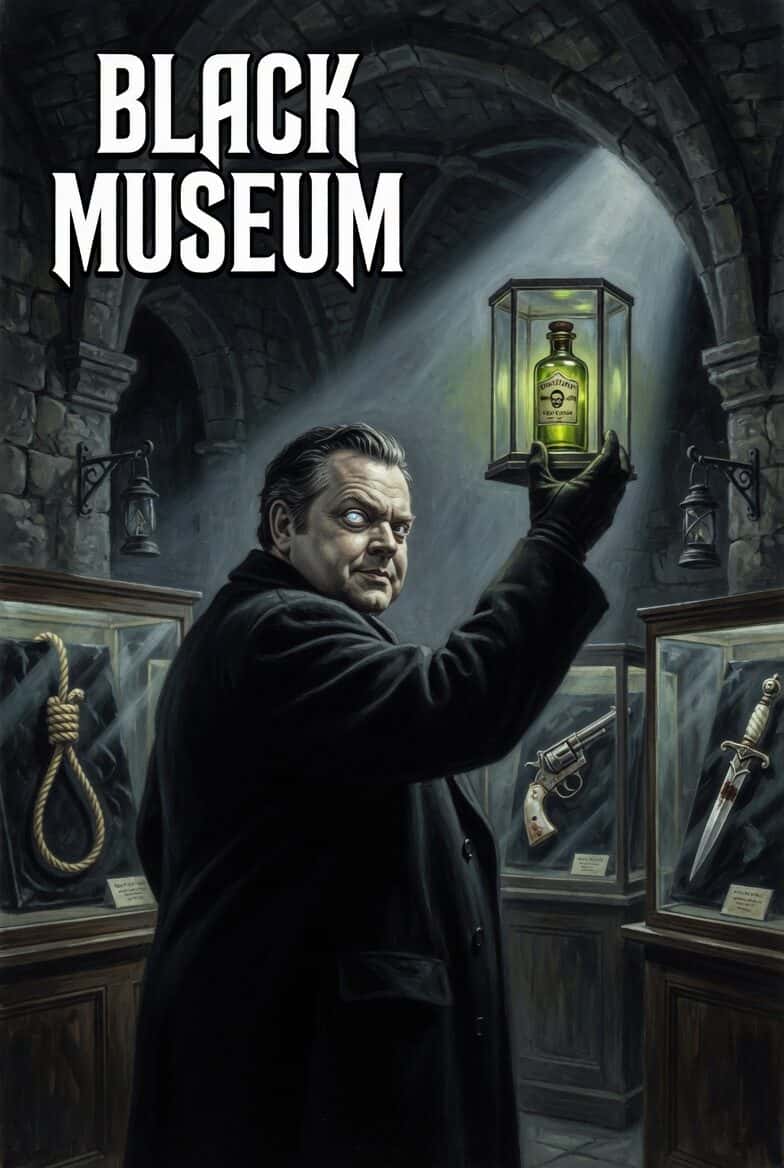
This is Orson Welles, speaking from London. The Black Museum. Here in the grim stone structure on the Thames, which houses Scotland Yard, is a warehouse of homicide. Where everyday objects, a flower pot, a coffee cup, a curtain rod, all are touched by murder.
Here's a shilling. This is a familiar object, a shilling. It's a coin of the realm. So much silver alloyed with harder metals for purposes of wear, milled, edged, engraved with the face of a British sovereign. Very familiar object indeed.
"It's a lucky piece, all right, Inspector."
"Lucky for you, Bob."
"That's just what I mean, sir. Shillings don't buy much these days. But this one bought plenty."
The Black Museum starring Orson Welles. Here we are in the Black Museum. Scotland Yard's museum. The Black Museum of Murder.
Now here's a small radio. Made for entertainment, for obtaining all the sounds that reach out through the ether, the air. Think for joy, for pleasure. But note the little wires protruding here, connected to the switch that turned this little sound box on. The man turned that knob, as was his habit. The little extra wires conducted current to an explosive. The man died. Later, he was followed to death by his murderer.
All right, here we are. Here's the shilling. Subject of our story. Some tarnish still, gleaming silver. Without a doubt, it passed through many hands. Reposed in pockets and purses.
And then one day, a telephone rings. So many things are heralded by that sound. This one rings in an office in the yard. Two men interrupt a desultory conversation. One of them picks up the instrument.
"Inspector Graves, office."
"For you, Inspector."
"Thank you, Sergeant."
The inspector listens briefly, acknowledges the message, hangs up the telephone.
"Well, well, well."
"Trouble, sir?"
"Not yet. Just an interesting bit of information. Remember Joey Barth?"
"Dartmoor, isn't he?"
"Not after tonight."
"Oh, is it that long since we sent him away?"
"Time off for good behavior. He gets out in the morning."
"Wonder if Brother Davey knows."
"Same idea crossed my mind. How do you suppose it feels, Sergeant, to know your brother is getting out? When you've taken over his business, bar, band, and bottle club, and your brother believes you framed him into Dartmoor."
"There's a word for it, sir."
"Uncomfortable."
That, of course, is an understatement, particularly when it's well known, both to the underworld of London and to the police, that Brother Joey has sworn to get Brother Davey as soon as such action is possible.
Now, obviously, no self-respecting police force appreciates murder. Follows then that certain precautions must be taken.
"Sergeant, will you arrange for a 24-hour detail to stay with Brother Joey from the moment he leaves the hospitality of Dartmoor tomorrow?"
"Yes, sir."
"And advise the station house, which covers Brother Davey, as well as Brother Davey's rather disreputable club, that Davey is expecting company."
"Yes, sir."
"I'd rather like to be there, you know, when Joey tells his brother he wants the club back, and his share of the earnings of these past six years."
Yes, it must have been quite a meeting. Took place, of course. No question about that. In fact, no attempt was made to prevent it. The police knew when it happened. They knew exactly when Joey Bart walked past the uniformed doorman into the nightclub in question. They so reported to Inspector Graves.
It was some 45 minutes later, that his telephone rang once more.
"Inspector Graves, office."
"Just a moment. Smythe, Inspector. He's on the Bart matter. I'll take it. Yes, Smythe?"
"Where's Joey?"
"Gone, sir. We saw him go in. We didn't see him get out."
Oh, a self-respecting police force does not appreciate murder. When the murder is committed while policemen are on watch outside the scene of the crime, it is appreciated even less, if possible. Therefore, action is required.
"General alarm for Joey Bart. Description is available. Yes, sir. Yes, sir. Close that club, and I'll hold the customers from the start until I get there. Let's go, Sergeant."
All the resources of a great police department spring to life. And soon the Inspector and Sergeant Maxwell are at the scene, viewing the body of David Bart through the hole in his chest.
"Yes, that's Bart, all right. All right, Smythe. Let's have it."
"Well, that's just the way we found him, sir. Sprawled like that. Gun near him. Nothing's been touched except a check for fingerprints."
"Pictures been taken?"
"Yes, sir."
"Coroner been here?"
"Yes, sir."
"All right, take him away. Sergeant."
"Very good, sir."
"Print on the gun?"
"Only the dead man's. Just the one set."
"There he is. Medical report?"
"Shot at close range. Powder burns."
"It's a .38 automatic. I can see that. Anything else?"
"Well, there's a wall safe. It was searched."
"What's this?"
"It's a shilling, sir."
"What's it doing here?"
"It was lying there on the desk when we got in, sir. The lights were on, and it was shining in the lamp."
Quite clear, wasn't it? A killing. An ex-convict disappeared, open and shut. Simple. Still, the evidence... Evidence must be collected with a view toward the eventual trial.
"You're George Lyons."
"Yes, sir."
"You have a record."
"Well, I went away once. Three months. Attempted robbery."
"Since then?"
"I worked for Mr. Bart."
"Doing what?"
"Oh, sort of his assistant."
"Yes, I know what you mean. All right. What happened here tonight?"
"Well, Joey came here, and the boss told me to let him in. Joey told the boss he needed money. The boss said he didn't have any. They started to argue. That was when the boss told me to wait outside, and I did."
"You heard anything?"
"Oh, the place is... soundproof, Inspector. The inner thing."
"Why did you come back inside?"
"I took a chance. Seemed like an awful long time when Joey didn't come out. I found him. The boss, I mean."
"What do you know about this?"
"Hey, that's the boss's lucky piece. When Joey asked for money, the boss took it out of his pocket and told him it was all the money he had on him. That's when Joey said, I ought to kill you for that. Only your life ain't worth a shilling."
Build the case. Interview the employee. First, the doorman.
"Well, I was kind of surprised, Inspector, but Mr. Bart said let Joey in the club when he showed up."
"Why?"
"Why, everybody knows, sir. Joey thought Mr. Bart framed him to get the club away from him."
"So you let him in?"
"So I let him in."
"See him leave?"
"No, sir. He must have gone out the back way, through that door. It leads out to the kitchen and the dressing rooms. There's a rear exit, sir, out in the alley behind."
Now, it's the turn of the kitchen help. The man in the best position to notice anything is the second cook.
"Yes, sir. That's my position, opposite the door."
"Did you see anyone go by tonight?"
"Only waiters. And the girl in the show."
"The girl in the show?"
"Yes, she has a dressing room in the hall. She sings. Her name? Miss Fair. Mitzi Fair."
"Get the girl, Sergeant."
"Yes, sir."
"You at your station all evening?"
"The chef, he called me over to taste his dressing. Only once. All the rest of the time, I..."
"Yes, and you must have missed anyone who went through the hall during that time."
"Well, it was only a minute."
"That would be enough. All right, leave a name and address for the constable on..."
The henchman, Lyons, saw and heard nothing. The doorman was too far away. The kitchen help were too busy. Still, everyone seemed to have known that Joey Bart was there that night. Everyone, including the girl in the show.
"You sing in the floor show, Miss Fair, is that it?"
"Well, I am the show, you might say. Or was."
"Yes, was. The club is closed. You'll need another job."
"Thanks for the two weeks' notice."
"We can do without that. What do you mean, I am the show?"
"I am the show. I am the show. Well, I sing. With a piano. When the band rests. There's no line, no comics. This place is too small."
"I see. What's your background, Miss Fair?"
It was the usual shabby story, the early ambitions, the voice that failed to make the big time, the small jobs, to make a living, and the eternal hope for the break. Then the steady work in the club.
"Any particular reason why Dave Bart kept you here so long?"
"If you mean what I think you mean, there was nothing like that."
"Did you know his brother?"
"Well, only to hear Davey talk about it. I came here after Davey took over."
"Your dressing room is out there, off the hall."
"If you can call the six-by-ten rat-trapper dressing room, yes."
"See a stranger tonight?"
"Not tonight."
"Other nights?"
"Maybe. Maybe not. And if I had, I'd know better than to talk, Inspector. Davey operated within the law, as far as I know. But I've been around, Inspector. And if I knew anything, chances are my life wouldn't be worth that shilling."
"Ever see it before?"
"Looks like any other to me."
"I'm told it was Davey Bart's lucky piece."
"Was it? Well, I wouldn't know. With me, a shilling's a shilling, and they don't come my way easy."
Now, today, a shilling can be found in the Black Museum. In just a moment, we will continue with the Black Museum, starring Orson Welles.
Inspector Graves waited in his office at Scotland Yard for the report he knew was inevitable. That Joey Bart had been run to earth. This was routine. Meanwhile, he sifted facts.
"What, Sergeant? And Maxwell?"
"Nothing to it, Inspector. It's Joey. It couldn't be anyone else."
"Say that in court, and a smart lawyer will prove it could have been any one of a dozen people. Reasonable doubt, that's all."
"But Joey said he'd get his brother once he got out."
"That's not evidence, and you know it, Sergeant. There's plenty of evidence of the gun, for instance. Davey's gun, registered, with only Davey's prints on it. The doorman saw him go in. Lyons was there at the beginning of the fight. The open safe."
"With nothing stolen."
"At least plenty of money in it, and Joey came for money."
"He left by the back way."
"Well, no one saw him. No one saw him go out. They could have missed someone else coming in. Our case is full of holes, Sergeant. It's not the kind I want to go into court with."
You see, it's one thing to be certain in your own mind that someone committed murder. It's another thing to prove it in court, where your facts are subject to attack by lawyers, subject to the workings of 12 minds in the jury box, subject to the judge's interpretation of reasonable doubt. The Inspector knew this.
Perhaps this time.
"Graham speaking. We've found Bart. He's holed up in a tenement. In the East End. 409 Ellison. One of those places cut up into one-room flatlets. He's in the third floor rear."
"Set the cordon, Smythe. Seal the place. Don't go in until I get there."
The quarry run to earth. His hole sealed, front and rear, by the cordon of police. The Inspector arrives.
"All under control, Smythe?"
"Yes, sir. He won't get out the back way this time."
"Good enough. Let's go in."
A small, tight group gathers around the Inspector. Smythe, Maxwell, several uniformed constables, all are armed. They enter the tenement. Some shackled buildings, start up the rickety stairway. Somehow this place escaped the holocaust of Hitler's bombs. It's old, dirty, dangerous. The landings are illuminated by fitful light from flickering yellow electric bulbs in fixtures that once held gas burners. The third landing, the group stops. Splits up. Each man takes his station, one to each side of the doorway. The officer with a gun in position to shoot off the lock on the scaly door. The Inspector with Sergeant Maxwell and Detective Smythe facing the doorway.
"Here it goes. Unit!"
"Do you know who it is, Bart? Police! Open up!"
"Come in, gentlemen. Come in."
"Check him on this, Arden."
"Yes, sir."
"Oh, nothing on him, Inspector. No weapon."
"Very well."
"I could have told you that. No guns for me, Inspector. I'm glad you got here first, though. I thought maybe it was some of Davey's boys with the same idea you have. But I didn't kill him. Not much sense killing the goose with the golden eggs, is there, Inspector?"
They took him to the yard. Held for questioning, the record said. The questioning was sharp and to the point.
"What did you get from your brother?"
"A hundred pounds to start."
"That was all?"
"Oh, he argued first, but I got good and sore."
Told him his life wasn't worth the shilling he threw at me.
We know about that.
Yeah. George Lyons was still there. After that, they threw him out. Then I told Dave I could prove he'd framed me. He acted like he believed me. Told me I'd be a fool to take the club back after the way he'd built it up. Said he'd cut me in for plenty. He went to the wall safe. Took out a hundred quid and gave it to me as a down payment, sort of. Of course I took it. And took his shilling, too. Told him he'd get it back when I figured he was going to be regular on the payoff.
You took his shilling?
Yeah, here. That's it. He had it since he was a kid. See that nick, isn't it? He got that putting it on a railroad track so the train could run over it.
Sergeant, bring Lyons and the Fair girl down here.
Yes, sir.
You see anybody in that back hall about?
Nobody. Dave said to go out that way, and I did. I wanted a little privacy, you see. Your boys were with me all the way to the club from Dartmoor.
You hear anything in that hall?
Only the pans in the kitchen. Now, look, Inspector. I didn't kill him. Why should I? He was paying off. Nobody kills a guy who pays.
Maybe. Maybe not. Outside, Barton. Wait there. I'll see you again later.
An accommodating ex-convict, to say the least. And willing to talk.
Willing to talk his head off.
The Inspector was puzzled. This was not part of the usual pattern. The puzzle seemed deeper when Mitzi Fair told him.
That shilling? No, that's not Dave's. Dave's was the one on the desk. I watched him play with it lots of times.
You're certain of that?
I'm sure. Positive.
And the puzzle seemed deeper still when George Lyons said.
Yeah, I remember now. That nick in the shilling. Hey, Inspector. If Joey had this shilling with him, who put the other one on the desk?
Know something, Lyons? The answer to that question could be very interesting. Very interesting indeed.
A whole new avenue of inquiry suddenly opened up. Suddenly became possible that Joey Bart had not been the last person to see his brother alive.
It's a matter of who is telling the truth about those coins, Sergeant. If Lyons and Bart are, then the girl is lying. If the girl is honest, then Lyons and Bart are both lying.
How do we find out, Inspector?
We take our time. And we let Joey go, for the time being. With a continuous watch on him, of course. Arrange for it, will you, Sergeant? I want a little quiet. I've got some thinking to do.
The Inspector had his peace and quiet briefly. Shortly thereafter, he adjourned to the Padlock nightclub with Sergeant Maxwell and Detective Smith.
Yes, sir. I saw him to provide wall-to-wall carpeting. I hate tearing up floorboards.
Well, it helps for soundproofing. How are you coming along the wall, Smith?
Nothing hollow. Soundproof tiling under all the draperies.
Hello? Here's something. Back at the couch, Inspector. Bobby pin. Blonde.
The singer's a blonde?
Too bad she's not the only blonde in London. If she were, we'd have to prove she dropped it after Joey left this office.
Nothing doing on the walls, Inspector. Next?
The desk. Take it apart, if necessary.
Yes, sir.
Dave Bart. Dave Bart. You look too honest, Sergeant. There's a reason for soundproof offices. And if there's any record of that reason, it'll be here, someplace.
Well, the girl said something about visitors, back-door visitors.
I know she did. Hello. Here's something. A false bottom to this drawer. It measures six inches deep on the outside, and only four and a half on the inside. Sliding panel? Probably. Sounds hollow enough. Here it is. The bottom slides back when you press this nail head. A couple of letters.
Letters, here. The record book. Good work, Smith.
Well, Mr. Bart was methodical. Record of payment to the witnesses who swore his brother into prison. Income from various enterprises. Letters. Well, well, well. Enough there on the girl to keep her working for free the rest of her life.
To say the least.
Then it's the girl, Inspector. Or Joey. Or both. Or neither. Lyons. There's a great deal on him, too. His 90-day sentence seems to... cover up a small item which could have meant ten years. Apparently, several people were interested in the sudden death of Mr. Dave Bart. Shut the drawer, Smith. Leave everything as it was, except for the papers. We'll take those. And as we leave, Sergeant, suppose you forget to snap the lock on the front door. Understand, Sergeant?
Yes, sir.
It was neat. Neat and simple. The bait, of course, was the contents of the drawer. Three people were interested in what it contained. And, given an open padlock, the opportunity to search. The magnet, which was the letters and records in that desk, should draw at least one person back to the room where someone had killed Dave Bart and left a shilling on the desk.
The Inspector waited. With him, Sergeant Maxwell and Detective Smith. And a dozen assorted detectives and constables. They waited in the silent, darkened nightclub behind the door with its open padlock. They waited in the dark hallway near the kitchen, among the piled-up tables and chairs in the main room. They waited in the echoing, empty club. Waited for the sounds they knew would come. Sounds which did come when the safety of night shrouded the street outside.
The door, Inspector.
I heard it, Sergeant.
Yes, they heard the footsteps. Light, then bolder, more confident, as eyes became accustomed to the gloom. A moment later...
The one, sir.
Shh. Quiet, Sergeant.
The first intruder was aware of the second. Quickly, now, the footsteps came into the main room of the club, crossed the dance floor. The first intruder... Suddenly, the second person broke into a run. Caught up to the first.
Thought you'd come back, eh? Tried to pin it on me, did you, with the second shilling? Now, listen outside the door, didn't you? That's when I came through.
All right, Smith. The light. Watch all this.
All right, Bart. Miss Fair, we'll take over now.
Smart coppers, eh? Sitting in the dark, waiting, eh? Take him over, Sergeant. Take him over. I told you once, Inspector, no guns from me. She's got one, though. In her bag. Tried to sock me with it.
Well, Miss Fair? Miss Fair, why did you plant that second shilling?
I knew George was in there. We joined me. This crack about the shilling. I went in after George left. I wanted my letter. David may be miserable enough with him, and we argued. He tried to threaten me with his gun. I grabbed for it, and it went off. I thought if there was a shilling, you'd think it was Joey.
Yeah, a woman. Every time it's a woman. Never mind, Bart. You can tell that to your friend.
Miss Fair, you're taken in charge.
And the charge?
His murder.
And today, the shilling, which was the main clue in this case, can be seen in an honored position in the Black Museum. Orson Welles will be back with you in just a moment.
Now, here in person is Orson Welles.
There was no premeditation. That was clear. And certainly, there was provocation. Mitzi Fair went away, convicted of manslaughter. Joey Bart eventually reopened the club, which had been his property in the first place. Seems to be going straight. Only time and the careful eye of the Metropolitan Police will know about that. Meanwhile, the shilling, contributed by Joey Bart, remains in its customary place in Scotland Yard, in the Black Museum. And until next time, we meet in the same place for another story about the Black Museum. I remain, as always, obediently yours.
The Black Museum, starring Orson Welles. Orson Welles is presented by arrangement with Metro-Goldwyn-Mayer Radio Attraction. The program is written by Ira Marion, with original music composed and conducted by Sidney Torch. Produced by Harry Alan Towers.