
The written record
Read the transcript
Read along with the recording · About 17 min to read
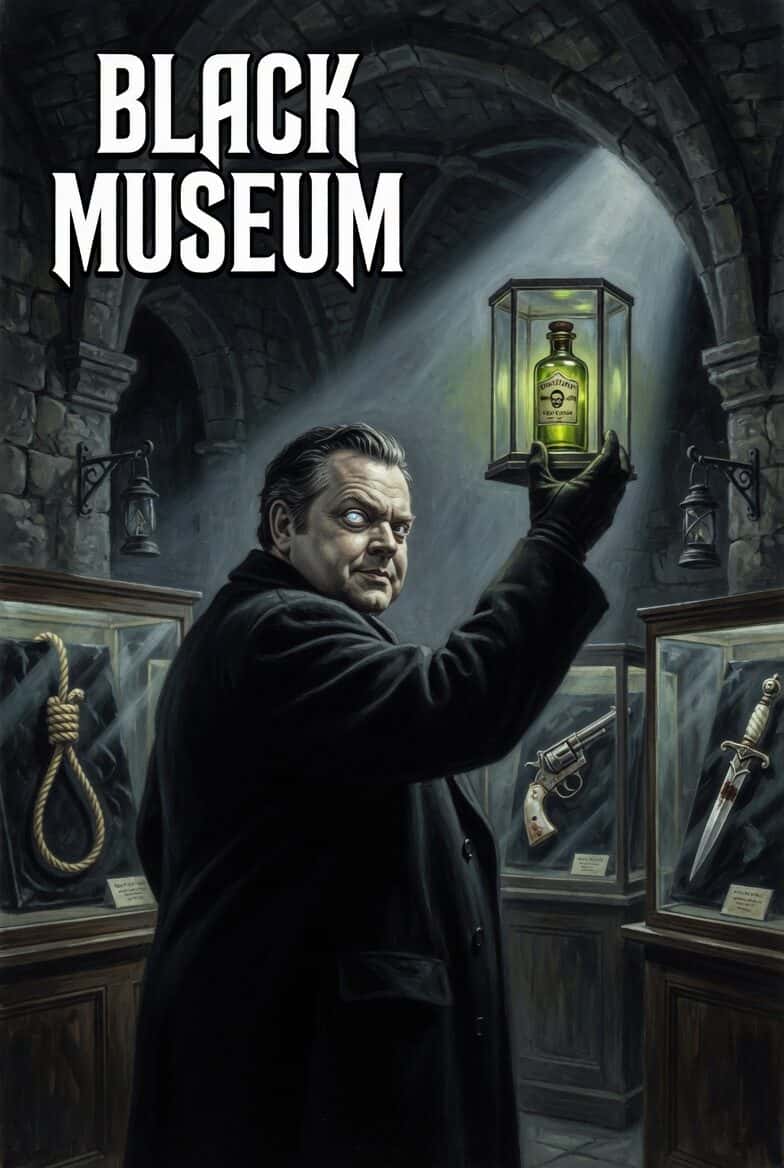
This is Orson Welles, speaking from London. The Black Museum. Here in the grim stone structure on the Thames, which houses Scotland Yard, is a warehouse of homicide. A warehouse where everyday objects, a salt shaker, a pair of scissors, an umbrella, all are touched by murder. A walking stick, silver-mounted. Maybe it's real ebony. A stick which might have belonged to your grandfather. It's that vintage, about 1865. A gracious era with crinolines and beaver hats.
Still harping on that walking stick of yours, Martinson?
I've stated a thousand times, and in public, this stick was given me by Garibaldi. I'm proud of it.
Well, it's not really my business, of course, but don't you think, Martinson, you ought to stop lying to yourself? Even if you don't stop lying to the gullible public.
That walking stick can be seen today at the Black Museum. From the annals of the criminal. The Criminal Investigation Department of the London Police. We bring you the dramatic stories of the crimes recorded by the objects in Scotland Yard's gallery of death. The Black Museum. Scotland Yard's mausoleum of murder.
And then I'm fascinated by the facts. Facts I've learned in this room. These silent witnesses to the act of murder. Now this is a plaster cast of a heel print. Found, it says on the small label, in a flower bed, outside the... ground floor window. Note the scratches and rubber heel. Those markings led a man to the gallows. With a steel file. Sharp-pointed, well-tempered. Meant for cutting metal cleanly. This file, which was not used to escape a prison. No, it was used to put a man in prison. This file became a weapon. Cut through human flesh and bone.
Ah, here we are. The walking stick. It came from Glasgow, more than 80 years ago. 1865. Its owner was Dr. Richard Martinson. An interesting fellow. Loved to give lectures, sometimes with lantern slides on places where he said he'd been.
This is Capri. Lovely isle in the Mediterranean. Loveliest of all the seven seas. Here, as you can observe, blue waters with a picturesque coastline. Adding thus...
He had the soul of a poet, apparently, this Dr. Martinson. And he was, according to himself, a great lover of liberty.
I knew Garibaldi, whose courage was as great as man can be. Garibaldi set freedom above life. He gave me my walking stick as a token of the high esteem in which he held me. All together...
Of course, there were those in Glasgow who were sceptical, and perhaps with reason. Capri, my foot. Martinson's never been out of the British Isles except for one week in Paris. And as for that Garibaldi nonsense, balderdash.
The discussions about his veracity didn't help Dr. Martinson's practice. This was something of a pity as the doctor had a wife who was chronically ill.
And how are we today, Sylvia, my dear?
As well as I can expect, Richard.
Have you had anything to eat today?
I don't have any appetite, you know that.
The tonic I gave you is to stimulate your appetite, dear.
Oh, I can't buy the tonic, Richard. I'm sorry, but I can't.
You make me feel rather inadequate, darling. Not only as a provider, but as a doctor. But as a doctor as well.
Oh, don't feel like that, Richard, please. It's not you. You're doing your best, I know.
I hope I am, my dear. I truly hope I am. It is a little strange. I'm the one who's ill, and I'm doing the...
But Dr. Martinson bore up under his trials. He bore up rather well. And then company came to stay.
Richard, I don't believe you're giving Sylvia proper attention.
Now, Mother Toomey, she's getting the best medical care available. And she still won't eat.
Richard, you're a fool. I won't have my daughter neglected. I won't have it.
You won't have it? So you suppose I enjoy it?
I've made up my mind, Richard. I'm taking over where Sylvia is concerned. First thing necessary is strength.
Oh, yes. Mrs. Toomey had come to stay a while, and she made her presence felt at once in the kitchen.
Evelyn, I want to make my daughter something light and tasty. Do you have any tapioca? There in the house?
And, of course, in the bedroom. Particularly in the bedroom.
Put the tray on the dresser, Evelyn.
Yes, ma'am.
Mother, what is it you're doing now?
Just rest yourself, dear. You may go, Evelyn.
Yes, ma'am.
Of course. But, Mother...
Hush, darling. Your mother's here now, and you're going to start eating at once.
Oh, Mother.
Night's tapioca. Light. Really tasty.
Oh, Mother, I can't. I won't.
Look, I'll put some sugar on it. Right from the bowl. There we are. Now, doesn't that look appetizing?
I can't stand the sight of it, really, Mother. I'm not a child.
Look, I'll eat some. Do you remember, dear, how I used to get you to eat when you were a tiny lass? By eating from your plate myself. Like this. Now it's your turn, dear. Come.
Of course it didn't work. Would it work with you? Of course not. Mrs. Toomey ate all the tapioca herself.
Evelyn, what's in the name of...
Doctor, he's taken so sick.
Who has taken sick, girl? My wife?
Oh, no, sir. It's Mrs. Toomey. She's taken dreadful sick. Moaning and groaning and all. She woke me up, she did. With the noise of it.
Richard, please. Is Mother sick?
It seems so, dear. Oh, please do something, Doctor.
All right. I'll go to her. Meanwhile, you get your coat on and run for Dr. Barclay on the high street. Hurry now.
Sir, I hesitate to treat my wife's...
That's quite ethical, you know. If you're a doctor, you don't treat members of your family yourself.
Dr. Barclay, despite his reservations concerning his colleague, honored his own Hippocratic oaths. He returned at once with Evelyn.
Oh, take my coat, girl. Where's the patient?
Yes, sir. In there.
Good of you to come over so quickly, Barclay, in spite of everything.
Our job, Martinson, is to heal the sick. Now, let me see the patient.
First, Barclay, I think you should see this.
Oh, where did you find it?
Near her bed. She reeked from the stuff.
Oh, then this is nothing more than an ordinary drug.
I would diagnose it as something more. She's been taking some of this, apparently.
Hmm, I know that sedative. Opium base. What's your diagnosis, Martinson?
Apoplexy. She's the choleric type, you know, apparently subject to these attacks. Now, if you'd care to examine the patient, Doctor, I should be glad to give you whatever assistance...
Barclay examined the suffering woman. She was prescribed a sedative and went on his way. He called again the next morning.
Oh, she seems to be resting comfortably, Martinson. She'll be all right in a day or two, I'm sure. If you want me, send her go.
The coolness between the two medical men remained. And succeeding events didn't tend to improve their relationship.
My mother. I'm the one who's sick. It must come to all of us, Sylvia. Your mother lived a full life. Now, she is at rest.
But I'm... I miss her. I miss her terribly.
The passing of her mother was extremely upsetting to Sylvia Martinson. Her husband, qualified physician that he was, used to the sight of death, seemed somewhat affected himself. His wife was not present to see him.
Evelyn, I want you to see something. This bottle. Remember it?
Well, of course, sir. I bought it from the chemist myself. Mrs. Toomey sent me. She said it was for sleeping.
When was that?
Exactly, Evelyn. Day before yesterday. The day she came. And the bottle was full then.
Oh, yes, sir.
And now... I can see for yourself, doctor. More than half the medicine's gone.
Exactly. And I want you to remember this, if there should be any question. Understand?
Yes, sir.
I've made out and signed the death certificate. Can you find your way to the registrar's office?
Oh, yes.
Go there, then. I'll give you a note. File this paper. I've certified the cause of death as apoplexy. Understand?
An obedient girl, that Evelyn. Not too bright, perhaps, but obedient. Very loyal to the doctor. In fact, her loyalty had a tendency to brim over at the edges.
I think he's a grand man. Grand. And why, may I ask?
Well, you only cook for him, Mrs. Bemis. You don't see him at the front of the house like I do. So... So considerate. So kindly. Have some more cheese, E.B.
Thank you, I will.
Now, this cheese. He went to the other end of the city for it. Just to tempt the madam to eat something. But she wouldn't touch any of it.
It's a husband's duty to care for his wife. A doctor does more than his duty. Spends all that time at her bedside. Tries to help her every way he can.
Hmm. Maybe it's because he's got so much time on his hands. Not having many patients and all.
Well, I'll have a bit more of that cheese myself.
I heard over the fence yesterday. Half the neighborhood is talking of what a prevaricator he is. With his walking stick from the Italian. Ha! Nonsense. If he says it was a gift...
Then you can be sure it was not.
Hmm. A great one for making up...
A bit of below-stairs gossip. A touch of the local scandal that kept patients away from the doctor's door. Just some gossip at the end of the servant's dinner. As they lingered over the cheese.
Poor sick Sylvia. She refused. Yes. The cheese.
Evelyn. Evelyn. My cabinet. Oh, where does the doctor keep his bicarbonate of soda?
I think in the medicine cabinet.
I don't feel so well, Matthew. I'll get it.
Oh, hurry. Oh, my stomach's that twisted. It must have been the cheese.
Oh, it did taste a bit tangy.
No hurry.
Oh. No. No. No.
Thank heaven the poor mistress refused to touch it. Thank heaven, yes. If I can find the soda. If I can find it quickly.
Another tiny piece of the puzzle. Another incident. The cheese which the wife refused. As she refused nearly every other food in the house. As she literally starved herself. Wasting away. Slowly. Slowly.
Oh. No.
I'm glad you called me when you... You did, Marteson. Your wife's in bad shape. Looks as if she hadn't eaten or slept in days.
Poor Sylvia. She's had gastric fever for months, you know.
No, I didn't know.
High time you called me. Here, send your old girl for this sedative. We'll get her some sleep. Then we'll try to take care of her properly.
You can't dodge truth with this doctor. As you do with your walking stick.
Oh, Mother. I see you. You're here.
Doctor. It's happening. He's talking to us.
Oh, Mother. It happens sometimes in the crisis of gastric fever. The patient has hallucinations induced by weakness.
Oh, Mother. Help me. I'm... I'm afraid to die.
Oh, Doctor. Can you do nothing?
Doctor. No. Sylvia. No.
Dr. Marteson's grief seemed genuine. How much of everything was play acting? And how much was truth? The answer to that question lay in the doctor's own hands. In the shape of a walking stick. That same stick that can be seen today in the Black Museum.
They took Sylvia Martens in Edinburgh to her own family. To place her with her mother. Her heartbroken husband took the long, slow journey. And it was long and slow in 1865.
At the church.
No. It isn't so. I... I cannot accept it. I cannot.
Wait. Wait. Wait. Before you take my beloved away. Let me kiss her. Sweet lips once more.
A trifle overdone, don't you think?
Well, perhaps it was sincere. However, the emotion was not considered unseemly. However, other things were considered so. And people at times made it their business to call the attention of strangers to such happenings.
Here's a peculiar business, Stuart. Just another letter, Sergeant.
A crank, I'd say.
I'd like to think so. But this fellow seems to know what he's talking about.
Are you certain it's a man, Sergeant? Do you notice the signature? Amicus judiciae. Friend of justice. Masculine. A man.
Ah, uses a foreign language. Latin. That's what it is. Latin. I thought only doctors knew Latin. And chemists. To read the prescriptions the doctors write.
You haven't read the letter yet. Read it, Stuart. Read it carefully.
Gentlemen of the police. It appears to me that a man who falsifies the way he obtained a walking stick and creates fantasies of trouble. Troubles he never experienced may well be a subject for suspicion in other matters.
Odd? Why?
Go on. Keep reading.
The man whose fabrications have entertained some and bored a great many more is the same man whose mother-in-law died some few weeks ago under rather strange circumstances at his house in Sauchiehall Street.
Yesterday, this man's wife also died. Under strange circumstances. This man is Dr. Richard Martinson, and it is the writer's belief that a thorough investigation can be only of benefit. Either it will restore public confidence in a man of medicine, or it will uncover a murderer. Amicus judiciae.
Well?
They never found the writer of that letter, but in the Martinson house which was searched, Warren provided the great deal of thoroughness while Evelyn Warren looked on.
Found this, Sergeant. Medicine bottle.
Oh, nothing particularly out of the ordinary about that in a doctor's house. Or is there now? Is there, my girl?
Oh, no, sir. Nothing at all. We have dozens.
Hmm. All with the label? Sleeping draught? Mrs. Toomey is directed? All of them?
No, sir. Only one. That one.
Not much left in it, is there? Anyone been taking it?
Oh, no, sir. The doctor was very definite. No one.
He showed it me just after the old... Mrs. Toomey passed on.
Stuart.
Yes, sir?
I want an analysis of the contents of this bottle, and I want a copy of the prescription from the chemist who filled it.
But there couldn't be anything wrong with it, sir. I fetched it from the chemist's shop myself.
Oh, you did, girl. Good. Then you can take us there.
The analysis was over quickly enough. The report was quite brief.
Here it is, Sergeant. Ten percent mineral poison antimony. Sufficient to kill a strong man, let alone an elderly lady.
Next stop, the chemist, where Evelyn Warren had obtained the sedative.
My name's Pine, sir. Sergeant Pine, CID, Glasgow Police.
Yes, Sergeant. Do you know this girl?
Not by name, sir. But you are Dr. Martinson's maid, aren't you?
Yes, sir. For him.
Good enough. Perhaps you'll tell me what was in the sleeping draught the girl had here.
It's a standard mixture, Sergeant. Some opium, not very much. We sell only small quantities. Some people have been known to boil it, evaporate the other contents to get at the opium itself.
Any mineral poison antimony in it?
Poison? Quiet, girl. Well, sir?
That's tartar emetic you speak of, Sergeant. There'd be nothing like that in our sleeping draught.
You're positive?
Oh, yes. Of course, Dr. Martinson did obtain some of the emetic from us, occasionally, in the past few months.
Enough to cause death?
He's a doctor, Sergeant. He'd know how and when to use it.
The telegraph wires. It was 1865, remember? Harmed between Glasgow and Edinburgh. Edinburgh Police C.I.D. official. Request exhumation order and autopsy. Mrs. Harry Toomey, daughter. Mrs. Richard Martinson. Suspect homicide. Wire reply. Paying Sergeant Glasgow Police C.I.D.
The wheels were turning. Even while the wheels of the train bringing Richard Martinson back to Glasgow were throwing to a stop on the railway station.
Dr. Richard Martinson?
Yes, I am he.
I'll have to ask you to come with me, sir.
May I ask who you are and how you knew my name?
Detective Stuart, sir. C.I.D. Your description was given me, particularly the walking stick.
Oh, yes, this. Given me by Garibaldi, a great man. He... Am I under arrest?
The sergeant has a few questions, sir.
Sir? If you'd step this way, I have a hansom waiting.
Sorry to put you to all this, doctor, but it kind of... isn't wait for the autopsies. I took the doctor in charge, as they put it, at once. Suspicion of murder was the booking.
A short while later...
Report from Edinburgh, Stuart. Both women were poisoned. The wife was full of arsenic. Apparently, he'd been getting it into her for quite some time. It's a cumulative poison.
The charge was changed simply to murder.
The trial... He gave the usual number of experts and police officers to the witness box. The medical evidence was almost overwhelming. But through it all, not one shred of motive. No one could find a reason for these deaths. Until, at last, this solicitor general, the public prosecutor in those days, brought in a surprise witness.
Your name, please, miss?
Evelyn Warren.
Miss Warren. We understand you were the housemaid in the establishment of the prisoner.
Yes.
During your employment in that household, did the prisoner make any advances to you?
Did he? Answer me, Miss Warren.
Yes.
When did this happen?
Before his wife fell ill?
Yes.
What did you do about it?
I spoke to the mistress. I asked to be... to be let go.
What did she say?
That I was to stay and she would speak to the doctor.
Did she?
I don't know.
Did the advances continue?
No.
Yes.
Did he ever ask you to marry him? Did he ever promise to marry you after his wife died? Answer me, did he?
Yes, sir. But only once, sir.
Was this the motive? Counsel for the defense refused to accept it. Naturally. Strangely enough, the defendant never took the witness stand in his own cause. Not once during the trial did he utter a word. It was almost as if he welcomed punishment. As if he were already... walking out to meet it.
The judge spent a part of his charge to the jury on the question of motive.
The question of motive is not your concern in this case. Why this murder was committed is of no moment. How it was done. By whom. If murder was committed, and if it was, did Dr. Martinson commit it? You have heard the evidence. Now you will consider your verdict. And during every moment of your deliberation, remember, the decision you make can never be undone.
The jury was out exactly 55 minutes. The verdict they brought in gave the judge no choice of sentence.
Richard Martinson, you stand before us found guilty of a terrible crime of premeditated homicide. It is the sentence of this court that you be carried from the bar to the prison and there be detained until the 1st of July 1865, and upon that day to be hanged by the neck until dead.
The walking stick. The evidence which helped to slender the value of the doctor's word. That stick which helped to hang him can be found today in the Black Museum.
Why did he do it? What had he to gain? In modern terms, what compulsion drove Richard Martinson to sacrifice his future as a physician, to the lies of his lectures, to the fabrication of his walking stick story, to the murder of his wife and her mother? Perhaps today's psychologist would have the answer. In 1865, no one had the answer. Not even Richard Martinson himself. He did state just before he died: "I can assign no motive for the conduct which actuated me beyond a species of terrible madness and the use of ardent spirits."
And now, until we meet next time, until we meet in the same place and I tell you another story about the Black Museum, as always...