
The written record
Read the transcript
Read along with the recording · About 21 min to read
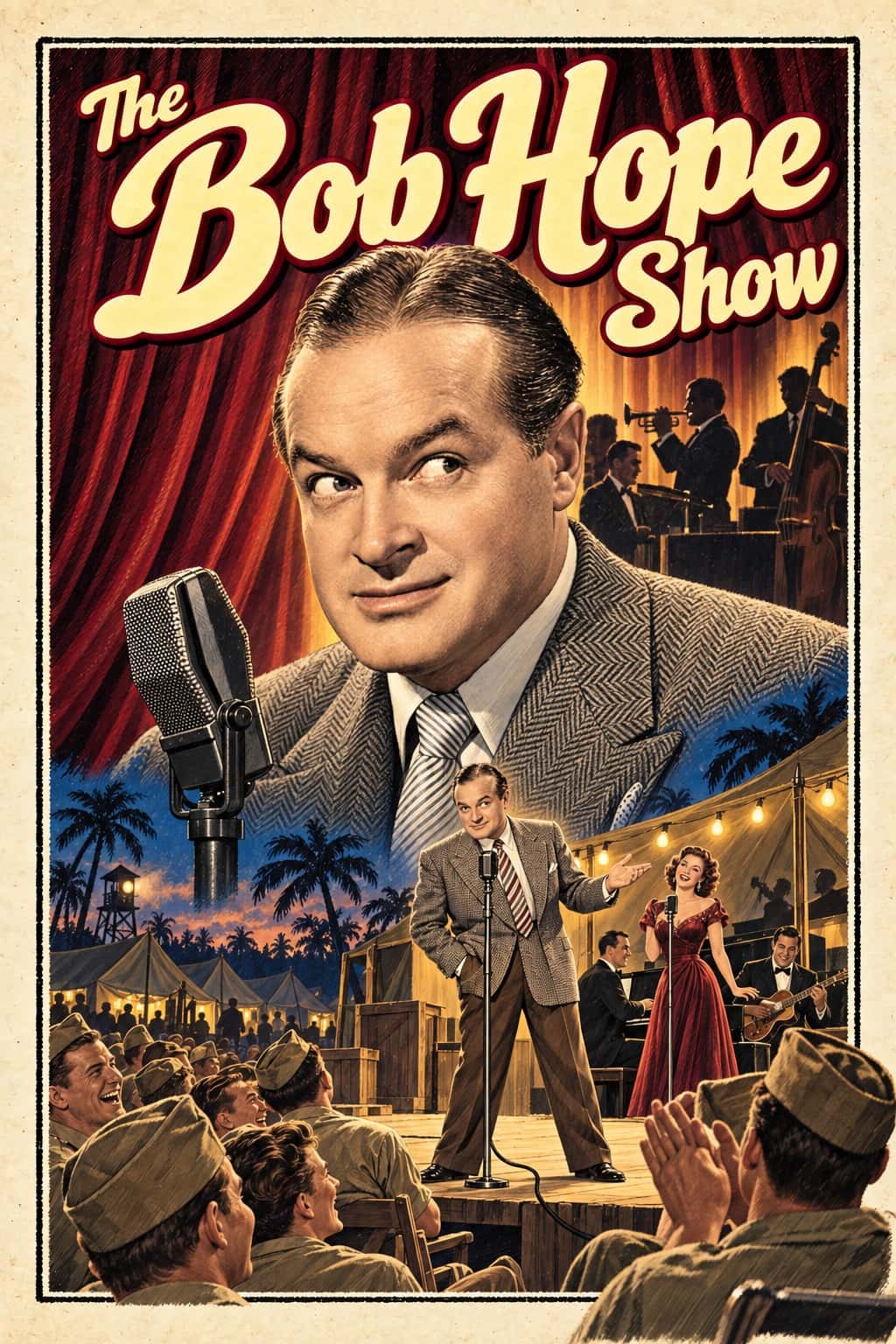
How do you do, ladies and gentlemen? This is Ross Tellett to Bob Hope McConnell, speaking over the KOMO Special Events Microphone. And on the other side of the mic is the well-known purveyor of humor himself, Bob Hope.
Bob, it's a real pleasure to have you here in Seattle.
Thank you, Ross. I understand you have many pleasant memories connected with Seattle.
Yes, I do. We've been here quite a few times. The last time, I think, we were at the University of Washington campus for that big Boeing show, you know?
Oh, yes. Trying to talk to people into making B-17s and B-29s, I remember. Did you succeed?
I think we did.
I'm sure you did. Well, how did your golfing match with Bing Crosby turn out over at Spokane the other day?
Spokane? Well, he played with Bud Ward and I played with... I had a very fine partner called Neil Christian, a fellow that hits the ball quite well. And we won, Neil Christian and myself.
Do you beat Crosby?
I should say that I carried Neil Christian's bag. I was on his back all day. I had the velvet spurs on.
Man wants my picture. Pardon me. Okay, old man. Go ahead. Thank you.
What was your... Go. It's my bad side, but check back. We can retouch all the time. Man is just taking our picture here. Let me know those things. Will you please? This is before breakfast. My face isn't shaped yet. It comes true around quarter to two.
Yes, Ross. What did you say, old man?
Well, let's see. Do you beat Crosby consistently on the green, of course?
No, I don't want to brag too much about beating that old man. I mean, I think it's sort of a hollow victory, don't you, to stand up? It's like saying that you can smash Dr. Townsend or something, you know? But I handled him the other day. I had 74 shots the first time I ever saw that downriver course. And Bing played five cents a hundred. I thought we had a nice game over there. It was really very nice.
What's your handicap?
You know, I don't know whatever happened to his horses, but it's the first time I ever saw a golf bag with a tail. Believe me.
Let's see now. Where were we? Oh, yes. What's your handicap?
My handicap? My swing. I have a... No, no. I have... My handicap is six. My handicap is six. Yes, sir. I had a nice game over there. We got up on the first... We got up on the first tee of that downriver course, and I took a full swing at the ball and missed it. They've lowered the course since I was there last. Then I took another full swing at the ball and missed it again. There were two little ants sitting on the ground. The one ant looked at the other and says, let's get up on this ball before this guy kills us. That is my story, and I'm sick of it. I'm stuck with it.
Incidentally, Bob, right now you're somewhat of a two-faced or rather two-voiced individual.
Read that right, will you, Ross? Please watch yourself.
Which one do you prefer? Two-voiced? Okay. You're being interviewed on... Double... Never on KOMO, and you're... This is a double station anyway. Isn't it? KOMO? On BC. On KOMO. You don't want to mention that other... Fisher's Blend Station Incorporated. We're here with the blue, but we're not talking. We're to the blue. Isn't that true?
Mr. Horton, this is NBC.
Yes, sir, Ross. Let's get back to the paper. And right now you're talking to the people and the listeners of KOMO, and you're... This is the regular thing that we're on, isn't it?
Oh, well, how do you do, ladies and gentlemen? This is the best of the... This is it. Oh, it's Dishon House. Say. Hey, do we come over here every Tuesday night on this thing?
Oh, yes, you do.
How do we sound? Do they make it funnier here? Do they tune it up, or how do... They give you your... Do they dub in a few laughs?
Oh, absolutely. Who is this up here? Is that the head announcer sticking out of the wall?
Oh, no, that's... That mountain goat? Or does he handle the Alaskan station or something?
May I speak for myself? I might say that sometimes I think it is.
That's very nice. Where are we? Oh, yes, you're out at 6th Seattle Stadium right now. I mean, those ears. Look at those. Where are... Where are we at, Ross?
We're out at 6th Seattle Stadium.
6th Seattle Stadium. Yes, let's not forget that. Because, as you see, this is a transcribed interview recorded within the hour. Let's stay with that 6th Seattle Stadium, Ross. We're out there this afternoon at 2.15 with 40 people. Do you think we'll have an aquacate or a regular stage show? What do you think? That's what I want to know. 40 people. 40 people. We have... Who are the other celebrities in the show?
That's very sweet of you, Ross. You're welcome. I've never kissed a man, but I feel something coming on. Ross, I want to... Please don't. Thank you. I'll take a half a dozen if they turn out. The man's taking our pictures from the back. Do you think I look better back through there? What is that?
We have Skinny Ennis and his band doing a wonderful program. They open the show and then play for the whole show. We have Olga San Juan, the Puerto Rican Peppa Pot. Then we have six beautiful Paramount starlets that the Paramount studio allowed us to bring up here. And we have Eddie Rio, Jack Pepper, a kid that's been all over the world with me on our tours. We have the Nielsen twins, Jim and Mildred Mulcahy. Fine recording harmonica artists. And all in all, it's quite a big simmus. It's quite a big large show.
It really sounds like it.
Yes, it works out fine. And we always get out early, away from the FBI and everything. It works out great. And the show will be repeated tonight at 8.50. You're so lovely, Ross. Say it louder.
What's the purpose of your present tour, Bob?
The purpose, we're just trying to get even. We're just trying to get enough money to pay for our laundry and get out of town. We don't ask much, Ross. All we'd like is a hot cup of soup. And just to get out. Would you like to talk to my manager? He explains those things. Did you read the paper? I read the paper this morning. I know we mentioned the paper on the radio. Oh, just what is the Bob Hope Enterprise?
The Bob Hope Enterprise is a little corporation set up to make pictures and to play golf. And we also make mothballs on the side. We have a lot of rackets, you know, different things. We're just trying to get our money back. That's all. We don't ask, Ross. That's all.
Well, Bob, you and Bing have teamed up in a number of films. Quite a number, I gather.
Quite a few father and son things. Yes.
When did you first meet Bing? How did you happen to team up?
I lifted a rock just outside of the Hollywood Bowl one day. And I heard this low guttural sound coming out of an adenoid laying there. And I was just about to step on it and said, stop. That's Mr. Crosby. I didn't recognize him at the time. He had his head under his shoulder. And there he was. So I pumped air into it. And I think I pumped a little too much because we've never been able to deflate him.
What was that page you just took away from me? We're now... Let's not be sneaky about this thing, Ross. I thought that was a charming... The man just took a whole hour out of my hand. Well, we'll do apologies to Mr. Crosby.
I noticed that during the dancing skits in the Road to Utopia, your dancing was, you might say, a bit more polished than things. Did you take more lessons?
Yes, I did. I see. I wrote to Arthur Murray regularly. And he answered back. But Bing, of course, moves all the time on account of a little room rent trouble he has. And he very seldom gets... Lessons, you know. But I stayed right in there and I fought. And I thought I was sort of twinkle-toes. Didn't you, Ross? I don't know, though.
Well, Bob, how did you happen to get into moviedom?
Movedom. Well, that's Hollywood, I guess. That's right. Movedom. I was on the New York stage for a while, stealing money. And I happened to get a sort of a fair part on one of the shows. And they offered me a little more kibosh to move west. And there I went with my pouch and grouch bag. Moved immediately to the west to steal more money. That's all. It's nothing at all. Just all I want is bread.
Bob, I think it goes farther than that. Have you got any bread with you, Ross?
Well, the bread's a little short. You haven't got an old loaf under your arm or anything, have you?
Well, half a loaf is better than none. That's where Ben Franklin got that idea. I imagine there was a bread shortage in Philadelphia at the time. I just thought of that. Working right together here, Bob. I don't know why.
Well, seriously, Bob, we'd like to take off our hat to you for the many long days that you devoted to entertain members of our armed forces during the war.
Well, we had a lot of fun.
You covered almost all the fighting fronts, bringing a lot of cheer to those fighting men.
Well, I'll go anywhere to get a piece of meat.
Wait a minute, Bob. You must have had a lot of unscheduled happenings during those tours. What would you say was the most unusual experience that you had?
The most unusual experience happened right out of this town. We were on the way to Anchorage, and we got over Anchorage, by the way, and we were up at 13,000 feet at 10 o'clock at night, and the airport closed. That's a little embarrassing. You know what I mean? You can't get your agent on the phone or anything. And we... They had the boats out on the bay waiting for us. We had our parachutes and Mae West's on, and we were all talking it over. And a lot of things flashed before my mind at that time, a lot of bad programs that I'd done and bad pictures that I'd made and money that I owed and things. But a man made a wonderful instrument landing, and they threw up 12 searchlights to mark off the thing, and we came in sideways, and it worked out pretty good. Otherwise, Ross, you'd be talking to some other old man, wouldn't you?
Could be. Bob, what was, say, the funniest incident that happened during those?
During the tours? Well, we were down in a little island on the South Pacific called Numphor. This is one thing that happened, and we just finished doing a show. That was quite a ways up front at that time. That's just before they went into the Plough Islands. And we'd finished the show, and we went back to eat, and we were sitting down eating, and a man with G2 intelligence came in. They handed this colonel a notation, and he read it for us. They just killed a Jap 1,200 yards from the stage. We didn't know what he was doing. He was going to the theater or coming away, but they got him, and I couldn't get a taxi, so we had to continue with it.
In other words, you didn't know whether he enjoyed your performance or not?
No, we couldn't tell. Didn't know which way he was running.
In your visits to hospitals, Bob, what's the best method you use of cheering up, say, a badly wounded patient?
Well, we try to just act a little mad in those hospitals and sort of try to startle them because you can't. As you know, those boys need a lot of help, and the sympathy routine doesn't bring them out and lift them any, so we always try and sort of go in and startle them and yell a little loud and get their attention first and be a little different than the usual run of person that they see in those places. I'm the one that can do it, you know. I have my mad moments, and I haven't got my cup of Ovaltine with me.
How many miles have you traveled?
About 325,000.
Most of it by air?
Yes, sir.
What theaters were you in?
Believe me, huh? What theaters were you in? In the European Theater twice. We were in Africa, of course, African Theater. We were in the South Pacific. We were in Alaska twice and the Caribbean.
And where did you enjoy yourself the most?
Well, I thought the most exciting trip that we made was the first time we went to the European Theater because a lot of things happened. We had a lot of fun. I hid in a few sewers and gullies and things, and it was exciting, you know, a little away from my general routine. I'm living in a sewer. No, no, I'm not. No, I'm not. Take it back. I've got a room this week. I'm sorry.
How was the food?
Over there? Well, the boys were pretty good to us. They used to rustle up a few extra hunks of Spam here and there, and we used to get into those bakeries and come out with a roll every day or something. They're fine.
Well, getting back to Seattle, Bob, we've been conducting a Know Your Seattle campaign to keep us informed on the charms of the city so we can better entertain the 750,000 visitors expected here this summer.
You have visitors here today, too. A man came down in the Olympic this morning wearing a sheet. I thought he was stealing. I found out later he was from Egypt. I've never heard of you. You've got it all here this week, haven't you? You've got the entire world. The ILO conference. Is that what they're doing?
Quite an important conference.
Are they buying boats here or something, or what?
Well, they're going to establish wages and rates and whatnot.
Well, it's really an important conference. We're very proud of it. You should have my dialects here with me.
You certainly should. You can talk to some of them.
Great. Well, getting back to Seattle again, what's your opinion of our charms?
Of your charms? Oh, your weather is wonderful. It keeps everything so green. You know, if you have your water wings on. I mean, I'm here to tell you that, you know, it's real nice. I like this town. I love to play Broadway, and, you know, that's my racket. My other racket is golf, as you know, and you have such a wonderful golf course.
Well, what are you going to do if a few showers come on out at the show? I could only get one to talk to me.
What did you say, Ross?
What are you going to do if a few showers come down out at the show?
We're all set for that. We're all set for that. We strip down and do it in bathing suits. It's my idea. I haven't talked the girls into it yet, but I think it's a jolly thought.
Well, for the benefit of the listeners, though, we're going out there, Bob, but don't happen to have umbrellas. You have some covers out there, don't you?
We sell umbrellas. My brother handles that concession.
Well, Bob, while listening to your radio show, we hear it every once in a while here, heard over NBC and this station, KOMO, we sometimes wonder if you don't depart from the script. How much ad-libbing can you get away with?
How do you mean? I don't like your tone, Ross.
How much ad-libbing can you get away with?
What do you mean? How many minutes spread do we have? Or the type of material? What do you mean?
Oh, you can elaborate as you wish. Go ahead.
No, we always leave 50% spread on our dialogue and 100% in the monologue to gild those eggs, you know, because you just can't stand up in front of 1,500 people or 500 or 1,000, whatever the audience is, and tell a joke and just have it lay there. You know, it's pretty sickening. Because I can't stop those flop bumps from coming out of my head. You've got to talk it over when you lay an egg. You know that, don't you?
That's true.
Can't handle that. We can't handle that at all. So we leave a lot of spread on the show. That's why I think we have... I don't want to brag, but I think we have the most ragged finish to our program on radio, don't you? Hmm? I mean, you never know when we're going off.
Well, speaking very frankly, Bob, I might be off next week for that matter.
Do you, Ross? I really do. Give me your hand, Ross. Take a fish out of it. Thank you very much.
Speaking of the audience, would you rather work with an audience in the studio than you would without one?
Oh, you have to have an audience. I think it's contagious. I really do. Picked it up. Sometimes you hear complaints that the audience interferes a little bit to the... It's just like the old laughing record. You remember the musical Magpies? Your father's told you about that. They made that laughing record, and it's contagious, you know? When you hear people laughing at a joke, I mean, it sort of convinces you that it's fair. That's been my... I shouldn't tip that off. That's the story of my success, you know? My relatives get in there and convince the rest of the world that it's funny.
Well, Bob...
I'll get a cup of coffee with you.
Right-o.
Bob, how's your competition going? A hunk of shredded wheat or anything.
My what?
How's your competition with Crosby and Eddie Cantor along the reproduction line?
The reproduction? Don't you know? I have two, you know. I have a little boy and a little girl. Totally. Five and a half and six and a half. They're getting to that snotty stage, you know. Oh, they're... They're talking back to me. You can't say that on NBC, though. I forgot. Is this NBC? I take back my last line. No, they're really cute. They're really cute, and they recognize me once in a while. I had them up at Pebble Beach Lodge two years ago, just before I went to the South Pacific, and I was sitting in the corner of the dining room with a bunch of fellas that I was playing golf with, and the nurse came in, and I came in with the two kids, and I yelled down. I said, good morning, and my boy said, good morning, Bob Hope, and he got quite a laugh, so I walked down, and I said, look, I said, when you're in public, I said, just don't give me that Bob Hope. Just say good morning, Daddy, if you don't mind, and the girl looked up, and she said, we know, Daddy. We'll let you get the laughs.
Ross, don't go like that. I'm telling a joke. Look at me. Will you please? I must have your eyes, Ross. I'm just trying to find out... Thank you very much.
Do we have a final here? Fine. Good idea.
Well, Bob's on our selling iron with him today, hasn't he? That's Dick Green, ladies and gentlemen. That's right. Dick Green of KOMO.
Now, Bob, what advice do you have for any of our young listeners who might want to become a comedian?
Become a comedian, huh? Well, I think the best thing to do is to get a few jokes and get out in front of an audience and play with them. Just tell them and learn how to handle a joke, and it's a matter of experience, I think, just getting out and telling gags and quipping jokes. It's a matter of experience, and it's a matter of experience, it's a matter of experience, don't you think, Ross? Or do you?
I would like to. Very much. You've got it in mind. I can tell by the way you're raising that fringe on your upper lip. You're doing something with that.
Bob, you use Pepsodent, but I can't. You've got beautiful teeth.
I really have. You're like mine. Would you like to see the mouth?
Oh, please, please.
Now, here.
Well, Bob, how'd you happen to change your name from Lester Townes Hope to...
This is sabotage. Who told you that? Get my cane and spats. I'm leaving this establishment. Are you kidding? Who told it, Ross? Who told you this, old man? I think it was your... Well, I'll tell you. You know, I could never understand. I couldn't... I thought I was... I'm such a ham, you know, that I figured that someday I might have my name in lights. And I couldn't imagine that name up in lights. Leslie Townes Hope, you know? It's sort of a dressmaker tinge to it, don't you think? So I thought Bob is sort of a regular name and it's the kind of a thing the audience would come out, you know, and before they smashed you in the face, they'd say, hiya, Bob. Well, instead of Leslie Townes, you know, it's sort of... It's the upper strata, don't you think?
Was that in the hoofing stage?
Yeah, Leslie Townes. I needed... I needed something in the hoofing stage for protection. I didn't want anybody to talk to me till I really learned how. But that's my only solution to that. I just couldn't understand Leslie Townes. I still like to have a long talk with my father. I mean, just about the name, you know? Oh, yes. I know about the birds and the bees, because they're not talking either as far as I'm concerned. But I'd like to talk to him about this little racket here.
One more question, Bob. It was posed by our publicity girl, Nelma Fredericks.
Who?
Nelma Fredericks.
This girl back here with the Orson Welles glasses on?
That's right.
Hello, darling. She's attractive. I know this is the girl. She had this big thing that's on our show, Martha Wright. You know, the girl that won the Cinderella Girl contest.
Can I drink a 7-Up out of her slipper tonight, if you think? She's very attractive, by the way.
Well, she wants to know, Bob, quote, do you prefer blondes, brunettes, or redheads?
Yes.
And yes, is my answer.
Yes to all of them?
Yes. Yes. Yes. Yes. Yes. That's my answer.
You won't commit yourself.
Oh, that's it. Yes. That's my blanket answer, old man. Yes. And you need a blanket today.
Say, what about this, uh, what about this Sick's Seattle Stadium? Is that, uh, what time do I have to get out there for that show?
You're going to have to leave here right away. And, uh, thanks a lot for coming over and, uh, helping us out here. We really enjoyed having you on our program.
Ross, thank you. It's, uh, it's been fine talking to you. And, uh, call me up anytime, will you? I'm here tonight. And drop over the hotel. And, uh, good luck. I'll give you some seltzer water.