
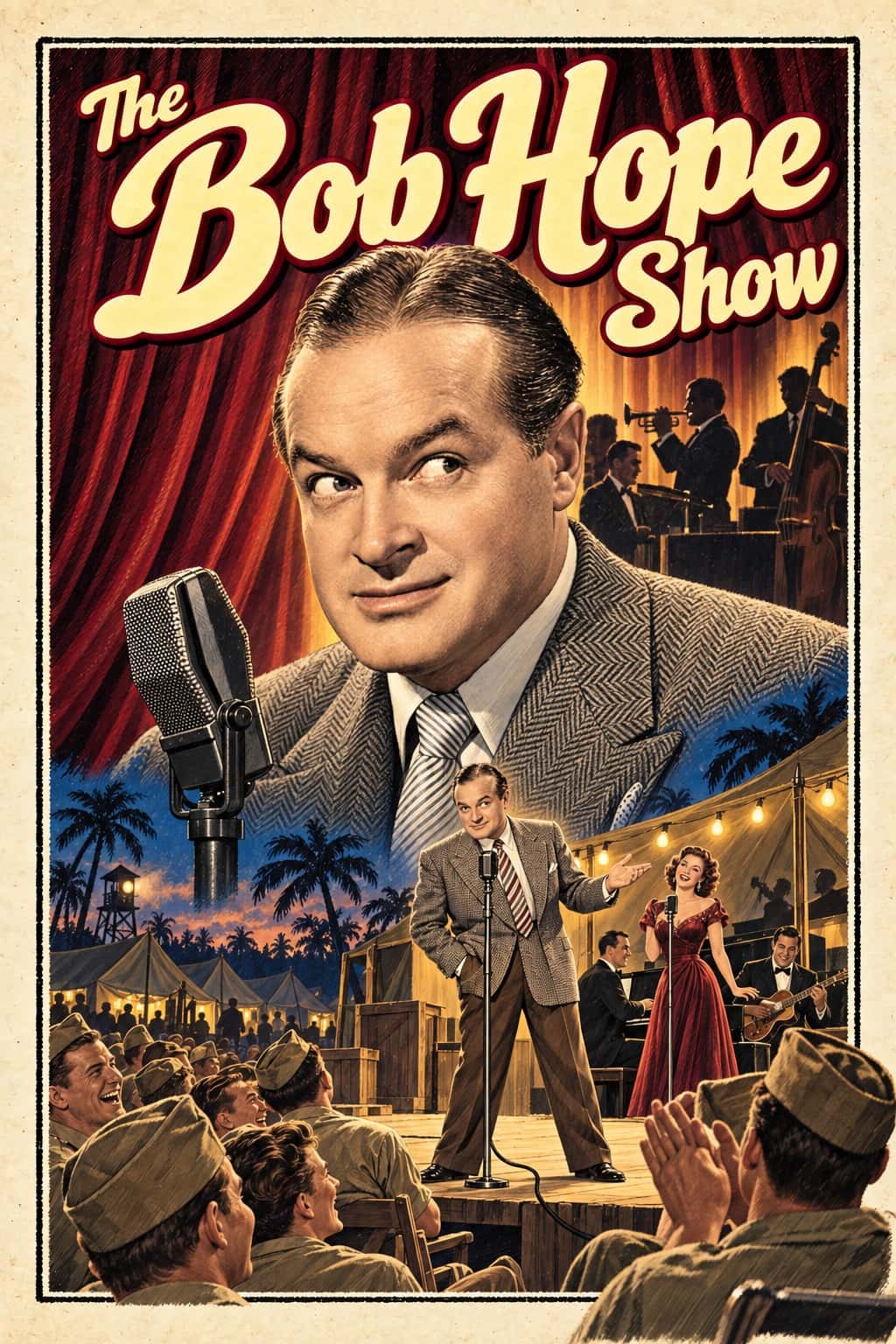
The written record
Read the transcript
Read along with the recording · About 16 min to read
Armed Forces Radio and Television Service presents the Bob Hope Show with Les Brown and his band of renown and guest Trulie Bill Goodwin. And now here he is, Bob Hope.
Thank you very much. Thank you, ladies and gentlemen. No, but I've just returned from a trip through Minnesota and Canada and I'll never know why we criticize our California weather. It was almost as cold up there. No, I had to make the whole trip with one arm down in the baggage compartment. My hand was frozen to my suitcase.
I played Saskatoon, Saskatchewan. Saskatoon, Saskatchewan. That's pretty tricky, but once you learn how to say it, it pays off. You never again have to buy dental floss. Of course, some people never learn how to say Saskatoon, Saskatchewan. One guy tried for years, but he couldn't say it. He finally did the only thing he could do. He moved to Montreal.
South Saskatoon is way up in northern Canada, but it's easy to get there. You can go by plane, train, dog sled, or make a wrong turn on the freeway. When I arrived, they gave me a ticket. They gave me a wonderful welcome, but I didn't like the way the papers wrote it up. The headline in the Saskatoon Daily News said, American ham arises from Canadian bacon.
It was pretty cold up there. I saw a Pontiac, and the Indian was wearing earmuffs. White-haired Indian.
I got back here just in time to go to all the big department stores around town and autograph copies of my book, Have Tux, Will Travel. And it was a lot of fun, although I didn't like the attitude of one department store manager. When I arrived to autograph the books, he looked at my nose and said, I see you brought your ballpoint with you.
Autographing copies? Your book is a favor you have to do for the publisher. Well, it's not exactly a favor. It's part of the deal. Let's face it. We have to get the money back somehow. One kid was standing there for an hour just staring at me. I said, aren't you interested in reading my life story? He said, no, I'd rather watch it on Dragnet.
But my book is really exciting. It tells the story of a poor, barefoot boy in Cleveland who was determined to be a comedian regardless of his talent. And I'm sure you'll like Have Tux, Will Travel. I tell all about my education, all the awards I've won in show business, and all the beautiful girls. They're crazy about me. Page two is exciting, too.
The New York Times printed two reviews of my book. The first one said my writing ranked with O. Henry. The second one said not the author of The Candy Bar. One of the editors of Reader's Digest phoned me and asked if my book could be boiled down. I said it could. He said, that's fine with all this smog. We hate to throw it in the incinerator.
Jack Benny read my book with tears in his eyes from strain. He was trying to finish it before the clerk made him put it down. I still have a few books left, so if any of you have any questions, if you haven't got your copy, please see me after the show. I'd love to get my car back in the garage. Thank you very much.
And now, ladies and gentlemen, I'd like to introduce our guest for this evening, Mr. David Niven, right here.
Oh, thank you, Bob. That's a very nice introduction, but why the mister?
Well, David, I thought it was appropriate I consider you a perfect gentleman.
Well?
A distinguished actor.
Well?
And besides that, I like you.
Easier, I'll hide your tweed monocle and you'll be drummed out of the Deborah Carr fan club. You'll never get into the Huntington-Hartford Theatre.
Well, how about we, um, exchange a few unpleasant pleasantries? What type of show are we going to do, Bob?
Well, I was just thinking, David, you know, they're giving out Academy Awards for the movies, Emmy Awards for television, but radio doesn't get its share of recognition. And, you know, radio will soon be celebrating its 50th birthday.
50th birthday? Milton Berle been around that long?
Oh, yes, he went to medical school with Joyce Jordan.
I gather we're going to do the history of radio tonight, Bob.
That's right, David. We're going all the way back to 1900 when Hollywood was just desolate, flat country. Then the movies came along, radio came along, and Hollywood became the glamour capital of the world.
Yeah, and then Santa Anita came along and it became flat country again.
Well, David, shall we plunge in and tell the story of the magic wireless from its infancy right up to today?
I'm all set, Bob. Let's go. Music, Les.
Radio had its first glimmerings way back at the turn of the century. In the science laboratory at Yale University, an excited young student rushed up to his professor and said, Look, Professor, I've found it.
What is it, my boy?
Oh, I've created a vacuum tube with a filament that emits electrons across a magnetic field so that high-frequency modulation up to 18,000 megacycle causes sonic alternating audio amplification.
Sorry, folks, but what else could I do with him? That young student, of course, was Lee DeForest. On May 1, 1903, radio was born. DeForest invented the Audion tube. And on May 2, 1903, radio received its greatest setback.
What's that?
DeForest dropped the tube.
Lee DeForest continued his labors on the electron tube. And in 1905, at a meeting of the stockholders of his company, he made an announcement of tremendous importance. Gentlemen, I'm happy to say that I've finally perfected the first radio tube. Here it is before you. A huge rectangular tube, and only one thing is stopping us from putting it into mass production for use in radio.
What's that?
We can't get Arthur Godfrey's picture off it.
Bob, how could Arthur Godfrey's picture possibly be on a radio tube? Is that historically correct?
That's pretty close, David. My writers looked the whole thing up in the racing form.
Well, we can't dispute that, can we? Well, what happened next, Bob?
Aerials began appearing on rooftops. And it was dangerous, David. I'll never forget my Aunt Minnie got a couple of electric wires crossed one night.
What happened?
She became the first woman in Cleveland to have a crew cut.
What's the next milestone of radio, David?
The presidential election of 1924. Here's the first president to speak on radio.
Thank you, Calvin Coolidge.
The world's fastest human is interviewed after running the four-minute—
Thank you, Roger Bannister.
Or Rin Tin Tin. But getting back to our story, in the 1920s and 30s, radio grew by leaps and bounds.
Yes, everybody was tuned in. You were entertained by such famous names in sport as Babe Ruth, Jack Dempsey, Errol Flynn.
Yes, the average family could sit home in the parlor, switch on a receiving set, and hear the great stars of the era. Crosby sure sounded good in those days.
Radio soon became a giant of the entertainment field. It brought us fine drama, the best music, great comedians. In 1931, we were all thrilled by the lively singing of a young man named Eddie Cantor.
If you knew Susie like I know Susie, ooh, ooh, ooh.
I'm sorry, that's the best I can do. That was Eddie Cantor, straying through Anthony Heaton's Homburg.
But at the same time, another great star thrilled the nation.
That's right, he's now known as Evelyn and her magic violin. You know what?
Oh, Bob, I never realized there was so much to radio.
Oh, these are only a few highlights in the field of entertainment. Radio was also used in industry and commerce, and it played a very important part in World War I.
World War I, let's do some of that.
Okay, music, Les.
The time, the closing hours of the war, November 10th, 1918. The German armies are collapsing on all fronts. For the first time, radio is used as a means of military communication.
Achtung! Achtung! General Ludendorff calling General Huffenhausen. Come in, Rudy.
Jawohl, jawohl, I am here. Can you hear me?
Nein, I can't hear a thing. What's the matter? You talking to a Wienerschnitzel or something?
What do you want, Herr Mann?
Something's gone kafflui. I can't, I can't find the army anywhere.
Me neither. What do you suspect, mein General?
I don't know, but something is definitely verstonken in Wurzeln. 26,000 men, where could they all... Where could they all disappear to?
Oh, I know. I know where they might be.
Where?
Mademoiselle from Armentieres.
Oh, I called her up, didn't I? Now, wait a minute. But, Rudy. Rudy. If we can't find the army, you just gave me a great idea.
What?
Mademoiselle from Armentieres. I get mine helmet and go with you.
Okay.
Well, what happened next in Radio Boy?
Well, we'll continue our history in a few minutes, David. After this number by a star of present-day radio, Margaret Whiting, singing Melody of Love. There she is.
Pray, oh boy, your king, the choir, sings on twice.
This is Bill Goodwin. You know, someone once said humor is the true democracy. And that's why we Americans can smile when we tell the stories of the legendary heroes who helped to build our country's great institutions and industries. Like old Pecos Bill of the cattle industry.
Now, when Bill was a year old, he was crawling around the ground one day when a swarm of mosquitoes swooped down. Bill crawled under a fat-rendering kettle, and when the first mosquito hit it, his stinger went clear through. Quick as a flash, Bill whipped an axe out of his diaper, and he bent the stinger back like a nail. He did the same to the other mosquitoes till the outside of the kettle looked like a plum pudding filled with raisins.
When Bill was 14, he invented the lariat, the roundup, and the branding iron. And his special brand has become... become the heritage for all American cattlemen, IXL.
Yes, it is a democracy which lets us tell stories of such legendary heroes with a twinkle in our eyes and a chuckle in our throats. So long as we continue to laugh together as a people, ladies and gentlemen, we will live together as a nation.
Bob, should we continue our history of radio?
Yes, David. Now let's look at radio as an advertising medium.
You mean commercial.
That's right. And here's the man who invented the first commercial jingle.
Mary, Mary, quite contrary. How does your garden grow? With silver bells and cockle shells?
What? No big at all?
Well, Professor Kona, right? You're the man who invented rhyming commercials, Professor.
That's right, Hope. I'm the first man who ever found a rhyme for orange.
Well, that's remarkable, Professor. How did you rhyme orange?
Squeezed it. And I rhymed juice with spruce.
Professor, you're off your trolley.
Yes, but I'm not worried.
Why not?
I've got a transfer.
Professor, do you really know anything about radio commercials?
Everything. I introduced the paper-mate pen sweethearts to each other. And single-handed, I put over one of the most popular products on the market today. Chibaba, chibaba cigarettes.
Chibaba, chibaba cigarettes? I've never heard of them.
Of course you have. Why, four out of five doctors who smoke them say, quote...
Quote.
Quote.
Are they good, Professor?
There's no cigarette in the world like a chibaba. It doesn't have any ordinary cotton filter or a nylon filter. Absolutely no harmful ingredients could get through the filter of a chibaba.
Why, what's it made of?
Cement.
Tell me, Kelowna, did you ever jump out of a window and land on your head?
Why, no, don't think I ever have.
Pardon me a moment. What do you know? It's fun.
Kelowna, you're two steps below an idiot. Don't drool. And au revoir.
So long, brush-mush.
Well, what's next, Bob?
Well, disc jockeys have become very important in radio, David. Let's show the folks how those happy record spinners operate. Music, Les.
Now, for you early morning listeners, Flaky's, the breakfast food that bites back, will rise and shine, boys. Hello, everybody, hello. We're here to say hello, so hello. Hello, everybody, hello. We don't mean au revoir, but hello. We don't mean au revoir, but hello. And now we're trying to say hello to you and you. So hello, everybody, hello. Hello, hello, hello.
Second chorus. Hello, everybody, hello. Hello, hello, hello, hello. That's funny. What happened? They hung up?
Well, good morning, Bob.
Oh, good morning, David. Well, here we are, folks, the Rise and Shine Boys. Good morning, everybody. It's 5 a.m., but the weatherman says we'll have a beautiful day, folks.
What is the weather report, Bob?
Six below and more snow. Which reminds me, folks, are you prepared for a cold snap? Get a suit of Zinglemire's long underwear today. The only long underwear with the electric flap.
5:01 a.m. Folks, why wake up with a grouch in the morning? Sleep alone. Come on, come on, sleepyhead, throw the covers off. Now open your eyes and take a good look around. Are you in the right house?
And now, and now for the first joke of the day. Tell me, Bob, how do you make antifreeze?
I don't know, David. How do you make antifreeze?
Hide her woolen pajamas.
Oh, I'll work on that.
And now, the makers of Woofoo, the dog biscuit that tastes like a cat. The makers of Woofoo bring you the news. Hollywood, California. Jascha Heifetz is playing Beethoven tonight at the Hollywood Bowl. The winner will meet Bobo Olson.
And now, a word about Dr. Niven's reducing method. Step in, Doctor.
Thank you. Attention, ladies, over 300 pounds. Do you have the feeling you're being followed? You are. It's you. If you have this problem, by all means, try Dr. Niven's reducing method. It's simple. No pills, no diet, no exercise. Once a week, Dr. Niven comes to your house and beats you with a rubber hose.
And now, your favorite platter spinner is bringing you the first record of the day. What do we play for the folks, David?
The song that's number one all over the country. "I've Got Those My Baby Done Left Me, She Ran Off With Another Guy, I Feel So Bad If I Ever Catch Her, I'll Break Her Neck" blues.
Now, if you think you should dedicate this stuff to the boys down at Firehouse No. 7, don't forget, fellas, dab a little of Mother Murphy's brass polish on the knees of your pants and your fire pole will always be bright and gleaming.
Now, we'll play the record. Whoops, too late. Our time is up. This is the Rise and Shine Boys signing off and saying...
Goodbye, everybody, goodbye. Goodbye, goodbye, goodbye. We mean goodbye.
That took care of the disc jockeys, and I hope they forgive us. You know, Bob, we can't do a history of radio without bringing in the dear old BBC.
British radio? Good idea.
Here we go, David, some Piccadilly music, Les.
How do you do, ladies and gentlemen? This is the BBC commencing another evening's broadcasting. Our first offering of the evening is another visit with the master detective, David Niven, Private Eyeball, and Gentleman Bounder.
Thanks, Joe. Before tonight's chapter, a word about our sponsor, Father and Gay's Mutton. That mutton that makes you a glutton.
Ladies. Ladies. Next time you want to serve something delicious, remember that only Father and Gay's Mutton contains that unusual locked-in aroma. It has to be locked in. Once it got out and killed Father and Gay.
Remember, friends, there are many imitators of this fine product, but Father and Gay's is the only mutton that contains genuine mutts. That's right. It comes in three delicious flavors, orange, raspberry, and caucus banu.
Now for tonight's adventure with David Niven, Private Eyeball.
How do you do? My name is David Niven, private eye. I am a private eyeball. I am a private eyeball. I am a private eyeball. I am a private eyeball. I am a private eyeball. I am a private eyeball. I am a private eyeball. I am a private eyeball.
I was sitting in my office today when the door opened and she came in. Believe me when I tell you, she was most captivating. She had honey blonde hair, blue eyes, and the deepest dimples I'd ever seen. In fact, her dimples were so deep that when she smiled, her face turned inside out.
Suddenly, this heavenly creature spoke.
My husband has just been murdered.
What?
Yes, I stabbed him six times and then shot him through the head.
I see. Who do you suspect?
I've come to you to help me to, as they say in America, beat the rap.
Well, very well. Bring in the rap and I shall... I shall beat him. Just one moment, dear lady. I'm on to you and I shall have to report you to Scotland Yard.
No, no, you can't. Don't you see I'm in love with you? I insist that you kiss me.
Take my lips.
No, thanks so much. I have a pair of my own.
Take my lips.
All right, but I shall have to wear them on my watch chain. Now, romance won't help you, my dear. I'm going to turn you in and they shall send you up the river.
You wouldn't say that if you'd kissed me once.
I'm sorry, you're going up the river.
Come here.
Well...
All the shortest going, is your...
You cad! How dare you kiss my wife?
Your wife? I thought you were dead.
I was, but now I'm alive again.
Well, how could that be possible?
I ate an extra large portion of Father and Gay's delicious mutton.
Oh, David, say, that just about wraps up our little saga of radio and I hope somebody appreciates it.
Mr. Hope, Mr. Niven, I've been listening to your show upstairs in my office and it was wonderful. Thank you very much. Who are you?
Well, I'm the producer. I'm the president of the NBC network and I want to thank you. This history of radio you've just put on will bring us millions and millions of new fans.
Well, that's fine. And you're the president of the radio network?
No, television.
Speaking, this is the United States Armed Forces Radio and Television Service.