
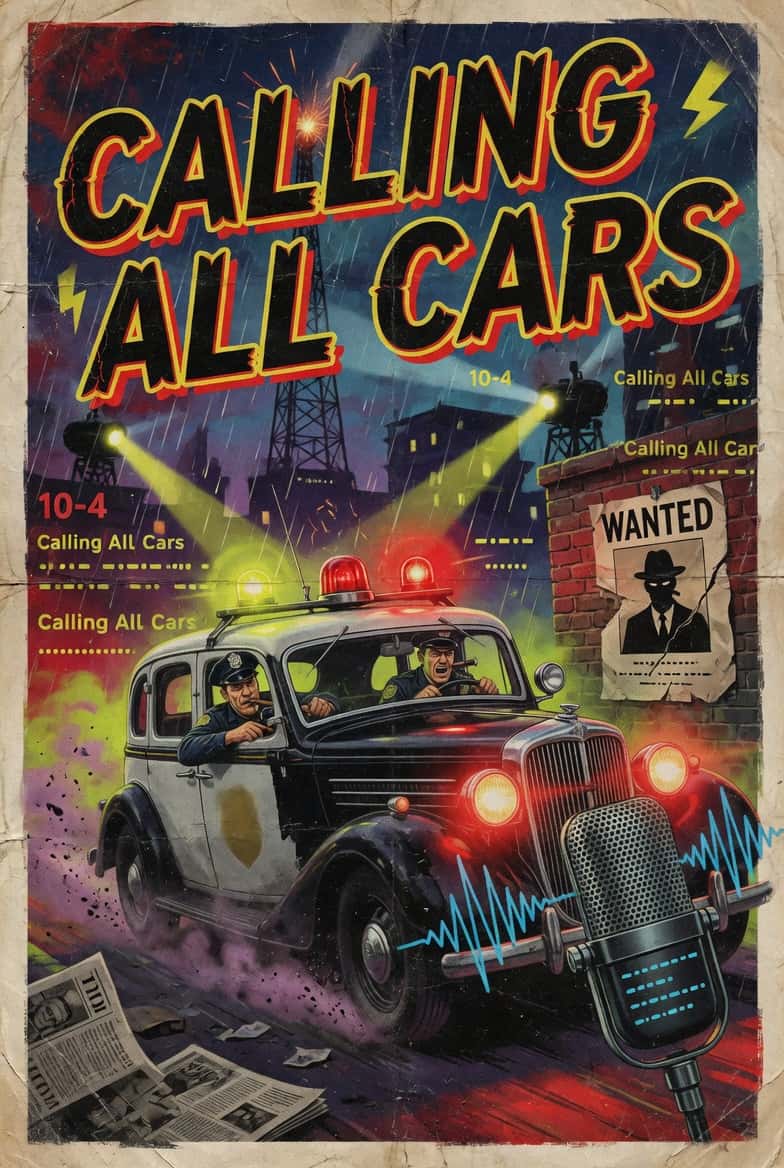
The written record
Read the transcript
Read along with the recording · About 20 min to read
To get an insight into the problems of policing your cities and towns you can never appreciate the most thankless never-ending job your mind can conceive. Davis in his modest way for brave men flying equipment and good gasoline to do a satisfactory job. You have seen and heard police cars and ambulances screaming down the street to aid someone in distress. Good gasoline will give them the performance they demand.
You have also seen patrol cars or motorcycles driving up one street and down another, hour upon hour. Rigid economy in this branch of city government stipulates economy of operation. When you hear advertising claims of quick starting, pickup power, mileage, anti-knock, you hope you're getting it in the gasoline you buy. The police car performance you get from Rio Grande Cracked includes all these qualities. That is why in the great Southwest so many police cars, fire engines, motorcycles, ambulances, and other emergency equipment.
Once more the Rio Grande Oil Company is proud to present Chief James E. Davis of the Los Angeles Police Department, whose interest there is an axiom in England as old as England itself: that no matter where a citizen of England is when he meets death at the hands of an enemy of England society, no force on the face of the earth can keep Great Britain from reaching out and avenging his death. Police of London are patrolled by uniformed bodies, unarmed with but few exceptions. Arms are carried by the police of England.
Citizens of that country have a hearty respect for the age-old truism which has reached into Canada, into India, into the British East India, into the islands of the Pacific, into Africa, into all the dominions of Great Britain, that the English police always get their man. Here in America only recently has public decency been so outraged by the brazenness of the criminal element house to bring to every citizen a realization of how important it is to support the police and peace time army on a criminal front where battle never ceases.
For years the law enforcement agencies of this country have carried on undaunted under a burden of public disrespect which has made their job the hardest in the world, almost impossible to successfully finish, until but a few months ago. If a gangster killed a policeman, that was not news. But if a policeman killed a gangster, that was news, so colored by sentimentalists that a wave of criticism over the policeman and his colleagues so overwhelmingly that he not only lost courage but faith in the citizens whose job it is for him to protect.
Tonight's story tells more eloquently than ever before than can any words of mine what it means to kill a policeman. It concerns the water murder of a garden in the law by self Stiles taught a from Texas, unaccustomed perhaps to the unseemly doing of police officer. I hope that every citizen listening to this program will realize, they think years, this story on cole, how important it is for him to back up morally and actually if necessary the police firm who risked his very last year of serving very life to protect him, his property, and his family.
Professor Lindsley will now go on with the story. National Bank at 7th and Hooper is spotted for a whole run. Chief of Detectives George K. Holm details officers Bond and Forbes, members of the department's famed crime crusher, an organization of 300 patrolmen working in plainclothes to stake out of the bank. We join them on February 20th. After several days on the job, we move a little off the side of the main banking room.
Well, this is a soft one, Forbes.
Yeah, I don't mind it a bit. A few days we've been sitting around here.
A lot better than checking down.
How do you know? You've only been on the force a couple of months.
Six months. I have. I'll wait until they've pounded the beat as long as I have. Then you'll really know how soft this steak is.
Hey, Forbes, you never can tell. They seem to have a pretty hot tip at headquarters. What would you do if they did dry job?
What would I do? Well, Glenn, that's hard to say. You never know, for instance, what you'll do before you get into an automobile accident. If you manage to do the right thing, well, you don't live to tell about it.
Yeah, that's right. Well, police works the same sort of thing.
Yeah, and it's swell, don't you think so, Forbes?
No, I don't know. It's a good job, not very that much.
Yeah, but there's more to it than just that. It's the idea of being a peace officer, keeping the peace, being on the right side. I get a big kick out of it.
Yeah? Well, kid, if you get such a big kick out of it, take a look through the door and see how things are going in the bank.
Okay. Say, did you notice while we were talking you got awful quiet in there?
Yeah, I did at that. Take a look.
Right. Get back in there. Of course.
Okay, kid. You just have to be a hero. Unleather your coat and follow me. Drop that gun. We're police officers. Come on, kid. Get in the car. Detective, you're all. Long you've been talking.
Right away. 7th and Hoover.
Officer. The cops are waiting. That's fast. What's the trouble here?
Bank holdout. They got away in a race. One was shot.
One was shot. There were three of them. And they headed north on Hoover Street.
One was shot. I saw him stand.
Wait a minute. Wait a minute. Don't all talk at once. You said they headed north on Hoover?
That's right.
Yeah, I saw him drive away.
Okay. Frank, you take your car and see if you can follow them.
Okay. Now, where's the officer that was shot?
In my office. I'm the manager of the bank. Will you take me to him, please?
Sure. Right inside the door. There are two of them, you know.
Both shot?
Yes. I've already seen them. I've seen them. I've seen them. I've seen them. I've seen them. I've already phoned for the ambulance. Here we are. Right in here. Forbes and Bond. Poor guys.
You heard that, Forbes?
No. I'm okay. It's just my head.
How about it, Bond? How are you feeling?
Not so good, Lieutenant. He got me for a case, I guess. But I did my duty, Lieutenant. I got him.
He's wounded. Look for the guy that's wounded. I can't believe it. I'm sorry. I'm sorry. I'm sorry. I'm sorry. I'm sorry. I'm sorry. I'm sorry. I'm sorry. I'm sorry. I'm sorry. I'm sorry. I'm sorry. I'm sorry. I'm sorry. I'm sorry.
A couple of hours later, Glenn Bond, the police rookie, dies in the receiving hospital without ever regaining consciousness. And with the news of his death, the unwritten law of the police officer begins to work. There is not a man on the board, but who pledges highly to himself to work unceasingly to avenge the death of his brother-in-law.
In his office, Chief of Detective Holm issues orders to a group of officers.
Now, from what Forbes has been able to tell us, we know that there were at least three and possibly four men in this galley. Numbers one and two enter the bank. Three serve as the lookout, and four, if there was a four, drove the red Buick sport model in which the men escaped. We also know that one of them was wounded.
All right. I want every red Buick sport model in Los Angeles stopped and examined for bloodstains or any other evidence that might connect you with the crime. I also want you men to check every drugstore on the west side of town for any suspicious purchases of bandages and antiseptics.
Yes. On the contrary, doctor, I think you're helping us more than you know. Well, where did you treat this patient? Thank you very much, doctor.
What is it, Chief?
I want you and O'Connor to go to a rooming house at 522 South Olive Street and find a man there who's suffering from a gunshot wound. Go through the place until you get him. I think he's one of the boys we're looking for.
The officers conduct a systematic search of the Olive Street rooming house, followed by a frightened man. They come upon a disheveled apartment on the second floor.
I hope you gentlemen will forgive the appearance of this room. It was just vacated a half an hour ago, and I haven't had time to clean it yet.
Just vacated it a half hour ago, eh? Know what I smell like?
Yeah.
Misceptics. Bill and Mark Thomas.
Who was it?
One of them was hurt?
I don't know, but my guess is he was shot by a dead man. Nothing, nothing. I don't know, but they're They left here with another fellow in a green top taxi. Oh, come to think of it, Mark Thomas, one of the brothers, did look a little... Well, they didn't know many people, but there was a couple down the street that used to call on them.
What was their name?
McBride, I think it was.
Where do they live?
Why, in that hotel just three doors down the street.
Okay, see you in a minute.
A visit of the McBride.
Is Mr. McBride upstairs?
Mr. McBride, see him?
No.
Any idea when they'll be back?
Well, we'll wait.
Well, you might wait a long time. There's no time when they will come back.
Yeah? Well, maybe I'll find out quicker if I run that switchboard.
Well, what do you mean? You sit over there.
I can run a switchboard as well as you can.
Well, you must be nuts. Can't let you do that.
Come on, switch stolen. You know who we are. You probably know why we're here. Now, move over there and make it snappy. I'm the telephone operator for a while. And Mike, you better go up and wait in the room.
Okay. Hey, you, which room are the McBrides in?
I don't know.
Listen, sonny, I'm going to lose patience with you in a minute and run you in. Now, which room? Where's McBride?
150.
Then ring me down here if they come in the back way.
For several hours, Dalton fills the position of telephone operator, handing all the routine calls to the house without hearing anything. Then suddenly a call comes from McBride's apartment. Dalton allows a few seconds to pass and then returns to the phone himself.
Hello. What do you sound for?
Well, uh, I'm afraid of the bulls.
Well, let's see then. I'll tell you. I'll meet you in front of the garage at 4 o'clock. Mike, come on down. We're going places.
It takes one side of Olive Street and O'Connor the other. As they approach the corner of Olive and 4th, they discover to their disgust that the meeting place Dalton thought of on the spur of the moment is obscure. There are three garages at the corner of 4th and 4th. However, the officers can do nothing about it except keep on the lookout for a young man who might look as though his name was Tom. O'Connor softly calls several passersby by Tom with no success and is about to give up the vain waiting when a tall young man approaches the corner, looking up and down the street. O'Connor quickly walks up to him.
Hi, Tom. Why? Wait a minute, brother. I'm a police officer. I want to talk to you. What's your name? Get acquainted.
By the name of, uh, you must be a Bob Bloke. Will you come down to the station with us and...
His protestations of innocence. The man who claims to be Bill Smith is taken in and booked on a vagrancy charge.
Later in the afternoon, the cab driver, the free man from the Olive Street address, is located and tells the police that he drove one of whom appeared to be sick to the corner of East 4th and Cummings Street near Hollingbeck Park. Immediately, a force of 300 men under the command of Captains Bernard, Dean, and Wynn is thrown around the neighborhood of the park with instructions to search every apartment house and to inquire of every drugstore for purchases of bandages. Detectives Kahn, Daffer, and Hickey.
Good afternoon, gentlemen. What could I do for you?
Bandages?
So, why are you asking?
I'm doing the asking, you're answering. Have you sold any bandages?
Well, first I've got to know where you are.
Here's why.
You see that? Oh, oh, policeman, Bill, that's different. Now, what could I be doing for you?
Do you want to know if you sold any bandages and antiseptics or something?
Bandages and antiseptics. Hey, just a minute till I look in my book. Yeah, yeah, here it is. To one man I sold a roll of a easy thing, a roll of gold, a bottle of carbolic acid, and a bottle of iodine. That ought to be it.
What did it look like?
Well, I'll tell you. It didn't look like much or nothing.
So, how was he drunk?
Well, he had on a cap and gray trousers.
Did he drive a red Buick?
Oh, no, no, he didn't drive anything. About five minutes after he bought the goods, he got on a streetcar out front.
He got on a streetcar. Did he still have the packages with him?
No.
We must be right close here, Frank. Come on.
The search is centered on the neighborhood in the immediate vicinity of the drugstore. Two apartment houses are entered without success. But the trail goes warm as Hickey and Condaff interview the landlady of the third.
Why, yes, there's a sick man here. I don't know what is the matter with him.
What apartment is he in?
By number six, just two doors down the hall.
Who's it registered to?
Mr. Grant and his wife.
Okay. Come on, Jerry, let's talk to her.
What did you say?
Nothing.
What do you want?
I want to talk to you.
Well, you can't come in.
You slam the door in my face, will you? Come on, Frank, we're going in.
Let that gun go, fella. Put your hands out at your side.
Haven't you had about enough shooting for today, young fella?
Oh, what's it to you? Can't I shoot myself if I want to?
Sure, but not policemen. Get that gun under the pillow, Hickey.
Okay. Now, what's your name, kid?
I ain't done nothing.
Nothing wrong, only I'm a parole violator from the state reform school. Now I'll have to go back there.
We'll worry about that later. What's your name?
Louie Perry.
Who's this girl?
She's my sister-in-law. She's been trying to fix me up. She ain't done nothing.
Maybe she hasn't, but we'll take you down to the station with us.
What for? You haven't got anything against me.
What's wrong with them, Billy? They can't do nothing. They can't keep you. Just don't tell them anything. You got nothing to tell them anyway. I shot myself cleaning my gun. That's all. Go on with them, Billy.
Oh, all right. I'll get my hat.
Just a minute. I'll take a look in that closet before you do.
Look here, Jerry. Back cleaning your gun, eh, kid? Where are the other boys that were in on this job with you?
Oh, so you want to go through the trap alone, huh?
The trap?
Sure, you killed a copper, didn't you?
Oh, no, I didn't kill a copper. I didn't kill anybody. I swear it's the truth. I'm innocent. Innocent, I tell you.
Yeah, and I'm a ballet dancer. Call the ambulance, Jerry, and we'll get this kid to the receiving hospital.
Perry is taken to the receiving hospital as the wife of his brother is brought before Chief Holm for questioning. She stoutly denies any knowledge of the bank robbery, claims an alibi for her husband, and states that Louie accidentally shot himself. The questioning goes on for hours.
No, Mrs. Perry. I'm informed that when you first saw the officer through the door of your apartment, you turned and warned somebody inside. Isn't it true that you were warning your husband to make a getaway?
No, you're dead wrong.
You know that a bank was held up today and that one of the hold-up men was shot. That man was Louie Perry, and we have reason to believe that your husband was in on the deal, too. What do you think of that?
Nothing. You're doing the talking.
All right. You're wearing two diamond rings and a wristwatch. Where did you get them?
My husband gave me one of the rings and the watch.
He must have a good job to be able to afford such things. Where does he work?
He isn't working now. He had some money saved up before we were married, and he bought these things for me.
Where did the other ring come from?
That's none of your business, copper. I bought it myself for a dollar.
The continued questioning of Louie Perry fails to uncover a single enlightening fact regarding the whereabouts of her husband or the identity of the other members of the gang. Louie Perry, questioned at the hospital, is likewise silent. The investigation is checkmated until late that night when the operator at detective headquarters receives a strange phone call.
Hello? Eddie who? Who is this speaking?
A hurried examination of the police record shows that Eddie Montijo had been arrested five times on charges of burglary, robbery, and petty theft. On one of these jobs, Oscar Perry is also implicated. However, there is no record of Tom Bailey. Headquarters immediately teletyped the description of Montijo to all points in California, and two days later, he's arrested in San Diego with a young man named Barkley. Brought back to Los Angeles and told that Perry was under arrest, and that he and Perry had been identified by the holdup victims, Montijo confesses. Police cannot connect Barkley with the crime. And three days later, Eddie takes the young man out of his freedom when he's suddenly stopped.
Hey, wait a minute, Captain. I think I see someone I know in this cell. Hi there, Tom. How's the boy?
Hello, kid. What are you in here for, Tom? Say. Well, I'll be seeing you soon then, huh?
Yeah.
Come on, Barkley.
Okay. Who's your friend?
Tom who?
Well, it's Tom Bailey. Don't you know him? I thought at first he was in for the same thing Eddie got hooked for. Tom Bailey, and identify him to the police.
Tom Bailey. Tom Bailey. Tom Bailey. Tom Bailey. Tom Bailey. Tom Bailey. Tom Bailey. Tom Bailey. Tom Bailey. Tom Bailey.
A young man who had been arrested by Dalton and O'Connor under the name of Bill Smith. With three of the gang under lock and key, police center the search on Oscar Perry. Failing to develop any case against Perry's wife, she is released. And detectives are assigned to shadow her constantly while the wires to her apartment on East 4th and also to her sister's home in Long Beach are tapped. The officers grouped in Chief Holmes' office haven't long to wait for results.
Chief Holmes' office. Special operator, Chief. Chief Holmes' office. Chief Holmes' office. Chief Holmes' office. Chief Holmes' office. Chief Holmes' office. Chief Holmes' office. Chief Holmes' office. Chief Holmes' office. Chief Holmes' office.
A call has just been sent to that number in Long Beach.
Good, let's hear it.
Something good, Chief?
I don't know. We'll see.
Honey, how are you?
Fine. Now listen, Sugar. All stick to what you say. If anyone or anything change your mind, there'll be no attention to the newspaper. Stick to your story, Sugar. Somebody might be listening. Call me later, will you? Then I'll stick right to that phone.
All right. Goodbye, honey.
Goodbye, Sugar.
Operator. Where was that call made from?
It comes from a pay station on Main Street.
What address?
Why not? Listen here. You got that information or it'll be too bad for you.
Sorry, sir. All I know is that the call comes from someplace between 7th St. and 12th St. on Main.
Well, why didn't you say so in the first place? That damn clock. You must think I'm a mind reader. Boys, this Perry's playing hide-and-seek with us. I want you all to go down Main Street and cover every rooming house, restaurant, and cigar store between 7th and 12th. Bring in Oscar Perry. And don't come back without him.
Detective Jack Traynor, who leads one of the squads of searchers, possesses one clue in the form of a tracing of Perry's handwriting, taken from the register of the apartment on Olive Street, where he had registered as M.R. Thomas. A peculiar circle precedes the letter M. Traynor, scanning the registers of the rooming houses, looks constantly for this mannerism of handwriting. Finally, in a rooming house in the 1100 block, he finds the name M.R. Thomas on the book, and the M is preceded by an identical flourish. He questions the landlady about her guest.
Who is this M.R. Thomas?
Why, a young fellow who just come in. He's in room three.
Room three, huh? Where's that?
Why, just across the hall.
Have you done anything bad?
Thank you. We're in trouble. Boys, let's go. Pick him up, Perry.
What do you want?
First, come in.
What is this, a surprise party?
Yeah, and we brought you a present. A nice pair of steel bracelets.
No witness of a bank robbery had been close enough to Oscar Perry to positively identify him as a member of the gang. Still, at his show-up a few days later, he was identified as the hold-up man who had robbed the Barbara Cafe of $700 two days after the bank job. He was found guilty of first-degree robbery and given a sentence of from five years to life.
Thank you, Chief Davis. An old Western saying is, chock full of good sense. And that saying is this, pick a good brand and sit tight. Better reason can you have for picking the brand of Rio Grande than that it's predominantly preferred for police and fire equipment wherever Rio Grande is sold. Another reason is that wherever you buy Rio Grande, you can also buy its companion product, Sinclair Oil. Sinclair Opaline gives you the assurance of the brand of Rio Grande. Sinclair Oil. Sinclair Oil. Sinclair Oil. Sinclair Oil. Sinclair Oil.
Positive motor protection. Seven extra steps in refining. Eliminate petroleum jelly and wax. Worthless and harmful properties in oil. Petroleum jelly makes your oil thin and watery in hot summer weather and does not provide the film of oil that protects moving parts from friction.
Rio Grande has prepared for your information a complete list of forthcoming cases to be broadcast on Calling All Cars. Drive into your neighborhood Rio Grande service station tomorrow and ask for the Rio Grande radio log. It's free.
For the attention of all cars, cancellation broadcast 30 minutes. Regarding a tip bank, this case now in custody. Frederick Lindsley saying goodnight for the Rio Grande Oil Company.