
The written record
Read the transcript
Read along with the recording · About 22 min to read
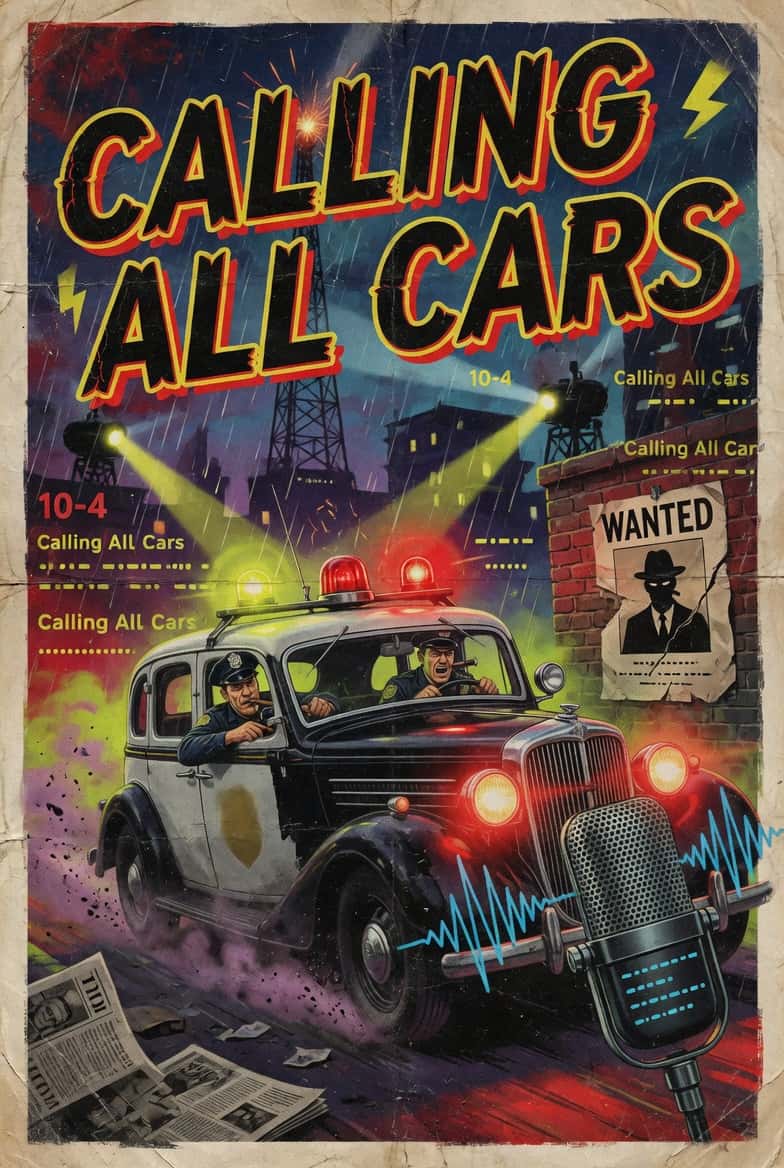
A Rio Grande presentation. Los Angeles police calling all cars, attention all cars, broadcast 58. Stand by for review of preceding broadcasts covering murder, bank holdups, and dynamiting.
That's all. Rose and Cruz. Two police officers cruising about their territory tonight in a radio patrol car have as their guests a representative getting first-hand information for the next broadcast of Calling All Cars. Let's listen in.
It's sure good to see the new year come in. 1934 wasn't such a good year for us all.
Not for all of us, maybe, but so far as Rio Grande was concerned, 1934 was a splendid year.
You mean to tell me that you sold more of that Rio Grande crack gasoline last year? I understood most companies are losing this.
Oh, no, sirree. Crack gasoline sales have been growing month after month. We've more than doubled our sales.
Well, you've got a mighty fine gasoline, no question about that. We wouldn't be using Rio Grande crack in our police cars if it wasn't the finest that the city could buy.
Yes, more police cars in California and Arizona are using Rio Grande than any other gasoline. You know, most of our business comes from new customers, motorists who want to get police car performance in their cars.
I imagine that Calling All Cars radio program creates a lot of new customers for you.
Yes, that's right. Nearly every listener is driven into a Rio Grande station to try crack gasoline, and they stick with us. Rio Grande has a mighty loyal following, and the company tries to show its appreciation by giving better broadcasts every week. It is a special program on tonight. Let's listen to it.
During the year just past, you have heard broadcast on this program many cases from the police files of Oakland, San Jose, San Diego, Tucson, and other western cities, as well as cases from the files of the Los Angeles Police Department. Tonight, we ask you to look back over the past year as we review memorable scenes from Calling All Cars for 1934.
In every case of violence and law-breaking, which you will hear re-dramatized on tonight's program, bear in mind that the criminal paid the full penalty prescribed by law. We westerners have a great tradition to uphold, and the blood of the vigilante seems to flow in our veins. For out here, we have shown beyond a shadow of a doubt that crime does not pay.
Do you remember Tom White, the rattlesnake bandit, and his blonde wife and partner in crime, Burma? The very evening that newspapers screened the headline story that she was on her way to Tehachapi, Calling All Cars broadcast the dramatization of her career in crime.
Yes? How do you do, ma'am? We're a police station. We're police officers, and we'd like you to help us.
Why come in? Is anything wrong? What can I do?
We're looking for a blonde who lives in this building.
A blonde? Well, there are several blondes here. Who are they?
Well, now, there's Miss Arnold. What's she like? Well, I wouldn't want to go any further, but she's heavy. In fact, she's fat.
That's not the one. Who else?
Well, then there's Miss Gilman. She's 40. She's a day. Don't try to tell people she's only 32, you know.
That's not the one.
Oh, yes. There's young Miss Adams. Hasn't been here very long. What's she like?
Well, she's just a child. About 19 or 20. Slim and pretty, in a way. In 218.
Now, look here. I don't want any trouble in my place.
There won't be any trouble. You just stay right here in your apartment.
Detectives Burris and Bergeron call Detectives Anderson and Maxwell in from the alley. And with John's gone, climb the stairs to apartment 218. They find the door unlocked.
That's her. Grab her, Burris. Hey, Andy, there's that guy down the hall. Get him up.
Now, hang on over there. What are they doing, killing Tom?
No. Tom White went to a gunman's grave. And Burma White should hatch at the women's prison for from 30 years to life. But this sort of expiation can never bring back the sight of Miss Cora Whittington, who was blinded by brutal Tom White's murderous gun.
Total police calling all cars, attention all cars. A bombing at the Los Angeles Times building. It is one o'clock in the morning of October 1st, 1910. While the city sleeps, a band of men who toil by night and rest by day is working at top speed. From the far corners of the world, another page of history's book has been assembled. The morning paper is going to press.
In the composing room on the second floor of the Times building, a line of men, green eye shades clamped to their heads, clatter at the linotype machines. In the engraving room on the sixth floor, mercury lamps throw their ghoulish glare. The dog watch in the city room sleepily eyes the clock, hoping that no big story will break to disturb their somnolent ease. Until thirty comes for them at half past four.
Seated by their silent telegraph keys, two men stand by in the wire room for last minute news flashes. In the basement, the huge presses hungrily await the plates for the final edition. Horses and wagons stand ready in the alley to dash away with the ink-red edition to carriers all over the city that Los Angeles may have her news with her morning coffee.
The hands of the clock slowly move on. Activity increases as press time approaches. It is now one-five, one-six. In Ink Alley by the press room, another clock ticks ominously, unnoticed by any of the busy workmen in the building. The seconds pass. The clock says one-seven. And then...
With a roar that is heard ten miles, the center of the Times building blows up. The force of the explosion snaps the girder supporting the second and third floors as so many toothpicks down into the gaping hole hurtle the heavy linotype and posterior typing machinery carrying their operators to a crushing death. The gas beam sees the building is ripped open and instantly ignited. A searing fountain of flame leap through the building. Within a moment, the entire structure is ablaze.
Workmen clutched in the freezing mold of all the rest of the fire escape to be met by a fiery wall. Through such escape is an impossibility. But the two telegraph editors trapped in the room slowly burn to death. Compositors and linotype operators horribly maimed, arms torn off and legs broken lie helpless on the floor. As the facetious fire creeps toward them, their pitiful cries reach the street below where all the downtown fire operators have already arrived. But rescue is an impossibility. No man can enter that seething funeral fire and live.
The reporters and editors on the dog watch in the city room of the third floor are forced to jump to the street. Those who survive the jump are crippled for life. Within a few minutes after the explosion, the last cry of the helpless victims trapped within the building has been smothered in the fever and breaks the flame. In an astonishingly short time, the entire building, the building is gutted.
And then a new danger appartens. As one after the other, the wall, lacking any support, sways. The car drives to the street where a huge crowd of citizens hurls from their beds while the explosion are straining at the hastily rigged guard rope. All night long, the fire rages, completely ruining the plant of the Pymes. Yet just a little later than usual the next morning, the Pymes is delivered to its subscribers, printed at the emergency plant by the battered, bruised, and bandaged survivors of the catastrophe.
Before the last smoldering ember has died away, the law swings into action. Sam Brown, Chief of the District Attorney's Investigators, and William J. Burns, world-famous detective, team together in a manhunt which extends halfway across America before the McNamara Brothers, arch-terrorists, are run to earth and sentenced to life in prison.
Captain Chitwood of the Los Angeles Narcotics Squad was one of the big heroes of calling all cars in 1934. He it was who posed as a dope peddler, and met with three wily Japanese high on the top of a hill. His problem was to get the goods on the Orientals and then arrest them and bring them into headquarters. He took his life in his hands.
Under his threatening revolver, Captain Chitwood forces the three Japanese to bring the dope up and put it in his car. Although he watches his captains with great care, he cannot but feel the constant threat of Koto's great strength. As the car is loaded finally, he orders the three Japanese into the car.
In your work, Mr. Jordan, you do not make a great deal of money.
Well, it's not very much according to your standards.
A sum such as $10,000 would be quite large in your eyes.
It would be very large.
I happen to have such a sum within easy reach. You'll be able to hire a good lawyer with it. I was thinking of making a friend a present.
A very lucky man, I should say.
You are the friend, Mr. Jordan. And how do I merit this friendship?
You return to the police station with the sad news that your suspect disappeared.
Sorry, Count, that's out of my line.
$10,000 is a lot of money.
No, you better get in the car. Back there, Koto.
Mr. Jordan, I will give you one more chance. There are three of us. Koto here is a trained wrestler. We all know jujitsu. Once we are in the car, you will be unable to manage us. True, you have a gun, but you cannot succeed in getting us to the city.
I've been thinking about that.
I think you had better accept Count's offer.
It is impossible you will arrive in town alive.
Let's move another way. Let's say that it is impossible that all of us will arrive in town alive.
I do not quite understand.
It's very simple, really. Don't you see that Koto is the main threat? How much do you weigh, Koto?
210.
When you count in Oashi here, carrying Koto through the fields down to where I can call a police car, you won't be very dangerous.
But why should they carry me?
Because I'm going to kill you.
You cannot do that.
My dear fellow, I can and will do exactly that. Koto, unfortunately, resisted arrest. My duty as a police officer, although unpleasant, was very plain. I had to shoot him. The law is quite explicit on that point.
But I'm not resisting arrest.
Oh, you have no imagination, Koto, huh? Who will ever know?
You will not do this thing. It is fantastic.
Just to show you that my gun is loaded, gentlemen, and that I mean what I say.
This must be another way. We plead with you, Mr. Jordan. We have been very fair. We have offered you money. Well, you will not take it. But that is no excuse to murder one of us.
I have no desire to kill, but there is one other way.
What? Please?
Koto will lie on the floor of my car. You two will lie on top of it. And him with your hands at my side. If you make a false move, I'll shoot all of you. If you don't, he'll arrive safely at the station.
We accept. Into the car, then. And watch your step. This gun is liable to go off in my hand by mistake.
One hand on the wheel, the other covering his uncomfortable prisoners. Captain Chitwood transported the dope smugglers to police headquarters. They were speedily tried, and speedily sentenced to two and a half years in the federal penitentiary in Leavenworth for violation of the Harrison and Jones Miller Narcotic Act. Since serving their time for that offense, the count has been sentenced to fulsome on a verdict of first-degree murder. Koto has returned to Japan, and Awashi is a fugitive from justice, having jumped a bond on a forgery charge.
The murder of a soul, broadcast 29 of Calling All Cars, marked an experiment in the introduction of psychological drama into radio. For weeks, distraught Marie Trentini broods over the fickleness of her cousin Vincenzo and the brutal frankness of Gaetano, his brother. For weeks, behind her impassive, saddened face, her brain is in a turmoil, trying to adjust herself to the outrage she feels has been done her. And then, finally, on August 7th, 1928, as Marie lies tossing sleeplessly in her bed, something in her brain snaps. The turmoil of thought and counterthought lines up into one straight, clear path of action. Marie slips from her bed, tiptoes into the front room, takes Gaetano's shotgun from the closet and silently walks toward the bedroom in which her cousin and his wife are sleeping.
I love him, Gaetano. You could have made him marry me. It would have been all right once I had him. He would have learned to love me. I would have made him a good wife, better than any of those little fluffs. You could have done this for me, but you wouldn't, Gaetano. You left, you left me. You told me I was old and fat, but I'm good inside, Gaetano. I had a soul. I had a feeling. You don't know about that. No, that you would kill me. You would kill my soul. Oh, you would kill me. But see, Gaetano, my body is not dead yet. My body can still kill you, Gaetano. That is a fear, isn't it, my cousin? You kill my soul. I kill your body. You see how my body still lives. Call me Gaetano or I'll lift this gun to my shoulder. I would have put my finger on the trigger.
I'm sorry.
Marie Fantini established an alibi to the police, but Captain Barlow, police fingerprint expert, discovered her prints on the gun. Confronted with this damning evidence, Marie, excusing herself for a minute, stepped into an adjoining room and slit her throat.
September 26, 1933. Under the hail of machine gun bullets, our mate Ray Harris here found enough of what accompanied by seven other convicts to successfully escape from the Indiana State Penitentiary. As the ten desperate criminals disappear into the mists of early morning, all Indiana awakens to a reign of terror.
Two days later in Lima, Ohio.
You like Sheriff?
Yes.
Are you holding John Dillinger here?
Yes.
We've come to get him.
Who are you?
Officers from Michigan City, Indiana. He's wanted there.
You'll have to show me your credentials.
Here's our credentials!
Terror spread throughout the Middle West. Hysterical fear mounts. Not since the days when Jesse James robbed the prairies have respectable citizens lived in mortal dread of a ruthless outlaw.
Do you want to hear this news? Indianapolis. $21,000 taken from the Massachusetts Avenue bank. Euclid, Ohio. And it's said that it's $3,000 from the Euclid Bank in daring daylight robbery. Farrell, Pennsylvania. Hold up there. Farrell Bank. Lost $24,000. Daleville, Indiana. Hold up and lost $3,500. Montpelier, Indiana. $4,000 hauled from the Montpelier Bank. Ravenna, something. Hold up to the American Bank and Trust Company. Lost $23,000. $27,000. Greencastle, Indiana. $74,000 bank robbery. East Chicago, Indiana. Hold up to the First National Bank. $20,000 stolen. One policeman murdered.
Such is the list of crimes attributed to the Dillinger mob. Federal authorities combined forces with state and local peace officers. Roads are blocked. The militia is called out. Then, suddenly as it began, the reign of terror ends. Peace once more reigns in the Middle West. The scattered nerves of farmer, merchant, and banker gradually return to normal. Dillinger seems to have disappeared from the face of the earth.
A pale desert moon casts its transparent coverlet over the jagged crest of Mount Lemmon. From a sandy wash, a coyote howls at the silent saguaro that broods above him, thrusting its spiny arms toward the star-speckled velvet dome overhead. Across this scene of beautiful desolation comes a discordant note. A tinny popular song played by a three-piece orchestra in a desert roadhouse. The place is a few miles from Tucson, Arizona. It is the night of January 24th, 1934. Here, Clark, the Dillinger henchman, boasts to a couple of traveling salesmen about his prowess with a machine gun. Three days later, the Dillinger gang is in the Pima County Jail. And a week later, are transported to Indianapolis. But Dillinger bluffs his way out of the Crown Point Jail and the reign of terror begins again.
Then, late in July, the trail once more grows hot. Tipped off that Dillinger will attend the Biograph Theater in Chicago, a score of Department of Justice agents stake out the neighborhood. Melvin Purvis, chief investigator and an aide, sit in their car a few doors from the theater. More than an hour passes uneventfully, and then, just before nine o'clock...
Hey, Ed.
There he is.
Where?
Walking into the ticket office. I can't mistake that head.
Oh, yeah, I see. Now, he's turning. That's him, all right. And look, Mel, he's dyed his hair.
Yeah, black. He's wearing gold-rimmed spectacles. That's him.
You gonna let him get into the theater?
Yeah, we won't take any chances. He bought his ticket and gone in. If he died on the exit, Ed, I'm gonna give the boys their final orders.
Okay, chief.
I was in, Charlie.
Yeah, I thought so. You and Mike, stick around the door. We have a tavern here and keep your eye glued on that theater.
Russell.
Yes, chief?
You and Kelly watch those exits down the alley.
Right.
You'll probably be in there a couple of hours, but he might get suspicious and try to get out the back door.
Yes, sir. And get this straight. No matter what he does, we're taking him tonight. Try to get him alive, but if you can't, get him dead.
Torturous hours are spent by the officers surrounding the theater. Two hours and four minutes. And then the doors of the theater swing wide and the shirt-sleeved audience throngs out into the sweltering summer night. Dillinger saunters onto the sidewalk, accompanied, so some reports say, by a young woman clad in red. Purvis closes in behind him. As Dillinger crosses the alley, Purvis waves his hand. Five officers close in. Suspicious, Dillinger reaches for his box. John Dillinger died on the way to the hospital and 72 hours later, the story of his career of being a doctor of crime was being broadcast on Calling All Cars.
Another famous master criminal was the subject of Broadcast 36. Herb Wilson, the nitroglycerine parson, minister-turned-safe robber. Only once in his career did he fail to break a safe. That was one night in Detroit when the gang, after weeks of preparation, set about to crack the safe of the National Maccabees organization, which contained 13 million dollars. One by one, the guards are overpowered and locked up in closets. One by one, the 13 burglar alarm boxes are put out of commission. Then, all precautions taken, Wilson unwraps his equipment, the gas tank is wheeled in, and donning an asbestos apron of his own invention, the nitroglycerine parson lights his torch and sets to work on the massive safe. Like a knife through cheese, the hissing blue flame of the torch cuts through the thick steel box. Deeper, deeper as the hours of the night wheel on. Closer, closer to a tremendous fortune. The members of the gang crouch around their leader, watching with eyes gleaming with avarice as the hooded figure of the master cracksman dies. Wilson bends over his work. Finally, toward dawn, Wilson raises his hooded head.
Another quarter of an inch, boys.
Well, hurry up, Herb. It's getting late.
Yeah, just a matter of a few seconds, and then... Thirteen million dollars!
Yes, sir.
Hey. Hey. What the... Herb. Herb, what the hell's wrong?
I don't know. Let me try that tank.
Well, that's that, boys. We're out of gas.
Out of gas? Another quarter of an inch away from thirteen million dollars.
Yep, that's the way it stands.
Well, what are we gonna do, Herb?
What can we do? You can't get gas to any place at three a.m. on Sunday morning.
Well, we could use nitro on it.
Yes, if we had any.
Oh, that's right. We didn't bring any with us.
Yeah, well, it won't do any good crying about it, boys. We'd better get out of here and get out fast. Come on!
After stealing more than fifteen million dollars in three years, Herb Wilson finally made a little mistake. He left his fingerprint on an electric light bulb. He is now in San Quentin for life.
The biggest Western crime story of 1934 was the kidnapping of William F. Gettle, Beverly Hills oil millionaire. Forty-eight hours after Mr. Gettle was released, Calling All Cars dramatized his adventure and presented Mr. Gettle himself to the entire nation over a coast-to-coast hookup of the Columbia Network. The most pitiful aspect of the Gettle case was the horrible tension under which Mrs. Gettle lived during the long days when her husband's fate was a question. In the sun-filled garden of the Gettle mansion, the four children of the kidnapped millionaire, Billy and Betty, the twins, and Bobby and Jimmy, play their childish games, ignorant of the terrible plight of their father. In a darkened room on the first floor, Mrs. Gettle receives Mr. Noon, the attorney who is negotiating with the kidnappers.
Mr. Noon, is there any news?
Yes, Mrs. Gettle. I have just received a call from the man who calls himself Percy.
That is the way the ransom note I received last night said the message would be delivered.
What did he say?
He said to hold myself in readiness for further instructions.
Do you think Will is all right?
I have every confidence he will be back soon.
Oh, I hope so.
Mama, Mama, I want my daddy. Where is daddy?
Now, children, run out and play.
But where is daddy, Mama?
Your daddy's gone away for a few days on business.
When will he be back, Mama?
He should be back any day now.
But two days later, due to the keen ears of Detective Burris staked out on the dictaphone, the kidnappers are located and Mr. Gettle is released. Twenty-four hours later, they are sentenced to life imprisonment in San Quentin. And twenty-four hours after that, while they are speeding northward to prison, Calling All Cars brought the biggest radio scoop of the year to the ears of the nation.
Another famous criminal case of 1934 was the Nellie Madison murder case. Mrs. Madison, accused of murdering her husband, is faced with an overwhelming array of circumstantial evidence. Her attorney, in summing up his plea to the jury, was played by Richard Legrand in one of the most moving character depictions of the year.
Ladies and gentlemen of the jury, have you ever lost suddenly and horribly someone you held most dear? Have you ever been so stunned by personal misfortune that you were cold and indifferent to all that transpired about you? If you have, then you know what has been happening to Nellie Madison throughout this trial. There can be no murder without motive. And what possible motive could this woman have? The Madisons were a loving couple. You are being asked by the prosecution not only to hang a woman, but by all we've shown during this trial to hang an innocent woman. Don't do this thing. Don't have it on your souls and consciences for the rest of your lives. Don't send this innocent woman to the gallows upon the tenuous threads of circumstantial evidence. Remember the command of our almighty father. Thou shalt not kill.
Well, fill her up with Rio Grande Cracked. I wouldn't dare give a police car any other gasoline.
I don't think you could. I've just been listening to Rio Grande's Calling All Cars.
You hear it? We've got a Calling All Cars man right here with us tonight.
Oh, well, I suppose you two cops will be the heroes on the next broadcast.
Hey, how about putting you on the radio, too? What have you got to say on behalf of the independent dealers who sell Rio Grande gasoline?
Well, you tell your listeners that we independent dealers got a kick out of the many people driving in after every broadcast and asking for a tank full of police cars.
How about a business prediction for 1935? Everyone else is predicting. What do you think about business?
I can predict good business for every independent gasoline dealer who lines up with Rio Grande. That's the only big gasoline company that doesn't compete with its own dealers. My business has grown steadily ever since I put in Rio Grande pump. And my customers stick with me. They should. I give them better value in Rio Grande cracked gasoline, more power, faster starting, greater speed, higher anti-knock rating, and tetra-ethyl at the price of ordinary gasoline.
Well, come on, fellas. We got to go. Happy New Year.
I'll go one better. Rio Grande wishes you a prosperous New Year.
Los Angeles Police calling all cars, attention all cars, cancellation broadcast 58. And congratulations on the good work, boys. Keep it up.
Rolled and quick. Calling All Cars is written and produced by William N. Robeson. The orchestra is under the direction of Frederick Stark. This is your narrator, Frederick Lindsley, bidding you good night and a prosperous New Year. For the Rio Grande Oil Company.