
The written record
Read the transcript
Read along with the recording · About 24 min to read
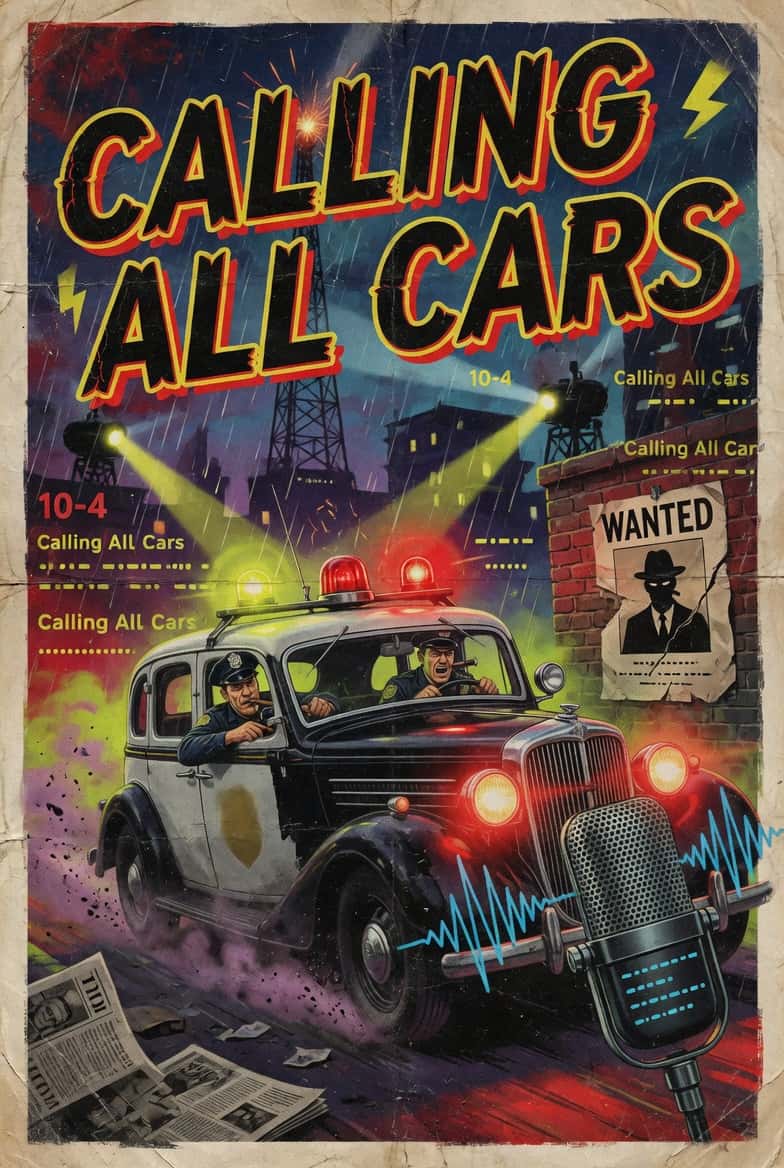
The copyrighted program created by the Rio Grande Oil Company. Los Angeles Police calling all cars, attention all cars, broadcast 126 regarding the body of a murdered woman found in a vacant house on Arlington Street.
That's all. The amazing speed and efficiency of the police and emergency cars operated by the West's largest cities and counties make the best possible advertisement for Rio Grande Cracked Jack Gasoline. Whenever you hear the shriek of a siren, when police cars whiz past you with motors racing at top speed, you can't help but think, there goes Rio Grande Cracked Jack Gasoline. For it is absolutely true that more police and emergency cars are powered with Rio Grande Cracked wherever it is sold than any other gasoline. Thousands of motorists have discovered that they can enjoy police car performance in their own cars by getting their gasoline from the neighborhood independent dealer who offers the same gasoline as Rio Grande Cracked, that is used in all police and emergency cars operated by the cities of Los Angeles, Maricopa County, Arizona, and many, many others. Careful records of car operating costs for the West's leading cities prove that Rio Grande Cracked is the most economical and efficient gasoline they can buy. It's thrilling to have such fast-starting gasoline in your car, to enjoy such lightning-like acceleration, to have more power than you need, and it's also comforting. It's thrilling to realize that it costs you no more to enjoy police car performance.
I wasn't able to be here this evening, but he has sent us the following message.
Well, Chief Davis has just come in the studio. Chief Davis, you're right on cue. You want to read from my copy?
Good evening, friends. Fingerprints have so long been associated with police and criminals that the average citizen feels that he would be disgraced if he were confined in jail. For his fingerprints to be taken and filed, it's a matter of record. This is a false attitude and civic organizations all over the country are working to break it down. If every citizen in the country were to be fingerprinted, the work of the police would be much easier. I do not say this to infer that in the eyes of the police, every citizen is a potential criminal. Far from it. But universal fingerprinting has its serviceable aspects in many walks of life. It's a matter of record. It serves as a positive identification. It avoids many unfortunate mistakes. It is unimpeachable proof of identity. In the case you are about to hear, our work would have been much simpler in solving a baffling murder. If the victim had been fingerprinted, we would have had the murderer before he had a chance to get away. Fingerprinting does not imply a criminal stigma. It is a protection for every citizen. Thank you.
On Arlington Street in Los Angeles walks young Phineas Benjamin, son of the carpenter on the job. His father has sent him to match some hardware on the second floor. Whistling merrily to himself, Phineas picks his way among the lumber strewn around the first floor, ascends to the pitch-stained new staircase, his footsteps echoing through the empty building. He gains the second floor landing.
He is summoned by the horror-stricken youth to quickly drive out to the Arlington house, meet the young man and his father.
Phineas, slowly mount the empty unpainted stair, thickened at the top. She's lying on her face. Turn her over, Wendell.
Yes, sir. Look, Lieutenant. The legs are burned and there's burned paper all around her.
Hmm. Tried to cover up the murder, I guess. It's impossible to make out those features, blast beyond recognition. What's this? What's that? The neck of a beer bottle. Cap's still on it. There are blood-stained pieces of the broken glass all around the hallway here.
Yep. The murderer must have beaten her over the head with this beer bottle. I have never seen anything more brutal. If that paper had burned, the whole house would have gone up and there wouldn't have been a trace of the body. We should dust what the murderer planned. But why didn't the paper burn?
Well, you see, it's asbestos paper. We use it in buildings because it's fireproof.
Have you any idea who this woman is?
No, sir. I haven't.
Who are you building this house for?
A finance company.
Hmm. I haven't seen anybody around the place recently.
No, sir. You see, we've been working on another job for the last few days. There hasn't been anybody around here.
Well, our first task is to get an identification of the victim. Better phone the morgue to take her in, Wendell.
Yes, sir.
All those Angelenos' newspapers scream the horrible details of the crime into a breakfasting populace. The detectives assigned to the case listen to the finding of autopsy surgeon George W. Campbell.
I find, gentlemen, from the condition of the corpse, that the victim had been dead about 48 hours. That would place the murder sometime on May 7th.
Precisely.
What caused her death?
Fracture of the skull. She'd been struck three times by a heavy glass object, which broke on the third blow. The murderer will undoubtedly have cut on his hand from the broken bottle.
His hand? How are you so certain that it was a man, doctor?
In my opinion, it would have taken the very giant of a woman to have delivered such a deathly blow.
I see. There's another gruesome aspect to the victim's death.
What's that?
She was still alive when the murderer set fire to the body.
How do you know that?
Her legs were blistered from the fire. Blisters do not form after death. I believe she had lived for three or four hours after the attack.
Anything else, doctor?
Nothing, except that the autopsy shows that this was really a double murder.
I... I see. Thank you very much, doctor.
Not at all. Good day, gentlemen.
Good day.
Well, boys, here's the setup. We've got a brutal murder. A mutilated corpse and not a single clue. No fingerprints on the murder weapon. No laundry or cleaning marks on the clothes. Excepting a Marshall Field's label in the coat. Before we can get very far with catching the murderer, we've got to identify the victim. Any suggestions?
Well, the papers are plain, Mr. O'Brien. We've got a story for all of them to take. You'd better have them print a full description of the woman as well as pictures of her clothes. Ask for reports on missing persons and all that.
That's a good idea, Jarvis. You'll send the same information to Chicago police on the hunch that that label in her coat means she came from Chicago. As soon as the story's printed, we'll be swamped with tips and clues. Most of them, maybe all of them, will be phony. But I don't want you boys to overlook a single one of them. It's going to mean long hours and hard work. But you must not fail.
Lieutenant Klein's guess was right. The description of the mystery corpse in its clothes is published. Hundreds of letters, phone calls, and letters of missing women pour into the detective bureau. Scores of positive identifications are made and then run down to end in blind alleys. Dozens of fight letters and cranked messages are followed through, investigated, dismissed. The detectives work from early morning until long after midnight, sifting the plethora of rumors, tips, or clues. And they're the ones who are going to be killed. And they're the ones who are going to be killed.
The mystery deepens. The identification of the mangled corpse becomes less likely. A fruitless week goes by. And then the officers return to their original clues.
Let's look at the clothes again, even though there were no identification marks on them. Take these shoes, for instance. Notice anything peculiar about them?
No. Just another pair of brown shoes.
Yes. But look here. These shoes have had new heels put on them recently. If we could find the shoemaker who did that, we could find the man who did that. It might give us a lead.
Yes, it might. But good Lord, man, think of how many hundred shoemakers there are in Los Angeles. It makes no difference. We've got to check them all. Okay. And look at this hat. It's unusual enough so that it ought to be recognized by the person who sold it. And that a picture of the hat's already been around in all the papers.
Yes, but pictures don't show color. And look at the color of this hat. Bright blue with cream-colored feathers on either side. You'd never forget selling that hat, would you, Charlie?
Me? I wouldn't sell it for gold.
Well, we've got to canvass every millinery store in town and see if we can trace our victim's whereabouts. You take as many men as you need for the cobblers, and I'll work the milliners. R.J. Hammond, best of luck.
I'll need it, and so will you.
Days, Jarvis and his squad of men interview shoemakers searching for the man who put the new heels on the unknown woman's shoes. And for days, Klein, embarrassed, feeling out of place, enters millinery shop after millinery shop with the blue hat under his arm. Finally, in a shop on South Broadway.
Oh, good afternoon, sir. Could I show you something?
No, I'm from the police headquarters, and I'm trying to find out where this hat was sold.
Why, no, I haven't. Of course I have.
You have?
Mm-hmm. Why, there was a picture of it in the papers, wasn't there, in connection with the Arlington Street mystery.
Yes. Well, that's where I saw it. Tell me, officer, do you think, who do you think killed that poor woman?
I haven't any idea. I'm trying to find out who that poor woman was first.
Well, now, I've been following that case pretty close, and I said to my girlfriend last night, I said, Now, listen, are you sure you never saw this hat before?
Why, yes. Okay. I've only been working here a week.
Why didn't you say so in the first place? If one of the girls has been here longer than a month.
Well, now, there's Miss Baldwin over there. She's been here all along time. Maybe six years.
Months, three years. Call her over, will you?
All righty. Oh, Miss Baldwin, dearie. Will you come here? And now, as I was saying, I said to Stella, Why, you're not even listening. Aren't you interested in what I said to Stella?
No.
Oh. Well, this man, he wants some information. He's a police officer.
Oh, yes. I'm investigating the Arlington Street murder, and I'm trying to find where this hat was sold. Did you ever see it before?
Yes, I sold that hat. Now, it's there.
You did? Who did you sell it to?
Oh, let me think. A Mrs., uh, what was the name? For heaven's sakes, try to remember. A Mrs. Who. I think, um, Mrs. Dillon. Yes, that was her name, Mrs. Dillon. She came in with her husband. I remember quite plainly now. Somehow, we got talking about Chicago.
Oh, Chicago. Yes, that checks. What did this Mrs. Dillon look like?
Well, she was about the size of Marjorie here. I remember she wore a coat with a plaid collar.
A coat with a plaid collar. Yes, that's right. What did her husband look like?
Well, I didn't know. He didn't want to pay $15 for this hat. Well, anybody can see it's worth all of that. Well, I imagine he was about 38 or 40 years old, medium height, and he had big brown eyes, and his hair was a little thin on top. He limped, too.
Brown eyes, limp, hair thin. She didn't have a charge account, I suppose.
No, she didn't. Ah, too bad. We certainly need an address to work on.
Wait a minute. Wait a minute. She didn't have a charge account, but she did wear this hat out of the store, and she had her old one sent to her home. Now, isn't that an... Good to be true. Can you find that address you sent the old hat to?
Now, try. There's just a chance I might have it here in my sales book. Let me see. That was about four weeks ago. Does that remember it was some address on Hope Street? Of course, it was so long ago. I doubt if I... Why, yes. Here it is. Mrs. C. Dillon, 940 North Hope Street.
Oh, my dear girl. This is the first real lead we've got. I feel so good I could kiss you.
Well, really, I'm afraid you'll go...
There's one more thing I'd like you to do for me. Come down to the morgue with me and identify the body.
The morgue?
At the morgue, Miss Baldwin positively identifies the body of the woman she knew as Mrs.
Dillon. Klein at once calls in his partner, Jarvis, and the two of them go to the address on Hope Street.
Here's 940.
Yeah, it's like a rooming house.
It is. Here's the sign by the door. And I certainly hope this isn't another wild goose chase.
No. I got a feeling we're on the right track at last.
Yes?
Are you the landlady?
Well, I'm taking care of the place just now.
Who owns it?
My mother and father, but they're out of town for a while.
What's your name?
Why do you ask? Who are you?
Police officers. We're investigating a case.
Oh, I see. Won't you come inside?
Thank you. Have a seat, please.
Thanks. Now, what do you want?
What's your name?
Miss Thompson.
Miss Thompson. Did a Mr. and Mrs. C. Dillon rent rooms here recently?
Yes, they did.
When?
Well, let me look at the register here. They came in on April 27th.
Ah, they're still here?
Oh, no. They left a couple of weeks ago.
On what date, to be exact?
On May 7th.
May 7th. That's the date of the murder.
Murder?
Yes. We're investigating a murder on Yarlington Street, miss.
But you don't think that Mr. and Mrs. —
Ah, we don't think anything. We're just trying to find out.
Yes. Yes. Yes. How did Mr. and Mrs. Dillon check out together?
Well, that was a little strange. I was out on the night they left. I went downtown with my beau and didn't get home until 10 o'clock. When I got back, I noticed that the Dillons' door was open and that their baggage was gone. But they'd left the money for the room rent on a table.
Did they leave any note?
No, just the money.
Didn't it occur to you that their departure was rather abrupt?
No, I didn't think anything about it. Mrs. Dillon had told me that they were just out here from Chicago and they were looking for a house. They hadn't even taken their trunks out of storage.
Did she say where the trunks were?
At the depot. She didn't say which one.
And what did this Mrs. Dillon look like?
Well, she was about my height, with a little tow, had light brown hair and blue eyes. I guess she was about 35.
And her husband, what was he like?
Well, I only saw him a few times. He was a little older than she was, and he walked with a limp. If my father was here, maybe he could tell us more about him. He's in Washington, D.C. He's staying at 1052 G Street.
We'll get in touch with him right away.
While those evening papers carry the news of the identification, Washington police, at the request of Lieutenant Klein, are questioning Mr. and Mrs. Thompson regarding the Dillons. Next day from the Capitol comes the report.
Well, Charlie, we didn't get much from the Thompsons.
Well, what did they say?
Merely that Dillon had told them that he had lived in Chicago.
Well, we already know that. What else?
That he was once an intern.
Well, it looks like we'll have to ask for more help from the public.
All right. I'll have the papers carry a story requesting information about a man named Dillon from Chicago.
Well, I hope the papers are more helpful than they were in the identification of the body. In the meantime, you cover the railway station for those trunks he was supposed to have checked.
The published request for information about a man named Dillon has immediate and concrete results. The next day, the story appears. A man calls upon Lieutenant Klein at headquarters.
Lieutenant Klein?
Yes?
I've come to see about this Dillon fellow you're looking for.
Yes?
On April 30th, I showed Mr. and Mrs. Dillon a house that was right out in Glendale.
You did? What did this couple look like?
Well, the man walked with a limp, and the woman wore a blue hat with cream-colored feathers on it.
Right. That's the couple. What happened?
Mrs. Dillon seemed to be very pleased with the house. She wanted her husband to buy it, but he seemed to be in an ugly mood. Refused to consider it. I asked him what his objections were. And he said — He growled at me and said it was her idea to buy a house, not his. He didn't seem to get along very well with her.
That's all right. Come in, Charlie. This gentleman was just giving me some information on Dillon.
This gentleman showed Mr. and Mrs. Dillon a house in Glendale.
If they were in the market to buy a house, that would account for Mrs. Dillon being murdered out there and I have finished her.
You mean Dillon lured her there on the pretext of inspecting it as a possible buy?
Exactly.
Is there anything else you know about this couple? Did they give you an address or anything?
No. As I said, Dillon wasn't interested, so I just figured it was no sale.
I see. Well, I want to thank you for coming in with that information.
That's quite all right.
We'll call you if we need you. Good day.
Now, what's on your mind, Charlie?
I found the trunks.
You have? Where are they?
In Chicago.
Oh. You've been to Chicago since lunch, huh?
Oh, stop it. This is my trace from Chicago, see? Oh. He arrived from Chicago on April 21st. Him and Dillon's ticket under checks number 61514 and 5. They weren't claimed until 6 o'clock on May 7th.
May 7th again. No doubt that was the date he killed her.
Well, at 6 o'clock on May 7th, a man who gave his name as J.W. Jones bought a ticket to Chicago and rechecked the trunks. One on his own ticket was check number 351487. The other on excess baggage, check number 10193. They left on the 9:45 train that night via Sacramento, Ogden, and Omaha.
Good work, Charlie. Get that information off to the Chicago Police Department right away.
On receipt of the Los Angeles officer's information regarding the trunk check, the Chicago Police immediately set to work on the clue. Captain of Detectives Halpin traces the trunk in the baggage room of the depot to the residence of C.C. Dillon at 5420 Evanston Avenue, Chicago. A faded little woman answers the door when Captain Halpin arrives at the house.
Yes? Is this the residence of C.C. Dillon?
Yes.
Is Mr. Dillon at home?
No. I'm Mrs. Dillon. What can I do for you?
You're Mrs. Dillon?
Oh, yes. It's so surprising that —
Nothing. How long have you been married?
Well, I don't see why I should answer such questions to a perfect stranger.
I'm from police headquarters, and I'm making an important investigation. It would be wiser to answer my questions.
Police headquarters? Well, what's the matter? Are you excited about it?
I just want to ask you some questions. May I come in?
Well, all right. I'm sure I have nothing to hide.
I suppose you may have worked downtown.
Thanks. Now, Mrs. Dillon, how long have you been married?
Ten years.
You've been married to Mr. Dillon ten years?
Yes.
Mr. Dillon just returned from California, didn't he?
Yes.
What was he doing out there?
He was on a business trip.
He brought some trunks back with him, didn't he?
Yes.
I'd like to look in those trunks.
Well, I don't see why I should let you.
It would be better, Mrs. Dillon. Well, if you have nothing to hide, then everything will be all right. But they're my husband's trunks. There's nothing in them that would interest you.
Perhaps I am the best judge of that.
In the hall here. They're not even unpacked yet. I think they're unlocked.
Oh, Mrs. Dillon.
Yes? Yes.
Now, how do you explain that the lower part of this trunk is filled with women's clothes?
They, they're mine. I, I was going to join him out there.
These shoes yours?
I, yes.
Mind trying them on?
Oh, are you pretending? Those shoes aren't mine. They're two sizes too big.
That's what I thought. Whose shoes are they?
They, they belong to a servant girl named Millie Quinn. My husband left me for her. He took her to California with him.
What happened to her? He came back alone, didn't he?
Yes. He, he said he couldn't go through with it. He gave her some money and got her a job in Los Angeles. Then he came back to me and the children. And he said he was sorry. He apologized and I forgave him. But I'm so ashamed.
Where is your husband now, Mrs. Dillon?
He, he's out looking for a job. I, I don't know when he'll be home.
I think I'll wait for him, if you don't mind.
Of course, if, if you want to. But what is it you want to see him about?
I want to ask him some questions about a half-finished house and a broken beer bottle and, uh, Millie Quinn.
But I don't understand.
You will in time, Mrs. Dillon.
Oh, please, don't let me upset your household. I'll just sit in here and read the paper. You just forget about me.
Well, all right, I, I, I was just going to the store when you came in. I, I think I'll get my marketing done.
All right. If, if, if I'm not back by, by four o'clock when you give the baby her bottle, it, it's on the stove and she's in the back bedroom.
I certainly will, Mrs. Dillon.
Frightened, bewildered, Mrs. Dillon rushes out of the house, down to the corner, not to a market, but to a saloon. Bursting through the swinging door, she finds her husband standing at the bar.
Carl, Carl!
Yeah, what the devil's got you following me down here? Can't I have a minute to myself?
Listen, Carl, I, I have to talk to you.
Can't you wait till I get home?
No, this won't wait. I have to talk to you privately.
All right. Come on in the back room. Sit down. Now, all the hysterics about —
Listen, Carl, there's a detective up at the house.
What?
Yes. He asked about your trunks. He made me show them to him. Are you cold? I couldn't help it.
Oh, Carl, what have you done?
What have I done? Waiting up there for you to come. He said he wants to talk to you. He wanted to talk to me about —
He said, he said he wanted to talk to you about a half-finished house. A, a broken beer bottle and Millie Quinn.
Millie Quinn. He knows about Millie Quinn?
Yes. And a half-finished house. And a broken beer bottle.
Yes, Carl. Oh, what's it all mean? What's he talking about?
It means I gotta get out of here. I gotta make myself scarce.
You better go up and talk to the man, Carl.
Hey, not me. Hey, not in your life. I'm going away.
Where?
I don't know. Somewhere, anyplace. I don't want to see any detective. I've got nothing to say to the police. I'm gonna stay away from them.
Carl, Carl, come back.
Terrified, Dillon wanders aimlessly through the streets of Chicago until late at night. Then he boards an interurban car and a little later finds himself in Evanston, Illinois. Limping along in the shadows through dark alleys, he finally arrives at the tracks of the Northwestern Railway. For a half hour, he stands fascinated. It's a faint reflection of the signal light from the highly polished rail. Then, from a great distance, comes the whistle of the Chicago Limited. Dillon tenses. His throat dry. His hands moist with the sweat of fear. That distant whistle is his summons to horror. Roots him to the spot. Fear sends sharp, hot pains through him. Nearer and nearer, the increasing roar of the approaching Limited. The throb of his destiny. The reflection of the red signal light on the rails becomes the face of Millie Quinn, leering at him, mocking him. And then the Limited swings around the curve for the straightaway. And the huge headlight of the locomotive blots Millie Quinn's dancing face from the rails. And instead, its relentless roar bursts into Dillon's brain. Forms words. Screams. Police! Police! Police! Police! Police!
Police Department, Los Angeles. Man named Dillon killed by train near Evanston, Illinois, 6 a.m. today. Stop. Apparently suicide. Stop. Answers description, Dillon. Wanted in your city for murder. John J. Halpin, Captain of Detectives, Chicago Police Department.
For information about the true police cases dramatized on these broadcasts, we refer you to the Calling All Cars News. A fascinating, illustrated publication given away free wherever Rio Grande Cracked Gasoline is sold. It's full of true detective stories, latest movie and radio news, and of a story that's true. It's a special interest to boys and girls. It tells how to get a complete junior detective or G-man outfit absolutely free of charge. Fifteen free gifts for every boy and girl who joins the Rio Grande Junior Police Department. Ask your Rio Grande dealer. Ask him, too, what motor oil he can absolutely guarantee to lubricate perfectly all the time.
You will be driving soon in desert heat at high speeds. And that's when most motor oil fails. That's why your Rio Grande dealer so enthusiastically recommends Thin Cleanser. At last, he can offer his customers an internationally famous canned motor oil as low as 25 cents and 30 cents a quart. An oil that is absolutely pure, because all useless wax and jelly-like filler are removed. It is this waste material in ordinary motor oil that makes it break down at high speed in hot weather. Thin Clear motor oils are guaranteed to give perfect lubrication. And every Rio Grande dealer knows how to scientifically determine the correct oil and lubricant for every moving part of your car. You can't go wrong if you use Thin Clear motor oil. And the same gasoline so many police prefer, Rio Grande Crack.
Police calling all cars, attention all cars, a cancellation of broadcast 126 regarding a murder on Arlington Street. The victim identified and suspected committed suicide. That's all. Those who were...
Your narrator, Frederick Lindsley, bidding you good night for the Rio Grande Oil Company.