
The written record
Read the transcript
Read along with the recording · About 21 min to read
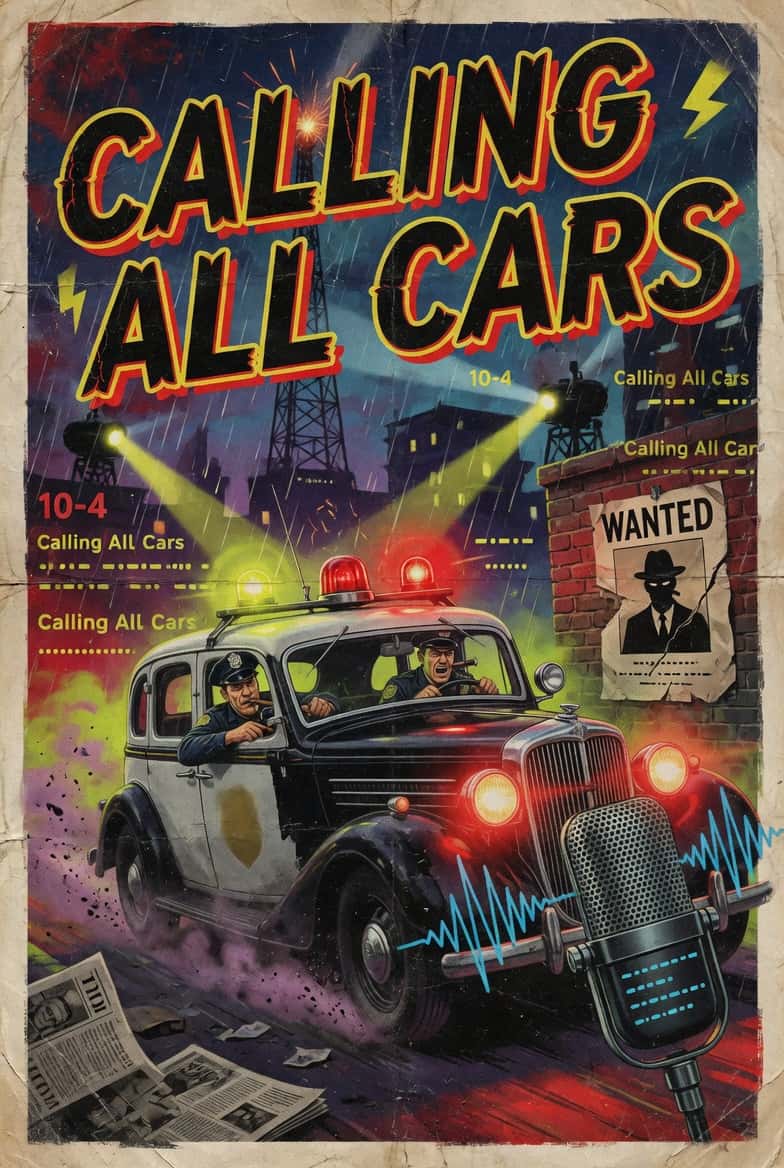
created for the Rio Grande Oil Company. Offended police calling all cars, attention all cars, gas 143. Investigate a man dragging a body down Franklin Avenue. That's all.
Everybody wonders why year after year, Rio Grande continues to get so many contracts from cities and counties throughout the web, specifying Rio Grande Quack gasoline with Cetra Ethyl to power more police and emergency cars than any other brand. The secret of Rio Grande's success lies in the refining process, which is protected by patents, the Sinclair cracking process, which is used exclusively by Rio Grande in the Pacific Coast market. Rio Grande's outstanding success with Quack gasoline has led many other companies to install cracking plants, but none of these are as efficient as the patented Rio Grande Sinclair process. Millions of dollars have been invested by Rio Grande in complicated pressure stills that chew up gasoline for the rest of the world. So it will start quicker in your engine, accelerate faster, and turn into power without waste. No burning units are extracted. Naturally, it costs Rio Grande more per gallon to process Quack gasoline. Cost to you is no more, and Rio Grande is rewarded for this extra expense growing sales of Quack gasoline, which have outstripped competition. You have been impressed, like hundreds of thousands of other motorists, by the undeniable fact that Rio Grande Quack gasoline is preferred above all others, fastest, most powerful cars on the road. Police cars, find out for yourself what a tremendous difference this super-refined gasoline will make in the performance of your car. Rio Grande Quack gasoline offers you police car performance in your own car at no extra cost.
Now it is our pleasure to present Chief James E. Davis of the Los Angeles Police Department.
Chief James E. Davis, good evening, friends. The job of being a policeman is a discouraging one. We, whose duty it is to enforce the law, see all too much violation of laws, both man-made and natural laws. Sometimes we despair of the human animal, so prone is he to make mistakes, and having made them, continue to do so. It is a difficult path to apply the legal yardstick to cases where natural laws are violated. An example is the case you are about to hear. The murderer was maladjusted to life. The damage had been done to his personality, long before he committed his crime. He called in, as we were to investigate, and in a sense, as is always the case, to sit in judgment upon this fellow man. We could not help realize that he was paying, not for the crime of murder, but for deep-rooted maladaptations in his personality, beginning perhaps in babyhood. If so much are the sentimentality and false values, false propaganda and prudishness, which goes into our social training, could be swept away. If we could be trained from infancy to think instead of to feel, then indeed would crime drop to a historical low level. Then indeed, would crimes of passion, of the nature you will soon hear, disappear completely.
March evening in 1930, in a bungalow court apartment in Hollywood, two men are seated around a card table before a blazing fire.
That gives us game and rubber, not much luck for the visiting fireman tonight.
Well, you can't win all the time, you know.
Well, I really think we must be going. It must be past ten o'clock.
Oh, come on, let's play another rubber.
Sure, Edith, give me a chance to show this card shark I know some tricks.
Well, all right, but I know you, Harry, you never want to stop.
That's right, except when I'm winning. It's your deal, Jimmy.
All right, how would you like it, four aces apiece?
No, just give me the four aces.
Jimmy, look. There in the doorway, a man.
Pardon us?
Don't, Jimmy, a living ghost. She's in the kitchen there, like she's asleep. He took her head out of her blood.
Oh, Jimmy, are you sure she's dead?
There's no question. How awful, and that stranger. We're all about him. That's him making a getaway. Look out.
Gee, we should have made him wait until the police get here.
Well, it's too late now. Come on, come on. We'd better go outside and wait for them. You girls had better stay here.
But, Jimmy, I...
You don't want to get into this thing mixed up as a witness and all, do you? Just stay in here. Come on, Harry.
Yeah, I never handled a dead party before. Did you, Jimmy?
No. Gives you the creeps, doesn't it?
Yeah. Look in there again.
No, no, I don't want to go near her. I can see her through the window. Streetlight makes her look like she was here. But she isn't. Go up to the sidewalk and wait for the cops.
What's the trouble?
There's a dead woman in the bungalow back there.
Okay, lead the way. Come on, Paige.
I haven't any idea. I live next door to the bungalow, and Mr. King here and his wife and my wife were playing bridge when a man came in our back door and asked us to help him with a woman who was sick. We tried to lift her off the floor where she was lying. We...
Where's the man?
He drove away.
Why didn't you hold him? In such a hurry to call you, we got all about him.
The side door here is open. I'm sure she's in the living room.
In here? I switched right for the door. Come with you, boy. And she got tired.
Oh, I'm sorry. I'm sorry. She was dead waiting for us to take her to the morgue, so she grew wings and flew away to heaven by herself, I suppose.
You guys have got to believe us. We saw a corpse here. Tried to lift her. She's been addressed and there was blood.
That's what I want to know. So do I. What if you were playing nuts? She ain't played this guy.
What's the matter?
Drop that. What's the big idea?
Shake him down and put the cuffs on him.
Paige, I want to look at this.
He's dead, all right. Been dead for several hours. Where did you put him? He was a boy. Our pal here had this on his hip.
He's dead, all right. Been dead for several hours. Where did you put him? Our pal here had this on his hip.
Break it open.
No shells for her.
What's your name, buddy? Who's this girl? What'd you kill her for?
I didn't.
How many of you people know this man?
I never saw him before tonight.
Neither did I.
He rented that bungalow for me this afternoon, officer.
He did? What did he say his name was?
Mr. Burns. He gave me a $40 check to cover the rent. It was signed C.L. Burns.
Know anything else about him?
Well, after he rented the place, he left. But he came back about 5.30 with this girl here. He introduced me to her. I didn't want to.
You didn't want to?
No, I didn't want to. I didn't want to. It was just my wife, and I noticed at the time that she seemed surprised when he said that. They stayed in the bungalow until about 7.30, and then they drove away. I didn't see them again until just now, when I saw them this way.
How about that, buddy? Is your name Burns?
Hey, there's a Ford Cooper parked over there. Has that your car?
Yeah.
Let's all go over and take a look at it. Check that registration page.
That's what I'm going to do.
Then you're blad.
Yeah. It's registered to a dealer on Figueroa. There's a pencil notation here. What's that say?
Sold March 23 to Charles Thomas.
So you're desperate.
Yes. bought the car yesterday, huh? Is your name Charles Thomas, or is it C.L. Burns?
Oh, I'm going to book this baby on suspicion of murder. I'll send the morgue wagon out and a couple of boys to impound the car. You stick here until they come, will you, Page? Right. And you better throw a sheet over that corpse until the wagon gets here. She ain't as pretty as she once was.
James Bean of Central Homicide assigns Lieutenants Leroy Sanderson and Aldo Corsini to the case. After a conference with Dwight and Pace, the Hollywood Division detectives interview Burkhart and then report back.
We can't get this guy to say a thing, Captain. He won't affirm or deny anything. He just won't talk. He's a strange one, there's no doubt of that. But we got one lead.
What's that?
We found the telephone number in the dead girl's purse. According to the phone company, the number is assigned to a Sally Martin who lives on New Hampshire. Better check on it right away.
Offer late at night to wake up people, Captain.
I know. We've got to get to the bottom of this as soon as possible. Go ahead and ride her out of bed.
Or a heavy sleeper.
Yeah, if she's home. She's home at 3 a.m. Here comes the one now. We want to talk to you.
Trying to get an identification. We need your help.
I don't see what you have to wake up people in the middle of the night for. I've got to be on the set early in the morning.
Well, very sorry, ma'am, but this is important.
Well, what is it?
Your telephone number is Normandy 7258.
That's right. And your name's Sally Martin.
Yes. What is this all about?
There was a woman murdered out in Hollywood last night. We're trying to identify her. Found a slip of paper in her purse. It was Normandy 7258.
What is this all about? There was a woman murdered out in Hollywood last night. Normandy 7258 written on it. The only clue we have. You remember giving your telephone number to any young women?
Why, no. I can't imagine who it would be. Do you know a Mrs. Burns?
No.
Or a Mrs. Thomas?
No. Of course, I've got lots of girlfriends who might have my number, but I don't know anyone by either of those names.
We have reasons to believe those names are false, but we must get an identification so we can go ahead with the case. Now, I wonder if you'd come over to the mall and see if there's a morgue with us.
When, now?
Yes, now.
Well, of all the going to the morgue at three o'clock in the morning.
It's terribly important, Miss Martin.
Very important, Miss Martin.
Very important, Miss Martin. Oh, very well, then. You wait out here until I get some clothes on.
My name's Anne McKnight. Can you tell us what you know about Anne McKnight?
I first met her on the Broadway Melody set. She was a dancer and a big player. There hadn't been... Many calls in the past few months, and she got a job in a drugstore at Santa Monica and Western Avenue.
Was she married?
She had been married. In divorce. She was married to a fellow by the name of Burkhart. They didn't get along very well. He... He was awfully jealous. He abused her.
What else do you know?
That's quite a lot.
Well, it's enough to put the B on our suspect. Name isn't Burns, and it isn't Thomas. It's Burkhart.
That's quick work, pal.
Yes, my name's Burkhart. And the woman you killed was your former wife, Anne McKnight. Isn't that right?
Oh, no. That's where you're wrong. You can't say Anne's murder on me. I did the job, and you can't prove that I did.
Well, if you didn't do it, who did?
I'll tell you all about it. Anne and I went out riding yesterday, and there was another fellow went with us.
What was his name?
Charlie Hunter. He used to be a boyfriend of Anne's.
Where does he live?
I don't know.
Well, go ahead.
The three of you went riding.
Yeah. And I stopped to get some cigarettes. When I came back, Anne was sick. The other fellow had gone. I took her back to the bungalow. I thought she was sick. I didn't know she was dead until you told me.
Oh, come on now, Burkhart. That's a pretty flimsy story. Why, anyone could see the girl had been shot. There was blood all over her.
I tell you, that's the way it happened, and that's what I thought. Well, that's my story, and you'll have one swell time proving anything else.
But we will prove something else, Burkhart. We'll prove you a murderer, and we'll hang you for it.
Having established the identity of the victim and the strong suspicion of the slayer, Corsini and Patterson begin the complicated job of spinning a noose around Burkhart's head. Their first call is at the office of Dr. A.F. Wagner.
Los Angeles County Autopsy Service.
Well, Doc, what's the verdict on that girl they brought in from Hollywood last night?
Yeah, she'd been shot five times, once over the heart, once from the left side, and three times in the back. I extracted one bullet. The others had gone through the body completely. And that smart guy decided to tell us he thought she was sick.
The only sickness that poor girl had was lead poisoning. Otherwise, she was a perfect woman.
Did you get the bullet you took out of her?
Take a look at Burkhart's car. The love of those bloodstains all over the cushy. From hitting the metal. Two more in the upholstery. This door here. Apparently, he shot her twice, and then as she tried to get out of the car, he emptied the rest of the gun into her back.
Well, we've got to be sure. Come on.
He slugs into Spencer and Marksley and find out if they were fired from the gun the boys took off Burkhart last night. The gun you brought in and then compare them with the bullets found in the murder car and in the victim's body.
And what did you find?
There's no question. All ten bullets were fired from the thirty-eight you took from the suspect.
Follow the blood marks from the sidewalk all the way to the bungalow here. One tail goes in and another comes out. Plenty lazy, that guy. He didn't even try to carry her. He just dragged the body. He shot her in the car, dragged her into the house, and then when the neighbors called us, he got scared and dragged her out again.
Well, we've reconstructed the crime pretty good. Now we'd better start backtracking on his movements before he murdered her.
Yes, I saw him park outside the store a little before four-thirty. I didn't know who he was until I saw Ann Lee. She gets off at four-thirty. And as soon as she walked out of the store, this fellow jumped out of the car and walked over to her. They talked for a few minutes, and I remember thinking what a good-looking day Ann had. Then she got into the car, and this fellow came in and bought two bottles of wine tonic from me, and I thought, oh boy, I'll bet they're going to have a party. And then he went out and got in the car, and they drove off.
Are you ready to come clean?
What do you mean, come clean? I've told you the truth.
You've lied all the way through.
Prove it.
Sure, we'll prove it. And we'll prove that you murdered your ex-wife.
You've got a job on your hands.
We're only trying to be honest with you, Burkhart. It's too bad you won't do yourself a favor and come clean.
Well, I'm not. What do you want me to do? Break down and cry?
Well, just to show you how honest we want to be with you, I'll tell you everything we know about you. Maybe you'll realize that we're trying to have such a hard time hanging you as you think. Of course, you might get off with life if you cooperate with us.
I'll never go to trial. I'm innocent.
Yeah, well, listen to this. On Sunday, you bought a Ford Coupe on South Figueroa Street. You made a down payment of the check for $150 buying Charles Thomas. Before we begin talking about murder, you might recall that the California Penal Code provides a long-term penalty for murder. You didn't sleep at all Sunday night. Now, it may have been something else. Now, you may have been planning murder. So we'll let that pass as an uncertain point. You quit your job, drew your pay Monday noon, rented the apartment Monday afternoon. At 4.30, you met your ex-wife when she got off work. You persuaded her to take a ride with you. After buying two bottles of wine, Sonic, you drove off, arriving at the bungalow quarter 5.30. Two hours later, you drove to some unknown place. You didn't know what to do. You didn't know what to do, but you emptied your gun into your ex-wife's body and returned to the court. Well, you dragged the body into the house. Then you got scared, so you called in the neighbors. They went for the police, and you completely lost your head. So you dragged your body out of the apartment and down the street where you were found.
How am I doing, Burkhardt? That's the way you take reconstructive crime. No wonder there are so many unsolved cases.
You know, Burkhardt, it would give me great pleasure to smack you one right on the post.
Yeah, but you won't. On account of the policemen, you'll have to friend.
Okay, Costini, hold on to that Latin temper of yours.
Well, how about it, Burkhardt? What's the matter with my story?
Well, let's hear yours.
Ann and I split up in the first place on account of our relatives. We loved each other. She promised me that she'd come back to me if I got a bungalow where we could live alone and I got an automobile. Oh, I did. On Monday, I met Ann, and we started with a bungalow, but we ran into this Charlie Hunter. He rode with us a little ways and then got out. I went to the bungalow and Ann got a little sore at me because I was drinking wine tonic to celebrate us getting together again. But I, we went out at 7.30 and we ran into this Hunter again.
Yeah, quite a coincidence.
Yeah. I told you before, I stopped for some cigarettes and when I came back, Hunter was gone and Ann was sick, so I took her back to the apartment with all these people next door.
You mean you dragged her dead body back to the apartment?
Wrong there, copper. You can't prove it.
Wait until you see the photograph of those bloody tracks.
The shot? Charlie Hunter shot her.
Oh, don't be such a nouse in a tool, Burkhart. Every bullet that came out of your wife's body and out of that car was fired from the gun we found on you.
You can't prove that.
We've been hanging men in ballistic testimony for years.
The last given is hot, the truth, the whole truth, and nothing but the truth, so help you God.
What is your name, please?
Joanne, it's Knight Hodgson.
You are related to who, did you say?
It was my sister.
Mrs. Hodgson, will you tell the court in your own words? What do you know about...
Well, Your Honor, we were married less than a year when Ann was forced to divorce him in 1929 because he was so cruel to her and because of his intense jealousy. He threatened her life if she didn't come back to him. Soon after they were divorced, she had him arrested for making these threats. He was put under a peace bond. But Ann told me often that she'd die before she'd ever live with him again. And that's just what she did.
Is there anything else to talk? Has the defendant ever said anything to you about his relationship with your sister?
Yes. I met him in the street several months ago. He said, if I can't have Ann, nobody else will ever get her. I'll see to that.
Thank you, Mrs. Hodgson. Call me down.
Of course, Your Honor. There you are. That's all.
I would like to under his people's activity, this letter, written by the defendant to the deceased. It may be. It may be. And I would also read this paragraph. The defendant writes, though you have been having a marvellous time with he, I hope you have enjoyed yourself to the fullest degree. I guess I am not a he-man. I am double. Remember, I am still your husband. And remember that you repeated after the minister until death do us part. Now, the word death is written in countless letters and underlined in the exhibit. The letter continues, I myself have formed a firm resolution adhering to that line. Do you understand? If not, here it is in plain and narrow. Over my dead body only, some other man can have you.
Documents. Counsel for defendant, near intelligence, to find the motive for the crime of the he-man.
First, next, Your Honor, counsel for defendant, the point of the jury, the first of the opinion of the argument. The same. First, counsel's remarks following the reading of the exhibit. Counsel for Navy's argument for the summary. I beg your court pardon. The same is the opinion for closing argument. Closing. The argument for the defense that some other person killed Anne McKnight, or if Burkhardt did do it, he was insane at the time, and failed to convince the judge.
The jury, all testimony having been given, the argument having been heard, the jury quickly read the verdict, unprecedented in California legal history.
Please read the verdict.
The jury find the defendant guilty of first-degree murder and recommend that he shall be hanged.
The information of the jurors, the verdict of first-degree murder carries a mandatory death sentence. It is unnecessary to add a recommendation. Such as you have done, and indeed it is the usurpation of this cause that might be construed as context. The jury wanted the proverbial eye for an eye. Twelve jurors outraged at the crime of murder wanted it doubly certain that justice would be meted out by the state upon the murderer.
So it was done on January 29, 1932, when William Burkhardt stepped through the trap door at San Quentin to eternity.
Thank you, Chief Saban. Thank you, Chief Saban. Thank you.
Ladies and gentlemen, every month, a half million people drive into Rio Grande Cracked Gasoline Station to get their free copy of the Calling All Cars news. We invite you, too, to read this unusual publication full of latest movie news, radio news, and illustrated true detective stories of the crimes you hear solved on these Calling All Cars. Even if you are not a regular user of Rio Grande Cracked Gasoline, you are a listener to this program, and we want you to have a free copy of the news every month. Drive in today or tomorrow. If you aren't in the market for Rio Grande Cracked Gasoline, you will certainly be interested in the outstanding motor oil values offered by all Rio Grande dealers. In refinery seal cans, selling as low as 25 cents a quart, you can now get the famous Sinclair motor oil, the same oil that is used for the leading American railroads, the leading airplane lines, because it is de-waxed and de-jellied. All impurities are extracted from Sinclair motor oils to leave a concentrated pure oil that is positively guaranteed not to break down. To give complete lubrication no matter how hot or cold the weather. To protect your engine, even when you're going faster than ever before with speedier Rio Grande Cracked Gasoline. See you good night for the Rio Grande Oil Company.