
The written record
Read the transcript
Read along with the recording · About 12 min to read
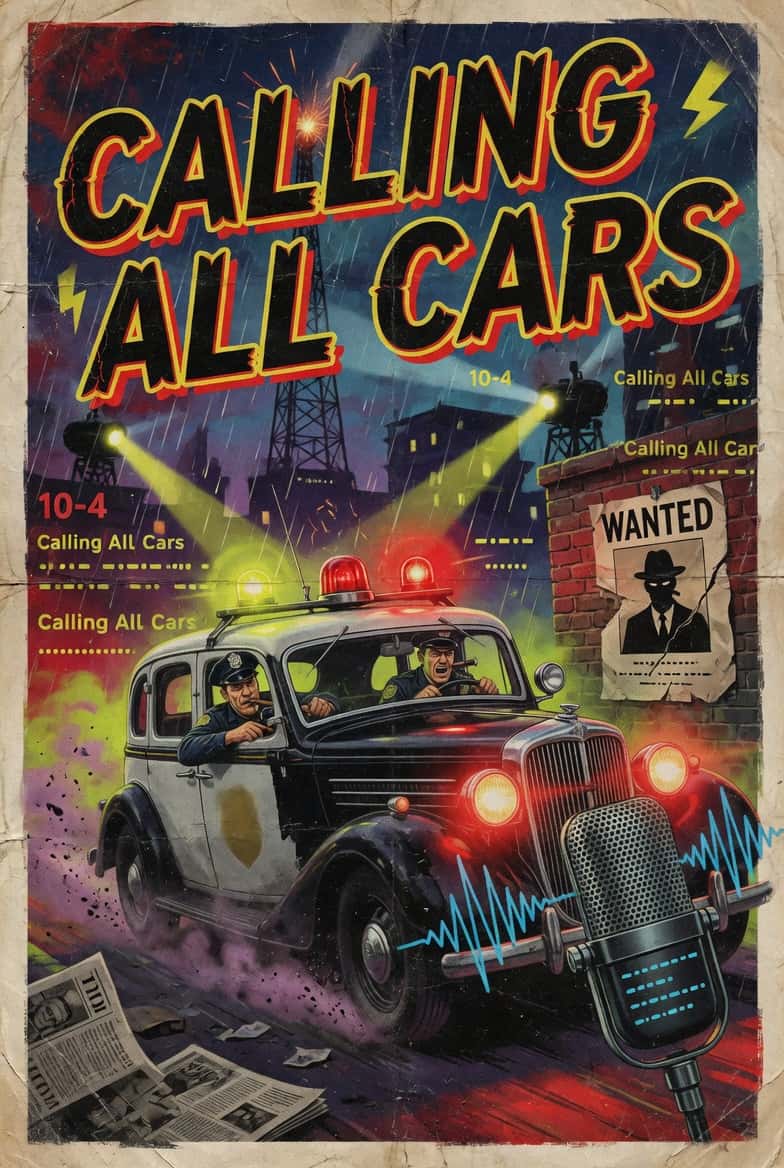
Rio Grande Oil Company presents Calling All Cars.
Wanted for murder. The man described as follows: medium build, has black hair, blue eyes.
If you are an average motorist, you drive your car approximately 10,000 miles during 1937. Police cars of Los Angeles will each travel 80,000 miles during 1937. Any kind of gasoline will get you over 10,000 miles if you buy enough of it, but any kind of gasoline will not give you the remarkable performance police cars get. Rio Grande Cracked is the gasoline of police car performance. Los Angeles police cars have used it exclusively year after year. This is likewise true of Oakland, Berkeley, Fresno, Santa Barbara, San Diego, Orange County, San Diego County, Maricopa County, Arizona, and many, many other cities and towns. Yes, more police cars, fire engines, ambulances, and other emergency equipment use Rio Grande Cracked gasoline wherever it is sold than any other brand. This is because it is cracked. It's tiny atoms, like a thin flare tracking projectile. These broken up atoms burn more readily and more completely. You'll get quicker starting and greater power just as police cars do. You'll need less Rio Grande Cracked gasoline to travel 10,000 miles. Don't be satisfied during 1937 with slow burning, sluggish gasoline. Make it a year of sizzling police car performance. Start tomorrow using Rio Grande Cracked gasoline. Ask your nearest independent Rio Grande dealer.
It is our pleasure at this time to present once again Chief Bowie Walman of the Oakland Police Department, who will speak to you from our studios at KSFO in San Francisco. Chief Walman.
From the files of the Oakland Police Department, a story of one more individual who thought that he could commit a crime and get away with it. That he was wrong, you will hear for yourself a little later. Right now, I would like to point out how vitally important it is to you, as citizens, to cooperate with your police force in every way. A great many people have the idea that a policeman is just a man with a badge who stands on the corner lying in wait to give you a ticket for parking. A man who has nothing better to do than to direct you to the curb when you violate some traffic law and give you a citation to appear in court. And you don't like it. You feel angry about it. But if you stop and reflect, didn't you feel just the same way about your instructor in school? Yet now that you're out of school, you realize your lessons were very valuable after all. The point that I'm trying to bring out tonight is, the policeman is a person who dedicates his life to advise and protect you. When he stops, questions, or arrests you, it's because you're doing something that may endanger your own life or property, or that of someone else's life, limb, or property. He is performing his sworn duty as a police officer. So when you think of the police, think of them not as your enemies, but as your friends. In closing, may I say good night, and a happy and prosperous new year to all.
Patrolman O'Brien of the Oakland Police Department, detailed to the city park, walks a leisurely beat along the edge of a small pool filled with water lilies. To his way of thinking, this is the perfect day. Warm, clear, nothing to worry about more than keeping people off the grass. But as he rounds a turn in the winding path, he hears the sound of a child crying. His curiosity aroused, Patrolman O'Brien decides to investigate.
"Here now, what's all this crying about, little fella?"
"He's carrying on."
"Oh, come on now. You'll never find him. There's a patrolman around here somewhere. You stop that crying."
Ronald does get a ride in a police car. Driving him to the address found on him, the radio car officer, finding no one home, decides to leave him in the yard where his parents will find him upon their return home. Then, after reporting, that same afternoon, George Sotover, huddled on the front porch, a girl of 11, a boy of about 6, and—
"Why not? Maybe you got something else. Come on, let's see it. Where are your parents?"
"This little Ronald? If I tell you how I knew Ronald's name—"
"For the papers. There was a note pinned on him with his name and address on it."
"He would tell Bobby to his show, but he didn't want us to come home."
"Excellent. He's a—photographer."
"You have to study him? We'll do our best, young lady."
"Being a fireman, I won't. Look, what would you think about being like a reporter trying to write a novel and get underway? I'm beginning to turn to ice."
A man accompanied by three small figures. A complete journey around the house. Trying windows, doors, anything that might afford a means of entrance. And finally, as a last resort, they decide to unhinge the back door.
"That's done it. Put it down over here. Now, let's see what we can do about getting him in a place warm."
"I know where the lights turn on, mister."
"Good. I suppose we need to go in and turn them on."
"Yeah. I got a funny idea, boy. These kids are on the raw end of a family walkout."
"That's because you're a reporter. Probably finally took a drive and had a flat tire or something. As a matter of fact, we'll probably get shot as burglars. Come on, Ed. It's like an earthquake hit. I mean, let's call the station."
Family of police inspectors Evans and Plummer arrive at the Delta Road address. Our network autoburgs and lodgers, who, while waiting, have uncovered some interesting things.
"When we called the inspector, it was only on a hunch because of the furniture's condition and all. But since then, I've looked around, and now I'm sure something's—well, in the first place, there were about three—kind of stains with what it is now. They're already going away."
"We thought it warrants assertion that the person responsible for the date of slaying can be no other than the chosen father, Louis Tanner."
With this theory, it's very, very confusing. He's a—available bit of police machinery that's set into motion. Every police identification bureau in the United States is notified and set for the record. And in less than 36 hours, Chief Walman begins to get results.
"New Zealand Police, scouting a bulletin number 25543. Louis Tanner arrested here in November 1912 as stowaway. Fined five pounds for seven days. This is the only record we have. New Zealand Police."
"New Zealand Police. Find the record of Louis Tanner as follows. December 1912, arrested here as stowaway. Fined ten pounds for four weeks of hard labor. Took four weeks. This is the only record we have of him under that name. Newcastle Police."
"I found a record on Tanner."
"Walman?"
"Well, it's in your diary, too. Good. What is it?"
"He's trying to find you. Why are you in the mood tonight? He's getting thrown in jail here. Then she changed her mind. Got out on bail and he turns around and murders her. To every possible point."
"Yes, sir. I'll tell you better. Tell the fact that it's—150. He found the left. Hold and notify Oakland Police immediately."
Harbourfront. Inspector Evans and Summers with a squad of six men mingled with a crowd of sailors, laborers, even a less watch for the time of their party. Wife killer, Louis Tanner. They probably disguised themselves in some way.
"Well, there's no time to look around. Good luck to you all of us, sir."
"Seems just to be different, eh? Something like that. What did they do with the kids?"
"Took them over to the juvenile hall. Told you young—the idea to murder someone."
"Yeah, maybe they don't then. But they think about—you and I—no."
"Wrapping up on a man who works for you."
"On the job. He's here on the job. Permitting killer. They must have forgotten the brutal Tanner slaying. News they was a long time—in Seattle, Washington. Sheddy Swanson, 13-year-old, sickly youth, and a young companion dived clearly along a windswept street. Coats wasn't high against the bite of a bitter cold February night. As around the corner near Eddystone, they cast one of the many straggling lines of human gallery, waiting for a free—border stop. Eyes very red at nothing. Screams as for an instant as a face that seems vaguely—like it's dark from the door. His memory suddenly flashes a message. Galvanizes his body into instant action."
"That you, Eddie?"
"Yeah, but go down now. What on earth are you doing?"
"So cold. That's something important to see about up in my room. Where did I put him? Oh, I don't even—oh, in here somewhere. Here, I'm in the—we're trying to—oh, you're not on earth, you are free. First you run in like a madman, and now I find you trapped in those old magazines to see for you."
"I'm in an awful hurry, Mom. I gotta look through these files. I think I saw a fellow at a free—"
"Oh, nonsense. You're always thinking something of the sort. Now put those silly things away and get ready for dinner."
"Here, I got it. I got the right one, Mom."
"Well, you don't have to get so excited about it."
"I'll be back later, Mom. Gotta go now."
"But your dinner is almost ready. You can't—"
"I'll turn it up, but I gotta get to the police station fast. So long."
Five minutes. Police station.
"Hurry up. I got a man you're looking for."
"Wait a minute. Take it easy, son. You'll bust if you aren't careful."
"Yeah. I know, but this fellow's standing in a bread line. And if you don't hurry and get there fast, he'll be gone again."
"Let me see that picture you got there."
"Here, here, y'all. I had a—I wouldn't forget a face that easy."
"All right, son. Don't worry, Phil. I'm right. You see? I'm a detective, too."
"Oh. And I'm not like you. I haven't got a bag."
"Well, if this is the right man, we'll see what we can do about it."
"Oh, thanks."
But at last, they reached the bread line.
"And that's—one man. Try to get away? Stop with the look, sir. You haven't got anything on me. There's nothing to make me stick my hands out."
"Listen, Tanner. I'm going to stick out your hands and be quiet. And this is the last time I'm going to."
"Oh, please. What have I got to worry about? Well, you can't blame anything on me."
"I don't have to. You've already blamed yourself. Now, are you going to walk back to the station quietly with me, or do I have to drag you?"
"Keep yourself. I'll walk."
"Good. That's the first smart thing you've done yet. Come on."
But once back in Captain York's office, the man denies all knowledge. He denies his name as Tanner. Denies him everything. And Captain York continues to throw questions at him.
"Well, if your name isn't Tanner, you're not promoting him. Then who are you?"
"That doesn't make any difference. My name's not Tanner."
"How do you explain this picture of you in the detective magazine?"
"I don't."
"How do you explain this bulletin I found in our files with a description of you?"
"I don't. I don't. That's not me."
"How long do you think you can take with all these questions? You don't have to thank me, tell me."
"I don't."
"You don't."
"If you're lying."
"I don't."
"You don't what?"
"I don't. I don't remember."
"Your name is Tanner, isn't it?"
"Yes. No, it's not Tanner. Lewis Tanner. And you murdered your wife and left your three kids deserted in Oakland."
"Give me that."
April 22, 1936, he was convicted of murder by a jury of seven men and women. He was stated Judge Frank M. Ogden, Alameda County, sentenced him to the death penalty. An appeal to the California Supreme Court was denied in October. He wins the death warrant. But for Lewis Tanner, murder was not possible for the arrest, with a worth of some $100 for his alertness.
So ends the case of Oakland's heinous murder.
No matter what the age or make of your motorcar, resolve to give it the finest you can buy during 1937. Resolve to use only thin, clear motor oils and grease. Go to your nearest independent Rio Grande dealer and ask for thin, clear Pennsylvania or thin, clear, gelled motor oils you can buy. And if you haven't tried Rio Cracked gasoline, a pleasant surprise awaits. Later mileage gasoline will give you a new conception of performance.
Flashing type of performance of police cars, fire engines, and ambulance of Los Angeles, Oakland, and many, many other cities and counties getting their emergency services. Important changes in Calling All Cars radio schedules are explained in Calling All Cars news. Get a free copy tomorrow from your independent Rio Grande dealer.
Raising broadcast 150 degrees. Starting man wanted for murder. That's the stage now in that stage.
That's all. Frederick Simpich, Rio Grande Oil Company. For happiness and prosperity throughout 1937.