
The written record
Read the transcript
Read along with the recording · About 23 min to read
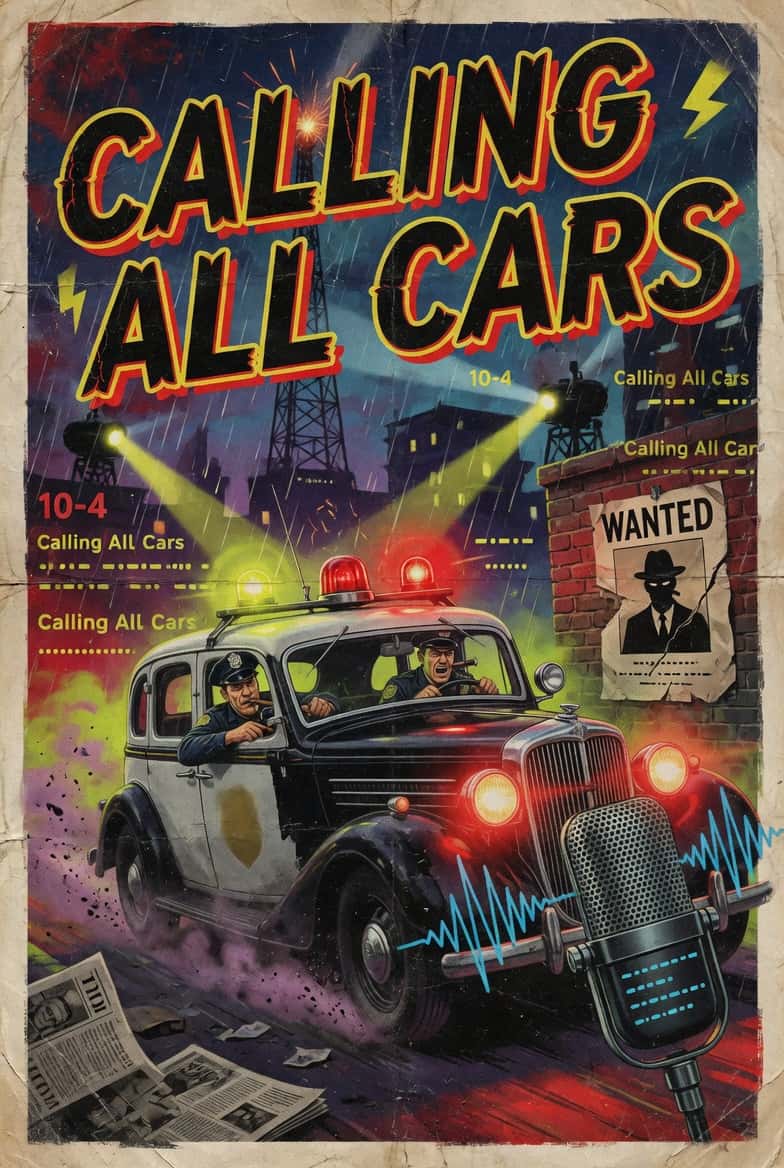
All cars, the copyrighted program created by Rio Grande. One time it was police calling all cars, and all cars were called at 214 at the Garden of Missing Jewels. Be on the lookout for a small boy, 11 years, 65. This boy, lad, seen in the company of a man driving toward Long Beach. Hold and notify the Missing Persons Bureau. That's all.
You know, most of us, envious men who drive our police cars and other public serving equipment because of the rigors and hazards of their emergency work. However, in one respect, some motorists do envy the matchless police car performance of their cars. Apparently under the impression that because Rio Grande cracks now has more emergency cars wherever it is sold than any other brand, this superior gasoline is not available to the general public. You, of course, know better than that. But if you have a neighbor whose motor, as well as he, has been laboring under such an impression, you might tip him off to the facts in the case. He's going to buy a lot of gasoline this coming year. A good resolution to use Rio Grande cracks will save him some real money during the year and give him matchless performance. Ask him why he uses some average gasoline when it's an established fact that Rio Grande cracks is the most thoroughly proved, highly endorsed gasoline in the West. Tell him what the officials of 30 leading cities and counties throughout California say about Rio Grande cracks. That it does give you quicker starting, more acceleration, longer mileage, greater efficiency, and more efficiency. The reserve power and the maximum speed of which your car is capable. Show him that Rio Grande cracks is first in public service. And when he, like yourself, becomes a dyed-in-the-wool user of Rio Grande cracks, he'll thank you for saying, get police car performance with Rio Grande cracks gasoline.
It is our privilege and pleasure to welcome again to Calling All Cars Chief James E. Davis of the Los Angeles Police Department.
Chief Davis.
Good evening, friends. The amount of work necessary to solve... to solve a case is never a deterrent to a police officer. In the story we are about to present, the Rio Grande again brings home the valuable lesson that crime does not pay. And at the same time, emphasizes the work sometimes necessary to bring about a capture of the criminal. In this case, the perpetrator of the crime was known even before his crime was realized. But his capture was a different thing entirely. I wish, however, to reserve additional comment on the case for the close of the program.
We're going to the beach before we get back. I'll be waiting.
You should play good quality music, Harry.
Oh, I will, Mrs. Gray. We're just going down to Long Beach for a while.
Leaving us sticking?
Yes, Dad. Mr. Eagles is going to take me down to see a music piece in Long Beach. Maybe I can get some lessons and learn to play my cornet now.
That's well. Be a good boy now and mind how I...
Be a good boy, darling. I will.
Don't look for us till you see us coming.
What's the matter, Mother?
What's the matter? What's the matter? What's the matter, Mother? What's the matter, Mother? What's the matter, Mother? What's the matter, Mother? You're acting like Dick is going to be gone a week.
Oh, I don't know, Will. I'm so nervous. We've never let him go off by himself like that, and I just worry so...
You know why he's going off by himself? I know we'll take care of him, all right.
Oh, I know it, but I just feel nervous.
Well, now, don't you worry. Harry's a good driver. We don't have to worry about Harry.
Oh, but Dick is so young.
Why, Helen, he's 11. That's old enough to know his way around. Now you stop worrying. We've got to get the Christmas tree out.
Thus, Dickie Gray began his adventure. An adventure that was to develop into one of the most baffling cases ever to face the Los Angeles Police Department. Late on the second day, Christmas Eve, when no word had come from the boy or his companion, Mr. and Mrs. Gray go to the police.
Oh, now, Mrs. Gray, calm yourself. I'm sure you have nothing to worry about. Mr. Gray, will you try to give me a few more facts about this case?
About a year ago, I went to the free employment bureau looking for a painter's helper. This man, Eagles, was introduced to me. He seemed to be a pretty good painter. I hired him.
Where did he come from?
Why, I never checked up on that. He told me he had his car registered to a place in North Broadway. I got the address here in my book somewhere.
Oh, never mind. We'll go out there later. Why didn't you come to us before this?
Well, I was afraid that something might happen to Dickie if I started police looking for him. If this man has kidnapped him, he won't say anything.
Is there anything peculiar about this man?
Well, I don't know. He was a little hip on the subject of freedom of thought, that sort of thing. Always... Oh, he's talking about it. And about everybody having a right to make a man of himself.
How did the boy act toward Eagles?
Oh, Dickie was a sort of hero worshipper, as far as Harry was concerned. Harry had been a soldier, and he used to tell Dickie stories by the hour. He was always talking about traveling, adventure, all that kind of stuff.
Have you any pictures of the boy?
Oh, yes, this little Kodak picture of him. That's a funny thing, Captain Allen. You know, last week I was talking to Harry about the boy. Dickie's got two brothers. We got to talking about... And this man, when we went to get them, all the pictures had been taken out.
I see. Have you got a picture of Eagles by any chance?
Well, here's a little sort of pin-type thing that he had made down at Venice one day while he and Dickie were sightseeing.
Did he have a habit of taking the boy places?
Why, no. Not any more than he did the other children. He seemed crazy about all the youngsters.
Know anything about this man's background, where he came from, anything at all about him?
Now that I think of it, he used to talk about having... having some mining property in Death Valley. Seemed pretty familiar with the whole place.
Oh, Captain Allen, please find my boy. I know something terrible's happened to him.
Now, now, don't get upset again, Mrs. Gray.
Oh, he took that man into our home. We kept him from starving, and he's stolen my boy.
Say, Dickie's all right. He'll be all right. Now, look, Mr. Gray. You and your wife go on back home. But for the time being, we'll get out descriptions and bulletins and stuff. We'll let you know as soon as we get a lead.
All right, Captain Allen, but please...
Fine, Dickie.
Armed with only the poorest photographs of the abductor and his victim, police prepared bulletins for distribution throughout the Southwest. Sensing a need for speed, bulletins were rushed to out-of-the-way places, hotel to mobile, and airplanes. Then, on the night of December 26th, while the search was going on full force, a cracked Santa Fe train was speeding toward Barstow, past the slumbering town of Hesperia. On into the desert roared the train, bearing sleeping men and women. A long needle at the headlight, stabbing the blue. The alert eye of the engineer caught a peculiar gleam on the rails ahead. A piercing beep, and the engine whistles took the air. It was breaking over the desert.
Fred Phillips, chief special agent of the Santa Fe, and Lieutenant Allen arrived at the scene of the wreck. The clue that had brought the Los Angeles officers into the picture, a set of footprints, had been found in the sand along the right-of-way.
According to our investigation, Allen, this wreck didn't just happen.
What makes you think that?
The engineer said he saw a bar of metal lying on the rails just before the crash, but he wasn't able to stop before he hit it. He found the bar back there where the engine jumped the track. It was one of our own crowbars, used for pulling spikes.
Any idea how it got there?
Yeah, pretty good one. It came from that tool house over to the right there. The lock had been broken off, and the sledgehammer and crowbar were missing. We haven't found the hammer yet, but here's the important part, at least I think it is. There are two sets of footprints leading from the road to the tool house, and then to the track, and one of them is made by a child.
What? Are you sure of that?
Positive. Come on, I'll show you.
Now, here's where the bar was found. Somebody used it. Somebody used it. Somebody used it to pull spikes out of three ties. Evidently, the hammer was used on the fish plate bolt. See this mark here?
Uh-huh.
Well, that was made by a sledgehammer being dragged. You'll notice that the footprints along here are small, you know, like a child. Apparently, the child was dragging the hammer, so he must have been a small youngster.
Well, otherwise, he would have carried it, eh?
That's right. Now, you'll notice that this set of footprints here show a slight limp on the left side. And Gray told me that Eagles had a slight limp in his left leg. And besides that?
The kid's prints are made by new shoes. And according to your bulletin, the Gray boy wore new shoes.
You're right about these footprints leading to the road. But what happens now?
Well, here's some tire marks. Looks like a car was parked here. You see these marks?
Yeah.
Well, here's a new Goodrich tread right here.
Yeah, that's the kind of tire Eagles had on his car. If you ask me, I think the trail's hot.
And so do I. I'm going to Victorville and get a bunch of men and scour this part of the desert.
The marks of the tires were followed and found to enter the shack about four miles from Victorville. And off the beaten road. At Victorville, a check of hotels and restaurants revealed that a man and a boy answering the description of the missing pair had passed through on the night of December 22nd. Mr. Gray was brought from Los Angeles. He identified the footprints in the sand as similar to ones made by his son's new shoes. Meanwhile, back in Victorville, officers had succeeded in establishing that Eagles and the boy had been in town on the night of December 26th, the night of the wreck. Wholly satisfied now that they were on a hot trail, Allen asked for orders. His instructions were to proceed to Barstow and continue the search.
His force, augmented by other officers and Los Angeles and Barstow officials, the searchers combed the town.
Well, Harris, what did you find out?
My men have been in every nook and cranny of this town. So far, here's what we found out. Eagles and the boy were here on the 27th. A waitress over at the Harvey house remembers a man and a boy who came in there about four o'clock on that morning.
Well, how does she happen to remember them particularly?
Well, I showed her pictures of them, from that bulletin, you know. She recognized the boy right away.
What else did you find?
Well, about 8:30 on the night of the 28th, Eagles drove into a... filling station near the depot and bought five gallons of gas.
The filling station man remember the car?
Yep. It was a Dodge roadster with the homemade curtains.
Well, looks like our man is still in the neighborhood.
Looks that way. I've asked Sheriff Shea to send me enough men to block all the highways leading out of here. If Eagles is still here, we'll get him.
At the request of the deputy, Sheriff Shea arranged the blockade of all two roads. The sheriff's men then covered all known mines and tracks in the vicinity of Victorville and Barstow. Then, on the morning of the 29th of December, seven days after... Mr. Dickie and his abductor had disappeared, Harris and Allen arrived at a filling station at the edge of town.
And robbed it.
That so? When?
Sometime after midnight last night. I left here just about 12 o'clock.
Oh. Oh, Joe, meet Detective Allen of the Angeles. He's up here on the case.
How are you?
How do you do? Seen anything that might show how the burglars worked?
Nope.
Except that the door was broken open with a sledgehammer or something.
Hammer, eh?
Yep, it looked that way.
Well, let's take a look. Anybody except you been around here this morning?
Nope, I'm the only one.
Oh, Harris.
Yeah?
Yeah. Let's take a look at these footprints.
Where?
In this sand here. Right by the side of the door.
Uh-huh.
You see that toe mark? Heavy toe, light heel. Like a guy with a game leg might make, eh?
Yeah, that's it. And it's the left foot, too. That's the same kind of print we found out at the wreck the other night.
I believe it is, at that. And here's a small footprint, made by a new shoe. Harris, that's the two we're looking for. Looks like this bird's taking the kid right along with him, doesn't it?
Hey, Ed.
Uh, Mr. Allen.
Yeah?
Get some car tracks fresh with us.
How do you know?
I raked this part of the driveway last night, just before I left.
Well, maybe somebody just drove through.
If they did, they'd stop. Here's where the car skidded on one side.
That's as good as it said, Harris. And that's the kind of tire Regal's car had on the left rear wheel.
Okay. Let's round up some of the boys and see if we can follow the trail.
Day after day, the search went on. From Barstow to Needles, the entire country was scoured, but no sign of the missing pair. From Pinon Wells came a report of a strange footprint. And so a checkup revealed them to be the same as the tracks previously followed. Still the quarry eluded pursuers. Through the burning heat of the desert, through the snows of the mountains, down into the dark and marrow-chilling tunnels of abandoned mines, twenty intrepid officers. Each time, they came back empty-handed and discouraged.
Back in Los Angeles, Allen confers with Chief of Detectives Klein and Vicki's father.
Well, Mr. Gray, we've exhausted every... Klein Mountains, lit on our necks down wet mine shafts, burned up in the desert, and I even spent ten days on horseback. But the net result? Nothing.
Have you received any more letters from Eagles, Mr. Gray?
No, not since the 28th of December. That's the one I showed you.
Well, we've done just about all we can do until we get another tip or some more clues. They've got the entire Southwest plastered with bulletins.
Yes, I realize that you've done everything humanly possible to find my boy. Of course I know that doesn't make it any easier for you or your wife. And personally, I can promise you I'll keep on as long as there's a remote possibility of finding the boy.
Thank you, Mr. Allen. I know you will.
Allen, the councilman from Mr. Gray's district has made arrangements for Fenn to send a couple of National Guard planes out to see if they can find any trace of the boy. Oh, that car Eagles is driving. I want you to go along and sort of point out the likely places where they might be hidden.
All right, Captain. When do we start?
As soon as you're ready.
Okay, we'll leave tomorrow morning.
Well, I think Mr. Gray should go along if possible.
I'll be at the airport whenever you say, Captain.
Okay, make it six o'clock.
All set, Mr. Gray.
Ready. Whenever you are.
Okay. You'd better follow us and keep in sight. If we find anything, you can fly back for help.
Well, we keep an eye on them.
Good. I hope we find them.
And so do I. See you later.
All right, pilot. Let's ride a little, will you? Past that hill.
Okay.
I see a car. Let's get down and get a look at it.
All right. Hold on.
Jules!
What's the matter? Can't you take it?
I can, but my stomach hurts.
See anything?
Yeah. I saw the car.
Yeah.
Yeah. They're walking the roadster. Let's go.
There's another car down there. Let's take a look.
No, I'm getting awful tired of this.
So am I, but we've got to do it.
Just you say.
Oh, no good. Oh, make up your mind.
For two days, the searchers flew back and forth over the territory where Eagles and the boy had been last seen. Again, failure greeted their efforts. Weeks went by. Then, on February 22nd, Chief of Detectives Klein called Allen into his office.
Send for me, Chief.
I just got a call from the motor vehicle department. They've received a letter from Roswell, New Mexico, requesting license plates for the Dodge Roadster. The engine number and old plates checked with a car driven by Harry Eagle.
And all this time, we've been looking all over Death Valley for him.
Yeah, apparently he's in New Mexico. Now, I want you to get there the quickest way you can, by train, automobile, or plane. But get there.
Well, if it's all the same to you, Chief, I'll drive.
Well, suit yourself. The car's started.
Got any address on Eagle?
Nothing but general delivery, Roswell.
Maybe you'd better take somebody with you on this trip.
I'll take Fred Phillips.
Phillips. He's interested in the case because of that train wreck. And if something happens to the car, at least he can flag a train.
Well, all right. Let me know what you find out when you get to Roswell.
Arriving in Roswell, the officers began a systematic check of places likely to have been visited by Eagles and the boy.
Now, let's try this little hotel.
Okay.
Something for you, gentlemen?
We're looking for a man and a little boy, about so tall. Got anybody like that around here?
Nope. Haven't had a kid in here in months.
Okay. Thanks.
Thanks. Let's try this restaurant.
All right.
What can I do, boys?
Coffee.
Same.
Hey, what's up, bud? I've seen a tall fellow and a little boy wandering around here lately.
Not that I remember. Have lots of people in here, though. Wouldn't pay no particular attention to them.
Well, I don't suppose you would. Thanks, brother.
Gas her up. Five gallons.
Mm-hmm. Five gallons. You might check the oil, too.
Okay. You don't happen to remember a fellow coming in here in an old Dodge Roadster with homemade curtains, do you?
Nope. I haven't. I haven't seen him.
What does he look like?
Oh, sort of tall, thin-faced. Has a little boy with him.
Yeah. Well, no, I ain't seen him.
Thus, from place to place, Allen and Phillips drove, looking for persons who might have seen either Eagles or the boy. On the second day, Phillips took the car and began making a tour of auto camps near the town. Allen started out on foot.
So, this is quicker?
That's all right, sonny. You were going pretty fast, anyway.
I like this game, don't you?
Well, I don't know. I haven't tried it since I was a kid.
I like it a lot. Get your skates for Christmas?
Mm-hmm.
How come you're not in school today?
I haven't any books, and Dad hasn't any money to buy them.
Who is your father?
Harry Eagle.
Did you say Eagle?
Well, look, what do you say we go over to the fire station and talk this over? Maybe we can do something so screwable.
Sure. Can I get a finder?
Of course.
Well, I thought the police station was over there, too.
Well, maybe it is. We'll find out.
Well, Dad told me not to go around the police station.
We'll just go to the fire station. How's that?
Well, I guess Dad won't care if I do.
I'm sure your father would be very glad to know that we were there. It's really so fun being out there, isn't it?
It sure is, sonny. Oh, by the way, what's your name?
Robert Eagle.
You sure of that?
Mm-hmm.
Can you write?
Sure.
I wonder if you'd write your name in this little book here.
Sure, I will. Robert Eagle. Age 11. I have no brothers. He's dead.
What does your father do?
He's a painter. He's working over by the lumberyard painting the house.
Oh, is that so? Well, now, I'll tell you, son. You stay here in the chief's office while I run out and have a talk with your dad. Will you do that?
Sure.
Keep your eye on him, will you, chief?
And how.
So, Fred, when did you get back?
A few minutes ago. I couldn't find a hide nor hair of that pair.
I did. Come on, drive me over to the lumberyard. It's in the next block.
Okay, what's up?
Plenty. Let's go.
Well, let me in on it. What's happened?
I found the boy.
You what?
I found the boy.
Where is he?
He ran into me.
What?
Yeah, he was skating up and down an alley. He barged right into me as I walked by.
Where is he now?
In the fire chief's office. He's being taken care of all right.
Does he know who you are?
Oh, not yet. He claims he's Robert Eagle. That his mother's dead. Eagle's evidently told him to say that.
I wonder what Eagle's hold is on that boy.
You've got me there. Maybe the kid's scared to death.
Looks like it. Take it easy now. Eagle's painting a house over here somewhere.
Well, uh... Hey, there's a guy on the roof. He's pulling a ladder at that second house down the street.
Uh-huh. That's the monkey. Pull up by the house. If he starts to get funny, we'll yank the ladder out from under him.
All right.
Hey, Eagles! Come down here a minute. We're police officers. You know what we want. Come on, Bill. He's going up on the roof.
Oh, no, he's not. Stand up there.
All right, Eagles. Your game's up. Come along nice like now, or I'll take you in the hard way.
Hey, what are you arresting me for?
Now, don't try to tell me that you didn't know child stealing was illegal.
I haven't stolen a child.
What do you call this stunt you're pulling with Dickie Gray?
Maybe you just went for a... drive and haven't found time to get back yet.
Well, just to tell you I didn't steal him. He wanted to get away from home, and I... Well, I just took him along when I was ready to leave.
Is that the reason you wrote that long-winded letter to his family?
I was trying to get them to see my point of view about Dickie.
Just what is your point of view about him?
Well, Dick was unhappy at home. The other boys picked on him, always beating him up. And he'd been talking about suicide.
Yeah? I figured I'd get him away for a while and give him a chance to make a man of himself.
You figure playing in the streets, keeping him out of school, do you think that's going to make a decent man out of him?
Well, he's happy. You didn't give a thought to the feelings of his parents, though, did you?
Why, I never dreamed it'd cause all this excitement. I never realized you'd find me down here or any other place. If I had, I never would have stopped.
Say, tell me something. Where did you go from Barstow?
Oh, we drove down Dale Pass, oh, sold Dick's clarinet, and then we come on up here.
Why'd you wreck that train?
I wanted the kid to have a good time.
No, I never wrecked a train. I don't know what you're talking about.
Come on, Eagle. We're taking you back to Los Angeles.
Now, look, let me go by the house and get some things, will you? I don't want the boy to know about this. I don't want him to see me this way.
All right, come on.
Okay, we'll go in with you.
I've got some stuff in the closet here.
All right, Allen, get your hands up. Give me that shotgun.
Get you, Allen?
No, this'll hold him.
Oh, nothing to it, Fred. I'm getting old. I can't hit him as hard as I used to.
In just a moment, Chief Davis will conclude our program. Before another Calling All Cars program comes your way, 1937 will end, and we shall set out on the new year. Some folks will raise their right hands and firmly resolve they will swear off this or that. May I suggest for some of you an affirmative resolution that tens of thousands of Californians apparently made last January 1st and kept throughout the year? It goes like this. A certain motor fuel is the overwhelming favorite of police car drivers and the pilots of fire engines, ambulances, and other emergency equipment. And whereas these men are the world's highest authorities on gasoline, because they demand the most of it and drive the most, and whereas the aforesaid motor fuel not only delivers police car performance but costs less per mile, therefore, be it resolved that I, an intelligent motorist, with an eye to getting the most for my money, will henceforth use no other gasoline but Rio Grande Cracked, the most highly endorsed gasoline in all the West, the gasoline that is first in public service and will be first in mine. Then your document will be witnessed by a happy and powerful new year, and you will have police car performance, and in your car.
And now, Chief Davis.
Harry Eagle stood at the bar of justice, and with a sneer on his face, heard the judge sentence him to a life term in San Quentin Prison. Recommendation was made that no consideration ever be given to any application for pardon or parole. Let the complete sentence be served.
But no sentence that could be imposed by a court could ever take away the searing mark left on the minds of Dickie's parents by the sorrow and anxiety they suffered.
Thank you, Chief Davis. Thank you, Chief Davis. In all cars, the conflagration broadcast 214 regarding the missing juvenile. The child in this case has been returned. That's all. Loading room.
This is your narrator, Frederick Lindsley, bidding you good night for Rio Grande.