
The written record
Read the transcript
Read along with the recording · About 27 min to read
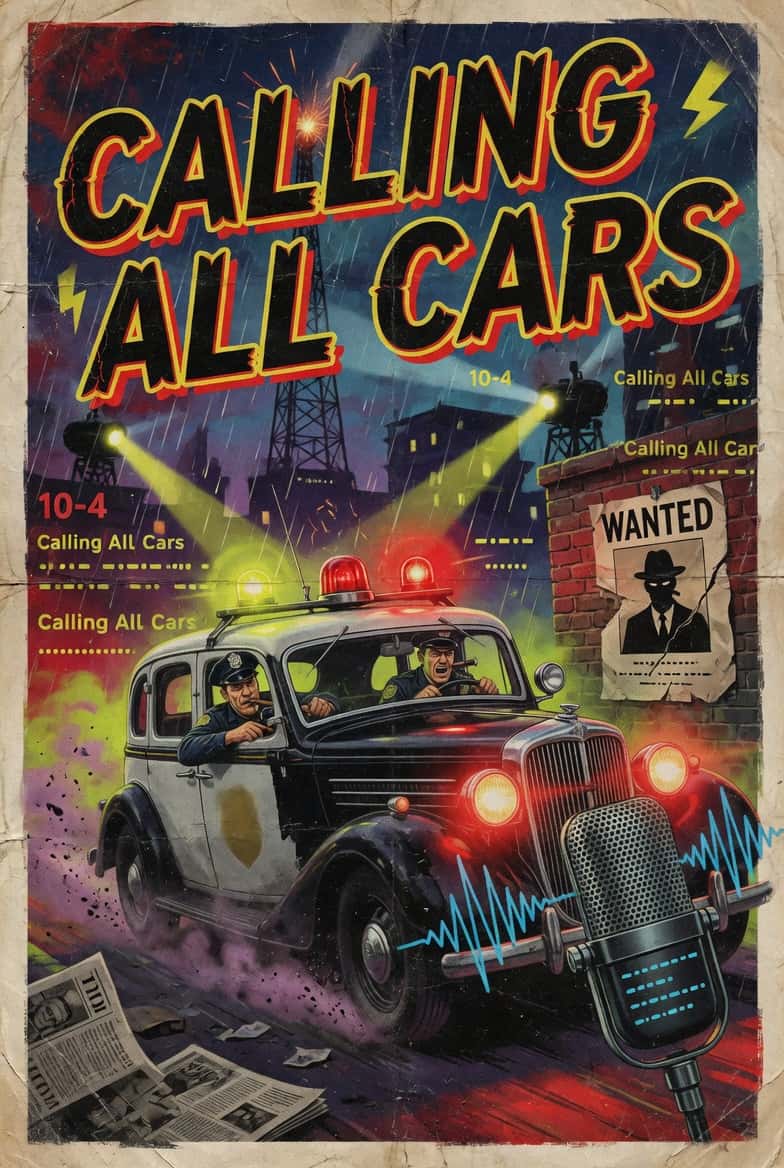
The copyrighted program created by Rio Grande. Orange County Sheriff's Office calling on all cars. Attention all cars. Broadcast 296 regarding a missing person. Be on the lookout for Joseph Wallace. 30 years old. 5 feet 10 inches. Weighs about 150 pounds. Missing since March 15th. That's all.
Rose and Cliff. Six years now you have heard me tell you that more police cars, fire engines, ambulances, and other emergency automotive equipment use Rio Grande-backed gasoline wherever it was sold than any other brand. Have you ever stopped a moment to give this statement some serious thought? If you have, you must have realized that motor equipment subject to such strenuous demands would have to be powered by an absolutely dependable motor fuel. All-purpose cracked gasoline must have great power in order to carry the tremendous loads of heavy fire equipment. It must be so blended that it will carry all this equipment at fast speed. You will say that Rio Grande is different and that it is superior in order to cope with all these strenuous demands. And you are correct. It is different. All-purpose Rio Grande cracked is scientifically made of six important power-producing ingredients instead of three found in most ordinary gasoline. And that is why this gasoline is chosen by so many police and fire departments. Try it. You will notice a difference in your car's performance. Station in your neighborhood tomorrow morning and fill up your tank with this new all-purpose Rio Grande cracked gasoline.
The story we have prepared tonight has been built around facts supplied by the office of the sheriff. We have therefore asked Sheriff Jesse Elliott to prepare a foreword to our program.
Good evening, ladies and gentlemen. Orange County is not the largest county in the state of California, but it is a prosperous one. It is also situated so that a greater part of the traffic between San Diego and the more northern cities flows through the county and also through the city of Santa Ana. The problem of policing such an area is complicated, therefore, by our geographical location. Thank you. But the record of my department is one which can well be envied. Justice in Orange County is sure and swift. We not only declare that crime doesn't pay, we prove it. The story we are to hear tonight happened many years before I took office. But it is nevertheless an excellent example of the swift and sure justice that we promise to lawbreakers. It is our desire and intention to keep Orange County the center of the Orange Empire in Southern California, a place where we can live and work. A place where crime of any sort is a losing game.
On March 15th, 1926, broke over the hills which surround Santa Ana Canyon. The bow-lying mist spread a pall over the scene. A car sped along the winding road.
We won't get home until morning. We won't get home until morning.
It's morning now. We ought to be home now.
I have another drink. You'll be there soon. Have another drink.
That's a good idea. One more drink. I don't care. We never get home.
Give him the bottle. Here you are. Take a good one.
A good old bottle. Put up. Now, you're my pals. I'm a pal. Here's your bottle. The best pal.
You better find the right place, too. I didn't make the infirmary, you know.
If you like the infirmary, I'll keep your shirt. Here, have a little drink, boys.
I'm way ahead of you. Oh, you keep the bottle. Oh, no. That's not fair. Pretend to drink with us. Okay, just one more.
Going down for us? Don't look like home to me. What's the rest? What's the rest of it?
All right. All right. No, there's just more time to drink.
Oh, darling. Oh, Lord. Land that bunch of trees. That'll do. Stop the car.
Hey, what's that? Stop him here. Come on. Let's get out and stretch our legs.
Oh, that's too much work. Come on. Come on. Come on. Look at that sunrise.
Sunrise? Say, now, that's how. Come on. Let's go. We'll get a well view from behind these trees.
Hey, what are you carrying those cans for? Oh, you thought we might build a fire. You don't build a fire with cans?
Soft gasoline. Soft. Fire. I suppose you got that wire and all the locks together. Here's some Boy Scouts. You will make out all right.
Yeah, this is the silliest thing I ever did, but I don't care.
No. There isn't any reason for you to care.
Well, what do you mean? Is this place good enough? What are you going to do with that iron bar?
I don't like the looks of this. So what?
Hey, give me that bar. I know you don't. Well, take this then.
Hey, grab him. I got him.
Hey, you can't do this to me. Hold him still. Give me that wire. Here. Around his wrist.
Oh, my God. You're wrong. Hang on. There.
Hey, fellas, what's the idea? Is this a joke?
Now, see if you can hold his head. Ow. Now, put that bar down. Don't do that to me. Stop.
Well, that did him. Don't stand there looking at him. Pour the gasoline on him.
Yeah. Yeah, sure. Look out where they're meant. Hurry up. We've got to get going.
Yeah. Yep, we've got to get going. Yeah. Yep, we've got to get going. Yeah. We've got to get going. We're good. Too bad we won't have time to look at the sunrise.
In the morning. At Santa Ana, Sheriff Sam Jernigan and Deputy Herman Zabel face a difficult problem.
Well, if that isn't a mess, I never saw one. Fine chance of getting an identification on that.
You'll have to get it from what didn't burn. Starting with what?
Starting and ending with a belt buckle, a fragment of clothing, and a locket. All of that, huh?
Yeah. The belt buckle has the initial W on it. If we knew his name started with W, it would narrow down to one letter. The piece of the suit he wore may help later.
Yeah. But not now. So that leaves the locket. Here it is. That's it. It couldn't be something a man would wear. It'd have to be a woman's locket.
Yeah, it's a woman's, all right. Well, not even an initial on it.
Nope. Well, it's sort of a funny thing for a man to be wearing. That's just what I thought. But does it mean anything?
I don't know. But I've got a hunch it's the one thing that's going to give us relief. Here, let me polish it some more. There seems to be a charm or something in the center there.
No, it's just a common variety.
No, no. No, there's a charm in the center. Made out of a piece of quartz.
Yeah? Let's see. It's a nice stone. Hey, this is something.
What? What? You see that tiny bubble in the center of the stone?
Yeah. Looks like liquid. That's what the Indians call a teardrop. It's very rare.
Well? Men who work in mines usually save specimens like this and have them mounted.
You mean this teardrop comes from mines in a certain locality?
Yeah, Arizona. Oh, I forgot to mention they found the pocket mirror on him, too.
Well, what's a pocket mirror got to do with this?
Plenty. The guys don't generally carry pocket mirrors anymore than they wear women's lockets. That's just it. The mirror advertised a merchant in Miami, Arizona.
Yeah? Well, Miami is the center of a mining district in Arizona.
Oh. So that's what your hunch was. Yeah, I couldn't tie it up without this teardrop. A guy buys pocket mirrors and wears a woman's locket. We'll identify him.
Yeah. And when we do, I'll bet we run into some very funny angles.
To every identification bureau in the country went circulars describing the victim. To every peace officer in the vicinity of Miami, Arizona went photographs of the teardrop charm.
Carrying this picture, I'm always... After several visits to the mines in his territory, Sheriff A. Al Edwards of Globe, Arizona, continued to search for a man who could identify the teardrop charm. After questioning hundreds of miners, Sheriff Edwards saw little hope of identification. Then, four months later, almost as a matter of habit...
Hey, I wonder if I asked you before whether you've seen this stone or not.
Sure, I've seen it. You have? It belongs to Joe Walsh. He went to Los Angeles five or six months ago. His brother works in a bank in Miami.
Yeah. That's all I wanted to know.
Word of the identification was sent to Sheriff Jernigan of Orange County, asking him to contact Miss Ruth Walsh, a nurse in the Los Angeles General Hospital, a friend of Joseph Walsh. The next day, R.B. Walsh visited the sheriff's office in Santa Ana.
Sit down, Mr. Walsh. It didn't take you long to get here.
No, when Sheriff Edwards showed me the picture of my brother's teardrop, I knew what I'd suspected for some time was true.
You suspected? What was that?
Tall clay of some sort. Here's the locket. It belonged to my brother.
Miss Walsh recognized a piece of cloth as coming from the suit your brother wore.
Yeah, and this pretty well ties it up. Now, Mr. Walsh, we realize it's shocking news, of course, but we have to ask you why you suspected your brother was murdered.
I didn't know just what had happened to him. Go on.
Well, all of my letters to him were unanswered, and he'd never failed to write Mother. Her letters to Joe returned.
You mean that's the only thing made you suspect foul play?
No. Two of my brother's checks cleared through the bank where I work. I couldn't prove it, but I believe they were forged.
Forged, huh? Well, why didn't you go to the authorities?
I told you. I couldn't be sure. How much were the checks for?
Nearly $2,000. You thought they were forged and did nothing about it?
Oh, yes. Yes, I did. I decided to make a personal investigation. And just how did you go about your personal investigation?
Well, I wrote to various people who might have contacted Joe. Mr. Walsh, what were your reasons for not going to the police?
Well, I just wasn't sure anything had happened to him. That's all.
Oh, yes, indeed. I just decided to come to Los Angeles to look for myself when Sheriff Edwards showed me the teardrop charm Joe wore. Then I knew the worst.
Well, there's nothing more you want to tell us about him. I'll tell you anything I can. Mister, we're going to find out plenty.
To a small hotel on Crown Hill in Los Angeles went Deputy Sheriff Walter Keating. Nearly five months had elapsed since the murder of Joseph Walsh.
Are you the manager?
Yes, sir. What can I do for you?
I'm from the Los Angeles Sheriff's Office. I'd like to see your registration for February and March of this year.
Certainly. Just a moment. Ah, here they are.
I'm interested in a man who was staying here for a year. I'm interested in a man who was staying here for a year. I'm interested in a man who was staying here for a year. He was staying here and then suddenly stopped writing to his family. March? You don't mean Mr. Walsh?
I certainly do. What makes you remember him? Was there anything happen to him?
What makes you think something might have happened to him?
I didn't think that exactly. It's just the circumstances of his leaving were so unusual. And, uh, other things.
Just what do you mean by, uh, other things?
Well, we'll find out about that later. What was unusual about the way he left?
Oh, I'm sure he expected to return, but he never did. That all?
Yes. Somebody hit him over the... Hit him over the head, poured gasoline on him, and burned him.
What? You want to talk?
Oh, that's horrible. Yes, isn't it?
Well, he left here on the morning of March 13th. We have, uh, reason to believe he was killed on the way back here two days later.
Oh, but that's impossible. What do you mean?
Well, I had a letter from him from San Diego a couple of weeks after he left.
What? Yes. He said he was staying in Tijuana for a few weeks. Now, that's something. Go on.
Well, before he left, Mr. Walsh was very friendly to the man staying here by the name of Dewitt. Anybody else?
Yes, a clergyman. The three of them were together continuously.
A clergyman? Yes, who came here from New York.
Well, at least he dressed like a clergyman.
Now, wait a minute. What do you mean, uh, dressed like a clergyman?
Oh, I just can't tell you what I mean by it. I can't put it into words. Ah.
Well, what about this guy, Dewitt? He mentioned something about a trip to San Diego with Mr. Walsh in a rented car. The three of them left together.
A rented car, right? What agency?
Oh, it's advertised here on the desk. Uh, here's the phone number.
Oh, thanks. I take it you, uh... You haven't seen Dewey or the preacher lately?
No. You didn't know the preacher's name?
No, no, I didn't.
Hello? This is Deputy Sheriff Keating. I want you to look into your rental records for March 13th. Tell me if anyone by the name of Dewey or Walsh rented a car. Now, hold the phone. I saw Dewey and the other man after they came back, though. Dewey left the hotel, but I saw the clergyman for several weeks. He didn't explain Walsh's absence?
I asked him about it. He denied having gone away with Mr. Walsh.
Oh, I see. And yet you saw Walsh go with him.
Oh, I couldn't. I couldn't be sure it was the same man, but he was dressed like him.
Uh, hello. No one by the name of Dewey or Walsh, huh? Well, could you tell by your records if a clergyman hired a car that day? What do you mean by saying, oh, that guy? You don't say. A Goodwin, huh? That explains a lot of things. What name did he give in the address? Now, thanks very much.
Have you got the clergyman today?
Yeah. Now, about this letter you got from Walsh two weeks after he was dead. Did you get it after you asked Reverend Philip A. Goodwin? Why Walsh didn't come back?
Yes, it was several days after that.
I thought so. I'll just take that letter with me, because I think a handwriting expert will prove it was written by your Reverend Goodwin himself. The one Walsh went away with.
But Dewey told me Mr. Walsh didn't go away with any minister.
And I'll bet he told the truth, because I don't think he is a minister.
Police were contacted, and three days after the identification of the body with the teardrop charm, Reverend Philip A. Goodwin was arrested in the National Vaudeville Artists Club on West 46th Street in New York. After being held ten days in the Tombs Prison to await deputies from California with extradition papers, the fake priest was brought to Fullerton in Orange County.
I think we'll get anything out of him. He talked for the papers in New York. If he doesn't give me anything, I'll frame an interview that'll convict him. I'll give those rags you worked for a break to let me talk to him.
Now, will you listen to what's given us a break? Save it for this, sister.
Yeah, well, you can sob through the bars. Here he comes.
How about a statement for the press, Reverend? Anything to say from the woman's end. Are you going to plead guilty?
Blessings. On you, my children. I appreciate your interest in me, but one at a time, please.
Well, how did you enjoy your trip? Were you handcuffed?
Oh, I had a grand time, but it's all a terrible mistake. I know I'll be exonerated. You'll find Joseph Walsh in Tijuana, alive and well. Then everything will be cleared up.
Will you raise a howl about being pinched?
I don't mind waiting. I'm told the Orange County jail is far superior to the theatrical boarding houses in New York.
Tell us about the play you're producing.
Well, it was one I wrote myself. It was a play I wrote myself called Double Cross.
You played the lead in it, didn't you?
Yes, I was the priest.
Oh, then you're not really a priest.
Oh, but I am. I'm a priest at the American Church of Los Angeles. That's a branch of the Greek Orthodox.
What were you doing in a play?
Yeah, was it a religious play?
Oh, yes. Yes, with the proceeds of the play, I intend to build a cathedral in Los Angeles.
Well, how about the deck of cards and a pair of loaded dice they found in your pockets when you were pinched?
Oh, all those. They were just props. The things I used in my play.
Ah. Now, if you'll excuse me.
Oh, sure thing, Reverend. See you in court.
And I'll see you in jail, Reverend. But we'll never see him in a cathedral.
There's fantastic headlines about the case. Officers fought over every available scrap of evidence which would link the pseudo-priest to the murder.
I tell you, we can't be wrong on this angle. He went away with Walsh and came back without him.
Let the newspapers scream.
Yeah, that's easy for you, but I'm taking the rap. Even the governor's yelling for action.
Couldn't you get anything out of his correspondence?
Plenty from the governor, but nothing from the reverend. I hoped it might give us a lead on this guy, Dewey. You know, the one who went on the trip with him.
Yeah, so did I. We got his fingerprints in the hotel room in Los Angeles. Dewey's got a record, all right. Did a year in Utah and a few other states.
Well, now that's something. But the priest won't even admit knowing him. He just sits in his cell showering blessings all over the place.
Yeah, the nerve of that guy. Oh, by the way, I got the record of that ex-convict who came to see him this morning.
Oh, there you are. Why should an ex-convict come to see him?
They're trying to pin half a dozen jobs on this baby right now.
Yeah? Well, we'll talk with him when he's done communing with the reverend.
Why do you suppose the priest... saved this letter?
Oh, there's lots of them like that. Just form letters. Couldn't, uh... Couldn't even do it in code.
You decided. Don't you notice what's written on the back of the envelope?
Where is it? Navy. Navy Admiral or something?
Oh, stop trying to be funny. Anyway, Dewey isn't his right name. It's Gaines.
Well, how about that letter that was supposed to be written by the murdered man from Tijuana? Does it, uh... Handwriting?
I don't know yet. We've got to have something right now.
Well, I hope that's it. Come in.
They said you wanted to see me, sir.
Yeah. Sit down, Slater.
Say, what's the idea? Can't a guy visit his friend?
I'll ask the questions. The first one is, why did you come to see Goodwin?
Well, what's it to you?
Don't talk to me like that.
All right, all right. Sit down. Now, I don't feel like talking anyway.
Why not?
Well, what do you... Do you guys think I am, a rat?
We know you are.
You ain't got nothing on me. And I ain't talking, see? And to prove it, we'll hold you as a suspect. We'll forget all about Goodwin and start working on the jobs you've done recently.
Oh, fellas. Now, wait a minute.
All right, but wait a minute. I just... I come here friendly like to see the Reverend. We did a stretch together in a Utah stir.
So did Dewey.
Who?
You know. His right name is Gaines. He and Goodwin knocked off a guy.
Oh, no. You guys got a bum steer. They didn't turn that trick. The Reverend wouldn't do nothing like that.
Keep on talking, but say something.
The Reverend was framed by a dame in Utah, but they sprung him when she confessed.
We know that. You came here with a message from Dewey.
You know. Oh, no, no. You can't pin that on me. I... I haven't seen him since we got out, honest. I was just awful good friends with the Admiral, and I wanted to see him.
The who?
The Admiral. That's what we called the Reverend. You see, all the cons liked the Reverend. He called a Utah stir Hotel Divine.
And why did you call him the Admiral?
He was head of Hotel Divine, so we called him the Admiral.
That thing over there. That's a very funny angle. Where does Dewey come in?
Well, he was the Admiral's best friend.
Yeah? So what?
Well, I'm just trying to explain why I was friends with the Admiral, and... Navy. And who?
Navy. That's what we called Dewey.
Oh, so you called him Navy.
Sure. Just like you guys would call a person... pal.
That's all we wanted to know. Now get out of here.
I'm going. Don't hit me.
We'll fumigate this room later, but first let me see that letter.
You mean the one from Great Falls, Montana, with the word Navy written on the back of it?
Yeah. I want to see if Goodwin keeps up the Reverend act when we throw Navy in the cell next to him.
A few hours later, Albert Gaines, alias Dewey, was arrested in Great Falls, Montana, returned to Santa Ana by Deputy Ed McFarland. He maintained a solemn silence.
What's this? What's this, Reverend? No visitors? Now don't tell me the person you're admiring public has deserted you.
Oh, the solitude is welcome, Sheriff.
Well, that's fine. Then you won't mind about 50 years of it, providing you don't get hung.
Oh, you will have your little joke, won't you?
Yes, yes. And I've got another little joke that will just kill you.
All right. Or hang you.
Dear, I wish all my visitors had your sense of humor.
Yes, yes. Well, your next visitor may not have a sense of humor, but here's the funny part of it. I'm going to put him in the next cell to you and keep him there.
Nothing will surprise me anymore.
Oh, yeah? Well, take a look at your visitor.
Navy, you dirty... You got me into this.
Hey, wait a minute. Get in there.
I forgive you, my son.
Yeah? The man was born. The man was born to sin. You forgive me? Are you lying hypocrite?
Now, you can go to it. You can scratch each other's eyes out through the bars.
He was the one that did it, Sheriff. He made me go with him, but I didn't do it.
Shut up. You keep sniffing heels.
Why, Reverend, what would your congregation say?
Listen, Sheriff. If Walsh is really dead, then he's responsible. I didn't have a thing to do with it.
Go ahead, you two. I'm listening.
Yeah. Why did I ever have anything to do with you?
Oh, I tried to save you from your sins, my boy. Sorry, but you were ever the errant one.
It's a lie. It's a lie. He let me into it, Sheriff. He played on my emotions. He told me I'd never have to worry again.
I did not. I never promised you anything. I did not.
Yeah, but it was his idea to pour gasoline over Joe.
You shut up.
No, I won't. I'll never get that picture out of my mind. Joe was still moving when he started to burn.
You set fire to him.
It wasn't me. I wasn't even there. I didn't have anything to do with it. I'm a priest.
Yeah? I'm a priest, I tell you. You're a fake. A hypocritical fake.
Come on, Gaines. I want to talk to you.
Okay, Sheriff. He told me about it, and I told him not to do it. And now he's trying to blame it all on me. And I'm the innocent one. I'm innocent.
Gaines, I'm giving you a chance to talk. You're both mixed up in this, and we know it. So you might as well give us a straight story.
Yeah. Yeah, I'll tell you the truth. I liked you for a long time, but I was afraid, Joe. I was afraid of that guy. I've always been afraid of him.
Well, you don't have to be afraid of him anymore. We'll just go in my office.
Yeah, okay. Now, he's in a cell and won't get out. So you can tell me. Just what happened. All of it.
Yeah, well, after we got out of jail, we wrote to each other, see? After about a year, Phil wrote to me. He told me he had a swell job, a job we two could put over, and he wanted me to come to California.
So you came out here?
Yeah, yeah, yeah. And when I saw him in that clergyman's outfit, I nearly died. At first, he pretended he really was a clergyman, but pretty soon he started to tell jokes like he used to. So I knew everything was all right.
Yeah, well, what about this swell job he wanted to put over?
Well, yeah. He got there. He was very friendly with this Joe Walsh. He was living near him, and he was buying and selling stocks with him.
I see. Well, just what was the angle?
Well, he made a few buys and sells. He was going to forge some big checks on Joe, see? And then kill him, gee. And he made me help him.
I'll get a stenographer in here, and you can make a complete confession.
Yeah, yeah, I'll do that. I want to, for a long time.
Yeah, you just give us all the details, and we'll check up on him. Then we'll find out what really happened.
During the trial of Philip Goodwin, the pseudo-priest maintained his innocence despite overwhelming evidence of his guilt.
Ladies and gentlemen of the jury, it is my duty to remind you that this man is a sham priest with a sham story, one whose godly garb conceals a satanic character, a colossal liar, but one deadly shrewd. Knowing how he could play on public sympathy, he took this role in it. And all this happened. I was in New York doing God's work. The play I wrote was about to become a success, and the worldly people never reached by a church would have been converted.
But Satan found a way to prevent me from building a cathedral in Los Angeles. I've been accused of a bigamy at all.
Now I would like to call a handwriting expert. Now there is absolutely no doubt in my mind that the letter written from Tijuana, supposedly by Joseph Walsh, two weeks after he had been murdered, was written in the same hand that Philip Goodwin used.
Thank you very much. Now I will bring to you the conclusive evidence that this crime was committed not only for personal reason, but for financial gain. This is the final link. An account was opened in our bank on March 18th by Philip A. Goodwin.
And how much did he deposit at that time?
$1,669.
Is that my check?
Yes.
Signed by Joseph Walsh.
And that check has been proved a forgery?
Yes.
Now, ladies and gentlemen of the jury, it has been claimed that these defendants were all in San Diego with Walsh, that they were all drinking, and that in starting the conversation, not too soon, Walsh was injured. That they started driving with him to Los Angeles, but fearing he would die, stopped the car and built a fire. It has been claimed that since the fire would not stop, they tried using gasoline. That Walsh's clothes became ignited, and that he was burned. That they took him back to San Diego, left him there, and then returned to Los Angeles. That is a fine explanation, ladies and gentlemen. It fits the picture perfectly. However, I have one more witness, a silent one. This witness will be represented by a more articulate individual, the man who checked the speedometer of the car driven by Philip Goodwin, called Joseph Cowles.
Joseph Cowles? Raise your right hand. Do you solemnly swear the testimony you are about to give and the action pending before this court to be the truth, the whole truth, and nothing but the truth?
I do.
State your full name.
Joseph Cowles.
Mr. Cowles, are you employed by the auto livery that rented the car to Philip Goodwin?
Yes, sir.
To have made the trip, to Tijuana, to Santa Ana Canyon, and back to San Diego, and then to have returned to Los Angeles, as the defense contends, how far would that car have traveled?
Well, let's see. 490 miles.
Yes, that's right. Just 490 miles. 490 miles. Just how far did that car travel?
Exactly 431 miles.
That's all. The state rests.
In just a moment, we will give you the concluding facts on tonight's program. At all, we are granted, in the statement, you will see a brilliant poster. It says, try it. And that is exactly what I would like you to do. All I ask is that you try all-purpose Rio Grande Crack gasoline once. I am confident that you will be more than satisfied with the results in your car, that you will become a regular user after you have tried it just once. It is a better gasoline because it has twice as many ingredients as found in ordinary gasoline. So let's further unite it as to give you more mileage, greater smoothness, and more speed and power. Try it.
Tomorrow, the little hydrolite crystal, the teardrop charm, had avenged Joseph Walsh. Goodwin and Gaines were convicted and sentenced to life terms in Folsom Prison, where they are learning that a life of crime cannot pay.
Boyne County Sheriff's Office calling all cars, attention all cars, a cancellation of broadcast 296 regarding a missing person. This man was murdered. Suspects in this case are now in custody. That's all. Throw him away.
Sir Frederick Lynn, getting you a good night for Rio Grande. Next week at this time, Rio Grande will present the case of the body on the promenade deck. This is the Columbia Broadcasting System.