
The written record
Read the transcript
Read along with the recording · About 42 min to read
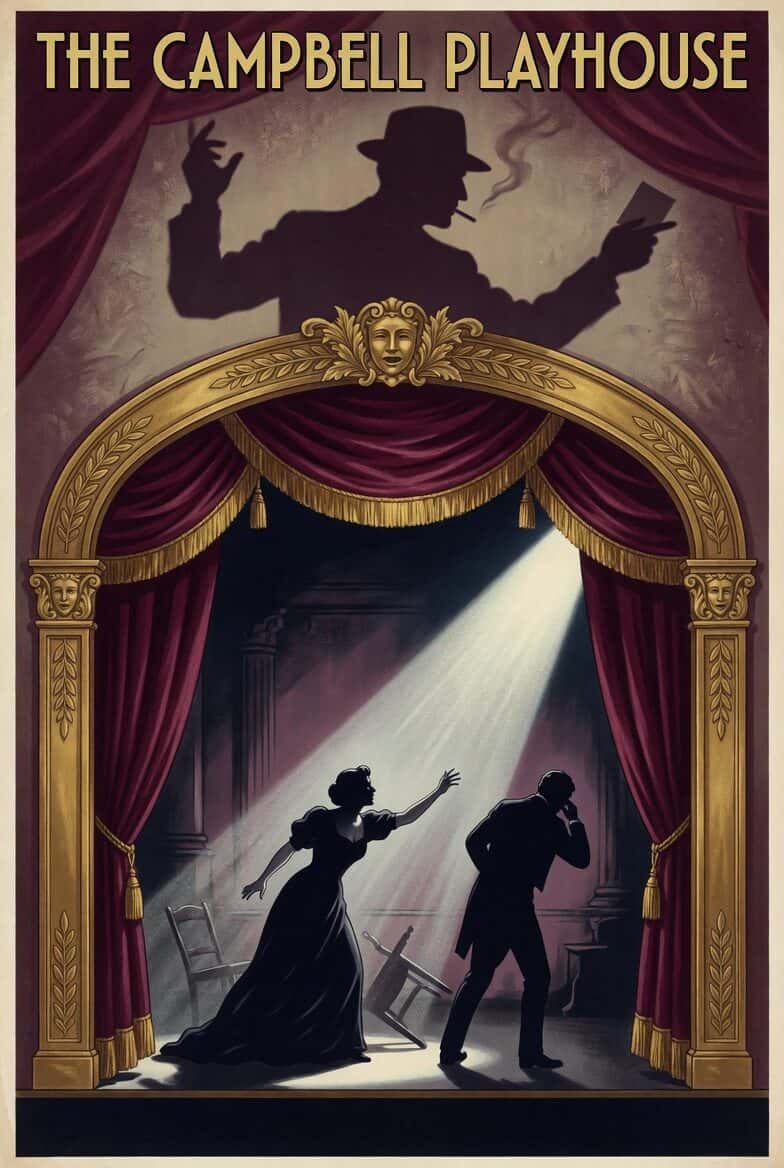
The makers of Campbell's Soups present the Campbell Playhouse, Orson Welles producing. Good evening, listeners. This is Ernest Chappell speaking. Tonight, the Campbell Playhouse presents Orson Welles in his own radio version of that great sea story, Mutiny on the Bounty. But first, a word from our sponsor.
Any day you look on the lunch or dinner menu of the most popular restaurant in town, you will likely find that one dish featured is chicken. Ask the proprietor about this, and he'll tell you that chicken is a bestseller, not only with the regulars, but with people who are eating out, in style. And it's true wherever you go. Chicken is usually first choice when the meal is to be something specially fine. I mention this because it seems to me the widespread liking for chicken is one reason Campbell's Chicken Soup is enjoyed so eagerly by families everywhere. You see, this soup is chicken through and through, and the aroma that drifts up as this soup is set before you, there's an unmistakable promise of chicken. There's deep-down chicken flavor in each spoonful as you taste it, and tender pieces of chicken meat, too. That's what makes this such a grand soup, the lavish emphasis on chicken. Why don't you surprise your family with Campbell's Chicken Soup for some meal this weekend?
Good evening, this is Orson Welles. On the 12th of September, 1792, there occurred in England the most remarkable court-martial in maritime history. Seven naval officers and men were on trial for their lives before the Lords Commissioner of the Admiralty on charge of high treason. Revelations of this trial of conditions prevailing on the ships of the British Navy came finally to exert a powerful influence in humanizing the administration of the world's navies and making more tolerable life at sea.
Listeners, stand forth. Watch your fire and midship up.
Yes, sir. James Morrison, boatswain's mate.
Yes, sir. William Purcell, ship's carpenter.
Yes, sir. Thomas Burkett, seaman.
Yes, sir. John Millward, seaman.
Yes, sir. Thomas Ellison, seaman.
Yes, sir. You are here to be tried by a special court of naval inquiry assembled aboard His Majesty's flagship Duke under Article 19 of the Naval Articles of War, which read as follows. If any person in or belonging to the fleet shall make or endeavor to make any mutinous assembly upon any pretense whatsoever, every person offending herein, being convicted thereof by the sentence of the court-martial, shall suffer death.
First witness to the crown, Captain Bligh.
Captain Bligh!
Yes, my lord.
Captain Bligh, have you any statement to make to this court concerning the mutiny aboard His Majesty's ship Bounty while under your command in the great South Seas?
I have, sir. I have prepared a statement which I now beg the court's permission to read.
The court will hear your statement, Captain Bligh.
And I will give it to you as soon as I can. I respectfully beg to submit to the Lords Commissioner of the Admiralty the information that His Majesty's armed vessel Bounty under my command was taken from me by some of the superior officers and men on the 28th day of April 1789 in the following manner. A little before sunrise, Fletcher Christian, who was mate of the ship and officer of the watch, together with the accused and certain others of the crew, came into my cabin and while I was asleep seized me in my bed and, with cutlasses and bayonets fixed at my back, my breast threatened me with instant death if I spoke or made the least noise. I was hauled on deck in my shirt and without a rag else. The boatswain was ordered to hoist the launch out and the officers and men who remained loyal were ordered into the boat. We then veered astern, all 19 souls. The boat was so lumbered and deep in the water that it was believed we should never reach shore. The size of the boat was 23 feet from stem to stern and rowed six oars. After considering our melancholy situation, I was earnestly solicited by all hands to take them toward home. Therefore, after commending our souls to God, I bore away for New Holland and Timor, across a sea but little known, in a small boat laden with 19 souls, without a single map of any kind and nothing but my own recollection and general knowledge of the situation of places to direct us. After enduring dangers and privations impossible to describe, we sighted Timor on the 12th of June and on the morning of the 15th before daylight I anchored under the fort of the Dutch settlement at Coupang. This voyage was a journey, a voyage in an open boat, I believe to be unparalleled in the history of navigation.
One thing I wish to add, that on the night preceding the mutiny, coming up on deck during the middle watch, according to my custom, I discovered Fletcher Christian, the ringleader of the mutineers, in earnest conversation with Roger Byam, midshipman, one of the accused. In the darkness of the deck, I was not observed by these men who were standing on the starboard side of the quarter deck between the guns. Nor had I any apprehension at that time that their conversation was not innocent. But as I approached unseen, I saw Roger Byam shake hands with Christian and I distinctly heard him say these words, "You can count on me," to which Christian replied, "Good. That's settled then." The moment they discovered me, they broke off their talk. I have not the slightest doubt that this conversation concerned the forthcoming mutiny.
It is all alone. Roger Byam, stand forth.
Roger Byam, you have been accused with others of mutinous and piratical seizure of His Majesty's armed vessel Bounty. You have heard the crown's witness. Roger Byam, do you plead guilty or not guilty?
My lord and gentlemen, I declare before God and the members of this court that I am innocent, that I have never been guilty either in thought or in deed of the crime of which I am charged.
Roger Byam, the court is now ready to receive whatever you may have to say in your own defense.
My lords, I joined His Majesty's armed transport Bounty as a midshipman. On the 21st of December, 1787, we were off Spithead, lying to for stores and crews to come aboard. I remember my first sight of the Bounty. The crew crowded in the afterdeck around the huddled form of a man, lashed to the capstan's bar, and Captain Bligh reading from an admiralty order. "If any person in or belonging to His Majesty's fleet shall strike or endeavor to strike an officer, he shall be flogged in turn on board every ship of the fleet."
Master, yes, sir. How many lashes are due from our ship?
Two dozen, sir.
Very well. Mr. Morrison.
Yes, Captain Bligh.
Two dozen lashes.
One moment, Captain.
Yes, Surgeon.
Prisoner is dead, sir.
Lucky devil, we were only the fifth ship. Well, Mr. Morrison, what are you waiting for?
But the man is dead, sir.
Yes, I heard the surgeon's report. God, my dinner's getting cold. Two dozen lashes, Mr. Morrison. Two dozen lashes, dead or alive. Two dozen it is.
On the morning of the 23rd of December, the 45 officers and crew aboard, and as the guns of the fleet fired a farewell salute, the Bounty set sail for Tahiti and the great South Seas.
Lieutenant Fryer.
Aye, Captain Bligh.
Take charge of raising anchor, sir.
Very well, sir.
Fryer. Topsoil.
Aye, sir.
Purcell.
Aye, sir.
Staines.
Aye, sir.
Sergeant Huggan.
At your service, sir.
Sergeant Huggan, you'll moderate both your voice and your rum rations. At your post.
Very well, sir.
Mr. Morrison, we're ready, sir.
Aye, sir.
Holmes. George. Ben. Those to top those. On the fore-topsail. Top of the rope. Aye, I command. Yo, heave. The fore-course. Ho! Get the main car out. Heave. Harding. Woody. Lord, the main tops'l, the library. Ho!
On Christmas Day, we passed Land's End, and the Bounty headed away to sea with stock to its head. She was a small ship, as you know, of little more than 200 tons. And the great cabin aft was rigged as a garden for the transportation of breadfruit trees, from the island of Tahiti to the West Indian plantations. Thus, the ship's quarters were more than usually crowded, a circumstance which undoubtedly affected the temper of its company.
The officers messed in a screened-off space on the lower deck, aft the main hatch. At the captain's table sat Mr. Fryer, the ship's navigator, an elderly man long in the service of His Majesty's Navy, and Mr. Christian, the mate, a man of only 24, a fine presence, from a good English family.
You're talking to me about seamen, Mr. Christian. I know them better than you, because they're a lazy, incompetent lot of scoundrels. Heaven knows the captain has trials enough with such a crew. Dregs of public houses. They don't know a sheet from a tack.
I should differ with you, Captain Bligh. I should call Ellison and Mills first-class seamen. Even Burkett, though he may be willful...
Have my eye on him. By his report of misconduct, I'll have him duped and flogged.
If I may express an opinion, Captain Bligh.
Yes, Mr. Christian.
Burkett's a man to tame with kindness rather than with blows.
La-dee-da, Mr. Christian. On my word, you should apply for a place as master in the young lady's seminary. Kindness, indeed. A fine captain you'll make, I warrant. Our seamen understand kindness as well as they understand Greek. Fear is what they do understand. Without fear, mutiny and piracy would be rife on the high seas.
There's some truth in that, sir.
I can't agree. Seamen don't differ from other Englishmen. There are some, the best of them, who will follow a fair and kind officer to the ends of the earth.
Rot. Sir, if I trust them, it's the end of me. If you have to talk such nonsense, Mr. Christian, don't do it in my mess, where I have to listen to you.
Very well, Mr. Bligh. In the future, I shall dine where my opinions are more acceptable.
From that day on, and for the rest of the voyage, Captain Bligh took his meals by himself in his cabin.
In latitude 39 degrees north, just off the coast of Tenerife, we ran into heavy weather. A huge wave stove in three of our longboats, carried away our cases of beef, and spoiled a large part of our stock of bread. We laid into Santa Cruz for fresh supplies of water and beef. The meat that was taken on ship was so tainted, the men threw most of it overboard. Captain Bligh kept the men at work, repairing the ship's boats from morning till night.
Captain Bligh, men are asking when they can start shore leave, sir.
So they can get drunk in the taverns, I suppose.
Been at sea nearly eight weeks, sir.
Maybe eight months before they set foot on land, and might as well get used to it. No shore leave, Mr. Fryer.
Aye, sir.
We left Santa Cruz at the end of February. We carried no purser. Bligh filled the office himself, assisted by Samuel, his clerk. A smug, tight-lipped little man, who was believed to be the captain's spy. On Monday of every week, he and Captain Bligh opened up the casks, and checked over the supplies in the storeroom.
Eighteen pounds, sir, please.
Eighteen pounds, sir. What's wrong with that keg, Burkett?
Seems like it's been opened, sir.
So it has. Mr. Fryer, come here at once, sir.
Mr. Fryer, Captain Bligh calling you, sir.
Yes, Captain?
One of these casks has been opened, and two cheeses in it.
They may have been short-weighted when we were provisioned, sir.
They were not, Mr. Fryer. I checked them. These cheeses were stolen.
Well, perhaps you'll recollect, sir, that while we were at Spithead, a cask was opened by your order, and the cheeses carried ashore.
Tongue, Burkett. Boat is manned by a pack of thieves.
Surely, Captain, you don't think that I'm...
You've got an insurrection against me. Oh! Officers and men! But I'll tame you by heaven, I will. I'll make you eat grass before I'm done with you. Daniel!
Yes, sir?
If the allowance for cheese stops, and the officers too, mind you, until the deficiency's made good...
Yes, Captain.
...then, Burkett, if I hear another word out of you, I'll have you seized up and flogged to the bone. Samuel, you. Lock the storeroom. And keys to my cabin.
So help me. I ordered those two cheeses taken out at Spithead, I can beg you there, Burkett. I carried them myself. Two cheeses and a cask of vinegar.
A blithe house. That's the game, is it? Lining his pockets by starving us. Curses. Blunt. I'll be hanged if I do any more work on this ship. If he puts back our cheese products. I'm with you, lads. No more work by any in this mess. I'll give the word to Quintel's mess, and he'll pass it on.
No more work. No more work. No more work. No more work. No more work. No more work.
Come in.
Captain Bligh.
Yes, Mr. Christian.
As officer of the deck, sir, I feel it my duty to make a report.
Well, what is it?
Grumbling in the forecastle, sir. Becoming serious.
Ah, is it? What are the scoundrels grumbling about now?
Many things, sir. Chiefly, the food. And they're not satisfied with the ration, sir.
By heaven, they'd better make up their minds to be satisfied. Captain Bligh, a second officer. I am in a measure responsible for their conduct. I may suggest, sir, I think it would be wise to listen to their grievances.
You may keep your suggestions to yourself, Mr. Christian. I don't think it only right that you should hear what they...
I am the only judge, sir, of what's right and wrong on the ship. Tired of their bloody complaints. Since you seem to be their advocate, Mr. Christian, you can tell them this. The first man to complain from now on will be placed in chains.
About a hundred leagues off the coast of Brazil, the wind chopped around to north and northwest, and the Bounty lay becalmed. Here, another incident occurred to aggravate the resentment of the men. We'd been at sea six months, and for ten weeks now, outside of the officers' mess, there'd been no fresh food of any sort on board the Bounty. Taking advantage of the calm, the crew employed themselves with fishing for shark, with pieces of rotten pork for bait.
Give him the bait, there! Strike the line! Got him or get... Hooked, by heaven! He's on! He's a big one! Go to the moon! Tomahawk is on deck with him! Ho! Ho! Here he comes! He's a big one, all right! Ho! Ho! That'll be friendly now! At him, boys! At him with your knives! Slice him up, men! Careful there, Mills! That cutlet! Watch where you're cutting! Shark meat's good. It's better than dried dog's meat any day!
Look out! Someone's coming. It's Samuel. Samuel. Captain Spy. He doesn't get a scrap of the shark's meat. You hear, men? Not a scrap.
Fine catch, eh, men? I say it's a fine catch of fish you got there. I must have a slice, eh, Mr. Burkett?
Oh, you must have a slice, Mr. Samuel! Well, I must have a glass of grog and a stiff one, too, if you eat shark today.
Come, come, my good man. You have enough fish there for a dozen. You have enough grog stowed away for a thousand, by heaven. For the captain's table, I want it.
Catch him a shark yourself. This is mine. He gets the best of the bread and the pick of the junk cask as it is. You may get yourself, Burkett. Come. Give me a slice. That large one, and I'll say nothing.
Double with you. You take your slice right in your sneaker. Take your slice right in your sneaking face!
Burkett spent the night in irons. His messmates saved him their entire lounge of grog to fortify him against the flogging they knew to be inevitable. At six bells, Mr. Bligh came on deck.
Christian?
Yes, Captain Bligh?
Call all hands on deck to witness punishment.
Yes, sir. All men on aft deck, Forsen.
Aye, Mr. Christian.
Point all men on deck, Captain Bligh.
Very good, Mr. Christian. Rig the gratings, Mr. Purcell.
Gratings are rigged, sir.
Thomas Burkett, step forward.
Anything said?
No, sir.
Strip! Mr. Norton, seize him up.
Seized up, sir.
Thomas Burkett, for mutinous conduct, I sentence you to three dozen lashes.
Morrison.
Yes, sir.
Mr. Morrison, see that you lay on with the will. Put to me at breakfast when you're done.
Yes, sir.
Very much so. Did you see Burkett when they cut him down? Black in the face he was. The bald shone through the flesh. And now the old devil's got Purcell in irons. As they say, Mr. Fryer and Bligh ain't speakin' no more. Pretty past that for a ship what's got half the world between America and England. What way do we get back? Could be a day of wrecking for old Bligh. Aye, and maybe before we get back. What are you sayin', Mills? We gotta get back to England, don't we? We could get back without Bligh if we had to. As a man that can take the body home, I ain't a better man than Bligh. Christian, you mean? Christian. Yeah, that's right. Mr. Christian.
Mr. Christian.
Fortunately for Captain Bligh, a gale blew up that night, and all hands were kept busy keeping the ship from being swamped. Day after day, we scudded before strong westerly to souwesterly winds, carrying only the foresail and close reef main topsail. At last, on the 20th of November, we rounded Cape Horn. Five weeks later, we sighted the first coral reefs and saw the great mountains of the island of Tahiti.
Christian.
Yes, sir.
Jake and Sounding.
Yes, sir.
By the mark eight, by the deep seven, water surely.
Per anchor.
Yes, sir. Morrison. All men to the station.
Station.
There it is, Mr. Christian. The isle of Tahiti. Long, hard voyage. By heaven, there it is at last.
Looks like a beautiful island, Captain Bligh.
It is. Captain Cook, under whom I sailed these waters, loved it. Only next to England. Were I an old man and my work done, I should ask nothing better than to end my days under its palms.
Mr. Christian.
Yes, sir.
Sounding. Mills.
By the deep five, one half less bite, sir, and shoaling fat.
Lower away.
Lower away, there. Lady, there's coming a boy, sir. Lower the line.
Aye, sir.
Mr. Christian.
Yes, sir.
Set a watch. See that those sleeping yellow devils don't steal anything when they come aboard.
The next day, the crew went ashore. The danger of the mutiny seemed past. The hardships of the voyage were soon forgotten. We lived on the fat of the land, amongst affectionate native friends. Those were the happiest weeks I ever spent. Our host was the chief of the island. He had two daughters, Hina and Tahani. Mr. Christian and I used to visit them often. The four of us would go swimming, sporting in the breakers or lying on the white sand of the coral beach.
Hina.
Yes, Byam?
The tide is high. Swim with me out to the reef underwater. How about it, Christian?
Oh, Byam, you're not lazy enough for the south seas. I'll stay here, with Tahani.
Ready, Hina?
Ready. Come. I'll show you when we get to the reef.
Christian.
Yes?
Are you a chief in your own land?
More when perhaps done. I knew you must be. And have you no wife?
Yes. I have no husband. Tahani.
Why do you stop? Tahani is listening. When the ship sails, Tahani, I must go with it. But it will be two moons before the ship sails. Two moons are soon past, Tahani. We have a legend, Christian, here in Tahiti, that time is a long lizard that sleeps with its tail in its mouth. And to those who keep their hearts within its circle, no harm can come.
No harm will come, Tahani.
What are you doing with those flowers?
Tahani make a wreath to go around your neck. White flower. Long stem. What do you call it?
This one? The tofano. Looks like a lotus. In my country, we have legends too, Tahani. In my country, they say a sailor who once tasted a lotus, never goes home.
You are listening to the Campbell Playhouse presentation of Mutiny on the Bounty. We pause now for station identification. This is the Columbia Broadcasting System.
This is Ernest Chappell welcoming you back to the Campbell Playhouse. In a minute or two, we will resume our presentation of Mutiny on the Bounty starring Orson Welles. Meanwhile, may I say a word or two about mutiny in another form? Over many years, modern genius has been showing women the way to give their families better food with less kitchen time. And call it mutiny or call it evolution, women have been quick to take full advantage of these benefits for their families and themselves. No longer does the good housewife feel she must spend long hours each week making her own bread and churning her own butter. To give her family their favorite dishes, it is no longer necessary to spend so many hours in her kitchen. Her household shelves are laden down with many of these foods ready prepared for her and of a quality equal to her own good homemade kind. Among these fine foods are soups, Campbell's soups. If you have never tried them, I invite you to try a can of Campbell's chicken soup tomorrow. I cannot think of a finer way to introduce you to Campbell's soups than that. Once you've tasted Campbell's chicken soup, I feel certain you'll be convinced that soup making at home is a task you can well turn over to Campbell's chef.
And now, back to the Campbell Playhouse presentation of Mutiny on the Bounty, starring Orson Welles.
Spitzeldorf, Stamford, Roger Byam, midshipman.
Yes, sir.
James Morrison, boatswain's mate.
Yes, sir.
William Purcell, ship's carpenter.
Yes, sir.
Thomas Burkett, seaman.
Yes, sir.
John Mill, seaman.
Yes, sir.
Thomas Ellison, seaman.
Yes, sir.
Roger Byam, have you anything further to say in your defense?
I have, my lord. Toward the end of March, it became evident to all hands that the Bounty would soon sail. More than a thousand young breadfruit trees in pots and tubs had been taken on board. The relaxation of discipline now came to an end. Captain Bligh ordered Samuel to seize all the gifts which the friendly natives had given the men. With abundance around them, the crew were again put on slender rations. Two of them, deserted to the hills, were caught and severely flogged. On our last visit ashore, Mr. Christian was more than usually silent.
Christiane, you are going to sail. Is that not so?
Yes, Tahani.
When?
Tomorrow, sunrise.
Oh. Where will you be, Tahani, when we sail?
Here on the shore, waving my hand. I'll watch for you.
Christiane, will you think of Tahani sometimes in your own land?
I will not stay in my own land. I shall come back, Tahani.
Here, Christiane. These are for you. Black pearls. Tahani, where did you get these?
I swam very deep one morning off Coral Reef. Our people say pearls make man never forget.
Your people say right, Tahani. And I shall wait, Christiane. I shall wait for you to come back. And every noon I shall watch for your ship. Make hallow, how holy, Christiane. Make hallow, how holy. Yah, yah.
Mr. Christiane, Mr. Bligham.
I'm sorry, sir. I didn't realize.
There's no definite time for our return, Captain Bligham. We'll be back by four bells.
We got there, Mr. Christiane. Some gifts there from our friends on shore. Mr. Samuel.
Yes, Captain.
You'll take charge of these Indian curiosities which may be useful for trading in other islands.
Yes, sir.
One moment, sir. These things were given me as gifts for members of my family in England.
Mr. Samuel, who heard my orders?
Your bundle, Mr. Christiane. Captain's orders.
Very well, then. Take it.
Mr. Christiane, you still have something in your hand. Come, let me see what it is. Hm. Well, a pair of pearls. They appear to be remarkably fine stones.
Yes, sir.
Give them to Mr. Samuel, please. Black pearls are highly prized in the friendly islands where we shall do some trading.
Surely, sir, you won't take these. They were given to me by...
By your very close friends. Oh, Mr. Samuel!
Captain Bligh, I've obeyed every order you've given me. And some of them with the utmost distaste. But this I refuse. I intend to keep this gift, sir, as long as I live.
Very well, Mr. Christiane. I accept your refusal. And I shall remember it.
On the 4th of April, 1788, the Bounty with her cargo of breadfruit trees set sail from Tahiti. All went quietly enough until the evening of April 4th. That morning, we left the island of Numuka in the friendly archipelago, where we did our usual trading with the natives. A great many coconuts had been brought aboard and piled up on the quarterdeck between the guns under the captain's eye. At about noon, some of the coconuts were found to be missing.
Mr. Morrison.
Aye, sir.
Are all the officers assembled on deck?
Aye, sir. Gentlemen, I inform you that several coconuts have been stolen. I expect you to help me find the culprits. Why, speak up. Some of you must know the guilty party. Mr. Christian, step forward, please. I wish to know the exact number of coconuts you purchased for your own use, Mr. Christian.
I really don't know, sir.
How? You don't? I hope you don't think me so mean as to steal yours.
Yes, I do think so. You must have stolen some of mine. You'd be able to give a better account of your own. You may be officers, but you're rascals and thieves, the lot of you! I'll break the spirit of every man of you. You'll wish you'd never seen me before we reach the Indies. Samuel!
Yes, sir.
You'll stop the officers' grog and refer their orders. And instead of a pound of yam for men, you'll issue half a pound to all the messes. Understand?
Yes, sir.
And by heaven, I'll reduce you to a quarter of a pound if I find anything else missing. And make you crawl on your bellies for that.
It was feverish hot below deck that night. And there was an uneasy stirring in the forecastle. I couldn't sleep and went up on deck. It was then about one o'clock. And with the exception of the watch, there was no one on deck but Tinkler, curled up asleep under one of the guns. Mr. Norton, the watch, was standing at the rail on the opposite side of the deck. I could make out his form standing in starlight. Someone appeared at the after ladderway.
Who's that?
Oh, it's you, Byam.
Oh. Hello, Mr. Christian. Have you seen Captain Bligh tonight? Did you know that he invited me to sup with him? Why? Can you tell me that, after spitting at me, wiping his feet on me, sent Samuel to ask me to his table?
He didn't go?
After what happened, I should say not.
Maybe he's got a conscience, Christian. His invitation might have been a way of letting you know he was sorry.
I might have believed that once, but not now. Byam, we're in his power, officers and men alike. He considers us so many dogs to be kicked or fondled as he pleases. There can be no relief, none, not till we reach England. Heaven knows when that'll be. Heaven knows if I can stand it till then. Heaven knows if the men can stand it. Byam.
Yes, Christian?
Something I wish you'd do for me. A voyage like this one never knows what may happen. If for any reason I should fail to reach home, I'd like you to see my people in Cumberland. That be too much trouble for you?
Not at all, Mr. Christian. Just before I joined the ship, my father asked that I make such an arrangement with someone on board. In case anything should happen, he said that it would be a comfort to enter one of my friends.
You can count on me, sir.
Good. That's settled, then.
Wait.
Yes, sir.
You, Mr. Byam. Can't you sleep?
It's very warm below, sir.
I've noticed it. A true sailor can sleep in an oven, if the case requires. Or on a cake of ice. Good night, Mr. Byam.
Good night, Mr. Christian.
Wake up. It's three bells.
Heard it. Where's the other lads?
Thompson's gone to the arms chest. Come with me and be quick about it.
Aye, that and I will. Coleman. Coleman.
Huh? What do you want, Thompson?
The key to the gun locker. Hurry, man. It's hanging above the hatch.
Thompson. Is that you?
I broke it.
What did you get, man?
A brace of pistols. Pass them around, mate.
Smith.
Aye. I'll take one.
Quintal.
Aye. Give me one with a bayonet.
Ellison.
Thanks.
Churchill.
Aye. I'm with you. Where's the rest of the lads, Burkett?
On the upper deck. You see, Mr. Christian.
Aye. We need Christian, we do. He's the man that'll rid us of that swine.
Aye. Christian.
Yes?
Put on your clothes. There's no time about it.
What is it? Have we been attacked?
Have we been attacked? No. We've taken a ship.
Do you have any idea what you're doing?
We know what we're doing. Bligh brought all this on himself. Now, by heaven, we'll make him suffer. We're going to shoot the dog. Don't you try any of your young gentleman's ideas on us or we'll murder some more of you. Seize them up, Burkett. They're not to be trusted.
Hold your tongue.
Mind the gun locker. Come, gentlemen. Hurry near close.
Oh, Quintal.
Yes, Burkett.
Stand fast by that door there. No one's to come forward without my orders. You understand?
Aye. Aye. Aye. Aye. Aye. Aye. Aye. Aye. Aye. Aye. Aye. Aye. Aye. Aye. Aye. Aye. Aye. Aye. Aye. Aye. Aye. Aye. Aye. Aye. Aye. Aye. Aye. Aye. Aye. Aye. Aye. Aye. Aye. Aye. Aye. Aye. Aye. Aye. Aye. Aye. Aye. Aye. Aye.
Mr. Christian, I give you my word that nothing more should be said of this matter.
Your word is of no value, Captain Bligh. What do you mean to do with me?
Shoot you, you swine! Seize him up at the gratings, Mr. Christian! The last man! We'll give you justice, Mr. Bligh. Just more than you've ever given us. You're right to know. Mind what you're about, Thompson. I'm master of the ship.
You swine! That's what you are, Christian! They'll never listen to you!
Maybe that'll teach you to hold your tongue.
Mr. Christian!
Stand back, Byam. What are you doing, Christian? This is my affair. Fryer, put fell. Over on that side of the deck with Byam and Morrison.
Mr. Christian, are you in this?
Yes, Mr. Fryer. I've taken the ship. None of you will be hurt unless you resist.
What are you going to do with Captain Bligh?
That's what the villain's going to do.
No, Mr. Bligh, no, no. I'm not going to kill you. I'm going to put you adrift in the longboat.
Longboat? Turn him into a... Let me loosen that rotten little boat, will you? Three thousand miles from land? What else is that but murder?
It's giving you a chance, Mr. Bligh. It's more than you'd give me. Mills.
Aye, Mr. Christian.
You're the launch and deliver me.
Aye, aye, sir.
Ellison, Quintal, give me a hand with the davit.
Aye, aye, sir.
Now, gentlemen, you have your choice. The rest of the men who haven't joined us, you stay on ship with me or you go with Bligh.
Good, and I'll see your hand. I'll stay. I'm with you, Mr. Christian. Stand on the side.
I'm going with the captain.
Not me. Over here, then.
Mr. Fryer.
Mr. Christian, listen to reason.
There's no time, Mr. Fryer. Answer my question.
I have sympathy for you, the wrongs you've suffered, but none whatever for what you're doing now.
I have not asked for your sympathy, Mr. Fryer. Mr. Byam, what's your decision?
Mr. Byam.
I shall go with Captain Bligh.
Very well. Over here, then. That side.
Purcell.
No matter what I think of Mr. Bligh, I know my duty as an officer.
Well, I shall remember that. All that are going, Mr. Bligh, ready to man the launch. In the boat, men. First, Mr. Bligh.
I'll never leave my ship of my free will.
Very well. Carry him, men. Into the longboat, Mr. Bligh.
Yes. And back. And back, gentlemen. Break it. Keep your musket ready if anyone makes a move. That's it. Into the boat, men. Keep him in, Matt. Now, the rest of you, Fryer, Purcell, Nelson, all of you that are going, keep moving. Allison, tub and the supplies. In you get. Christian, we can't take it anymore. Don't send anymore. She's overloaded, Christian. She's overloaded with swag. No more men. Don't swamp the boat, men.
I'll see to it. I'll see to it. I'll see to it. The cutlass has done you. Very well. Back the rest of you. If I am, get back.
Yes, Mr. Fryer. Lower away, men.
Aye, sir. Lower away.
One more charge, Christian. One more charge to surrender.
Too late for that now, Mr. Bligh. You'll pay for this. Every one of you, you'll pay.
Give us some cutlasses at least, Christian. Some maps.
Allison, throw down some cutlasses.
Aye, sir.
Are these all the arms you'll give us?
You'll get a belly full of lead. There are. There are.
Give him a whip of grace.
Aye, sir. Whip him that gun, Quintal. I'll put you in irons. Cast off that line. It's ten o'clock. Breakers. I have vengeance on you. I'll see you swing in the autumn before two years are past. If I have to go to the edge of the earth to get you.
The launch was soon a hundred yards from the ship with Bligh and 18 men crowded aboard. There was no chance of my joining them. A nor'easter breeze freshened and the Bounty began to gather way. Under Christian's command, we put back to Tahiti. There we parted. It was his intention to turn his back forever on civilization and settle in some remote island in the South Sea. The rest of us were determined to return to England. With him aboard the Bounty went eight members of the crew, eight native women, and Maimiti, his wife. The last I saw of the Bounty, she was standing off the shore of Tahiti, with all sails set, heading north into uncharted waters where the light easterly breathed had been.
Prisoners, Peter Heywood.
Yes, sir.
Roger Byam.
Yes, sir.
James Morrison.
Yes, sir.
William Musprat.
Yes, sir.
Thomas Burkett.
Yes, sir.
John Millward.
Yes, sir.
Thomas Ellison.
Yes, sir.
Do any of the accused have anything further to say in your defense?
No, my lord.
No, my lord.
No, my lord.
No, my lord.
No, my lord.
No, my lord.
No, my lord.
Having heard the evidence produced in support of the charges made against you, having maturely and deliberately weighed the whole of the evidence, this court is of the opinion the charges have been proved against you. It doth, therefore, judge that you shall suffer death by being hanged by the neck on board any of His Majesty's ships of war not later than one month from now, this day, and at such a time and such a place as the commissioners for executing the office of Lord High Admiral of Great Britain and Ireland shall, in writing, under their hands direct.
Our story tonight is the true account of an adventure at sea. It is not fiction. It is history. And history seldom accommodates us with a happy ending. The boundaries of fact reach farther than the boundaries of romance. And even when the last of the principals of any action have died, it cannot surely be said that any human event has ended in the sense that a story ends. If our hero tonight was Captain Bligh, then our story concludes with the fulfillment of his promise. For Captain Bligh, sailing without charts or instruments, against thirst and hunger, against heat and cold, after forty-one perilous days on the open sea, brought the launch of the Bounty with its crew of nineteen souls into the Dutch port of Timor, three thousand six hundred and eighteen miles from where they had been set adrift. He kept his word, returned to England, brought seven of the mutineers to trial and saw them convicted of treason and condemned to death.
If our hero was Roger Byam, then the story still has a happy ending. For in spite of Captain Bligh and quite in keeping with the best traditions of melodrama, he was reprieved from hanging, at the eleventh hour, and lived to marry a girl and to become a captain in the British Navy.
As to Mr. Christian, the end of his story has not been written. It has been told that with his wife Maimiti and a few of the mutineers, he sailed the Bounty far off the trade lanes to an island they called Pitcairn. They may not have lived happily ever after, but for almost a hundred and fifty years their descendants have continued in existence, free from the bondage and misery against which Fletcher Christian rebelled.
In a moment or so, Orson Welles will return to the microphone with his guest of the evening, Mrs. Dorothy Hall, a person who has had direct contact with the descendants of the mutineers and who has been recently and dramatically associated with life on Pitcairn Island. While we are waiting for them, let me remind you of something I was talking about a little while ago, of the lavish emphasis on chicken in Campbell's Chicken Soup. Actually, all the good meat of fine government-certified chickens goes into the making. The broth bubbles slowly and softly in shining kettles until it takes on a golden glint and the flavor of chicken is rich in every drop. Pieces of chicken meat, cooked deliciously tender, go into the soup too, along with snowy rice. Every woman knows that the merit of a chicken soup depends on the amount of chicken used in making it. And since that is so, then as surely as you like chicken, you'll like Campbell's Chicken Soup.
You'll like it for lunch, for supper, for family meals, whenever the idea of chicken sounds good. Why not put Campbell's Chicken Soup on tomorrow's shopping list and have it this very weekend?
And now, Orson Welles.
Ladies and gentlemen, the last or at least the latest chapter in the strange story of the mutiny on the Bounty we're going to tell you tonight before this broadcast is over. It was written only last summer and only a few miles from this studio.
Hack is a taxicab. It is also what you call a writer if you're mad at him. Quack is what Donald Duck says and what you should never call a doctor. Ham is the most distinguished reference you can make to an amateur radio operator. But there are two kinds of hams, and smile when you call a radio actor a ham. Say ham to Mrs. Dorothy Holmes—Mrs. Hall, however, and she'll just smile. I'd like to make this quite clear before I go on. When you say radio ham to me, it is either dramatic criticism or fighting words, depending on how big you are. But okay around Mrs. Hall because ham is just a pleasant reminder in the queer vernacular of her own people that she has passed tests A and B of the Federal Communications Commission and belongs to the elect among amateur radio operators of the world. Mrs. Hall's kind of ham pioneered radio. Mrs. Hall's kind of ham stays up late and gets up early, eats irregularly, rescues flood victims, and talks like an E. Phillips Oppenheim spy into an H.G. Wells machine, thinking nothing of such phrases as QRM, QSC, QRT, and QSL, the exact meaning of which I am not entirely certain. Eighty-eight, however, means love and kisses. This I have committed to memory in several languages. Eighty-eight.
YI5KG is what Mrs. Hall assures me when she calls His Royal Highness Crown Prince Faisal Ghazi of Iraq. I said Crown Prince Faisal Ghazi of Iraq. And there are a lot of other hams, Mrs. Hall's kind. I mean, there is W5DEW, for example, who is Mary, the dewdrop of Texas, and the mother of four children. There is Howard Hughes. There is Wilma Allison, the tennis star. There is Dr. James Hard, the John D. Rockefeller of Mexico, who has invested $150,000 in amateur radio. There is the son of Herbert Hoover, too, and Andy Sannella, the bandleader, and about 85,000 others, including Amos of our own Campbell Soups, Amos and Andy.
I don't know what makes a ham. Mrs. Hall's kind, I mean. But I do know that it's very lucky for an awful lot of people that hams do exist. And 214 of those lucky people are especially lucky and especially grateful to Mrs. Hall. They are the 214 great-grandchildren and great-great-grandchildren and great-great-great-grandchildren of the crew of the HMS Bounty.
Remember the headlines? "Pitcairn Islanders Face Starvation," "Bounty Survivors Isolated by Typhoid Rumor," "Queen's Woman Rallies British to Aid Survivors," "Radio Amateur Acts to Save Starving Inhabitants." Well, that was only last summer, and only last summer it was that the rumors of a dangerous epidemic forced the little island into a tragic quarantine that threatened to erase all life from Pitcairn. That same Pitcairn, that same paradise that Mr. Christian and the rest of them founded 150 years ago in tonight's story.
What happened was this. Stories of a contagious disease on Pitcairn Island spread faster than any disease through the islands, from Panama to Tahiti, from Samoa to New Zealand, and boats, all of them, from the biggest traders to the littlest tramps, kept off. The harbor was closed. Pitcairn Islanders watched them, boats with food and, most vital, with medical supplies, sail past them almost within shouting distance and away into the sky. And so it was that slow death and death by torture faced a community in the very presence of civilization, faced a people whose ancestors had known this torment and this kind of death. And here's how another chapter was written in the saga of the Bounty.
Andrew Young, descendant of midshipman Edward Young, latitude 25 minutes, 4 seconds south, longitude 130 minutes, 6 seconds west, fighting time, fighting the ebbing power of his radio transmitter, found an old friend in the ether whom he knew well and whom he had never seen 7,740 miles away. A colleague in the great good fellowship of radio hams found and gave the word to Mrs. Dorothy Hall, 186-18 Williamson Avenue, Springfield Gardens, Queens, Long Island, New York. And here she is. Mrs. Dorothy Hall, who picked up the message and gave it to the world. I'd like you to meet Mrs. Hall.
Good evening, ladies and gentlemen.
Mrs. Hall, will you please read the entry which you made in your log on July 19th of last year?
Certainly, Mr. Welles. Here it is. 4:38 a.m. While in contact with VR6AY, he requested that I contact the British Consul that no ships had stopped for trading since May 25th and they needed food and medical supplies.
Mrs. Hall, when did help finally reach the islanders?
Just nine days after I received the message.
They must be tremendously grateful for what you've done for them.
Well, they're very nice people.
I think you're understating the situation, Mrs. Hall. I must tell you that since Mrs. Hall rescued Pitcairn Island, I found out from other sources she's become what amounts to its unofficial consul general, purchasing agent, advisor, and guardian angel.
Well, Mr. Welles, that's quite a title.
Tell us, Mrs. Hall. What do you think is the outlook for the islanders?
I'm afraid not so very encouraging. They are entirely cut off from regular professional medical attention, and whereas they recovered from this epidemic, which incidentally has never been diagnosed, it is more than possible, particularly with the threat of cholera, that someday a ship will pull into the harbor and find no one alive.
Mrs. Hall, certainly something should be done about this. The people at Pitcairn Island need a doctor. They need someone to tell them what they've got when they're sick and someone to cure them when they've got it. They need at least the simplest medical supplies. I don't know what can be done, but maybe somebody somewhere who's listening to this will know the answer.
Let's hope so. And now, before wishing you good night, Mrs. Hall, and thanking you for visiting us at the Campbell Playhouse, I'd like our listeners to hear what I found in your log when I visited your home the other day. It's your most recent entry regarding the island. It's just a sentence, but I think it's very eloquent. It's from the chief magistrate of Pitcairn Island to Mrs. Dorothy Hall. Quote, "You do what is for our good. It's okay with me." Signed, Richard Edward Christian.
And now, ladies and gentlemen, just before I lose my voice and just before we say good night, just a minute of next week's story. A preview is what the movies call it. Music, if you please, Professor Hermann.
When Mr. Pippin took the mules out of the traces to lead them down to the stream to drink, he noticed that his wife continued sitting on the spring seat staring ahead of her, and that Addie, now ten years old, remained in the wagon under the canvas. When he came back, they were as before.
Ah. Josephine, are you feeling all right?
Fine.
Don't you like this camping place?
As well as any camping place.
Well, what about supper?
I don't plan to cook any more suppers in this fine, free out of doors.
Well, how come?
Tomorrow, Addie and I is going back to some town to live or die. Some town like Natchez.
You mean?
We, too, are going back to that town to live or die.
Perhaps Mr. Pippin's poker playing, in spite of his wife's frequent corrosive remarks about it, had given him some helpful training. At any rate, Mr. Pippin leaned down and began pulling at Brixtil's long ears.
Brixtil. We all want to go to town, we do. We're ashamed of the old wagon. Well, we anyhow. Well, we're the chicken wagon family and ain't got no home except in only such and such. Yes, Brixtil. We can't be chicken wagon people no more. It's disgraceful. We're ashamed. We're going to town, we is, Brixtil. Hey, we're going to town. And by dogs, we're going to the biggest downtown in the world. We're on our way to New York City.
Mrs. Pippin screamed.
Ladies and gentlemen, what you've just heard comes about at the beginning of next week's broadcast and the voice you heard telling you the story, because he happened to visit the Campbell Playhouse in this studio tonight and because he was nice enough to do this for us, is the voice of America's finest actor, Mr. Burgess Meredith, who is the star of next Friday's story, which is a queer story, a funny story, a very, very good story, and a very, very human story called The Chicken Wagon Family. Until then, until The Chicken Wagon Family, Burgess Meredith, who is next week's star, my sponsor and I, and all of us on the Campbell Playhouse, remain obediently yours.
In tonight's broadcast of Mutiny on the Bounty, Captain Bligh was played by Orson Welles, Roger Byam was played by Carl Frank, Joseph Cotten was Fletcher Christian, Thomas Burkett was played by Ray Collins, Mr. Fryer by Frank Readick, Morrison by Myron McCormick, Edgar Barrier was Purcell, Richard Wilson was Thompson, William Alland was Samuel, and Meno Holt was Tahani.
Don't fail to listen in next Friday night when Orson Welles brings to the Campbell Playhouse Burgess Meredith in that lovable, laughable bestseller of a dozen years ago, The Chicken Wagon Family.
This is Ernest Chappell saying goodnight on behalf of the makers of Campbell's Soup.
This is the Columbia Broadcasting System.