
The written record
Read the transcript
Read along with the recording · About 38 min to read
Your Hit Parade, starring Frank Sinatra. Who knows what evil lurks in the hearts of men? And now, Smile a While with Lorenzo Jones and his wife, Belle. Here's the Manhattan Merry-Go-Round that brings you the bright side of life, that whirls you in music to all the big night spots of New York town. To hear the top songs of the week sung so clearly, you can understand every word and sing them yourself.
This is the golden age of radio. I'm Dick Bertel, and tonight we'll take you on another audio excursion back to radio's formative years. You'll hear the programs that made the era golden and meet people who made those broadcasts a reality. The golden age of radio is brought to you by Burritt Mutual Savings Bank, serving Central Connecticut since 1889, and by WTIC. You'll meet announcer Tony Marvin after these words from the Burritt.
When looking for that new car, here's a suggestion. Go to Burritt Mutual Savings Bank. No, the Big B does not sell new or used cars, but it does help people to buy them. Chances are that you didn't know that Burritt Mutual Savings Bank will make you a car loan at low, low rates. Before buying that new car, call any of our five convenient offices for information. But wait, that's not all. You will need another car when this one wears out, and the Big B has a plan for that, too. When you finish your new car loan, keep on making the payments into a Burritt Mutual Savings account, where you will earn big, big dividends with no effort at all. Rates range from 5% to 6%, depending on the plan you choose. But whatever the plan, the next car you buy will be paid for by your Burritt Mutual Passbook. So don't wait. Drop in at any office of the Burritt Mutual Savings Bank for your new car loan, or to make that monthly payment on your old car loan. Burritt Mutual Savings Bank. New Britain, West Hartford, Rocky Hill, and Glastonbury. Member FDIC.
And now your host, Dick Bertel.
Good evening. And with me once again is the man with some 2,500 hours of old-time radio memories on tape, Ed Corcoran.
Dick, we have a man tonight who's going to upstage both of us with his voice. There's nobody in the world like him.
That's right. Tony, it's a pleasure to have you on the program. You know, we're going to be able to cover ground tonight that we have never been able to cover before because you are the first announcer that we've had on the show. We've had actors on the program. We've had producers, directors, sound effects people, but you're the first announcer.
Well, I'm honored. Believe me, Dick. Ed, I'm overcome as a matter of fact.
Well, I hope you can pull yourself together to do the show.
I'll do the best I possibly can.
Well, you know, most people don't realize what it was like for a person to be on staff at one of the networks in the late 30s, early 40s, and that's the area that I want to explore with you tonight, but we really have to go back to 1937 and WNYC for your radio debut, don't we?
That's correct. That's correct, Dick. I was an aspiring actor, you know, and just came in off the road. We had died on the road with a national company of Having Wonderful Time, which was a great play. I was very much intrigued by the new radio station, WNYC, that had been refurbished and remanned, and they did a magnificent job at the top of the municipal building down there, and I was on my way to an audition up at NBC for some dramatic role. I had a book of plays with me, but I did have about two hours to kill, so I thought I'd just dash over to WNYC, see what the new studios were like, and I was met at the reception desk by a little white-haired old lady, and I asked her if I could see the studio manager, and she said, well, he's very busy giving auditions. I said, oh, I wanted to have a tour through the studios, and she said, well, you'll have to take an audition. I said, I don't have to take an audition. I just want to come up here and look at the studio. Well, we argued back and forth. I finally said, all right. Give me that piece of paper, and I filled it out, and I went in, and there, behind the glass, you know, a couple of chaps, and I turned to one. I said, are you the studio manager? He said, yes. I said, fine. I said, I did want to come in to see what the studios were like, and thank you very much. I've seen this one. I'd like to go see another. He said, well, aren't you going to audition? I said, no. He said, well, you're here for an audition. I said, no, I'm not. I came in to see the studio. Beautiful. So he finally insisted that I do. So I said, look. I said, I happen to be a singer. I'm an actor. I'm on my way up to NBC. I really don't have much time. He said, well, won't you do something for us? I said, all right, I will, and I flipped open the book of plays, and I think it was something from The Valiant, Taste of Death But Once, you know, and I read it. He said, wait a minute. Call someone else. You're our man. He said, how would you like to join our dramatic group here at WNYC? I said, well, I might, you know, learn something about this crazy business. He said, fine. I said, how much money do you pay? He said, nothing. I said, goodbye, you know. But I finally said, all right, I'll go along.
And, of course, that led to my being appointed as a member of the staff at WNYC by Mayor LaGuardia, who had heard me portray the part of a priest in one of the plays we did, and he was very much impressed by the depth of my voice, I guess. And he got me on the phone and told me that he'd like to have me on the staff, and he would appoint me, because that was a civil service job.
That's right. That's right. And...
The station is owned by the city.
That's right. And that started my real career. Radio and radio, and later on television and radio, both.
We were talking earlier about the World's Fair, and you played a prominent role in covering the 1939-1940 World's Fair.
Well, it was the 39, actually, Dick. I had covered the building of the fair as a special event feature for WNYC. I had then been moved up to director of news and, well, special features and special events. And I climbed the Trilon while it was being built with a pack transmitter on my back, not wearing a hard hat and trying to duck these red-hot rivets that were flying from one end of the tower to the other. But I really covered the construction of the World's Fair and the city buildings and all the magnificent edifices that were put up by the different countries. And, of course, then after the fair opened, we covered every one of the opening ceremonies at the foreign pavilions, and then, of course, all the activities that were done at the Court of Nations, as they called it. And then I... MC'd, or in those days you didn't call it MCing. You were the announcer on a pop band show, the big dance bands, Louie Prima and Bunny Berigan, I think you brought up, Ed. Ben Bernie was there. Glenn Gray, Ben Bernie. There are a couple of amusing stories. I took Louie Prima for a few moments respite during the afternoon performance and the evening performance to come up on the parachute tower. And Louie's shoes fell off when the thing hit the top. And he changed color slightly, and he vowed he would never go up on a parachute tower again.
You know, from your collection of band remotes, I think we could go back to the World's Fair, Ed.
Yes, Dick. These were kind of rare recordings. I do have some broadcasts that were done at the World's Fair itself, and you ought to hear one just to put us in the mood for that particular period.
Taking us back to 1939 with that sound from the World's Fair. Were you at CBS, with CBS at the time, Tony, when you were doing the coverage for the World's Fair?
I was in between, between WNYC and CBS. I had taken my audition at CBS and I was scheduled to go with them, but the World's Fair was in operation.
Tony, you mentioned the CBS audition. Oh, oh. Now, I want to hear about that CBS audition. What was it like?
Well, it was murder. It was absolute murder. After all, you know, in those days, I think even today, of course, why should it change when an announcer has an opportunity to come down and audition for the big networks? Well, you know you were really in the big leagues, and they had an announcer's audition that took at least 45 minutes to an hour, and you had to have a minimum of three to five years' experience in the field prior to that. You had to have a working knowledge of two other languages, primarily French, German, because you did a lot of symphonic work and you did operatic work, and you also had to be fast on your feet, and they'd lock you in a studio after you'd gone through a list of things from Mussorgsky to Beethoven and all the rather esoteric types of symphonic and operatic music, and you had to be conversant with that. And then they say, all right, now you have ten minutes. We want you to describe the studio and give, in minute detail, just what is in there and just what you think. If you were locked in this room for ten minutes, how would you occupy or tell someone about the color and cast that you were saturated in, you know? And then after that, of course, then they gave you news that you read cold. It was just handed to you, now go. And you went. So that when you got through, you knew that you had been put through a bit of a ringer, and in my case, I was called into the production office and they said, well, you've been accepted, and you will start on such and such a date. And I remember I almost fainted, because I was going to become a member of the CBS staff, and I still love CBS. After all, it's my alma mater. But I remember dashing to the nearest phone booth and calling my wife, saying, honey, guess what? I got the job.
That's a beautiful thing.
Yes, it was. It was marvelous. I'll never forget it. And of course, the money was magnificent.
That's right. They paid big money in those days for staff work. I want to tell you, when you were a staff announcer at CBS or NBC in those days, you were rolling in wealth.
You started out at $50 a month, $75 a week. And if you were a good boy and did your job well, at the end of five years, you now got $75 a week. Marvelous.
But Tony, there were commercial opportunities for the announcer as well.
Yes, there were. In those days, there were not too many freelance announcers. There were a few who did exceptionally well, but by and large, most of the radio commercial sponsored shows were done by men on the staff. And the staff man had to be capable of doing any kind of a commercial and had to be capable of doing any kind of a show.
How long might your average day run?
Well, we ran an eight-hour day.
Eight-hour day.
Well, in the beginning, the junior boy came in. The first thing I did in the morning was the 6 o'clock news, so I had to get up at about 4 o'clock in the morning. And then you do sustaining programs, if you remember what those were. You had dramas and you had children's programs. You had children's programs that were completely sustaining and put on as a public service by the networks. Nila Mack, Let's Pretend, which was the great birthplace of so many, many performers. You had the School of the Air on CBS, which was a great standby for many years. Then, of course, you had your great house bands and orchestras. You had the CBS symphonies. You had the little dance bands. And then you had a string ensemble in the morning.
What about Major Bowes? This was a big event in your career.
Yes, it was. Yes, it was. That was my first network commercial. And I was scared silly, to tell you the truth, because I'd only been on the net for about three months. And Ralph Edwards had been the announcer for Major Bowes and the Chrysler Corporation. And the word came through the production office that all of us were to get ourselves over to Playhouse 3. And... And there was an audition to replace Ralph. Well, I turned around, and I saw Andre Baruch, and I saw Frank Gallop, and I saw David Ross, and I saw... Well, you name them, they were there. And we got up there, and Old Major was seated out front, and, of course, three or four of the people from the agency handling Chrysler. And we read the commercials and did the intros. And by the time I got back across town to the production office, the chief called me, and he said, Tony, you've just won the Chrysler audition, and I went to a swoon. This was it. And it was just great. And I saw some fantastic acts on that thing. We had spoon players, automobile pump players, musical saw players. We had one chap who came in and played the xylophone on his head. By changing the aperture of his mouth, he emitted various and sundry groans and whatnot. Of course, by that time, the Major had taken the hook out of him, and he was out of the business.
Yes, that's right. We went to the gong then, and he said, All right, all right, next.
They still would cart them off, though.
Oh, yes, yes. He did manage to put a few in like that to make the show interesting, didn't he?
Oh, yes, I think so. We had a wonderful gal by the name of Bessie Mack who really sat there and did all the pre-auditioning. And, of course, the producer and director did. But we'd sit around, and I could see this thing building. One or two of these real yo-yos, you know, for the big laugh, and it had to be. But it was an astounding show.
You're listening to The Golden Age of Radio with Dick Bertel and the recordings of Ed Corcoran, brought you by Burritt Mutual Savings Bank, serving Central Connecticut since 1889, and by WTIC. Do you know how being a preferred borrower at Burritt Mutual Savings Bank can help you? The other day, a man who was waiting in the personal loan department was asked if this was the first time that he had applied for a loan at the Burritt Mutual Savings Bank. No, he said. It was actually the fourth. Why had he come back to the Burritt? Burritt was his bank. The loan officers were friendly and sympathetic to his needs, and they were willing to take the time to discuss his financial problems and help him. The rates are lower, he said. Monthly payments are convenient. And once he had established a loan, and had established credit at the Burritt, he had become a preferred borrower, and his loans got top priority. Sounds like a position you'd like to be in? If so, drop in at any one of the Burritt Mutual Savings Bank's five convenient offices in New Britain, West Hartford, Rocky Hill, and Glastonbury. You, too, may become a preferred Burritt borrower. The long-term benefits are tremendous.
What was it like to do the Columbia Symphony?
It was marvelous. It was marvelous. As a matter of fact, there's another story out of school prior to the Columbia Symphony. Well, I had been doing the Columbia Symphony with Howard Barlow, who was then the conductor. Brilliant man. Fine conductor. But Frank Gallop had been doing the New York Philharmonic broadcasts. And for some reason, Frank was away. He couldn't make that particular Sunday. And they said, All right, Tony, you get over there and do the Philharmonic. And I did. And Jim Fassett was the producer. And Jim later became president of the Columbia Records and whatnot. And Jim was my producer sitting next to me. And we ran through the program. And on the air we go. And everything went beautifully. It came to the end of the program. I was going to sign off. And I said, Well, this is such a distinguished program. And I said, Your commentator for this afternoon's Philharmonic concert has been Anthony Marvin. And I said, Oh, you know, this is... Well, I got back to the production. I got back to the office. Jerry Maltby. I think Jerry's just retired recently. I said, Hey, Tony. He says, Who's this guy, Anthony Marvin? I said, Well, that's my name. He says, I know. He says, But around here, you're Tony. And I don't ever want to hear you called Anthony by yourself or anybody else. So that took care of Anthony Marvin.
Good story. We have an excerpt from a show that Tony was associated with. And before we hear it, I think we should talk about it. One which we have never discussed before, to my knowledge, it's called—
Well, as a matter of fact, I did that with Bob Dixon. Dave Elman, who was the original MC and creator of Hobby Lobby, had decided that he didn't want to do any more air work. And they came up with the concept that they'd have a co-host operation. Well, Bob Dixon is a very talented guy. He is still around doing things in our business. And we had these rather strange hobbyists, coin collectors, that they're not strange. They're very well-to-do. But there were some odd ones. I think they were escapees from the old Major Bowes Show. They finally got to Hobby Lobby.
Were you on the show when the lady had the singing dog?
I remember that very well. Yes.
Were you really?
Yes, indeed. Sure, sure. And again, we had people who raised flowers and they talked to them, you know, and the flowers would squeak. We had a squeaking flower person. All sorts of weird things. But then again, we had some very unusual guests. Some of the Hollywood stars would come in and they had hobbies and they'd talk about it. It was a good show.
Well, let's listen to Hobby Lobby.
Well, I thought maybe you might remember this. A man interested in graveyards. Do you recall anybody with a hobby like that?
No. There were so many, but...
Well, this one, the voice might be familiar to you when you hear it, so why don't we play it, Dick?
Hobby Lobby, it's for you, ladies and gentlemen, it's for you. And now, on with the tour. Hey, Dave, you're walking too fast. I know, Tony, but we've got to catch him. Well, who is he? Well, don't you recognize him? He's the man whose wit is enjoyed by millions of listeners when he assumes the role of Titus Moody on the Fred Allen Show. Ladies and gentlemen, Parker Fennelly.
Well, Parker, you look very happy this evening.
Yeah, I just got back from the graveyard.
The graveyard? What were you doing there?
Catching up with my reading.
Well, doesn't your wife let you read in the house?
Oh, shucks, that ain't it. No, I'd walk around the graveyard reading the tombstones, collecting epitaphs. That's my hobby. You ought to read some of them. Better than the funny.
Well, I haven't time to go out there now. Do you remember any of those tombstones and scriptures?
Dave, I remember them all.
All right, Parker, let's hear a few.
Well, sir, beneath this stone lies Reginald Chuck. He called his mother-in-law a ten-ton truck.
Snap itself, eh, Dave?
Now, here's another one. Dead at the age of 30 lies our friend William Mundry. He's the author of that famous book, How to Live to be a Hundred.
Well, I'm beginning to see your point. Here's a pipperoo. Three times she had a face. Lifted. Our dear, beloved Miss Eliza. And so we pray and hope the good Lord will recognize her.
And not, eh, not far away from Eliza, I found this one. Here lies Joe, the waiter. God finally got his eye.
So, uh, Parker, Jeffers, aren't there any serious tombstones in that graveyard?
Yeah, here's the best one. It says, Joe, the waiter, here's the best one. Always crawling out from under was councilman Jonathan Bliss. And now the voters would like to see the councilman crawl out of this. Here. Here's something you don't know. There's a tombstone out there with an advertisement on it.
An advertisement on a tombstone?
Yeah. It's the oldest tombstone in the graveyard. And this is what it says. Sacred to the memory of Elmer Klinger, who died April 12, 1801, leaving a 60-acre farm to his widow who was young, intelligent, affectionate, and easy to please.
Well, thank you, Parker, thank you.
You know, just hearing you talk, Tony, makes me realize how flexible the announcer had to be. You were a newscaster. You had to cover special events. You were sent down the hall to do the Columbia Revolution. You were sent down the hall to do the Columbia Symphony. You had to introduce a soap opera. You had to be able to sell. We don't have that flexibility in the business today. We don't require it.
No. We've become so specialized now, Dick, that I, for one, feel very, very unhappy about that because there's very little area for the young, aspiring announcer or radio personality, let us put it that way, to find those facets, to find his abilities in all these fields. He does get locked into a very narrow corridor and that is unfortunate. No, in those days, you had to be a one-man gang and a good one-man gang or else you weren't around very long. They didn't stand for anything at all. That's one of the reasons I feel so much at home here at WTIC because it has the same aura, the same feeling, the same demand all the way through.
Oh, you're very kind to say that.
I mean that. I mean that most sincerely.
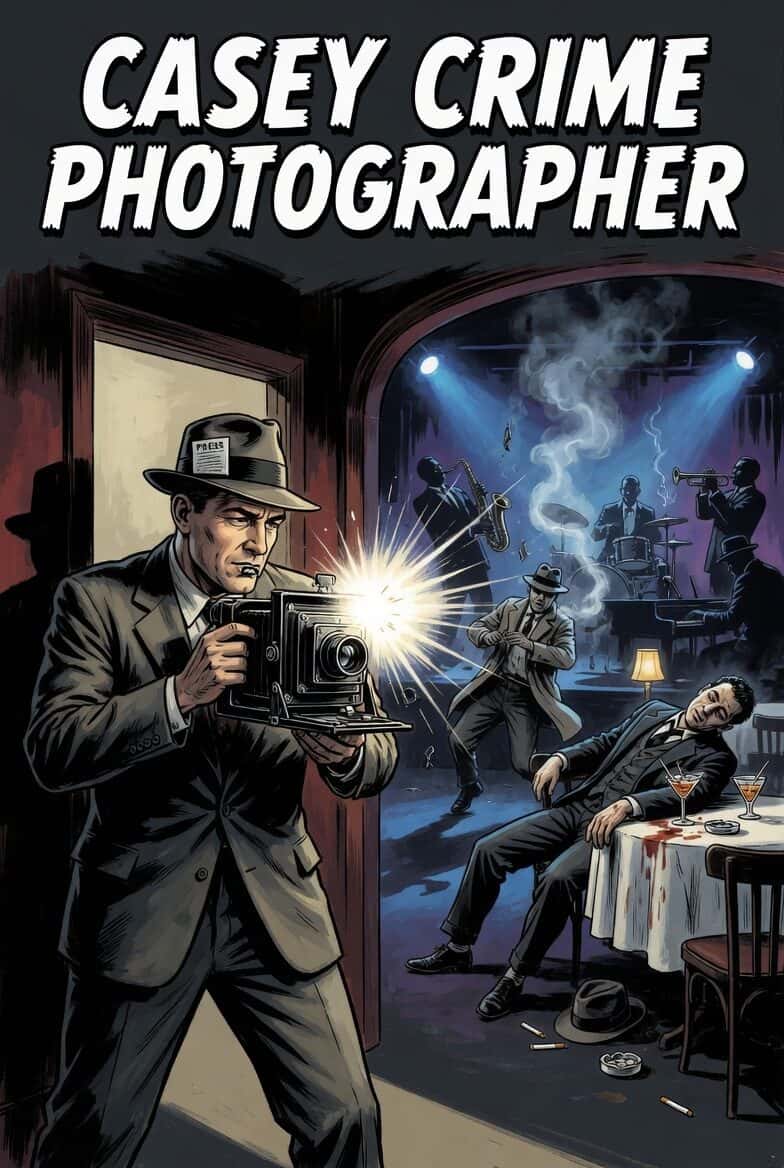
Let's talk about another show that our audience is going to recognize. This one, an adventure story. Casey, Crime Photographer.
Yes, and he says photographer like no one else can. As you'll hear in the introduction, I think he changed the pronunciation of the word.
The Anchor Hocking Glass Corporation brings you Crime Photographer.
Good evening, ladies and gentlemen. This is Tony Marvin. Every week at this time, the Anchor Hocking Glass Corporation of Lancaster, Ohio, and its more than 10,000 employees bring you another adventure of Casey, Crime Photographer, ace cameraman who covers the crime news of a great city. Written by Alonzo Dean Cole. Our adventure for tonight, King of the Apes.
Good afternoon. The Blue Note Cafe. Leaning comfortably on the bar are Casey and Ann Williams. And behind the bar is Chief Custodian Ethelbert.
You and Miss Williams are going to the circus tonight, huh, Casey?
Yeah, we gotta go, pal. It's an assignment. Every year, Ethelbert, he's found an excuse to go to the circus.
You think I'd like to go to the circus, honey?
Well, if you don't, you'd better reserve yourself for the circus.
She's right, Casey. Any guy who can't enjoy the circus is slippin' and fast.
I love the clowns and the elephants. I still like the brass bands and the peanuts and popcorn.
I go for the lady bareback riders and the lady acrobats and the lady... That's enough. Well, I just wanted to establish that I'm not slipping, Annie. I'm simply matured, that's all. Principally, we're covering the feature act, King of the Eight. They say that's swell. According to pictures on the billboards, that fella, the king, keeps 20 or 30 giant gorillas under his complete control.
Now, circus posters sometimes exaggerate a little bit, Ethelbert. The 20 or 30 giant gorillas are really six orangutans. And their trainer isn't the king. His name is King, Charles King.
Oh. But an orangutan is a pretty big monkey, isn't it?
Big enough. A full-grown male can break a couple of Joe Louises in two.
Then I guess six orangutans are plenty for a guy to go into a cage alone with.
I'd say so. Well, we better get over to the circus, Annie. It's nearly time for our date.
Oh, yeah. I thought you said you were going to the circus tonight.
We're interviewing Mr. King after the matinee performance. So long, pal.
So long, Ethelbert. Have a good time. And, uh, don't let him lock you up in the monkey cage.
Nuts to you, pal. And so long.
So long, Casey. And nuts to you.
King's dressing room is this way, Annie. The afternoon show is still going on.
Casey leads Pete through those back curtains.
Oh, no, no. Look, we'll see the whole thing from out front tonight, Annie. Besides, that's the wind-up you hear now, the grand finale.
Oh, yeah, I guess it is. Oh, I'm glad you're coming through the ring. Oh, let's watch.
Oh, I've seen clowns before. We've got a date, remember?
Oh, just a minute, Casey.
Oh, okay. Some nice-looking, uh, uh, performers coming through the curtains now. That one in the black spangled tights has got beautiful eyes.
We'll find Mr. King.
No, I'm in no hurry, Annie. We've got a date.
Huh? Oh. Oh. Okay. Uh, there. There. That's the star dressing room there.
Well, give a knock.
Well, here's the one with the King's name on it. I'll crown you with that band of finale again.
Oh. Little argument inside that room, Casey.
Who's King? Your jealousy. If I feel like talking to a man, any man, I'm going. I'm not gonna sneak up in corners with finale again, I tell you.
Brian, stop me.
I'll stop you. Don't you put your hands on me. Don't you.
Time to break this up, Annie. Come on.
That knock should do it.
Who's that? Uh, Miss Williams and your press agent made a date for us to see you.
Oh. Oh, yes, yes, of course. Just a moment.
All right. End of the battle, Casey.
The biggest show in the world is about to present the most daring, colossal, engrossing, educational exhibition of man's mastery over the savage beast that has ever been witnessed in the history of the world. The history of the universe.
This is it, Annie. This is King's act. They're throwing up a cage, King. Most dangerously intelligent animals known to man. Just outside over on the left there, Annie. See? Look, they're letting the apes into the ring cage now from those wagons. Dillinger's coming into the cage now. Ooh, he's a mean-looking animal.
Mm. I'm sorry we're not gonna see Nimboo do his stuff. He's the real star and everything depends on him. He told me he doesn't have to carry that big whip in the ring with him when Nimboo's there. He's the boss.
Look, Annie, look, the big monks are gonna ride those tricycles. Look at that, Annie. I, uh, thought you didn't care for circuses.
Uh, oh, well, it's part of my job to come here and take pictures.
That's right.
What was that?
Funny cry, wasn't it?
Animal or something, I guess.
Casey, those big apes stopped riding in that car. Again. Seemed to be listening. There it goes again. Look at Dillinger. He grabbed Mr. King. He's got him on the throat, Annie. Annie, I'm gonna shoot some pictures of this. That cry we heard, Annie, I've got a hunch this wasn't any accident.
Be a payday saver at the Big B, Burrett Mutual Savings Bank. Come into any office of Burrett on the first day, last day, 15th day, and you will meet a select group of savers. The payday savers. Businessmen, tradesmen, professional people, career girls, and even mothers who save from the grocery money. Why do these people all stop in at the Big B? To save on a regular and very profitable basis. A payday saver is a regular saver. A saver who knows that only through a systematic plan of savings will he be able to pay for that college education, or retirement trip around the world. At the Burrett, the payday saver receives 5% on a regular account with interest from day of deposit to day of withdrawal. 6% on two year certificates of deposit. 5 and 3 quarters percent on one year certificates. And 5 and a quarter percent on 90 day notice accounts. Join your friends at the sign of the Big B. The Burrett Mutual Savings Bank. With offices in West Hartford, Rocky Hill, and Glastonbury. Become a payday saver. Deposits insured by FDIC.
Tony, I know our listeners have been wondering when we would get to the Godfrey Show. I mean, holding off as long as we could. That's the part of the program for right now. So it is Arthur Godfrey time. 1946 is the year. That's right. Well, it was a strange thing. Arthur asked me to join him on that show. Actually, Arthur had been given an opportunity to go network. Up to that time he had been the local morning man. He had come up from Washington to take over the 6 a.m. to 9 a.m. slot. And was doing both shows.
Yes, for a couple of years, yes he was. But they had great belief in Arthur and he certainly proved that belief because he is without a doubt one of the great salesmen of all time. Fourteen years ago. Arthur had come to me one afternoon and asked me if I could work the show. And I said, well, gee, Arthur, I really can't. I'm involved in the soap operas and I have this to do and that to do. And I said, besides, Arthur, you're a sustaining program. There's no loot involved. Let's face it, when you're concerned about making enough to keep body and soul together, although by then we had been doing quite well. I said, well, I'll try to work out something on the schedule and I said, I'll take the assignment Monday, Wednesday and Friday because I know Tuesdays and Thursdays were dead for me then. In any event, did that with Arthur for about four or five weeks and he came to me again after the show. He said, my goodness, Tony, what do you do to that audience? He said, I've never had such a response. I said, well, I said, I don't know. I said, I like people. Sometimes, albeit a little ponderous, I suppose, but I said, that's an attitude that you develop if you want to do a particular kind of warm-up. But I said, he said, no, he said, I'm talking about how do you bring them to that point where I get this warmth from them? I said, well, I said, I find it very, very important that in doing a warm-up you don't overdo it. You can do a warm-up that is so great and so fine and so humorous that when the star comes on he's absolutely nothing. He's flat on his face. So I said, I managed, I think, to get to that point where when I bring you on, why, now they're ready for the big yocks. Otherwise, I might as well get lost. So it worked out that way. And finally, we worked out the schedule and we shifted the time, I think, and we went to the 10 a.m. slot and we were on there for another month or so and an author came to me and said, Tony, there's an outfit by the name and he said, they're interested in buying the show and he said, you and I both smoke Camels. What shall we do? I said, Arthur, we are now smoking Chesterfield. And of course, it didn't take long. We agreed. And they were off for a sponsor. Well, we went from, they bought us a half hour across the board Monday through Friday. And of course, Arthur and I just went at it hammer and tongs and anything could happen. We never knew. We never had a script. We just got a rundown until the dialogue was absolutely ad lib. And then we had some very, very amusing and amazing incidents on the air.
You know, this is perhaps one of the rarest shows to find because it was so plentiful when it was on the air. On the air five days a week, it was always there. Nobody bothered to make a record of it and put it aside. However, in 1947, with my disc recorder, I was preparing for this business. I decided one day I would record Tony Marvin on the air. And I let the disc go for an hour and a half and we're going to hear an excerpt from the old Arthur Godfrey show right now.
You are tuned to CBS. Glass Wax cleans 30 kinds of dirt in 30 seconds. Oh, yeah, you wipe it on and then you wipe it off. Yeah, yeah, yeah. The company maker of that sensational chemical cleaning discovery, Glass Wax, presents Arthur Godfrey time. It's Arthur Godfrey and Arthur Little.
Thank you, thank you. Thank you, thank you, thank you. Thank you, Tony Marvin. I'm going to start out with a telegram I received last night from Hartford, Connecticut. Arthur Godfrey, Columbia Broadcasting System. You think Thursday's program was terrible. You should hear today's. Signed, Harriet Kellish. Will you take a wire to Miss Kellish? Dear Miss Kellish, if you think yesterday's program was terrible, wait until you hear today's. Actually, I didn't think yesterday's show was so lousy, did you? I thought it was a pretty good show. Right after the broadcast, I got a telegram from the company saying if we ever lost a sponsor, they'd like to buy our show because it would do a great job for their product. Where's that wire? Oh, here it is. Here, yes. Signed by the president of the White Stripe Fur Company. You know, in judging a show like this one, to be fair, you have to take into consideration the fact that we do an hour's show every day of the week. You can't expect them all to be great. In fact, I was talking to the, just the other day, to a CBS vice president. We have one that can talk. And I, I explained to him very logically, too, that you have to judge this show over a period of time. See, you know, you have a good one, a bad one, a good one, a bad one, just like a basket of apples. And he said, yeah, it's just like a basket of apples, all right. And he saw the whole bunch.
I always tell my sponsors not to worry too much about my jokes. This whole program is deductible anyway. So what? Look, we've been working on a thing here, Archie and the Mariners and I, all morning. Archie tells me that this is quite a tune, that you folks are nuts about it. All right. Okay. So, you're nuts about it. Let me see what happens when you're a good singer. Here we go. Archie, I've faced a barren waste without the taste of old Dan and ice and the throat's burnt dry and so the pride and speed of sick whole lazy drink.
She calls it the rule of 14. And she says if you follow this formula, dressing to go out at night will be as simple as adding up a column of figures. I saw a gal last night who must have been dressed that way. The column of figures looked okay, but I think she hit a decimal point in the wrong place. But anyway, here's the way Miss King's rule of 14 works. You allow so many points for each article of dress, and then you keep score. For instance, one crepe afternoon dress, allow one point. With peplum, one more point. Suede sandals, that's two points. A brown felt sailor hat, four points. Five if your head has a point. A pouch purse, one point. Two gold trinkets, one point. Two gold bracelets on one hand, one point. Two gold earrings, one point. A short fur jacket, one point. One gold necklace, two points. You've allowed yourself the points, Miss King says. You quickly add them up. The total is 18. That's too much. You're overdressed. You've got to eliminate four points quickly. What can you do, says Miss King. Late now to change your fundamentals. Besides, maybe your only other pair is still in the laundry, so what are you going to do? So here's where Miss King's formula comes to your rescue. A count of 18 points, she says, indicates you have too much on from the neckline up. So she says begin there and take things off until you're down to 14.
I'm adding you up, Jeanette. You've come to about seven. So you see, uh, no, but, uh... You can't hide anywhere, can you? He comes back to haunt you. Ha ha ha. Because I decided... I decided to, uh, listen to you and to study your style. We have that, uh... You don't sound like him, though, Dick. I don't know what the... No, I've noticed that, Ed. I, uh, I, uh... You know, I... Just a, just a quirk. I don't dare. You know, you know the stories, of course, Tony, and I'm sure you were involved in the elevator stories at NBC and CBS, where the voices would get deeper and deeper, and I decided a long time ago I would never... Ha ha ha. They were really something.
What happened when you parted? Did you part friends?
Oh, Arthur and I, yes. Yes, very much so. Well, of course, he had been ill, you know, and, uh, Arthur had this, uh, lung removed. He had developed carcinoma of the lung, and, uh, it was pretty much touch and go. They, at least the doctors, thought it was very bad, but, uh, he decided he'd better cut down on his operations, uh, radio and TV-wise, and so, uh, by that time, we had run the string out just about, I guess, and, uh, Arthur and I parted company. Uh, he made it very, very plain, and he said, Tony, there's no more budget for a guy of your price right now and under our contract, and that was the end of the second seven-year contract. He says, I'm gonna do just... do the commercials myself. There'll be no one to act as a buff performing, and we'll just go. And, uh, we parted as good friends. I see him every so often, uh, in New York, and I saw him about four months ago, and he looks fine. He's red-headed as ever, you know, and, uh, just as, uh, sprightly, and, uh, uh, brilliant.
Well, how about, uh, some of the people who are on the show? Uh, could you tell us where they are today, like Marion Marlowe or, uh, the, um, some of the singers and so forth?
Yeah, I-I think I can. Well, Marion Marlowe was still in the business. The, uh, last I saw Marion, she was, uh, in The Follies, a, uh, show in New York. Frank Parker, the chap we talked about, magnificent tenor, uh, Frank is retired. Frank is honestly retired. He's enjoying himself, uh, having a lot of fun. He still lives in New York and looks great.
How about the Mariners?
The Mariners are out of the business completely. The, uh, Chordettes are all out of the business, all retired. Archie Bleyer, who was our orchestra leader at one point there for the longest time, married one of the Chordettes, and, uh, he's retired, but, uh, I ran into him about a year ago. He looks marvelously well, and he's, uh, still taking lessons. He's taking lessons in conducting. Now, he, he loves music that much. Uh, who else? Holly Loki. Holly Loki is retired. Holly is, uh, fine and well, and, uh, she, uh, spends a great deal of time down in Miami in Florida. I think it's Miami or somewhere in the environs there. Janette Davis. Janette is retired completely and, uh, raising a family, and they live out on Long Island. She married one of our producers, a chap by the name of Frank Musiello. And, uh, I understand that. And, uh, I understand that. And, uh, I understand that. And, uh, I understand that. I hadn't seen Janette in, uh, about two years. Janette, uh, doesn't come into New York too much. She comes in maybe once or twice a year. She says, that's enough. I don't, I don't care for the big town anymore. It's amazing how people's lives change.
The only one who's really survived all around the business is you, Tony.
I guess so. Yeah, well, I'm much too young. Much too young.
But, Tony, uh, you're, uh, you're on a freelance basis now, and you've worked your, your work week down to about three days a week. Now, let me ask you, aside from the fact that you're able to play golf,
Mm-hmm.
and enjoy life,
Yeah.
do you miss the, uh, the pace of, of the business that, that you knew in the 30s and...
In the early days?
In the early days. In the olden days, as we get to say.
Uh, no, not really. No, not really. Uh, I miss some of the, uh, the weird and wild moments we had, both on and off the air. Uh, and, uh, I, I don't really miss that, uh, terrible pace, because, uh, there, there were times that you just didn't know whether you could survive it. You know, there were so many things that you had to do. You were forced into this pace. You weren't, you weren't driven within yourself, but the very business itself made you rush. But I don't miss it too much. I do miss the camaraderie. I do miss the, the fun and the laughs and the, uh, offstage things that went on sometimes because, uh, radio was, uh, sort of a, a movie script idea of what radio was, what it was in the early days, you know.
Marvelous memories, and, Tony, I want to thank you very much for sharing them with us tonight here on the Golden Age of Radio.
Well, I thank you very much, Dick, and you, Ed, too, for having me here.
And until next time, this is Dick Bertell.
Ed Corcoran.
Good night.
The Golden Age of Radio with Dick Bertell and the recordings of Ed Corcoran has been brought to you by WTIC and by Burrett Mutual Savings Bank, serving Central Connecticut since 1889. Be sure to hear the next Golden Age of Radio broadcast Thursday, August 23rd, when our guests will be actresses Gale Storm and Barbara Britton. With the engineering and technical assistance of Bob Cherego, the Golden Age of Radio is produced and edited by Brian Hartnett. This is Norm Peters. From the Paradise Restaurant in the Great White Way, Manhattan, New York City, played by Glenn Miller and his orchestra. Hi-yo Silver! Fiery horse with the speed of light, a cloud of dust, and a hearty hi-yo Silver! Hi-yo Silver!