
The written record
Read the transcript
Read along with the recording · About 14 min to read
<!-- kimi_cleaned -->
My name is Clifton Fadiman, and the sound you hear is the sound of the atmosphere and the sound of wind, the sound of thunder, the sound of rain, universal sounds, sounds that are heard around the world, sounds that are the voices of eternity. But when you leave the heavens and approach the earth, you will hear the sounds of the living, the sound of the countryside, and the sound of a city. On any city block at any time of day or night, there's a world of sound, a special world, for people who are willing to listen, for people who are willing to hear. New York is a city of sound, and that sound is the voice of a city, the voice of New York.
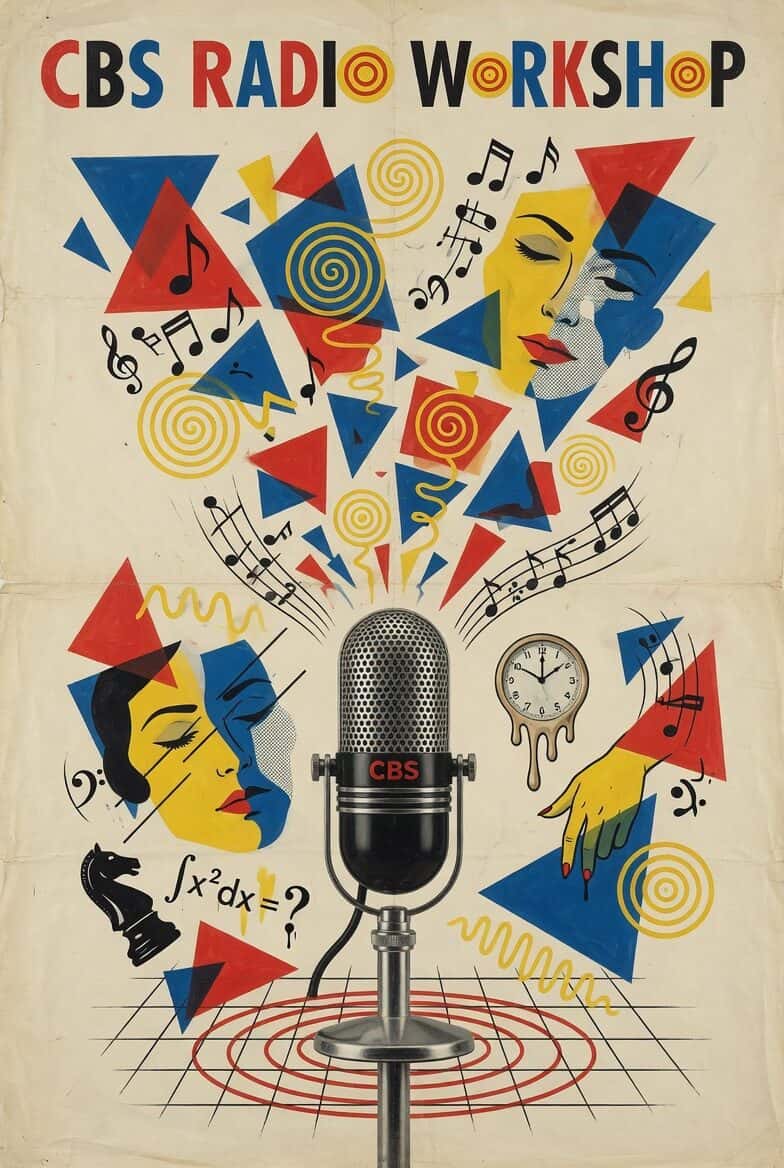
CBS Radio, a division of the Columbia Broadcasting System and its 217 affiliated stations, presents the CBS Radio Workshop. Dedicated to man's imagination, the theater of the mind. Tonight, a documentary in sound, as recorded by Tony Schwartz, a young man who walks the streets of a city as familiarly as a farmer walks his fields. He is a man who listens, and what he listens to, he records. Tony Schwartz and his portable tape recorder have recorded the voice of New York.
New York. New York. New York. New York. New York. New York. New York. New York. New York. New York. New York. New York. New York.
Empire State.
At the end of the city is Wall Street, the financial district. Now look directly left to the river, and notice that square box-like structure with all the windows? That is the Parliament and Quarters of the United Nations on the East River. There are six acres of glass in that building. Now come with me, folks, please, to the north side.
That's what you'd hear high above the city. A description, nothing more. It might even be what you'd write home about. But would you know New York? Would you hear its voice? The sound of the streets?
Solid Times Tribune American News Bureau. Sunday, Craig, it's all the same. 10 cents and 2.15. 10 cents and 2.15. Shine your shoes, brush your coat. Make you like New York sport. How about a shine there? Get your shine right there.
The subway rises from the tunnel and stops at 135th Street.
Orchard Street on the Lower East Side.
The Port Authority bus terminal at 41st Street and 8th Avenue. Cornwall, Newburgh, Beacon, Wappinger Falls, and Poughkeepsie. Coach is loading at gate 19, lower left. 11:15 a.m. departure. Mohawk Coastline loading at gate 19, lower left.
It's the city at ear. The sound we, all of us hear. But there are other voices. Voices we have to listen for. Listen as Tony Schwartz and his recorder listen.
New York is a port city. The largest in the world. People from all the world settle here and with them they bring customs. And they bring songs. They bring music. And street band. You don't have to go into the hills for folk music and you don't have to go back a hundred years. It's woven into the rhythm of New York. It's all there if you listen. You can hear it on the way to work. Riding a bus or subway or going out for a late dinner.
Tony went out for a late dinner one night.
On my way to a little French restaurant on 9th Avenue, I met Henriette. She was sitting on the stoop singing to her baby and tapping her leather sandals as she sang.
La bourrée en auvergne, la bourrée va bien. Ecoutez la cabrette. Tu fais une ligne. A briou tourne les douze. C'est qu'à Saint-Claude. Les époux, les épouses. Ils reviennent toujours. Faut bien la chanter. Vive la limousine. Faut bien la danser. Vive les aubergnats. Que vous cherchez, garçon de la montagne ? Que venez-vous chercher ? Je n'en sais pas. Si vous ne dansez pas. Garçon de la montagne. Si vous ne dansez pas. Allez-vous en là-bas.
I wondered where she learned her songs.
Oh, I learned them when I was a little girl at school or for my mother or grandmother in Normandy or during vacation with other people in some countries of France.
And this woman's mother came from Romania.
La chanson de la chanson de la chanson de la chanson de la chanson de la chanson de la chanson de la chanson de la chanson de la chanson de la chanson.
A group of Nigerian students gathered together to sing on Thanksgiving Day afternoon.
Joy to the world.
A Sunday night service a week before Christmas.
I've heard songs from all over the world in New York and in many, many languages. For instance, here's a Spanish song I found on a jukebox in a restaurant that catered to Puerto Rican news.
I asked a man if he could translate the song for me and he said yes. I put a nickel in the jukebox and the man told me what the song was about.
I will change my heart, dance by the empire's fate in this country of such a cold weather. The Puerto Rican mountains, the birds sing there. They sing from way down to up the peaks of the mountain.
I won't change Puerto Rico by 60 New Yorks. I won't change Puerto Rican chickens by frozen chickens in the ice boxes here. When I saw the snow coming down like coconut flakes from heaven, I was going crazy seeing that kind of stuff coming down. My soul was very disconsolate. I won't change Puerto Rico by 4,000 New Yorks.
Not only do people from all the world settle in New York, but people come from all sections of the United States. These are men from the Carolinas working a fishing boat in the Hudson River, bringing their Carolina ways and their Carolina voices. And from Mississippi, now driving a car in New York, singing a spiritual and beating out time on the steering wheel while driving Tony down Park Avenue. And a blind street musician from the West, accompanied by a young man from New York, by the harbor sounds on 11th Avenue and the river.
For the real New Yorkers, the children. The children who make the folk music of the city in parks and playgrounds, in the middle of busy streets.
He went to heaven, he went to heaven, without a head. And when he got there, and when he got there, St. Peter said, St. Peter said, my dear old goat, my dear old goat, where is your head? Where is your head? The goat replied, the goat replied. I cannot see. It must have gone, it must have gone, right down to hell, old folks.
On the mountain, stands a lady, who she is, I do not know. All she wants is gold, the silver, all she wants is ice cream, so jump in my car, so jump out my big gate. You have to come out. Who, me? Yes, you. Couldn't be. Then who? Bernie. Who, me? Yes, you. That's a lie. Then who? Margie. Who, me? Yes, you. Couldn't be. Then who? No, no. Who, me? Yes, you. Couldn't be. Then who? Bernie. Who, me? Yes, you. That's a lie. Then who? Margie. Who, me? Yes, you. Not me. Then who? Nikki. Who, me? Yes, you. That's a lie. Lived in a tent, she had to pay her rent. She borrowed a one, she borrowed a two, and passed it on to you.
On my way home one night, sounds coming through a basement window. I went downstairs and saw a group of teenagers. They were beating out rhythm on boxes, benches, one small drum and a Pepsi-Cola bottle. I spoke to one of the boys.
Tell me about your playing. Just talk about it for about five, ten minutes.
I'll be playing, you know, it doesn't, you know, it doesn't suit me then, you know, but after a while, about 15 minutes, 20 minutes playing, well, I start, you know, feeling good, you know, and then I'd be able to bring out a few more beats better than the others. It brings a good feeling to me, you know, that after a while it brings a good feeling.
These are the rhythms in music, the voices of song, but there are other rhythms, there are other voices that make up the voice of the city. People talking, people asking to be heard.
Number two is a fine line. I hear is a pen that hasn't got the feature of a number on it, but it gives you any sort of line without changing the point. Now if you understand, realize and appreciate a real good value, and if my physiognomy is not too conspicuous to be comprehended, I'm going to clarify to such an extent that each and every individual standing here at the present time can very well afford it. I'm going to give it this Parker 51 type. Now don't forget, you can take my pen and bring it into any pawn shop, ask him for ten dollars, see how quick they'll chase you out. But you ask him for five dollars, they may give it a look. And today I'm not going to charge you dollar bills for the penny, but the first lady or jackman gives me 25 cents gets the pen, and I think it's worth a quarter penny about it. Anyone who understands and realizes and appreciate something real good, you can go downtown, uptown, out of town, in the time, in the summertime, in the wintertime.
That was a pitchman trying to make a sale. You can hear it at any corner in New York. But if you want to hear people telling stories about themselves, stories that tell you what the people are like, well, all you have to do is ask.
I asked a little girl to tell me what she liked about stories.
I like to hear people tell stories because when they tell stories that you can picture in your mind what would happen as they tell the story.
I listened to a plumber who came to fix my sink.
I mean to me when there's music I'll stop anything. I don't know, I think, I think music is everything. Without music I think there'd be life. There won't be no world. Everybody'd be downhearted. Don't you think so?
I agree. I think that music is the only thing.
A cab driver taking me to a date told me how to solve the traffic problem in New York.
I can straighten that traffic out in 48 hours.
What would you do?
The more parking lots in Midtown the heavier traffic there is. Do away with your parking lots in Midtown from 14th Street to 59th Street. No parking allowed in the daytime, only after six o'clock. There you solve your whole traffic problem. If you or me can't know that we have nowhere to park it, we're not going to bring it in there. But if Mr. Ashmoor knows he's got a parking lot he can afford it, he's going to bring his car in. That car doesn't stop him from coming in. Without a car he'll have to come in just the same. And as long as you got them parking lots right around on Broadway in Midtown, you're going to have a traffic problem. That's the only solution. Do away with your parking lots in daytime and you got no traffic problem. There is not a way out. If you know that you are not allowed to park here, you're not going to bring that car in. But if you know you can park it, you're going to bring it in. You work here, you're going to come in just the same. And if you want to shop near Macy's, you're going to come just the same. Eighty-five cents.
And I listened to a doorman talking to a barking dog locked in a car.
Why don't you be a good. Come on. Stop barking. Why don't you be a nice baby. They like you. Oh quiet, quiet. Come over here. Come here. Ah quiet. Be nice. Ah whoa, whoa yourself. Yeah. Whoa, whoa, whoa. What do you want. You want you to have. Yeah. Frenchie. Whoa, whoa, whoa, whoa, whoa. That's right. Get him. Get him. Get him. That's a good one.
I asked an old woman for her memories.
Oh my thistle cat was wonderful. His name was Thistle Blossom and he named himself because his fur was so soft like that of the purple part of a thistle blossom. His little fingernails are like the prickers around the outside. And he got so that he knew everything. He could do all sorts of things and he can almost talk. Thistle was a wonderful little cat. He knew so much. He had better table manners than the majority of children. I taught him to eat slowly. When he's a little kitten I just let him take one piece of meat at a time.
And I'd tell him to chew it well and I'd make my jaws go as though I was chewing. He learned what I meant. He'd stop chewing. If I said, all right, he'd swallow it. If I said, chew it some more, he'd chew it some more. And he could take the tin cover off a jelly glass. He'd paw it with his right paw and tip over the glass, then put his left paw on to hold it, and then he would claw it until he got the cover off. Then he'd look up at me and smile. He'd curl the corners of his mouth up and back when he'd smile. And he knew a waltz when he heard it on the radio. He'd put his paw on my foot and sit down in front of me. That meant pick me up. So I'd pick him up and waltz around the room, holding him in my arms. I'd jiggle him, and he liked that. And Old Thistle died March 12, 1929.
The Voices of a City
The voices arrive. At 7:30, they collect the garbage. Saturday at 8, the streets are repaired. Thursday, construction begins on the new Coliseum at Columbus Circle, three blocks away. Saturday at noon, there's an air raid drill. There are church bells. On holidays, there are parades. After school, there are football games in the street. Street gospel group inviting you to a service. There's rain. Election time, there are politicians and there are sound trucks. The very wild custom of the janitor eating the garbage every day. There's no program. Futility. I've demonstrated that he has no program. And every night at 3 a.m., there are cats. And so to sleep while the city continues to speak.
The city is a vast complex made up of millions of people and a perpetual sound. It is in these many and endless sounds that we find a single rhythm and a single voice. We've been atop a skyscraper. And we wandered in the streets. We've heard the city through an open window of an apartment in the West 50s. The rhythm is everywhere. And if you listen carefully, you'll find it right beside you. In the voice of a 14-month-old baby playing on the floor. Of a city. The voice of New York.
You have been listening to The Voice of New York as recorded by Tony Schwartz and narrated by Clifton Fadiman, editor of the new American Anthology Treasury. The narration... The poem was written by Norman Corwin. This is Warren Sweeney inviting you to listen to the CBS Radio Workshop next Friday when we will present Report on the Unknown. A study of clairvoyance, extrasensory perception, and telepathy. A dramatic account of actual cases and current research in the mysteries of supernormal communications. The CBS Radio Workshop was produced and directed by Paul Roberts. Over most of these same stations on Sunday, the distinguished British pianist Dame Myra Hess will be heard as soloist as the New York Philharmonic Symphony under Bruno Walter's direction opens a two-week Mozart Festival in observance of the bicentennial of the composer's birth. Hear Dame Myra Hess with the New York Philharmonic Symphony this Sunday. Stay tuned for five minutes of CBS News to be followed on most of these stations by the Jack Carson Show. America listens most... CBS Radio Network.