
The written record
Read the transcript
Read along with the recording · About 22 min to read
<!-- kimi_cleaned -->
You've often heard that old saying, things are not always what they seem. Well, let us be brutally frank with you tonight and say that it is our happy duty to demolish completely that ridiculous little phrase with this objective reappraisal. Things are always and only what they seem. It depends entirely on the point of view.
It is upon this premise, then, that tonight we would like you to take a closer look at Hamlet, Prince of Denmark.
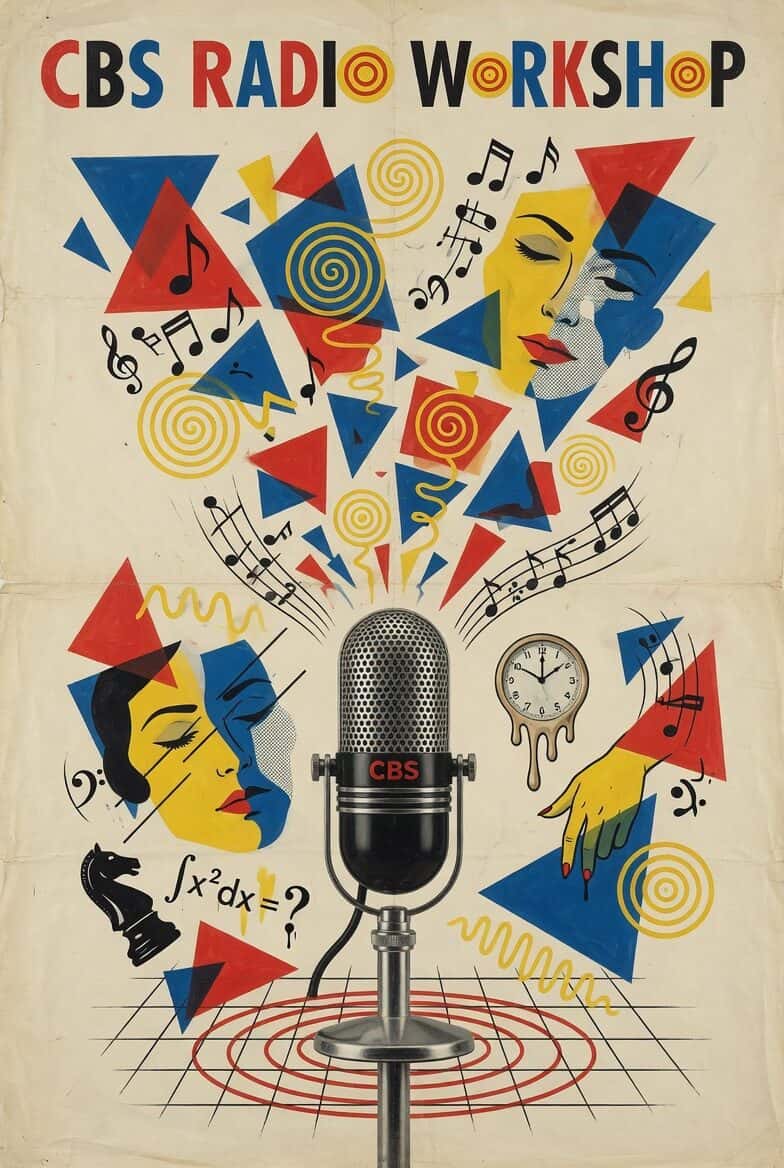
From Hollywood, CBS Radio presents the CBS Radio Workshop, dedicated to man's imagination, the theater of the mind. Tonight, transcribed for your amusement or fury, according to your temperament or philosophy, another point of view, or Hamlet revisited, being an analytical misrepresentation of Shakespeare's greatest hero figure, compiled especially for the workshop by Ben Wright and William Conrad. And now, once again, here is Mr. Conrad.
Now, with regard to Hamlet, it seems a little more than strange to us, and historical debate gives us grounds, that if Hamlet were such a hero in Denmark, he would automatically have been elected king upon the death of his father. And yet, he was not. We wonder why. Again, it seems highly probable that Claudius did not kill Hamlet's father purely from lust or desire to usurp the throne, but simply because he was a patriot with the highest moral motives who realized that the danger to Denmark made the removal of a useless king a national necessity. And again, historical debate gives us most valid grounds for this supposition. And finally, it occurs to us that there was really nothing rotten in the state of Denmark, but Hamlet made it so.
You will, of course, demand proof, and proof you shall have. Firstly, however, we must confirm that Hamlet was not a king. And secondly, we must confirm that Hamlet was not a king. And thirdly, we must confirm that Hamlet was not a king. And fourthly, we must confirm that Hamlet was not a king.
I must confess that though we use only the words of the Bard of Avon in our drama, we've had to make deep and prolonged cuts for the sake of timing, for the play, uncut, as of course you're all well aware, runs some four and a half hours. Well, without further ado, ladies and gentlemen, we present, for your consideration, another point of view, or Hamlet Revisited.
Our scene, Denmark. Elsinore Castle. The new king, Claudius, has been enthroned, and having offered himself as king, and having offered himself in marriage to his brother's widow, Gertrude, has been accepted by her most gratefully, for she is well realized that marriage to Claudius will mean not only happiness and security for herself, but will provide a strong and guiding hand for her moody and difficult son, young Hamlet. And here in our first scene, Claudius is trying most sincerely to make friends with his stepson.
Now, my cousin Hamlet and my son.
A little more than kin and less than kind.
How is it that the clouds still hang on you?
Not so, my lord. I'm too much in the sun.
Now, Claudius, rather taken aback by this unpleasant bit of double talk, but determined to make a go of things, looks pleadingly to his queen for a little help in the awkward conversation. Gertrude, ever helpful, tries this piece of sensible advice on Hamlet.
Good Hamlet, cast thy nighted color off and let thine eye look like a friend on Denmark. Do not forever with veiled lids seek for thy noble father in the dust. Thou know'st 'tis common. All that lives must die, passing through nature to eternity.
Aye, madam, it is common.
If it be, why seems it so particular with thee?
Seems, madam? Nay, it is.
Well, obviously, the young man is annoyed at mama, too, but Claudius, dear soul that he is, is quite determined. And to be, in the true sense of the word, a dad to his stepson. And is now prepared to jackknife backwards to keep the peace, for let's not forget that this little altercation takes place in front of the entire court. So how is this for a beautiful piece of understanding and moderation?
'Tis sweet and commendable in your nature, Hamlet, to give these mourning duties to your father. But we pray you throw to earth this unprevailing woe and think of us as of a father. For let the world take note that you are the most immediate to our throne. And with no less nobility of love than that which dearest father bears his son, do I impart toward you. And we beseech you, bend you to remain here in the cheer and comfort of our eye, our chiefest courtier, cousin, and our son.
Let not thy mother lose her prayers, Hamlet. I pray thee, stay with us.
I shall in all my best obey you, madam.
And now, surely, you've got to admit that that's not the case. It's just about as petulant a stamp of the foot as you could look for in a month of ballet rehearsals and rather ugly behavior for a hero. Now, does Claudius swing one at Hamlet for this baldish effrontery? He does not. And why? Because he has obviously read all the books about bringing up children properly and knows very well the dangers of submitting them to the traumatic shocks of anger. No, dear old Claudius, a dad is very simply a dad and he's duty-bound to see the youngster through the difficult years. And let's not forget, for one second, that our young Hamlet is only 31 or 32 at the most.
Now, note this for a superb example of turning the other cheek. Hamlet has just sulkingly mouthed... I shall in all my best obey you, madam. To which Claudius says...
It is a loving and a fair reply. Be as ourself in Denmark.
Now, quite honestly, have you ever heard anyone be so warm or charming? Yet this is Claudius speaking, the very man that we are asked, nay, forced to call... a villain.
Now, to expand our premise, let's listen to a fragment of Hamlet's outlook on life. Of course, he comes downstage center for this, as he is wont to do with all his little pleasantries.
O, that this too, too solid flesh would melt, thaw and resolve itself into a dew, or that the everlasting had not fixed his canon 'gainst self-slaughter. O God. God, how weary, stale, flat and unprofitable seem to me all the uses of this world.
Well, one could say that that's a fairly unhealthy attitude toward life. But let's try to be understanding. Let's try to be as understanding as Claudius. Now, perhaps Hamlet is sick with love. After all, the court chamberlain has a most attractive daughter, Miss Polonius, or Ophelia, to her friends. And Hamlet has certainly been playing a bit of footy-footy with her, much to the distress of her father. For even Polonius seems to have a pretty good idea of Hamlet's moral worth. Consider now his advice to her.
For Lord Hamlet, believe so much in him that he is young, and with a larger tether may he walk than may be given you. In few, Ophelia, do not believe his vows, for they are brokers, not of that dye which their investments show, but mere implorators of unholy suits, breathing like sanctified and pious bawds, the better to beguile. This is for all. I would not, in plain terms, from this time forth, have you so slander any moment leisure as to give words or talk with the Lord Hamlet. Look to't, I charge you.
Now, of course, Ophelia is not a particularly bright girl and not a very stable character either. In fact, pretty easily knocked off balance as we find out all too soon. But back to Hamlet for a moment. It might be well at this time to point out that our young hero suffers from hallucinations. You will remember, of course, that he's convinced that he's had a long chat with the ghost of his dead father. Also that Papa's spirit has begged him to avenge his death, etc., etc., etc. Now, of course, unfortunately, we cannot prove that Hamlet is a chronic alcoholic, but it is not beyond the realm of possibility that on the night in question, he may have had, well, let us say, one too many.
However, for the moment, Hamlet does nothing about revenge, merely contenting himself with a visit to his lady fair to do a little courting. The effect on Ophelia is not surprising, she comes belting into her father, not only bewildered, but terrified.
My lord!
Listen.
How now, Ophelia, what is the matter?
Alas, my lord, I have been so affrighted.
With what, in the name of God?
My lord, as I was sewing in my chamber, Lord Hamlet, with his doublet all unbraced, no hat upon his head, his stockings fouled, ungartered and down-gyved to his ankle, pale as his shirt, his knees knocking each other, he comes before me.
Mad for thy love?
My lord, I do not know, but truly I do fear it.
What said he?
He took me by the wrist, and held me hard. Then goes he to the length of all his arm, and with his other hand thus o'er his brow, he falls to such perusal of my face as he would draw it. Long stay'd he so.
Uh, now a question, gentle listener. Has the boy next door ever behaved in that manner towards your daughter? I mean, when she was just sitting there on the front porch, tending to her knitting? Well, that's pretty frightening behavior, don't you think? And it would take a good deal of understanding.
Ah, understanding. A quality. A quality in which more than anything else our Claudius abounds. The very first thing he does when he realizes that Hamlet not only is a problem, but has one, is to invite, regardless of expense to the management, two of Hamlet's old school friends to Elsinore for a long vacation, hoping that they may get Hamlet out of himself with a few brisk games of ping-pong or croquet or whatever. And how does Hamlet react to all this? The usual gambit. He is abominably rude and his friend suspects them of treachery, an incipient paranoiac, if there ever was one. And finally, having dismissed them in a most cavalier fashion, cuts back sharply at what he feels about his stepfather, poor old Claudius. Well, this time, we're only going to give you a snippet of the speech because, well, it's really rather frightening.
Bloody, bawdy villain! Remorseless, treacherous, lecherous, kindless villain!
Very unstable, this young prince. And rather a cad, too, as you must agree when you hear our next scene. Do you recall what our hero says to little Ophelia, the girl whom he has professed to love?
I did love you once.
Indeed, my lord, you made me believe so.
You should not have believed me. I loved you not.
I was the more deceived.
Get thee to a nunnery. Why wouldst thou be a breeder of sinners? O, help him, you sweet heavens. If thou dost marry, I'll give thee this plague for thy dowry. Be thou as chaste as ice, as pure as snow, thou shalt not escape calumny. Get thee to a nunnery. Or, if thou wilt needs marry, marry a fool. For wise men know well what monsters you make of them.
Now, honestly, doesn't that rather shock you? Well, there's more yet. For instance, has it ever struck you how conceited Hamlet is? A veritable know-it-all. You remember in what terms he talks to the actors when they visit Elsinore for a one-night stand? No? Well, listen.
Speak the speech, I pray you, as I pronounced it to you, trippingly on the tongue. But if you mouth it, as many of your players do, I had as lief the town crier spoke my lines.
Now, isn't that a gracious little speech? One might suppose that a professional theatre company might know how to read their lines. Therefore, it seems that our hero figure is not only a cad, appallingly ill-mannered, but conceited beyond belief. And now, we must add to these strange hero virtues his extraordinary power, his extraordinary power, his extraordinary power, and his propensity for intrigue. Yes, that's right, intrigue. You must realize that since the day the crown was ripped unceremoniously from his grimy little fingers, Hamlet has gone his petulant way, making life just as difficult as possible for his uncle, Claudius. Ah, but he finally really gets down to business and comes up with as unpleasant a piece of underhanded nonsense as you could wish for. What? This.
I'll have these players play something like the murder of my father before mine uncle.
I'll observe his looks. I'll tempt him to the quick. If he but blench, I'll know my course.
Item. Gift. From Hamlet to stepfather Claudius and mummy. Two on the aisle for this gloomy little one-acter. Charming, huh? But Claudius goes along with it, for he wants more than anything else to make Hamlet happy. And so the evening arrives, and the stage is set, the audience assembles, and the play begins. The drama proceeds, and as it draws toward the end, a quiet uneasiness falls over the audience, and now the death scene. It takes place in the garden. The player king lies down to take a nap. The onlookers have long since caught the parallel to their own king, and they wait expectantly, breathlessly for the entrance of the serpent.
Ah, but wait. There will be no serpent. In a moment, an entrance will be made, to the king's brother. He will creep quietly to the king's side, and pour a vial of poison into the king's ear. Ah, he's making his entrance now. Listen.
Take some light! Poor old boy. You know, it's no wonder he's upset. Who wants to be continually reminded of past unpleasantnesses of that sort? After all, it was a necessity of state, wasn't it?
Ah, but Hamlet, well, our hero, is feeling just dandy, thank you. Here he is now. He has so successfully cleared the hall.
It is now the very witching time of night, when churchyards yawn, and hell itself breathes out contagion to this world. Now could I drink hot blood, and do such bitter business as the day would quake to look on. Soft, my mother.
Well, that's about as quaint a set of night thoughts as you could wish for. Yet it is in this same frame of mind that our young friend trots upstairs to kiss mommy goodnight. But en route he happens to pass the open door beyond which he sees his badly shaken stepfather at his prayers. We are now permitted to hear another side of Hamlet's nature which, frankly, makes our hair curl, and only heightens our compassion for poor old Claudius. Softly now, coming a bit closer.
What then? Ah, that's it. What rests? Try what repentance can. What can it not? Wretched state. Now might I do it, Pat. Now he is praying. And now I'll do it! And so he goes to heaven? No. Sword! And know thou a more horrid hand when he is drunk with sleep or in his rage at gaming, swearing, or about some act that has no relish of salvation in it. Then trip him, that his heels may kick at heaven, and that his soul may be as damned and black as hell whereto it goes.
Now we feel that that is pretty revealing. However, having delivered himself of these few kind words, our hero pops in to say goodnight to mama. Well now, we're very sorry, but we simply cannot bring ourselves to tell you what he says to mommy in there, nor what he does in a bedroom, but you can take it from us that when he leaves, mama is due for quite a heavy dose of phenobarbital, in order to catch forty winks that night.
The following scene, however, will give you a pretty fair wrinkling as to what happened as Gertrude rushes madly into her husband's chamber.
Oh, my good lord, what have I seen tonight?
What, Gertrude, what does Hamlet?
Mad, as the sea and wind when both contend, which is the mightier, in his lawless fit behind the arras, hearing something stir, he whips his rapier out, and cries, a rat, a rat, and in this brainish apprehension kills the unseen good old man.
Oh, heavy deed. It had been so with us had we been there. This liberty is full of threats for all, to you, yourself, to us, to everyone. Alas, how shall this bloody deed be answered?
Well, there you are. Um, do you have a pen knife handy? Good. Notch one killing for Claudius, done for the common good. Call him villain. Now, Notch, one murder for Hamlet, done solely because Polonius happens to have been eavesdropping in the queen's bedchamber. However, call Hamlet hero. So far, so good. One apiece, even Stephen.
But meanwhile, back in the throne room, Claudius, realizing that things are getting a little out of hand with his fractious boy, has made a decision. He subtly leads up to it.
Now, Hamlet, where is Polonius?
At supper.
At supper? Where?
Not where he eats, but where he is eaten. A certain convocation of politic worms are e'en at him.
What dost thou mean by this?
Where is Polonius?
In heaven, sent thither to see. If your messenger find him not there, seek him in the other place yourself. But indeed, if you find him not within this month, you shall nose him as you go up the stairs into the lobby.
Hamlet, this deed, for thine especial safety, which we do tender as we dearly grieve for that which thou hast done, must send thee hence with fiery quickness. Therefore prepare thyself. The bark is ready, and the wind at help. The associates tend, and everything is bent for England.
For England?
Aye, Hamlet.
Good.
Did you expect a touch of remorse from our hero, perhaps? Oh, no, not a bit of it. One word, that's all. Good. However, you haven't forgotten Ophelia, have you? Well, we should hope not. That's right, thee rather dim, but a pretty young thing that Hamlet has cared for so gently. Ah, here she comes now. And sad to say, as nutty as a fruitcake. Well, with reason, though. After all, her lover has just made a pincushion of her poor old father. Well, there's nothing to be done about it, though.
But Rosemary, that's for remembrance. Pray, love, remember. And there's pansies, that's for thoughts. And there's fennel for you and columbines. There's rue for you and here's some for me. We may call it herb of grace o' Sundays. And will he not come again? And will he not come again? No, no, he is dead. He never will come again.
And there she goes, out of doors, down to the nearest stream and then plonk right into the middle of it to do a little boating on her back with flowers for company. Fatal, of course. She drowns. However, box score for murder. Claudius, villain, one, Hamlet, hero, two. Unless you want to quibble about Ophelia's death being accidental. We don't. We say murder, notch two for Hamlet.
But at least Claudius has finally gotten Hamlet out of the country with his two chums, Rosencrantz and Guildenstern. And that certainly must have been a relief. But it didn't last long, though. No. Back bounces happy Hamlet, having in the meantime contrived the death of both of his dear old school chums. And why? Oh, some delusion that they were going to have him killed in England. And in fact, he mentions as evidence a letter that he is supposed to have seen expressly ordering this, written by kindly old Claudius. Now, what can one think? After all, when a young man believes in ghosts and is quite convinced that he's had a long chat with one, a ghost, mark you, we feel that a pinch of salt is indicated.
Now then, with our hero back home again and in fine fettle, here is the murder score for the second half. Claudius, one, Hamlet, four. And do you know what he does the first crack out of the box on his homecoming? He makes a circus out of his fiancée's funeral. And right in front of her brother, Laertes, too, and the whole court. Well, here's Laertes now, quite understandably mourning his loss.
Oh, treble woe. Full ten times treble on that cursed head whose wicked deed thy most ingenious sense deprived thee of. Hold off the earth a while till I have caught her once more in my arms.
And then Hamlet, a little jealous of Laertes being downstage center and feeling that he should get in on the act, pops up with this.
What is he whose grief bears such an emphasis?
This is I, Hamlet the Dane.
The devil take thy soul!
Hamlet!
Hamlet!
Why I will fight with him upon this theme until my eyelids will no longer wag?
Oh, my son, what theme?
I loved Ophelia. Forty thousand brothers could not with all their quantity of love make up my sum. What wilt thou do for her?
Oh, he's mad, Laertes. Would weep? Would fight? Would fast? Would tear thyself? Dost thou come here to whine? To outface me with leaping in her grave? Be buried quick with her, and so will I. I'll rant as well as thou!
And he does.
Well, ladies and gentlemen, we are now rapidly approaching the end of our play, and it's well worth bearing in mind that it is not until the end of the play approaches that our friend Claudius causes us a slight twinge of uneasiness. Oh, yes, you're quite right. The duel scene and the poisoned swords. Now, let me ask you another question. At what point would your patience have run out? Put yourself in that place and in that time. Now, here is Claudius, the head of a state threatened with invasion by the power of the very young Fortinbras of Norway, and Claudius is trying desperately to put that state in order. And he might well have had a good chance had it not been for his stepson, Hamlet. He has done everything in his power to keep Hamlet on an even keel. He has, in fact, been kindness itself. While Hamlet, with great precision, is knocking off, one by one, his entire court. And finally has the bead drawn on Laertes. Now, we feel that Laertes cannot be blamed for hating the man who was directly responsible for the death of his dear sister, who also skewered his papa without so much as an I beg your pardon. And in all fairness, we cannot blame Claudius for helping Laertes to his revenge.
Now, unfortunately, being a little pressed for time, we have had to condense the last scene, the dueling scene. However, we feel that you are all familiar with the gory details, so we will just make the pertinent points. And they are, as follows. Yes, there goes Gertrude. Poison, you know. And that, of course, will be the end of Laertes. Yes, poison on the end of the sword. And that was poor old Claudius. And here comes... Yes, that's right, Hamlet.
Now, let us move in, ladies and gentlemen, and hear Hamlet's last speech, his dying speech. For here, we make a point, and a big one, as you shall discover, for with his last breath, our hero proves himself beyond a doubt a traitor to Denmark.
Oh, I die, Horatio. The potent poison quite o'ercrows my spirit. I cannot live to hear the news from England, but I do prophesy the election lights on Fortinbras. He has my dying voice.
You have just heard Hamlet, Prince of Denmark, cast his vote for Fortinbras of Norway, relentless and savage enemy of Hamlet's own country. And that is our last point, ladies and gentlemen. To recapitulate, then. Qualities for our hero, Hamlet. He is vain, bad-mannered, suffers from paranoiac delusions, is an intriguer, a cad, and a traitor. But for our villain, Claudius, he is patient, kindly, and understanding. A man with moral courage, love, and selfless patriotism. Final score in the Scandinavian murder stakes, villain Claudius, one. Hero Hamlet, by means both direct and indirect, seven. There you are, ladies and gentlemen. That is our case. And we rest it.
Oh, one final note. Did you realize that the Danish name Amleth, or Hamlet in its anglicized form, means the bungler? Good night.
CBS Radio has presented the CBS Radio Workshop. Tonight, another point of view, or Hamlet Revisited. This scandalous misrepresentation was transcribed and produced by Antony Ellis, and written by Ben Wright and William Conrad. The felony was compounded by Mr. Conrad's direction. Those aiding and abetting with portrayals were Ben Wright, John McIntire, Jeanette Nolan, Sammy Hill, and Fred McKay. Music was composed and conducted by Jerry Goldsmith.
This is Hugh Douglas. Here's exciting news. You may enjoy reading Who's Who on CBS Radio Workshop in the current issue of TV Radio Mirror Magazine. Many of the performers on Radio Workshop are pictured in rehearsal, and future shows are outlined. All of us associated with CBS Radio Workshop say thanks to TV Radio Mirror.
Stay tuned for five minutes of CBS News, to be followed on the most of these stations by My Son Jeep.