
The written record
Read the transcript
Read along with the recording · About 14 min to read
<!-- kimi_cleaned -->
The purser said we'd meet her about 11. I have to see her.
Impressive, isn't it?
Like a phosphorescent water bottle.
Oh, much prettier. I suppose they are having a ball, too.
Oh, isn't it thrilling? Christmas Eve, in the middle of the Atlantic Ocean, and... Gee.
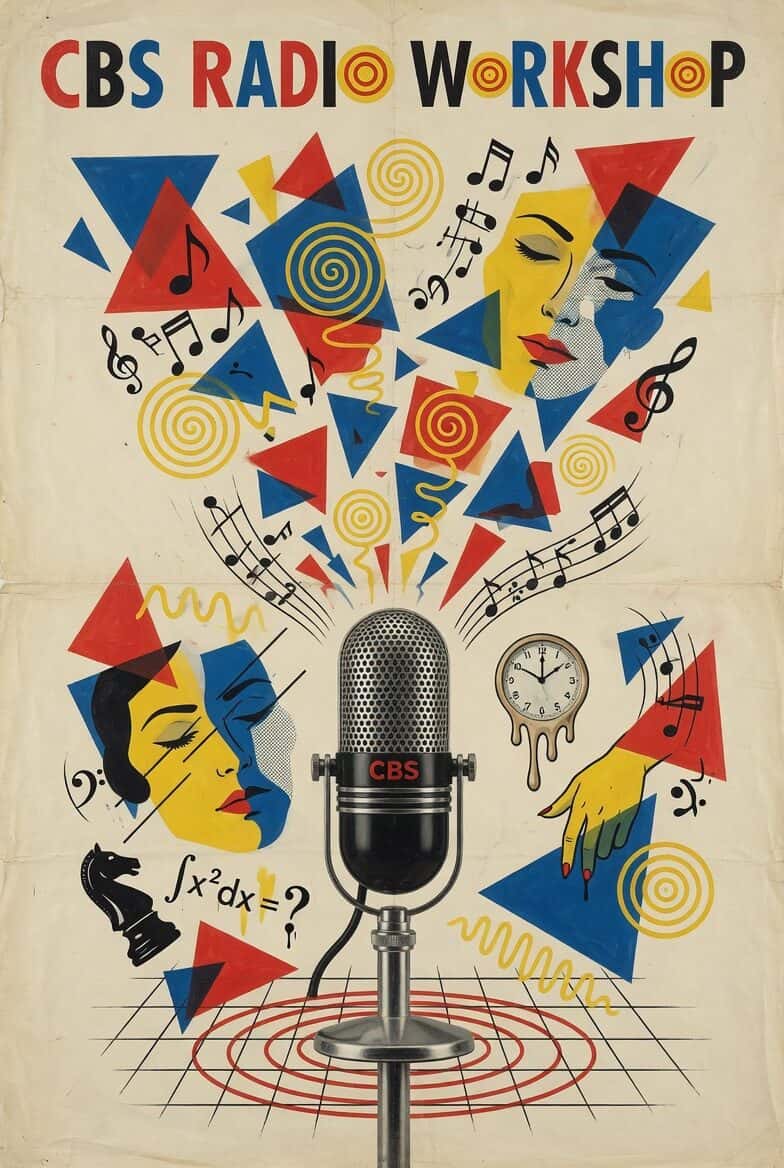
The CBS Radio Workshop, dedicated to man's imagination. The theater of the mind. Today, all is bright. A simple story of a simple song, which from long lost beginnings, through the help of a persistent king and a melodious bird, trained by a truant schoolboy, developed into the world's most beloved expression of the spirit of Christmas, the feast of men and women of goodwill, and especially of children.
Takes me back, that.
Huh?
I mean, I beg your pardon?
I said it takes me back, that waltz.
Quite a way, I'm afraid.
Oh, yes. Yes, still, they are not playing it right.
Oh?
In what way?
Not enough spirit, not as the Viennese thought of it.
Oh. They are playing it as an English waltz, I suppose.
Ladies and gentlemen, ladies and gentlemen, this, as you know, is Christmas Eve. So, on the eve of this, our greatest of holidays, we will play a melody which I am sure you all know. Play, boys.
What? Who?
I'm sorry, Mr. Conductor. I did not mean to be hurt.
Well, sir, I don't see why... Oh, my maestro.
Ladies and gentlemen, I'm sorry I didn't recognize the voice immediately. Allow me to introduce, ladies and gentlemen, the noted, the famous conductor of some of the greatest orchestras in the world, Maestro Reinhardt Schremer.
No, no. Ladies and gentlemen, the maestro is Austrian, I know, by birth, that is. And since this worldwide favorite of all Christmas carols was written in Austria, I can't think of anything more fitting that the maestro himself, should take over the baton. What do you say, ladies and gentlemen? Come on, old boy. It will be an honor, sir, something all of us will remember.
Well, if you insist, so... Thank you, thank you, ladies and gentlemen.
There's a guitar in your band, Mr...
Woodson, sir.
Here, maestro. Thank you.
Yes. I will have to ask your indulgence, ladies and gentlemen, Mr. Woodson. But this song, you see, has meant a great deal to me ever since I was a child, so long ago. That was in a place called Hallein in Austria, near Salzburg. The composer of this melody, Franz Gruber, was his name. Still lived there when I was a boy. And I went to school with his grandson, Felix. He later became a conductor in Vienna. Well, he also is now dead.
It is really a very simple song. It was first written for just one guitar and two voices. Clear, young voices. And the melody was somewhat different from the one we play today. It is only a peasant song, after all. A song without pretension. What feeling it has came from the hearts of two simple men, two friends. Imbued with devotion to their fellow beings. A love of life. Humility in the face of its mysteries. And a deep sense of reverence.
I say, old boy, why not tell us the whole story?
My reliable British friend, of course. Well, this was in... Now, let me see. Yes, in 1818, just a short while after the Napoleonic Wars. There were two men who met several times a week in a small village near Salzburg called Oberndorf. The local priest, Father Josef Mohr, and the schoolteacher. The two used to sing and play the guitar together, and the schoolteacher always helped the priest out on Sundays by playing the organ in the village church.
Christmas, of course, was the most festive season of the year. And no one for miles around ever missed the Christmas Eve Midnight Mass, in Oberndorf. But on the day before Christmas, 1818, there was an unexpected disaster.
Father! Father!
Oh, gelobt sei Jesus Christus. Ewigkeit, amen. What is the matter, Franz?
The organ, Father. I had called the children in for practice, but the organ won't play. I can't get a sound out of it.
You're sure?
Of course I am sure. But there's the Midnight Mass. It couldn't have happened at a worse time. The organ man is not due until February.
Your March.
But what will we do for music at the Mass? We can't disappoint all those people.
I will have to think, Franz. Please, go back to the church now. I will be with you soon.
It's no use.
Franz!
Yes, Father.
I can't make it work.
It is all right, Franz. I have had an idea. Here is a little poem I have written. You think you could put this to music?
Stille Nacht. Heilige Nacht.
But we have no organ, Father.
Well, we still have our guitar.
Ah, you mean we'll use the guitar?
The guitar and two voices, perhaps. That may be all we can count on. You and me.
Yes. Let me see. Alles schläft. Einsam wacht.
We don't have to do the singing, Father. There are two girls in the choir with the sweetest voices we have ever had.
And within a day, Franz Gruber had indeed set Father Mohr's little poem to a simple yet beautiful melody. This is what the people of Oberndorf and the nearby mountain farms heard that Christmas. A melody so touching and so easily grasped that all the other children in the church quickly joined in.
That is how Silent Night was born. But there is more to it. First of all, there are the mice.
The mice?
Yes, the mice. And then there is a bird in the story, too. Well, the mouse part is simple. When the snows began to melt in the valley of the Salzach, where Oberndorf lies, the organ man, as Father Mohr called him, arrived in the village. Organ building and repairing were highly specialized trades in those days. And many of the men skilled in them came from villages along the Ziller River in the Austrian Tyrol.
Well, Mr. Mauracher, nothing serious, I hope.
Nothing serious, Father. It's just that you don't seem to feed your mice very well. No. They ate out a whole section of the bellows the size of a silver thaler and then built a nest inside. I cleaned out the mice and put a patch on the hole. You want to try it out?
Oh, Mr. Gruber here plays the organ for me.
Franz.
Of course, Father. I'll try our new Christmas carol.
Say, that's a nice song. I never heard it before. That's great. Mind if I take it with me? I'll write it out for you.
Oh, nah. I couldn't read it. Me, I carry them up here in my hat.
Well, Mauracher, the organ man, did carry the new song in his head. And when he returned to his native Ziller Valley, he taught it to all the children there. Later, the young Strassers, two brothers and their two sisters, became especially fond of the song from heaven, as they called it. And they worked out a four-part singing arrangement for the two-voice melody.
Old Mr. Strasser was a glove maker. And when his children were old enough, he sent them each year to the many big trade fairs of Europe to sell his output. But the children often felt lonely, of course, and homesick. And they used to relieve their feelings by singing all the songs that reminded them of home.
And so, one day in Leipzig, the capital of the kingdom of Saxony, a dignified, elderly gentleman approached.
Don't be alarmed, children. My name is Paulitz. I am, well, in fact, I am the director general of music of this kingdom of Saxony.
Yes, sir?
I, uh, well, I like your singing, especially that last one you sang. The song from heaven. What was that?
The song from heaven. The song from heaven. We call it that. The people in our valley.
Oh, and where might that be?
In Tyrol. We are Austrians.
Oh, a Tyrolian folk song. Well, children, I want to ask whether you would be interested in singing for me at a concert.
This was only 15 years after Franz Gruber and Father Mohr had written their little hymn of devotion. But Mauracher, the organ builder, had never troubled to ask who had written the song. And so when the Oberndorf carol had a great success in Leipzig and then swept through Europe, it was as an orphan.
Another 20 years later, King Frederick Wilhelm IV of Prussia heard a melody during Christmas Eve services in the Berlin Cathedral. He called for the royal concertmaster.
Your Majesty.
Herr Eck, you are the concertmaster of the kingdom of Prussia. What is the origin of that hymn, that lovely melody that was played tonight during our services?
I'm sorry to say that I do not know, Your Majesty. The melody, if I might say so, suggests an Austrian origin. Haydn, perhaps.
Well, then it's off to Austria you go. I want to know who wrote that song and I don't want to see you again until you find out.
Yes, Your Majesty.
Well, the Prussians are a determined people and the royal Prussian concertmaster soon was on his way to Austria. To Vienna first, of course. It was then the musical capital of the world.
Most honored, sir. I have been music librarian here at the Imperial Archives for many years and I can assure you I've never heard nor read that melody. And I can further add that Joseph Haydn did not compose it, nor did a great Mozart. Of course, it is just possible that Joseph Haydn's brother Michael wrote it. Now that I come to think of it, there are certain similarities of phrasing.
Yes, yes, but where can I find it?
Well, most of Michael's works have been lost, unfortunately. However, he was organ master at St. Peter's Abbey in Salzburg for a good many years. You might inquire there.
On went the Prussian concertmaster Ludwig Eck. But in the length and breadth of Austria he could find no trace of the song or of anyone who might have composed it. The Berlin concert season was coming up and so one day concertmaster Ludwig Eck, miserable over his failure, reluctantly took a coach back to Berlin.
He stopped at an inn in Bavaria on his first night after leaving Austria and composed a letter to the publishers of the official Prussian hymn book. And would therefore suggest in the next edition of your hymnal you list Silent Night, Holy Night as probably by Michael Haydn, brother of the celebrated Joseph. Yes. Yes. I know how to do it.
By next morning, though, Ludwig Eck had recovered sufficiently from his disappointments to stop by in the dining room of the inn for a hearty breakfast. Now then, after the soup, a few eggs, perhaps, and some of that wonderful bacon of yours, and then, yes, a half chicken and a stein of beer, of course.
That bird!
Sir?
That bird, my song! He has my song!
Oh, I am sorry, sir, but I am not responsible for singing when I got him.
Yes, yes, man, yes. But where did you get him?
A traveler left him here, sir.
Now, never mind that. Where did he get him?
A man came from Salzburg, sir. He did say that he had bought the bird from someone at St. Peter's.
St. Peter's in Salzburg. So it was Michael Haydn after all. Tell my coachman we are not going on to Berlin. We are going back to Salzburg, St. Peter's Abbey.
Lord, say, Jesus Christus.
Yes?
The, the, the, the abbot. I am emissary of his majesty, the king of Prussia. Now, please, please tell your abbot that I must see him.
Ludwig Eck was cordially received by the abbot and invited to stay and examine Michael Haydn's remaining manuscripts. He pored over yellowing scores for a week and found nothing. And so, Ludwig Eck went home to Berlin.
There was one person, though, who had overheard the concertmaster's story of the singing finch. Ambrosius Prensteiner, who had himself studied at the Abbey School and was now choir inspector of the Salzburg district. He had developed an idea.
Let's see now the first two windows. That would be the fifth class. No, probably not that old. The next two, the fourth. I don't think so, but let's try it. Anyway, I hope I can still whistle. No, that's no good. Well, let's try the third class.
Felix, your bird is back.
That singing bullfinch you taught that Christmas song to. The one you saw in that Bavarian inn.
No.
Yeah, well, listen for yourself. There couldn't be any other bird who knew that melody.
But how could he have come back?
Well, don't ask me. Let's look, then.
Sir?
What's your name, boy?
Felix Gruber, sir.
And you have been caught capturing birds and teaching them to sing and then selling them?
Well, only a few times, sir.
Oh, never mind now. I myself tried to earn a few groschen that way when I studied in that same room. Not that that is any excuse.
No, sir.
I have something more important now. Did you ever teach one of your birds a song that goes like this?
Yes, sir.
Well, where did you learn that melody?
From my father, sir. He's a musician. He made it up.
He made it up?
Yes, sir. At home, we always sing it at Christmas.
And where is home, may I ask?
In Hallein, sir. My father is choir master.
Come on, boy. Jump down from the window. I'll catch you. We're going to Hallein. You boys, you may tell the master that Felix Gruber has been excused for the rest of the day.
Just to the right, down the street, sir. That white house.
I hope your father is at home.
Oh, he's always home. Except Fridays and Sundays.
You did write that song.
Only the melody, Inspector. My friend, my very great friend, Father Mohr, wrote the words. He died about six years ago in Wagrain.
Do you still have your original manuscript?
Original? I don't know. It was so long ago, and the song was such a little thing. I would have to ask my wife. Marie... Oh, never mind now. You will find it later. But that little song of yours has gone a long way in the world. There was a man down here all the way from Berlin to find out about it.
About that song?
Yes, about that song. Here. Here is a copy of a book he left with me. It was published in Leipzig, and it has your melody. But here is what you had better do now that fame is catching up with you.
Well, that's almost the end of my... My story, ladies and gentlemen. Except that the letter went off shortly from Hallein to the royal concertmaster of Prussia, Ludwig Erk. Authentic history of the composition of the Christmas song Stille Nacht. And since this song subsequently appeared in a collection in Leipzig in a somewhat changed form, the author begs to submit a copy of the original music. Hoping that my essay will suffice, I am with veneration and high esteem your most obedient servant.
Franz Gruber died ten years later as poor as he had been born. And now, ladies and gentlemen, there seems to be only one thing left for me to do. And the only thing I was asked to do in the first place. And that is to play the song from heaven, as those Tyrolean children called it, as I feel it should be played. I hope that the orchestra, perhaps some of you, will join me.
You have been listening to the CBS Radio Workshop and All Is Bright, the story of Silent Night, written by Henry E. Fritch, with the original music of Franz Gruber, and additional music composed and conducted by Alexander Steinert. Rudolf Weiss was heard as Kramer, Joe Julian as Father Mohr, and Herm Dinkin as Gruber. This is Bob Pfeiffer inviting you to listen to the CBS Radio Workshop each Sunday at this same time. Stay tuned for Suspense, which follows immediately over most of these same stations. America listens most to the CBS Radio Network.