
The written record
Read the transcript
Read along with the recording · About 11 min to read
<!-- kimi_cleaned -->
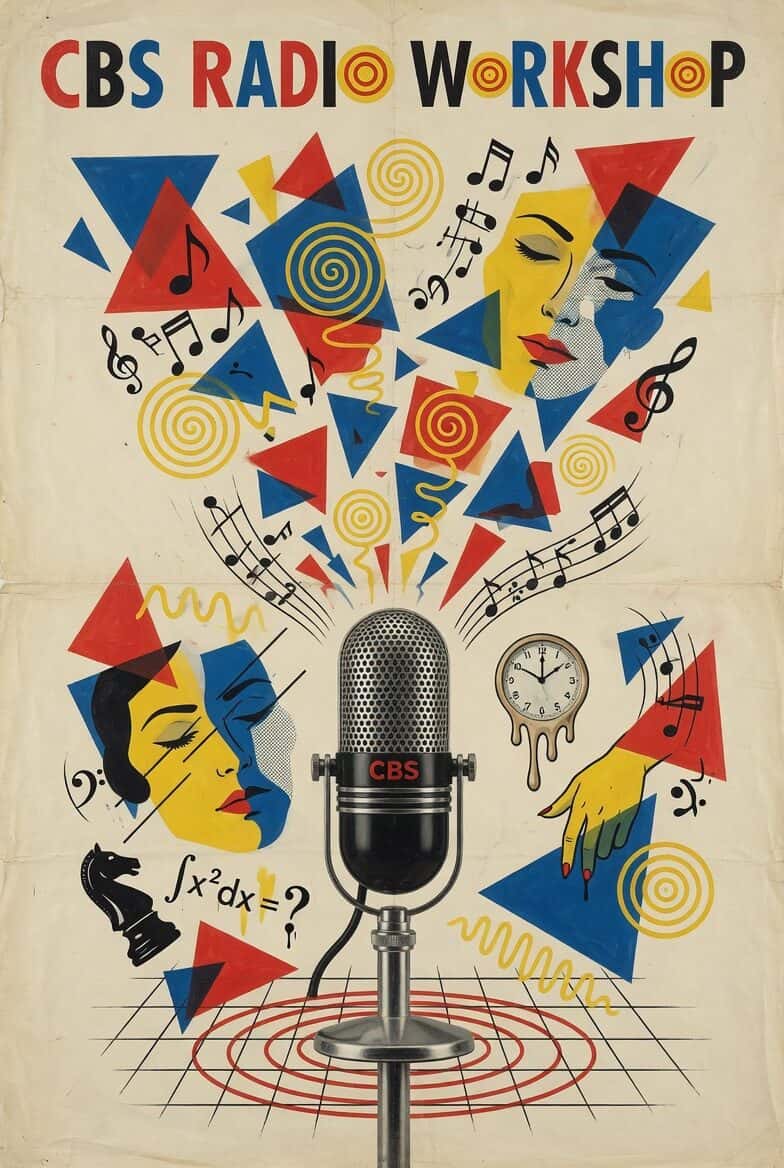
From Hollywood, the CBS Radio Workshop. They say one picture is worth 10,000 words. I wonder, is it? CBS Radio presents the CBS Radio Workshop, dedicated to man's imagination. The Theater of the Mind. The Theater of the Mind, where words create pictures. Here, then, are 1,489 words. The voice of William Conrad and the music of Jerry Goldsmith.
Mr. Conrad.
Thank you. With no prejudice against pictures that are worth 10,000 words, we will bring you, in the next half hour, 1,489 words, which are worth innumerable pictures. Exactly how many, only you can tell, for, well, it's the magic of your imagination that will paint them. We begin with 956 words arranged by the English poet Alfred Noyes into a pattern he called The Highwayman. Uh, Mr. Goldsmith, if you please, overture for The Highwayman.
The wind was a torrent of darkness among the gusty trees. The moon was a ghostly galleon tossed upon cloudy seas. The road was a ribbon of moonlight over the purple moor, and the highwayman came riding, riding, riding. The highwayman came riding up to the old inn door.
He'd a French cocked hat on his forehead, a bunch of lace at his chin, a coat of the claret velvet, and breeches of brown doeskin. They fitted with never a wrinkle. His boots were up to the thigh. And he rode with a jeweled twinkle, his pistol butts a-twinkle, his rapier hilt a-twinkle, under the jeweled sky.
Over the cobbles he clattered and clashed in the dark inn yard. And he tapped with his whip on the shutters, but all was locked and barred. He whistled a tune to the window, and who should be waiting there but the landlord's black-eyed daughter, Bess, the landlord's daughter, plaiting a dark red love knot into her long black hair.
And dark in the dark old inn yard a stable wicket creaked, where Tim the ostler listened in the dark old inn yard. His face was white and peaked. His eyes were hollows of madness. His hair like moldy hay. But he loved the landlord's daughter. The landlord's red-lipped daughter. Dumb as a dog he listened, and he heard the robber say:
"One kiss, my bonny sweetheart, I'm after a prize tonight. But I shall be back with the yellow gold before the morning light. Yet if they press me sharply, and harry me through the day, then look for me by moonlight. Watch for me by moonlight. I'll come to thee by moonlight, though hell should bar the way."
He rose upright in his stirrups. He scarce could reach her hand. But she loosened her hair in the casement. His face burned like a brand as the black cascade of perfume came tumbling o'er his breast. And he kissed its waves in the moonlight, oh, sweet black waves in the moonlight. Then he tugged at his rein in the moonlight, and galloped away to the west.
He did not come in the dawning. He did not come at noon. And out of the tawny sunset, before the rise of the moon, when the road was a gypsy's ribbon looping the purple moor, a red-coat troop came marching, marching, marching. King George's men came marching up to the old inn door.
They said no word to the landlord. They drank his ale instead. But they gagged his daughter and bound her to the foot of her narrow bed. Two of them knelt at her casement, with muskets at their side. There was death at every window, and hell at one dark window, for Bess could see through her casement the road that he would ride.
They had tied her up to attention, with many a sniggering jest. They had bound a musket beside her, with the barrel beneath her breast. "Now keep good watch," and they kissed her. She heard the dead man say:
"Look for me by moonlight. Watch for me by moonlight. I'll come to thee by moonlight, though hell should bar the way."
She twisted her hands behind her, but all the knots held good. She writhed her hands till her fingers were wet with sweat or blood. They stretched and strained in the darkness, and the hours crawled by like years, till now, on the stroke of midnight, cold on the stroke of midnight, the tip of one finger touched it. The trigger at least was hers. The tip of one finger touched it. She strove no more for the rest. Up she stood to attention, with the barrel beneath her breast.
She would not risk their hearing. She would not strive again, for the road lay bare in the moonlight, blank and bare in the moonlight, and the blood of her veins in the moonlight throbbed to her love's refrain.
Tlot-tlot, tlot-tlot. Had they heard it? The horse-hoofs ringing clear. Tlot-tlot, tlot-tlot, in the distance. Were they deaf that they did not hear? Down the ribbon of moonlight, over the brow of the hill, the highwayman came riding, riding, riding. The redcoats looked to their priming. She stood up straight and still.
Tlot-tlot, in the frosty silence. Tlot-tlot, in the echoing night. Nearer he came and nearer. Her face was like a light. Her eyes grew wide for a moment. She drew one last deep breath. Then her finger moved in the moonlight. Her musket shattered the moonlight, shattered her breast in the moonlight, and warned him with her death.
He turned, he spurred to the west. He did not know who stood bowed, with her head o'er the musket, drenched with her own red blood. Not till dawn he heard it, his face grew gray to hear how Bess, the landlord's daughter, the landlord's black-eyed daughter, had watched for her love in the moonlight, and died in the darkness there.
Back he spurred like a madman, shrieking a curse to the sky, with the white road smoking behind him and his rapier brandished high. Blood-red were his spurs in the golden noon. Wine-red was his velvet coat when they shot him down on the highway, down like a dog on the highway, and he lay in his blood on the highway, with a bunch of lace at his throat.
And still of a winter's night they say, when the wind is in the trees, when the moon is a ghostly galleon tossed upon cloudy seas, when the road is a ribbon of moonlight over the purple moor, a highwayman comes riding, riding, riding. A highwayman comes riding up to the old inn door. Over the cobbles he clatters and clangs in the dark inn yard. And he taps with his whip on the shutters, and all is locked and barred. He whistles a tune to the window, and who should be waiting there but the landlord's black-eyed daughter, Bess, the landlord's daughter, plaiting a dark red love knot into her long...
Now love has always been the special province of poets. And who of us, having fallen in love or thought we had, has not tried to express this overwhelming passion in a poem? Well, more than a hundred years ago, there was in London a young woman who managed this rather more successfully than most of us. Her name was Elizabeth Barrett. Her lover was Robert Browning, who tenderly called her his little Portuguese because of her dark complexion. As their romance progressed, she wrote him a series of sonnets inscribed from the Portuguese. Here is the immemorial Sonnet 43. 128 words of love.
How do I love thee? Let me count the ways. I love thee to the depth and breadth and height my soul can reach, when feeling out of sight for the ends of being and ideal grace. I love thee to the level of every day's most quiet need, by sun and candlelight. I love thee freely, as men strive for right. I love thee purely, as they turn from praise. I love thee with a passion put to use in my old griefs, and with my childhood's faith. I love thee with a love I seemed to lose with my lost saints. I love thee with the breath, smiles, tears, of all my life. And if God choose, I shall but love thee better after death.
They say one picture is worth 10,000 words. Do you still believe it? Well, listen then to 398 words from the pen of the late, great Thomas Wolfe. From his book Of Time and the River, a passage known as The Thunder of Imperial Names.
The names of men and battles. The names of places and great rivers. The mighty names of the states. The name of the wilderness. And the names of Antietam, Chancellorsville, Shiloh, Bull Run, Fredericksburg, Cold Harbor, the Wheatfields, Ball's Bluff, and the Devil's Den. The names of Cowpens, Brandywine, and Saratoga. Of Death Valley, the Chickamauga, and the Cumberland Gap. The names of the Nantahalas, the Badlands, the Painted Desert, the Yosemite, and the Little Bighorn. The names of Yancey and Cabarrus counties, and the terrible name of Hatteras.
And then for the continental thunder of the states. The names of Montana, Texas, Arizona, Colorado, Michigan, Maryland, Virginia, and the two Dakotas. The names of Oregon and Indiana. Of Kansas and the rich Ohio. The powerful name of Pennsylvania. And the name of old Kentucky. The undulance of Alabama. The names of Florida and North Carolina. And the red oak thickets at the break of day. Long hunters lay for bear. The rattle of arrows. The laurel leaves. The war cries round the painted buttes. And the majestical names of the Indian nations. The Pawnees, the Algonquins, the Iroquois, the Comanches, the Blackfeet, the Seminoles, the Cherokees, the Sioux, the Hurons, the Mohawks, the Navajos, the Utes, the Omahas, the Onondagas, the Chippewas, the Crees, the Chickasaws, the Arapahoes, the Catawbas, the Dakotas, the Apaches, the Croatans, and the Tuscaroras. The names of Powhatan and Sitting Bull. And the name of the great chief Rain in the Face.
Let it go westward in the dark. Brother, have you seen starlight on the rails? Have you heard the thunder of the fast express? The names of the great chief. The names of the mighty rails that bind the nation. The wheeled thunder of the names that net the continent. The Pennsylvania, the Union Pacific, the Santa Fe, the Baltimore and Ohio, the Chicago and Northwestern, the Southern, the Louisville and Nashville, the Seaboard Air Line, the Chicago, Milwaukee and St. Paul, the Lackawanna, the New York, New Haven and Hartford, the Florida East Coast, the Rock Island, and the Denver and Rio Grande.
The names of the great rivers that are flowing in the darkness. The names of the great mouths, the mighty moors, the vast, wet, coiling, never-glutted and unending snakes that drink the continent. Where and in what other land will you find others like them? And where you can match the mighty music of their names. The Monongahela, the Colorado, the Rio Grande, the Columbia, the Tennessee, the Hudson, the Kennebec, the Rappahannock, the Delaware, the Penobscot, the Wabash, the Chesapeake, the Swannanoa, the Indian River, the Niagara, the St. Lawrence, the Susquehanna, the Tombigbee, the Nantahala, the French Broad, the Chattahoochee, and the Potomac.
These are a few of their princely names. These are a few of their great, proud, glittering names. Fit for this immense and lonely land that they inhabit.
Just a few more words and we're done. From the ancient Japanese, a tanka, a poem consisting of only seven words. A poem called Silence.
Sleep. The temple bell.
The CBS Radio Workshop has presented 1,489 words starring William Conrad with music composed and conducted by Jerry Goldsmith. 1,489 words consisted of The Highwayman by Alfred Noyes, Sonnet 43 from the Portuguese by Elizabeth Barrett Browning, The Thunder of Imperial Names by Thomas Wolfe, and Silence by an unknown Japanese poet of antiquity. This experiment in words and the pictures words evoke. This experiment in words and the pictures words evoke was directed by Mr. Conrad and produced in Hollywood by William N. Robson. Next week, from New York, the Workshop will present Space Merchants, directed by Paul Roberts.