
The written record
Read the transcript
Read along with the recording · About 13 min to read
<!-- kimi_cleaned -->
Shut her up, Lefty. Shut her up. I got her. Empty his pockets before the cops come. Look, go on. What are you waiting for?
He looks like he's dead.
No, ain't that shocking? I only stabbed him in the heart.
You're too quick with that knife, I told you. Come on, empty his pockets and stop preaching.
Can't hold this woman all night.
Okay, okay, Lefty. Have all the lousy luck. Ten bucks is all he has.
You're lying.
No, Lefty, honest. Now cut out your heart.
Come across. Lefty, you know I wouldn't lie to you.
Look, I know you're a liar. Come on.
Well, happy dog. Two more dead presents stuck in my hand. Yeah. What do you know about that? We gotta get out of here.
Hey, what do we do with the dame?
If she knows what's good for us, she'll keep quiet and take her old man to the morgue. There's a real good sawbones up at the hospital there, lady. He helped me.
Hey, shut up, you fool, and pick up your feet. Come on, get going, get going.
Oh, George, no. I can still hear you, hon. Just a little. I'm still beating. How do I get up to the hospital? Let it keep beating until I get a doctor somewhere. There must be a doctor who can help you. There's got to be one somewhere.
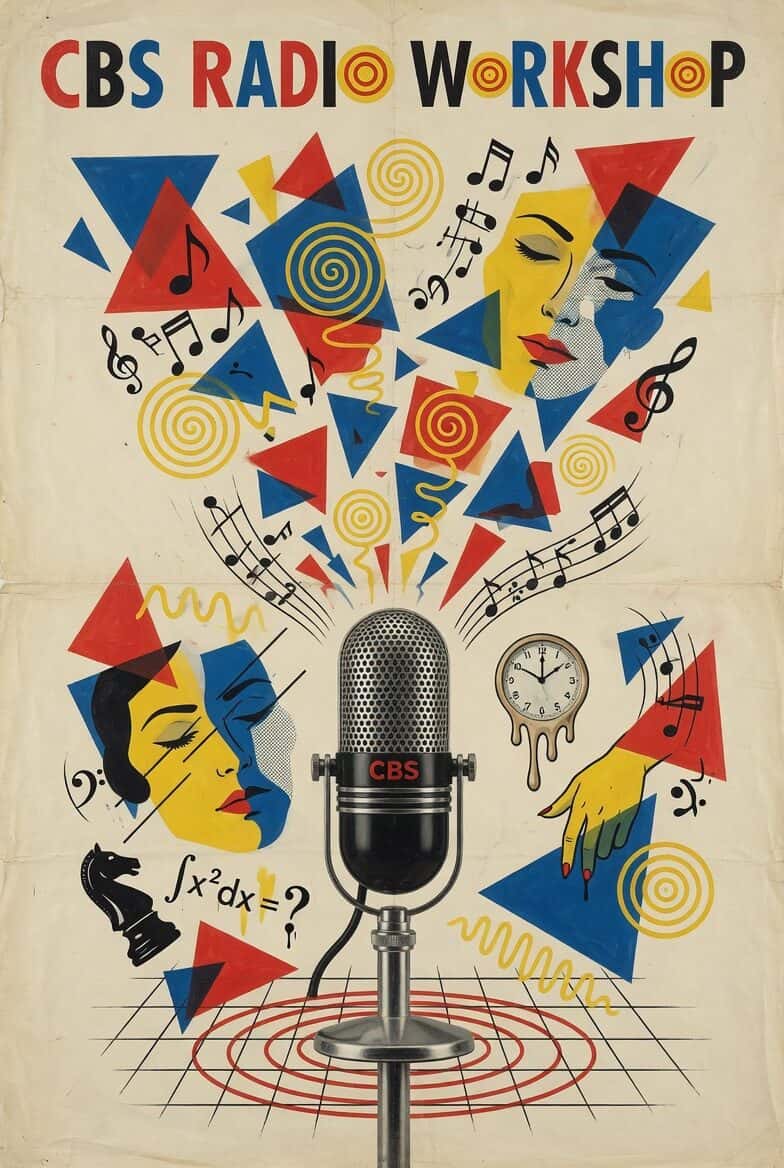
The CBS Radio Workshop, the theater of the mind, dedicated to man's imagination. Today, let the proscenium of that imagination encompass the heart. Our story, written by Peabody Award winner Richard Durham, titled The Heart of the Man.
The human heart. Rhythm. The sighs. The whispers of your fist. I live in a dungeon between two lungs, the lonely abode of the soul. I am the timekeeper of human life, fair, impartial, equal to Turk or Tartar, Roman. I am old. I circulated blood for Cro-Magnons, Neanderthals, Rhodesians. I am young. I warm the breast of the fresh and the new. I have moved. In some men, I have been called cold. In others, I am the lion, and in others, the lamb. In some, filled with love, and others, full of hate. I have been tame. I have been wild. But if, as among men, the good is often interred with their bones, so let it be with the blood which I drive through their veins. So let it be with the few men who have mastered me, who have learned the laws of veins and lobes, of arteries and auricles, who have timed my restless writhing and twisting to planet precision, who fought to heal me whenever I was ripped and split, as I was one stormy night in the breast of a dying man, outstretched on a hospital table.
Right in here, Doctor.
Stethoscope, please, Nurse.
His lips are moving, Doctor. He's trying to say something.
Mm. He's too weak. He can hear us, I think, but he's too weak to make us hear him. The scope hardly picks up a sound, but the heart must be beating. How long has the patient been here?
About three minutes, Doctor. I called you right away.
Checked his pulse, respiration, temperature?
Pulse rapid, thready, 130. Respiration, 30. Temperature, 105.
If I could have just gotten to him sooner. This wound in his chest. Down to his heart. His heart is punctured. Got it. It was almost home. He wanted me to hold up my hand. His heart's weakening. Adrenaline. Adrenaline. That'll hold it a while. His heart's been split. Only one thing we can do. Don't let him move, Nurse. Call the emergency staff into the operating room. His heart's split and leaking badly. He'll die if we can't sew it up. Prepare him for surgery. We must operate immediately.
You can't operate on my heart. Not on my heart. There's one chance in a thousand. If we take it, he may live. I'll die. You don't fool me.
Yes. I am the heart. And I speak to you, Doctor. You here, scrubbing your arms while red sand drips down an hourglass. Dusting your hands with powder. Flexing your fingers for the rubber gloves. While inside your brain and nerves is etched the memory of the long, long search for my secrets. A long search which began for you 20 years ago, Doctor. 20 years ago, when you were a young pre-medical student and whatever spare time you could spare, was spent in the home of a Texas surgeon.
Daly, will you stop that humming, please?
Oh, I'm sorry, Doctor. My wife's dead, boy. Dead. Let her rest.
Rest. Yes, Doctor. I didn't mean to be disrespectful. I'm sorry.
Excuse my gruffness. I just can't get her out of my mind. I'm tired, you'll see. Tired. I finished marking the class papers for you, Doctor. Would you want to look them over?
Yes, Doctor. Thank you. Thank you. Thank you. Thank you. Thank you. Thank you. Thank you. Thank you. Thank you. Thank you. Thank you. Thank you.
Can I look them over?
Yes, yes, where are they? I need something to get my mind off this.
Right here, sir. The examination's from your surgery students. I checked over them. Here you are, sir.
Hmm, you've got a fine head on you, boy, even if you're overly curious. Mm-hmm. This one's all right. Here's an odd one, Doctor.
What's odd about it?
Well, I didn't know how to mark it. You see, this student thinks it's possible to sew up the human heart when the fibers are cut. He thinks you can take the needles on the human heart. He's mad.
But he drew a diagram. He thinks that if the pericardial sac can be reached...
I said he's mad. It can't be done. If it could, wouldn't I have saved my own wife? Didn't I try it after she stabbed herself? Didn't I try it?
Yes, Doctor, you did. Not just me, but doctors everywhere in Germany, Italy, France, Switzerland, have tried for years and failed. It just can't be done. Don't you see that?
How shall I mark it, then?
Zero. I was talking of it makes me hear the way a heart beat that night. I can't forget it. Son, you've got nimble fingers and a good head. You'll be a fine surgeon someday. You'll find we surgeons can do something with the kidney, the bladder, the stomach, the scalp, everything in the body, except the human heart. The poet put it correctly. The heart's a lonely hunter. But when it's wounded, there's not a chance in a million to heal it.
Everything's ready, Doctor. All assistants are here.
Good. Let's look this way, please. We'll cut a window on the chest wall above the heart. A half-circle incision this way. Every move counts. We can't afford a single slip. Scalpel.
Scalpel.
Clamps.
Clamps. More clamps.
Clamps.
Sponge.
Yes, Doctor.
Sponge. A single slip and I stop. Scalpel. Scalpel. Scalpel. Scalpel. Scalpel. Scalpel. Scalpel. Scalpel. Scalpel. Scalpel. Scalpel. Scalpel. Scalpel. Scalpel.
Speaking to you, Doctor, you with your body bent over a table under the glare of a white light, concentrating on a six-inch half-circle, your fingers demonstrating the meaning of the words you spoke decades back in a college hall when you took an ancient oath. Repeat after me. I, Ulysses Grant Daly.
I, Ulysses Grant Daly.
Swear by Apollo Physician, by Aesculapius, by Health, by Panacea, and by all the gods and goddesses.
Swear by Apollo Physician, by Aesculapius, by Health, by Panacea, and by all the gods and goddesses.
Making them my witnesses that I will carry out this oath and this indenture.
Making them my witnesses that I will carry out this oath and this indenture.
To use treatment to help the sick according to my ability and judgment, but never with a view to injury and wrongdoing.
You took an oath, and you carried it out to the letter. In whatever house I enter. You went out to heal me in homes, in hospitals, in clinics. I shall enter to Health to Sleep. You went across the sea to learn my laws in Paris, in Rome. You stood watching me under the bright lights while I lay outstretched on a table. You watched French surgeons with shrewd fingers try to suture me in Paris. It's impossible, impossible. And in Rome, you watched.
Nurse, we're almost at the heart.
Incastri.
Yes, doctor. I hope we can reach the heart in time. It's very weak. Put it away now. Here it is, doctor. We're here. Here's the heart. Give me a knife, nurse. The long one.
Yes, doctor.
All right. Let's see if I can cut it in half. And it falls together.
Yes, doctor.
Doctor!
Amen. You saw me stop dead in hospitals in Rome. You probed archives to see if any had survived the prying of a knife into the inner sanctum of the soul. You went to Germany to find new methods to heal my wounds.
Um der deutschen Herzensgesellschaftswillen möchte ich meine amerikanischen Kollegen willkommen heißen. Sie sind alle frei, ihre Untersuchungen in Berlin und anderswo in Deutschland fortzusetzen. Ich danke Ihnen.
Or, as I would say in English, I welcome you American doctors to Berlin to do your research in surgery.
Thank you, Professor Gerhardt. My colleagues and I have been looking forward to seeing your work at Eichelberger Clinic.
Ach, jawohl. We've done very good work there. Just until today, we had your American surgeon, Dr. Ulysses Grant Daly assisting us. Until you heard the news...
We're especially keen on your suture methods, Professor. We understand some German doctors have come pretty close to finding a way to operate on the human heart.
Ach, ja, but in America...
Our hope is that one day surgeons will be able to sew up the heart as we can suture skin or any other organ.
But it has already been achieved, Herr Doktor. Here?
Nein. In America. I'm sorry. I should have told you. The news came over the wire this morning. An American doctor, Dr. Dan Williams, completed a successful operation on the heart. Your Dr. Daly has left for Chicago to work with him. Now, surgeons in Germany are waiting to hear the details. How was it done? Oh, it must have been a marvelous thing. But how was it done?
So, Dr. Daly, you've come from Germany to work with me.
Yes, Doctor.
Good. But what can I tell you that you don't already know but this? This patient got up in two weeks and walked, and now he's back at work. When they brought him to me, his heartbeat was so faint I had difficulty picking up a sound with the stethoscope. But I followed that sound until I found it. I tell you, Doctor, there is no sound on heaven or earth more beautiful and poignant than the beat of a human heart. I took him into the operating room. As I recall, it was 2 o'clock in the morning. What a morning. Rain, thunder, and lightning. The elements seemed out to extinguish life, not give it. There was no time for my staff or even for proper equipment. I had to work fast. I got inside, and with these hands, then I took out his heart and stitched it six times. I did it for one patient, and I've done it for another. Now we know it can be done.
How? How can I say it? This heart, this great human heart, is not only delicate like a butterfly's wing, but it's tough and strong and can fight with a fury. Yet, it acts as though it's got a soul of its own. It's sensitive as a baby's body. And be pious when you pressure it. And when you go in to handle it, it's the little things that you do that'll make the difference between life and death. Doctor, remember this when you're calling for your scalpel, sponge, sutures, clamps. You cannot give the patient much anesthesia. He's too weak to stand it. The patient will have his eyes open, watching. He'll be watching you all the time. Cut your window over the fourth rib. Tie off the vest. When you lift the window, then you'll see the heart. The heart. The first time you see it naked and alive, it's an awesome sight. It's like some strange animal come up out of the sea. It slips and writhes, twists and struggles like a captive trying to break free.
Clamp four. But you must be bold. Take the stitches in between the heartbeats. Suture. And if the stitches hold back the flow of blood, you've got a chance. But remember, keep in rhythm with the heartbeat. Keep the rhythm. Never break that rhythm.
It's ready. We'll lift up the window. Steady. There, it's off. The heart. The heart. The heart. We'll check on his respiration. Transfusion ready?
It's on the rack, doctor.
Pressure?
He's gasping.
He's weakening. We've got to get on. Ready to lift the heart. Lift it out. Out of the body. Not too much pressure. Keep in rhythm with the heart. A little more. There. The heart is out. Now to hold it in my hand. And don't break the rhythm. Blood leaking out. Not much time. Nurse. Needle. Curved needle. Right here. Fine silk. It's threaded ready. If the stitches hold, three stitches should stop the leak. One. Two. It still leaks. Still leaks. One more, maybe. Three. It still leaks. Good Lord, let it stop. It stopped. Thank heavens. But his pressure, it's gone down. His heart's hardly beating. Adrenaline. Quick, adrenaline.
Yes, doctor.
Transfusion set?
Yes, doctor.
Then let the blood flow into him. It's holding. Give him more. Let it go freely. It's going in. The beat's picking up. Good. Clean the incision. Sprinkle sulfur. Take off the clamps of the vessels. The blood flowing and let him sleep.
He's crying. I know. His heart's lonely. Oh, so lonely. Let him cry. We've won. He'll make it.
I did make it. I am the human heart. A hollow bag, the size of your fist. The timekeeper of life. Fair, impartial, Mongoloid, or Caucasoid, the common denominator of us all. I salute the men who first mastered me, who took me in. I salute the men who first mastered me, who took me in. I salute the men who first mastered me, who took me in. I salute the men who first mastered me, who took me in. Who timed my writhing and twisting to planet precision as I drive my blood to the endless artery, a mortal part of us all.
You've been listening to the CBS Radio Workshop. Today's venture, Richard Durham's The Heart of the Man, produced and directed in New York by D. Engelbach. Percussion, Saul Gubin. Our cast, Martin Blaine, Barry Kroger, Louis Van Rooten, Ralph Korn, Ralph Camargo, Guy Repp, Bill Mason, Joanna March, Lester Fletcher, Danny Ako, Inga Yolas. Next week from Hollywood, Malakimi Magic, a satire on a vacation in Honolulu. This is Ted Pearson speaking. You hear America's favorite shows on the CBS Radio Network.