
The written record
Read the transcript
Read along with the recording · About 19 min to read
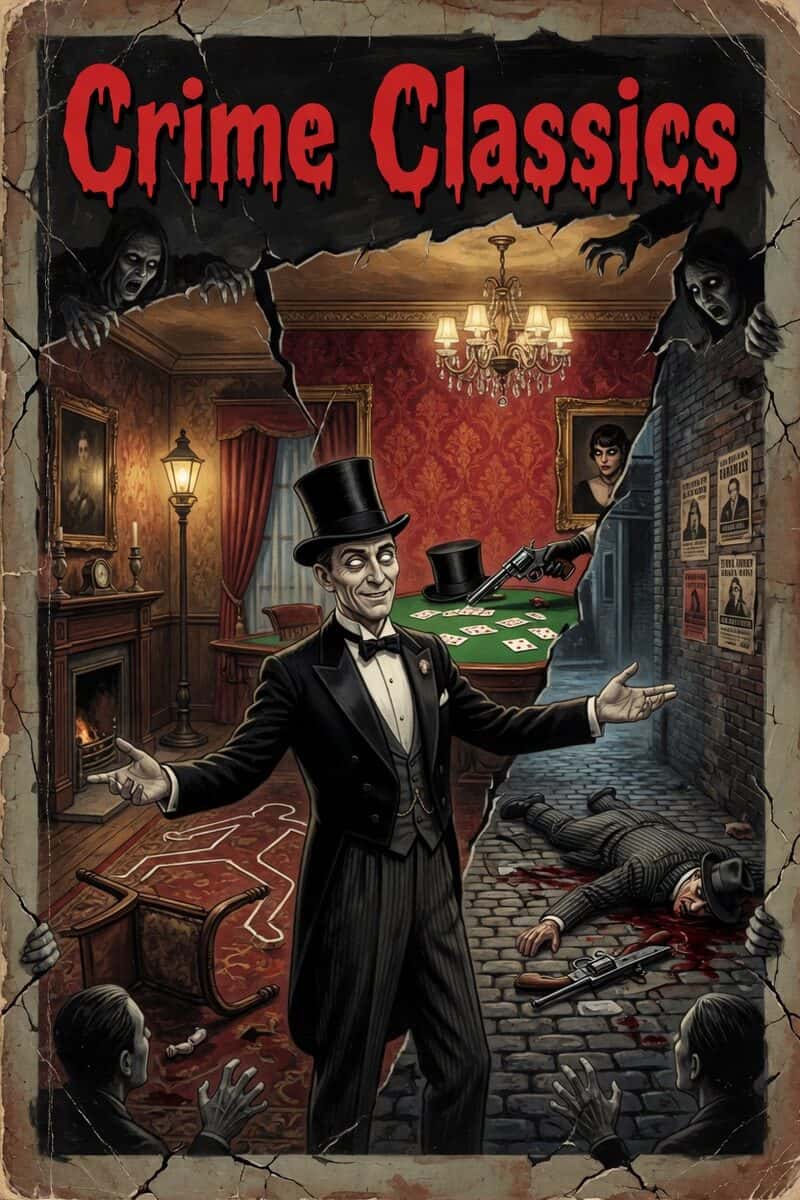
Good evening. This is Crime Classics. I am Thomas Highland. I'm going to tell you another true crime story. Listen. The sound you hear is that of a man having his right-hand hook filed. It's Saturday night in London Town, and he wants to be gleaming and presentable. The year is 1739, when a well-sharpened hook in London Town was considered prudent, and Captain Ratt, that's R-A-T-T, besides being a drunkard, a scoundrel, and a smuggler, was a prudent man. The young man handling the file is named Charles Drew, Jr., and he is performing this intimate little ironmongery because he needs a favor done. Captain Ratt can help him out. He can supply the youngster with an alibi, and Jr. badly needs one, for he has just shot his father dead. And tonight, my report. To you, on the shrapneled body of Charles Drew, Sr.
Crime Classics, a new series of true crime stories taken from the records and newspapers of every land, from every time. Your host each week, Mr. Thomas Highland, connoisseur of crime, student of violence, and teller of murders. Now, once again, Mr. Thomas Highland.
The year, as I've told you, is 1739, and the place? Long Melford. In the county of Suffolk. Long Melford was a small, quiet town near London, and in it, a manor. And in the manor, a high-vaulted room of roaring fire, great shadows, and flying buttresses. Directly beneath the buttress that flew toward the west, two men. Father, son, Charles Drew, Sr., Jr.
Son?
Yes, Father?
The time has come for you and I to have a talk.
I'm grateful. There are things vexing me.
Perhaps what?
What I have to tell you will answer your vexation.
I'm very fortunate. I've tried to be a good father.
A most excellent father.
There's no one richer than you in Long Melford.
Which is what I want to talk with you about.
I know. I've drawn my latest will.
This. What a gentle and most excellent father I have.
Have you ear to what they say of you in the square?
No, what do they say?
That you are gentle and most excellent.
What of the will?
Oh, I'm leaving everything to your five sisters. And to you, sixpence. To lend, to spend, to start your fortune.
But the last will, the one before this, you left me everything. And only a kind word to my five sisters.
That was when you were eleven. Now you are nineteen. And a good son.
To whom good?
To you good. Nay, to the cutthroats and smugglers with whom you cousin.
It is not so.
This is so. I know it. You consort with people of ill-fame, and also with Mr. Richardson's housekeeper.
Oh, shall I explain this of Mr. Richardson's housekeeper to you?
It would be well.
She is a most excellent housekeeper, and I wish to employ her for our own household.
And this you have been trying to do for the last year?
Oh, she demands high payment. Our family can afford high payment. But I personally cannot, father. Not until I inherit your fortune.
Hm. And which with this new will. Will never be.
Father.
I don't scare, son. Wave that gun or...
A smattering of intelligence concerning 1739 ballistics. Ammunition was chiefly of two types. Round or irregular. The former was manufactured by dropping chunks of molten lead from a great height. And when it reached the vat of water at the bottom of flight, it was round. Due to centrifugal forces and gravity. Among men who puttered with this sort of thing, round shot was considered pretty fancy. Mostly, guns were loaded in this era by whatever iron junk was to hand. It should be recorded that Charles Drew, Jr. had stopped at a small junkyard on his way to talk with his dad. This is the reason the coroner found numerous pieces of irregular junk iron in dad's corpse.
Let's see what dad's son is up to now. Scene, Ye Olde Bunnery. A rundown bake shop on Avenue 1. The time, two hours later. Principals, Charles Drew, Jr. and Mr. Humphrey, bun baker.
That brings you to Ye Olde Bunnery, Charlie.
I want to know a thing.
And that is what?
Humphrey, how would you like a hundred pounds?
You ever say a hundred pounds?
All you must do is say you killed a man.
I killed a man. My hundred pounds, please.
You must say you killed my father.
I killed your father. My hundred pounds, please. To the police.
Sheesh. I don't know. I don't know. I don't know. I don't know. I don't know. I don't know. I don't know. I don't know. I don't know. I don't know. I don't know.
Charlie. You must say you killed my father.
I killed your father. My hundred pounds. To the police.
Charlie. Two hundred pounds now and two hundred pounds after you've been to the police.
You killed your poor old dad, Charlie?
With this pistol.
Oh. Leave you to be a very rich man. If someone were to go to the police and said he killed my father, he would be rich too. With his neck in the gibbet.
I would guarantee that the man would be released. Inside of a week he would be released. There are jailers who would release such a man, persuaded correctly, with enough money.
A guarantee, eh?
I know a guarantee. Write me a confession that you killed your poor dear old dad. I will hide it. I will go to the police and confess the deed. If I'm still in jail in a week, I will tell the jailer there to find your confession.
Wrap me up half a dozen of your excellent buns, Humphrey, and I will give you two hundred pounds, plus the price of them.
Thereupon Humphrey plucked a quill from his favorite goose in the back goose coop, sharpened it, and presented it to Charlie. With it, the lad wrote out his confession, paid up, and left. Humphrey waited for his wife, got permission to leave the shop, stopped at his house for a moment, then walked into the local constabulary and made history with this statement.
If you boys are looking for a corpus, try 26 Bloom Street. If you're wondering what his name is, it's Charles Drew Senior. If you're wondering who did the murder on him, it's me. And my name is Humphrey.
The police, upon arriving at the appropriate room at 26 Bloom Street, understood immediately that foul play had been done. One of the constables was assigned to look in on the household of Mr. Humphrey, and there saw the Humphrey children at play at Thistle-de-Doo, a game usually played with marbles, but by the Humphrey children, played with pieces of iron junk, which latter were of a size that could easily be rammed down the muzzle of a gun. The gun was there, too, under a pillow on Mr. Humphrey's side of the bed. Mrs. Humphrey, who in the meanwhile had returned home, shook her head philosophically when apprised of the situation. It is recorded that Mrs. Humphrey's parents had both been put away as confirmed smugglers, a felony against the Crown.
The next day, in jail...
Nice of you to visit me, Charles.
Yes. What news do you bring? When am I to be released?
I went to see Sir Roger Firebrace.
How is Sir Roger?
He's dead. It's a pity, too, for he would have gotten your release in an ounce for a few hundred pounds.
Don't forget, laddie, I've got your confession. You've got till Sunday.
The youngster, however, knew another man of note, Sir Chauncey Fenwick. Sir Chauncey was compassionate and understood the situation exactly, but unfortunately had just had... Sir Chauncey had one of his periodic fallings out with the magistrate's wife. But Sir Chauncey did not send the lad away empty-handed. He suggested an old sea-dog named Captain Rat, uh, with two T's.
What's the file, Mr. Drew? You'll be missing me hook and be scraping me wrist.
I'm very sorry, Captain Rat. Nervous, being here. I travelled here to London to talk to you. You see, Sir Fenwick sent you to me.
Sir Fenwick took five hundred pounds and said he could do nothing with it. You're my last resort, Captain Rat.
Wee bit here, Mr. Drew. Aye. Now, what can old Captain Rat do for you?
Do you have any influential friends?
What be you needing?
An alibi.
For yourself?
For a friend.
Aye. It is always for a friend. What about him?
He confesses he killed my father.
And he be your friend?
By killing my father, he made me rich. I bear him no malice.
And for him you want an alibi. Why? Why not let him rot? Why, Sonny?
You see...
You kill your daddy, Sonny?
Heed the hook, Captain. You almost stuck me.
Pardon, young gentleman. An alibi you wanted. For a friend. To say what?
That my friend is making a mistake. That he is having hallucinations. That he did not kill my father. Because he was with you the night my father died.
And where, Mr. Drew, will that leave you?
Since one has confessed to the crime, it is doubtful whether I would be charged with it.
Sly one. Be ain't you a sly one, young gentleman? Be ain't you?
I'll travel down to the jail. We'll hear and have a talk with your friend. How's that?
Very good. I'll need 500 pounds for expenses. Oh, yes. Now. Yes.
That is wasting a Saturday night and all. Coming down here to the dungeon speaking to you, Mr. Humphrey. But I don't mind.
And you're going to furnish me an alibi, Captain?
This be a strange one. I explained it all to you, Captain. You kill your dad. This one here says he done it. Now the both of you want me to say he couldn't have done it.
He couldn't have done it because he was with me. That lad thought it up. He's the bright one. Not me. My plan will work. By the time you get Humphrey out of here and the police begin to dig about again, I'll be in Paris. Lost. I will change my name and with my fortune I...
For your fortune, I will do it.
I gave you 500 pounds.
Bah! The pittance. Your fortune, Mr. Drew. Except what he's promised to me.
What about it, lad?
What?
No.
Bah! Stay there! There isn't talking to both of you. It's Saturday night, Charlie. What will you do?
It's Saturday night, Charlie. I've got your confession hidden away. And tomorrow's Sunday. What will you do?
They looked at each other there in the dungeon. The jailed and the young visitor. And the question hung there. What would Charlie do? It's Saturday night. And tomorrow is Sunday. What will you do, Charlie?
You are listening to Crime Classics and your host, Thomas Highland. Tomorrow night, hear the premiere performance of 21st Precinct, a new hard-hitting mystery series revealing the inner workings of the world's largest police force. Precinct, produced by CBS radio team that gave you Gangbusters. It's a program you'll want to listen for every Tuesday night on most of these same stations. Premier performance tomorrow night on CBS radio.
Now, once again, Thomas Highland and the second act of Crime Classics. And his report to you on the shrapneled body of Charles Drew, Sr.
It's a short, dusty road from Long Melford to London. Not only that, but these days it's hard to find. In its day, however, it was remarkable for two things. The brothers' shoe-spooner, Dick and Harry, who embarked on a career of high-womanship on the morn of June 3, 1771, were hung on the eve of that same day from the highest branch of an elm at a fork on Long Melford Road. The other historic feature of Long Melford Road is the fact that on a Sunday morning, a young murderer, Charles Drew, Jr., and his lady-love rode a coach down its ruts.
Oh, he's a ranting, roving lad. He is a brisk and a bonnie lad. Be tied, what may, I will be wed. And follow the boy with the white cockade.
Liz.
What is it, dearie?
Shut up.
Everyone's singing that song, dearie. It's the rage.
Please, shut up.
Oh, duck, what's the matter?
You're the cause of it all.
Of what, old duck?
My killing my father. You wanted a way to have all his money? I told you a way to do. That's all.
Yes. Oh, duck, dearie. You'll see when we get to London what a time I'll show you. Make you forget. Since I've killed him, I've done everything wrong.
Will you listen to Liz again? Will you?
Surely I'll listen, poodle.
Oh, duck.
Monkey.
Will you listen to Liz?
Surely.
When we get to London, we change your name and you forget about Humphrey. But if I don't get him out of jail tonight, he'll show the police my confession.
But you'll be in London. Start forgetting about him right now. Now.
All right.
And so they fled to London town, little knowing that they had made a road famous.
In London, they located a little-known hideaway called Bonhomme Carter's Thorny Bull Inn, on the corner of Asquith and Chiswick. The lad registered under an alias Thomas Roberts. Liz, however, registered in her own name, Elizabeth Bathall.
As this was going on back in Long Melford Jail, where Mr. Humphrey was, there transpired this.
In one hour, wifey, I'm getting out of here.
You be a fool.
How, a fool? When did you ever have so much money? What bun are you baking, wifey?
This bun. The lad's giving you money, all that money, and he's good for more.
Aye. All we want. He's a rich one, that's true. Oh, we can get more money before you show his confession.
How? You said he fled.
His Liz told me they were off to London town. You could write him a letter and say as long as he paid you twenty pounds a day, you'd be willing to stay where you are.
Twenty pounds a day? That's a robbery.
I will go to London and find Master Drew and present him with the letter.
How will you find him?
I will ask here and about of him.
London, aye?
What?
London.
What of the children?
Mrs. Nicolrod says she will take care of them.
And you alone in London?
So Mrs. Humphrey went to London.
A few observations about Mrs. Humphrey. Wash away the flour and the excess dough. Put on long sleeves to hide the muscles made of the dough. Comb the hair, exchange shoes for boots. And Gertrude Humphrey was rather presentable. When she went to London, Mrs. Humphrey did all of these things. Plus making a mental note not to laugh too much. Not only because of the horrible sound she made, but also because of the mischievous twitch it brought on, which she could not control.
So off she went to this place, to that, to this pub, to that, asking for a Mr. Drew. I should like to comment here that in 1739, the gin was of an excellent Holland distillation. However, its chemistry had a peculiar reaction with Gertrude Humphrey. Though she fought it, and though she laughed not at the most hilarious joke, including the historically famous one about Lady Mumbly and the troubadour, the gin caused her to twitch mischievously. This attracted to her London dandies, who plied her with more Holland gin, and who promised her help in finding Mr. Drew, and who never did. But Gertrude never lost sight of her mission, and one night in a pub in Covent Garden...
Mister, Mister.
What's the present, dearie?
One hour, dearie. I wants a gin.
Gin for the lady.
What's your name, dearie?
Gertie.
Gertie? Aye. Here's your gin, Gertie. Pick up. One hour, dearie. Where now, dearie?
Here's your name, Drew. Is that what you want my name to be?
I'm looking for Mr. Drew.
Mr. Drew. Here's the Mr. Drew.
Oh, now, Gertie. I'm the one who's bought you the gin.
Yes. My name is Drew. You like the Drew I'm looking for.
Well, now, why do you say that?
Ah, here now, lad. I'm the fellow who's bought her the gin. Here's the guinea, my lad. Find another lady who likes gin.
Oh. Oh, I will, that guinea. Thank you. Bye, Gertie.
Oh. Oh, now, now. Why do you weep, pretty one?
Your son. He's crying, beautiful thing. Gin for the lady.
Now, now, now, now. Stop that weeping.
Ah, here's your gin. I see. Mischievous wink you have. Truly your name. Truly Lady Bird it is.
Lady Bird.
You are a conniver, you are.
His name really was Drew, Timothy Drew. It's one of those coincidences in history which gave rise to the old saw, truth is stranger than fiction, as they say. And he was a curious man and a proud man, jealous of his name, Drew. He had heard his name mentioned and he was forced to find out why. He read the letter then and there. He read it again, a little later, out loud, to the police.
And my missus told you have gone to London with Liz Bathall. But, Charlie, my lad, you shall pay me 20 pounds a day, else I will tell that you have murdered your poor daddy. I have your paper, which you confessed you did, right where nobody but me knows where. So when my wife hands you this letter, you better give her money and find a way to keep it, giving it to her, your faithful servant, Mr. Walter Humphrey.
Gentlemen, here in London is a man named Charles Drew, who has murdered his father and he bears the same surname as I. I cannot permit this deed to go unpunished.
Even in 1739, the London police were thorough, and, goaded by the enormity of the crime, and spurred and accompanied by a man whose name had been besmirched, they combed the alleys, hostelries, pubs, dens. It was late on a moist Thursday morning, when Timothy Drew happened into Bonhomme Carter's Thorny Bull Inn, on the corner of Asquith and Chiswick.
Bonhomme Carter.
Bonhomme Carter denied the presence of a Mr. Charles Drew, but affirmed that a Liz Bathall was most certainly a guest there. He directed Timothy to Liz's chambers.
Open the door.
No games, dearie. Truly.
Who is it?
A representative of the police.
Why didn't you say? May I come in?
If you'll be the police, you can do anything, ain't that so? Thank you. I ain't done nothing.
Is your name Elizabeth Bathall?
It is.
You know a man named Charles Drew?
What's he look like? I don't know. Then how can I tell if I know him? Here, what sort do you take me for? There's no one in me closet.
What is this young man doing under your bed, madam?
Ah, what's he...
Quiet, woman.
Is your name Charles Drew? I'm talking to you under the bed there. Is your name Charles Drew?
Yes, sir.
Come out from under there, sir.
That's right, sir. My name is Charles Drew, sir.
And did you kill your father?
It would be a small life, living as I have been. Yes. Yes, I killed my father.
I have the original issue of a gazette dated January 22nd, 1740, from which I'd like to read.
The melancholy proof that when a man has abandoned all religious principles and has suffered his depraved appetites and passions to govern his reason was shown yesterday when Charles Drew, Jr. was hanged in Long Melford. Since then... The hanging elm on Long Melford Road had recently been demolished to make a keel for the British Navy. A new gibbet was erected. This gibbet was equipped with a new mechanical device, invented by Mr. Douglas Langford of Eastburn. Mr. Langford is to be congratulated.
In just a moment, Thomas Hyland will tell you about next week's Crime Classic.
The shrapnelled body of Charles Drew, Sr., tonight's Crime Classic, was adapted from the original court reports and newspaper accounts by Morton Fine and David Friedkin. The music was adapted from themes of the period and conducted by Bernard Herrmann, and the program is produced and directed by Elliot Lewis. Thomas Hyland is portrayed on radio by Lou Merrill. Charles Drew, Jr. was played by Terry Kilburn and Liz by Betty Harford. Featured in the cast were Paul Frees, Ben Wright, Irene Tedrow, William Johnstone, and Anthony Ellis. Bob Lamond speaking.
And here again is Thomas Hyland.
Next week, the office directly below that occupied by... Oliver Wendell Holmes is the scene of a catastrophe. The place, Harvard Medical School, the time, 1849. My report, On the Terrible Deed of Dr. Webster. Thank you. Good night.
It's big news when a former publisher, soldier, and congressman, the famous son of a famous father, stars in a new radio series. And this Wednesday night, you'll want to listen with all your might when CBS Radio stars Will Rogers, Jr. as Rogers of the Gazette, over most of these same stations. Rogers of the Gazette tells the story of a small-town newspaper editor, what he stands for, and also what he refuses to stand for. Premier performance this Wednesday on CBS Radio.
Stay tuned now for Gary Moore with Arthur Godfrey's Talent Scouts, which follows immediately over most of these same stations. And remember, America Now listens to 110 million radio sets and listens most to the CBS Radio Network.