
The written record
Read the transcript
Read along with the recording · About 19 min to read
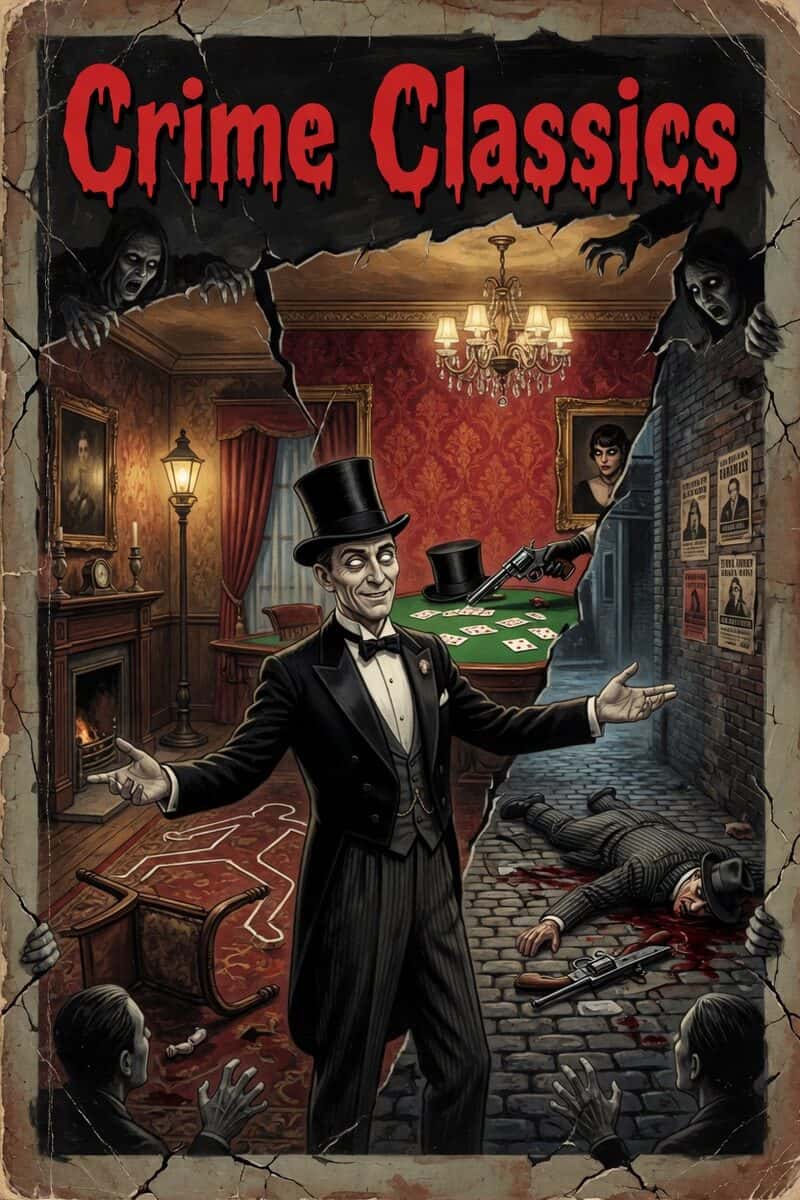
Good evening. This is Crime Classics. I am Thomas Highland. I'm going to tell you another true crime story. Listen. In the county of Suffolk, the willow grows green and there was once a smithy. His name was Edmund Thrower. He was a powerful man who could make the anvil shudder and spring sparks into shadows cast by the willow. He made horseshoes. He mended scullery ware. He made hammers to drive nails, to mend shoes, to bludgeon people to death. And tonight, my report to you on the dread event surrounding Mr. Thrower's hammer.
Crime Classics, a series of true crime stories taken from the records and newspapers of every land from every time. Your host each week, Mr. Thomas Highland. Commissar of crime, student of violence, teller of murders. Now once again, Thomas Highland.
I should like to pose a conundrum. Of course, I already know its answer, but it took history 11 years to solve it. But was this puzzle solved? Well, perhaps. It has some interesting ingredients. A man hung for stealing a heifer, a gypsy, a chap who cut ling for a living, a young woman dead across a gooseberry bush. And the mending of a shoe on a wet day. Now, was ever a puzzle so tweaking? It happened in 1793. And there are two versions as to how it started.
Version one. Scene, Shotford Heath in Weybread, Suffolk. And a man is driving sheep to town.
Oh, no. Enough of cod beastie. On to town with us. Come on. Ho! Ho!
Rest your flock, wild shepherd. We've some ruby red wine.
Aye. Wine would be clever.
Tilt the skin for him, gypsy. Give the shepherd a drink.
Aye. Very clever. And ruby red. To whom be I be hoarding?
I be Gypsy Dick.
I am John Head.
Ah, thanky, thanky.
I be Edmund Thrower. They call me friend here, gypsy. Because he does things gypsy-like. He touches the wind and says who will die in the next town. He looks at the hand of a man and tells whatever.
It's true. Gypsy Dick will show you.
Oh, I have no money. No silver from the palm of a shepherd. Give me your hand.
Willow, shining dim. Hang down your little cattykin.
Well?
John Head. Do you see what I see in the shepherd's palm?
Look here. Ten pounds in golden coins for the future.
Then it shall be. There, shepherd Thrower. Ten pounds in your palm. Like the gypsy said.
Thanky, thanky. Gypsy.
Aye. What else do you see?
Before you covered his palm with gold, I saw the shepherd waiting here, while we went into yon house.
For ten pounds? That be all you want me to do?
Aye. And give the alarm if you see anyone coming.
You be thieves.
Especially if you see a constable coming, give the alarm. And the ten pound be mine?
Indeed.
Oh, I will scream my lungs out if anyone approaches. I could see it in your palm. Come, John Head.
Aye.
The last there. Leaning over the gooseberry bush.
The hammer, John Head.
Aye. Quietly. Quietly.
Oh, a dear old Danny would grieve if he found his daughter so. Look through the window. Our father sleeps in a chair. Quietly. Quietly.
Aye. Father and his daughter.
Have you got a lovely little child over here for a couple of weeks now? were just bludgeoned to death. Their names? Thomas and Elizabeth Carter. They owned a small house on the outskirts of the village of Cratfield in Suffolk, and they kept a small shop of tasties and oddments. In the evenings, they had often been seen walking in the garden, now stopping to sniff a rose, now pausing to pluck marigold, now lifting their cheeks to the setting sun.
That they were murdered, there is no doubt. As to the manner in which they were murdered, you have just looked in on version one. Now for version two.
Scene. A rainy day in the town of Swatham. A ling cutter, that is, one devoted to hewing common heather, sits at his stall and mends his shoe.
But it be wet outside and foul.
The ling likes the damp, it keeps its color. And fine-looking ling it be, John Head. I'll fill your arms with it, Thrower, if you'll give me a moment to fix this shoe.
Ah, a pox on this hammer.
Ah, listen, John Head. Fix the sole of your shoe, but do not sell me ling. I look for lodgings.
For the night or for the while?
Oh, ruddy hammer.
Yeah, you'll be using broken hammer to mend shoe.
It is the only hammer I have.
Ah, I will make you a trade, John Head.
How?
I have a hammer here in my kit. Ah, ah. There. This hammer.
Oh, tis a hammer indeed.
A trade. The hammer for the lodging.
A trade. And it be a special hammer. You know it?
Special?
Aye. With this same hammer, I beat in the head of one Mr. Carter and his daughter, too.
Oh, hey. And that would make it a special hammer indeed.
Ah, they were poke-noses.
What?
Mr. Carter and his daughter, they poked their long noses into what did not concern them.
Aye, and for that you hammered them, aye.
For that indeed. You will notice I am not with my wife. The Mr. Carter and his daughter spoke to my wife and told her to go off with someone else, and my wife did.
Ah, tis a real cruelty.
Well, you want the same room, Mr. Thrower.
The two versions of how the Carters, father and daughter, met their respective ends. Version one, Gypsy Dick and John Head did it. Version two, Edmund Thrower did it. In any event, the Carters were discovered the next morning lifeless. And, as we well know in these times, the things that were raised were hues and cries. Also, there was much scurrying and running about and clamor. But all this fell apart. And all this fell upon the stillness of the Suffolk heath. There were seasons, and rainy days, and days of sunshine and heather. And the ling cutters came and went, and the sheep became coats and mutton, and a certain gooseberry bush bloomed lovely and berries died unpicked. And somewhere far away, a gypsy with the unlikely name of Dick held a palm and said this.
Willow, willow, shining dim, hang down your little catty, catty keen, and picked a pocket.
There were seasons and there were years. Eleven years. Mr. Thrower was now a blacksmith among the willows. Mr. John Head was now a convict among the vermin and the lice of Ipswich Jail. Mr. Head had committed a felony. He had robbed a sailor. His sentence hadn't been passed yet. But his cellmates had.
John Head.
Eh, what is it, Saunders?
I can't sleep.
Eh, you'll sleep for long, in a few hours. They say that on the gallows, sleep is slow to come. That it's painful, unless you have a friend, a friend to hold down your legs, then death is quick.
Heh, if they will let me, I will do it for you, Saunders.
Oh, thank you. Seems to me... What?
Cruel death. What I did was cruel. To steal a heifer is cruel and deserves death. I knew it when I stole it. And you'll die, too. You stole a heifer? I but robbed a sailor. My brother robbed a sailor. He was hung and he was given to the surgeons. You'll die.
Ah, tis odd.
Oh, what?
Once before there was a time like this. Once before they would hang me. Why? Long ago, ten years or so, eleven. They, they took me from a public house where... Where? A public house where I'd lay drunk and told me I'd killed a man, a man and his daughter. That I'd knocked their heads in with a hammer. About eleven years ago?
Ah, but then I was left free. They decided I didn't do it. And where was this?
In Cratfield in Suffolk. I think... And the name of the man and the name of the daughter?
Oh, I can't remember. Carter. Carter. What was the name?
How did you know?
Carter. Carter. Carter. Saunders, lad.
What?
If they will let me do it, I will hold down your legs and pull hard on them. And you will die quick.
Thank ye. Thank ye. And something else, Saunders, lad. The gibbet and the switch will not get me for a long time yet. I don't die not soon, Saunders. Lad.
He yelled some more. He got the jailer's attention.
I know a murder that's been committed, and I'll tell you all about it. Their names were Thomas and Elizabeth Carter. And he was led to the warden. And they was father and daughter, Your Honor Warden. And their heads was bashed in.
And John Head was then led to Mr. Oldershaw, a magistrate.
It was 11 years ago, sir, in Cratfield in Suffolk.
Why have you waited this long to say anything of it?
I was just reminded of it.
By whom?
By a laddie whom you will hang this evening. His name is Saunders. I shared his cell.
And his gibbet, too, if this be a story for cocks and bulls.
It's true, I tell you. I know the murderer. The true murderer.
Who is he?
A man named Edmund Thrower. He himself told me of the killings. He even wished to give me the hammer with which he killed. I thought. The story was a joke. Now I know it was not. And I remember.
Very well. Tell me about this Edmund Thrower and the murder of a father and a daughter.
It was like this, Your Worship. It was a rainy day. And I had me a little shop.
What kind of a shop?
Ling. And I was sitting there mending a shoe with a broken hammer.
And John Head proceeded to tell the magistrate version two of the double murder. You remember the one where Thrower offered Head a hammer? The very one he confessed with which he had committed the crime? The result of John Head's story, he was not hanged. And the search was begun for Edmund Thrower.
Now that's really making the most out of straws, isn't it? You are listening to Crime Classics and your host, Thomas Highland.
I guess we can all relax now. Since Arthur Godfrey told the nation he was going away for some surgery, the phone operators have been busy trying to answer the questions about when he'll be back. Things are normal now. It's August and Arthur's back on his Monday through Friday daytime show and on the Talent Scouts Monday evening. Most of these same CBS radio stations bring you Godfrey, so be listening for him next time around.
And now once again, Thomas Highland in the second act of Crime Classics and his report to you on Mr. Thrower's Hammer.
England in 1804. It was a peaceful time for England. They didn't have the colonies to worry about anymore. And on the boards of the theaters, a play called Heels Up was all the rage. Also, the towns were getting accustomed to the sight of red Indians from America walking the streets. And it was the year when Lady Gwen Fitzmoreau rode to Hounds one day and showed up a week later in Paris, thereby rocking the world from the Bay of Bundy to the Mediterranean. Too, it was during the reign of King George. And for the most part, except for losing the colonies, George's reign was acceptable. Generally speaking, a pleasant time in England.
In Suffolk now, however, there was a stir. Something about a double murder committed 11 years before. Memories and records were tapped. And sure enough, on a spring day in the year of 1793, Mr. Thomas Carter and his daughter Elizabeth had been hammered to death. One in his chair, the other over a gooseberry bush. The most fruitful tapping of memory was John Head's, who remembered that it was Edmund Thrower who did it. But Mr. Thrower was nowhere to be found.
Observe now, a coincidence of history.
Another tankard of ale, Mr. Fox.
Oh, thank you, Oldershaw, no. Just this pipe and to relax.
Drink away if you like it, though, don't mind me.
No, no, no, enough for me, too. Pass me the taper.
Aye, here. It's good tobacco you brought from London town. What kind is it?
Virginia. Equally fine in the pipe or the nose.
Yes, I'll send you a packet.
Aye, and thanks to you. Your business accomplished in Ipswich, Mr. Fox?
Aye, a matter of a legacy. Some lucky people have legacies. Would that you would deliver me one.
And what would you do, Oldershaw?
Take a frigate to America. You've been to America, have you not, Mr. Fox?
Aye.
Is it true about Kentucky, Mr. Fox?
I would not know. I never got out of Virginia. As a matter of fact, though, the woman to whom I delivered the legacy plans to go to America, too.
A Mrs. Thrower. Thrower, did you say? Aye, a Mrs. Edmund Thrower. And where in Ipswich did you find her? In a cardboard house on Pretty Prentiss Lane. She is a gatherer and the seller of kindling wood. It took me a year to find her. And I've been looking for her husband for six months now. Her husband? Why? For two murders. I am quite sure that Mrs. Thrower knows where her husband is. Oh? This legacy. I brought to her. The papers had to be signed by both her and her husband. She took the papers from me and brought them back a few days later and signed by Edmund Thrower. Pretty Prentiss Lane? A cardboard house. And on the door it says kindling for sale. Shall we enjoy one more tankard, Mr. Oldershaw? Surely you're not going to Pretty Prentiss Lane at this hour. Good night, Oldershaw.
Hello, mister. I'm of the police. What you want? Are you Mrs. Edmund Thrower? Yes, Edmund Thrower. I'd be. Where's your husband? What you wanted now for? There's a crime I was told he did. Who? A terrible crime. Of what manner? Murder. To whom? A Mr. Thomas Carter and... Elizabeth? That's right. Oh. What's the matter? Oh, such a sweet family. The man and his daughter. Ah, well, I remember them. And Edmund it was who killed them? With a hammer, tis said. Ah, a brutal way. For such gentle people, that is. You knew them well? Oft Elizabeth would fill me apron with gooseberries. And oft she'd tell me of my husband. Oh? What a terrible man he was. How I should leave him. Why? He was a tweaker and a scoundrel. With other women, you mean? Aye. With Elizabeth? Under her own dad's nose. Did you believe her? I saw with me own eyes. Mr. Carter and meself, we hid and we watched. And one day Edmund drove his sheep by and stopped into the house of the Carters. Oh, he was a tweaker. I left him. Did he try to find you to bring you back? He told all of Suffolk how he wanted me back. How he missed me. And me tripe pudding. And the sweetness I was. And he found me. But I likes me freedom. I said, I said. What? Edmund, tweaker, I likes me freedom. And it's plain to see you know what to do with yours. So let's keep it that way. Mister, you know what he did? What? He blew into his fist and slammed it down onto the table and swore he'd get even. Where can I find him? He's a smithy now, you know. No, I did not. Over in Carthage. There's a line of willows. You'll find Edmund there. Smithy. You know what? He didn't tell me nothing about putting the hammer to them nice people.
Edmund Thrower? Yes? I am a magistrate of the law. You will come with me. Yes, your honour, magistrate. How do you fare in yourself? Terribly, sir. I'll listen to your story now, Thrower. Yes, sir. I am a smithy, and I have been a smithy for the past year now. And before... No, no, of the murder of the Carters, of why I have explained to you that you are here. Very happy to. I can remember everything. Good, good. In March 1792, I was discharged from the Navy and went to work for Mr. Potter at Stradbroke and helping him to fetch and carry sheep about. Till when? Oh, till Michaelmas 1793. Some time... After March 1793, as I was going over Shotford Heath in Weybread, Suffolk, I was overtaken by a man called John Head and one called Gypsy Dick. One of them had a skin ruby red wine. And so it was that Edmund Thrower told version number one. This is the version wherein John Head and Gypsy Dick were supposed to have committed that double murder.
And so we come now to the final playing out of the conundrum I posed for you a while ago, and whose elements have been... been displayed for you. Jurisprudence now and the English law. Edmund Thrower was brought to trial. I have a copy here of the original indictment, and I'd like to read it to you. Edmund Thrower, 58 years of age, not having the fear of God before his eyes, but instigated by the devil, feloniously, willfully, maliciously, and with malice aforethought, made an assault on Elizabeth Carter at Cratfield in the county of Suffolk on the 16th day of October in the 33rd year of the present reign. Edmund Thrower, then upon the body of the said Elizabeth Carter, and with a certain hammer, then and therewith, did strike the said Elizabeth diverse mortal wounds upon the head of which she died, against the statute and against the king's peace.
At this trial, Magistrate Oldershaw presided. Edmund Thrower, how do you plead? Not guilty. Then a second indictment was read concerning the murder of Thomas, father of Elizabeth Carter. Edmund Thrower, how do you plead? Not guilty. Then from almost nowhere, a man who went by the name of Gypsy Dick was sworn and took the stand and made a statement. He told where he lived. At Cratfield. And did he recollect the murder? Oh, yes. I was walking in Shotford Heath on the morning of the murder. It was about nine o'clock when my attention was excited. I heard a sharp woman's shriek and I said to myself, I have heard a woman's shriek and it was enough. It was enough to stun anybody. And more? I saw a man running or walking quick when I got to the four crossways from Carter's house and I made a kind of halt when he went before me. He went over a stile on the left hand of Cratfield Green and it was a very bright morning and I could see the man well. And it was that man sitting over there who is called Edmund Thrower.
So the case was given to the jury who deliberated 35 minutes. Guilty. And sentence was passed. Edmund Thrower, you have been tried and convicted by an impartial jury of your country of a most foul and cruel murder. A murder on an inoffensive poor girl who gave you no provocation and of her aged father too in the moments of quietude. The motives which led to that murder are best known to God and your own conscience. Therefore, it behooves you to make your peace with him and to make your peace with him. Before whose awful tribunal you must appear. You will be removed from hence to the place from whence you came and from thence to a place of execution on Monday next where you will be hanged by the neck until you are dead and your body afterwards will be delivered to the surgeons and the Lord Almighty receive your soul.
It took history 11 years to solve the problem. But was it solved? As a student of crime, I'm not sure. Nor should you be. But one thing is certain. In the county of Suffolk, the willow grows green. And from one of them, there hung a smithy.
In just a moment, Thomas Hyland will tell you about next week's crime classic.
Mr. Thrower's Hammer, tonight's crime classic, was adapted from the original court reports and newspaper accounts by Morton Fine and David Friedkin. The music was composed and conducted by Bernard Herrmann. And the program is produced and directed by Elliott Lewis. Thomas Hyland is portrayed on radio by Lou Merrill. In tonight's story, William Johnstone was heard as Mr. Thrower. Featured in the cast were Eric Snowden, Jay Novello, Joseph Kearns, Paula Winslow, Tudor Owen, and Alastair Duncan. Bob Lomond speaking. Here again is Thomas Hyland.
Next week, a certain house in the Heidelberg township in Pennsylvania. Since 1795, the tenants of that house have been unable to remove the blood from the floorboards. My report to you will be on the Axe and the Drute family, how they fared. Thank you. Good night.
In the wide open spaces east of Hollywood, some people forget that there's a university where men actually study in Hollywood. Later this evening on CBS Radio, you'll meet screen star Joseph Cotten as one of them, a professor who meets an intriguing young woman on a bus and begins to learn from her. It's a charming tale entitled Romance to a Degree. So be listening for it when on most of these same stations later this evening, the Lux Summer Theatre stars Joseph Cotten. Stay tuned now for Arthur Godfrey's Talent Scouts, which follows immediately over most of these same stations. And remember Bill Cullen's Walk a Mile show as heard Monday evenings on the CBS Radio Network.