
The written record
Read the transcript
Read along with the recording · About 18 min to read
Good evening. This is Crime Classics. I am Thomas Highland with another true story of crime. Listen. The good ship El Capitan used to sail the bay between Oakland and San Francisco in the 1870s. Mostly in the fog. Its skipper was Captain Bill Tranchel, and he was known among the ferry boat set as having a heavy hand on the whistle. He found any number of excuses for tooting that whistle, but the one excuse which he never forgot was the time he was entertaining Mr. and Mrs. Crittenden on the bridge. And an uninvited lady named Mrs. Laura D. Fair suddenly threw open the door, walked over to Mr. Crittenden, and shot him through his heart. Captain Bill Tranchel, it must be admitted, for once lost all control. And unwittingly gave the nautical signal for icebergs in San Francisco. San Francisco Bay, which caused much hoisting of flags and battening of hatches, but could not change the fact that Mr. Crittenden was lying face downward on the deck. Tonight, my report to you on The Incredible Trial of Laura D. Fair.
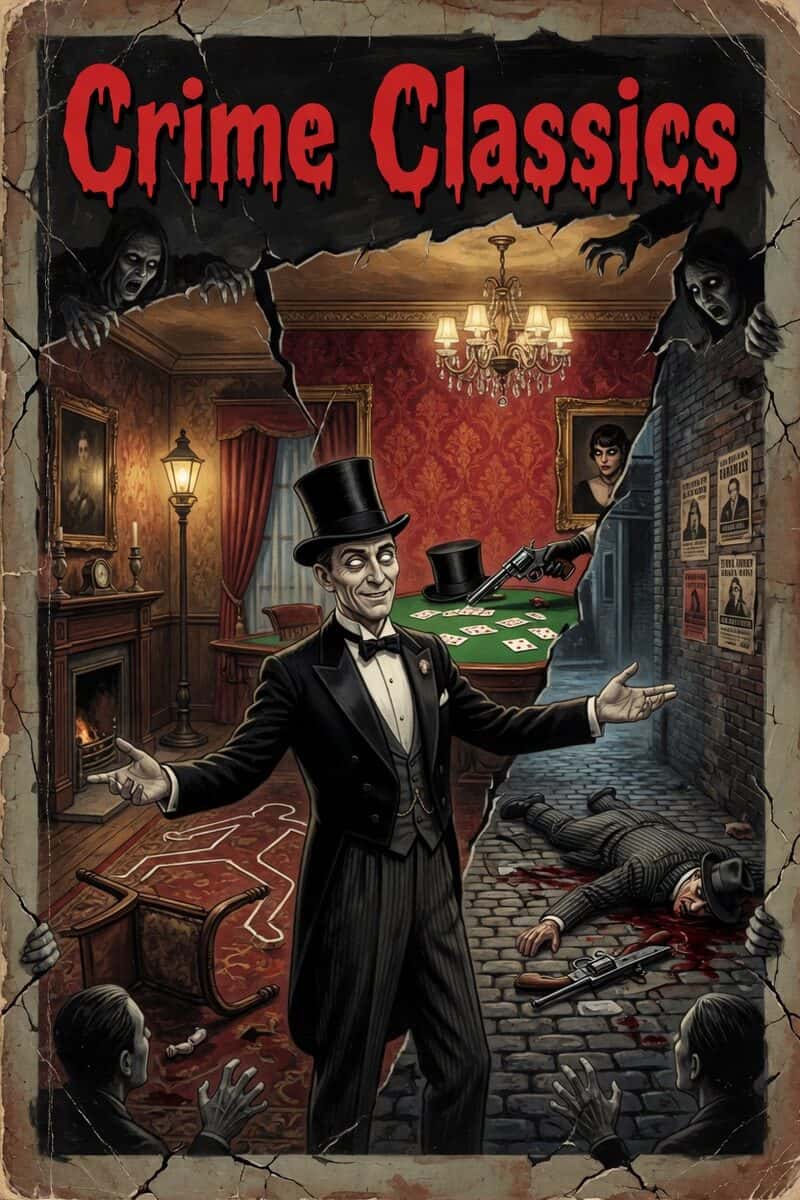
Crime Classics, a series of true crime stories taken from the records and newspapers of every land from every time. Your host each week, Mr. Thomas Highland, connoisseur of crime, student of violence, and teller of murders. Now once again, Thomas Highland.
San Francisco in the 1870s was coming of age. It was getting civilized. By this I mean that gentlemen who carried guns wore them beneath their coats. And the can-can could be viewed by mixed company. And mixed company was the theme of the day. It was a very romantic time and a time of elegance. Of crystal chandeliers reflecting swirls of silken gowns. And, from another angle, so did polished brass cuspidors.
Already the names Barbary Coast, Nob Hill, Gold Coast, and Chinatown were becoming legends. And, if we are to believe all we hear, Grandfather didn't have it so tough. If he chanced to look over a certain fence on a spring day in 1870, he would have seen this. A lovely lady on a swing. Dipping, swooping, gliding, soaring. A lovely lady with a lovely name. Laura. Laura with a rose twisted in her hair. And on the ground, her mother.
Isn't my daughter a pretty sight, Mr. Crittenden?
And Mr. Crittenden, late of West Point, Kentucky, and Virginia City.
Truly the fairest of the fair, Mrs. Lane. If I didn't know otherwise, I'd say she'd been bred in the bluegrass.
My daughter's first husband was from the bluegrass country. How about her second husband?
He never did say. There was no one around who would ask him, either. Oh. He was forever shooting things, walls, chickens, various things.
Your fair daughter has lived a fulsome life. Look at her up there, like a ladybird.
Hello, Laura.
Up there like a ladybird. You're going to marry my daughter, Mr. Crittenden?
I fear she still grieves for her late husband. Her third husband was tragic. Poor Colonel Fair.
That's the one who blew out his brains, isn't it? I wonder why.
Uh, Mr. Crittenden?
Yes?
You're going to marry my daughter?
If she weren't still grieving for the Colonel, why does she still bear his name? Why does she still call herself Laura Fair?
Why not? Look at her, swinging like she does. Have you seen a woman more fair?
No.
Laura! Laura! Oh, the grace of my daughter. She is lovely. About 32. Going on 33. And she doesn't swing as high as she used to.
Um, Mr. Crittenden?
Yes?
Forgive me for being rude. I forgot to ask you. How is your wife?
In the best of health, thank you. You must tell her soon that...
Mama. Mama, dear, you get on the swing, Mama, dear. Mr. Crittenden will give you a start.
Oh, some other time. Mr. Crittenden and I were just talking about Mrs. Crittenden, dear.
Oh, how is she?
Oh, how is she? Oh, how is she? Oh, how is she? Oh, how is she? Oh, how is she? Oh, how is she? Oh, how is she? Oh, how is she? Oh, how is she? Oh, how is she?
In the best of health, thank you. Have you told her?
I told her you bore her no malice.
What did she say?
That she likes you, too.
Oh, I'm so happy. Now you go home and tell her you want to marry me.
My dear Laura...
You go home and tell your wife you want to marry my daughter. Come along, Laura, dear. Let's...
...they went into the house, saying, Mama. And a tat. And while they're doing this, let me fill you in with some background notes. Laura and Mama had newly arrived from Virginia City, where their family-style rooming house had netted them $45,000. During the years and the welter of collecting the rents, changing sheets and towels, and setting the board with succulents, Mama had gained and lost three sons-in-law. It seemed that fate consistently made her daughter a hard woman to be married to. Laura's three husbands, each of them, died. And, as to our other principal, Alexander Parker Crittenden, he was a corporation lawyer with a wife and seven children and two grandchildren. Once, hot and dusty and alone in Virginia City, he happened into Laura's house, made known his desire for a bath and rest. No sooner had he changed into fresh linens and had listened to Laura's tale of how she had become widowed recently, than he became that weekend her star boarder. And, in turn, Laura and Mama were so taken with the world that they were so much more than just friends. It was with his quips and twinklings that they followed him to San Francisco. They took a house on Nob Hill, and there, tatted and waited for a proposal of marriage.
They understood the delay. They comprehended that Mr. Crittenden's wife was of a peculiar mold.
Who is Laura, Alexander?
Fine, ma'am. Just fine. And her mother?
Eager.
Eager?
Yes, ma'am. She wants me for her son-in-law.
And no wonder. You're a fine man, Alexander.
Thank you, ma'am. And a good father.
I try to be. And an excellent husband.
Yes, ma'am. Such a man as you is hard to come by, Alexander, dear. I should miss you.
I should miss you.
Then it's settled. Laura and her mother will be our good friends.
But Laura wants me for her husband. She keeps asking me. And her mother, too.
Dear. What?
Tell them no, but nicely.
I've told them. Keep telling them.
You're a remarkable woman.
Thank you, Alexander. To be friends with a woman who wants to take me away from you. I respect ambitions and honesty. Laura has both. That she should love you has my complete understanding.
Ma'am.
Yes, Alexander?
I must tell you that you are a flower. Womanhood should be proud to number you among its sisters.
How many is the time?
Alexander, we have an appointment for dinner tonight.
Yes, ma'am.
Ma'am.
What is it, Alexander?
Laura loves me. And I think I might love her right back.
Why, then, eat your heart out, Alexander. Now hurry, dear. We're going out to dinner.
Oh? I've sent a message to Laura to meet us at Burbisher's for dinner.
Oh. I do so enjoy watching her eat. She's so ravenous. Well, hurry. Hurry along.
Pretend, then. Be a pleasant one, though.
Every day is pleasant. When I'm... When I'm near you, dear Laura. And last night, how wonderful. Sitting between you and your wife. What a wonderful woman she is. I wish you two wouldn't like each other so much.
We both have the same consuming interest in life, Mr. Crittenden.
You?
Laura.
Yes?
I must tell you that you are a flower. Womanhood should be proud.
When are we going to get married?
Soon.
Upon your honor?
Upon my honor.
You're a liar, Mr. Crittenden. Therefore...
Laura.
Therefore, I shall not see you again, ever.
Laura.
I've thought it over, and that's the way it is.
Well, I love you, Laura. And you love your wife, too. I die without you. You love your wife more than you love me.
No.
Swear it.
I swear it.
Liar.
I mean it, Laura. You'll see. I'll get rid of her somehow, and I'll marry you. I'll make her see that I don't love her. I won't even kiss her anymore.
Swear it.
I swear.
I'll race you to the tree, Miss...
All right. Come on. Come on. Come on. Come on. Come on. Come on. Come on. Come on.
There were more foot races. When is he going to marry you, Laura?
Soon.
And much swinging in the garden.
Has he set the date for your marriage yet, Laura? Come out of there and talk to me.
And the tatting session.
Mama.
What?
I'm weary of his excuses.
And one day, wearily, she wandered down Market Street. There was a shop on Market Street run by a fellow who specialized in four-shooters. Now, a four-shooter is the same thing as a six-shooter, but it's for ladies, because it weighs two shots less. Now, this fellow who specialized in four-shooters was such a persuasive salesman that no sooner had Laura pressed her pert little nose against his shop window that he had her inside measuring her palm for pistol grips. When this chap let her go, Laura was the proud owner of a pearl-handled pistol, which this chap personally guaranteed. And that was in the days when a guarantee meant something.
Also, you must be told that on the morning the purchase was made, Laura had been without a husband for one whole year. Laura had never experienced this omission since she was 18 years old. So, gun in purse, she took to following Mr. Crittenden around. One night, she followed the gentleman and his wife through the fog onto a boat called El Capitan. This was the ferry boat between Oakland and San Francisco. Its skipper, you remember, was Bill Tranchel, the heavy-handed fellow who liked to entertain on his glass-enclosed bridge.
Well?
Thank you, Captain. Thank you very much.
To your very good health, sir.
To the health of your lady. And to yours, Captain.
Thank you, ma'am. This place is getting overrun with tugboats.
Mr. Alexander?
Tonight, somehow, you appear radiant.
Dear Alexander. Very dear to me. Dear.
Captain, you don't mind if I kiss the lady?
You just don't write.
I leave you for the moment with this note. Though he died... face to the deck. Mr. Crittenden was not buried at sea.
You are listening to Crime Classics. And your host, Thomas Highland. And his report to you on the incredible trial of Laura D. Fair.
In 1870, San Francisco was a city where violence was commonplace. But this violence was by far predominantly of the species male slaughtering male. Or male doing in female. So when Laura Fair shot Mr. Crittenden on a ferry boat, she practically invented a category. And thereby caused a stir. It planted ideas in feminine minds where such ideas never dared to be. The sale of four-shooters skyrocketed. And somehow, the sale of marriage licenses, likewise. The episode on the ferry boat was a shot in the arm for the suffragette movement. To the entertainment business slump. As many a husband spent more evenings in the bosom of his family. It was a city seething with unrest. With slow change. With static passion. It was a city whose entire attentions were focused on the trial of Laura D. Fair. For the murder of Alexander Parker Crittenden.
There will be order in the court. You may continue with your testimony, Captain Tranchel.
Kissing that lady over Mrs. Fair.
To explain, you were Mr. Crittenden's wife.
Mr. Crittenden, I have the question.
On the witness box here.
One moment, Captain. I wish to hear why Mrs. Fair considered herself to be the wife of Mr. Crittenden.
Another selection. That outfit may cause me to clear the court.
Thank you. My feet have not been made sacred in heaven. The sergeant-at-arms will bring forward immediately the parties that applauded.
I applauded more than anyone.
The sergeant-at-arms will bring forward that lady.
I applauded more than her.
And will bring forward that man, too.
Nature could not stand the denial of the truth by that lady over there. It was I, indeed, who was married to Mr. Crittenden.
Francis M. Hughes. Did you applaud?
I stamped my foot.
Why did you stamp your foot?
Because of compulsion.
Why?
I was carried away with what Mrs. Fair said, and I felt a compulsion.
I fine you $25.
Judge.
Yes, Mrs. I will pay it.
You are dismissed, Mr. Hughes.
Oh, bless you, Mrs. Fair. Bless you, ma'am.
Thank you, Mr. Hughes.
Emily Pitt-Stevens. Did you applaud?
I said, good.
Stand down on the bench in front of me. Come on.
Fine, $25.
But I made no noise with my feet.
But with your hand, you did.
With my hand, I did. You're fined $25.
Thank you, Mrs. Fair. And thank you. They believe you've been the best woman. You're there.
Mrs. Fair, you will have to draw heavily upon your bank if you will pay the fines of all who are loaded.
As long as you fine them for cheering me, I will pay those fines. Your Honor.
Just a moment, Captain. I just wanted you to know what could... Thank you, Your Honor. And Mrs. Fair came in and shot with a four-shooter. That's all. The court reports here. And that's what they say. And if you think this was an unseemly way to conduct a trial, I have something else here. I'd like to read it to you. This is a consensus of legal opinion of the time. And I quote, "The trial was conducted in the main thoroughly and well, with somewhat less regard for the decorum of the courtroom than is customary in most eastern cities, though far in advance of the practice in New York City in this respect." Unquote.
And now that we have resolved any uneasiness you may have had about the conduct of the trial, let's listen in again.
Mama on the stand is an imposing figure. She wears brocaded black, and a great veil that drops from her hat to her waist. Her feet, however, were cold.
Bring the lady a footboard.
That cushion will do.
Much better, Judge. Thank you. Your feet will warm up in no time at all.
Oh, I'm sure of it.
And now, what were you saying about your daughter?
I've always had trouble with her.
I know what you mean, being a parent myself.
Oh, not like Laura.
What do you mean?
Doctors, doctors, doctors. My daughter has tried to kill herself. On numerous occasions. There's madness in the family. Besides, my daughter's second husband was mad. I don't think that helped. Grief and doctors and madness. I tell you, raising Laura was trying. I think I did a pretty good job. Although my daughter is not sane, you know.
Not sane?
Crazy.
And doctors were called to corroborate. And this they did. Little known facts about Laura Fair were brought to light. And caused more nudging of elbows than applause. Some of her ailments, described by the learned physicians, had symptoms that weren't talked about very much in those days. One medico described the raving exhibition put on by Laura. A recounting of which held spellbound his students at medical college. Another doctor described a malady owned by Laura Fair so vividly in one of the trade journals that he was considered 20 years ahead of his time. When faced with these revelations, Laura accepted them by lowering her eyes modestly.
Dr. Leonard Byfrosser, chief spokesman for the doctors, summed up medical testimony by suggesting strongly that Laura was unconscious when she shot Mr. Crittenden. That's what it says. Laura was unconscious when she shot Mr. Crittenden.
Back to the trial now and the lady who became Mrs. Crittenden by marrying Alexander in the city hall, somewhere in Kentucky.
It is ridiculous to believe there is madness in that woman over there. She's vicious, predatory. And since the moment she was thrown in contact with my husband, she pursued him, worried him, and pled with him to marry her. That this necessitated getting rid of me didn't worry her in the least. She killed my husband out of frustration and anger. That woman there!
The high spot of the trial was on a morning in November. The court had denied Laura permission to lie on her lounge, upon which she had reclined throughout the trial. So Laura has been made to arise and take the stand, and was so sworn in. Demanded and received a foot-warmer and said interesting things, like this.
...Mr. Crittenden to let his wife keep the furniture. I told him we could get new furniture and a new house. And that in every corner in each room we could kiss. And he could hold me in his arms in each chair, sit by me on the sofa, hang over me while I played his favorite march on the piano.
In the afternoon she enthralled listeners with this.
And I remember well when Mr. Crittenden said, "And I remember well when Mr. Crittenden said, 'Please do. Put arm about my neck, his dear face close to mine. And he whispered, shall I say it, Jack?'"
Please do.
He whispered that he would cross mountains unshod, walk through storm uncovered to come to me. He said he cared not for hardship nor exposure, for every step he took brought him nearer to me. To the other and better half of his own soul, he would tell me. Shall I go on?
Please do.
The night that he said I shot him, I can remember only glass.
Glass?
What is the touch? And through it, a disagreeable and peculiar voice.
Did you recognize the voice?
That woman over there.
Continue.
I put my hand against this glass, and it opened, and I saw Mr. Crittenden leaning close to a woman and kissing her, and I felt myself slipped into an awful pit of blackness. I do not remember how I got away from there, or what was done to me after.
Gentlemen of the jury.
We have your honor.
The accused will rise from her lounge and face the jury. The jury will face... And what is your...
Guilty of murder in the first degree.
...led away to jail.
An enterprising young reporter of the time, Garth Preebles, interviewed her in her cell where he learned and had published the fact that Mrs. Fair had spent $12,000 in her defense. She confided to what she spent on her second trial, which was in the amount of $30,000, and which broke her. Where this $30,000 went to is a mystery, since the second trial was not nearly so spectacular as the first. Captain Billy Transhell of the ferryboat El Capitan somehow was not there as a witness. There was a new judge, too, who in later years became known as Kindly Judge Reardon, and a new jury, 12 men and true out of 400 examined.
And our love was a greater love than is given to most women. That was the second trial, and that was Laura again, and the jury was not there. And the jury was not there. And the jury was not there. And the jury was not there. And this time, another verdict. Not guilty.
So, after acquittal, she went on a lecture tour and told of her hardships. That was Mama, tambourine handler, advance man, and treasurer.
How did we do, Mama?
$1.85. When you lecture tonight, honey, pep it up a little. Promise Mama, will you?
I'll make it real peppy, Mama.
Mama passed her last tambourine one cold winter's night in Sacramento in the year 1889. But Laura lived on. She lived until the age of 82, after another husband and another long period of widowhood. Until the moment of her death, she insisted that Mr. Crittenden had only been her very good friend. And once, in a moment of mutual transgression, they held each other's hands. That's what it says right here.
In just a moment, Thomas Highland will tell you about next week's crime classic.
Laura D. Fair, tonight's crime classic, was adapted from the original court reports and newspaper accounts by Morton Fine and David C. Crittenden. The music was adapted from themes of the period and conducted by Bernard Herrmann. And the program is produced and directed by Elliot Lewis. Thomas Highland is portrayed on radio by Lou Merrill. In tonight's story, Mary Jane Croft was heard as Laura and Florence Walcott as Mama. Featured in the cast were Herb Butterfield, William Johnstone, Paula Winslow, Gene Wood and Joseph Granby. Hugh Douglas speaking. And here again is Thomas Highland.
Next week, Ham, England in the year 1673. A time of money cutting and highwaymen. And of course, violent theft. My report to you will be... Beyond the Halsop family. How it diminished and grew again. Thank you. Good night.
Crime Classics has come to you through the worldwide facilities of the United States Armed Forces Radio and Television Service.