
The written record
Read the transcript
Read along with the recording · About 18 min to read
Good evening. This is Crime Classics. I am Thomas Hyland, with another true story of crime. Listen. The sound you hear is that of a swimmer in the Adriatic Sea. Her name is Agrippina, and the stroke she's using, 'tis one of the day. According to research, a kind of combination overhand side and flutter kick. Agrippina is quite good at it, too, she being the mother of the Emperor of Rome and having the best instructors in all things. For instance, her swimming instructor told her to roll over on her back and float when she got tired, which she just did. And she was tired all right. She'd been swimming toward shore for the last two hours. Not for laurels, not for prizes, but to save her life. It seems her son had tried to drown her by rigging up a boat whose bottom would fall out, and which did when Agrippina was on it. Sonny's name? Nero.
So tonight, my report to you about a mother and son in Rome in the first century A.D., listed in my files as Your Loving Son, Nero.
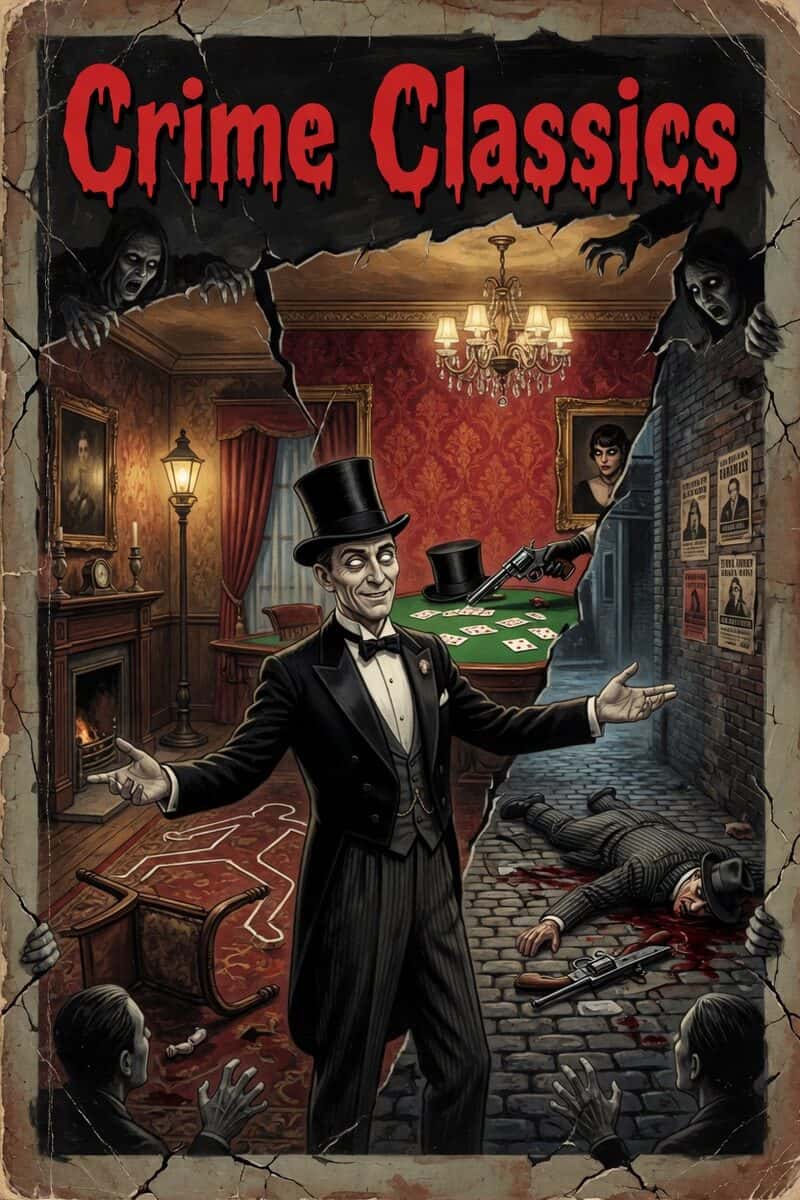
Crime Classics, a new series of true crime stories taken from the records and newspapers of every land from every time. Your host each week, Mr. Thomas Hyland, connoisseur of crime, student of violence, and teller of murder. Now once again, Mr. Thomas Hyland.
Rome, in the year 62 A.D. Nero had been on the throne for eight years, and had put on 60 pounds. And no wonder. At 25, he had tasted every sweet from Ethiopia to Britannia, and had scouts out for whatever he had missed. I'd better tell you some nice things about Nero before we really get into this. First of all, he had a genuine love for Rome and its people. Oftentimes, Nero would release a thousand birds of every kind, some with Roman money attached to them. He also threw to the people pork and mutton saddles, as well as tickets for grain and togas, and choice seats to concerts, at which he sang. This was the Nero that history forgot.
Now, let's have a look at the Nero who is remembered.
Scene, dressing room in the Roman Colosseum. Principals, Nero and Seneca, his mentor.
Hold high the sheet. You look for me, Seneca, so that I may look into it.
You look like... What? Out with it. Out with it, Seneca.
Like a beast of the Nubian plains.
Which was my design when I put on the skin of a black leopard. I meant sleek. And you meant handsome? And dangerous. Do I frighten you? Yes. Well, then cower. Oh, Nero. The emperor will have great sport today. The crowd will love this novelty. I am beloved, is that not so? The poets sing of it. But listen now, great Nero. I have a thing to speak of. Hand me that broadsword. Here. This sword will be my claws in the arena this day. Beloved Nero.
Seneca. This thing I have to speak of.
Yes.
They say... Who?
Those about you of importance.
They say you grow overly fond of your mother.
As I am her son, why not?
That she saps you of your wisdom.
Why not? Why not? Why not? Why not? Why not? Why not? Why not? Why not? Why not? Why not? Why not? Why not? Why not? Why not? Why not? Why not? Why not? Why not? Why not? Why not? Why not? Why not? Why not?
She does undue influence upon you.
Agrippina's a loving mother.
Just so? Too much so. Her mother love saps you of your vigor.
What you say is an impiety, Seneca. Lord Nero, be careful of your sword. What more of my mother and me?
I repeat only what they say.
Come, Seneca. Lift me into the cage.
Yes.
Then down your back so that I can step on it.
Yes.
Be brave now, Seneca. I am in a cage. What else is there? What else is at your brain as concerns my mother?
Kill her.
For your sake? Because I love her more than you?
For the sake of Rome.
Which is me.
Of course.
Have the slaves wheel me into the arena, Seneca.
Yes.
What happened when Nero was rolled into the arena in a cage dressed in a black leopard skin is a fine clue as to the lad's personality. Also in the arena and tied securely to stakes were slaves. Then the cage was sprung open. Then Nero leaped out with his broadsword and performed whatever ritual came to mind. Later, when the sands of the arena were swept clean and in some places re-sanded, Nero performed again. This time with stringed lyre in curls and silken toga.
Nero sweetly strikes his lyre. Apollo's his bull. Nero's song is the tongue of Phoebus' bull. And Nero... And so on into the night. He didn't sing well, but he sang loud and long. And he had a special arrangement with the Colosseum guards. Collect the heads of all those who tried to leave while he was singing. It was usually after midnight when Nero finally gave the signal for his audience to go home.
Nero was fatigued and he wanted his mother. History tells us Agrippina had a restorative influence on her son because of the soothing quality of her voice, perhaps of the understanding light in her motherly eyes, or just perhaps because of a way she had with...
Nero's oil and myrrh.
Hush, son. How tired you must be from the day. Let me this soothing of you...
Mother...
Turn your other shoulder to me, son.
So help me, Jupiter, mother, if you don't let me ask you what is...
Yes, what is it?
What I did today in the arena with the wearing of the leopard skin.
What of it, mother?
Terrifying.
Huh?
What else?
Exciting.
Yeah? And what else?
Poppaea sat beside me. She bit the soft. She bit the soft of her hand till blood came in such ecstasy.
Oh, mother, Poppaea's always biting the soft of her hand when she sees me.
She's fond of you. Why do you laugh?
Last night, Poppaea painted her face in ochre and went to the oracle. She's afraid Acte, the slave girl from Germania, has taken a place in my affection.
Has she?
Acte opened her veins this noon because I demanded it, and Poppaea doesn't know it yet.
Anoint my hair, mother. Oh, not that much.
Poppaea is waiting for you. She's waiting for you, isn't she?
Oh, of course she is. What does she say of me?
We hardly talk, mother. I sing to her and then we stare at each other.
Oh, thank Jupiter for ears. But Seneca talks to you, doesn't he?
Hand me that garland, mother.
Doesn't he?
Oh, much. Constantly, pratingly, ceaselessly without end.
Of me?
Much. Constantly, pratingly, ceaselessly without end.
What does he say?
He wants me to kill you.
I see.
He says you love me too much and have undue influence upon me. Therefore, you should be dead.
Nero, my son.
Yes, mother.
Remember that Claudius died suddenly and for that reason you are emperor. Remember that Claudius died because I wished it. Somehow there was poison and somehow Claudius died. And remember too that rightfully your stepbrother Britannicus should sit on the emperor's throne and remember...
Jupiter, look at the hourglass. The sand's run out. I'm late. Let me kiss you. Ave, my dear.
A poppy blossom of slender shaft, of scarlet petal, her gaze enthralled. Give thanks to Olympus. Give thanks to the gods that seize Nero as to her cause.
Emperor.
Wait. I lay on the leisure today after the pool. And I gazed up at the heavens and the thoughts went through me in a rush. Millions of thoughts and...
Bad boy. Bad boy. Bad boy. Bad boy. Bad boy. Bad boy. Bad boy. Bad boy. Bad boy. Bad boy. Bad boy. Bad boy. Bad boy. Bad boy. Bad boy. Bad boy. Bad boy. Bad boy. Bad boy. Bad boy. Bad boy. Bad boy. Bad boy. Bad boy.
After tonight is tomorrow. And the being emperor again. And the whisperings and the intrigues. Ah, Poppaea, my head swims in thoughts. My poor, poor, poor, poor, poor head. Who rested upon me.
Emperor.
Yes. Your mother anointed well. Your curled smell of the dew.
She hates you, Poppaea. I know. She hates Seneca. Because he is wise.
Poppaea. Poppaea. Poppaea.
Not your girl and bind your brow. Here, let me take it off.
Oh, ah, gentle puppy.
Seneca's wise, Nero. Do you want my mother dead, too?
Only for your sake.
How?
It is said that Agrippina is anointing her stepson, Britannicus, lately, and in private calls him Emperor.
Ah, it's a rubicose. Dwells a witch. Pluto's daughter, ill-got she. Her name is Locusta, Locusta, Locusta, horrible witch. From the river of the dead, her poisons be.
Oh, sing no more, Nero. I love thee too well, Emperor.
Poppaea wasn't the only one who bade him lay down his lyre and still his song. A man named Petronius did the same thing. He wrote Nero a note and told the Emperor that he was the worst singer of all time. Then, Petronius, to save a lot of time all the way around, opened his veins. But Poppaea, being currently Nero's type of love, she got away with it.
Also, in Nero's ear, she went on and on about the new Delphic Oracle, who knew the mysteries, she said, like no other Oracle in Rome or in the provinces. A younger man, she told Nero, one with younger ideas, one who could conjure voices, speak to the gods, and recognize ancestors in various places. So, Nero kissed her for her concern, retrieved his garland, left her.
On the way to the Delphic Oracle, he made a decision.
And I'll do it now, as long as I've got my mind made up.
And he made a detour. Stopped in to see Locusta on the Iter Rubricus, then paid a call on his stepbrother, Britannicus.
This vase of wine I bring you, brother, from Gaul. It is where the Rhone flows gently and the grapes grow fat. Oh, great stepbrother, whose love is dear to me and who desires nothing but good for me. For these reasons, I give you this wine that you should drink. Drink it. Like that, boy. Throw back your throat and let the coolness of it, the death of it, touch you and chill you. Come on!
Britannicus has drunk poison and is dead. He hated life and wanted no more of it.
Then Nero called upon the Delphic Oracle. No sooner had the Oracle lighted his pot of fire and said the words, then Nero asked the question.
My brother Britannicus is dead. What should be of my mother?
Jupiter and those on Olympus are jealous of you, O Caesar Nero. They would smile more brightly upon you if Agrippina were dead and belonged to them.
Nero went home to the palace, and the Oracle went into his back room.
It is done, Seneca, I have told him.
And he will kill his mother?
This I believe.
How shrewd is Poppaea to have sent him to you?
This I believe.
On the table is a thousand sesterces, Oracle. I will say words for you into the fire, Seneca.
Hail. Hail.
Nero went to sleep that night with a new mission in life. He was going to kill his mother.
You are listening to Crime Classics and your host, Thomas Hyland. Don't walk a mile, just sit at your radio for hilarious entertainment Monday nights on CBS Radio's Walk a Mile Quiz. Bill Cullen's in charge of the game with a high-paying jackpot in prizes and pleasure. Later tonight, don't miss Walk a Mile. And say also later this evening on most of these same stations, listen for Arthur Godfrey's Talent Scouts with Arthur himself back in the saddle again.
And now, once again, Thomas Hyland and the second act of Crime Classics and his report to you on Your Loving Son, Nero.
A word about Rome in the year 62 A.D. Rome was in her glory. Her subject people stretched from Asia Minor to Britain, and they paid their taxes on time. A city of slaves and temples and chariot races and the like. And visitors from Greece and freedmen from the provinces and spices and oils and unguents. And here and there on the streets, an old Etruscan. The Colosseum was the center of attraction. Here, man fought man, beast fought beast. And on holidays, they switched.
Nero was emperor, and you already know how Nero loved to set an example. Agrippina was his mother, and some background on her. Out of a maternal concern for her son, she poisoned a lot of people. Most prominent of whom, her third husband, the Emperor Claudius. Pliny the Elder, in his letters, mentions her as the vilest of women, and I just quote it. But Pliny was called in the journals of Tacitus as a sour man, and I just quote it again. Anyhow, her son Nero woke up one morning determined to murder her. So, he sent for Locusta of the Iter Rubricus.
Get off the floor, witch, and come close. You brought poisons. What's this one for?
Nephews.
And this?
Daughters.
And this?
Mothers.
Mothers? Oh, tell me of it. It is powdered stuff of a thing I know, plucked from a swamp I know, when one night the moon of fertility rode.
In the eighth month of Octavian, when there was harvest, it kills mothers quickly, instantly. Without pain. I would not like my mother to see this. Psst. Like that. How is it used? Yes, a drop in a sweetmeat. Or whatever. I'll have it. Oh, Seneca! Pay her, Seneca. A thousand sesterces. Seneca, have the wall splashed with sweet-smelling oil to take this reek out. Go, go.
And so, mother, as a small gift of the day in honor of Persephone, sweetmeats from Thebes. Plump dates, rolled in cinnamon, stiffened honey from Alexandria, wild berries from the south slope of Lebanon, drowned in sweet essences. Which is your favorite, son? This one, this one. Put it to my lips. First. Yes? I would kiss you, mother. Persephone's day is a favorite of mine. You make it happier. Then to me. Now here is your walnut sweet. It's very good. Excellent. May I have another? Of course, of course. Here's a choice. One's bigger. Now, bro, you... Oh, the gods should know of it. And may I have some of that? What is it? Oh, morsel from the Hebrews. A cluster of almonds chopped with apples and dipped in wine. Oh, delicious. Ah, thank you. Mother? What? How do you feel? Blessed by Jupiter, who's given me such a fond son. Son. Yes, mother. Eat of your gift. Here, I will place a sweet meat to your lips. Stop. Stop it. Do you ail? Stop it. Stop it. Stop it. You ail. Let me hold you, son. Sweet son. Emperor's son.
I have here a translation from a Latin historian named Suetonius. In essence, here's what the gentleman has to say. Thrice Nero tried to poison his mother with sweet meat, and other devices, but each time, warned of his plans, she suffered herself to swallow antidotes beforehand. Nero then planned another method for his mother's destruction. He tampered with the ceiling of her bedroom, contriving a mechanical device for loosening its panels and dropping them upon her while she slept. But this leaked out through some of those connected with the plot, so that Agrippina was warned and slept elsewhere. Imagine Nero's chagrin and fury and petulance.
Sir. Sir. Oh, his mentor, Seneca, came up with a thought. Now, now, the first thing you've got to do is control yourself. Throw that last Grecian urn and get it out of your system. I'm glad you did. It was a hideous bit of pottery anyway. Now the thought. Write your mother a letter. To say what? Well, you wrote Petronius a letter telling him it would be best for himself and the state to open his veins, did you not? Yes. And he did it. As did Fluvius when you wrote him a letter. And Casper. And Aunt Maria sent his... His three sons and that, uh, senator. Lucius. Loud from his mouth of taxes and excesses. And others. Write her. And you will tell me what to say? As before, with the others. Let us do it. And since, mother, it appears you are trying to have me slain, for the good of all of us and of the state, I, Nero, emperor and faithful... You're going too fast. Where are you? I, Nero. Emperor and faithful son do request your death. This gift I enclose, small knife of gold, for slitting. And sign it, your loving son, Nero. Now put your seal to it, and I'll have a slave take it over right away.
The slave has just now brought me your letter, which needs prompt reply. I will not kill myself, are they? Mother. Mother. What is it? Did you enjoy the banquet? You sang beautifully. That is not what I mean, mother. What then? No one fell dead at the banquet, mother. Neither your taste nor mine. I don't want to think about it. I know that. That's why I've arranged this voyage for you. And when you return from Thessaly, you will bring back forgiveness in your heart for me. Son. Yes? Do you still want your mother dead? No. Swear it? By the gods of Olympus. Then my voyage will be joyful. With a new and fleet ship to take you to golden sands and return refreshed. I love it. I love you well, Nero. You are my love, mother. Ave. Ave. Sail home to me soon.
If this tender scene of Ave's and loving kindnesses perplexes you, well, it really shouldn't. Nero was still up to no good. In spite of the sumptuous banquet he had arranged for his mother out of the clear blue sky, and in spite of the trip he had arranged for her to golden sands and return by way of a peace offering, Nero still had murder on his mind. This ship he had built for his mother, you know who built it? Anicetus. And who is Anicetus? Any of your better histories on triremes and other Roman naval craft will devote at least a few paragraphs to Anicetus. He was forever trying things against the laws of navigation. For instance, this ship that would take Agrippina to Thessaly, he designed it so its bottom would fall out five miles at sea. And did it? Well, let's pick up the ship just before it was five miles out on the Adriatic. Quiet ocean. Azure skies. As fine a two decks of slaves chained to the oars as you'll ever find. And Agrippina, having grapes at the captain's table. You men of the sea, captain, all my life a great wonder I've had about you. What's that? Help me! Well, everybody drowned except Agrippina. Not that she was the greatest swimmer in the world, as she only knew one stroke, but she had sense enough to roll over on her back and float. When she got tired, so she got to shore. She made known who she was, which got her a fresh toga and transportation back to the palace. Nero was waiting for her. Mother. Mother! Mother! Oh, mother! Slaves! Angle her! And they did, with a silken scarf.
It is interesting to note that the word mater in Latin means mother. From mater, we get the word mater. The word matricide.
In just a moment, Thomas Hyland will tell you about next week's Crime Classics.
Your Loving Son Nero, tonight's Crime Classic, was adapted from the original court reports and newspaper accounts by Morton Fine and David Friedkin. The music was composed and conducted by Bernard Herrmann, and the program is produced and directed by Elliott Lewis. Thomas Hyland is portrayed on radio by Lou Merrill. In tonight's story, William Conrad was heard as Nero and Betty Lou Gerson as Agrippina. Featured in the cast were Sammy Hill, Edgar Barrier, Hy Averback, and Martha Wentworth. And here again is Thomas Hyland.
Next week, Troy, New York, in the year 1845, and my report on the funniest woman in town. She really made the town folk laugh. It's listed in my file as The Torment of Henrietta Robinson and Why She Killed. Thank you. Good night.
If you went away from home for ten years and returned, what would you expect to find? The answer may unfold. The answer may unfold for you later tonight when Claire Trevor stars in One Last September, a touching, enchanting, dramatic story on the Lux Summer Theater. Don't miss it later tonight on most of these same CBS radio stations. Stay tuned now for Arthur Godfrey's Talent Scouts, which follows immediately over most of these same stations. America's 45 million radio families listen most to the CBS radio network.