
The written record
Read the transcript
Read along with the recording · About 15 min to read
Good evening. This is Crime Classics. I am Thomas Hyland, with another true story of crime. Listen. That's the way a room sounds. A particular room in a narrow street in Edinburgh, Scotland. Someplace on the wall there was a drip. When the room was still, when there was a lodger in it, asleep, that was the sound. But listen again. That's the way it sounded when it rained, because the room was just below gutter level, and the rainwater rushed by the room's only window. Many lodgers caught cold in this room. They were lucky. Many other lodgers wound up on a dissecting table. They were murdered. By Mr. Burke, who smothered. By Mr. Hare, who held.
So tonight, my report to you, If a Body Need a Body, Just Call Burke and Hare.
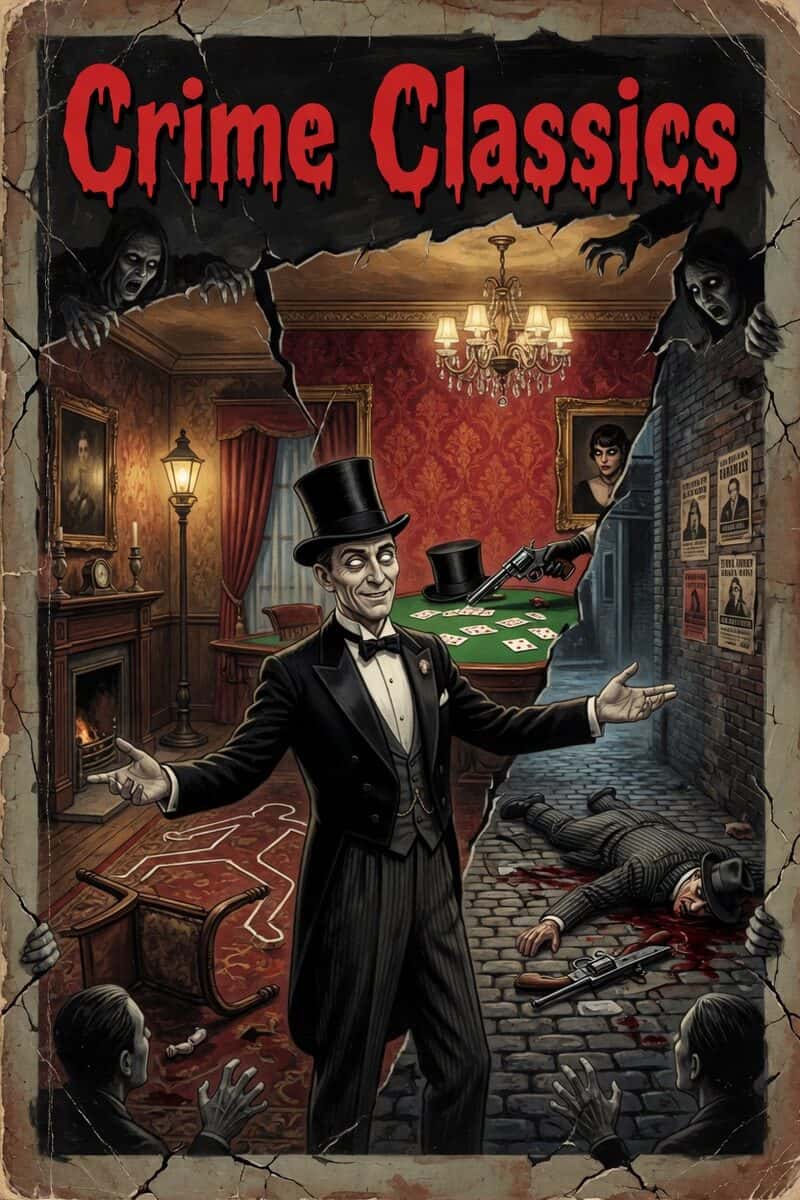
Crime Classics. A series of true crime stories from the records and newspapers of every land, from every time. Your host each week, Mr. Thomas Hyland, connoisseur of crime, student of violence, and teller of murders. Now, once again, Mr. Thomas Hyland.
In 1826, a city famous for lasses, laddies, people coming through the rye, Scotch, kilties, and medical schools. It is this last I'd like to speak a word about. Now, when a student entered medical school, he studied anatomy right off. No road. He was a foreman in the gloamin'. Enter school, cut up a cadaver. Except, there weren't enough cadavers. Executed criminals were the only legitimate source of supply. Therefore, a new occupation sprang up and flourished. Grave snatching. Piecework in corpses. Rob a grave of its contents and sell it to science. Yet, the supply didn't meet the demand. So, as in every profession, there were those who looked for shortcuts. Burke and Hare came up with one. They owned that room. I told you. A room in Tanner's Close.
I'm tired of waiting for him to die, Burke. Go look at him.
Yes. I can't tell whether he's breathing or not. The old man's so skinny. So sick. Hear if his heart beats. Such a skinny man. Such a sick, skinny man. Such a sick, skinny old man. And he will not die.
Burke.
Aye?
The other who sought lodging here and who died brought us eight pounds.
Aye. This one?
Aye. He's older than the last. Dr. Knox will not be happy of him. However, we should not accept less than eight pounds.
Aye. Hare. Is there more whiskey, Hare?
Nor food. Nothing. Nothing save an old, sick, skinny man who takes space and will not die. It's so cold. So cold. Oh, may hands be numb. Whiskey would warm them from the fingertips. From the fingertips.
Hare.
Aye.
Hare. Say it, man.
If this old man were to die this minute. If we were to stuff him in the tea chest this minute. And walk with him to the anatomy laboratory of Dr. Knox. And Dr. Knox pays upon delivery. We would have whiskey in a half hour from now. That is if this old man were to die this minute.
But that would be murder. Have you ever done a thing like that?
No, no, no, no. Such an old man. To lie sick. To suffer in a cold room. Wet room. No family to give him comfort. Poor old man.
Burke.
Aye.
To kill him would be to bruise him. Dr. Knox perhaps would not accept a corpse unpretty by bruises. However.
What?
However, if I... If I put my hand over his nose and mouth like this.
Jamie. Jamie. It's such a time like... Oh, such a time to come. Hold his feet, Hare. He'll not kick. A lad like that.
Is he dead? I'll listen to his heart. Is he dead? Is he dead? Is he dead?
To insist upon it, I suggest...
Enough words, Dr. Knox. Take a look.
Was it worth calling you away for, doctor?
A half hour dead, I'd say. Less, wouldn't you say, Hare?
Oh, I'd say it was worth more than eight pounds. Fine specimen. Fine specimen. Ten pounds. I'm not a quibbler, gentlemen. As a matter of fact, I'm on record as saying that quibbling is a...
The lecture's in the other room, doctor.
Just give us the tenor.
Certainly. Here. Thank you. Two bodies in a week, gentlemen. Basis for an acquaintanceship, do you not think? Therefore, if I might make a suggestion.
Suggest away.
Two bodies in a week. Both male. My students, when they will become physicians, will be called upon to administer to both sexes. Therefore, you want a lady.
Good day, gentlemen. I must back to my students.
Dr. Knox had more students than anybody. He was much admired in the city of Edinburgh. A man of culture and wit and an excellent surgeon. A democratic man. He got along as well with the aristocracy of the city as with its murderers.
Approve? Ain't that Dr. Knox a nice gent, eh? A ruggy-boo. A donny man. Proof as furnished by Burke and Hare. Two fellows with ten. Less what they paid for a bottle. He said he wanted a lady. Have a drink.
Aye. A real ruggy-boo, that Dr. Knox. A drink. And arm in arm, they walked through the slums of Edinburgh. And they looked fine against this background. Bags and bones and cat skin and human hair and cast-off shoes. No! No! Trinkets and fish heads, second-hand goods purveyed to people who were dying the instant they were born. Stalls of tatters, shops of fragments and shame. Alleys and filth, ten years old. And through it, chameleons, Burke and Hare.
Have a drink, Mr. Hare.
Eh. Oh. I'm done. Have a drink.
Aye, Jimmy. Aye, lad. Have a drink. Who knew? Here's a coin, lad. Thank you. You got a song I can sing for you?
Oh, have a drink, lad.
Oh, no, sir, Mr. Burke. Oh, no, sir, Mr. Burke. Like an angel, he says it. Angel with cheek like down between me fingers. Have a drink.
No, sir. No, you run. Give the coin to your mother, boy. Funky. Come along, Hare.
Aye. I was saying, Hare. About Dr. Knox, you were saying.
Aye. What his lack was. What he said he's needing.
Have a drink.
Aye, there's no more in it, Hare. Ain't me wanting a drink. Aye, there's a place.
Aye. A bottle of your finest.
Aye, that's the word, barman. The finest. The finest for Burke and Hare. Hare, have a drink, Mr. Hare.
Aye. Here. Have a drink, Burke. Mary. Mary. A lady. Such as ladies are in this corner of Edinburgh.
Yeah. You're laughing. Tell me a one so I can do a laughing, too.
A fable, Mary. Pretty Mary. Bonny Mary. Not for your ears.
And what of my ears?
Oh, dainty and little pearl shells. Give us a kiss. Give us a copper.
Good, Mary. Have a copper, Mary. Give us a kiss, Mary. A bargain's a bargain. Ain't it? Such pretty shoulders on you.
What did you say?
Such pretty shoulders.
Ah, you're a darling. Is it true, Mary, he was painted by an artist?
Ah, true. A dolly lad with a beard. A tickling beard.
Aye, Mary. A kiss of copper. You need lodgings tonight, Mary.
Aye. One more copper and I can pay for it.
Oh, I got a clean room, a lodging room. Next to my cobbling shop, I got one.
Aye, I've heard. And from the looks of your shoes, Mary, you could stand some cobbling.
With what money?
For free. Now, ain't them pretty words, Mary? For free.
Oh. For free. Cobbling for your pretty feeties. And a clean bed. Now, come along, Mary.
What trick?
Come along, Mary.
Is it a trick?
Now, come along, Mary. You wouldn't play a trick, would you? You just come along.
Oh, very well.
So, Burke and Hare and Mary Patterson went to the room under the gutter, and Mary took off her shoes to cobble.
Oh. Oh. Oh. Oh. Oh. Oh. Oh. Oh. Oh. Oh. Oh. Oh. Oh. Oh. Oh. Oh. Oh. Oh. Oh. Oh.
And she lay down in bed to sleep.
Ah, she was very beautiful.
You are listening to Crime Classics and your host, Thomas Hyland.
This land is your land, is mine. This land was made for you and me.
Everybody knows which company produces most of the world's tomato soup, but few know where the tomatoes come from. Not too many are aware of the vast tomato fields of New Jersey. Canning tomatoes isn't New Jersey's only claim to fame, however. The Miss America Beauty Pageant is held annually in Atlantic City, which also has delicious saltwater taffy and an amusement park with no roller coaster. Better than a roller coaster ride, though, or at least quieter, is a ferry ride across the Delaware from Cape May, about 45 miles from the boardwalk by way of Stone Harbor, with its nesting egrets and herons. Unfortunately, the casual observer seldom sees the richness of growing things or the beauty of the birds. He more often notices the swampy meadows, the towns and cities huddled along the railroad, the sign, Trenton makes, the world takes. It is usually the native New Jerseyite who delights in beaches such as Wildwood, the rolling farms of Monmouth County, the dairy country and gentle mountains of western New Jersey. One native thought that he would never see a poem lovely as a tree. Could be he was referring to the proud red oak, symbolic of the Garden State.
And now, once again, Thomas Hyland and the second act of Crime Classics, and his report to you on If a Body Need a Body, Just Call Burke and Hare.
In the winter of 1826, Edinburgh was a-talk again about the latest appearance of the Loch Ness Monster. And speaking of lochs, Edinburgh was also a-talk about the Loch Fenwick Imbroglio, whereby Sir Angus McDermott was stripped of his tartan and forced to flee with his six sons to the Netherlands, where they were received with snickers by the populace. Having been thus rocked, Edinburgh was little prepared for what was in store. For in Tanner's Close, a street that spilled into a pigsty, there lived two men.
As sure as my name is Billy Burke, she's a pretty.
And Billy Burke's friend, Billy Hare.
Aye, and a bonny sleeper.
Aye. Hold, hold her. Is she dead? Is she dead?
I said aye.
Tell me, is she dead?
What's the matter? What's gotten to you, man? Such a bonny sleeper. Why must I slap you so, man? Tell me a thing, Burke.
Aye.
That pretty thing, is she dead?
I said it. Now, what's gotten to you? Tell me, tell me, tell me. Didn't you feel the slaps, man? What is it?
She be dead.
Aye, she'll fetch 20 pounds in a dead market. Aye. Now, give us a hand.
What is it? What is it? What is it?
Aye. Aye. Aye. Aye. Aye. Aye. Aye. Aye. Aye. Aye. Aye. Aye. Aye. Aye. Aye. Aye. Aye. Aye. Aye. Aye. Aye. Aye. Aye. Aye. Aye. Aye. Aye. Aye. Aye. Aye. Aye. Aye. Aye. Aye. Aye. Aye. Aye. Aye. Aye. Aye. Aye.
A heaping of rags in the corner, clothes of two others who had died there, and outside the thin yelping, and outside the thin hand still outstretched.
I need out of here, Burke. I need out of here, Burke.
Touch the tea chest.
I need out of here, Burke.
I learned it was pleasant that you invited me for tea, Dr. Knox.
A ritual, sir, to all who come to me to learn. I, um, I like to get to know my young doctors.
No doctor yet, but as good as one it is said. From London north to here, in all of the cities, there is no greater teacher in the field of anatomical study than you, sir. They say that wherever doctors gather, those who have studied with you are assured of a future.
Hold your thought, young man. I'll return in a moment.
Who is it?
I'll close your lamp, doctor.
Dr. Knox, quick, man, who is it?
Burke. Burke and Hare. And the tea chest.
Oh, inside, quickly. Well, what have you? You made us suggest the last time we were here to deliver, doctor.
Well, well, show him.
I'll close your lamp when you look what we've brought you.
Good. Good. 20 pounds. Good. That good. Yeah, 20 pounds. Here. Okay. What, what's that? What's that? What's that? What's the matter, doctor? Why is her hand clenched so tightly?
Wait, I, I'm sure, sir, that... well, let's have a look. Yeah, let's tighten there. Two coppers. I wonder... You wonder what, doctor?
Such a pretty she is. Why to be clenching so tight to two coppers in her hand? Why, I wonder that too. So do I. I have a guest. Good evening.
Good evening.
Doctor.
Gentleman.
No, young sir, I believe you're holding a thought. What is it?
Eventually it stopped raining, and life went on in the alleys of Edinburgh. And over the counters and stalls, the secondhand things were bartered for, became necessities for a time, and were bartered again. And from these alleys, 16 people known disappeared. 16 people to whom death too was somehow secondhand, having known dying every day of their existence.
One of them here.
The boy.
A copper, Mr. Hare.
I, here.
Catch.
Funky. Now come along and I'll call you a pair of shoes, lad.
I, I don't, uh...
For free, lad. For free.
Funky. Funky.
And two days later, around the corner and down the street and up a hall and through a gate and up a walk and through a door and through a door and through a gate and up a walk and through a door and through a door and through a door and...
Now, if you'll come closer, young doctors, you will see how an incision from the umbilicus to this point, the sternum, then laterally...
Dr. Knox. A moment, please, sir, and I'll answer your question. Such an incision made with... Dr. Knox. Oh, such insistence. Very well. Not very well at all, however. I'm sure this boy has been murdered.
Murdered? Two nights ago I saw this boy. He was singing a song in Tanner's Close.
Tanner's Close? That garbage scowl?
This boy is known as Jamie. I know, for I spoke with him. And he sang a song for me. And he was well. And, sir?
Aye?
There is a bruise here. Come, look close here. At his throat. Surely that is a bruise.
Young sir, what are you after? So much talk of how bodies are obtained for dissection. Therefore...
Young sir, what are you after? Surely you would not condone murder as a source of supply.
Young sir, you have not answered my question. When I have asked you, what are you after, I mean, is it to become a physician?
Yes, sir.
And a healer?
Yes, sir.
And knowledgeable in your profession?
Yes, sir.
Then admit, sir, that the study of the human body is a prime requisite.
Of course.
Return to your place, sir.
Yes, sir. The incision I know means... Make from the umbilicus toward this...
You want to sell?
What to sell?
Come see.
Where?
I've got a place. A big bag full.
I'll come to look.
Then come. Come.
A bit.
No, gents. I'll go with these gents to buy.
In Tanner's Close, near the end.
A pigsty?
Aye.
Love me. How can you live there?
Some say it is difficult, Granny.
Come, come. No, no, no.
What is she? Who do you speak of, son?
My Mimsy.
Who be you?
I'm Gray. Mimsy's son-in-law. Mimsy who you took last night.
Ah. Who you took last night to sell thee. She did not return. I'll the night long awaited.
Why, lad? Why is she?
She's gone.
Why gone? To where did my Mimsy go?
Gentle, lad. Gentle.
Away with your hand. Such a big lad. Such a big...
What's that?
Now, lad, now.
Mimsy's shawl. A mistake, lad.
Mimsy's shawl. And here. The shirt of her. And blood.
Now, gentle lad. Now, here. Take a fiver and...
Blood. Blood. All these rags.
Hey. Hold him back. I'll get me a knife.
Here's Mimsy. Under the rags is Mimsy.
The boy finally got himself understood by the police. They came then to Tanner's Close and found Mimsy. Then they found Burke and Hare. Then they were asked if they had anything to do with Mimsy's death.
I done it. And to 17 others. Just like that. Confessed.
For some reason that history makes obscure or just doesn't like to talk about, Hare was let free. Burke, however, suffered the last penalty of the law. He was brought to the gibbet, his heart pounding. The rope was placed about his neck. His body was delivered to Dr. Monroe's Academy, where it was dissected by young sirs on their way to becoming doctors.
And Dr. Knox?
And Dr. Knox, buyer of murdered men? He fled from scandal and disappeared. But one source has it that he was seen some ten years later walking the narrow street in Edinburgh called Tanner's Close. Walking northward toward the pigsty.
Burke and Hare, tonight's crime classic, was adapted from the original court reports and newspaper accounts by Morton Fine and David Friedkin. The music was composed and conducted by Bernard Herrmann. And the program is produced and directed by Elliott Lewis. Thomas Hyland is portrayed on radio by Lou Merrill. In tonight's story, Jack Kruschen was heard as Mr. Burke and Jay Novello as Mr. Hare. Featured in tonight's cast were William Johnstone, Jeanette Nolan, Charles Davis, Betty Harford, and Richard Peel. Bob Lemond speaking. This is the United States Armed Forces Radio and Television Service.