
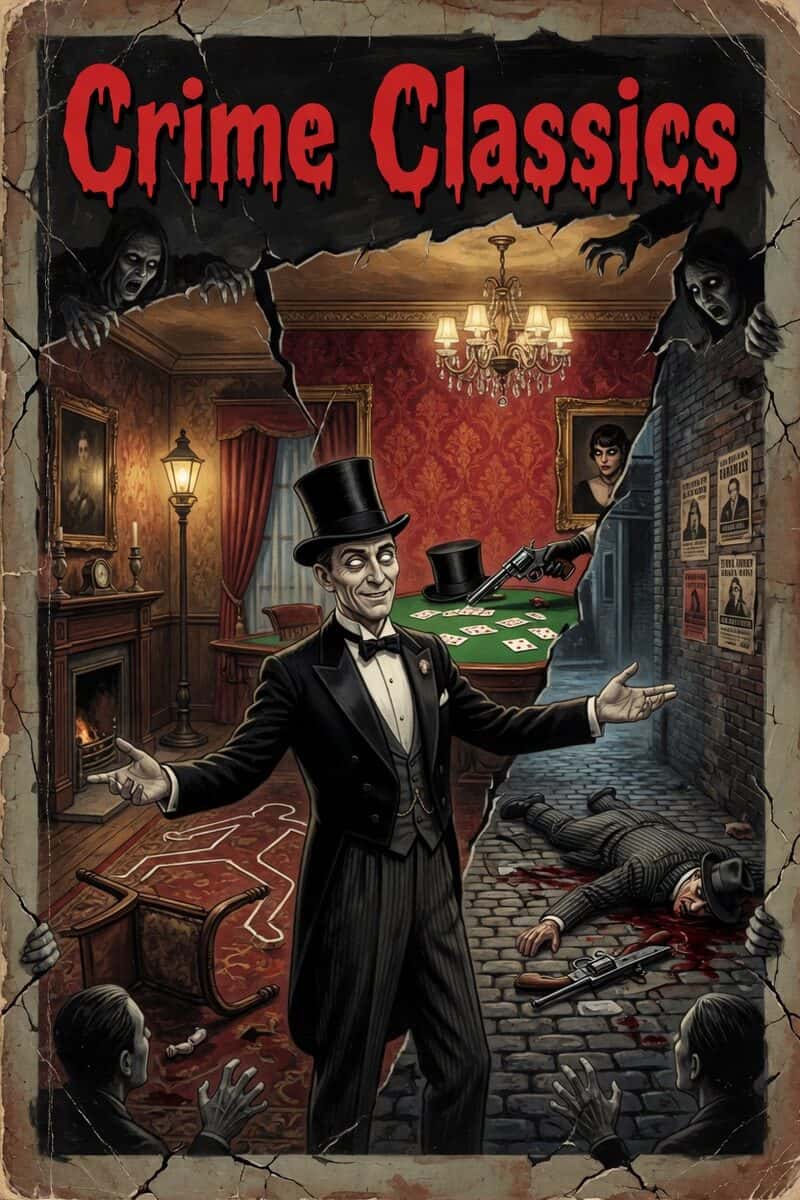
The written record
Read the transcript
Read along with the recording · About 18 min to read
Good evening. This is Crime Classics. I am Thomas Highland with another true story of crime. Listen. That's a frigate cutting through the Caribbean. It's just before dawn and cloudless is the sky. The year is 1736, when the stars were younger than they are now and shone more brightly. And this particular sky of tropic brilliance was a navigator's dream. The land was close, and a trade wind bellied the mainsail and set the good frigate scudding. And daylight was just beyond the horizon. There, at the wheel, the helmsman John Richardson. And holding his bottle for him was his small and drunken friend, Richard Coyle.
The frigate sank in six minutes and drew sharks. The helmsman and his friend got away, only to commit other nuisances on the seven seas. So tonight... I report to you on Coyle and Richardson. Why they hung in a spanking breeze.
Crime Classics. A series of true crime stories from the records and newspapers of every land, from every time. Your host each week, Mr. Thomas Highland. Connoisseur of crime, student of violence, and teller of murders. Now, once again, Mr. Thomas Highland.
They were making rum in Havana in 1736. The place went good with rum. It was hot. There were a lot of people. A lot of mosquitoes. And in every nook and cranny, there were dark-eyed beauties. It was necessary to fortify oneself. Beside which, Havana was under almost continual attack by pirates and buccaneers. Some of whom stayed over because of the rum. So, the town was peopled mostly, beside the dark-eyed beauties, that is, by transient cutthroats, deserting sailors, runaway slaves, uncaught murderers, and, generally speaking, black-hearted knaves. All in all, a populace dedicated to... Oh, Saturday night.
One of the fellows who just had Saturday night, and was lying in an alley, was a deserting seaman named John Richardson. That's John for you. And here comes Dick. Dick Coyle, a little man who robbed drunken sailors.
Here, mate. Such a big one you are, mate. So much of you unconscious. Now, let's see what you got in your pockets to make a small one like me more comfortable. Ah, now here's a... Gotcha, little weasel. Let me go! Let me go! Little scurvy. Going through my pockets, were you? How you want it, mate? Knife, or just twist your neck? What do you do? Little sparrow. Think I will twist your head clean off. No, mate. No, mate, listen to me. At what? It's an important thing I got to tell you, mate. Ah. I swear. And something to give you, too, mate. Hey, now. Hey. What? Ain't you... Uh, ain't you... I'm John Richardson. What? John Richardson! John! Old John! Big John! How be you, John? What weaseling you doing, mister, to keep me from killing you? Now, why should you be killing me? For stealing my pockets dry. I was leaning close over here to see if you'd be big John Richardson. Because I got this for you. What? This watch. This watch I'm holding up for you. Oh. See how it spins, John. See how pretty from a chain. Pretty. Gold. Pretty. And it's yours, big John Richardson. Take it. Go on. What's the matter? You weren't looking for me to give me a... Shh! What? Shh! Shh! What? There comes a sailor, John. With a sea bag, John. What of it? Who can tell what's in the sea bag? Jewels, maybe. Or what can be sold for money. Could you take it from him, John? Give me the watch, you said. You take that sea bag from the sailor boy and I'll give it to you. You swear? I do, John. Oh, I do. Now give me the watch. Now first let's see what's in the sea bag. Why, here's a pretty, John. A knitted hat. Put it on, John. Do. I'll help you. There. How nice you look, John.
And a friendship was born. And all over the Caribbean, people ducked when John Richardson and Dick Coyle came into town. However, there were the unwarned, the unwary. For instance, on a night in Port-au-Prince, a lascar off a trader. You can pluck it. You can pluck the earring from his ear, John. Get him. Oh, a lascar. Good, John. That's the boy, John. Help yourself. It'll look fine in your ear. Or on a night in Roanoke, just when the colonists were finally going good in there with the Indians. Indians has got nothing. Have to hit a dozen of them before it's worth the night. And then professionals that they were, they were ready for New York. And they made out well. The big city folks hadn't heard about them. So, no one was ducking.
And just when Big John and Little Dick were raking it in, so to speak, you guessed it, a woman.
Put me down. Put her down, John. He's a strong one, John is, ain't he, Bertha? Oh, he is. John. Aye. Would you like to kiss Miss Nalding? Aye. He'd like to kiss you. Aye. Aye. Aye. Aye. Go on, Johnny. The friend Johnny is, he's my friend. Dick. Dickie. Kiss her again, John. Kiss her. Now you'll listen to me, Dickie. Dickie. Don't you do it, John. Don't you do nothing to me. I'll leave him be, John. I just want to tell him. I'm listening at you, John. I like this one, Dickie. I like to marry this one. I'll be blowed. I like you too, John. Oh, Oscar. Oscar. You. Me. Miss Nalding. My friend would consider it indeed a great honor if you give him your hand in marrying. Oh, I'd love to.
Which are the events immediately surrounding the marriage of Bertha Nalding and John Richardson. They moved into a small cottage and took in one boarder. You know who. Dick Coyle. Dick Coyle. Dick Coyle. Dick Coyle. John was so enamored with Bertha that Dick couldn't get him to go out nights and do their routine on the docks. So soon, their money ran out.
Let's go to sea again, John boy. Bertha. Yes, John boy? He wants me to go to sea again. Why? The money's run out. Why don't you go to sea again, John boy?
And they got a berth on the good ship Malta Queen shipping tar out of Boston, picking up sugar out of Havana and taking it to Florida. And one night, just before dawn, John was at the wheel. He got on the wheel and Coyle was by his side. Have another, John boy. Drink here. Good rum. Havana rum is the best. And look what you've done. And what have I done? Let go of the wheel and look at the zigzag you're making. Come wheel. Come to me wheel. Wheel. Wheel. Wheel. Spin. I'll have you another, John boy. After you, mate. Well, after you. All righty. Havana rum's the best rum. Tell you what it does. Goodens the eye. You wouldn't know. Goodens the eye, eh? Goodens it. Give you a for instance. Give me one. Journey, boy. Off the bow there. Rocks. The Kiss of Three Sisters Rock, they call it. Know it well, for when I sail... And you're thinking we'll hit it with the boatie now, the way we're sailing. Aye, that I do. That we won't. Sharp eyes in me now that the Havana rums. You remember that shipwreck, don't you? In which the frigate sank in six minutes? It is interesting to note that the coral rock known as the Kiss of Three Sisters was later changed by seamen to Shark's Feast Rock, and so it remains today.
Coyle and Richardson, however, clung to a spar and drifted to shore, the sole survivors of their grisly mistake. They were picked up from an atoll in Key West by a pirate band with whom they made fast friends, as their personal philosophies were very much akin. In six months, Richardson and Coyle were back in New York, sunburned and broke. They made their way immediately to the little cottage where resides John's wife, Bertha.
And what did you bring for me, John? I had your name tattooed to me. Now, what a thing to bring to a wife. Dick here had your name tattooed to him, too. Now, did you, Dick? Aye, right across me chest. Mrs. Bertha Richardson. Your loves, the two of you. Now, I have a surprise for you. What be it? I've got 800 pounds. Oh. Have you now? My daddy, dear, died of the jumping glanders. Oh, poor man. And 800 pounds he left, did he? He did indeed. And where's the pounds, me darling, Mrs. Richardson? In the loose brick there, keeping it as a surprise for my wandering Johnny boy. Come to me, Johnny boy. Aye. Aye. Johnny boy, I missed you. Do it, John. A pretty throat, John. Bertha. John, do it. We'll have that money, John. Bertha. Bertha. That's the lad. Bertha. You've done it, lad. Bertha. Lad. Lad, John boy. Let go, Johnny boy. You've done it. It's here, John. The money's here, just like Bertha said. What a surprise, but a homecoming. Good boy.
As luck would have it, there was a boat leaving that very night for Italy. The Sorrento Dove, Captain Lucian Faber Master. The boys signed on. Three nights at sea, Dick Coyle got the first mate so drunk that all he had to do was lead him by the hand and... That's how Coyle's friend, Richardson, got to be first mate.
You are listening to Crime Classics and your host, Thomas Highland. This coming Sunday for the fifth consecutive year, CBS Radio's Edward R. Murrow calls in CBS Radio newsmen from all over the world to take part in person in his Years of Crisis report to the nation. A review of 1953 and forecast for the year to come will come from correspondents who've seen it all happen in Europe and Asia during the past year. You owe it to yourself to hear Years of Crisis, 1953 this coming Sunday. And now, once again, Thomas Highland and the Second Act of Crime Classics and his report to you on Coyle and Richardson, Why They Hung in a Spanking Breeze.
Venice, Italy in 1737 is where Richardson and Coyle made their next appearance. They were in a gondola being pulled down the Grand Canal enjoying the sights and the company of Carlotta Faber.
It was my husband kind to you? A question asked because Captain Lucian Faber was her husband and Captain Faber was the master of the vessel that had brought the lads to Venice. I was kind to them. Ain't he a pretty one, Mr. Coyle? No! The captain asked, jabbing Dick Coyle with his elbow. What's the elbow, Captain? When my mate stumbled overboard, I made Richardson there take his place. And when I lost my second in the blow off the Azores, well, I promoted Mr. Coyle. Didn't I, mister? Oh, please, Captain. And a fine mate, I'd say, Mr. Richardson did make. Fine, you'd be saying true, Mrs. Captain, Captain Faber, look at him there, sleeping like a babe. Big John Richardson. Bambino. Molto bambino. Molto, molto. Carlotta, you promised not to talk Italian when I come home. I've got no way of knowing what you said when... I said simply that Mr. Richardson was a large baby. Large, large. Captain. Yes? How come you come to settle here in Venice, Captain? Carlotta, her home. She doesn't want to leave. I want to take her to Camden, New Jersey to live. My home. But the dear darling wanted to stay here in Venice. Molto, molto, molto. Huh? What did you say, dear darling? Nothing. Bring yourself here, dear darling, and lean against me. Come. No. Now you just come here. No, no. Now you don't have to be bashful about my friend. If I will move, I will awaken this great Bambino who has fallen asleep. In such a way that I... Let's don't wake him, Captain. He'll just clutter up. Let's talk about what we started out to talk about. Yes. John and me always wanted to own a ship, Captain. What are you humming for, Carlotta, dear darling? I want to hum, that is all. Captain. Oh, yes. Go on, mister. What were you saying? John and me always wanted a boat. I ain't saying we got enough to buy a whole boat. Not a whole boat such as... Yours. But half a boat. How much you holding, mister? 600 pounds. Can't sell you no partnership for so little. Seven, Captain. I'm loading cargo tomorrow for Honduras, mister. Before I get clearing, I'm needing more than seven, mister. Eight. And that's all we got. And that's all I need. We'll draw papers in the morning. Good. Full partners. Full partners. If one of us gets hurt or dead, the share goes to the others. Agreed. John. Johnny boy, wake. We own half a boat, Johnny. Half a boat. How did I get here? Molto, molto. Now, mind you, Johnny boy, keep it on course. Aye. Hold the wheel as tight as if we were your own lady. Aye. This ain't the Malta Queen to be run up on the rocks, John. This is our own ship. Half. Johnny boy, that's thinking you're doing when you say it's a shame only half the ship belongs to you.
Half the ship belongs to us. And such a shame, too.
Aye.
Aye, you say. And why do you say that? What could be in that thinking brain of yours, huh? You said it was a shame only half the ship was... You said it, so it must be a shame. Shall I tell you why, Johnny boy?
Aye.
Because half a ship is half a cargo and half a profit.
Aye.
And the whole ship... Well, now, listen, Johnny boy. We contracted with a captain. One partner dies, his share goes to the other.
Aye.
He's in his cabin, Johnny boy. In his hammock. Peaceful. And... Let's have him an accident, Johnny boy.
Aye.
Now.
Aye.
Aye, prebals. Avast, prebals. Take the wheel for Mr. Richardson, mister. The captain's calling to us. Oh, it's a... A good day for us, Johnny boy. You know who is a nice lady? Uh-huh. The captain's wife. She's a widow you can marry with.
Aye.
Here.
Oh, Mr. Hartley. Now, what can I do for you, mister? As steward, you'll be holding the blunderbuss under lock and key.
Aye.
And so?
Well, let's have it, lad. Let's have it.
Only the captain asks for the blunderbuss and gets it, mister.
The first mate here wants it.
I want... I want it.
Only the captain wants it and gets it.
John, boy.
Aye.
Such a big gun, this blunderbuss. Come along, John. It's a beautiful way to die, Johnny boy. Sleeping in a hammock with soft dreams. Put the muzzle to him, John, and send him on.
Well, do it. Dickie. Do it.
I can't.
Chicken heart of a man. Pull the trigger. Shoot his head off.
What? What? The trigger? He's stuck. What is happening here? Strangle him, John, boy. Throw the gun aside and strangle him.
Aye.
No, you don't. No.
Catch him, John. Shoot him. Strangle him. Run. Put the gun aside. Strangle him.
Witch. What do you want me to do? Catch him. Catch him and kill him. He's climbing the rigging, Dickie.
Well, let him climb. We'll shoot him down from there like a nesting bird.
Captain. You, don't you? You'll sell to the death of Oliver. Get the trigger fixed, John, boy.
Aye.
Aye, aye.
Let me try to construct a picture for you. A picture first, a frigate under full sail on the Honduras run. Sea, sky, ship. Now, rigging of ship. Now, on rigging, captain of ship. Fresh from a noonday snooze in a hammock. Who, from force of habit, had time only to grab his plumed captain's hat. Scared. Below him on deck, Dickie Coyle and John Richardson. Dickie, threatening the captain's life. And John, fingering the trigger of a blunderbuss, which had a pretty good range. And now, gathering toward the scene of this nautical picture, the crew, muttering, pointing, and wide-eyed. Now, the picture moves, as the captain holds on with one hand and gesticulates with the other.
Listen to me. I'm your captain. And you who have sailed with me before, know, oh, how well you know, that I have only your welfare at heart. Now, which of you has it in him to stand by and watch his captain perish? Which of you does not remember the storms I've sailed you through? The still seas and the torrents? And which of you could not come to me in times of stress, needing advices or medicines, and I would give it to you? Men, I order you, seize those two men who wish to murder me and throw me into irons. I order it! And there will be no more. There will be rum in the forecastle when I get back on deck. You've heard me, men. Now, act!
The men, used to a ship where fair play had been practiced, only shifted their feet and listened just as attentively to what Dickie Coyle had to say. And Dickie Coyle said it.
Oh, men, I'll divide with all of you what monies there are in the captain's chest. Get below!
How's the trigger, John boy?
Fixed.
Throw him overboard, John. Now, turn the boat around. Turn the boat around, John boy, and let's go back to Venice.
Hello, ma'am. So it is you. Finally, it is the two of you. After a year it's been.
Hello, ma'am. Molte. I cannot allow myself to say it.
Oh, yes, you can. Your husband's dead, ma'am.
You tell me this.
Foot caught in a halyard, ma'am, and over he went. In a storm he was. Men begging him to stay below, they loved him so. But not him, brave fool that he was.
Police!
Ma'am, what are you saying?
There came here a steward to my husband, from whom you arrested the blunderbuss he would not give you. He has told me the story. How you shot.
John boy, we'd better run. We'd best leave here, John boy.
I'd like to read a translation from a Venetian chronicle of the time. Richardson and Coyle were apprehended by the local police on the Ponte Vecchio, where they were splitting a goatskin of wine. When taken in custody, they were dressed as gondoliers. In prison, Richard Coyle convinced his jailer that a terrible mistake had been made, that he and his friend were indeed servants to the King of Naples. They were released.
Don't feel too bodily good, ma'am. Mistakes will happen. Come along, John. The King must be worried. Come, come.
Only to be apprehended again when they paused over another skin of wine. And they were tried, and found guilty of murder and mutiny. And one day, they were led in chains to a ship of the Navy which was about to sail. The order of execution had it that Richard Coyle was to die first. But there was a conference.
You want to go first, don't you, John boy?
Well.
Sure you do.
I want to go first!
So the order was reversed. And as the ship sailed to sea, they were hanged from a yardarm. And past the breakwater, they were cut down. John Richardson hit the water first.
In just a moment, Thomas Hyland will tell you about next week's crime.
Crime Classic. Coyle and Richardson, tonight's crime classic, was adapted from the original court reports and newspaper accounts by Morton Fine and David Friedkin. The music was composed by Bernard Herrmann and conducted by Lud Gluskin. And the program is produced and directed by Elliott Lewis. Thomas Hyland is portrayed on radio by Lou Merrill. In tonight's story, Walter Tetley was heard as Coyle and Clayton Post as Richardson. Featured in the cast were Georgia Ellis, Herb Butterfield, Gladys Holland, and Charles Calvert. Gil Warren speaking. And here again is Thomas Hyland.
Next week, the border country just after the Civil War. And a report on some soldiers who continued killing after it was legally prohibited. It's listed in my files as the Younger Brothers. Why some of them grew no older. Thank you. Good night.
Don't forget. The old redhead Red Barber will be masterminding CBS Radio's exclusive broadcast of the Maryland-Oklahoma Grid Fracas. Down in Miami's Orange Bowl this New Year's Day. Your radio's your ticket and your midfield seat as well. For the big one of January 1. The Orange Bowl classic. Miami to you via most of these same stations. Thursday night, Marlene Dietrich stars in Time for Love on the CBS Radio Network.