
The written record
Read the transcript
Read along with the recording · About 18 min to read
Good evening. This is Crime Classics. I am Thomas Hyland with another true story of crime. Listen. The sound of brace and bit boring into wood. Good wood. Mahogany. A hard wood. And since this is 1821 and the tools weren't as finely tempered as they are today, a resisting wood. One needed to really lean into it. Give it muscle. Here's something. Water coming in at last. But how slowly. Just boring holes in the bottom of the ship. That's no way to scuttle it. Here's an axe. As I said, mahogany is a good hard wood. Fine for ship's keels. Doesn't hold up under an axe though. Here comes the Atlantic Ocean.
My report to you on The Good Ship Jane. Why she became flotsam.
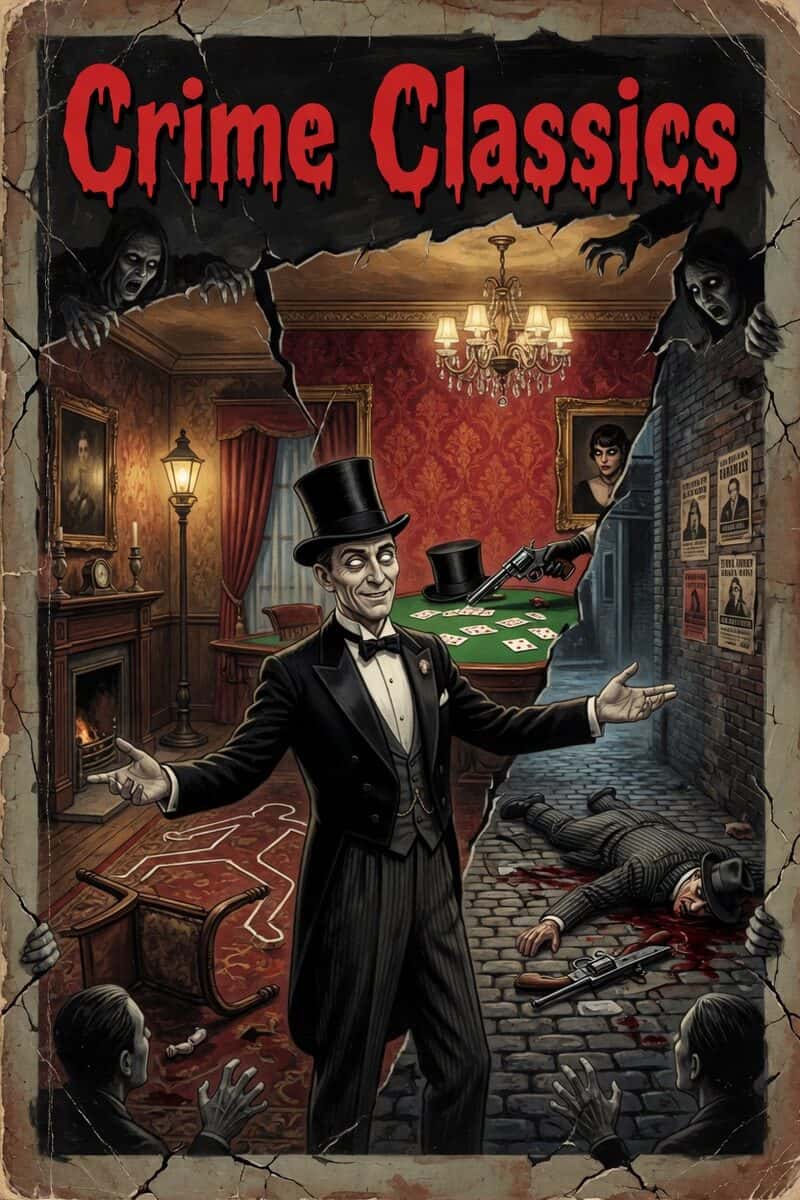
Crime Classics. A series of true crime stories taken from the records and newspapers of every land from every time. Your host each week, Mr. Thomas Hyland, connoisseur of crime, student of violence, and teller of murders. Now, once again, Mr. Thomas Hyland.
Let's talk about schooners for a moment. The first one ever built was in Gloucester, Massachusetts in 1713 by Captain Andrew Andy Robbie Robinson. The schooner is a fore-and-aft rigged vessel. And was much used in fishing in its earliest days. However, it was soon used as an ocean trader. Taken as it was into the hearts of ship owners since it used a smaller crew. The vessel that concerns us here is Jane of Gibraltar. Rigged four-and-schooner rigged at. She'd carry from 90 to 120 tons and had seen service on all of the seven seas.
The Jane was weighing anchor at Gibraltar. On her way to Brazil. Her captain was Thomas Johnson. Her cabin boy, a youth from Malta named Andrew Cunale. And in the captain's cabin. Ten pipes of sweet oil, 120 barrels of beeswax, 14 round jars of fine oil.
Boy.
Yes, captain.
How old are you, boy?
16, sir.
You understand the promise I made to your father, boy, that I would return you a man?
Yes, sir. Continue with the manifest, boy. 300 oblong jars of olives, 14 boxes of raisins. 19 bolts of silk.
Boy.
Yes, sir.
Your father said you were meek. Too long, milk-fat and soft. We'll harden you, boy. Put leather where now there's down on your cheek.
Shall I go on with the...
Boy.
Yes, sir.
Saltin' that blonde hair of yours with sea spray. Muscle those thin arms.
Boy.
Yes, sir.
What have you got in your hand?
Your watch, sir. I know it was right here on my desk a minute ago.
I fidget, sir.
So your father told me. Put the watch down.
Yes, sir. My father also gave me a book called Tales of the Ocean Sea.
Never mind that. The one with the manifest.
That's all except the dollars, sir.
Read the manifest, boy. Six 18-gallon casks and one of about nine and one of about seven gallons. All filled with Spanish dollars to the number of 38,000. All the above to be delivered to Jose Miguel de Faria, Bahia, Brazil.
You watch your P's and Q's, boy. Stop fidgeting.
Yes, sir.
After which, Andrew never tried to steal the captain's watch again. Instead...
Captain, I saw Seaman Smith opening a cask in the hold and dipping into the olives.
The youth quickly developed a sense of loyalty to his captain and the ship and its cargo. And the captain sensed it.
Good boy.
And did his best to instill the youth with a sense of responsibility. And the next day...
You may flog. Seaman Smith, boy. Here. Take a whip. Now don't flinch.
Good boy.
And nearly skinned Seaman Smith alive. A youth two weeks at sea and manhood busting through all over. Yet with a streak of gentleness.
Mate? Mate Hyman?
Yeah.
He came down here to Crews Quarters to see how Seaman Smith feels.
I've seen whipping before, lad. But I got to hand it to you. You're a son of a... You're a scientific whipper, you are. Isn't that the truth, Frenchie?
Oui.
Yeah. Old Frenchie's seen whipping, too.
Oui.
You're a one, you know that, lad? Rumply blonde-haired boy like you with chittered face and a whipper like you.
I didn't want to do it. Captain ordered me. I'm so sorry, Mr. Smith.
Can't hear you, laddie. Tell him how sorry I am.
I had to flog him unconscious.
There's a question I'd like to be asking you, lad.
Yes, sir.
Because the crew's all asking me. How did the captain know in the first place that Smitty there was thieving?
You tell, Captain, little pink cheeks.
Please.
Please what?
Leave me alone.
Snitcher, ain't you, Pinky?
You leave me alone, huh? Or what?
You see this knife, don't you? You see this knife, don't you?
Please leave me alone.
Oh, look at him, Frenchie. Look at him with the knife.
Oui.
Funny, ain't it? Well, I'm going to tell you what, laddie. Playing with knives, you be, eh? Well, now, I'll be playing, too. A sticking game. You'll be all over the deck in a second.
Please.
That's your laddie. Please. Please leave me alone.
Now, look. Look, laddie. Take that knife away from my throat.
Then?
Then will you let me alone?
Oh, we was just gaming, laddie. You're a good gamer, you are. Put the knife away from my throat, laddie.
Yes, sir, laddie. Yes, sir.
He's a one, ain't he, Frenchie?
Yeah, oui.
Please, let's be friendly.
Oh, we're shipmates, we are. My father told me to make a friend.
We're shipmates, we are.
Oui.
The captain doesn't like me.
Don't he, now? And you're such a gamer and a nicey.
He thinks I want to break into the hold and steal all those Spanish dollars in those casks, just because I know where the keys are.
Who are you, now?
Thirty-eight thousand in Spanish dollars. Them's the best kind. That's what's in those casks, eh?
Oh, yes, sir. I could use some of those dollars, couldn't you, Frenchie?
Yeah, oui.
Now, don't you tell the captain I told you about...
All those dollars, oh, no. We're shipmates.
Glad I've made friends.
Yes, oh, you have. But Mr. Patterson doesn't like me either. He's with the captain all the time and takes watch over him when he sleeps and...
Mr. Patterson don't know true quality in a lad.
Mr. Patterson's outside the captain's cabin right now. He's such a black nut. He hates me.
Then we're your friends. Come along, Frenchie.
There's your Mr. Patterson for you, sleeping under the stars from a belaying pin. If he awakens, he'll raise an awful row.
Oh, you know where that key is to the dollars, lad?
Yes, but if Mr. Patterson wakes up...
Frenchie.
Oui.
Throw Mr. Patterson overboard.
Oui.
Wait.
Yes, lad.
I read in the book it was called Tales of the Ocean Sea, how bad pirates used to tie iron to the legs of victims.
Oh.
So they wouldn't float. So I bought a piece of iron along. Here it is.
Frenchie, lash the iron to Mr. Patterson's leg so he won't float.
Oui.
Let's to see the captain now, lad.
Yes, sir. He's a very sound sleeper. Here's his gun. Be careful how you point it.
Blimey. Shot the captain right between the eyes. That's what you did, lad. Right between the eyes, I tell you. Deader than a pickled mackerel from Cooper's coasties. Blimey.
Oh, lad. I know how you feel, lad. Accident, weren't it, lad?
Yes.
Yeah. You go on and weep. It'll do you good.
That night, Andrew cried his heart out. So forlorn was he for having shot his father's friend and his captain that he did not venture above deck. And that's where all the activity was.
Here, tie this piece of iron to the captain's leg, Frenchie.
Oui.
And using a ship's shank knot and a 25-pound weight, they prepared the captain for sinking. Sinking. These few hours' activity was known as piracy. There was also murder. Altogether, a night of perfidy sprung as it did from the innocence of a 16-year-old boy's suggestions. Just because the youth has read a long-since-banned book, Tales of the Ocean Sea. Just because his father had gotten him a berth aboard ship. Just because his father wanted to make a man of him. But Andrew still had a long way to go.
Boy.
Boy.
Boy. Never knew a soul could ache one like this. But it can.
Oui.
Where's the key to the dollars, boy?
There. Beneath the captain's pillow.
Frenchie, now we'll fetch.
Wait.
Yes, lad.
What did you do with the captain?
As we did with Mr. Patterson.
Now there are eight of us. But Smitty cannot work.
No, not since the flogging you give him.
Have you noticed that Mr. Strawn is feeble and recovers poorly from his drinking?
True. What are you saying, lad?
Nothing.
Frenchie.
Oui.
There are eight of us now, but two of us ain't very useful. Ain't no sense having them around to divide those dollars with.
Frenchie.
What Mr. Hyman and Frenchie did was unlock that section of the hold where the dollars were kept, remove the casks, and insert two of their shipmates, Mr. Smith and Mr. Strawn. It was then that the lad Andrew appeared on deck.
What are you going to do with those tarpots, Mr. Hyman?
Fire them and lead the smoke into the hold of Smitty and Strawn now?
Why, then they'd suffocate.
Frenchie?
Oui.
You are listening to Crime Classics and your host, Thomas Hyland. Tomorrow night on CBS Radio's Time for Love series, hear Marlene Dietrich as Diane LaVolta in a new adventure in colorful Spain. The sultry-voiced chanteuse helps a great bullfighter out of his difficulties in a story titled The Man Who Wanted to Die. Remember, tomorrow and every Thursday night on most of these same stations, the star's address brings you Marlene Dietrich in Time for Love.
And now, once again, Thomas Hyland and the second act of Crime Classics and his report to you on The Good Ship Jane. Why She Became Flotsam.
Some words about piracy. Next to being a sailor, being a pirate is man's oldest profession since he took to the sea. There is literature concerning this type of criminality all the way back to the Phoenicians. The Vikings were great pirates and you'll be interested to know that during the Roman Civil Wars, the city itself was all but starved to death by the incursion of the old Etruscan pirates. Now, many of you undoubtedly think that piracy is a matter of the crew of one ship plundering another. Not so. As far back as the plunder of the Barquentine Athena in 1702, the admiralty ruled that a crew which mutinies and murders its captain and plunders its cargo and steers the vessel off course, perhaps toward a different continent, a crew which does these things is lumped under the heading of pirates. Therefore, the crew of the schooner Jane of Gibraltar were pirates. Of this, there can be no doubt.
I say let's take her to Africa, mates.
Then Africa it is. Helmsman, change your course. South by southeast.
Africa it is, lads. With Spanish dollars to fling and Spanish dollars to spend.
Lad. Andrew.
Yes, captain?
You're nearly done, lad.
Aye, captain.
Each of us, now that we are six, will receive $6,300.
Aha. You hear that, lads? $6,300 Spanish dollars for each of us. Oh, Morocco, Tangiers, Cairo.
Captain.
Oh, you like Africa, you bonny lad. Oh, the sights I can show you. And you, the curvy, early-headed, blondie lad you are. You'll have the ladies nippier than Thurston's kitty.
Captain.
Yes, lad.
The African seas are filled with pirates.
What are you saying, lad?
I've heard. Corsairs from Tripoli and Turks and Saracens.
And what?
I'm frightened.
Well, then be frightened, lad. What do you expect, us to turn tail about and go to England, maybe, or...
Scotland.
Scotland? With their lonely shores and their long, lonely beaches, we could get ashore and nobody would know what.
Ah. Wouldn't be any pirates, are there?
Oh, no.
Scotland. Scotland. Bonnie, Scotland.
Oh, yes.
Yeah. Scotland it is. Helmsman, change your course. Norther, nor west.
And they sailed in that direction for 17 days. It was a singularly uneventful voyage. In passing other ships, they hoisted the American colors, identified themselves as the Rover, 30 days from New York, bound for Archangel. And Hyman went about clothed in the captain's green greatcoat. The boy Andrew stayed below most of the trip, reading. But one day, when Hyman brought him his breakfast, the boy looked up from his book and he said...
When are you going to give orders to scuttle the ship, Captain?
Scuttle it, lad.
Else there'll be surely someone in Scotland who'll recognize the ship as the Jane and ask of the captain.
Scuttle it, I say. Off the Cape of Stornoway.
Off the Cape of Stornoway.
And two nights later, within sight of the Scottish coast at Stornoway, you remember, Hyman began to drill holes in the bottom of the boat.
Here's an axe.
Ah. Oh. Ha, ha, ha, ha. Yeah.
Sir.
What is it, you bonny lad?
I think you should give orders to man the longboat. Get your becks into it, men. You, what's the matter with you, Dora?
Tide against us. We never make it sure.
Pull. Pull, I tell you. There she go. There she go.
What?
The oar. I lost me my oar.
Can't she go?
Ah, you stupid lump thumb. Dumb of them frescoes symbol.
Yeah, I know, lad. Never. Never.
What are you saying, lad? You'll never get the oar. All drown in our chest with money. We'll lie at the bottom of the sea.
Oh, now, lad. Everything she forced me to do was a terrible thing. Lad, lad. The awful thing.
Now, hear this. Now, hear this. What the sea did. It sent a huge and wonderful wave to the scene. And this huge and wonderful wave did this. Lifted high the longboat, the dollars and the sailors and on a narrow strand of beach put them down again. This huge and wonderful wave.
Phew. Limey. Ain't this something Frenchy?
Oui. Wave tossing us boat and all right to shore.
Lad. Andrew, lad.
Yes?
We're saved.
Yes. Yes, we're saved. We're saved. Give it to you, lads. We're saved. We're saved. And it's this bonny, bonny lad that's the cause of it all. This lad. This Andrew. This curly, blundering Andrew, lad. Oh, lad. It is a great and good luck thing to know you. To sail with your larks.
Thank you. Thank you, he says. Hey, such a lad. Such a lad you are.
But the rest of that night was a terrible one. The fury of the skies and the sea over that narrow strand and six men huddled there. Not daring to move lest they lose their way in the dark and stumble into the torrent. Yet, even in these small hours of despair, they had presence of mind enough to bury each of them part of their Spanish dollars. And we should take an oath of secrecy. And they, each of them, took a terrible oath. Swore never to reveal what had happened, nor of the money, nor the murders. A good thing, too, for the next day, a suddenly becalmed and sunny day, a group of men came running up the beach toward them.
I... Hello. What do you hear?
A boat broke up in the sea and praised me for a sturdy longboat. Who be you?
Roderick McIvers.
Ah. We be of your fated catch, the Betsy out of San Francisco. I am McIvers, surveyor of customs. These are my men.
Oh? And we'll want to look at your sea chest.
Oh. You, Colonel, open me that sea chest, for instance, and I'll have a look.
Ah, we'll see. See? Now, what's this? Dollars now. Huh. Spanish dollars. Hmph. Now you. Please, sir. How come a blondling boy like you is so scurvy-lookers, eh?
Please, sir.
Colonel, stand guard here while I fetch a brace of constables to this spot. This has the looks of I don't know what, but I didn't like it.
Please, sir.
Ah. How old be you, boy?
Sixteen, sir. There's never been a razor to my cheek.
Pale yard. If I could see my father.
Sir.
Yes, lad?
Could I walk with you?
Fairly hated boy could be me own son almost. Surely. Walk with me.
I have something to tell you, sir.
Oh. Look what happened. Sir. Sir. What, lad? What? They held me prisoner out of Malta and murdered Captain and Mr. Patterson and Nice Mr. Smith and Mr. Strawn. They suffocated the Nice Mr. Smith and Strawn with smoke from a tar bag. They stole the Spanish dollars.
Are you saying the truth?
I'll take an oath on it.
And you'll so testify, lad?
I want to.
Go on, lad. Continue with your story.
And I struggled with Mr. Hyman with the pistol and he overcame me and killed Captain.
And then?
I had that one who we call Frenchy tie iron to Captain's leg and throw him overboard.
And then?
Suffocated two others with smoke from a tar barrel.
How old are you, lad?
Sixteen. My father's far away in Malta.
I must tell you, boy, as a father myself and as judge in the court of law, that ne'er have I witnessed such a courageous lad as you. You are as candid a witness as e'er appeared before me. Your manners are modest and your statements are sincere and distinct. And it is to your ado that justice is try in the case of these men, Peter Hyman and the Frenchman Francois Gautier. You may step down, boy.
Peter Hyman and Francois Gautier, the rest of your crew has been dismissed as not guilty of the heinous crimes as charged. But the jury has found the two of you to be beasts of the sea and guilty as charged. Therefore, I announce to you the sentence of death which will be put into execution. Though your crimes as charged be murder and piracy, the sentence to my mind your guilt is of a far greater kind. The scar slashed across innocence. The innocence of that youth sitting there, gentle child of blundering curl, bravely hiding the scalding hurt. Vipers! And upon the second Wednesday of January next to come, you will be dead.
I have here an account of the execution. The two men, Peter Hyman and Francois Gautier, ascended the drop at twenty minutes past eleven. They remained on the platform for some minutes, being administered as they were by men of the cloth. But observers noted that neither one seemed to listen to prayers, nor did they repeat any supplications. Rather, did they merely stand there and shake their heads as if, some observers say, they did not believe what was happening to them. In the pressing crowd of onlookers was seen Master Andrew Cammellier close to the front, smiling and bowing to those who recognized him.
Andrew Cammellier, I should tell you, never went back to Malta, nor to sea. He was married next year to the comely daughter of a widower. And, when his father-in-law shot himself to death in six months' time, he inherited a large sum of money.
In just a moment, Thomas Hyland will tell you about next week's Crime Classic.
The good ship Jane, tonight's Crime Classic, was adapted from the original court reports and newspaper accounts by Morton Fine and David Friedkin. The music was composed and conducted by Bernard Herrmann. And the program is produced and directed by Elliott Lewis. Thomas Hyland is portrayed on radio by Lou Merrill. In tonight's story, Gayne Whitman was heard as Andrew and Van Wyck as Hyman. Featured in the cast were Herb Butterfield, Paul Frees, Steve Roberts, and William Johnstone. Bob Lemond speaking.
Now, here again is Thomas Hyland.
Next, next week, Suffolk, England in the year 1676. We will concern ourselves at that time with a rousing croquet match, a fine old castle at stake. Winner take all. It's listed in my files as Roger Nims, how he, though dead, won the game. Thank you. Good night.
This coming Sunday, CBS Radio's Department of Public Affairs offers a documented progress report on the Negro in America. Titled, The High Mountain. Narrators will be William H. Hastie, United States Court of Appeals judge, and Admiral Alan G. Kirk. The same production team that brought you Bomb Target USA, 38th Parallel, USA Parole File 732, and other hard-hitting factual documents about life in America, now turns its attention on The High Mountain for a look at the progress and problems of the Negro in America. This Sunday, on most of these same stations, you hear America's favorite shows on the CBS Radio Network.