
The written record
Read the transcript
Read along with the recording · About 17 min to read
Good evening. This is Crime Classics. I am Thomas Highland with another true story of crime. Listen. A maiden's laughter. A maid of India with bells on her feet that jingle when she runs. She's having a lovely time. The picnic's been a great success. And now her husband's chasing her through the tall grass. Here he comes. For an older man, he's got a pretty good stride. And before she knew it, he had his wife circling around an almond tree. Caught her. Then the thing that ruined the picnic for everybody. Jealousy lurking nearby with a sledgehammer.
Tonight, my report to you on Old Six Toes. How he stopped construction on the B.B.C. and I.
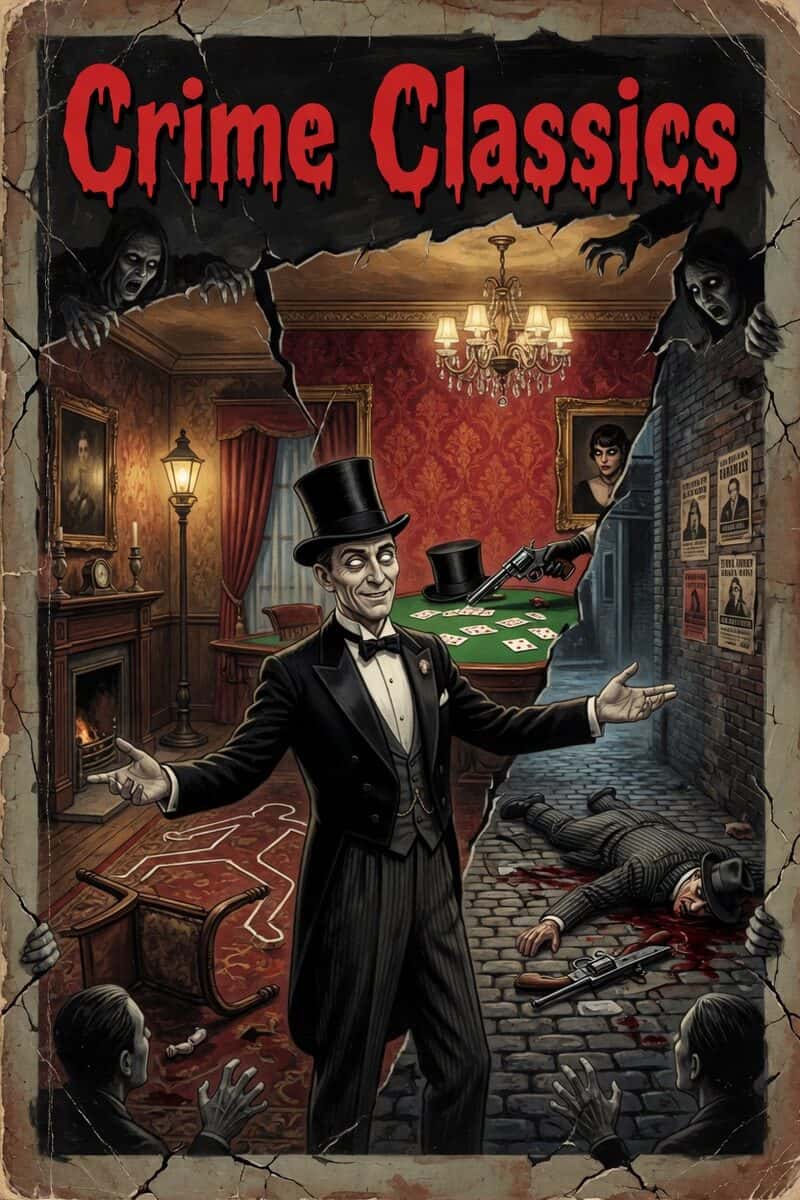
Crime Classics. A series of true crime stories. Taken from the records and newspapers of every land. From every time. Your host each week, Mr. Thomas Highland. Connoisseur of crime. Student of violence. Teller of murders. Now once again, Mr. Thomas Highland.
In 1880, the Great Sepoy Rebellion was already just a memory. And those who had lived through the hundred days of lance and torch and British square had settled back with a tight little smile, waiting. Queen Victoria had been proclaimed. And Lord Dundridge was saddling his first pony in the cool gardens outside Bombay. And to the west and south, Konkan Province was welcoming spring. The soft winds up from the Gulf were cooling and set asway the temple bells.
Of other bells, however, those small ones held to the ankles of Baki with golden wires, she set them asway herself. She seemed to always be running. From this task to that. From this person to that. On this mission or that. And one day, she was noticed, and admired, and bargained for.
I have seen her, and am told you are her father.
As I am.
Has she been spoken for?
Many times. The young men of the village all...
Young men. They have youth. What have you?
What I gave my youth for. Wealth.
And what would you give for my daughter, Baki?
Two goats. Two bullocks, and a field to till.
My daughter dances lightly to whatever music may be. If I give you this, then I shall be poor.
If you be poor, then work. My daughter will wait home for you to kiss away the pain of toil.
My daughter is slender as the reeds on the river, and as pliant. My daughter's voice is as the lute, and her hands are wings.
Enough. Enough.
Then it is done?
Done.
Baki! Baki! Come!
Baki, bow to your husband. Now, greet him.
I have waited long, my lord. Command me.
Command her, he did, to dip three times in scented water, which was the custom, for they were to be wed this night, to bind her hair in the manner prescribed, to spend the appointed hour with her mother, the appointed hour with her father, and thus, anointed with fragrant oils and wisdom, to come to him in the place of marriage, and thus, anointed with fragrant oils and wisdom, to come to him in the place of marriage, to come to him in the place of marriage, and thus, anointed with fragrant oils and wisdom, and they were wed, and went to the hut of the newly married of the village, and removed their shoes before entering.
Beloved.
Yes?
You have six toes.
Since birth.
A good omen, husband.
Baki, beloved.
Yes?
Draw closer.
Your command, husband.
First, a thing.
What?
In the village I come from, far to the north, a ritual.
Which guaranteed identity?
I do not understand.
Identity, beloved, in case you forget who you belong to.
But...
Therefore, these I show you, beloved. Oka, sienna, vermilion, and a needle.
For what reason?
The tattooing of you.
Please, please do not...
I command it. Be still!
You may ask why I, Sonu, formerly of wealth and station, now hold spikes so that they may be driven by you into the ties which hold the rails. You may ask why I, Sonu, formerly of wealth, am now but an employee of the Bombay, Bengal, Calcutta, and Indian Railroad. You may wonder these things, and I will tell you. I have traded wealth for greater wealth. The lands which I had and the animals, these I bartered for a price. And such a bride, a child of eighteen summers, who is called Baki.
Friend, friend Dondu, muscular youth, wieldeth the great hammer while I hold. Come home with me, and I will show her to you. Will you come home with me?
Yes.
More wine, Dondu?
Well...
Of course he wants more wine. Fill high his cup.
Have I not said it, Dondu, this treasure?
Truly.
Sir?
Yes?
And what do you do on the railroad?
Well, uh... Marvelous things. With his hammer, all day long, he drives deep the spikes. More spikes and deeper than anyone else.
Oh.
Pour high my cup again. Weary, weary and toil. This is wine will soothe, husband. Drink.
Ah, good wine.
Good? Bring it.
Sir?
Yes?
The arms of yours could lift him as if he were a child and place him upon his bed.
Yes.
His bed is here.
Sleep well, honored husband. Toiler, bringer of bread to this happy house.
Baki?
I know. Let us walk to where the night will wash over us.
I want to.
Come, then.
Do you love me?
With all the might and passion that is the strength of me.
My husband has six toes.
It is written that this is a good omen. A man with six toes is said to be blessed. In this way, he has brought you to me.
Tarry here.
They tarried, and the moon swung over from where it was and became for that brief time their moon, as did all the marvelous things of the night. And Baki forgot all the vows she made to Sonu and made new vows to Dondu.
Always and forever.
And Dondu made promises to her.
Tomorrow night, when the old man is asleep.
Here, forever.
Always and forever.
Which goes to prove, I suppose, that railroading men have a certain fascination all over the world. And Dondu of the B.B.C. and I was certainly one who gave rise to the legend.
Baki.
Forever.
There is a thing. Listen to what I say.
Yes?
This is wrong.
What is?
You are bride to an old man.
What evil bird hammers at your brain where conscience is so that you say our love is wrong?
Did you not hear it?
You are bride to this old man.
Then you want done with our love?
No.
Then what?
If you were widow.
If I were widow?
We would not sneak about as children who do evil tricks. Think of it then. If you were widow.
Dondu?
Yes?
I... I want to be.
And so you shall. So you shall.
When they reached the village on the edge of it where they said goodbye, they were startled for a moment. Suddenly it was morning, and they looked and they saw. The sky was blood red.
You are listening to Crime Classics and your host, Thomas Highland.
Thirty-five years ago this week, a few hundred AEF delegates in Paris founded the American Legion. Today, in 17,200 posts, there are nearly three million legionnaires. Service to the community, state, and nation. Service to veterans and their families. These have grown to be hallmarks of American Legion activity, without which the nation and its people would be great losers. Happy 35th birthday, American Legion. Keep up your great work and continue to grow.
Now, once again, Thomas Highland and the second act of Crime Classics and his report to you on Old Six Toes, how he stopped construction on the B.B.C. and I.
Each country has and is proud of its own history of railroading. It may come as a surprise to some that laying track in India has a lore unparalleled in railroading annals. To give you a hint, there's a saying out of Bombay that never did the tigers eat so good as when the B.B.C. and I put down a steel through South Konkan, the place that concerns us here tonight.
Consider the feat, if you will. One hundred and sixteen miles of railroad, one hundred and sixteen miles of railroad, one hundred and sixteen miles of railroad, through jungle, swamp, and wasteland. A body died there for every cross-tie. One hundred and sixteen miles of rail, plunging progress from Taj Pahor to the sea. And, two-thirds of the way, the living legend of a man, Dondu. And at his feet, holding the spikes, an old man with a young wife.
Dondu, Dondu, tarry a minute.
Say the truth to me.
Of what?
Of my wife.
What of her?
Is she not beauteous?
Yes.
I see how you look at her.
How?
As young brother to me. Happy for my happiness.
Yes.
So now.
Yes.
The next spike. Sight it well. Get close to it. And line it.
Yes.
Bring your head closer to it, old man. And make sure.
In time for me.
Why do you stand with hammer poised over your head?
What?
The whistle has blown. Come, let us eat.
Yes.
Let us eat.
Tired, old man?
You are young. You would not know a sigh of happiness if you heard it.
Oh?
For I have just breathed one.
Oh.
Look how neatly my pride, my joy, my treasure, has made for me my lunch. Grape leaves. And chutney. And coconuts, too.
And you, Dondu.
What?
What I bought in the village. The same thing each day. Rice.
Would you like a grape leaf?
Well.
I hunger not.
Take it.
Well.
I am an old man. And such richness as grape leaves and chutney does not agree with me. In truth, I would prefer rice. But I would not tell my treasure of it since she pleasures so in cooking.
Well, then take my rice.
Ah. Mmm. Ah. Ah. Ah. Ah. Ah. Ah. Ah. Ah. Ah. Ah. Ah. Ah. Ah. Ah. Ah. Ah. Ah. Ah. Ah. Ah.
That was the young man falling over on his face. Because the old man's wife had put cobra venom in the chutney. So the old man would die. So she and the young man could pursue their love unencumbered. But the young man, having eaten the poisoned food, became deathly sick. He had eaten a dose that would have killed a less strong man. But he was the mighty Dondu and he did not die.
A month later, he was well enough to tryst.
And?
This he did.
I dared not come to you, Dondu. You know that.
Yes.
Lovely one, what do you do?
Kneel to the gods for having preserved you for me.
Add a prayer, then, of your husband.
That he should die.
For my love for you.
For your love for me.
Therefore, he must die.
And soon.
I will help.
Together, then.
Yes. Oh, yes. Yes.
But the precise opportunity never quite arose. Because either there was someone near, or within calling distance, or the old man didn't rise to the bait. There was one night when the bride put a krait, a small and deadly snake, into Sonu's bed. On the very night that Sonu elected to sleep in the hammock outside. Something always seemed to go awry.
I cannot stand him. He must die, or I shall.
There is a festival next week for us at the railroad for the completed section. There he will die.
I cannot stand him. He must die. Or I will.
And the days spun away, and a week, until there came a day of festival. And Mr. Graves of the railroad was concerned that everyone enjoy himself.
And what do you do, sir?
I am a spike holder, sir.
Ah. Each member of our team is as important as the other.
Yes, sir.
And who is this lovely child by your side?
My wife.
Oh, charming. Charming. Rise up, child.
Oh, charming, charming, charming.
A treasure, sir.
God bless, sir.
Yes, sir. Yes.
Enjoy yourselves.
Yes, sir. B.B.C. and I want you to have a day you'll remember.
Yes, sir. Yes. Oh, good day, then.
Margie, did you hear him?
I heard.
He noticed me.
Yes.
Perhaps.
Perhaps what?
This is the start of something, of position again, and wealth, as I was once wealthy.
Yes.
And perhaps again our own land, and a house, and bullocks, and servants.
Beloved.
What?
In your eyes. Am I old?
Oh, no.
Then look at me.
Yes?
What do you see?
Wisdom. A face which has pushed aside youthful folly to become lined with love and gentleness and knowledge.
But now, you...
What of me?
So youthful you are. Do you not sometimes miss the folly of youth?
Not I.
But it seems that you do.
Then let us be foolish.
How?
I will flee from you, and you will chase me.
Yes.
Then catch me. Catch me, Sonu.
You remember? The maiden's laughter, the maid of India scampering over the field, away from the crowd, and not running too fast so her husband can keep her in sight. And the maiden runs toward her lover, who is hiding in the tall grass with a sledgehammer, right near that tree. Where the old man caught his wife.
It is done. Now it is done.
Hold me, hold me.
As if...
What?
As if a great burden had been lifted up from me.
Now you are widow.
And I must grieve.
Then I will be bride again.
Yes.
Now we will take this one to the place where I have dug his grave, and put this one in it and cover him with tall grass. The stride of you as you walked on dew, the suppleness, the grace, and you belong to me forever. Always, always and forever. Here. Now the old man looks small there on the earth. I wish to see him no more. Then I will cover him.
Baghi. Yes? The thing we talked of. Yes? Do it now. Yes.
What has happened? Dead, dead. Dead, dead. Who, who, who are you talking about? My husband. But what... Awful. What happened? Tell me. There, down there at the river's edge. We were walking there where the bank was moist. He tore the river, and the bank slid away, and he fell into... He fell into the river? Yes. Oh, crocodiles. Do not say it. Child, child.
Son. Yes? I saw it. He slipped into the river, and the current was strong, and then the crocodiles, and the river reddened, and... Hush, child. Hush, hush.
Now I am widow. Now I am widow.
There was no question about it. Now she was widow, and she observed all the self-denials that ritual called for. For six months, she went about clad in coarse garments, her skin whitened with ashes, her hair unkempt. And when the allotted time was done, she washed the mourning from her, got out her best silk sari and the bells again, and went into the village and made it known that she was marriageable again. And it goes without saying that the first young man in line outside her father's hut was a hammerman. A hammerman named Dandu.
And what will you give to me for my daughter? Peace of mind, that your daughter is happy. And what will you give to her? My strength. If I refuse you, my daughter? There is no refusal. We have looked upon each other and found each other good.
Baghi! Baghi! Come! Baghi, bow to your husband. Now, greet him. I have waited long, my lord. Command me.
I'll help you down, Mr. Collins. Thank you, Mr. Graves. I don't know why the company bothered to send you all the way out here, Mr. Collins, but... BBC and I has a reason for everything, Mr. Graves. Now, let's look at it. Why you elected to build the spur right here. Why you have all these people building up a roadbed when you could run the road by way of barbed wire. You stand here, sir, and see for yourself. Below, you see how the river curves? Yes, yes, yes. Yes, I can hear you. It's like a needle in the shape of an S. Therefore, it would take two bridges to complete. But the company chart had but one curve. That's why we have men in the field, sir. Dig in. Have them dig away.
Sir! So, then you'll give a proper report of me, sir, with Mr. Glenda? What's he want? That digger there waving at you. Let's have a look, shall we? Tell Mr. Glenda it's all been well thought out and the spur will be completed before the monsoon. Yes, my man. What is it you want? Look, sir, where I was digging to provide dirt for the roadbed. Well, I'll be dreadful. Skeleton. Dreadful. Now, look there. Dreadful. There's a thing. Yes. Six toes. On each foot. Now, there's a thing.
Now, since burning was the manner of disposal of corpses, a skeleton in the ground was something to ponder. A skeleton with six toes now. Somebody remember? That an old man named Sonu who had had six toes and a young wife. So, the young wife was questioned by the local authority who happened to be Mr. Graves of the BBC and I.
Child. Skull crushed in like that. He did not fall into the river, did he? I cannot lie. Then don't. He did not fall into the river. He was murdered? He was murdered. He was murdered. By a man of strength, according to the fracture? By a man of strength. Hmm. Your present husband? Yes. Yes. You swear to this? Yes. Hmm. You realize that he'll be hanged? Yes. And what of me? What of me, sir? When your husband is hanged? Yes. I dare say you'll be right by his side. My present husband was hanged. Then she was.
In just a moment, Thomas Hyland. Thomas Hyland. Thomas Hyland. Thomas Hyland will tell you about next week's crime classic.
Old Six Toes, tonight's crime classic, was adapted from the original court reports and newspaper accounts by Morton Fine and David Friedkin. The music was composed and conducted by Bernard Herrmann. And the program is produced and directed by Elliott Lewis. Thomas Hyland is portrayed on radio by Lou Merrill. In tonight's story, June Whitley was heard as Baghi and Herb Butterfield as Sonu. Featured in the cast were Jack Edwards, Van Wyck, and Jack Kruschen. Bob Lemond speaking. And here again is Thomas Hyland.
Next week, we will concern ourselves with a band of gay conquistadores who decided to conquer the land of Peru in the year 1540. Because of what happened to them, it's listed in my files as Francisco Pizarro, his heart on a golden knife. Thank you. Good night.
This Sunday night, Herbert Marshall stars as the Honorable Edmund Burke, British statesman and member of Parliament. Burke is the man who spoke so eloquently on behalf of American freedom during the Revolutionary War that his colleagues called him a traitor. Hear his story on CBS Radio Sunday night when the Radio Hall of Fame, with Lionel Barrymore as your host, turns the spotlight back to this stormy time. The Radio Hall of Fame. On most of these same stations. America listens most to the CBS Radio Network.