
The written record
Read the transcript
Read along with the recording · About 19 min to read
Good evening. This is Crime Classics. I am Thomas Highland with another true story of crime. Listen.
Going to a fire in 1826. A team of horses pulling the fire engine of the Norwich Union Boys firehouse. Arriving at a fire. The Norwich Union Boys doing what they best like to do. Snuffing out fires in Manchester, England. There goes one of the Norwich Union Boys right into the thick of it. Where smoke and flame is the densest. Chopping things the way he was taught to do. The trouble is, he was a novice. He hadn't learned to discriminate.
Yes, sir. Tonight, my report to you on James Evans, Fireman. How he extinguished a human torch.
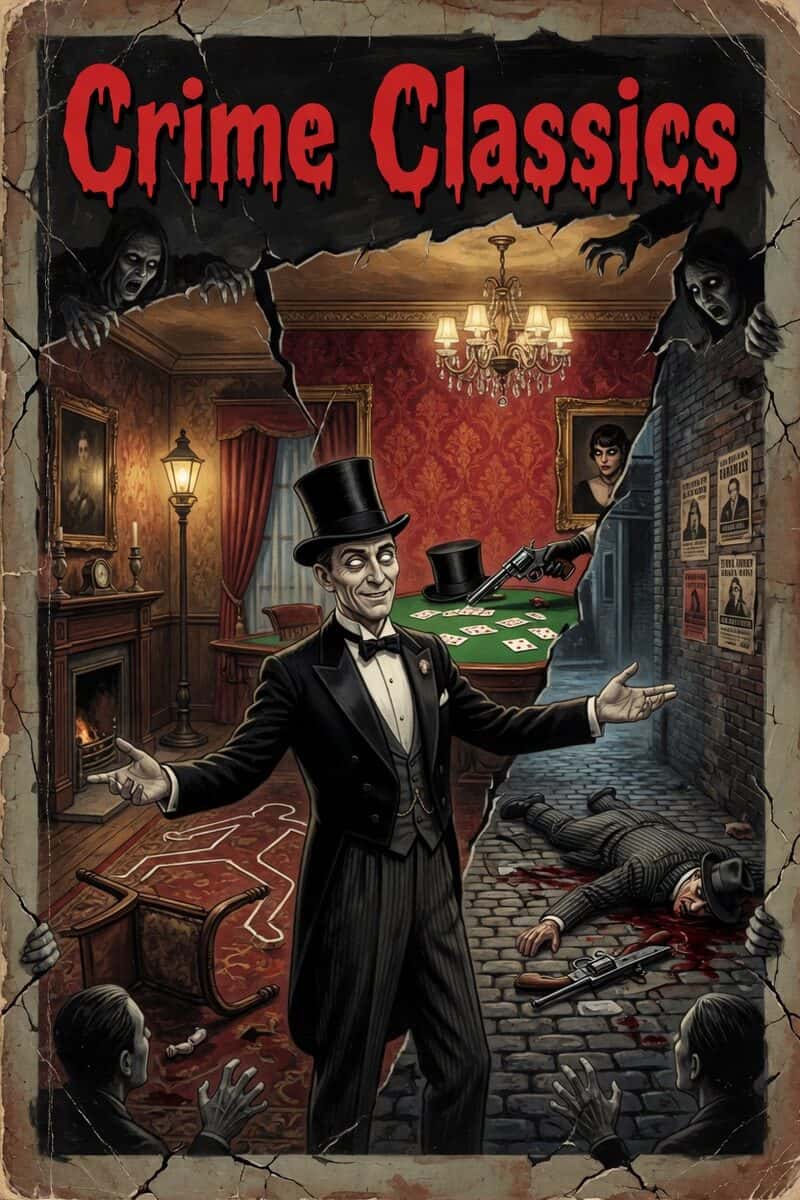
Crime Classics. A series of true crime stories taken from the records and newspapers of every land, from every time. Your host each week, Mr. Thomas Highland. Connoisseur of crime, student of violence, and teller of murders. Now, once again, Mr. Thomas Highland.
Civic-minded people called Manchester Cottonopolis. But those who could never forget the Peterloo Massacre called it the City of Orphans. Among other epithets, some in Gaelic. This massacre, you'll remember, was simply a matter of shooting and riding down and thereby slaughtering some thousand citizens who gathered in a park to protest the Corn Laws. Mary Warden's mother and father had the distinction of being trampled to death by the same cavalryman. And on Mary Warden's tenth birthday, too.
And what happened to Mary Warden is this. She was removed immediately to Mother Winnie Penn's Souls Harbour Orphanage, where she spent the next six years learning to be a drudge. Then, one day...
That one there, Winnie Penn.
Mary Warden?
Aye, if that be her name. She's Scrabble. For you, and cook, and earn her keep. Of dexterity. Tell me that. With a needle, her fingers fly like a doody bird.
Aye. How old is she?
She passed for twenty, couldn't she? But she's only... Sixteen.
What do you say, Mr. Price?
Call her to the wire. Let me have a look at her. Mary. Mary Warden. Come. Stop twisting your hair, Mary. And stand you still. Here's a gent thinking of taking you away from us.
Would you like to go with me, child?
Child? Shy ain't we today, Mary. Well, come you here. Bend your head close, and I'll tell you a thing that'll take away your shyness.
No.
Mary. You old crow. Fit for the stage, she is. Oh, Mary. Mary. We'll miss her.
I'll bend my head close. You'll try to stretch my ear from my head, you old golly-nacker. Them that don't appreciate the gentle and the loving kindness. Mister.
I'm Mr. Price. Take me away from here.
You want to go away with me?
I must get out of here before she whips the skin fair off me.
I asked you something, child.
I must get out of here.
With me? With me?
Yes, sir.
Winnie Penn. Them that don't appreciate...
She wants to go with me. Twenty pounds. Same as the rest.
Twenty pounds? Well, that's more than I... Oh, I want to go away, sir. With you, sir. I wouldn't go with anybody else.
Do you now? Oh, do you now?
Oh, yes. Yes.
So it was that Mary Warden was indentured to Thomas Price. At the wage of four pounds a year, Mary would be free to go her own way at the age of twenty-one. That is, if Mr. Price did not fine her for not obeying him in whatever was his whim. And he was nothing if not whimsical.
Now, while Mr. Price was situating Mary in the back room of his factory, seeing that she was comfortable in her new position and all, let's look in on the firehouse of the Norwich Union boys. A young man, James Evans by name, has just passed all the tests in order to become a fireman.
Oh, here are your buttons. Tardy, chief. And here your badge. Tardy, sir. And you must keep them polished all the time.
Yes, sir.
And notice the raised figures on button and badge. Crouched panther for always alert, the rose for courtesy, the coiled serpent for neatness.
Yes, sir. And you're one of us, a Norwich Union boy.
Chief.
Yes, Evans?
Thank you for everything.
Oh, of course. And I want to tell you this, that it is an honour to serve under the greatest net man in the business. Have your buttons sewn on, Evans. Come back and we'll have a game.
Oh, yes, sir. Do you...
Of course we do. Buttons? Anything in the line of clothes and buttons and fabrics. I want these sewn on.
Oh, then it's a fireman you are. A Norwich Union boy. Mary, Mary, this one's a Norwich Union boy and he needs his buttons sewed too. You just... Just go through that gate, sir, and Mary will sew them in an inch. And twelve buttons is a farthing, young sir. That's all.
I'll be packing the first year, Mary. Hey to me when you're done. Tardy, tardy for picking up for me. All over the floor.
I'll get them.
Oh, let me. Let me. Fumbly fingers, they tremble. Give them to me.
Oh, God. Give them to me.
Oh, they're chill. And your hands so warm.
Warm.
Then meet me. Tonight, when the river Medlock turns left past Crowley's Landing at twelve o'clock, you want me to sneak out, do you not? Does not your father let you?
Oh, my father. I'm an indentured servant, I am.
Oh, my. And James Evans, sensitive boy, was lost forever. This poor and beautiful girl, no better than a slave. And all day long, his hands felt the touch of her hands. And all day long, he remembered the scent and texture of her golden hair as she leaned to bite off the thread. Suddenly, life became complicated. A life that before this meeting had only poles and nets and ladders and hooks and solidarity meetings and hoses and hound mascots. Now, suddenly, there was a woman.
That night by the river.
How did you get out?
As he slept, I stole keys from him.
Poor Mary. Poor, poor Mary. And what will you do for your poor Mary?
My poor Mary? For I am yours. What shall I do for you?
Go to him who's bought me and offer him the price he paid.
Pay off your indenture? Twenty pounds.
Oh. Do you have all that much money?
It's all I have.
Oh, then you'll be penniless and I will. But with our love, we'll be richer than that Dickie Harness. Yes. And I have a good job. And I'll make you a good home. And then put your hand in mine.
Mary. Mary. Pretend.
Pretend what?
That I have paid Mr. Price and you no longer belong to him and that your fancies are free. Yet you can think of no one but me.
Oh, Mary. I cannot pretend it when it's reality. Tomorrow, tomorrow, I will go to him.
Then perhaps tomorrow it will be reality.
No. But, uh... No.
Mr. Price.
What's the matter with you, fireman? You can't take no for an answer.
But why? She's a good girl and she sews like a cherub and she scrubs like an angel. And besides, I have a contract with Mother Winnie Penn and I have no intention...
Twenty-one pounds.
Not an hundred. But she's not meant to be indentured, not such as she, as lully as she, a darbling. Why laughter? At such a time, why laughter?
You love her. Uh, you love her. Truly and without doubt. Tell me, sir. What? A love of the poet's, sweet and soaring, or a pitying love like Sir Mumford and Fanny. Or is it...
I love her and I wish to purchase her out of bondage.
Then let me tell you, sir, it'll never be. For meself, I have plans when she can sew nimbly as I like and when she cooks with smiling skillet as I like. When she keeps house in a manner neatly, then I could do worse than to take her as a wife. And what do you say to that, young fireman?
A pox to you.
To him. That's exactly what I told him. He wants to marry me. That's exactly what he told me. I wouldn't marry him if they were Lord Duncan and all his birds.
Well, then here's what he could do. Simply keep you indebted to him for as long as he wants by fines, by whatever.
I'd go to the courts.
And they would uphold him and not you. Then what will you do? What will you do for me?
Pretend.
What?
There's a world, a wonderful world when you pretend. Then anything can be yours for as long as, long as you pretend.
James. I do it all the time.
James. I pretend that you were mine. Pretending is... James, when I leave you, when I return to my straw on the draft, shall I pretend it's a palace bed warmed by a fire of burning oak? And shall I pretend that Mr. Price is a prince? What would you have me do?
Oh, rid me of him.
How?
You have your buttons, James.
Yes, I have.
Therefore, you have a good head upon you and a strong back.
I'm a Norwich Union boy.
Oh, yes, you are.
Then make a plan and follow it. Rid me of him.
I will.
Swear it?
I swear it.
Oh, James.
Yes?
Let's pretend there is no Mr. Price. Let's pretend I'm free for a while. For a little while.
And there, where the river Medlock turned left past Crowley's Landing, the cricket sang and the lovers spoke of love. Gore! And made promises. A way to rid him is already forming in my brain. Which is the way the evening went.
You are listening to Crime Classics and your host, Thomas Highland.
Teenage existence is often fraught with emotional pitfalls. What could be more intense, for example, than a bitter end disagreement about which teenage girl should lend what to whom? Tomorrow night on most of these same stations, follow these latest doings on Junior Miss, starring Barbara Whiting as Judy Graves. It's Junior Miss, the same fine and flighty young lady that Sally Benson created in her own CBS radio series. Remember, Judy and the terrible wardrobe tension. Tomorrow night.
And now once again, Thomas Highland and the second act of Crime Classics. And his report to you on James Evans, Fireman. How he extinguished a human torch.
To settle any arguments, it was Vander Heide who in 1670 invented the hose. A year later, he stumbled upon the principle of the suction pipe. And putting the two together, it enabled the fire engine to be some distance away from both the fire and the source of water. Before Vander Heide, fires were fought with squeezing streams of water from leather bags. It should be said that in this era, things mostly burned to the ground.
In the era we are concerned with, the 1820s, the city of Manchester depended upon three Newsham fire engines, manned by three fire companies respectively. And the company that was wanted most was the Norwich Union Boys. And the most recent recruit of this crack company was a crack youth named James Evans.
He knew a lady on Bent Farthington Street who sold ducks.
Here's a plump one, James lad. Enough meat and fatty on him for bread and spooning. Sophie. Pluck him for you before you can say Jack Rennison. Saved him for you, I did, knowing as I you likes your bird come Friday.
Sophie.
What you want, James lad?
A favour.
What could a handsome lad like you be wanting with twelve buttons a gleam and a badge a-shining? What could you be wanting, lad?
There's a girl.
Ah, then you'll be needing another duck and you have no money to pay poor Sophie. And you're going to stand and wheedle and make poor Sophie... Isn't that at all? And you don't want something from poor Sophie and for which you're not going to pay her.
The fact is what I want I'm going to pay you.
Good boy.
There's a girl and she's indentured to Mr. Price. Now, which Mr. Price be that be?
The cloth man in my house. Marsden Square. Know him?
Boy's a pigeon now and about. Go to him, Sophie and ask whether you can borrow this girl of his, this Mary Warden for the day for some work you need done.
What kind of work would that be?
Cleaning, sorting the feathers for ticking and pillows and I'll give you the money to pay him.
Ah. Will you do it? Go to him, hire her for today and keep her at your house tonight and deliver her back tomorrow. And money to keep me mouth shut for whatever's going to happen.
It's ten pounds for all of it.
You're a one, ain't you, James?
Will you do it?
Of course, of course, dear lad, of course.
Now then, you see how it's done?
Yes.
Then let's see you do it. Now, here's the cloth. Put the thread through here and here then loop over then through here and here loop then right through here and the machine is done. The machine is ready to sew. Now you do it, Mary.
Well, I want to, Mr. Price.
There. Good. Good, good, good. You've done it, girl. You know how to make a single thread chain on a sewing machine.
Oh, I'm glad. I'm Mary.
Yes, Mr. Price. Your fingers will not be stuck with holes anymore. The reason I bought this machine.
You're concerned for my fingers, Mr. Price.
Aye, for your fingers and your hands. And your fingers and your hair. What are you trying to say to me, Mr. Price?
You're comely. I noticed this first when you were behind the wire at Mother Winnie Penn's.
But I'm just an indentured maid, sir. And the way you speak to me as if I were a maid who's being wooed.
Oh, I'm Mary. Mary. Ducks and pigeons. Wants none today.
Now, Mr. Price.
Aye, now, lass.
Good morning.
Good morning, Aunty Sophie. And we've made enough without your birds, but carry off.
But I didn't climb these stairs for just a selling.
No, indeed.
Hello, lass.
Hello. I heard that you were a one for cleaning.
Oh. What's this? What's this?
I need a cleaning girl, I do.
Oh? And of money to pay for her. A pound till tomorrow morning.
Oh. Ah, well, a pound's a pound and in the pockets it's sound, I always think. What do you say, girl?
Well, what do you say, Mary?
Whatever you want.
Ah. And tomorrow when you come back we can take up the conversation we were having.
Yes.
Here's the pound then, Mr. Price. There you are. Have a good cleaning for Aunty Sophie, girl.
Oh, I will indeed. Come along, lass.
Aunty Sophie.
Yes, lass?
James Evans sent you to me.
La, la. To take me away for a night and a day. He's a one. He's a one, isn't he? La, la. Oh, him and his twelve brass buttons. Oh, my. I sewed them all on. All of them. Oh, my. Ducks and pigeons, pigeons and ducks.
That night, that very night. Fire! Fire! Fire in the cloth factory of Mr. Price. How it started, no one knew. But the hue and cry went up. Fire! Fire! And there was flame and smoke and shouts of alarm. And first on the scene, you guessed it, the Norwich Union boys. And first running up the steps, you guessed it, James Evans, axe in hand. First in the factory loft. The vision obscured, he went to work.
Very good boy with the axe.
Mr. Price! Of course, on fire! Help me! Where are you? Help me! Help me!
They saved most of the factory lofts. The Norwich Union boys did. The fustian vats, the sewing machine, and the main bales. The one thing they didn't save, which lowered their score considerably, was Mr. Price. He was found in some ashes with an axe wound in his head. Then suddenly, everyone turned on the Norwich Union boys. Careless with the axe, they were called. Wanton, and worse, murderers.
So an investigation was held, and it was soon determined that James Evans was the father of the Norwich Union boys. James Evans was the fireman chopping closest to where the body was found.
And then what happened?
Well, Chief, it was smoky, and the flames were fairly licking at me buttons, and I...
Rossiter says he heard someone cry out, as if to say, help me, help me.
Well, there was such clamor and excitement, Chief Munsley. Rossiter said he thought he saw, through the smoke, of course, a human torch. Possibly.
Then you admit it.
It is possible that there was an outcry, and it is possible that there was a human torch. Yes, sir.
And you also must admit it, that you were close by wielding the axe.
Yes, sir.
Therefore, it is possible that you delivered the axe blow, which found its mark in Mr. Price's head.
Yes, sir.
There is a noise, you know. A nasty noise. People speak of the Norwich Union boys and sneer. People speak of wanton murder. Yes, sir. Therefore, for the good of the Norwich Union, you understand, therefore, I must report this to the police and hand you over to them.
Sir.
Yes?
It was an accident. Oh. I admit I felled Mr. Price. Oh, now. I thought he was a flaming bale of rags. Oh, now. And I struck at the bad part to chop it apart from the good part as I'd been taught. Oh, now. I must tell you, sir, I put out the fire. If the fire happened to be a human torch and I could not do it, I could not know it then if it happened to be a torch. Well, sir, I put it out as I'd been taught. Oh, now.
And two weeks later in court, that was the boy's defence. And while he said it...
I was putting out a fire.
And while he said it, he looked so handsome standing there and so brave, twelve brass buttons and his shining badge with a shaft of morning sun twisting through his curls. The stance he took, he seemed somehow a symbol as if he stood between a hungry fire and a helpless child. And if he had but to wish it, the fire would go out like that.
As a matter of fact, just after the jury brought him the verdict, the judge made a statement.
I must commend the gentlemen of the jury for the verdict they have rendered. Not guilty, they have said. James Evans, approach the bench. Closer, boy. Boy, fireman, I imagine often what it is to face the flames. Sometimes, sometimes, I must tell you this, when I hear the clangor of the fire engine, I hasten to where the conflagration is. And I stand and watch the consuming as the tongues of flame leap up. Hmm, leap up. What a brave man you must be to walk into those infernos. I know you must be brave for I only stand and watch and I shiver. And how it must be to be like you are. I hear you. Hero of the flame. Master of it. Slayer of it. You are a hero, boy. And that you, overzealous, have made a mistake and put axe to a human being should not be held against you. If you will approach yet closer, I will shake your hand.
And later, the judge, Judge Wilcox was his name, married the two lovers, James Evans and Mary Warden, and became a great friend of the family. The three of them would sit there in front of the fireplace and just stare at the flames for hours.
In just a moment, Thomas Hyland will tell you about next week's Crime Classic.
James Evans, tonight's Crime Classic, was adapted from the original court reports and newspaper accounts by Morton Fine and David Friedkin. The music was composed and conducted by Bernard Herrmann. And the program is produced and directed by Elliott Lewis. Thomas Hyland is portrayed on radio by Lou Merrill. In tonight's story, Alistair Duncan was heard as James, Betty Harford as Mary, and Ben Wright as Mr. Price. Featured in the cast were Paula Winslowe, Florence Walcott, and Richard Peel. Bob Lemond speaking. And here again is Thomas Hyland.
Next week, Rome, Italy, in the year 1500. At that time, a girl's brother did her a favor, a big favor, but it wasn't easy. It's listed in my files as Cesare Borgia, his most difficult murder. Thank you. Good night.
We can tell you in a great many words or in just three words what makes CBS Radio News first and foremost with most Americans. Let's do it the short way this time. Those three words, or names rather, are Murrow, Thomas, and Trout. Because Edward R. Murrow, Lowell Thomas, and Robert Trout are just three of the reporters you hear regularly at the Star's Address. Because America knows and trusts these men and the great CBS Radio newsroom that backs them up with a worldwide network of reporting, America listens most to CBS Radio for its news as well as its entertainment. America listens most to the CBS Radio Network.