
The written record
Read the transcript
Read along with the recording · About 20 min to read
Your brother. Not forget it.
The first appearance of bleeding some days following operation is of the utmost significance to the surgeon. It will almost invariably be a recurrence unless measures are taken to prevent it. And it will ultimately prove fatal. The vessels most commonly affected are the lingual, the facial, and the internal maxillary arteries. Unless this offending vessel can be isolated...
Mr. Briggs, it behooves me to pause in the middle of this lecture to remind you of one important thing. Apparently not important to you, but extremely important to me. I have been paid as high as $1,500 an hour for lecturing on the after-treatment of surgical patients. I lecture here for the college medical class free of charge. I at least expect the courtesy of attention. I do not expect my students to tabulate their meager bank accounts while I am making every effort to instill some portion of physical knowledge into their thick-covered craniums.
I was making notes, Professor.
Apparently. Mentally, you were tabulating your money in the bank. Gentlemen, I regret that the lecture this morning will not be continued. Dismissed.
Julius, is the lecture over so soon?
Stupidity. Nothing but stupidity.
Stupidity, Julius?
Trying to teach those idiots the secrets of surgery is like trying to drill the Alzonian theory into a two-year-old.
Sit down, Julius. You're tired.
I'm not tired. I'm simply exasperated. What's come over you, Julius? You've suddenly become so, well, so cantankerous ever since the death of Stephen Hamblin.
I know, Carl. I know.
It was very close to you, wasn't it?
Close? I wonder if anyone knew. How close? I wonder if anyone knew.
You've known him ever since he was a boy.
Yes. Ever since he was a mere child. I remember when he first came here to the university. He didn't impress me as all the others did. There was no eagerness about him to learn. He seemed to have no ambitions to learn. And yet his grades were the highest that have ever been made in the history of our institution.
Yes. Just so. It's a pity that he had to die.
Perhaps. Perhaps.
Julius, all of us naturally expected you to be quite shocked to hear of Stephen Hamblin's passing. But you fooled us completely. Well, you didn't seem the least bit startled when we broke the news to you. No, you, well, you seemed almost, uh, almost glad.
Did I, Dr. Miller?
Yes, Dr. Zemeck. Has the body been cremated?
Yes, this morning.
Were my directions carried out?
To the letter, Julius. The brain of Stephen Hamblin was removed. I, myself, made the salutation. The solution you gave me. I submerged the brain into the solution and removed the air from the container.
Where is it now?
In my laboratory. It's a perfect specimen. The best developed human brain I've ever seen, doctor.
Take me to it.
Now?
Yes, take me to it. But haven't you another lecture, Julius?
Don't argue with me. Take me to your laboratory. Or must I go alone?
Why, of course, Julius. Of course. This way. I have the second solution at the boiling point for you. Here it is. Just as you ordered, Dr. Zemeck.
Good, excellent. Here, the brain.
Yes, just so, just so. Most excellent work, Carl. Most excellent.
I'm glad you're satisfied. Do you wish to add the solution now? It should be done, I believe. Stephen Hamblin's brain must be preserved. This is one sure way of doing it. I must admit I don't know what your method is. Certainly I've never heard of it before. I wouldn't think a solution like that would preserve anything.
It is. It is a preservant no one has ever known of before.
Are you ready, Doctor?
Yes, quite ready.
We can insert this glass funnel through the rubber stopper on the container.
I'll do it, Doctor. There. Now. You may extinguish the Bunsen burner, Dr. Miller. You want the second solution just below the boiling point.
Yes, very well. Is there anything I can do for you now?
No, nothing. Stand back now. I'm about to add the hot solution to the other. Perfect. Yes, perfect.
Is it necessary? Is it necessary to remove the air from the chamber again?
No, not now. Not now. I'll replace the punctured rubber stopper with a new one.
Yes, do that, Dr. Miller.
Just a moment. Dr. Zemeck.
Yes, Dr. Miller. This brain. I have looked at it, Carl.
Julius. That brain. It's alive.
Does that amaze you?
Julius. It's a beautiful specimen, isn't it? It is actually alive.
Oh, yes, indeed. It always has been.
Julius, I'm an old man. I don't much relish your tricks.
This is no trick, Carl. I assure you. Why, that brain is displaying the normal reaction you've often witnessed in viewing a human brain by means of x-ray.
Yes, but this brain has no cranium. And the body. No body attached to it. Yet it lives, Carl. It lives. Only Stefan Hamblin's brain could do that. Live after his death.
Now, it's a trick. The solution. It must be. The solution.
No, Carl. It is not the solution that causes the brain to live. I admit it could not live without the solution. Mere pickling would have destroyed it. But the solution will preserve the life, Carl. The life that has never left.
Impossible. Utterly fantastic.
No, my dear Dr. Miller, not at all. Not at all fantastic, nor impossible.
But the brain cannot live outside the body. The human brain, no. But Stefan Hamblin's brain can.
But, doctor. Stefan was human. Was he? Wasn't he?
No one knew Stefan Hamblin as well as I did, Carl. No one. Not even his parents. Oh, they knew he was different, yes. They knew he wasn't just an ordinary person. But they had no idea how truly extraordinary he actually was.
I can't believe a human brain existing after the body has been cremated.
Perhaps my good friend, if I were to tell you his story, you would see it. You would see the reason why such a thing could happen.
Yes, perhaps.
Sit down, Carl, sit down. Look deeply into the mystery you see there before you. The living brain of dead and cremated Stefan Hamblin. It was a most extraordinary brain, Carl.
Yes, most.
To know the mystery behind it was to know Stefan Hamblin. I remember the first time I met him. It was a little place in Kansas, a small town called Emporia. Stefan was born there 37 years ago. I was 10 years old when I met him. I was 10 years old when I met him. When I met him, he was 9. And yet he was crawling about from place to place on all fours, like a mere infant. He'd been examined by the best doctors in America, taken to New York, to the West Coast, everywhere for observation. And each examination brought the same verdict. Perfectly capable of walking, but apparently unable to do so. Probably because of some mental handicap. A good enough excuse, a good enough diagnosis for the stupid. It may have been a mental handicap, yes. But if it's so, it was of Stefan Hamblin's own making. He had never spoken a word, uttered a single guttural sound in all those nine years. He'd never smiled, never frowned, never cried. Nine long years crawling on hands and knees, never uttering a sound. And yet, his vocal cords were pronounced perfectly normal, completely developed. And yet he had never spoken. Never.
That first day I met him, was put in charge of him while our elders attended a ball game. It was the first day I really knew Stefan Hamblin. It was the first day anyone ever knew him. When we had been left alone, I went off to a corner of the room by myself. I turned my back to that crawling bulk of a lout there on the floor and chose a book to help while away the time until my uncle should return for me. And suddenly, after a brief passage of time, suddenly there was a hand upon my shoulder. I probably should have been startled. I knew Stefan and I were alone in the house, but I wasn't startled. Instead, I turned my head and looked slowly around behind me. Looked up into the wide, innocent, staring eyes of Stefan Hamblin. He was standing there beside my chair, gazing down on me. Yes, down. Yes, standing. Stefan Hamblin was standing. For a full minute, our gazes met, and fused. I was too startled. Too amazed. Too puzzled to speak. But after that long, burning minute, he spoke.
You don't like me, do you, Julius?
I was too bewildered to answer. Stefan Hamblin had not only completely astonished me by standing, walking, but he had actually spoken to me. And I knew he had never spoken a single word to a single living soul before in all his nine years upon this earth.
Yes?
His walking, his talking, completely mystified me. And yet there was something else. Something else.
Yes, something besides mere walking. Something apart. Something far superior to mere talking. And then when he spoke again, I knew. I knew what it was.
I said, Julius, you don't like me, do you?
He talked with the voice of an adult. I was more speechless now than I'd ever been before. Stefan Hamblin. Not only completely overwhelming me by a sudden and unheralded display of an ability to walk, but also causing my hair to stand on end by actually addressing me in perfect, mannish English with the voice of an adult. After what seemed a compilation of eon upon eon, I found my voice.
I... I have never had occasion to like you, I said.
Nor... He said. Have you ever had occasion to dislike me?
I admitted that was true. Then I said, Why is it you've never walked until now? Never talked?
To which he replied, I had no occasion to walk because there was no place interesting to which my walking could take me. And as for talking, so far I've never found anything interesting to talk about or anyone of enough interest to talk to.
How long, I asked, have you been able to do both?
I have had the ability to walk and to talk...
You said?
Ever since the day I was born.
After a while, we became acquainted. Long before the elders had returned joyously from watching their favorite ball club while I'd watched the visiting team, Stefan Hamblin and I were bosom pals. It was a friendship that was to exist until death did us part. After that, Stefan Hamblin stood upright on both legs, spoke like any other human. Did I say human? Forgive me. The only difference was that his was a fully developed mind. A fully developed voice, but a highly underdeveloped anatomy.
I remember one day when Stefan and I were playing together on the school ground. I remember I was practicing high jumping at the time. Stefan was watching me. And all of a sudden, he jumped to his feet from where he had been sitting and stood staring wide-eyed. Then quickly he raised both hands before his face as though to shut out an evil, horrible sight. Suddenly there was a noise in the air. The noise of wheels upon rails of steel, spinning, speeding, racing wheels. Clickety-clack! Clickety-clack! Clickety-clack! Screaming as they went. And at that very instant, Stefan covered his eyes with his hands as though to blot out... Terrible, terrifying, resounding crash. As though a million planetoids had collided in the stratosphere and come crashing down around us like pellets of falling hailstones. When I looked at Stefan, he had slumped to the ground. I rushed to him. My heart leaped within me. I raised Stefan into my arms as I threw myself down beside him. When he opened his eyes, he asked quietly, Was... Was anyone saved? Anyone... Saved?
I frowned. Tell me, Stefan, what in the name of heaven happened?
He was quiet for a moment. Then he pulled himself away from me, arose to his feet. He looked about him momentarily, on all sides, and then he spoke, still softly. There's been a terrible accident. A train has just left the rails and plunged headlong into a hundred-foot gorge.
The next day, our newspaper headlines screamed the details of the most destructive and death-dealing train accident ever to happen in the city of Paris. Yes, in France. It had happened at the very moment Stefan had covered his face in terror. And we had heard that pounding, awesome crash.
It was not until several years later, when we both entered Oxford College, that I saw Stefan Hamblin again. At first, he avoided me. Tried to pretend he didn't know me. But when I finally managed to get in a word with him and remind him of our first meeting, he told me he was glad to see me again.
But he was extremely cold. Almost insultingly reserved. And the very few times I saw him after that first day for the next year was between classes. He never partook in student activities. He never strolled the campus or climbed the cliffs or swam in the lake or enjoyed soccer or cricket with the rest of us. He was never seen with the rest of us.
There were constant whispers about him and his strange, weird actions. Many whispers. Most of them ugly and vicious and vile.
It was four long years before I talked to Stephan Hamlin again. Four years at Oxford, I heard those whispers about him all that time. I heard professors say he was the most amazing student of all times. Perfect grades in all subjects. A born doctor. A truly great scientist. A prospect for the world's greatest surgeon.
And then, Stephan and I suddenly found ourselves to be classmates. Even then, I had difficulty in finding an opportunity to make speech with him. But after much effort, having exerted a great amount of patience, I finally cornered him.
"Oh, now look here, Hamlin, I want to talk to you."
"Yes, Dr. Simek?"
"Oh, please call me Julius, Stephan. I, uh, think I want to talk to you, Julius."
"Good, excellent, my dear fellow. Where shall we go?"
"My room should be as good a place as any. Suppose we go there."
"All right, Stephan, that's perfectly right with me."
So we went to his room. There were no books there, none. But there were a few sheets of composition paper and pen and ink. I picked up several of the closely written sheets. It was the most, the most profound and complete and exquisitely worded treatise in diseases of the human brain I had ever read in all my life. I remarked to Stephan that it was odd that he could pen such a masterpiece and yet had no books whatsoever for reference. He didn't smile when he answered. He simply said, "I don't use books, Julius, because I don't need books. What I write, what I recite in my classes comes not from anything I have ever read, not from anything I have ever been taught or have studied, but from somewhere deep within."
"You mean you're fully aware of all these facts without having studied or read or heard about them?"
"Yes. You see, there is nothing I don't know. To me, the theories of the scientists and the theologians and the professors and the doctors are merely nothing more than the alphabet is to you. I have no interest in them whatsoever, save that they are convenient at times to know. And most of those profound theories, profound to you understand, most of them are so terribly false, so astonishingly wrong and untrue and unsound that they fail to interest me in the least."
Yes, Stephan Hamlin was the fount of all the world's most intellectual knowledge. Everything that all mankind had ever known, the secrets of science, of medicine, of astronomy, of surgery, and numbers and mechanics and all the millions and millions of other subject matters were all embedded there, there deep in that superhuman, unbelievable brain of his.
After our graduation from Oxford, after we came here to medical college to study surgery, Stephan and I grew closer and closer together. Never did he open a textbook. Never did he study or concentrate upon the lectures of Europe's most eminent and distinguished scholarly instructors. And yet, his grades, his papers, his recitations were perfect in every degree.
And then one day, Stephan Hamlin told me his secret, poured forth his very soul at my feet and threw himself at my mercy.
"You think I'm odd. You call me different. You despise me. You despise me the first day you met me because I didn't walk, didn't talk, despite my apparent ability to do so. Men everywhere have always shunned me. All my life, I've been whispered about behind my back. All my life, I've been lonely. My heart has been heavy with loneliness that no human words know, not even those words I can summon may ever describe. I'm different, yes. To me, complete universal knowledge has always been more an instinct than an acquirement. All my days, I have had nothing, nothing to acquire, nothing for which to exist, save one thing. Ever since the day I was born, I have been looking for my brother."
"Your brother, Stephan? I thought you were the only child."
"I am. I don't mean my worldly flesh and blood, brother. No, I mean something far greater than that, Julius. I've spent my life searching for my spiritual brother, as it were, and yet, not altogether spiritual, no. You see, Julius, I am not of this race. It startles you, doesn't it? But it's nonetheless true. I was born 10,000 years ago, 10,000 years too soon. Yes, at least 10,000 years. Something went wrong in the plan of things, some mix-up in regeneration, some grave calamity in the routine of creation. For my kind, my race, it's not to be born into this world until thousands upon thousands of years hence. How I came to be, I have no answer, but I am, and so I shall be, till my span is ebbed. I have the complete knowledge of your universe because, according to the plan of things to come, all that is knowledge here with you now will be merely common inborn knowledge for the race in the future that is to be mine. That's why I need no books. That's why I'm different. Because the things you know are as mere nothingness to me. And because the things I know are 10,000 years beyond your understanding. I've brought you here, Dr. Julius Simek, to announce to you the end of your civilization. I found the means of destroying it at one fell swoop. The sooner to bring about the appearance of my race, the better for the world. I've sought the world over for my brother, the one like me, one of my race. But now I'm certain there is none. That I am alone. I can foretell everything. I know everything that is to come. All save one thing. I do not know my destiny, my own individual end. I do not have the power to foresee that or to foresee who will bring it about."
And then, he outlined to me the most devastating, the most terrible, the most death-rendering plan of all history. For the dispellation of the power of death, for the dispellation of the power of death, for the dispellation of the power of death, for the dispellation of the power of death, for the dispellation of the power of death, for the present race from the face of the earth. Bitterly, he outlined it, poison dripping viciously from his every word. It was so simply done, so quickly, so painlessly, that its very program rendered unto me a nausea that I found almost impossible to overcome.
I argued with him, pleaded, begged, I reasoned, bullied, threatened. All to no avail. He had made his plans. He was determined that they should be carried out. If he were to be destroyed too, he did not know. No. He could not foresee his destruction, nor his destroyer. No. He didn't know what his own end upon earth was to be. He could foresee all future things, save his own destruction, save his own destroyer. His destroyer. Someone had to destroy him. Someone had to. Someone.
He was still babbling about that wicked, wretched plan of his, outlining it like a madman. I looked about me, cautiously at first. Then, desperately, when I realized he had forgotten my existence, I groped for a solution. I groped for a solution. I groped for a solution. I groped for a solution. I groped for a solution to this terrible, impending calamity. And just then, Stephan opened a desk drawer, withdrew a small compass. I caught a glimpse of a small gun in that drawer. I could see, even at that distance, that the gun was loaded.
He was still talking about his plan. Still bewailing the fact that he alone on this earth had the power possessed within him. Still decrying the fact that he had searched the world over for his brother. Not his flesh and blood brother, but a brother of his kind. His race. He knew that were there any other people or another soul of his kind alive on earth, that soul could foretell the end. The destruction of Stephan Hamlin.
Suddenly, he arose from his chair. He ordered me to come with him. He was about to work his havoc upon an unsuspecting world. And then, desperately, I acted. Quickly, I yanked open the drawer of his study desk, took out the gun. I leveled it at his head. He stood terrified a moment. And then, then there was a pleading in his eyes. A pleading. Not for his life, but a pleading to spare him the damage a ripping bullet would do to his masterly brain.
And in that instant, in that final desperate second before he lunged at me in an effort to save his life, there was recognition. The flash of an age-old suspicion at last fulfilled. And as I lowered my gun to a level with his heart, I knew that the pain within my heart at that moment would never be removed. Like lightning he made for me, speeding across the room, charging at me, I tried to stop him, tried to warn him, shouted at him.
"Keep back! No! Keep back, Stephan! Keep back!"
He fell at my feet, kneeling, almost in supplication, not foreseeing his end. He did not know. He could not know his brother.
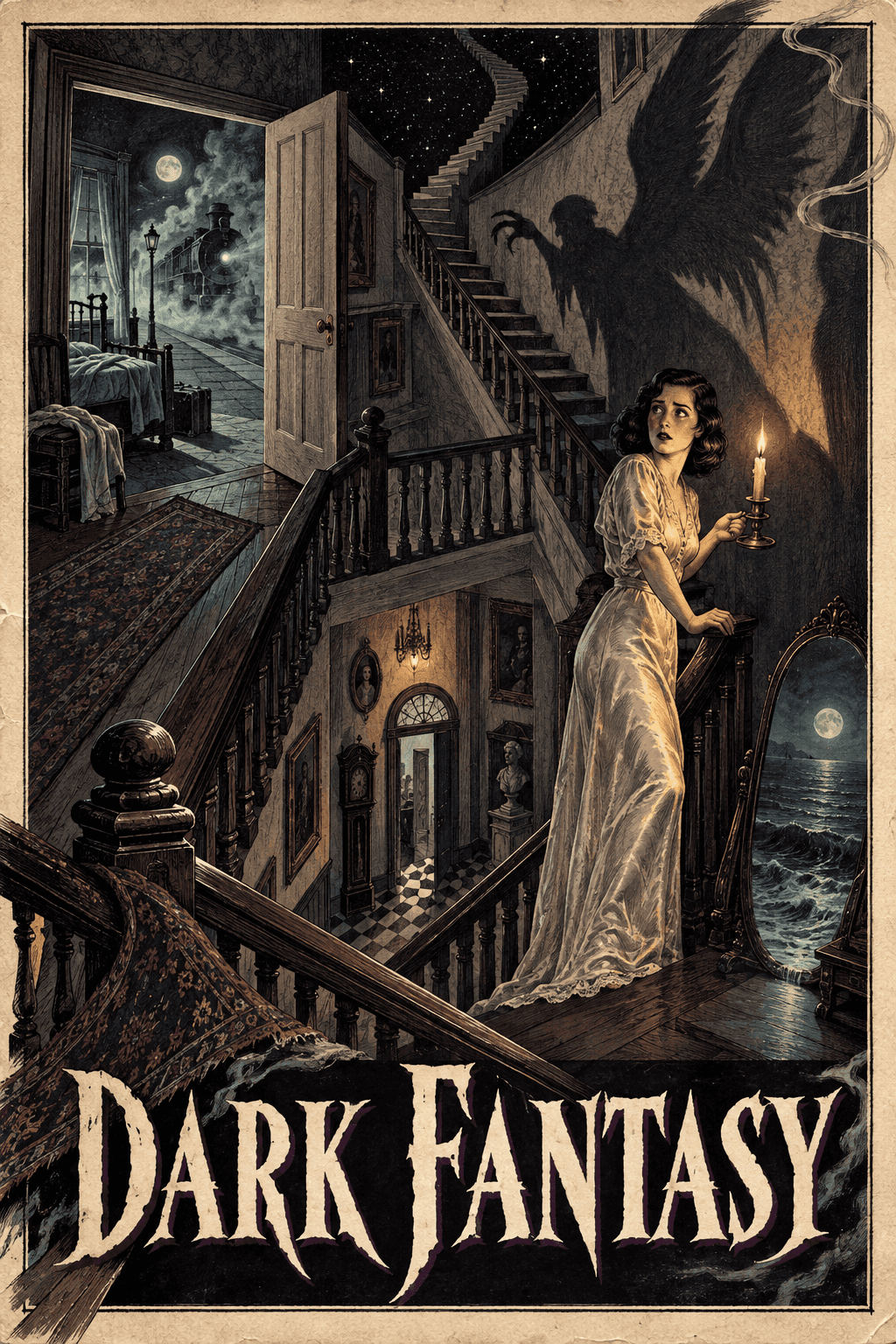
Tonight's original tale of dark fantasy, I Am Your Brother, written and directed by Scott Bishop and originating in the studios of WKY. Morris was heard as Dr. Julius Simek, Voice Wright was Stephan Hamlin, and Muir played Dr. Carl Miller. Next Friday at this same time, the 30th original dark fantasy adventure, The Sleeping Death, created for you by Scott Bishop. Tom Paxton speaking, Dark Fantasy comes to you each Friday night from Oklahoma City. This is the National Broadcasting Company.