
The written record
Read the transcript
Read along with the recording · About 21 min to read
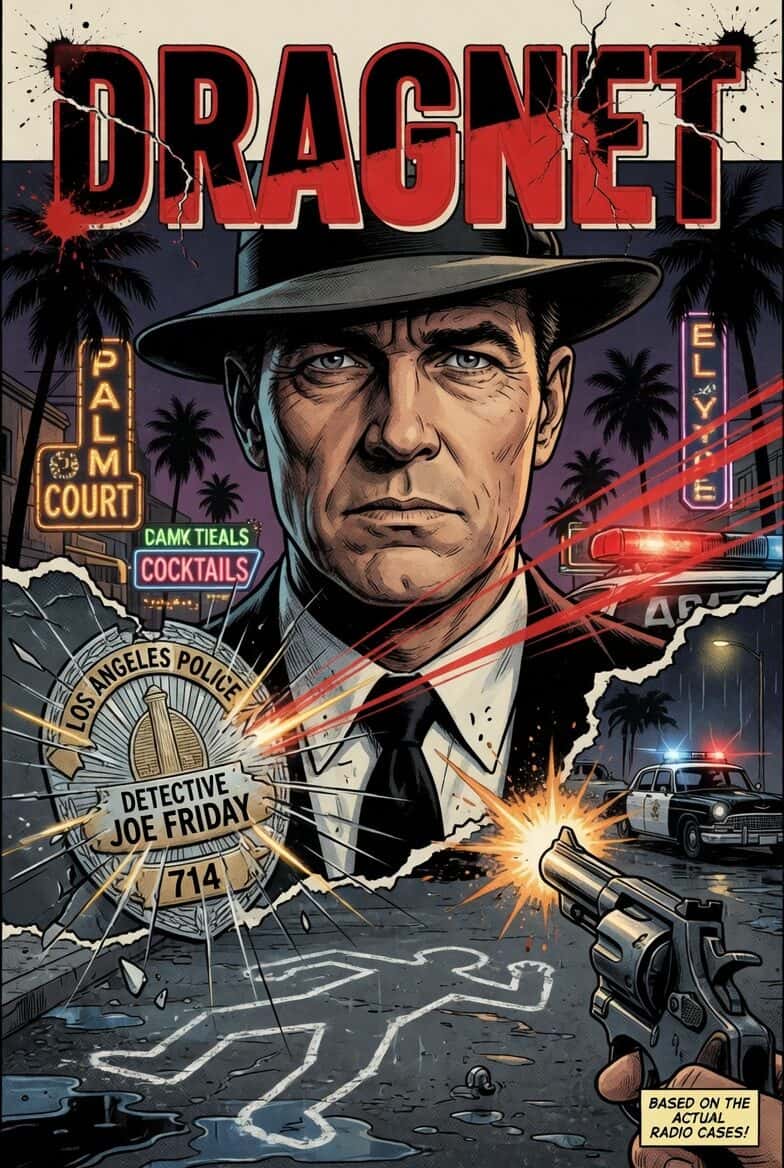
Here's another in NBC's great parade of new shows. The story you are about to hear is true. Only the names have been changed to protect the innocent. NBC brings you Dragnet.
...assigned to homicide detail. A 22-year-old girl has disappeared. It demands $30,000. The girl is signed The Wolf. Your job, get him. Dragnet, the documented drama of an actual crime, investigated and solved by the men who unrelentingly stand watch on the security of your home, your family, and your life. For the next 30 minutes, in cooperation with the Los Angeles Police Department, you will travel step-by-step on the side of the law through an actual case transcribed from official police files. From beginning to end, from crime to punishment, Dragnet is the story of your police force in action.
It was cloudy in Los Angeles. We were working the night watch out of homicide. My partner's Ben Romero. The boss is Ed Backstrand, chief of detectives. I was on the way back from the stats office, and it was 3:26 a.m. when I got to room 42. Homicide.
Got those mudjacks for you.
Here they are.
Thanks, Harris. Backstrand, leave yet?
In a minute. I'm going out with him.
What's the address out there to Sullivan Point?
814 Castro Boulevard. You go straight out Santa Monica, take a left at Castro.
All right, Mama. You ready, Chief?
Yeah, man. Brandy, you call Romero yet?
Right now. Get on it. Listen to me. Don't fool with... Yeah. Come on, Harris.
Sorry to wake you, Ben. This is Joe. How you feeling?
Oh, 3:30 a.m. How do you feel?
Be ready in 20 minutes. I'll pick you up.
20 minutes? Yeah.
Remember Martin Sullivan, vice president of the Third National Bank? Got a 22-year-old daughter. Or he had one. She's gone.
You made good time, Joe. Where we headed?
Sullivan home, out on Castro Boulevard. Ed's out there now with Harris.
Any leads to work on?
No, nothing so far. The girl disappeared a little before 1 o'clock yesterday afternoon. At 11 last night, he got a letter. They want $30,000. Sullivan hasn't got that kind of money.
Yeah, I know it. Poor guy's almost out of his mind.
Fill me in. How'd it happen?
Well, the guy took the girl out of business school. He had her called out of class. Told her her father was sick. Said he was a friend of the family.
Well, how about the teachers? What was their story?
Said the girl didn't want to go with the man at first, but he finally talked her into it. Kept telling her her father was dying.
That's about as low as it comes?
Yeah.
Did he use a car?
Witnesses said it was a blue sedan. They didn't get the license number or the make.
Did they remember what the guy looked like?
About 5'9", 160, brown suit, dark hair.
Hmm. Nothing else?
No. Here's a copy of the letter. Reusual. Read it.
Yeah. I have your daughter, Judy. Get, uh... What's that?
$30,000.
$30,000 quick if you want her back alive. Don't call police or I'll kill her. Contact you later. Signed, uh... What was it?
The Wolf.
Oh, Wolf. I can think of a better name. Come on.
Here we go.
Here we are. It's got the original note, Joe. Lee Jones down at the crime lab checking it for prints and handwriting.
Well, if he was... Oh, hi, Dave.
Yeah. Right on the house, boys. She's waiting for you.
Thanks, Dave.
Hi, Joe. Ben. In the living room.
That's the way I see it, Mr. Sullivan. Now, you understand exactly what you have to do?
Yes, sir. Here are the two men who will help you. Sergeant Friday and Sergeant Romero. Homicide.
Yes, sir. How do you do? How do you do?
Mr. B... Are you sure about all this?
Yes, sir. Are you sure about all this? He... He might get frightened. He might... Believe me, Mr. Sullivan. It's the only way. It's a feel, but... Come on back in the dining room.
There it is on the table. Second note from the guy. Tell us, man. When did this come?
About half an hour ago. Guy phoned it in to Western Union from a public booth. Couldn't trace it.
I see, Joe.
Yeah. We're at Elysian Park. Half o'clock. 30,000. We'll return girl. We will. 4 a.m. now, Skipper. Not much time.
I know it. We'll have to do as he says. No other way.
That's right. And Sullivan's going out there alone?
You're going with him. You and Romero. He'll be hidden out in the trunk of the car.
Any plan?
Get him. That's all.
Went out the back door and into the Sullivan garage. We jammed ourselves into the trunk compartment and Harris closed the door on us. The latch was fixed so that the door could be pushed open from the inside. A few minutes later, Mr. Sullivan came out, got in the car, and we drove off.
At three minutes to five, we pulled up at the meeting place in Elysian Park. At five, it started to thunder.
That's all we need now. Thunderstorm.
Mr. Sullivan?
Yeah.
It's getting daylight. We'll wait it out, Mr. Sullivan. Now, look, don't come back here again. If he's watching, you might tip him off.
I'm coming back here. Now, watch it. That's you, Ed?
The meeting's off. Got a cramp in my leg.
I'm cramped all over. Mr. Sullivan, drive back home. We'll contact you there.
All right, Chief.
Ben, Joe, come on over to the car.
What's the story, Ed?
The guy had no intention of following through with this meeting tonight.
Well, how come?
He told us he phoned at five o'clock. I tried to trace the call. He wouldn't stay on the line long enough.
What'd he have to say?
He wanted more money. Bragged about how smart he was, how we'd never get him.
Well, he knows Sullivan's called in the police.
Sure. Said he didn't care. We'd never get him anyway.
Yeah, pretty cocky. Pretty smart. Take my word for it, he's no dummy.
80K to 80K. Control 1. I'll get it.
80K to Control 1. 80K to Control 1. Go ahead.
80K, go to your office. Code 3, go to your office.
All right, Romero. Let's roll.
More than 12 hours had passed since word of Judy Sullivan's disappearance had been phoned in to homicide. During that time, an all-points bulletin containing the descriptions of the suspect, his car, and the girl had been sent out on the teletype to law enforcement agencies throughout the area. The same descriptions were broadcast over the police radio every hour. The Sullivan home had been placed under strict surveillance and Mr. Sullivan instructed not to contact the suspect without knowledge of the police. He'd raised almost $10,000 in cash to buy him off. The serial number on each one of the bills had been copied by a police stenographer and then rechecked by a homicide officer. So far, the wolf, as he called himself, had made three separate contacts, but he'd covered his tracks well. We knew that he was somewhere in the city, 500 square miles of it, and we knew we had to find him fast.
It was 18 minutes past six when we got back to homicide.
Hi, Chief. Fellas. You got something for us, Mike?
Here, this letter. Special delivery. Came in about 25 minutes.
Can I see that, Mike?
Stay away from Sullivan. If the kid's found dead, it's your fault. Stay away, the wolf.
All right, Mike. Get it over to the crime lab and have Lee check it for prints.
Right, Chief.
Will he find any prints on the second note, Mike?
Two. Running through R&I now. Friday, room and room. Get down there and see if they got a make.
Right, Ed. Let's go, Ben.
Who's watching the Sullivan house beside Harry?
Carpenter and Davis. Backstrand's afraid the girl's father will try to make a deal with the guy.
Has he tried it yet?
No, he didn't. He couldn't blame him if he did. Sick.
Oh, yeah. Hi, fellas. Just coming down to see you. Got something there?
Those two prints Lee Jones lifted off that letter. Got a make on them from the single print file.
Good, Larry. Let's see, huh?
There it is. Pulled the whole package on him. Donald Alfred Kiefer. Looks like a real bad one, doesn't he?
Donald Alfred Kiefer. Male, Caucasian, age 29, 5 feet 8 inches, 170 pounds, brown eyes, dark brown hair. He had one previous arrest for forgery in Los Angeles 10 months before. Kiefer's occupation at the time of his arrest was listed as bank clerk at the Third National Bank.
Ben went back into the files and pulled the crime report. Then we called Ed Backstrand.
There's the answer, Skipper. At the time, Kiefer pulled that forgery job at the bank. At the bank, Mr. Sullivan was one of the vice presidents.
Oh, go on.
Sullivan was the one who preferred charges against Kiefer and started his prosecution.
Where's this Kiefer now?
Oh, let me see. He was placed on probation and on May 16th this year he returned to his home in Omaha, Nebraska. That's 1380 Mackinac Avenue.
All right, Romero. Get Omaha on the phone and have them check out Kiefer.
Right, Skipper.
Friday, take Kiefer's package and this note down to Don Myers. Have him check the handwriting and get over to the crime lab and see what Jones lifted off that last letter we got.
All right, Ed. The faster we work, the faster we'll put this guy behind bars. Now move.
How's the writing compared, Don? What'd you find?
It looks good. See here? Slants as crosses, double loops as L's, open A's, pressure on the downstroke. Donald Kiefer, the wolf, same handwriting.
Lifted three prints off this last note, Joe. Brought them out with the iodine fume gun. They match with the first.
Thanks, Lee. Did you find anything else?
I don't know if it'll help you much. We examined the paper for watermarks and texture. Both notes are written on the same kind of paper. Impressions show both pieces of paper from the same tablet. Check the density of the carbon and the pencil he used. Both specimens match. Same pencil.
By mid-afternoon, Donald Kiefer's description had been broadcast throughout the area. Bulletins were dispatched to all departments and an APB was teletyped for the entire state. Men were stationed at every post office in the city to watch for notes that might come through the mail. The bus depots, railroad terminals, the airports, and all the main roads leading out of the city were under strict surveillance. The entire Los Angeles area was broken down into single square-mile districts and a house-to-house canvas was started. A squad of men were assigned to cover each square mile. Outlying towns and cities were requested to do the same. By 5 o'clock that afternoon, the greatest dragnet operation in the history of the city was underway. We were sure Donald Kiefer was somewhere inside.
At 12 minutes past 5, Ben got the callback from the Omaha police.
Yeah. Yeah, I got it. 6 X-ray 419. Nebraska plates, right. Well, thank you. Thank you a lot. Yeah, bye.
They had a make on the car. Lots more. The Omaha cops looking for Kiefer, too. Wanted him for a robbery there two months ago.
Yeah. And that robbery used a stolen 1939 blue sedan. Nebraska license plate, 6 X-ray 419.
How about his family and his friends back there? They all been checked?
Yeah. Well, get that car description and the communications, huh? APB, teletype and broadcast. I'll tell him.
Yeah, right, Jim. Right in, Romero.
Yeah. What are you tied up with?
Well, just got a call from Omaha. Make on Kiefer and the car.
Give it to me. You two get out to the Sullivan house as fast as you can.
T. Harris.
What's happened, Kevin?
Martin Sullivan's disappeared.
Harris, how'd it happen?
About three this afternoon, Mr. Sullivan got a phone call. Said he had to go down to the bank. I went with him. He had me wait in the reception room and he went in his office. After waiting 10 minutes, I got suspicious and went in. He was gone.
That's it. Did he get any more money?
This morning, $5,000.
Did you get the serial numbers off the bills?
Yeah. Shouldn't have let him get out of my sight.
Forget it. Right now, we've got to find out where he's gone to meet Kiefer. Did you talk to Mrs. Sullivan about that?
About it, Harris? She says she doesn't know anything about it. Let's try her again. Come on, let's go inside.
Hi, fellas. Hi.
Where's Mrs. Sullivan, Dave?
Back in the sitting room lying down. Doctor's with her. Come on.
What time you got, Ben?
6:35.
I'll get it. Where are you? Where are you now?
It's Martin Sullivan. He met with Kiefer in Laurel Canyon.
Did he get his daughter back?
Yeah. Wrapped in newspapers. All cars in the area were notified that a contact had been made with Kiefer. We got in the car and drove out to Laurel Canyon. The entire area had been blocked off. We found Martin Sullivan standing in the middle of the road on East Winding Way. Five hundred feet down the hill was a private residence where Sullivan had telephoned us. It was the only building in the immediate vicinity. A few yards beyond the point where the East Winding Way ended, we found the body of Martin Sullivan's daughter. We notified the crime lab. Chief Backstrand came in the corner.
Despite a severe state of emotional shock, Martin Sullivan tried to tell us the story. He said, "Officer, did you see his car, Mr. Sullivan? I wanted her back." He said, "I drove here." Martin Sullivan identified a picture of Donald Alfred Kiefer. He definitely identified him. The information was immediately relayed back to Central Division, rebroadcast to the entire police radio system. A teletype was dispatched to sheriff's offices and communications were sent to police stations throughout the country. The house-to-house search throughout the entire city intensified. The dragnet in which we hoped to trap Donald Kiefer was drawing slowly inward.
It was 12 midnight.
"Thanks for your night edition, Friday. Did the papers get a list of the numbers on that ransom money?"
"Yeah, got them in the final night edition. Two and a half pages of serial numbers. Gave it a big spread."
"Look at these pictures of Kiefer here, all over the front page."
"The more the better, Romero. I hope this town never forgets that face. Good reminder. We don't make deals with killers."
"Hi, fellas. Find anything here, Lee?"
"Just checking over these towels here. Found them wrapped around the girl's body inside the papers."
"Funny thing about those papers."
"What's that, Lee?"
"They're all yesterday's. Every story about the girl's disappearance has been clipped out."
"Maybe the guy's making up a scrapbook."
"How about the towels, Jones? Any laundry marks?"
"Not a one so far, Ed. Every one of them was clipped off. Pretty smart."
"The morgue post the body in?"
"They're doing it now."
"Yeah, nasty one."
"Yeah. Did you get any footprints or tire tracks out where they found the body?"
"Lots of them, all cast. Rossi and Taylor are checking them now."
"One thing... What is it, Jones?"
"I don't know. Under the seam here. This towel. Wait a minute. Joe, that pair of snippers there."
"Yeah, there you are. Thanks."
"Yes. Back under the seam. There. That's one tag he missed."
"Any markings, Lee?"
"Yeah. Greenway Apartments, Los Angeles."
The apartment was empty. In an adjoining garage, we found the car which Kiefer had used, a blue sedan. Nebraska license plate, 6-X-ray, 419. When we got back to the office, Chief Backstrand immediately issued a cancellation of the want order for the blue sedan. Then he ordered a detail assigned to stake out the car in the event Kiefer decided to come back for it.
"Here's the coroner's report, Joe."
"Oh, let's see it. Death, strangulation. Time of death, Monday, October 18th, 2 p.m."
"One hour after he grabbed her? That can't be right."
"Skipper in his office?"
"No, he's out for a minute."
"Hey, Joe, Ben, take the call on 2503, will you?"
"Thanks, Mike. Right. Would you give me the call on 2503, please? Hello? Yeah. Yeah, when? We'll be right over. Some of the ransom money, Ben, just showed up. Beverly and Highland. Come on."
The man's name was Ralph Donahue. He operated the used car lot on the corner of Beverly and Highland. He told us that early that morning he sold a dark blue late model coupe to a man who gave his name as Fred Sims. The man paid for the car in cash. Donahue told us that he checked the serial numbers on the bills after the man had driven away.
"Serial numbers check out, Joe. Every one of them."
"If I only thought to look, officer, and you know, I generally do. I'm the suspicious kind anyway, but, oh, this morning I must have been asleep."
"You got the full description on the car, Ben?"
"Yeah, Joe."
"All right, let's get it on the air right away. I saw his mug in the paper while I was waiting for you. Too late. Sorry."
"Yeah, thanks."
At ten minutes past three that afternoon, another piece of the ransom money turned up at a busy downtown department store. The clerk was unable to remember who gave her the bill. The detail throughout the general downtown area was strengthened. The house-to-house search of the entire city for Judy Sullivan's murderer went on. The afternoon dragged into the early evening.
At twenty minutes to seven, Ben and I had a hamburger and a cup of coffee in the drugstore at East Broadway and Third. And then we got back in the car, checked with communications and started cruising the neighborhood again.
At nine minutes to eight, a man answering the description of Donald Kiefer was seen crossing Sunset Boulevard just below Highland. Seven minutes later, the same man was reported near the intersection of Hollywood Boulevard and Las Palmas. Communications relayed the information. At twenty-one minutes past eight, our car, 80-King, along with a dozen others, were concentrated in the Hollywood Boulevard area from Gower Street to La Brea, Franklin Avenue to Santa Monica Boulevard. At twenty-four minutes past eight, another piece of the ransom money was passed at a cigar store on the corner of Hollywood Boulevard and Hawthorne Street. The number of men and radio cars in the area was redoubled. Plainclothes officers were stationed at every intersection to keep an eye on pedestrian traffic.
At eighteen minutes to nine, the dark blue coupe which Kiefer had bought that morning was spotted parked in an alley just below Hollywood Boulevard on Coenga. We called Ed Backstrand.
"2503."
"It's Friday, Mike. Chief there?"
"Yeah, wait a minute. Friday."
"Ed, just spotted Kiefer's car, the one he bought this morning, parked in an alley off Coenga."
"Harrison and I are on our way. What do you got?"
"You've got the list of serial numbers?"
"Right here. Let's check at the window."
"Yes, sir. How many, please?"
"Police officers. Sergeant Romero, Sergeant Friday."
"Oh, yes, sir. Mr. Rabin, the police are here. Would you step around to the side door, Sergeant?"
"Yes, ma'am. Margie, relieve Francis for a minute. Francis, come here. Bring that $10 bill with you."
"Sharp girl, officer, that Francis. Sharp. Here it is, Mr. Rabin."
"All right, Sergeant. There you are. $10 bill and the list of serial numbers."
"Check out all right, Ben."
"That's it, Joe."
"Good work, man. You reported the man came in about a half hour ago. You're sure it was Kiefer?"
"Yes, sir. I have his picture in the box office just behind the change machine. I recognized him right away."
"And as far as you know, he hasn't left the theater."
"That's right, sir."
"All right, Mr. Rabin, I'm afraid we'll have to interrupt the show."
"Anything you say, Sergeant. Anything."
"Ben, you keep an eye on the front exit. I'll call communications."
"All right, Joe."
"80-King to Control 4. 80-King to Control 4."
"80-King, go ahead."
"Control 4, clear all frequencies. The Sullivan murder suspect, Donald Kiefer, has been located in the theater on the southeast corner of Hollywood Boulevard and Fairview. Have all units..."
"80-King, roger. Attention all units. Attention all units. Assist 80-King at the theater on the southeast corner of Hollywood Boulevard and Fairview. The Sullivan murder suspect has been located in the theater."
"Go ahead, 80-King."
"Control 4, have all units converge in the general area, Hollywood Boulevard and Fairview. Unit 62-Robert to block off the intersection at Hollywood Boulevard and North Cherokee. Stop all pedestrian and vehicular traffic. Unit 61-Adam to block the intersection at Hollywood Boulevard and Hudson Street. Stop all pedestrian and vehicular traffic. Unit 71-Adam and 72-Robert to block the alley behind the theater. Unit 66 and 67-Robert to assist at main entrance to the theater."
Within a few minutes, the one-half mile area around the theater was completely blockaded. Every exit and entrance to the theater was covered. At 9:23, we met Harris and Ed Backstrand in the theater manager's office. Backstrand outlined our plan of operation. At 9:28, a detail of 14 men walked down the side aisles on the main floor of the theater and took up their posts on either side of the orchestra pit. The picture was stopped and every light in the theater was turned on. Ed Backstrand, Harris, Ben and I went down the aisle and up onto the stage. Backstrand made the announcement.
"Ladies and gentlemen, we're sorry to interrupt the picture, but this is important. We're police officers. We've traced the murderer of Judy Sullivan to this theater. He is in this theater now. We're going to search the theater row by row and we'd like to ask your cooperation. There's no need to be panicky or afraid. Those who wish to leave now may do so. Lead by the main entrance. Each one of you will be checked as you go out the door. And for the benefit of the man we're looking for, don't try to escape. Every exit is covered and the entire area is blocked off. No one will be placed in jeopardy."
"Backstage, Joe. We can make it from there."
"All right, let's go. Come on, hustle it, Ben."
"Yeah. The next building. He'll probably try to jump for it."
"All right, watch it. I think this door leads out to the roof."
"There he goes."
"All right, Kiefer, hold it. Throw your gun down."
"Over here. Let's get him."
"All right, coppers. I got it figured they won't top me for this. Didn't know what I was doing."
"Put the cuffs on him, Ben."
"Get away from me, you crump. You shouldn't have hit him, Kiefer."
"All right, Ben. Try the cuffs now."
"Yeah. Let's get him in out of the rain."
"What's the hurry? Why spoil a good rain?"
The story you have just heard is true. Only the names were changed to protect the innocent. Donald Alfred Kiefer was tried and convicted of murder in the first degree. He was executed in the lethal gas chamber at the state penitentiary.
You have just heard the 15th in a new series of authentic cases transcribed from official files. Technical advice for Dragnet comes from the office of Acting Chief of Police W.A. Worton, Los Angeles Police Department. Tonight's program is dedicated to Deputy United States Marshal John B. Glenn of Boise, Idaho, who on the morning of July 31st, 1940, gave his life so that yours might be more secure.
This is NBC, the National Broadcasting Company.