
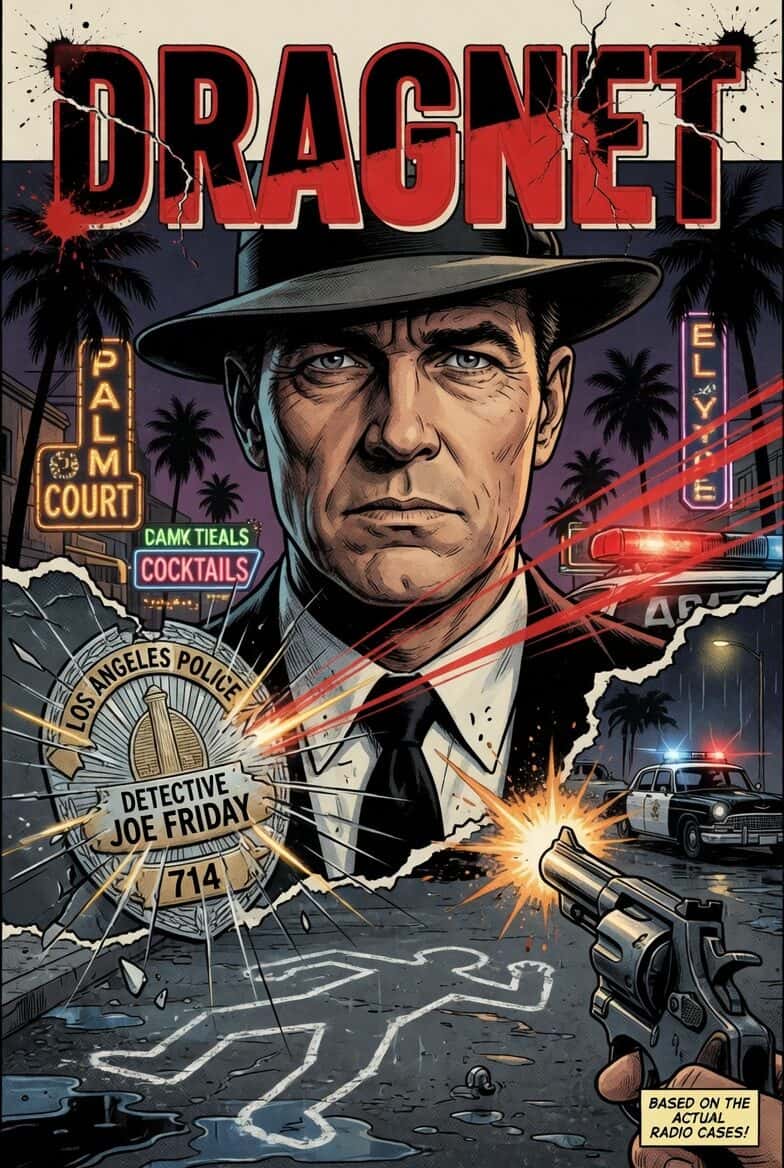
The written record
Read the transcript
Read along with the recording · About 17 min to read
The names have been changed to protect the innocent.
Fatima Cigarettes. Best of all, king-size cigarettes brings you Dragnet.
You're a detective sergeant. You're assigned a homicide detail. A 22-year-old girl has been abducted. Her family receives an anonymous message. The abductor demands $30,000 for the safe return of the girl. Your job? Get him.
See the difference. Taste the difference. Smoke the difference. You'll find that in Fatima, the difference is quality. Quality that gives you extra mildness. A much different, much better flavor and aroma. Yes, in king-size Fatima, you get all the advantages of extra length, plus Fatima quality, which no other king-size cigarette has. Fatima, best of all king-size cigarettes. Definitely the best quality in its class, but the same price as the cigarettes you're now smoking. Remember, thousands of Americans... Thousands of Americans are switching to Fatima, insisting on Fatima quality. So why wait? Switch to Fatima today. Look for the bright, sunny yellow patch. Buy Fatima. Best of all, king-size cigarettes.
The documented drama of an actual crime. For the next 30 minutes, in cooperation with the Los Angeles Police Department, you will travel step-by-step on the side of the law through an actual case transcribed, from official police files. From beginning to end, from crime to punishment, Dragnet is the story of your police force in action.
It was Tuesday, October 18th. It was cloudy in Los Angeles. We were working the early morning watch out of Homicide. My partner's Ben Romero. The boss is Thad Brown, chief of detectives. My name's Friday. I was on the way back from the stats office, and it was 3:26 a.m. when I got to room 42.
Homicide.
Hi, Brian.
Hi.
Hi. Which shot you want it, Joe?
Here you go.
Oh, thank you. Did the captain leave yet?
They're waiting for me in the garage. You call back?
I'll go into it right now, yeah.
Okay. I guess I better hustle it. See you out there, huh?
Right, Brian. Sorry to wake you, Ben. This is Joe. How you feeling?
3:30 a.m.
How's a sore throat?
We need you now, Ben. You want to be ready in about 20 minutes? I'll pick you up. Man by the name of Martin Sullivan, official down at the Third National Bank. He's got a 22-year-old daughter, or he had one. She's gone. Less than 14 hours before, it won a contest. At 11 o'clock the previous afternoon, Judith Sullivan was last seen driving off in a car with a man who'd represented himself as a friend of her father's. At 11 o'clock that night, the Sullivan family received an anonymous letter demanding $30,000 for the safe return of the girl. It had been the only contact made thus far by the abductor. As soon as we got word of what had happened from the girl's father, a broadcast and an APB had been gotten out. The entire force throughout the city had been alerted.
3:44 a.m.
Homicide, Romero.
Yeah, that's right.
Mm-hmm. Mm-hmm. How do you spell it?
Okay, right. Yeah, thanks a lot.
Record Bureau. Those two prints Stahl lifted from the letter? Run them through the single print file. Tell you what? They gotta make.
The fingerprint that was lifted from the suspect's letter was identified as belonging to a Donald Alfred Kiefer, WMA, age 29, 5 feet 8 inches, 170 pounds, brown eyes, dark brown hair. He had one previous arrest for forgery in Los Angeles 10 months before. At the time of his arrest, Kiefer's occupation was listed as bank clerk at the Third National Bank.
Well, I went down the hall to the record bureau to pull the crime report. Brian checked by latent prints to see if they'd gotten anything off the last note from the suspect. Ben went to check with John Meyer in handwriting.
7:23 a.m., Chief Thad Brown got back to the office. I showed him Kiefer's crime report.
All right, what's the rundown on it?
Well, at the time Kiefer pulled a forgery job at the bank, Mr. Sullivan was one of the vice presidents. He was the one that preferred charges against Kiefer and he saw that he was prosecuted.
Uh-huh. Where's this Kiefer now?
Well, let me check that. He was placed on probation on May 16th this year. He returned to his home in Omaha, Nebraska. That's 1380 Mackinac Avenue. You called Omaha?
I got the call in now. Ben took an exemplar of Kiefer's handwriting from the package. Don Meyer's going over it now.
Chief?
Hi.
What about that last note?
I got the report right here.
How's it look?
Well, Stahl lifted some prints off it, brought them out with the iodine fume gun. They match with the first.
There's something else.
What's that?
They examined the paper for watermarks and texture. Both notes are written on the same paper. Impressions show both pieces of paper from the same tablet.
Uh-huh.
Check the density of the carbon in the pencil he used. Both specimens match, same pencil.
Joe.
Oh, hi, Skipper. Hi.
Did you catch up with Don Meyer, Ben?
Yeah, he went over the handwriting. Looks pretty good.
What's the word?
It's as close as you can get. Here are the two exemplars.
Mm-hmm. Plants as crosses, double loops as L, open A's, pressure on the down stroke.
Uh-huh.
Donald Kiefer, the wolf, same handwriting.
By noontime, Donald Kiefer's description had been broadcast throughout the entire area. Bulletins were dispatched to all departments and a supplementary APB was gotten out. Special details. They were stationed at every post office in the city to watch for notes from the suspect that might come through the mail. The bus depots, railroad terminals, the airports, and all main roads leading out of the city were kept under strict surveillance. The entire Los Angeles area was broken down into single square-mile districts and a house-to-house canvas was started. A squad of men were assigned to cover each square mile. Outlying towns and cities were requested to do the same. By 4 o'clock that afternoon, one of the greatest dragnet operations in the history of the city was underway. We were sure Donald Kiefer was somewhere inside.
5:12 p.m. We got the call back from the Omaha police.
Is that so?
Uh-huh. Again, please, what was that?
6 X-Ray 419 Nebraska Plate.
Right. Fine, Lieutenant, thanks. Bye.
They made the car?
That and a lot more. The Omaha cops are looking for Kiefer, too. They want him for a robbery there two months ago.
Uh-huh. He used a stolen blue sedan in the robbery. A 1939 model Nebraska Plate 6 X-Ray 419.
What about his family and friends? Have they been checked?
Yeah, they say Kiefer left Omaha about six weeks ago. I don't know where he was headed.
We better get that car description to communications, huh? APB and a radiogram?
Yeah, right.
Friday?
Well, yeah. What are you tied up with?
Just got a call back from Omaha. Make on Kiefer in the car. Give it to me. You two get out to Sullivan House fast as you can. See Harris out there.
Okay, what happened?
Mr. Sullivan, he's disappeared.
You are listening to Dragnet. Authentic stories of your police force in action. Millions heard it. Yet only 54 have written. Starting on Dragnet over two and a half months ago, on September 20th to be exact, Fatima made a special money-back offer to more than 10 million listeners. The results? Amazing. Millions heard it. Yet only 54 have written. If you smoke king-size cigarettes, listen to Fatima's famous offer. Buy a pack of Fatimas. Enjoy their extra mildness and superbly blended tobaccos. If you're not convinced, Fatima is better than the king-size cigarette you're now smoking. Just return the pack and the unsmoked Fatimas before January 1st, and we'll give you your money-back plus postage. Fatima. Box 37, New York 1. Remember, thousands and thousands of Americans are switching to king-size Fatima, insisting on Fatima quality. So compare Fatima yourself. When you see the difference, taste the difference, smoke that difference, you'll switch to Fatima. Because in Fatima, the difference is quality. Look for the bright, sunny yellow pack. Buy Fatima. Best of all, king-size cigarettes.
Wednesday, October 19th, 5:48 p.m. Ben and I drove out to the Sullivan home where we checked with Bert Harris, the man who'd been assigned to watch Mr. Sullivan. He told us that at about 3 o'clock that afternoon, the father of the missing girl had a phone call. He said he had to go down to the bank, and Harris went with him. While they were at the bank, Mr. Sullivan succeeded in decoying Harris with a fake telephone call. While Harris was answering the call, Sullivan disappeared.
Did Mr. Sullivan get any more money while he was at the bank, Bert?
Yeah, $5,000.
Did you get the serial numbers off the bills?
Uh-huh. I shouldn't have let him get out of my sight.
Forget it. Right now, we've got to find out where he's going to meet Kiefer. Did you talk to Mrs. Sullivan about it, Bert?
Yeah, she said she doesn't know anything about it.
Where's she now?
Back in the sitting room, lying down.
Well, let's try her again, huh? She might be able to help.
Okay, it's back this way.
What time you got, Jim?
It's five minutes past six.
I get it. Hello. How's that? Yeah, where are you? Oh, where are you? Yeah.
Mr. Sullivan. He met with Kiefer out in Laurel Canyon.
Did he get his daughter back?
Yeah, he did. Wrapped in newspaper.
All units in the area were notified immediately that a contact had been made with the suspect, Donald Kiefer. We got in the car, and we drove out to Laurel Canyon. The entire area had been blocked off. We found Martin Sullivan standing in the middle of the road at the end of East Winding Way. 500 feet down the hill was a private residence where Sullivan had telephoned us. The only building in the immediate vicinity. A few yards beyond the point where East Winding Way ended, back in a clump of tall grass, we found the body of 22-year-old Judy Sullivan. We notified the crime lab, Chief Thad Brown and the coroner. Despite the severe emotional shock, Mr. Sullivan told us the story.
He said Judy was all right. I believed him. I wanted her back. Judy. I tricked the officer, the one watching me. Kiefer said to come alone. No police.
Did you see his car, Mr. Sullivan?
I wanted her back. I wanted Judy back. I did as he said. I drove out here at 6 o'clock. I waited. I put the money on the front seat, like he said.
Did he get the money, sir?
Then I got out. I left the parking lights on. I stood up there by the end of the road. And I waited. And then he drove up. He took the money. And then he came up to me. He had a gun.
I wanted Judy back.
He had a gun. Did you see his car?
He said she was up there. Beyond the road, she was tied to a tree, he said.
I wanted her back.
Now look, Mr. Sullivan, did you see his car?
I went to look for Judy. He drove away.
She wasn't there by the tree.
He couldn't find her. Way back. Hold him, bud. On the way. Lord, let me find him. Completely.
We showed the dead girl's father a picture of Donald Kiefer, and he identified him definitely. The information was immediately relayed back to Central Division and rebroadcast over our entire radio system. Teletypes were dispatched to sheriff's offices and communications sent to law enforcement agencies throughout the country.
9:52 p.m. The house-to-house search was intensified. The dragnet operation in which we hoped to trap the killer was drawing slowly.
A few minutes before midnight, Ben and I drove back downtown to the crime lab to check with Lieutenant Lee Jones.
Hey, fellas, come on back.
Anything yet, Lee?
Just checking over these towels here. Found them wrapped around the girl's body inside the papers.
What do you think about them?
What's that?
All yesterday's papers. Every story about the girl's disappearance has been clipped out.
How about the towels? Any laundry marks at all, Lee?
Nothing so far, Joe.
Every one of them clipped off. Mog post the body yet? They're doing it now.
Nasty one.
Oh, it sure is. Any footprints or tire marks out where they found the body?
No, lots of them. Got two of the men checking them now. One thing...
What is it, Lee?
I don't know. Under the seam here, this towel. Wait a minute. Give me that pair of snippers, will you, Joe?
Yeah. Here you go.
Thanks. Press back under the seam here. There. That's one tag he missed.
Yeah? Can you read the marking?
Greenway Pup. It's Los Angeles. 12.34 a.m.
We located the Greenway Apartments in the East Wilshire District, and we checked with the manager. He identified Kiefer's mugshot, but he said he hadn't been home to the apartment since the day before. We called the crime lab, and we went up to check the suspect's apartment. One look was enough. Lieutenant Lee Jones found specimens of the Sullivan girl's blood in the wash basin and the bathtub drains. In an adjoining garage, we found the car which Kiefer had used. A blue sedan. Nebraska. Plates. Six X-ray. 419. A cancellation of the want order for the car was issued, and a stakeout placed at the apartment and in the garage in case Kiefer decided to return.
All that night and into the next day, the citywide dragnet went on. There was no sign of the killer. At ten minutes past two that afternoon, the first piece of ransom money showed up. It was at a used car lot on the corner of Beverly and Naylor Streets. Two hours later, another piece of the money turned up at a busy downtown department store. In both cases, the man who passed the stolen money was finally identified as Donald Kiefer. Details were strengthened in both areas where the money appeared. The search went on.
6.42 p.m. Ben and I got a call to meet Chief Thad Brown at the Hollywood Division Station. Tommy Bryan from Central Homicide was with him.
This is the way it stacks up now. This pin map over here, this is where we're concentrating the search. This area here.
How about the lead we had on him downtown? Didn't it work out?
No, the last 20 minutes we picked up three possible leads on the man out in this neighborhood. Here. East of Vine, south of Franklin, west of La Brea, north of Santa Monica.
Uh-huh. More ransom money show up?
You got it there, Brian. Rate it off.
Yeah. Uh, 5.35, sunset in Highland. Newsboy thought he saw Kiefer crossing the street. 20 minutes later, a salesgirl in a dime store up on Hollywood Boulevard thought she saw him. Uh, 10 minutes after that, he was reported seen near the intersection of Hollywood Boulevard and Las Palmas.
Uh-huh. You figure the reports are reliable?
Yeah, they were all checked out. Didn't put too much faith in him until a few minutes ago. How's that?
Fine. Uh-huh. Uh-huh. A dollar bill was passed at a cigar store at Hollywood Boulevard in Hawthorne. Ransom money. We've already doubled the number of men in cars in the area. Men stationed at every intersection to keep an eye on pedestrian traffic. We're covering everything. Streets, stores, covering the whole neighborhood.
Uh-huh. I'll get it. Homicide, Brian. Yeah, just a minute. You, Chief.
Oh. That, Brian?
Yeah. Uh-huh. Where? Uh-huh. When was that? No, stay there. We'll be right there. Goodbye.
Another piece of ransom money. Where'd it start up?
A theater on Hollywood Boulevard.
A theater on Hollywood Boulevard between Fairview and Hawthorne. Who passed the money? You think it was Kiefer?
I think positively. They say he's in the theater right now.
The information on Kiefer was phoned into communications immediately, and within a few minutes, men and cars converged on the neighborhood. The one-half-mile area around the theater was completely blockaded. Every exit and entrance to the theater was covered. 7.23 p.m., Ben and I, along with Chief Thad Brown and Tom Bryan, met in the theater manager's office. Brown outlined our plan of operation. At 7.32 p.m., a detail of 14 men walked down the side aisles on the main floor of the theater and took up their posts on either side of the orchestra pit. The picture was stopped, and every light in the theater was turned on. Chief Brown, Bryan, Gomez, Thaxter, Ben, and myself went down the aisle and up onto the stage. Chief Brown made the announcement.
Ladies and gentlemen, if you'll hold it quiet for a minute, please. We're sorry to interrupt the picture, but this is a very important matter. Police officers, maybe you've read about it in the paper. Judy Sullivan was abducted and murdered the day before yesterday. We think we've traced the man who murdered her to this theater. We believe he's in this theater now. We're going to search the theater. If anything, Maggie, you're afraid. Leave for the main entrance. Each one of you will be checked as you go out the door. For the benefit of the man we're looking for, don't try to escape. Every place any more alive than just...
...stage, Joe. We can make it through there.
All right, come on. Through here. Down here. Right with you. In here. And over here. There. Air conditioning unit for the theater.
Yeah. I don't see him, do you?
No. He can't get out. There's just two exits. We've got them both covered.
All right, keeper, hold it.
Yeah, I got it.
All right, let's take him.
Shoot, actually, you forced me into it.
Put the cuffs on him, Ben.
Yeah, right. Put your hands off of me.
All right, keeper. All right, Ben, you all right?
Yeah. All right, try the cuffs on him now, huh?
Yeah, uh-huh. Yeah. Yeah, it's a rough one.
Hey, it's starting to rain again. It's really pouring out there.
Yeah? Guess you better get him out of the car, huh?
What's the hurry?
How do you mean?
Why spoil a good rain?
What you have just heard was true. The names were changed to protect the innocent. On January 19th, trial was held in Superior Court, Department 87, City and County of Los Angeles, State of California. In a moment, the results of that trial.
Now, here is our star, Jack Webb.
Thank you, George Fenneman. Friends, this Sunday evening, December 16th, Fatima brings you a television preview of Dragnet on Sound Off Time on NBC. Check your papers for the time. Now, it's an actual... It's an actual case history filmed right on the spot, right at the City Hall, downtown Los Angeles. Starting in January, Dragnet will be seen regularly on television, in addition to Dragnet Radio. Now, remember, Fatima is making all this possible and making it possible for you to give the best this Christmas to everybody who smokes king-size cigarettes. Fatima in the new holiday gift carton. It's the smartest of all Christmas cartons, just as it should be, because Fatima is the best of all king-size cigarettes. Give. Fatima.
Donald Alford Kiefer was tried and convicted of murder in the first degree, and on the recommendation of the jury, he received the death penalty. He was executed in the lethal gas chamber at the State Penitentiary, San Quentin, California.
You have just heard Dragnet, a series of authentic cases from official files. Technical advice comes from the office of Chief of Police, W.H. Parker, Los Angeles Police Department. Barton Yarborough is Sergeant Ben Romero. Also heard were Whit Connor and Vic Perrin. Script by Jim Moser. Music by Walter Schumann. Hal Gibney speaking. Fatima cigarettes. Best of all king-size cigarettes has brought you Dragnet, transcribed from Los Angeles. Counterspy fights international intrigue next on NBC.