
The written record
Read the transcript
Read along with the recording · About 18 min to read
You better stay right here, where you are.
Yeah?
Yes, please. And I think I hear Mr. Fields coming.
Oh. Oi, oi, oi, oi, oi.
Are you sure he's coming, Peggy? You're kidding me now.
Yes.
Yes, it is, Pa.
Yes, it is, Charlie. Yes, it's W.C. Fields, all right.
Uh-oh.
Can you see him?
Well, I can just see a little of him.
Yeah?
I can see him sticking his nose in the door.
Sticking his nose in the door?
Yes.
Oh, well, then it'll be five minutes before he gets here. Let me out of here. Hey, Spankers, I'll call him up. Oh, he's out with you there. Oh, Edgar, how are you?
Oh, hello, Mr. Fields.
Hello. Uh, where's the little, uh, woodpecker snack bar?
Yeah, well, I can explain everything about that incident.
Uh, well, explain, uh, why, uh, your belligerent little bundling board perpetrated an act of sabotage by stretching a wire across my garden path.
Yes, I'd be glad to do that. You see, it was perfectly innocent, Bill. You see, he was, he was setting a skunk trap. That's what he was doing.
Oh, a skunk trap.
Yeah.
Oh, that's fine. That covers everything.
Thanks for the compliment.
Oh, well, I didn't mean it that way.
That's okay. Nevertheless, the other evening, as I was traversing my garden in search of flora and fauna. Flora is my cook, you know.
Oh, I see.
That unlikable young lady makes wonderful crepes for bed.
Yes, well, I believe all that, but that's really none of my business.
Well, I was walking along when I unexpectedly tripped, and the next thing I knew, I was prostrate on terra firma, which was not unusual in itself, but the circumstances...
Yes, I can believe that. But, Bill, let's get to it. Let's get back to the skunk trap, remember?
Oh, you mean flora?
Oh. No, no, no.
Oh.
I feel it to me.
Yes.
Well, I'll tell you, it was quite an experience.
Yeah.
I broke my femur and fractured my decanter.
Oh, no. Well, now, that does sound rather serious, Bill.
Yes, it was. I heard of a hospital. Clang, clang, clang. Clang, clang. I heard of a hospital. I took a turn for the nurse.
Oh. Oh, boy.
Yes, it is. It's a secretary.
Yes. And I took some beautiful x-rays of my leg. Six reels of them.
Six reels of them.
Ah, a feature, huh?
Yeah.
What'd they find, Bill, in your...
Ah, just I expected the foul of my leg was hollow.
Is that so?
Tell me, Bill, were you running a fever, too?
No, I had a blood pressure.
Oh, I see.
Rather high?
And I'd approved.
Yes.
It was a wonderful place, that hospital. Very comfortable bed.
Well, that helps, yes.
Even had mattresses on the wall.
They made you feel at home, didn't they?
Yes, yes, Bill. Until I suffered a nervous breakdown.
Now, don't tell me you had a nervous breakdown. Bill, all that's awful. Well, Charlie certainly has caused you a lot of trouble, hasn't he?
I don't blame the little fella, Edgar. I love him. He's all right. He's always like that. Even though my fall also caused a full tendon, Paget's disease, double vision, a bad case of pernicious dandruff...
No.
Not mention Logog and Magogo and Ralph Adelman.
Oh, now, wait a minute.
Yeah, I heard by a slight case of Miffenship and Boppendale and the slip...
What?
A slip sacrileg.
No, a slip... Roaming.
Slip what was that?
Yeah. S-A-C-R-O-hyphen.
Yeah. From there on, you're on your own.
So that you recovered from all that?
Oh, yeah. The crockers had given me up in the spare. One day they discovered I had a, uh, uh, a past a crisis.
Oh, I see. So now it's crisis, is it?
Yeah, yeah. It's a technical word.
Yeah, yeah. Well, what day was it when you passed this crisis?
The day they found me blowing the foam off my medicine.
Oh.
Yeah. Well, Charlie learned that. Bill, he'll be very sorry. I know he'll be sorry. And I just want you to know, Bill, that he's ready and he's willing to apologize.
Oh, that's quite all right, Ed. As a matter of fact, I'm very fond of the boy.
Yeah?
Where is the little fire hazard?
Yeah. Call him in, Bill.
Just a moment. Oh, Charlie. He's out here. Never mind. Charlie. Back here, Bill. I want you to know that Bill is right here.
Yes.
Yes. And he knows all about it.
Uh-huh.
And Charlie wants to talk to you.
Yeah?
Yeah.
Yeah. Oh. No, no, no, no, no, no, no.
Good evening, Mr. Fields.
What did he say?
I said, good evening. That's all. Let's not jump at conclusions.
Charlie, I've been telling Mr. Fields that you want to apologize. Now, isn't that right?
Yes, it is. Yes, I do, Mr. Fields. I do.
Well, I was just fine, my little chump.
Uh, chum?
Yeah. There she goes again.
That's him. You just set a trap in my garden. Don't you know there aren't any skunks there?
No skunks in your garden?
No, no. I'm sorry. No wildlife with one possible exception. My place is occasionally infested with a horde, a herd. Pink mastodons.
Uh, pink mastodons.
Oh, elephants.
Yes. That's right.
I hear that the elephants around your place take aspirin to get rid of W.C. Fields.
Little nippers.
Yes.
Is it true, Edgar, that Charlie can trace his ancestry back to an old chestnut stump, the abode of a family of coal cats?
Yes.
Yes.
Well, this is like the old days, isn't it, Bill?
Yeah, boy. Remember how we used to fight, Mr. Fields?
Yeah.
Foolish, wasn't it?
Yeah, as far as my little plans. But we're above that sort of thing now.
Yes.
Those are the good old days, aren't they, Bill?
Yeah.
Remember the time I said I'd, uh, slice you into a Venetian blind?
Yeah.
That was a good one, I think.
I don't know, was it?
Yeah.
Yeah, it was.
Remember how I topped you by saying that makes me shudder?
That was good. I liked it.
Uh, who said you topped me?
I topped you.
Well, why, there was a start with a sneer from a disgruntled termite.
Why?
You keep that up and you'll pay a return engagement at the hospital.
And I'll be careful, my little friend. You know, Woodpump is in the priority list.
Yeah, well, listen, you long-nosed hater.
Now, wait a minute.
Now, please, please, gentlemen. I beg your honor's sake, Mr. Fields just doesn't love me anymore, that's all.
Don't tell me I don't love you or I'll break every knot in your body.
Now, wait. Please.
Why can't we be friends?
What do you say, Charlie?
Okay, okay. I'll make one more attempt at appeasement.
Yes.
Then I'll fire on sight.
Yes.
You'll do nothing of the kind, Charlie. You're going to be nice to Mr. Fields.
But he doesn't like me.
Why, I'd idolize the little chap. I'd do anything for him.
Would you, Mr. Fields?
Well, I'd be glad to do anything the little chap craves.
Hey, well, Mr. Fields, I have a new bicycle, you see.
Oh, would you like a bell?
Well... I can't, uh... I'm not affluent, but I could, uh, buy you a bell.
Well, that's nice that I have a bell. But I was just wondering if I could borrow...
Oh, I don't suppose it'd be right.
Yes, it's all right.
Oh, no, it isn't.
I love the little chap.
No, no, it isn't right.
Oh.
Could I borrow your nose for a taillight?
Let's see, Edgar, it's no use.
Well, Bill, it's only the mischief in the boy, that's all it is. That's what makes him say those things. Why, Charlie is his own worst enemy.
Not while I am around, he's not.
Can he borrow my nose for a taillight?
Well, I'll fill him full of eel lead and lose him for a pencil.
Yes.
I got my lapel bag in here. Wait a minute. I want to hang one on him.
No, no, you don't. That's not the... Remember, Mr. Fields is not a well man, are you, Bill?
No, that's right, Edgar.
Yeah.
I've been a fragile thing of beauty ever since I was born.
Yeah.
You weren't born. You were squeezed out of a bar rag.
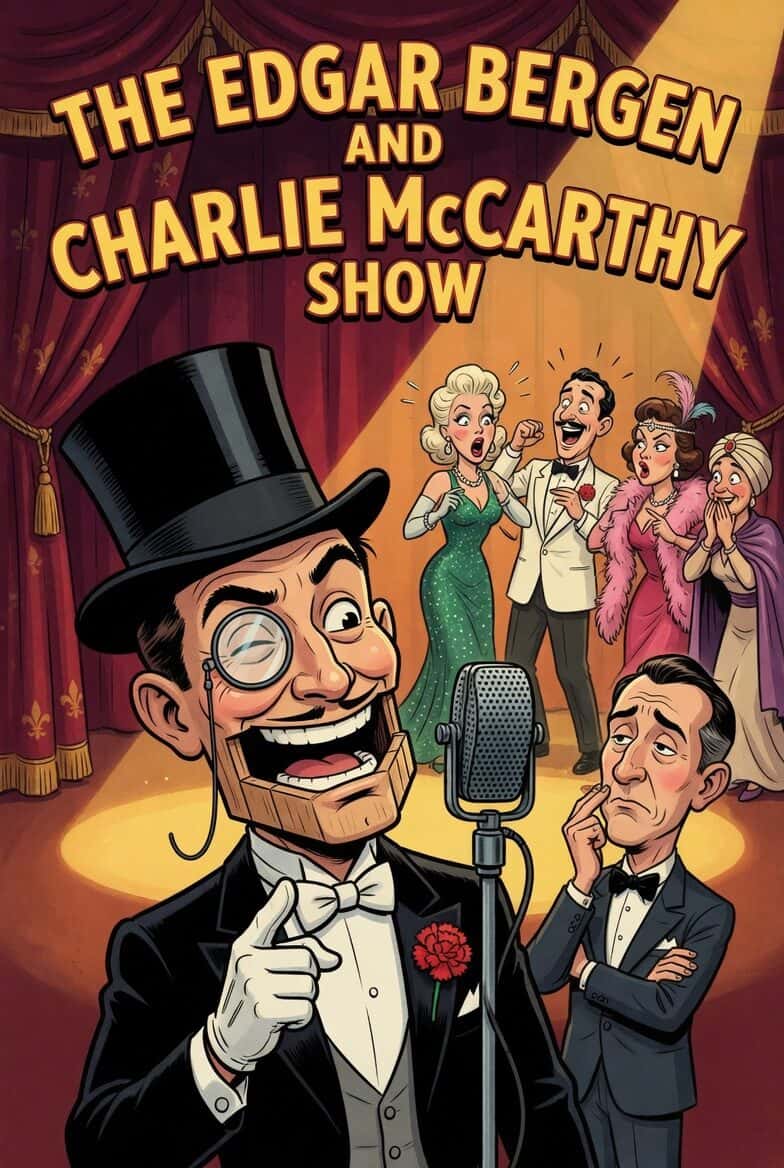
Edgar Bergen, I'm Charlie McCarthy, along with... W.C. Fields from their popular Sunday evening radio program of many years ago, known as the Edgar Bergen and Charlie McCarthy Show, and also known as the Chase and Sanborn Hour, which, of course, referred to the show's long-standing sponsor, Chase and Sanborn. They used to say, what Mr. Chase didn't know about coffee, Mr. Sanborn did. Edgar Bergen and Charlie joined the Chase and Sanborn Hour on NBC in the year 1936. Charlie, of course, was Edgar Bergen's principal dummy. He wore a monocle over his right eye, and he joined the show on NBC. He generally appeared in formal dress, including a top hat. And he never seemed to run out of quips about pretty girls, his troubles in school, and his friend, Skinny Dugan. And he constantly needled Bergen about moving his lips while he made Charlie talk. Of course, Mortimer Snerd was another popular dummy, and then there was Effie, an unattractive old maid whose chief interest was catching a man. Charlie and Mortimer were on much more than Effie. She only turned up occasionally. Eventually, the Chase and Sanborn Hour gave way to the Coca-Cola spot, a sponsorship of the Edgar Bergen and Charlie McCarthy show. This is all part of our tribute to Edgar Bergen on tonight's KSFO Comedy Hour. In just a moment, we'll be playing back an interview that Edgar Bergen did with KSFO back in 1971. We'll have some more excerpts from the Chase and Sanborn Hour with Fred Allen and W.C. Fields as the evening progresses, too, so stick around.
This interview with Edgar Bergen was done with a KSFO producer way back in 1971.
What is the origin of... Charlie McCarthy?
Well, I got him when I was a senior in high school. I had a papier-mâché figure, and I wasn't happy with him. Of course, it was... They have no character. And I always felt... I've always insisted that the face must look like the voice that goes with it. And so I saw a newsboy, an Irish newsboy, in front of the high school building in Chicago, Lakeview High School, and he had a real fresh little McMonkey face. And I thought, that's pretty good. So I sketched that in my history book, Medieval and Modern History. And my history teacher's name was Miss Angel, and she wasn't tall. And this was in February or early March, and I put an order into Woodcarver, who made dummies there in Chicago, and she said, would you remain after class? And she said, don't plan on graduating unless you can improve a great deal in your history work, because I cannot pass you. So it went on. I was booked anyway on Chautauqua for that summer, so I, you know, the diploma didn't mean anything too much. But I was busy writing jokes. Then I got Charlie down in late April or early May, and I went on a student recital, and I heckled all my teachers, including the principal, in a nice way. So Charlie says he had Miss Angel for history, and don't let the name fool you. She grows horns at examination time. And Brown was the principal, and we'd call him Square Deal Brown. He liked that. And Charlie says he's in his office so much he has his own desk there. Sometimes they close the door and play checkers. I said, you should be very flattered that the principal, Square Deal, would play checkers with you. He says, there's only one thing wrong. Square Deal cheats. Well, it was a big success. So the next day, she said, remain after class. And she says, if you just try, I will help you graduate. The world needs laughter more than it needs another ventriloquist. She said, you must go on with your work. That's how I graduated from high school. So don't let anybody not hanging around with a dummy. It paid off.
A visual act like that.
Well, that's true. I certainly didn't belong there. It wasn't. And I tried to get on. And I auditioned for the head of the NBC in Chicago when I was playing the Chaparri Club. And he said, no, it wouldn't work. It wouldn't go on radio. They wouldn't believe it. And the comedy isn't right. I said, well, they're laughing at it at the Chaparri. He says, but this is my specialty. I taught speech at his college and I know what it should be. So it was only two months after that I was in New York. And then I went on the Rudy Vallee show. And in another month or two, I was back in Chicago and they were piping me into New York because I was playing the Chaparri. They wouldn't let me out of it. So I would go out of my way to go past this man's office to say, how do you do? How do you do? You know, he became vice president of NBC in spite of all that.
I think your feud, of course, there are a number of famous, famous incidents, but your feud with W.C.
Fields is still remembered today. Could you tell us a little bit about W.C. Fields?
Yeah. Well, he was the most wonderful man I ever worked with. He's the greatest talent who could write comedy, play the comedy you wrote for him, and do pantomime. He just had all three things going. And we never had a disagreement. We had great respect. He sent me a wire when he was in the sanitarium when he was listening to the show. So when we moved to California, we asked for him and he came on. And it was, he was a great man to work with because, and of course, we both, he would write, we would say, this is what we'll talk about. Then, of course, this is the script and then we both would try and sneak in, dirty it up, you know, put in toppers to try. And he liked that. He liked the fight, you know. And we tried to keep it balanced anyway. And one day he said, I know Charlie likes me in spite of our arguments because he always calls me Mr. Fields. And I thought that was a pretty fine touch. And Charlie said, Fields once, he's the softest hard-boiled egg he ever made. Which was, he did a mock heavy. He was a lovable meanie, you know. A lot of people, comedians, they really hurt when they are out there with their remarks. It's open insult, some of it. it was a great experience. We had lots of fun.
What do you think is the difference between doing the visual Charlie McCarthy and the radio Charlie McCarthy?
Well, I have to watch my lips a little more. But I tell, as I say to Charlie, I'm an honest ventriloquist. I let him know who's doing the talking. I used to be very good when I was playing clubs in vaudeville and all. But it was silly to sacrifice diction for two, three hundred people in the studio for forty, fifty million people around the country.
And I have several firsts. One was having the highest rating of any, of any person on radio at that time in the forties and the late thirties except for me. Except Franklin D. Roosevelt's Fireside Talks. We had a forty-nine point something Hooper, you know. And we were the first ones to do a broadcast from a military base at March Field. We were the first ones to do a broadcast out of the country. And I was the first one to do a television show in a motion picture studio with an audience. We did everything wrong. We built the bleachers too low, so they were looking at the back end of the cameraman and then looking at the equipment. And the fire department got after us. We didn't have enough exits for two hundred people in the studio. And it was the first show to be seen, it was for Coca-Cola, the first one to be seen across the country the same night at the same hour, eight o'clock in New York, Chicago and out here. That was before network, so it was a big deal. We printed up eighty-five prints or whatever it was. Coca-Cola did, of course. And it went so well that NBC raised their rates then the next year.
What about your conductor for many years, Ray Noble?
Yes, he was a, he's a, fine musician, equally good actor and comedian and we had so much fun with him. And he's now living in Santa Barbara and he's, that's the closest he can get to London climate.
Well, San Francisco would be kind of close to it, too, I guess.
Didn't he get involved with a lot of the bits that you did?
Oh, yeah. Sometimes we would spite him by making him do Southern, you know, You All, Sir, and all that Tommy rot. No, he, oh, he's a fine, fine man.
Your program was such a showcase to those people. Didn't Abbott and Costello get their radio start on you for them?
No, no, they didn't get their start but they were on my show. They were one of their major exposures. Yes, they, we were on for a while and we had Moore and Gagston on for a while, too. And, oh, it's, there's nothing nicer than when you've got things going your way and when you're hot, you know, then everything goes fine. But, it, well, I was number one for the first five years on radio and then I was in their first ten and when I went off 20 years later on on radio, I was number one again. I thought that was a good time to quit.
Were there any times when Mortimer actually pulled more mail than Charlie? I mean, did you?
No, I don't believe so. Mortimer wasn't so strong then. Mortimer is a little stronger than Charlie now. I close with him, you know. But, he's a little newer. It's, I feel about Charlie, it's like bringing out Mickey Mouse. You know, a little of it's all right but it's for memory lane but I like to bring out the other characters too.
Where did Mortimer come from originally?
He came from the voice that I had. I was playing Chez Paris and I was bringing Charlie out two and three times for encores and that isn't right. You should do something a little different. Well, so I had to go through what I had in other voices and I had this Mortimer, this little yo, yo, yo, yo. So, it sounded stupid and I wanted a face to look like it. So, I drew pictures on tablecloths and I read books on phrenology and face reading. Mortimer is scientifically stupid. He's a combination of weak features. He has, he has a low brow. He has high arched eyebrows so he's a dreamer. He never knits them in thought. He has a low bridge nose. He lacks aggressiveness. He has a weak chin. He has no determination but he's charming and he's likable and to be ugly and homely wouldn't be good enough. So, I think there's something refreshing about him. He's not a, a simple, honest, modest, stupid person.
What about Effie?
Effie is a busybody. She is scientifically constructed as well. Uh, she has a long, sharp nose. There's truth in that. Nosy people are long, sharp-nosed people. They are nosy people. A bulbous nose is a kind of a, a more or less of a relaxed, uh, kind of a dreamer, you know. And a strong bridge nose is an aggressive type, you know. Like, uh, oh, you're, a lot of your executives generals and presidents had strong noses and strong chins. Well, it's, oh, I don't think that could change it, but it's pretty much it. They say you knit a brow in thought. Well, that's, that's also, they go straight across. That, that is, uh, there's some truth in that too, I think.