
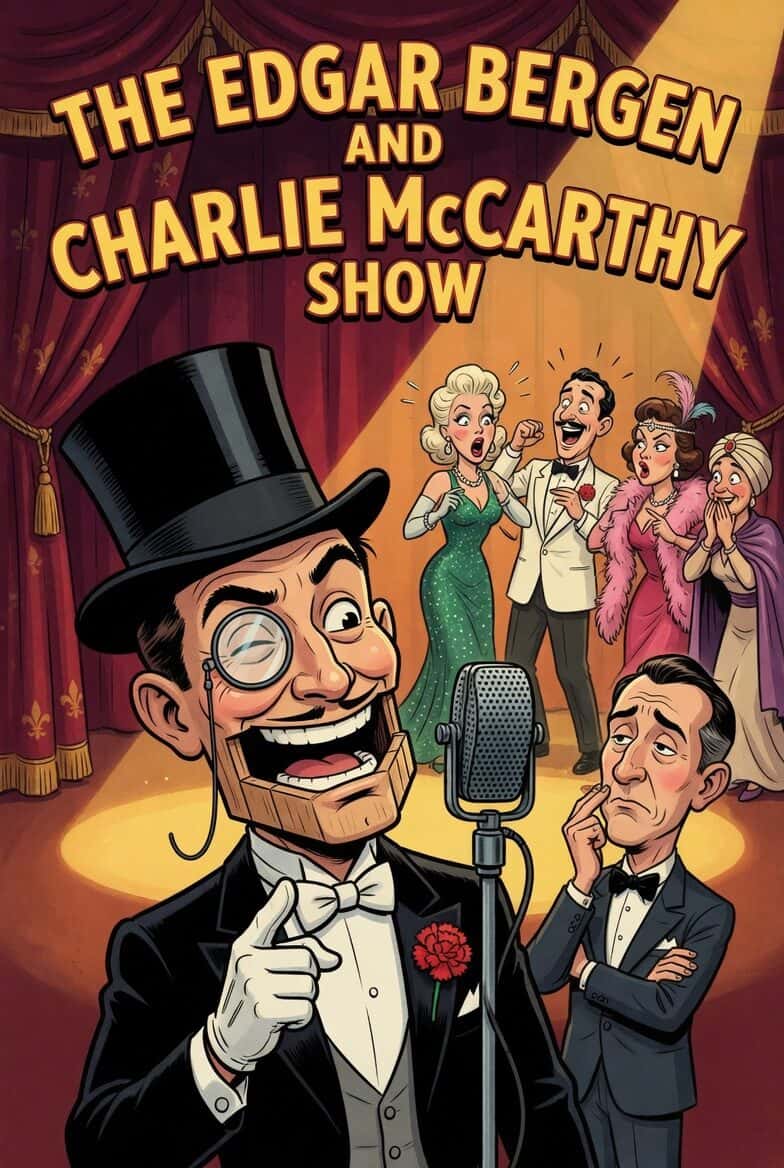
The written record
Read the transcript
Read along with the recording · About 35 min to read
The makers of Chase and Sanborn Coffee, the superb blend you know is fresh, present the Chase and Sanborn Hour. And your host, Don Ameche.
This is Don Ameche greeting you all and welcoming our wandering boys, Edgar Bergen and Charlie McCarthy, back from New York.
Ah, Dottie, my pet, my pet, Dottie.
Oh, Charlie.
Oh, it's so good to see you again, Lampie.
It's so good to have you back, my sweet.
Oh, Dottie, Dottie, my daughter. Ah, look, excuse me, please. Greetings also from our cooing dove, Dorothy Lamour, and from Donald Dickson and Robert Armbruster and the Chase and Sanborn Orchestra.
Oh, Dottie, Dottie, Dottie, Dottie, Dottie, Dottie.
Oh, Charlie, Charlie, Charlie, Charlie.
Welcome, welcome, welcome to our special guest this evening, Charlie Irwin and Andrea Leeds.
Oh, still must have, eh, Ameche?
Yeah, it's petty larceny, Charlie, if I were.
Sure, but I'm just out of breath from trying to get in a few words here. And in this momentary breathing space, let me add that we hope you will all enjoy our show, and that throughout the week you'll remain our friends as well as friends of Chase and Sanborn.
Oh, my heart belongs to Dottie.
Look, Charlie, if there's any singing to be done, Donald Dickson will do it, and Donald does it with Vincent Youmans' Flying Down to Rio.
I'd sing an old song down to Rio By this time we'll sing a new song Flying down to Rio Come with me Where the lovely Brazilian ladies will catch your eye By the light of a million stars in the evening sky They get to Rio Not to make time From the heaven and by there we'll fly there To make time
If you'll excuse me, Mr. Bergen.
Oh, what is it?
I gotta talk to Mr. Ameche, see.
Oh, wait till I tell him.
Wait a little, Don.
Now, just a moment.
Huh?
What's the matter?
Charlie.
What?
Just a moment. What are you going to tell him? What do you have to tell Don?
Oh, it's... it's all about our trip, you know. Flying out west here.
Oh, yes.
And about the great flyer, Bergen.
Oh, boy, oh, boy. Oh, Don. Just a...
Charlie, you're not going to say anything to Don about that trip.
What?
I say you're not going to say anything.
Who isn't going to say anything?
You're not.
Oh, yes, I am.
You can't do this to me, Bergen.
You're not going to say anything, do you understand?
No.
No.
What's that about you?
Well, why don't you... Well, I enjoyed the trip very much.
You enjoyed it?
Yes.
Well, you didn't look good.
That's beside the point.
I see.
I'm not going to let everybody around here have the laugh on me.
Oh.
Just because I have a nervous stomach.
Nervous stomach, yes.
Nervous. Well, it was hysterical over Pittsburgh.
Now, you know very well, Charlie, it was only for about 15 minutes that I wasn't myself.
Oh, I see. It was hardly worth mentioning.
Yes.
Now, remember, I was not airsick.
You weren't airsick.
No, I was not airsick.
I see. But you look...
No. I was not airsick, and that's that. Do you understand?
Well, I...
Do you understand?
Well, for a quarter, I could understand.
Well, you're not going to blackmail me, young man.
Oh, no.
Okay. Oh, Mr. Meade, you usually see him...
Charlie.
Now, wait a minute. I think maybe we can work something out.
Yes, yes, yes.
Now, I think we can come to an understanding.
Yes, just 25 cents.
All right.
Just a quarter.
Yeah, just a quarter.
Okay.
All right. For a quarter, I'll make you the picture of health.
All right.
Now, for 50 cents, I could make you a Samson.
No, no, no.
Well, well, well, boys, it's good to see you back.
Oh, hello, Mr. Meade.
Charlie, how did you enjoy your trip? You weren't airsick, were you?
I felt fine all the way.
Oh, you did, huh?
Oh, fine, yes. Yes, I did. And for an extra quarter, Bergen did, too.
Now, Charlie, that's not true.
Oh, then the bumps got you.
Yeah.
No, no, no, no. Though perhaps I shouldn't have eaten lobster salad, you know, for lunch before boarding the plane.
Yeah. That certainly was a dollar wasted.
Well, Edgar, you know what the rule is when you get airsick.
Yeah, he followed it.
Will you please hide?
Well, anyway, Edgar, no matter what Charlie says, I imagine you had a very pleasant trip.
Yes, yes, that's true.
Yeah, and he feels much better now, too.
Why, Charlie? Why I tolerate you, I don't know.
What's the matter?
You're always... you're always making trouble.
Well...
Yes, and you're always in the way.
Is that so?
Yes, continuously.
Is that so?
Yes.
Just to be a nuisance and disturbance, that's all.
Uh-huh.
That's the way you feel?
Yes, that's the way I feel.
Uh-huh. Well, I notice you don't mind having me around on Sunday nights, do you?
No.
Huh?
Is that true?
All right, all right. That burns him up, you know.
Say, Mr. Bergen.
Yes?
Why do they make you weigh your luggage before you get on a plane?
Well, you see, that's to save weight.
Oh.
They must know how much they're carrying.
Uh-huh.
Every pound counts on an airplane.
Yeah.
And that's why even the dishes are made of a light composition.
Oh, I see.
Is that why they make the hand towel so small, too?
Oh, I didn't think they were so small.
Oh, they were so small, I was almost ashamed to put them in my suitcase.
Charlie, tell me.
Uh-huh.
On the whole flight...
Yeah?
What impressed you the most?
Well, let's see. There were so many things.
Well...
Well, I think, uh... I think the free chewing gum was nice.
No.
Oh, uh...
No, I mean the sights.
Oh, the sights.
Oh, the hostess they got on at Kansas City.
No, no.
Well, I did notice her myself.
Oh, you did, huh?
Yes.
She was very charming.
Uh-huh.
Yes, I... I found her extremely interesting.
Is that so?
Yes, I did.
Why, you old rascal, you... What did she tell you?
Oh, yes, I had... Well, really, I think my...
Oh, did you promise her not to tell?
No, no, no.
Well, you can trust me.
Oh, all right. Well, she told me, though, that, uh... Although water boils faster at 10,000 feet...
Uh-huh.
It takes longer to boil an egg at that altitude.
No.
You got pretty chummy there, didn't you?
Cost her her job.
Oh, no, no.
Is that all you talked about? Just boiling eggs?
Yes, we talked about boiling eggs.
Is that so?
Yes.
Well, I guess... I guess you found that pretty exciting, didn't you?
Well, yes, I did.
Uh-huh.
Well, at your age, I guess you would.
Well, I suppose, from your way of looking at it, I should have held hands with her.
Well, it wouldn't have done much good, Bergen, because I found out that, uh... Well, she's that way about the pilot.
Oh, I see.
Yeah, yeah, yeah.
Oh, so it's the pilot.
Yeah.
He's the flyer in the ointment.
Oh, I...
Now, if I was a pilot, I really think...
See, Bergen...
Yeah.
Well, when are you going to give me some more of those flying lessons, you know?
Well, I don't think I'm going to give you any more.
Oh?
No, you don't follow orders.
Oh, yes, I do.
No, you don't.
What have I done now?
Well, I haven't forgotten the last time I took you up.
Well, what did I do that was wrong?
What did you do that was wrong?
Yeah.
Name eight things.
Eight things.
Well, I can't think of them right now.
Well, that's as good as I was any.
What did I do that was right?
Absolutely nothing.
That's what we want, facts.
Well, I remember one thing.
Oh, you do? Good for you.
Yes.
You couldn't hold your course.
Oh, couldn't?
Yes, you couldn't.
Oh, yes, I could.
Well, it wasn't my fault.
Yes, it was. I kept telling you to keep your nose on the horizon and your tail up.
Well, I was strapped in the seat. I couldn't...
No. I'm speaking of the plane.
Oh.
You have no regard for the rules of safety.
Uh-huh.
And you're always stunting and showing off.
Uh-huh.
Well, how about the time that you did that dive and scared me?
Well...
Well, that wasn't a dive.
Well, that was all right, I suppose.
That was an air pocket.
Oh, I see.
Now, you remember I explained what caused air pockets?
Yes, air pockets. It was, um... It was, uh... Up drafts and down drafts.
That's correct.
Uh-huh.
And what is the effect of air pockets?
Well, it, uh... Your liver comes up and slaps you under the chin.
Yes.
Now, can you describe a dive?
A dive?
Yes.
Well, let's see. A dive? I know one in Brooklyn.
No, no. I'm speaking about flying.
Well, I came out flying. I only touched the ground to turn corners.
Was I in a hurry?
Charlie, that's just the trouble with you, Charlie. You don't take flying seriously. I don't think you have the makings of a good pilot.
Yes, I have, Mr. Bergen. Honest, I have. Just give me one more chance, huh?
No.
No, I don't think I should, Charlie.
Oh, come on, huh, Bergen? One more chance, huh?
No.
Oh, come on. Give me one more chance. One more lesson, huh?
Well, I don't know.
See, you give me one more lesson, Bergen, see?
Yes.
And I promise you, I'll make a perfect ace of myself.
Yes.
Recently, a brand new tune made its debut into the world of popular songs, and it shows every sign of becoming a very definite success. The title? You Took Me Out of This World, and her own Dorothy Lamour sings it. Donnie, the floor is yours, and the pleasure is ours.
Oh, my.
This world. Had it not been for you, Who took on the crotch every time You took me out of the crowd That's bounded by you To the part where every end darling wouldn't be. Had it not been for you, Who took me out of the crowd By the stone of this world.
We had local announcers all over the country tell about Chase and Sanborn Coffee in their own vicinity.
Oh, my. Oh, my.
Don, I think people will be interested to know how that's done. Will you explain what a radio network really is?
Well, it's really a network of long-distance telephone wires.
Oh, Alexander Graham Bell again.
Oh, now stop it, Donald.
From Hollywood, we send the program by telephone wires to stations all over the United States and in Canada. It's a sort of a party line with about 60 stations listening in.
Now, is that clear, Mr. Watson?
I think you've invented a great thing, Mr. Bell.
And then, at a certain signal, the stations disconnect themselves from our phone wire.
You mean they hang up on us?
Well, in a way, yes, but just long enough for their local announcers to hear.
Long enough for their local announcers to give the local news about Chase and Sanborn Coffee. Then they hook back into our network.
Well, now for the experiment, Alex. Okay, let's try it. Here comes the cue, fellas. One, two, three, go.
Thank you, Don and Donald. This is Bill Spargrove. Now, I'm not talking over the whole network, but just to people here in the East. In this part of the country, we're the first to get the Chase and Sanborn dated coffee in the new silver package. It's a big improvement. In fact, one of the greatest advances since we started our famous dating plan. People who've used Chase and Sanborn... and Sanborn coffee right along have had a lot of praise for this dated coffee in the new silver package. And it's made just as big a hit with those who never tried dated coffee before. It's not only fine, rich coffee, but it's also always freshly roasted. And freshness means a great deal. Because coffee can go bad the same as milk or eggs. And when coffee turns stale, well, it's apt to taste bitter and rancid. So we make sure you get dated coffee freshly roasted. After roasting? After roasting, it's rushed to the grocery stores by our fast trucks. And the date your grocer gets it is marked on every silver package. And that way, you can always tell you're getting coffee that's good and fresh. And whether you serve it hot or as iced coffee, you get that rich, marvelous flavor of freshly roasted coffee. You don't pay a cent extra for Chase and Sanborn dated coffee in the new silver package? Try it tomorrow and see if your family doesn't like it better than any coffee they've ever tasted.
The hand-carved and brightly colored at home. The home sign which we hang out for people like Andrea Leeds. Currently appearing in the Samuel Goldwyn production, They Shall Have Music, with Jascha Heifetz. And shortly to be seen opposite Gary Cooper in The Real Glory, Andrea is a very busy young lady indeed. But happily, her full schedule hasn't prevented her from joining us this evening. It is my pleasure to appear with Miss Leeds in an original playlet entitled, Dear Ann, presenting Andrea Leeds.
The scene is the well-appointed home of Mr. and Mrs. Leeds. In the cold early hours of the dawn, John Perry is seated at his bedroom window, wearily staring at a letter he has just written to his wife. The words burn into his memory as he reads them.
Because our five years of marriage have been another failure. Although it sounds strange, I'm going because I love you so much. But first, I must make you understand, I think we owe that much to ourselves. To start at the very beginning, that was the day I asked you to marry me, Ann.
We're out on a picnic.
Yes.
You win. I can't run anymore. Maybe that will teach you a lesson, young lady. Anytime you can outrun me, I want to know about it.
Well, it wasn't easy for you, I think.
Oh, it was too. It was just like...
No, it wasn't. If you'd have kept down 30 seconds longer, I'd have conceded the race to you.
Is that all? Only 30 seconds?
Yeah, that's all.
Well, I don't feel so badly now. I could have run another 30 seconds.
Oh, you couldn't have taken another step and you know it.
All right. You win. But you came darn close to losing.
Yeah, it's just like a woman. Must have the last word.
Yes.
Will you marry me?
What?
I said, will you marry me?
I thought I heard you say that.
Will you, Ann?
Well, of all the strange proposals a girl ever got... See, I know it isn't the right time or the right setting, but... Oh, Ann, I don't need a moon and soft music and a garden to tell you that I love you.
Oh, my dearest. I wouldn't care if you proposed to me in a grocery store. Because I'll never marry any other man but you.
Oh, Ann.
Oh, John. Oh, John. We'll be married right away. And then we'll go on a honeymoon to Bermuda. Gleaming sands and hot suns. Oh, gee, I've always wanted to go there and now I'm going with you.
Oh, wait a minute, darling. Wait a minute. That all costs money and plenty of it, too.
Money? Oh, who cares about that? I've been saving money just for this. And now I've got enough for a great big blowout.
Oh, you have. You were pretty sure I'd do it. You were pretty sure I'd say yes, weren't you?
Oh, no, no, darling. I wasn't at all sure. But I wouldn't let myself think otherwise. Gee, I've dreamed of this night and day. That's why I haven't taken you to a lot of expensive places. I've been saving just for this. This marriage of ours and a honeymoon you'll never forget.
Oh, darling, you're nothing but a dreamer. One of us has to be practical and I can see right now who that's going to be.
Oh, who wants to be practical at a time like this? I want a real honeymoon with all the trimmings.
Oh, but darling, think a little. You and I are alone in this world. And we're going to need every cent we've ever saved to have a nice home.
Anything will be a home to me as long as you're in it.
Oh, now listen. We'll be married quietly. Just you and I and the best man and maid of honor. And afterwards, we'll have a nice, quiet honeymoon in our own home.
No, no, Ann. I wanted this to be an occasion to remember.
Oh, but we need the money for too many other things, John. You want a home of your own, don't you?
Yes, of course. But we'll get that eventually.
But we can have it now. Honeymoon is soon over. It's afterwards that counts, don't you see?
No, I don't see. I wanted it to be beautiful and wonderful and very special.
But if you'd rather have it the other way, it's all right, Ann.
Oh, that's wonderful, darling. I knew you'd see it my way. You'll be glad too, John. Just wait and see if you want.
I guess so.
You don't sound very happy about it.
Please forgive me, dearest. I was just being selfish. I was thinking of myself when I should have been thinking of the... future and you. Oh, why do I care for dreams as long as I have the reality of you? And I have you, haven't I, Ann?
Oh, yes, John. Forever and forever.
It was the day I got my first raise and came home early to tell you.
How early? Has something happened?
You bet it has! I got a raise! A big one! Come on!
How do you like it?
How do I like what?
The car, of course!
John, you didn't really buy it.
Yeah, but it's ours. Ain't she a honey, though?
Yes, it's beautiful, but... Oh, but darling, we can't afford it. You know we can't.
Who says so? Didn't I just tell you and then the whole neighborhood that I got a raise?
How much?
Oh, my Ann, you mercenary creature!
How much, John?
Seventy-five dollars a month.
Gee, isn't it wonderful, darling?
Yes, it is, dear, but you shouldn't have bought the car. We need that money for other things.
Please, Ann, don't start that again. What other things?
Well, for one thing, for a bigger home. What's the matter with this house?
Well, it's all right, of course, but we could find a nicer one in a better neighborhood.
Well, darling, I like this neighborhood. I like the people in it. They're my friends.
Oh, but don't you see, John? You have to advance yourself, and we must save everything we can for the time when you get to be a big executive. We can do without a car now, and you'll need one then, a bigger one, a more expensive one, and lots of other things besides. Oh, John, take the car back.
You mean that?
Yes.
You don't want it, hmm?
I know it's not terribly expensive, but it's yours, you know. I bought it for you.
Oh, thank you, dear. But I can do without it very nicely.
I see. Very well.
Where are you going?
To return the car.
Oh, that's a good boy. You won't regret it, dear.
Will I?
Well, goodbye.
Don't be gone more than 20 minutes, will you? Dinner will be ready then.
Well, I'm not hungry. I won't be home for dinner. Don't wait up for me. I may be late.
And then today, I finally got my promotion. I'd forgotten all about the incident of the car and hurried home this evening to tell you about the news.
Ann, I got it. I got it.
Oh, wait. Wait a minute, my goodness. What's this all about?
Ann, darling, I got that promotion. I'm manager now. And at two and a half times my salary.
Oh, John, how wonderful. And that's not all. The boss gave me a bonus of two months vacation. He said I earned it.
Two months vacation?
Yeah, isn't it marvelous? Gee, I could just yell for joy. You know, I think I will.
Oh, stop it. Stop it. The neighbors will think I'm murdering you.
Oh, who cares? Oh, Ann, listen. Now we can do all those things we wanted to do for so long. But first. You and I are going to take a trip. A nice long one. And just guess where.
A trip?
Sure. To Bermuda. We're going to have that honeymoon after all. And this time, you're not going to say no.
Well, of course not, John, if you really want it.
If I want it? Oh, gee, I've never stopped wanting it. Just think, Ann. You and I. Way far away from everyone. Walking along the beach in the moonlight.
Well, but we don't have to go to Bermuda, do we? I mean, we could go to some other place. Say, England, for instance.
England?
Yes. We could go. With the Morgans.
Ann, what are you driving at?
Isn't it lucky? Jane was here today, and she told me that she and her husband are leaving for England next week. I had no idea we'd be able to go along. She asked if we could possibly make it. Now I can tell her we will.
But, darling, this isn't going to be just a tour someplace. This is a special trip. This is our honeymoon. Don't you remember?
Oh, well, really, dear. That's all very well and good. But after all, we've been married five years. It would be kind of silly for us to have a honeymoon. Now, don't you think?
Silly?
And besides, Robert Morgan is one of your company's biggest clients. He can do a world of good in your business.
Ann, is that all you're thinking of? The business angle of it?
Oh, of course not. It'll be wonderful going away with you, dear, but...
But you still think we ought to go with the Morgans?
Oh, well, you don't have to be so tragic about it. I think we're very fortunate indeed that the Morgans want us to go with them.
Ann, Ann, what's come over you?
Oh, nothing's come over me. Don't you think I've forgone pleasures to see you getting to the top?
But I don't care about the top, Ann. I care about you. You. And I'm losing you. I'm losing you, Ann. I've always adored you. Ann, Ann, don't you see, darling? You must before it's too late, Ann.
John, you're just overwrought with excitement. Get some rest and you'll feel better.
Lose me? How silly you are.
Yes, and I guess I'm just a little tired of... I've been working hard.
Of course you have. Now you go to bed. You'll feel better in the morning.
Yes, I... I guess I will. Good night, dear.
Think over what I said about the Morgans, won't you? I'm sure you'll agree with me.
Good night.
Good night, dear.
And so you said good night to me, Ann. All through the long hours of this night, I've been sitting here at the window looking at our garden. Our garden, Ann. But how differently we look at it. The air is still and heavy. Heavy as my heart. For my decision has been made. It is still dark outside. In your room, you're sleeping peacefully, dear Ann.
Master said not to disturb you, ma'am, but it's almost noon and you have several appointments.
Yes, of course. The ladies' auxiliary, Mrs. Morgan's tea, beauty parlor. Oh, gracious, I'll be terribly late. What time did Mr. Perry go to the office?
Why, John, writing me a letter? What on earth?
Dear Ann, I am leaving you...
Don Ameche and the Chase and Sanborn Hour continues. Umberto Giordano, the composer, found such inspiration in the thrilling, but tragic life of the French poet, Henri de Chougnes, that he made it the subject of an opera. The beautiful music tells its own story as Donald Dixon sings Nemico della Patria, Enemy of the Country, from the opera Andrea Chénier.
Nemico della Patria... Stato costantinopoli... stranie studio... assasir... soldato... soldato... completito... i costo... etere...
The first time a gentleman whom many of you have seen and heard in all phases of show business. A gentleman of parts and a man of few words. It's a real pleasure to extend our most cordial greetings to Mr. Charles Irwin.
Ah, thank you, Don, and it's a real pleasure to be here, too. One, I might say, that I have looked forward to. I always look forward to this program, ladies and gentlemen. I... I always enjoy... I always enjoy it, especially today. You know, that last song that Donald Dixon just sang. Wasn't that a honey? Those old Irish songs get me every time.
You know, I hadn't intended singing 67 songs for you, but after listening to some of the singing on this program, I don't want to show anyone up. Not that I want to brag about my voice. I used to have a fair voice when I was a boy. But there was a quality in my voice that had a tendency to move an audience. I've seen the people go miles when I would sing. Further than that. But I used to sing the solos in our choir. And if I do say it myself, I had the loudest voice in the choir. I used to stand up there on a bright Sabbath morning and just shatter the atmosphere. I lost the most beautiful pair of tonsils. Well, I didn't lose them exactly, but I think I ruined them for life. My vocal cords are just like a lot of old, dried-up ropes now. Always dry.
You know, I was going to sing an old favorite. I was going to sing the Scottish National Anthem, Annie Laurie. But that's such a difficult song to sing. Have you ever tried it?
Max Welton, bray, bray. Max Welton, Braes are bonnie. Donald Dixon's Braes are bonnie, too. But we have to do with the Annie Laurie. Bray, that's the Scotch word for hill, and you have to get away up the hill, and you can't do it. But outside of the music of Annie Laurie, did you ever study the words? You know, we all, we all. That's a Southern expression. I got that from a Pullman porter. We all have to admit, whether we like it or not, that Robert Burns was a wonder. There was one Scotchman who could write poetry, but even he was eclipsed when Annie was written. I'm not quite sure who wrote it, and I don't give it. Well, that's neither here nor there. But I think, I think William Douglas was the name of the fellow that did the dirty work. Now, Willie was a great poet. You take the first line of the second verse where he says, her brow is like the snaw-drift...
It's like the snowdrift. Now, you know, after all is said and done, only a poet could think of a thing like that. You've seen a few snowdrifts in your time, haven't you? But you take a snowdrift in its prime, when it's working good. I mean to say, when it's really going to town. It's a cold proposition, is it not? Then think of a human being having the colossal imagination to liken a girl's brow under one of those. It's beautiful. You know, that's just a poet's plaintive way of saying, you know, it's beautiful. It's beautiful. It's beautiful. It's beautiful. It's beautiful. It's beautiful. It's beautiful. It's beautiful. It's beautiful. She had a frozen face. And the whole verse is just full of that wild, heathery beauty.
The second line where he says, her neck is like the swan. In your wildest flights of imagination, can you picture yourself taking a gal out to dinner with a neck like a swan? Not that she wouldn't have been handy for, ooh, lots of little things. Looking under the table, for instance. Or picking up crumbs. Not to mention the added expense of trying to keep a neck like that cooled off during a dinner. And then to come right down to the dinner itself, just think what a battle she could give to spaghetti. And then he camouflages on one line where he says, and dark blue is her E, meaning her eye. He simply says her eye is dark blue, but he doesn't say which one or what he hit her with or when or how he did it.
But like the true artist that Douglas was, and you have to give him credit, he reserves his best line for the last to clean up the entire situation for what he says, and for Bonnie Annie Laurie, I'd lay me doon and dee. Now there is his magnanimous offer right on the table. You can take it or leave it. He's going to lay him down, and with a great deal of aplomb and not a little clout, and with just a touch of savoir faire, he's going to kick the bucket.
Yeah. I think that is one of the most beautiful things that was ever written. I do, it's so typically Caledonian. Just think of it, he's going to lay him down, and without reservations, he's going to die for the girl. And to me, that line, what he's going to die for her, is the epitome of everything Scotch. Because it just embraces that wild, unmanageable generosity that's to be found in the Scottish nature, no matter where you come across it. You know, he could have been a wee bit generous at least, and said to what Annie, I'm going to keep on living, I'm going to marry you, I'll work for you, buy you pretty things, take you to a show once in a while. No. Before he'd do that, he was determined to pay for things.
Have you ever stopped to think of the meaning that can go into just one ordinary little word? Well, quite a while back, songwriters Arthur Johnston and Sam Coslow stopped and thought and wrote a very pretty song about a word. The word please. And I'd like to sing it.
Robert.
Cheer to my plea. Tell me that you love me too. Please, let me hold you tight in my arms. I could find delight in your charm every night my whole life through. Your eyes reveal that you have the soul of an angel white as snow. But how long must I play the role of a gloomy, roly, happy ending and please love me too. The ray of cheer to my plea. Tell me that you love me too. Let me hold you tight in my arms. I could find delight in your charm every night my whole life through. That you have the soul of an angel white as snow. Must I play the role of and please tell me that you love me too.
I think I could have done it just as well. I don't think I could have done it better.
I didn't know you could sing, Charlie.
Oh, yes, Andrea.
Well, I put the very birds to shame.
Really? What type of song do you sing?
Oh, well, type? Well, my, uh, well, my ripping twerp. Uh, my, uh, uh, my wrapping twine, uh, wrapping twine includes everything from the lightest caprice to the heaviest area.
Really?
Oh, yes, yes, yes. You sing sad songs?
Oh, yes, yes. Very sad songs. Some even grow some.
Well, Charlie, I think I prefer listening to your plays.
Oh, you, you mean my little dramas that I write?
Yes.
Oh, yes. Well, you lucky girl. You lucky girl. I have one today for you.
Oh, no.
Oh, yes. As if you didn't know.
Well, tell me, Charlie, what kind of a play have you written?
Well, it deals with the upper crust of a tenement district of New York. And it is presented in spite of thousands of requests.
Well, let's hear it anyhow.
Very well, my petting bannet. Presenting Charlie McCarthy's dismal drama of brumatic romance in a 10th Street tenement.
Yeah.
The egg is laid. Uh, the scene is laid, please.
Oh, pardon me. The, the scene is laid in New York on the Lower East Side. This play will not only appeal to your eyes and ears, but to your nose as well. It's a triple-trenner. In the cast are Andrea Leeds as Jenny Johnson, who is engaged to Charles McCarthy. The, the, the, the, the, the. The, the, the, the. The, the, the. Who is engaged to Charles McCarthy. Ma Johnson, played by Dorothy Lamour. Pa Johnson, played by Don Ameche. The part of Little Brother, played by Donald Dixon. And the Swedish janitor, misplayed by Edgar Bergen. As the scene opens, we find Charlie talking to the janitor in the vestibule. Curtain.
Okay, Bergen.
I don't ham it up, no. You've been looking for someone. I have to throw him apart once in a while.
Yes, who are you?
Well, I've been the janitor of this building. My name is Jorgensen.
Well, what floor does Jenny Johnson live on?
Oh, you mean Yenny Johnson.
Well, have it your own way.
Well, she men live on the first floor. And the Yonses and the Yameses live on the second floor. And then the Yennings and the Yenkens and the Yensens, they live on the third floor.
Yeah, boy, you've got a mess of them around here.
Yes, I often wonder why it is everybody in this building has a name that begins with a Y.
Well, that's just so there can be a part for a Swedish janitor like you.
Well, this is the Yonses door right here.
Thank you, bud.
Evening, Charlie. Come in. Is this the young man you were telling me about?
Yes, ma'am. This is my mother, Charlie.
Oh, how do you do? I'm sure. I... I'm in love with... I'm in love with your daughter.
Oh, she's a fine girl. I've tried to give her the best things in life. And I'm very happy that you were the man she chose.
Oh, thank you. I want you to know and to think of me as your own son. Your very own.
This is the face of you, son. And I know you won't deny mother a little loan of two dollars.
Ah. What? I guess maybe I overplayed my hand.
Why do you want two dollars?
Well, I got a sure thing in the third range. Jenny's father.
Oh, boy. You're not to pay attention to my wife. She either wants her own way or money. She's a little funny that way.
Well, thanks awfully. I'm awfully glad you told me.
Oh, could I trouble you for four dollars? I'm a little funny that way, too.
Well, I'm into.
Charlie, uh, I want you to meet my little brother, Dicky-boy.
Dicky-boy? It's gonna be me.
Hello, Dicky-boy. You're big for your size, aren't you?
Well, I've been sick lately.
Well, that's good. I wanna stay and watch him neck.
Now, run along, Dicky-boy.
I don't wanna.
He'd look nice under a truck.
There's someone at the door. Guest, perhaps. Dicky-boy, will you see who's at the door?
Dicky-boy? Dicky-boy. Dicky-boy. Dicky-boy. Dicky-boy. Dicky-boy. Dicky-boy. Dicky-boy. Dicky-boy. Dicky-boy.
There's someone at the door. Guest, perhaps. Dicky-boy, will you see who's at the door?
OK. Here's a package here for Miss Johnson.
Oh, he's in again. It is clicked. Uh, how much is it?
It is $14.25.
Charlie dear, uh, I hate to trouble you, but have you the money? My purse is way upstairs.
Well, I'll be glad to run all the way up and get it. Really nothing in it.
Right, then. Jorgensen? Here's the money. Goodbye.
Now, my dear, I don't want to appear mercenary, but it seems to me that until we're married, your father might take care of these little incidentals, eh?
Well, Charlie, business has been a little slack in my father's line lately.
Oh, I see. What does the old slug do?
Peter? Aye.
Why, he's the window box weeder.
A window box weeder. There's no chance of him ever leaning out too far, is there?
Oh, now, he's very careful.
Yeah, well, we can dream, can't we?
Oh, we're also very proud of our Peter.
Should I go to the door, sis?
Yeah, see who it is, Brat.
OK. Brat.
There's a package here for Miss Johnson. It's a C.O.D. at $14.50.
My God, he really gives it, doesn't he? Another C.O.D., huh?
Yeah. Let's have it for me.
Oh, Charlie, would you?
All right, all right. If you need money right away, see McCarthy without delay. No cosigners, no embarrassment, no money, no nothing. There's your money, Jorgensen. Goodbye.
Thank you.
Oh, Charlie, I want you to know that I appreciate these things. You do love me, don't you?
Oh, my dear, I'm the happiest man in the world. Now that I have you, I feel that I have found my crock at the end of the rainbow.
Yeah, hey, pal.
All right, I got my shoes on.
Well, then take your feet off the table.
Zicky boy, seals at the door, will you?
There's a special delivery here for Miss Johnson. Ten cents due for postage.
Oh, Charlie, dear, you'll take care of this little item, won't you?
Yeah, well, this may come as somewhat of a blow to you, but I haven't a penny left.
What? Why, you four-flushing fortune-hunter, you will you get out of my house?
Hold on, sucker. Ah, goodbye. Next time, I'll leave my pants in my other wallet. I'll be good.
Say, Don, I was just wondering, when the announcers give those local messages about Chase and Sanborn Coffee, does every station make its own announcement?
Well, about a dozen of them do, Donald, like Chicago and Los Angeles, but most of them are on little networks of their own. Those little networks cover just a certain section. For instance, Bill Spargrove in New York talks over a network of about 20 stations in the East. At the same time, Webb Wittner talks over six stations in the Southwest and so on, all over the United States and in Canada.
Well, with all those, there's telephone wires connecting everything up. Don't they ever get the wrong number?
Oh, it has happened, but not very often. The phone company and the broadcasting company work it out very carefully ahead of time. And right now, all over the continent, radio engineers have their hands on just the right switches. We hope. Local announcers are waiting at the microphone. We trust. Everybody's ready right at this minute, so far as we know.
Well, we'll soon find out. Gentlemen, click those switches and give the local news.
Okay, Don, and everything's in order on our Eastern network. You know, the reason we have this little network is so that I can tell about something special we have only here in the East. It's the Chase and Sanborn dated coffee in the new silver package. We're the first to get it, and people certainly like it. There's been a tremendous demand for it. When you buy dated coffee in the new silver package, you get a fine, rich blend. And what's more, you get it freshly roasted. You can tell it's fresh by the date marked right on every silver package. That's the date we deliver it to your grocer, fresh from our nearest roasting oven. So there's never a danger of your coffee tasting stale and rancid. You get rich, fresh coffee every time. And whether you serve dated coffee hot or iced, you'll notice that wonderful, fresh flavor. As for the price, it's the same as before. Everyone can afford Chase and Sanborn dated coffee in the new silver package. Now, the chances are, you'll have to get groceries tomorrow. So why not get dated coffee at the same time and give it a fair trial this week?
For the stillness and mystery of the darkness is Beatrice Fenner's lovely composition, Night Song. Donald Dixon sings it.
So we come to the end of another Chase and Sanborn Hour, an hour that's made possible by your purchases of Chase and Sanborn coffee. That's the best way of telling us you enjoy our show.
We'll all be back next week. Edgar Bergen and Charlie McCarthy, Dorothy Lamour, Donald Dixon, and Robert Armbruster in the Chase and Sanborn Orchestra. Our special guests will be Ida Lupino and Barbara Jo Allen. Until then, this is yours sincerely, Don Ameche, saying au revoir.
Miss Andrea Leeds appeared through the courtesy of Samuel Goldwyn Productions.
This is the National Broadcasting Company.