
The written record
Read the transcript
Read along with the recording · About 15 min to read
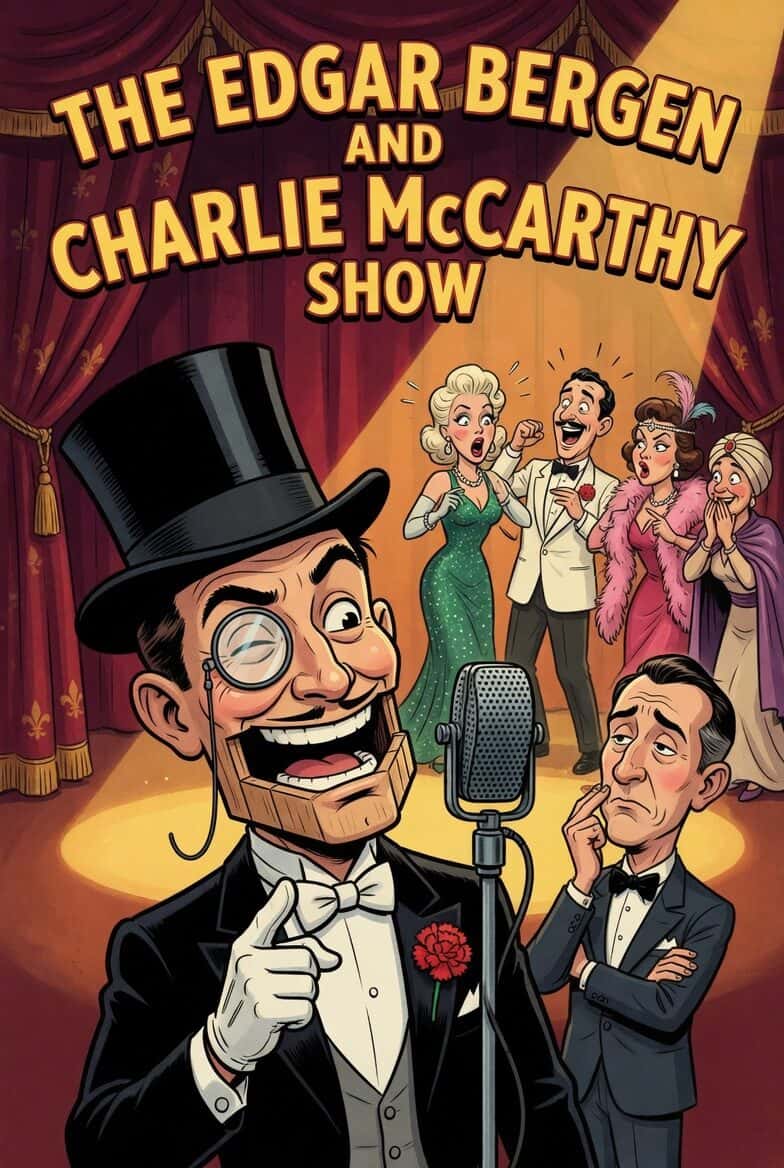
The makers of Jason Sanborn Coffee, the blend of friendship in a cup, presents Edgar Bergen, Donald Dixon, Robert Armbruster, and the Jason Sanborn Orchestra. Our special guests, Charles Laughton and Charlie McCarthy.
This is Charlie McCarthy making things ready for the regular Jason Sanborn Coffee Clutch. May I pour for you, Mr. Bergen?
Well, Charlie, first you ought to serve our guest, Charles Laughton.
Oh, sure, sure, sure. How are you, Captain Bligh?
Very well, thank you, McCarthy.
May I serve you a cup of coffee, Captain?
Never cared much for coffee.
Mutiny, eh, mutiny. He'll haul that man—
Shut up! Let me finish. Never cared much for coffee until I tasted Jason Sanborn.
Oh, well. We'll make him an admiral for that. He likes Jason Sanborn.
Yes, sure. He's an admiral.
Yes, that's right. And I first meet Donald Dixon. He carries on in the proper nautical manner. We've joined the Navy. Maestro Armbruster, the music. Mr. Dixon, the song.
Ah, beautiful. There he was. Beautiful day, too.
Yes, yes. Why, even you, even you, Bergen, look attractive.
Is that so?
Yes, yes. Well, you are in good spirits.
Yes, yes, I am. I could almost like Mr. Dixon now that I don't have to work for him.
Well, it was lucky for you that Donald collected the insurance on the car that you wrecked.
Yes. He did what?
Yes. He collected the full amount of money. He collected the full amount of insurance on his car.
Oh, he did, Dickie.
Yes.
Oh. Seems to me I ought to come in for a split on that, huh?
What do you mean?
Well, after all, I wrecked it for him, didn't I?
Charlie, I think you better leave well enough alone.
Yeah, maybe you're right. Well, Lamar, but maybe you're right.
You know, Charlie, I have a nice surprise for you today.
A nice surprise?
Yes. That's right.
Well, bust a balloon. What is it?
Who do you think phoned me from the Union Station and asked to be remembered to you?
As is. Is it Carol Lamar?
No, no, no.
Madame Carol?
No, no.
Mortimer Snerd?
No. Go back with him.
Grandpa?
Yes. That vineyard gargoyle?
No, no, no. That's no way to talk about Mortimer's grandpa. Remember, respect your elders.
Oh, yes, yes. And grandpa is almost a septuagenarian.
And his age, too. That means that he's almost 70 years old.
Oh, no, he's not. He's only 65.
Oh, 65. A mere lad.
Well, Mortimer told me grandpa shaved off his beard.
Well, he shouldn't have done that. Really shouldn't have.
Well, why not? You think the beard improves the appearance of his face?
Well, yes. It covers it.
It covers it. He's a humdinger, if there ever was one.
He is one.
Is that so?
Yeah.
What do you mean?
Well, you want to watch him, Bergen. Carrasco with a jackknife. He is.
Yes. He'll whittle a chair right off from under you.
Two visitors are here to see you from Snerdville.
Uh-oh. You think I'm going to have a—
Mr. Bergen?
Well, hello, Mortimer.
Hello, dear.
Yes. Well, welcome back. Welcome back.
Yes. Well, you're here.
Oh, yeah. Yep, yep. Nope. Nope.
Nope. Mr. Bergen?
Yes.
What do you think I brung from Snerdville?
I know, your grandpa.
Yep, yep, yep. Now, aren't you going to introduce him to Mr. Dixon?
Hmm? Aren't you going to introduce him to Mr. Dixon?
Oh, sure, sure. Yes. Introduce him.
Yeah, yes. To Mr. Dixon.
Yep, yep, yep, yep.
How do you do, Mr. Dixon?
No, no, no, no. No, introduce Grandpa.
Oh, yeah, yeah. Oh, Mr. Dixon? Uh, this is, uh, Grandpa.
Grandpa.
Grandpa.
Yep, that's who it is. Yep, yep.
Well, tell him Grandpa's last name.
Hmm? Grandpa's last name.
Oh, his last name. Yes. Uh, last name. It's Grandpa.
Grandpa. Shucks, I don't believe I ever heard it.
Last name is Snerd, isn't it, Whit?
Oh, yeah, yeah. That's what it is, yeah.
Oh, Mr. Dixon, this is Mr. Snerd, isn't it, Whit?
No.
No. Just Mr. Snerd.
Yeah, oh, Mr. Snerd, yeah, Snerd.
Snerd? Well, that's the same name as mine, ain't it? Maybe we're kinfolks, huh?
Well, yeah, sure we are. I'm a grandpa.
Well, I'm glad to know you. Why, you darn fool, I come out here with you.
Oh, so you did, so you did. Small world, ain't it?
Well, anyhow, I'm glad to know you too, Grandpa.
Well, just call me Hopper, sonny. Down there's Creamery. The boys call me Hank.
Say, ain't I seen you on the end of a porch?
Yeah.
Head somewhere, smiley?
I'm afraid not.
Say, Mr. Dixon, were you ever in Snerdville?
No.
When?
Edgar, if you'll excuse me, I think I'll split that. You sound stupid to me. Around here, all look kind of peaked.
Say, who's this little shrimp?
Well, Grandpa, that's our conductor, Robert Armbruster.
Mr. Armbruster and Mr. Snerd.
Howdy, Debbie.
Go on, go on.
Well, Grandpa, I'm delighted no end. Looks like he's been plowed under.
You know, Mr. Armbruster, I lead a band, too.
Oh, what orchestra do you conduct?
Well, I'm the head of the Snerdville Slidehorn Fire and Police Band, and when Lem Crothers has trouble with his plate, I do the flute obligations.
Show them, Orton.
Yep, yep, yep, it does, it does.
Grandpa is the official train meter, too.
Oh, does he meet all the trains that come to Snerdville?
Uh, no. No, no, just the ones that stop at home.
Well, anyway, it's nice to have him here.
Well, you know, say, Mr. Bergen, I've done you something.
You did?
Mm-hmm. Well, all the way from Iowa.
Well, now, that's nice.
Yep, yep.
But what is it?
It's a snowball.
A snowball? Sort of a novelty, you know.
Yes. Sort of a memento of an ear.
Yes. I got it right here in my pocket.
Oh, a snowball in your pocket?
Yeah. I guess it must be in this pocket, too.
Oh, go on. What's the matter?
Oh, the love.
Yes, Charles. I've been watching McCarthy tonight. It seems to me that boy is going up to be a little rowdy.
You don't like my saying so, boy?
No, not at all, Charles. There are times when I think you're right, too.
Have you, um, have you never tried the civilizing influence of beautiful stories on him?
No, Charles, I haven't. For a long time, I've wanted to read, Charlie, the children's stories of Hans Christian Andersen.
Uh, my favorite story is a little match girl.
You know, uh, Hermit's Fortunes might make an impression on Charlie, huh?
Mm-hmm.
Oh, that's the story of the little girl on New Year's Eve, isn't it?
Yes.
No?
Yes.
It was, um, terribly cold. It snowed and was already almost dark and evening came on the last evening of the year. In the cold and gloom, a poor little girl, bareheaded and barefoot, was walking through the streets. In an old apron, she carried a number of matches and a bundle of... With them in her hand, no one had bought anything off her all day, and no one had given her a farthing. Shivering with cold and hunger, she crept along, a picture of misery. Poor little girl. The snowflakes covered her long fair hair, which fell in pretty curls over her neck, but she did not think of that now. In all the windows, lights were shining, and there was a glorious smell of roast goose. Yes, she thought of that. In a corner formed by two houses, one of which projected beyond the other, she sat down, cowering. She'd drawn up her little feet, but she was still colder, and she didn't dare to go home, because she'd sold no matches, and did not bring a farthing of money. From her father, she would certainly receive a beating, and besides, it was cold at home, for they had nothing over them but a roof through which the wind whistled, though the largest rents had been stopped with straws and rags.
Her little hands were almost benumbed with the cold. Ah, a match might do her good. If she could only draw one from the bundle. Yes. If she could only draw one from the bundle and rub it against the wall, and warm her hands at it, she drew one out. How it sputtered and burned. It was a warm, bright flame, like a little candle when she held her hands over it. It was a wonderful little light. It really seemed to the little girl as if she sat before a great, polished stove, with bright brass feet and a brass cover. How the fire burned, how comfortable it was. But the little flame went out. The stove vanished, and she had only the remains of the burned match in her hand.
A second was rubbed against the wall, it burned up, and when the light fell upon the wall, it became transparent like a thin veil, and she could see through it into the room. On the table, a snow-white cloth was spread. Upon it stood a shining dinner service. The roast goose smoked gloriously, stuffed with apples and dried plums. And what was still more splendid to behold, the goose hopped down from the dish and waddled along the floor with a knife and fork in its breast to the little girl. Well, then, the match. It went out, and only the thick, damp wall was before her.
She lighted another match. Then she was sitting under a beautiful Christmas tree. It was greater and more ornamented than the one she'd seen through the glass door at the rich merchant's. Thousands of candles burned upon the green branches, and colored pictures like those in the print shops looked down upon them. The little girl stretched forth her hand towards them. Then the match went out. The Christmas lights mounted higher. She saw them now as stars. The stars in the sky, one of them fell down, forming a long line of fire. Someone is dying, thought the little girl. Her old grandmother, the only person who had loved her and who was now dead, had told her that when a star fell down, a soul mounted up to God.
She rubbed another match against the wall. It became bright again, and in the brightness, the old grandmother stood there. Clear and shining, mild and lovely. Grandmother cried the child, take me with you. I know you'll go when the match is burned out. You'll vanish like the warm fire, the warm stove, and the great glorious Christmas tree. And she hastily rubbed the whole bundle of matches, for she wished to hold her grandmother fast. And the matches burned with such a glow that it became brighter than in the middle of the day. Grandmother had never been so large or so beautiful. She took the little girl in her arms, and both flew in brightness and joy, above the earth, very, very high. And up there was neither cold, nor hunger, nor care. They were, but in the corner leaning against the wall sat the poor little girl with red cheeks and smiling mouth, frozen to death on the last evening of the old year. And the new year's sun rose upon the little corpse. The child sat there stiff and cold. With the matches of which one bundle was burned. She wanted to warm herself, people said. No one imagined what a beautiful thing she had seen. And in what glory she had gone in with her grandmother to the new year's day.
Are they still out? Are they still out?
Hey there, Captain Bligh. Ahoy, ahoy, ahoy, ahoy.
Charlie.
Hmm?
Before you talk with Mr. Laughton.
Yes?
I want you to know that he's very anxious to make a favorable impression on you.
Oh, he is, huh?
Yes.
Oh. Well, well, well, that one bottle there. And I think it would be a nice gesture if you would apologize for what you said to him the last time you two met.
Oh. Oh, that again.
Yes.
Well. All right, all right. Hello, Mr. Laughton, my pal.
Hello, Charles.
Oh, boy. Oh, boy. Yes. Mr. Laughton, as you probably remember, we didn't hit it off so very well last time. We both behaved rather badly.
Uh, yes. Yes, we did. Yes. But, but you were particularly nasty.
Hmm? Apologize, please.
Oh, yes. Apologize.
Very well, Mr. Laughton. I apologize for what I said the last time.
Well, that's, uh, very generous of you, Charlie.
Yes, it is. I'll go even further than that, Mr. Laughton. I'll apologize for what I'm going to say to you today.
Look, is he going to start again? Because I, I, I mean, I, I...
I don't blame you at all.
No, Charlie, I, I think you're missing a great opportunity.
Oh, I'll get him.
No, no, no. This whole thing is starting wrong. Your friendship with Mr. Laughton might have developed into one of those famous, well, as famous as Miles Standish and Captain John Smith. Damon and Pythias. Chase and Sanborn.
I, I, I don't seem to have disagreements with anybody in my stage and picture work, but every time I come to this broadcasting studio, this sort of thing happens.
Yes. I'm a bit fed up with... Mr. Laughton, it, it just may be, you know, it just may be that you, you just don't have anything to offer the radio.
I've got other jobs, and I've got other things to look after. I've got my reputation to look after.
Oh, yes, yes. Well, I, I know just how you feel, Chuck.
Butch.
Yes. I have no trouble.
Eh?
I do my stage work, radio, and my pictures, you see.
Yes, yes, I saw that last picture you made.
Oh, oh, yes. Yes, there is. Oh. Oh. You can explain that.
Yes, and the love of Mike, too.
Yes. Well, you see, I wasn't enjoying good health. I was sick all through the picture.
Yes, so was I.
Yes, old boy. Is it, is it, Laughton, that you played the Hunchback of Notre Dame without any makeup?
Gregory, he's lying again. It's about time I told him my little story.
The story with a moral to it.
A moral? You have to go out of your way to make yourself disliked.
I'm not disliked. Well, I know. Somebody loves me.
Did him hurt him, stealing?
Yes. Maybe I was a bit oversensitive about it. Oh, shut up. I can't figure him out.
All right, Mr. Laughton. What a story you're going. What are you going to tell me?
Oh, this story is a great classic. It was written by Aesop.
Oh, not Milk Shop, Aesop. Aesop, Aesop, Aesop. And a piece of cat's off. Da-da-da-da-da.
One of Aesop's fables.
Aesop's fables, yes. I haven't read any of his stuff recently.
Oh, this story's over 2,500 years old.
Yes.
Yes. You sure dig them up, don't you? You have a new switch on it.
A new switch?
Yes. I wish I had an old switch on you. I'd turn you over my knee and spank you. And it'll hurt me more than it'll hurt you.
You ain't kidding.
I said it.
I heard it. I heard it.
Well, I'll tell you the story. Once upon a time...
He found his cell phone. It's connected to him. Shut up, Ralph.
Once upon a time, there was a little shepherd boy.
What's his name?
I don't know.
What did he do?
Get his flock.
His flock of what?
Sheep. Someone's got to watch the sheep, you blithering idiot.
Well, why?
Otherwise, they'd run away. Sheep are very dumb, aren't they?
Yes. Shepherd boy who tended his flock not far from a village. Used to amuse himself at times in crying out, Wolf! Wolf! Wolf Wolf. No, Wolf Wolf. Go ahead, Wolf Wolf. Old village came running out to his assistance, and all they got was to be laughed at for their pain.
Silly, isn't it?
You shut up.
Last one day, the wolf really came. The boy cried out in earnest. But his neighbors, supposing him to be at his own sport, paid no heed to his cries. And the wolf devoured the sheep with that. It's the story of the little shepherd.
Quite beat up about it, aren't you?
So that's the story, huh?
Yeah.
Yes, and about as dull a thing as I ever listened to. I've been trying to agree with you.
Hey, but the moral of that story is a liar will not be believed, even when he speaks the truth.
Oh, I don't know. I believe you.
Look, I'm awfully sorry, but look here, Bergen, I can't stop you. I can't do anything with it. You're welcome to it.
Thank you. Thank you. As for you, I'm sorry you ever met me. Hope I never see you again.
It's a date.
Oh, I hate that man. I don't know why I hate him.
This is the National Broadcasting Company.