
The written record
Read the transcript
Read along with the recording · About 37 min to read
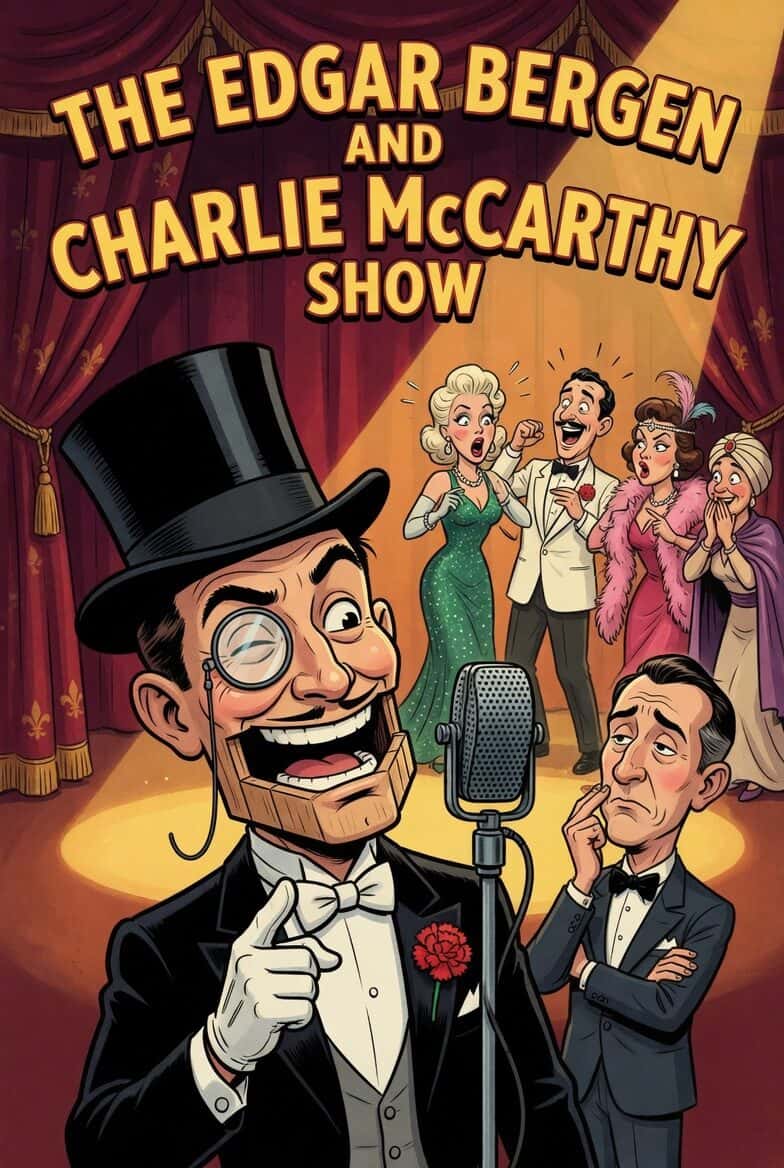
The makers of Chase and Sanborn coffee, the superb blend you know is fresh, presents the Chase and Sanborn Hour. And your host, Don Ameche.
This is Don Ameche hosting for Chase and Sanborn and bringing you the greetings of our mutual friends Nelson Eddy, Edgar Bergen, and Charlie McCarthy, Dorothy Lamour, and Robert Armbruster in the Chase and Sanborn Orchestra.
Oh, Mr. Ameche, I want to ask you...
Before you ask me anything, Charlie, I'd like to welcome our guests, Constance Bennett and Edward Everett Horton.
Yeah, good. Now I'd like to ask...
I also want to renew the hope that all of you enjoy our show and that you remain as always friends and boosters of Chase and Sanborn.
Oh, sure, sure. Now, what's on your mind, Charlie?
Well, I'd like to embarrass both of us by asking you a monetary question.
Oh, money, huh?
Yes, it happens so, yes. I happen to be temporarily fundless, and I'm afraid it might develop into a permanent NSF.
Oh. All right, Charlie, how much?
Well, how about 20 until Tuesday, or 10 until Thursday?
Okay, 10 until Thursday it is. Here's your dime.
Thank you. A dime? Why, you, you, you, Bergen, you... I mean $10.
$10? Why such extravagance, Charlie? What do you need all that money for?
Well, you see, I wanted to go to the world debut of your picture, Hollywood Cavalcade, Wednesday night, you know. Thought I'd give you a hand, you know.
Yeah, thanks, Charlie, thanks. But the ducats are $10 a throw, so we'll just forget it.
Oh, you wanted to go see my picture? Well, Charlie...
It's not necessary. It's all right. Forget it. It's all right.
No, no, no. No, I'll be glad to lend you the 10, Charlie.
No, it's too extravagant. Never mind.
No, no, no, Charlie, look, I'll tell you what I'll do. I'll give you a ticket to the picture myself.
Oh, it's just silly sentiment.
Well, you'll give me a ticket?
Yes, yes, I will, Charlie.
Oh, how nice. How nice. How about $3 for taxi fare down, too?
Taxi fare? Why, nothing doing.
Nothing doing, huh? Do you want me to boo you when you come on the screen?
Okay, taxi fare.
I knew you'd see it my way.
As the summer season ends and the leaves take on the gay colors of fall, Nelson Eddy sings a song of harvest time, a song of happy people reaping golden grain in the crown of the year. Nelson?
Sing, sing of the harvesting time, Hi-ho, the sun is so fair. Fields all aglow with sheaves in a row, And harvesters harvesting there. The jolly good wind...
Corn for the market and corn for the mill, Plenty for all and to spare, Plenty for all the glory and...
Although you may sing of the joy of the spring, Although you may sing of the joy of the spring, Yet this...
Sing of the harvesting time, Hi-ho, the moon is so fair. Fields all ashine with sheaves in a line, And never a harvester there to be.
Hi-ho, the sun is so fair. Plenty for lovers to share, Hi-ho, the moon is so fair. Although you may sing of the joy of the spring, Hi-ho, the moon is so fair. Although you may sing of the joy of the spring, Hi-ho, the moon is so fair. Yet this...
In Mozart's comic opera, The Magic Flute, there's a very amusing fellow with the amazing name of Papageno, who pursues the novel occupation of bird-catching. This unusual young fellow plays a most remarkable instrument whose piping drives away all evil spirits. Nelson Eddy sings... Papageno's Aria, Gente qui, l'uccellatore.
L'uccellatore, chi lo vuole? Eccolo, eccolo qua, che fa caccia tutto l'anno, Vecchi giovani lo sanno. Che gli uccelli ad un mio fischio Trovan tutti o rete o vischio. Che il migliore, migliore di... Son allegro, son contento, Che il migliore, migliore di me non va. Gente qui, l'uccellatore, chi lo vuole? Eccolo, eccolo qua, che fa caccia tutto l'anno, Vecchi giovani lo sanno. Di donnette una dozzina, perzi in bellia, Son allegro, son content, e venire a meve.
Oh, thanks, Charlie. Stuff like that. Did you like it?
Yeah, that was a very beautiful song. I have reasons to suspect.
Suspect? Don't you know?
Well, I enjoyed the music, if I must be frank, but I found it very difficult to understand the words.
Charlie, Nelson sang the song in Italian.
Oh, in Italian? Did you, Mr. Eddy?
Yes, I did, Charlie.
Oh, well, that explains it, huh? Well, watch it next time, that's all I'll say. I guess you'll miss it. I guess you're embarrassed enough as it is.
Well, you see, Charlie, the opera was written in Italian.
So it was written in Italian, so what? You see a sign that says, this way to Canarsie, that doesn't mean that you have to go there.
Oh, well, but, Charlie, that's one of the most famous operas Mozart ever wrote.
I saw, still giving me an argument, huh? Why don't you get him to write it in English?
Charlie, Mozart's been dead for many years.
Oh, still Mr. Eddy plugs the songs, huh?
Charlie, Mozart is immortal.
He's what, pardon me?
Mozart will live forever.
Oh, he's dead, he'll live forever. He's up, he's down, he's up, he's down, he's down, he's up. Why don't you guys get together on this thing?
Now, Charlie, Mozart was a great composer whose works live after him.
Yes. In addition to the magic flute, he was responsible for the marriage of Figaro.
Oh, are they hitched now? I don't give it six months.
Mr. Eddy, did you say that song, the magic flute, was opera?
Yes, Charlie.
That song. Would you like to hear the story?
Not particularly, no.
Well, I'll tell it anyway.
Yeah, okay, I'll get my opera glasses.
Now, if you're ready now, Charlie, I'll tell you the story of the magic flute.
Yeah, blow by blow.
Toot by toot.
All right, toot by toot. This is the magic flute. This is the magic flute. This is the story of Papa Gaino.
Yes, Papa Gaino, Mama Gaino. Three little Gainos.
Charlie, will you please?
All right. All right, thank you, Eddie. So sorry.
Now, you see, Charlie, Papageno was a bird catcher who went about dressed in feathers.
Sort of a Minsky fan dancer, I take it.
Oh, no. Oh, no. Oh, no. No, Charlie.
Oh, no. The fact that I said it, I know it's wrong.
Oh, yeah. Why did he go around in feathers?
Well, he was dressed in feathers, and he played a flute to attract the birds.
I see. Every time he opened his mouth, he put his flute in it. I think it's cute.
I think that's awful.
Yeah?
Yes. I'm embarrassed.
You're embarrassed? Yes.
Oh, he's embarrassed. How do you think I feel? They think I said it.
All right. I refuse to open my mouth for that one.
All right. All right. Well, shall I go on with the story?
Go ahead. Bergen might like it.
All right. I'll continue. But remember, young man, your interruptions are untimely and annoying.
May I say the same for the story, young man?
Yes.
Well, anyway, Papageno is the gay character of the opera.
Yes. Always laughing.
I suppose the feathers tickle him, huh?
No. No, no, no. He's naturally cheerful and happy.
Yes, yes. You ought to see how funny Papageno looks when he comes out to sing the aria.
In the what-a-ah?
The aria. The aria. The aria. What's that? You know, the aria. You know what that is.
Oh, yeah. You mean he's short and fat, huh? Sort of?
No, no, no. As a matter of fact, he's tall and thin.
Oh, he is, huh? I see. Had the right aria, but the wrong circumference.
All right. No.
Charlie, if you'll only listen, you might find the story of the magic flute very interesting.
I doubt it.
Why, at points, it's even gripping.
Gripping is the word.
No. Maybe it's just the way you tell it.
Mm-hmm. Well, what's the matter with the way I tell it?
Well, for one thing, I can hear it.
Now, Charlie.
Why, Charlie, there's one point of the story where a horrible monster appears.
What kind of a monster?
Well, it's a serpent in the front and dragon in the rear.
Oh. I see. Maybe it's been on its feet all day.
Charlie, you shouldn't interrupt Mr. Eddy this way.
I know. Well, after all this, Eddy, let me remember. Oh. Oh. Oh. Oh. Oh. Oh. Oh. Oh. Oh. Oh. Oh. Oh. Oh. Oh. Oh. Oh. Oh. Oh. Oh. Oh.
Let me remind you that I am the devotee of music in the highest strata.
Oh, right. Yes. Oh, right. Yes.
Not only that, but I also sing. Of course, I don't say that I have done quite so much as you have in that field, for you have, you have done rather well.
Thank you.
Of course, you had a lucky break. However, the choir I sing in is not to be sneezed at.
Well, Charlie, do you really sing in a choir?
Yes, I do, fellow artist.
Now, this choir of yours, what is it, Charlie? Mixed voices?
Most of the time, yes.
Mr. Eddy, have you ever heard the sextet from Lucia?
Gesundheit, Bergen.
That's all. Oh, yes, many, many times.
Does your choir sing the sextet from Lucia?
Pateste. Or better still, I sing it myself as a solo.
Oh, wait a minute, you sing a sextet as a solo?
Yes, and it's not easy, I might add.
It's impossible.
Well, that's why I've had trouble with it. I thought it was the audience that sort of threw me a little. They annoy me, the audience, you know.
Well, if you want to be a great singer, Charlie, you must learn to ignore the audience entirely.
Yes, that's all well and good, but you can't ignore tomatoes.
Well, I hardly blame them.
No. Oh, is that? So.
Yes, that's so.
Yeah. Sensitive, are you?
Yes, I am. One more word from you and I can clip Charlie.
What's the trouble here? What's going on here?
Oh, nothing, nothing, Mr. Eddy. Mr. Eddy just hit me with a rock, that's all, just a rock.
I did nothing of the kind.
Did so, did so, did so.
Charlie, Nelson was trying to tell Charlie the story of the magic flute and the part he sang in it, you know.
Well, you sang the part of Papageno, didn't you, Nelson?
Yes, that's right.
Gente qui l'uccellatore.
What does that mean?
Folks? I catch the birds.
Ah, oh. You catch the birds, do you?
That's right.
Well, catch this one.
Charlie.
This time of the year seems to be harvest time for popular songs, too. For from the current movies, musical comedies, and the activities of sundry gentlemen in Tin Pan Alley, we're having a bumper crop of smash song hits. Separating the musical wheat from the chaff, Dorothy Lamour is singing one of the best, the melodious Day In and Day Out.
Daddy? A mole who's pounding in my heart Whenever I think of you And darling, I think of you Day in and day out Day out Day My days be awakened with a tiny possibility in view That possibility of maybe seeing you Come rain Come shine I meet you and to me the day in There it is Day in It's with a tingle Possibility in view Possibility of maybe seeing you My dear, I have no fear And there'll be a dawn there
The man who said there's nothing new under the sun would certainly take it back if he heard this. Yes, here in the East, there are two new features about Chase and Sanborn dated coffee that are causing a sensation. A new guarantee of freshness and a magnificent new silver package.
Beginning right now, a new improved special delivery service is rushing Chase and Sanborn dated coffee from roasting to your grocer. Our trucks are now making more frequent deliveries, and they leave only a small quantity each time. Every pound is dated, and no pound stays on your grocer's shelf more than ten days. That's your guarantee against stale or rancid-tasting coffee. You get fresh, rich, delicious coffee every time.
And what's more, Chase and Sanborn dated coffee is now packed in the new prize-winning silver package. When that remarkable new package was perfected, we thought it was great. But we wanted to make sure housewives thought so, too. So, we put it on sale in Buffalo, New York. It went like wildfire. Next, Washington, D.C. gave the same verdict. And then other cities, too. Since then, it's captured city after city. It's a package so fine, it won a national award as the best of its kind.
But a thrifty package, too. Far less expensive than costly containers. So, we make a substantial saving and pass this saving on to you. So, you get the improved silver package, plus finer, fresher coffee, a superb full-flavored blend at a price that saves you money. Ask your grocer for a pound of Chase and Sanborn dated coffee in the new silver package tomorrow.
Probably no one in Hollywood has more varied interests and handles them more successfully than Constance Bennett. Ranking high among the town's best-dressed women and certainly one of its most gracious hostesses, Connie somehow still finds time for all the good acting she wants to do and does. It's a very real pleasure to welcome her here this evening and appear with her in a radio adaptation of a short story by Joseph Harrington. We present Constance Bennett in Fancy Meeting You Here.
Among New York hotels, the Howland Towers is a symbol. A symbol of wealth, luxury, success. Its residents personify that symbol as long as they can afford to pay for it. Eve Darrow has been a resident for two minutes. Alone in her room, she's making a telephone call.
Mr. Gerald Donnelly, please.
Yeah, this is he speaking.
Mr. Donnelly? Well, I wonder if you remember me, Jerry. I used to be your fiancée.
Oh, hello, Eve. Splendid, thanks. What are you doing in town, Jerry?
Just... traveling, you know, all the usual places. Right here in the Howland Towers. That's what I called you about. I happened to be glancing through the personal notes in the Times this morning and, lo, I discover my ex-fiancé is stopping at the same hotel. What will people think? Should I leave?
Should you leave? As a lawyer, what's your opinion?
Well, I've been away for so long, I wouldn't know. Well, it was pleasant to hear from you. Pleasant to talk to you again, Jerry.
Oh, yes, the usual business. New York never changes. Teas, dances, weekends. But tonight, thank goodness, I haven't a thing to do.
Why, I think that would be great, Jerry. Bring back old times. All right, then. I'll be waiting for you at 8 sharp on the Caribbean roof. Right. That'll be fine. Bye.
I've ordered. I don't expect to see that waiter again for at least an hour.
Well, this will give us a chance to get reacquainted, won't it?
That's a privilege I've been looking forward to for a long time.
Thank you. It's good to see you, Jerry. Are you living at the Towers now?
Mm-hmm, temporarily.
Hmm. Arrived recently?
Yes, just the other day on the Emperor.
The Emperor?
From Bermuda.
Oh. Oh, of course. Must be wonderful spending all the right seasons at all the right places.
Oh, I don't know. It gets sort of tiresome running around so much, but tell me about yourself.
Oh, there's practically nothing to tell.
Oh, come, Jerry. The papers have been full of your wonderful work as the crusading young District Attorney of Boston.
The papers? Bermuda papers?
Of course not. The New York papers. Oh, I always get the back issues when I come home to check up on what I've been missing.
Oh, I see. You haven't changed much, Jerry. You're not as tan as I knew you. You look a little grimmer and more serious.
Well, you haven't changed much either. Hardly seems like three years since...
Since that summer at Cape Cod? I was going to say since our engagement. I'm really surprised you remembered.
Jerry. Well, I mean, at the time from your letter of explanation, breaking it seemed to take so little effort.
Well, a letter of explanation seems such a futile thing when you're breaking someone's heart. I thought it would be best to make it as brief as possible.
Well, you were very successful. If it had been any briefer, you might just as well have saved the paper.
Oh, Jerry, I know it's over and all that, but what I want you to understand, I did do it for your sake.
Why couldn't you have done it for my sake at Cape Cod when you were telling me how much you loved me?
We were young, Jerry. We really didn't know what life meant. Besides, we lived in different worlds.
You mean I was a lifeguard and you were a social butterfly who considered a trip to Europe about as important as a subway ride?
You weren't just a lifeguard to me. You were Apollo in a blue bathing suit working your way through Harvard Law School. But, Jerry, engagements mean marriage, or at least they should. And you couldn't support me and go to school.
I offered to get a steady job and go to law school at night.
But think of the years it would have taken that way. Besides, Jerry, my life has been too gay an affair to live without luxuries, and you soon would have felt that. And, uh, how do you find life now?
Oh, still the same gay affair.
Well, then I suppose everything turned out for the best.
For you, I'm sure it did. And for you?
Equally well. And you still have everything in the world you want?
Mm-hmm, quite.
Well, I'd like to see you again, Eve. Anytime. Before you leave. You think that might be arranged?
I don't know, Jerry. I suppose you're busy tomorrow.
In the afternoon, yes, but how about breakfast?
No, no, I have a breakfast date with my aunt.
How about dinner?
Sorry, I'd love to, Jerry, but I can't.
Why not?
Date.
Oh. Well, how about Monday?
Still another date.
My, your social calendar's really full, isn't it?
Yes, you've no idea. Tomorrow night, for instance. Dinner with the Van Pelts. And Monday, lunch. Tea, dinner, and the theater. And Tuesday, I go back to Boston.
Well, I guess that means I'm not going to see you again.
Sorry, but, well, I guess it won't be possible. You see, I'm sailing again shortly.
Seems to me it's hardly worth your while keeping up the room at the boarding house with all those invitations.
What? What did you say?
I said it hardly seems worthwhile keeping your room at the boarding house. And don't those social engagements and trips abroad interfere a little with your job at the real estate office?
I don't know what you're talking about.
Eve, I know your mother passed away in Paris. But behind her, instead of the fortune you expected, she left nothing but bills.
How did you know that?
I was an attorney for your mother's brokers in Boston.
Oh. Why didn't you tell me?
That wasn't the only thing I knew. I had our New York office check up on you when you came home. Find out where you were living, what you were doing.
And, uh, were you satisfied?
I found out you were living in some boarding house, working as a secretary for $20 a week, riding the seagull.
Oh. Well, you know now. Now, you're the high and mighty one sitting on your pedestal of success. It's your turn to laugh, I guess. Go ahead.
Forgive me, Eve.
Oh, there's nothing to forgive, Jerry. You're just giving me some of my own medicine, making me feel some of the things you felt when I went off and left you. Because, well, because you were a lifeguard. Take care of yourself.
I'm sorry. I'm sorry. I'm sorry. I'm sorry. I'm sorry. I'm sorry. I'm sorry. I'm sorry. I'm sorry. I'm sorry. I'm sorry. I'm sorry. I'm sorry. I'm sorry. I'm sorry. I'm sorry. I'm sorry.
Well, because you were a lifeguard. Takes some of us a long time to learn about life. We don't really learn about it until we've been hurt, until we learn to take it for a change, instead of giving it.
Please, Eve, I thought you came here for pity, for favors. I couldn't understand any other reason. You know, I walk past this hotel every day to and from the Subway, and I see people enjoying the luxuries I once enjoyed. See them in their evening clothes, dining, dancing.
Uh-huh. Sort of, well, strange to see things like that, knowing that once you too possess them, I wanted to have them just once more. For just one day, I wanted to play Cinderella. That's why I came.
Eve. For months, I've been saving bit by bit. Boy, you can't save much out of $20 a week, but yesterday, I decided that this would be the day. I didn't know you were stopping here until this morning. I didn't even know you were in town until I read it in the paper. But I'd looked forward to this thing for so long, I couldn't cancel it. I decided to come anyway, to call you up, to see you again if you were in.
So that's why you came. With a suitcase full of telephone books.
Was Cinderella the telephone company?
Oh, please, Jerry. I know I'm a fraud, but don't be cruel about it.
Eve, if ever a Cinderella was real, it's you. I'm the fraud. I'm the one who should feel ashamed, knowing all the time what you've been through, offering you invitations, I knew you couldn't accept. It's like a cat toying with a mouse. But you were too big for it.
I'm going now, Jerry. There isn't much fun in staying any longer.
Oh, Eve, not so fast. We've hardly seen each other.
Well, there's not much future in seeing any more of each other, do you think? You've had your fun. I've had my thrill, so see you again sometime, Jerry.
Oh, wait a minute, wait a minute now, Eve. You can't just walk out like this.
Yes, I can, Jerry. This situation isn't very pleasant, you know. It was a mistake from the beginning. I should never have called you.
Eve, I've got to see you again.
Well, I'm afraid that's impossible, Jerry. Don't forget that I'm a working girl. This is goodbye, Eve.
Well, don't sound so tragic about it. A smart Boston lawyer shouldn't let a little thing like this get him down.
There isn't very much in the law that can help a smart Boston lawyer with a girl who won't see him.
Oh, I don't know. He could always issue a subpoena or something, couldn't he?
But he doesn't know where she lives.
No. He doesn't, does he?
No, he doesn't.
Naturally, that makes it a little... Goodbye, Jerry.
In all the works of Gilbert and Sullivan, there's probably no more tragic figure than the wretched, love-lorn little dicky bird of the Mikado. And no more comic figure than Ko-Ko, the Lord High Executioner, who tells us of the bird's sorrowful experience. Nelson Eddy sings Tit Willow.
On a tree by a river, little Tom Tit sang Willow, Tit Willow. Tit Willow. And I said to him, dicky bird, why do you sit singing Willow, Tit Willow, Tit Willow? Is it weakness of intellect, birdie, I cried, or a rather tough worm in your little inside? With a shake of his poor little head, Oh, Willow, Tit Willow, Tit Willow. He slapped at his chest as he sat on the bough, singing Willow, Tit Willow, Tit Willow. And a cold perspiration bespangled his brow, Oh, Willow, Tit Willow, Tit Willow. He sobbed on his side, and a gurgle he gave, Then he threw himself into the billowy wave, And a tit willow, tit willow. He'll just as sure as I'm sure that my name isn't Willow, Tit Willow, Tit Willow. That was blighted affection that made him exclaim, Oh, Tit Willow, Tit Willow. And if you'll remain, callous and obdurate, I shall perish as he did, And you will not absolve me.
When the name of Edward Everett Horton flashes across our mental horizon, we do not think of Horton the aberrant actor in RKO's That's Right, You're Wrong, nor even of Horton the pertinent personality in person. But rather there comes back to us the strange strains of a haunted refrain, a beautifully horrible song.
When she lays her eggs with no egg-cup beside her, Nothing else to hide her. The air is filled with mad music. No one to tell her the actual size, No matter how she begs so.
How does a hen know the size of an egg-cup when she lays her eggs?
Yes, indeedy. Mad music and Edward Everett Horton.
Oh, that was splendid, Eddie, splendid.
Oh, thank you, Don, thank you, thank you. What was?
You're singing.
What?
You're singing.
I am. Oh, dear, no, dear boy, no, no, no, no. You must be mistaken. I'm not singing at all.
Well, you were singing.
I was singing, yes, indeed. Take a chance, old man. Don't just confine yourself to the present tense.
I don't. I can use the past tense with the best of them.
Really? Well, that's very nice, of course. But for a real thrill, Don, wait till you try the future perfect.
To be, about to be, and all that. It's positively exhilarating.
You think that's good. But have you ever plunged into a quick pluperfect?
Oh, well, now, dear boy, please. We may be tense, but none of us is pluperfect.
Oh, I don't know how I think of them so quick, you know. Oh, that was rather good, didn't you think so?
No.
Uh-huh, yes. Well, you mustn't let it worry you, dear boy.
Let what worry me?
Your lack of education.
My lack of education doesn't worry me.
Oh, it doesn't? Oh, how pathetic. You're proud of it, I suppose.
No, I'm not proud of it. I'm not uneducated, do you understand?
You're not?
No, I'm not.
Well, then, dear boy, what have we been talking about?
My lack of... Yes, what I said.
No, no, no, you don't.
Don't I?
No.
Why don't I, do you suppose?
I don't know why you don't.
Oh, well... Well, really, that brings the conversation right back to where we started.
Yes. Do you do this sort of thing often?
I never do this sort of thing, except when you're around. Then I do it too often.
I understand, oh boy. It sort of gets under your skin, doesn't it?
Yes, you do. I know. I know, dear boy. You needn't explain. I know. It's the same way about acting with me. You wouldn't believe it, but I'm like an old fire horse at the smell of grease paint.
What do you mean? You start stamping your feet?
I just stamp and my double shuffle and off to... Please, please, please. Make an attempt to conduct an intelligent conversation.
All right, let's forget that. You were telling me about your acting.
Was I?
Yes, you were.
Well, well, that's my favorite topic. What was I saying about it?
Something about it being under the skin, I believe.
Under my skin, really? Oh, oh, oh, oh, yeah, it tickles, yes. Oh, oh, I see what you mean. Yes, that's just a figure of speech, yes. I mustn't take me so literally.
Well, what about your acting, Eddie? You had quite a fling at it this summer, didn't you, in the summer theaters?
Well, that's a fine thing. You've been keeping tabs on me. I hardly call that friendly, Amici, keeping a check on what I do with my summers.
I don't keep a check on your summers. I don't care what you do with your summers. Or your winters, or your falls, or your springs. Hi-ho, there goes another year, huh, dear? How time flies. I just happen to know you played in summer theaters this year because I read the papers.
You do what?
I read the papers.
Really?
Yes.
Well, well, what's new?
Why?
I don't know what's new.
Oh, you see, I thought so. Just a bluff, wasn't it? Just a bluff, reading the papers, yes. Dear boy, did you think you were going to fool me with that trumped-up story?
All right, all right, somebody told me. I don't care. Anyway, I know you had a successful summer in the theater.
Yes, yes, it was really marvelous, Don, hounded as I was from town to town, traveling as I did from town to town with the show.
Barnstorming.
Yes, yes. I, uh, nothing of the kind, barnstorming. I was acting.
Well, of course.
Oh, it certainly doesn't take much to convince you, does it? Oh, really, Don, you ought to try to develop a mind of your own, you know.
Oh, I don't know, Eddie, you seem to be doing very nicely without one.
I know, but everybody isn't as fortunate. I mean, they, you can't, uh, look here, really, really, really. I know your type, Amici. You never know. You never let your right hand know who your left hand is stabbing in the back.
I haven't stabbed anybody in the back.
Oh, is that so? Proud of it, I suppose, huh? Oh, my dear boy, you've sunk pretty low since I saw you last.
Oh, right, so I'm proud of it. I rob banks in my spare time, too.
Oh, really? Well, is that a fact? I suppose everybody has to have a hobby, huh?
Certainly, after all, you have your acting, I have my bank robbing.
Acting isn't just a hobby with me, dear boy. Oh, no, it's my art.
Well, you're gonna pursue your art this winter and springtime for Henry, aren't you?
Uh-huh. Don't tell me you haven't been spying on me, Amici.
Well, in any case, my spies tell me the play was enthusiastically received this summer.
Well, I did. I had my moments. Of course, everywhere you went, you were mobbed by autograph hunters.
Oh, was I really? Well, isn't that flattering, isn't it? Isn't it? Isn't that flattering?
Well, you were, weren't you? Mobbed by autograph hunters?
Yes. I do remember one small boy who got my autograph.
You mean only one person asked you for your autograph?
Well, he didn't ask for it exactly. I asked him if he wanted it.
And how did he feel about it?
He was very, very obliging. He said he didn't mind. Just as soon have it as not.
Oh. I thought he was. I thought it was very nice of him. Of course, I wondered why he hadn't asked me for an autograph, if he really wanted one. But he explained it very logically. He didn't know I could write.
Well, that was only natural.
Yes, because I didn't have a pencil. I didn't have any paper. I... Listen, Amici, please. I don't have to stand here and be insulted.
You don't?
I certainly do not. I do not. I do... But yet, why do you suppose I continue to do it?
I don't know. Maybe you like it.
Oh, my word. Do you think so, really?
Well, well. Well, well. Well, let's see. Let's see. Go ahead now. Go ahead. Insult me.
Well, I'd like to, Eddie, but I don't know what to insult you about.
You don't?
No, I don't.
You're sure?
Positive.
Well, well. Well, I don't suppose there's any point in hanging around any longer, then, is there? So long, Don.
So long, Eddie.
It seems traditional among songwriters, and I'm not one to disagree, that soft lights, sweet music, and a supper for two is far and away the best setting for a romance. One of the latest and best treatments on the subject is the tuneful, A Table in the Corner. I'd like to sing it for you.
A table in the corner, a window with a view. An orchid by your plate, a charming tête-à-tête for two. Two hands beneath the table that accidentally meet. A muted violin, a melody that's indiscreet. Away from all intrusion. This rapture I can't conceal. To share this sweet seclusion right opposite my ideal. A table in the corner, it was heaven's own design. That told me from the start the corner of your heart was mine.
Seclusion, this rapture I can't conceal. To share this sweet seclusion right opposite my ideal. A table in the corner, it was heaven's own design. That told me from the start the corner of your heart was mine.
You've heard of the gold rush and how fast the news spread. Well, here's another treasure people have discovered. Thank you, Don. Everyone within sound of my voice should be glad to get this information. A new improved special delivery service now supplies your grocer with Chase & Sanborn dated coffee in the wonderful new silver package. Under this new special arrangement, our trucks make more frequent deliveries. On each trip, they leave only enough to last your grocer until the next delivery. The date is on every package. And we see that no pound stays on the grocer's shelf more than ten days. Now watch that date. It is your guarantee of freshly roasted coffee. And that new silver package is worthy of the treasure inside. A treasure of fine coffee inside. It's a package that won a national award as the finest of its kind. And yet, a money-saving package, too. Handsome and effective as it is, it is a thrifty package. Far less expensive than costly containers. So, we make a worthwhile saving. And pass that saving on to you. Before we introduced this improved package on a nationwide scale, we made sure housewives really would appreciate it. As shown by their actual purchases. And they did. First in Buffalo, New York. And then in other cities. It proved a sensational success. So, remember, the roasting ovens nearest to you are rushing out their freshly roasted coffee faster than ever. And in this new package. You're guaranteed finer, fresher coffee at a cash saving. Try it. Get a pound from your grocer tomorrow. Chase and Sanborn dated coffee in the new improved silver package.
Oh, Don.
Yes, Connie.
Don, before I forget it, I'm giving a little charity bridge at home this evening. And I'd love to have you come.
Oh, be glad to. Thanks, Connie.
Oh, be glad to. Thanks, Connie.
Nelson.
Yes, Connie.
I was just telling Don I'm giving a little bridge party at home tonight. And I'd love to have you there.
Oh, thanks. That would be swell.
Oh, thanks, Harry. Well, well.
Dorothy.
Oh, Dorothy.
Yes, what is it, Connie?
I'm giving... We're giving a bridge party at our house this evening. We'd love to have you come.
We'll all be there.
We will.
Charlie.
We'll be there?
Yeah.
After all, I haven't even invited you.
Oh.
Well, if you want it to be as dull as dish water, okay.
Darn.
Go ahead.
Well, after all, Charlie, this is a bridge party. You don't play bridge, do you?
Oh, no. Well, only last night I played three chuckers and won every inning. It was a wonderful party, too, it was.
I'll bet it was.
Yes. Did they have any interesting favors?
No. No favors. No. Either you come or you don't. We don't toy around.
No, Charlie. I mean, favors. Small gifts.
Oh, yes. Yes. We had some small sandwiches. They were good. Small.
Did you really?
Yes.
Did you really play bridge at the party, Charlie?
I'll never forget it. In one hand, my opponent, see, bid two no trumps, see. So, naturally, I had to top her, see.
Oh, yes. Of course. What did you bid?
I bid three no spades, see.
Two three no spades?
Yes.
Well, and what did she say?
Well, what could she say? She seen I had her. So, they finally gave it to me for six spades.
Oh, six spades. Yes. Yes. Yes. Yes. Yes. Yes. Yes. Yes. Yes. Yes. Yes. Yes. Yes. Yes. Yes. Yes. Yes. Yes. Yes. Oh. Yes. Oh. Six spades. Yes. A small slam, eh?
No, but I got a dirty look, well...
Well, how many spades did you make?
Three clubs.
Ah. I think I must've misplayed somewhere.
Yes. I think you got something there.
Yes. Well, Charlie, if that's the kind of bridge you play, I'm afraid you're not invited to my party.
Well, don't you need a handy man around your place? You know, someone to eat the cookies or snitch the silver or something?
Well, as a matter of fact, my butler took ill this morning, and I haven't been able to find anyone to take his place.
Good. Say no more. I'm your man.
Oh, can you buttle?
I can split one with you, sister.
Well, Charlie, if you want this job, you'll have to know how to set the table, too.
Oh, I know how. On the left, you find the fork, and on the right, you find... You find a tip, if you're lucky.
Charlie, under no circumstances must you ask for a tip.
Why not?
Well, it would embarrass the hostess.
Oh. Well, can't I just hint at it a little? You know, just sort of say, uh, if you want to leave two bits, it's all right. Old Lady Bennet is pretty stingy with her dough. Can I say that?
No, you certainly cannot.
Oh, you're super snickety, huh?
Now, listen. You understand, forks on the left and knives on the right.
And the spoons?
Spoons and a coffee cup.
Oh. Charlie, no, that'll never do. That's definitely wrong.
I know, I know. Never drink coffee with a spoon in a cup. How boorish, you.
Now, the reason is, the spoon is liable to knock your hat off.
That settles it. I'm all set.
I get it?
No, you don't. You'll be at the door instead.
Oh, I'm at the door. I'm still inside, though.
Yes, you'll answer the door.
Yeah.
Well, why can't I wait on the table?
I'm afraid that isn't the job for you, Charlie. You see, this is a formal dinner. Everyone will dress.
Well, I hope so.
Charlie, I mean... The women will be in evening gowns, and the men will be wearing tails.
Wearing tails. What are they, mice or men?
All right. Now, Charlie, let's say my guests are at the door now. They're ringing the bell. What do you do?
I open the door.
Yes, and what do you say?
I sort of give them a glad hand. Hiya, lugs, pull up a chair and sit down. Sort of breaks down the ice a little.
Yes, that's a great beginning.
Thank you.
Don, will you help us out, please?
Why, certainly, Connie. What is it?
Oh, I want to try Charlie out for the position of doorman this evening. Could we have sort of a, well, you know, a rehearsal?
Why, sure.
All right, Charlie. We'll see how you do.
Yeah.
Will you come in now, Don?
Okay.
Ready, Charlie? Go ahead.
Come in.
Good evening.
Who says so?
I'm Don Ameche.
We don't want any.
Will you announce me, please?
Don Ameche, arriving on track four.
Charlie.
Ameche, who's this distinguished-looking duck with you?
Why, that's my friend, the Earl of Eddy.
Oh, may I check your Earl, Eddy?
No, just announce me, please.
Okay. In this corner, we have Earl of Eddy, weight 122 and a half.
Looks like a tough fight, Mom. I'll be right home.
Will you announce me, my good man?
Well, yes. What's your handle, bud?
I am the Baron von Armbruster, Knight of the Ball.
Why don't you relax one second? Knight of the Ball. May I check your soap and towel?
What's your name, Curly?
I'm Edgar Bergen.
Edgar who?
Edgar Bergen.
Never heard of you. Scram, riffraff.
That's right, Charlie. Don't let any gate crashers in.
No, sir. We've invited only the cream of society.
Yeah. Only the cream of society. Only the bluebloods.
Only the bluebloods. That's right.
You want me to give them a blood test at the door?
No, Charlie. You better take my word for it. They're bluebloods.
Uh-huh. Ah, Countess. How are you?
Oh, hello, Dottie.
Pardon me. I'm the Countess de la Mour.
Right you are, Toots. I wonder if you could get me a cup of coffee.
A very good question, too. I wonder, too. What kind of Chase & Sanborn coffee would you like?
Oh, I'll take Chase & Sanborn or whatever the hostess is serving.
Yeah. You'll take Chase & Sanborn or a bust in the nose.
Very well. A large cup, please.
It's demitasse or nothing.
If my guests want a large cup of coffee, Charlie, why do you insist on demitasse?
To keep these mugs from dunking. I know them.
Nelson Eddy sings Handel's lyrical and beautiful "Where'er You Walk" from Semele.
Where'er you walk from two—
We say so long was Nelson Eddy. Nelson, Edgar, Bobby, Dottie, Charlie, and I want to beat a few loud drums and sing a few praises in behalf of Chase & Sanborn coffee. It's no secret that we all think it's just about the finest coffee in the world. Of course, maybe you'll say that we fellas are prejudiced, but all we can add is the hope that you'll get some Chase & Sanborn coffee and tell us whether you don't agree with our opinion. We all feel sure that you, like us, will vote Chase & Sanborn the winner.
We'll all be back next week. Edgar Bergen and Charlie McCarthy, Nelson Eddy, Dorothy Lamour, and Robert Armbruster and the Chase & Sanborn Orchestra. Our special guests will be Charles Laughton and Vera Vague. Until then, this is yours sincerely, Don Ameche, saying goodbye.
The cities of New York and San Francisco are making it easy and pleasant for you to visit their two great fairs. In both cities, accommodations for visitors are splendid and reasonably priced, and there's a hearty welcome awaiting you. At the fairs themselves, don't miss the special Chase & Sanborn attractions. At San Francisco Golden Gate Exposition, visit our colorful House of Hospitality. In New York, see the magnificent Standard Brands building featuring our great outdoor marionette show with puppets of Edgar Bergen, Charlie McCarthy, Don Ameche, and Dorothy Lamour. It's fun, it's free, and you're always welcome.
Next week, another big Chase & Sanborn hour. Charles Laughton, Don Ameche, Edgar Bergen, Charlie McCarthy, Nelson Eddy, Dorothy Lamour, Vera Vague, and Robert Armbruster and the Chase & Sanborn Orchestra. Heard on this program, "The Big Show" by Jerome Kern.
This is Jim Bannon speaking for the makers of Chase & Sanborn Coffee.
This is the National Broadcasting Company.