
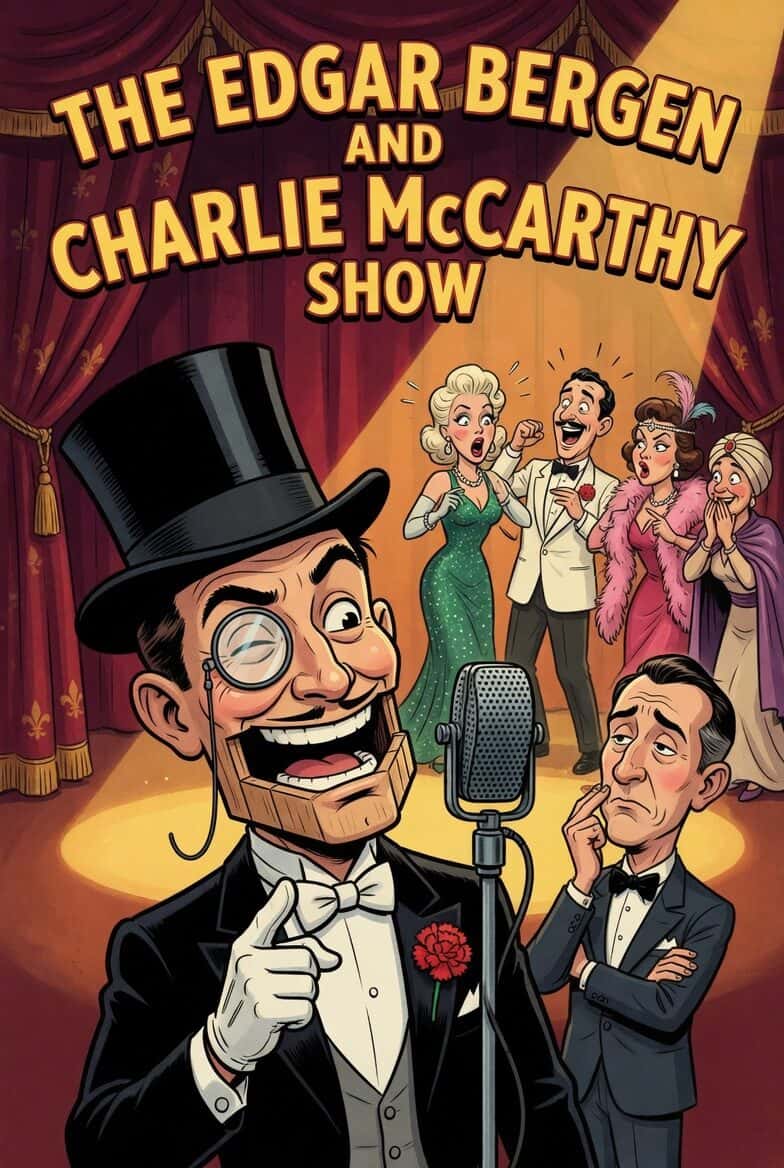
The written record
Read the transcript
Read along with the recording · About 38 min to read
The makers of Chase and Sanborn coffee, the superb blends you know is fresh, present the Chase and Sanborn Hour. And your host, Don Ameche.
This is Don Ameche saying hello for all your Chase and Sanborn friends. Edgar Bergen, Dorothy Lamour, Donald Dickson, Robert Armbruster, and the Chase and Sanborn Orchestra.
Hey, Ameche, how about me?
We extend a very special welcome this evening.
Ameche!
Oh, yes, yes, and Charlie McCarthy. Almost forgot, Charlie.
Yeah, almost forgot, Charlie. How do you like that?
As I said before, we... I'm not at all satisfied with Ameche's working. I don't think he's going to work out. Almost forgot, Charlie. Again, a very special welcome to our very special guests, Kay Francis and Don Luis Alberni.
Notice he didn't forget Kay Francis. You notice that, Charlie?
You're holding up Mr. Ameche.
Who?
Mr. Ameche.
Never heard of him.
We hope you'll all enjoy our show and that throughout the week you'll remain our friends as well as friends of Chase and Sanborn.
You say who?
Ameche. He's a stranger.
He's a stranger, that's all.
Ameche?
Ameche.
Oh, yes, yes, yes, yes. Oh, you mean that bit player we got around here.
Yes.
Oh, I keep him around for odd jobs.
You do?
Yes. He does what I tell him, or else.
Oh, gee. Or else what, McCarthy?
Uh, well, or else I do what you tell me, Mr. Ameche.
All right, then, listen.
Yes, sir.
Dottie and I have an important matter to attend to.
Yes, sir.
It's a song called The Boy Named Lem and a Girl Named Sue.
Yes, sir.
You ready, Dottie?
Let's go.
A boy named Lem and a girl named Sue, they hail from Maine and from Kalamazoo. You laugh at them and the things they do, the boy named Lem and the girl named Sue. May not come from that famous stock that landed here on the Plymouth Rock. But when you meet them, they both come through, this boy named Lem and the girl named Sue. Home sweet home is just a tiny cavern. Things go wrong, but you won't hear us crabbing. Storms may take their little patch of clover. They dig in and start over. There ain't much play and there ain't much fun. But from that cavern may come a son. A future Lincoln or a Washington. Someday you may take, take your hats off too. A boy named Lem and a girl named Sue.
May not come from that famous stock that landed here on the Plymouth Rock. But when you meet them, they both come through, this boy named Lem and the girl named Sue. Home sweet home is just a tiny cavern. Things go wrong, but you won't hear us crabbing. They dig in and start over. There ain't much play and there ain't much fun. But from that cavern may come a son. A future Lincoln or a Washington. Someday you may take, take your hats off too.
Love has proved the inspiration for more than its share of blues songs. But Vincent Youmans saw nothing melancholy in the emotion when he composed the glad rhythm of The One Girl. Nor does Donald Dickson as he sings it. Donald?
Who was right away along a trip when a girl? That's what I go home when I say goodbye. There's smiles and I see me on when I go. Out to the park. And my heart is like boys. Feel as strong as steel in a train.
Well done, Donald. Well done. Don't you think so, Charlie?
Huh?
I say, don't you think so?
Oh, wow. The song was well done.
Oh, the song. Oh, yes, yes. Yes, or do I? Well, don't you?
Yes.
Well, I'd say, I'd say it was adequate, yes.
Adequate, yes.
Adequate, huh?
Yeah.
I suppose you could suggest an improvement, McCarthy.
Oh, which is, uh... Well, yes, I think I could, yes. I think I could. Mr. Dickson, yes.
For instance, what?
Well, I, uh... I felt that you... You had only a superficial interpretation of the song. If I make myself clear. And, uh, I felt that it needed more fortissimo and more crescendo, you know? Or to put it in your language, more schmaltz.
Oh, I love this.
I might have expected such a remark from you.
Well, I'm glad you're not disappointed.
Well, after all, Charlie, I don't tell you how to tell your jokes.
Oh.
But I could.
Yeah.
You could.
Oh, this is delicious.
You can tell jokes. Why don't you tell jokes, then, huh?
Well, I don't tell jokes just out of courtesy to you.
Oh.
You mean out of courtesy to all of us.
Listen, Charlie. I can tell a joke just as well as I can sing.
Yeah?
Oh, now, you're just self-conscious.
Well, now, perhaps Donald is right, Charlie.
Do tell, Bergen.
Yeah.
Yes, I don't think we should jump at any conclusion here.
No?
No. I think we should give him a chance.
Uh-huh.
After all, we've never heard him tell a joke.
No, he's been kind to us, hasn't he?
Well, how about it, Donald?
Oh, sure, Edgar.
Say, Bergen, you realize what you're doing?
What?
If he gets a laugh on this joke, you better brush up on your singing.
Yeah.
Well, here's an amusing anecdote I heard some time ago.
Yes, of course, of course, of course, of course. He gives out with the anecdote stuff.
Well, you might enjoy it.
I doubt it. I doubt it.
Well, stop me if you've heard this before.
Yeah?
It seems there was a Scotchman.
Stop!
Have you heard it?
I've heard enough.
Now, Charlie, I insist that you give him a chance to tell it.
Uh-huh.
Now, Donald, you go right ahead.
Yeah.
Better start from the beginning, Dickson, you know. Get the theme of it, you know. Start over again.
All right, all right. Really, fellas, this'll kill you.
Yes, sure.
It seems there was a Scotchman, a thrifty old Scotchman.
Oh, Ed's living already, huh?
Oh!
Oh, come on. It gets better every time he tells it. Why don't you start over again?
Well, it seems there was a thrifty old Scotchman who got on a tram in London.
That's good. That certainly was good, wasn't it?
That reminds me of a story, a little different, of course.
Well, now, wait a minute. I haven't finished mine yet.
No.
This Scotchman, you see, was carrying a suitcase.
Quite so.
Oh, this is too good. This is just too good. Pardon me. I must call Mr. Niesen over.
Oh, Mr. Niesen?
Yes, yes, Charlie.
Oh, get a load of this. Mr. Dickson is telling a screamingly funny story.
Oh, yeah?
Well, what's it about, Donald?
Oh, it's a side splitter. It's, uh... It's...
You better start from the beginning, Dickson.
Okay, okay. It'll make it better.
Well, it seems there was a thrifty old Scotchman who got on a tram in London with a suitcase.
Oh, that's good. Donnie will have to listen to this.
Oh, Donnie.
Yes, Donnie?
Donnie, you'll want to hear this. Donald is telling a screamingly funny story. It's too funny.
Oh, really?
Yeah, Donnie, you'll want to hear this.
Oh, listen. He'll kill you. Won't he, Charlie?
I don't see why not. He's killed... He's killed a joke already.
Well, let's hear it, Donald.
Yeah, now, go ahead. You better start from the beginning, Dickson.
Well, it seems there was a Scotchman...
He's never sure. He's...
You better go back to anecdote.
How about... Wait a minute. You left out a thrifty old Scotchman.
Oh, yeah. Yeah, yeah. You want to watch that. So, those little things ruin the story, you know.
Well, once there was a thrifty old Scotchman who got on a tram in London with a suitcase.
He's a fair little hamster, Dickson.
What do you think of a joke, Donnie, huh?
I think I'm wanted on the phone. Excuse me, please.
Oh, why don't you listen, fellas? Now it begins to get good.
And high time, too.
Well, this Scotchman sat down and put his suitcase beside him on the seat.
Yeah.
Hey, Meechie, have you been fishing lately?
Yeah, yeah, Charlie. I was...
Oh, biting beautifully. Wonderfully well. I think it's very restful. Isn't that a wonderful thing, to go out fishing? I mean, get all by yourself, away from things.
Oh, nothing to do with fishing.
Oh, excuse me, Don. Excuse me. Go right ahead.
What happened then?
Oh, what happened?
Yeah, what happened to the Scotchman?
Well, the car got crowded. And the lady said, take your suitcase off the seat. I want to sit down.
Yeah.
And the Scotchman said, nay, lassie, that I won't do.
Oh, with dialect, he does that.
Oh, boy.
Oh, did you hear that? Nay, laddie, what kind of a Scotchman have you got there?
Maybe he loved Scotland when it was a...
Well, maybe I'd made a mistake in the dialect.
You made a mistake in telling the story. Why don't you start from the beginning?
Oh, no, you don't. I'll continue.
Yeah.
And now, fellas, comes the punch.
We've been expecting it any day.
This Scotchman was on the street car with his suitcase.
Yeah, sure. Yeah.
I don't want to hurry you, Dickson, but we're only on for an hour.
Well, the Scotchman didn't take his suitcase off the seat.
No.
And then the little cockney conductor came over and said,
Yeah?
I say, you simply must remove your portmanteau.
Oh, is he a limey now?
Oh, he's so clever.
Oh, he's a jolly beggar, that Dickson, isn't he?
Yeah. Go on, old bee. Go on. Get him off.
And then the Scotchman became quite indignant and said,
Oh, fiddlesticks.
Fiddlesticks?
Just a minute. Just a minute, Mr. Dickson. None of that strong language around here, please.
Yes, I quite agree with you, Charlie. Mr. Dickson, will you please remember there are ladies present?
Yes.
What's the matter?
Well, you should certainly confine your anecdotes to parlor stories.
Yes, and we don't mean billiard parlors, either.
Well, what's wrong with fiddlesticks?
Well, Mr. Dickson, in better circles, it's known as violin bows. If you don't think it's asking too much.
All right, now, fellas, all right. Enough's enough.
That's the way. That's the way you feel about it. Why don't you let Donald finish the story? At least let him get to the point of it.
Oh, does it have one?
Yes, of course.
Never mind. Go ahead, Donald.
Yeah, I'd better start from the beginning, Dickson.
No, Donald. After the conductor has asked the Scotchman to remove his suitcase, what happens?
If anything.
Well, the conductor lost his temper. And when the streetcar was going over a bridge, you see, he threw the suitcase into the river.
Too bad the joke wasn't in it.
Now comes the payoff. This is it, fellas.
Dickson, if you were smart, you'd stop now.
But there's more to it.
I don't think I can stand it.
After the conductor threw the suitcase in the river, what do you think the Scotchman did?
I don't know. What did he do?
Yeah.
Well, the Scotchman said, now look what you've done. You've drowned my little boy.
Well?
Well, there you are, you see. You wouldn't listen to us, would you? Go on, finish it.
Well, that's it.
That's it. Maybe it's a little subtler.
Yeah.
Feudal is the word.
All's well that ends.
Yeah.
Well, sometimes I tell jokes better than other times.
Yes.
Well, what's your excuse this time?
Well, you fellas got me mixed up. I'm not myself today.
You're not yourself. Well, whoever you are, you got the best of the bargain.
You know, maybe my sense of humor isn't very good, but somehow I didn't seem to care for that joke much.
Oh, that's all right, Mr. Niesen. Columbus told it to the Indians. And they didn't like it.
Don't you mind them, Donald. I think you deserve a great deal of credit for going through with it in spite of all these interruptions. And I think, Charlie, that an apology is in order.
You think so, Bergen?
Yes, I do.
Very well. So be it. Mr. Dickson, I demand an apology.
What?
I apologize?
Thank you very much. Thank you.
Judging from the response of singers and band leaders all over the country, If I Didn't Care is one of the hit tunes of the day. And judging from Dorothy Lamour's interpretation of it, we think it has good reason to be. Donnie, will you interpret?
If I didn't care More than words can say If I didn't care Would I feel this way If this isn't love Then why do I thrill And why does my head Go round and round While my heart stands still If I didn't care Would it be the same Would my every prayer Begin and end With just your name And would I be sure That this is love Beyond compare Would all this be true If I didn't care
So if your heart's in doubt And worried about Then cast your foolish fancy If I didn't care Would it be the same Would my every prayer Begin and end With just your name And would I be sure That this is love Beyond compare Would all this be true If I didn't care
Stop Hollywood Boulevard. There's a stand that sells out-of-town newspapers. And whenever I can go down there and pick up a good old Kenosha news, it's almost like a trip back home.
Did you ever do that, Donald?
Well, I'm afraid they wouldn't have my hometown paper, Don. I'm from Clairton, Pennsylvania, and the Clairton Progress only comes out once a week. That's on Fridays.
Well, Clairton's near Pittsburgh. You can get Pittsburgh papers.
I could get the New Orleans Item Tribune. I saw it there.
Oh, I do get it. It's great to read about Pittsburgh. People you know. And places you've been to.
Yes, that's what makes local news so interesting. So we're giving each part of the country the Chase and Sanborn news, all about what's happening there. Right now, local announcers are waiting in New York, Chicago, San Francisco, Montreal, Canada, and many other places to tell their listeners about the Chase and Sanborn coffee they like. Gentlemen, the air is yours.
Thanks for the air, Don. This is Bill Spargrove with the news for the East. It's about the Chase and Sanborn dated coffee that comes in the new silver package. All the grocers in this locality have it. And in the short while it's been on the market here, people all over this section have changed to it. When you buy that new silver package, you're getting one of the finest blends of coffee in the world. And it's freshly roasted right near here. Now, that's really important because coffee is like milk or eggs. It can spoil when it gets old. And nobody wants coffee that's stale or rancid tasting. But you don't have to worry about that now. Just buy dated coffee in the new silver package and you know it's fresh. You'll see the date marked right on it. So you can see that your Chase and Sanborn dated coffee was just recently rushed from the roasting oven. And that way, you know you're getting good, fresh, mellow coffee. And that's just what you want, whether you serve hot coffee or iced coffee. Just get that new silver package and you get fresher, richer flavor. And the price has not been raised one single penny. Everybody can afford it. Remember to get some the next time you buy coffee. See if your family doesn't say there's no coffee in the world like Chase and Sanborn dated coffee in the silver package.
It's a safe bet that the new picture in name only, mistress name of Kay Francis. It's always a happy occasion for Chase and Sanborn when Miss Francis pays us a visit. And she's here this evening to appear with me in Designing Woman, a play by Adelaide Heilbron. We present Miss Kay Francis as the Designing Woman.
The place is New York. The time, 10 o'clock of a bright spring morning. The scene is a small but smart interior decorating shop. Helen Rogers is busily engaged on the telephone trying to convince a client that interior decorators do know something about interior decorating.
Yes, I know, Mrs. Martin. But personally, I wouldn't advise it. I was so anxious. Well, I suppose I have such definite ideas about it because that little type of little white Connecticut farmhouse is a sort of dream of mine. With all the simple, homey things it suggests. Like cinnamon pinks in the garden and one maid in the kitchen and getting Sunday night suppers together yourselves. And open fires and tea and twin. Oh, I'm sure that I must sound awfully sappy, but... Oh, Mrs. Martin, may I call you back? A customer's just come in and... Thank you.
Good morning. Is there something... Phil. Why, Helen. This is uncanny. I was just thinking about you. Something that came up over the phone.
Well, I was thinking about you, too. I drove across 56th, and it might have been last May. That same hurdy-gurdy was playing on the corner and Nick's painting his shoe stand orange again. The door at your apartment house is still two sizes too big for a summer uniform. And they're hyacinth in your window boxes.
But I've moved. And I make it a point to avoid 56th.
Do you hate remembering?
I'm not too keen about it. We made such a beautiful mess of things.
Oh, but that's dimmed past. When did you get back, and how do you happen to come in here? Not with any idea of finding me, certainly.
You were just as flabbergasted as I was.
No, I couldn't believe it. You see, I just docked a couple of days ago, and I happened to ask someone on the boat about a decorator, and they recommended this place. I, uh, think they said, uh, Mrs. Clark. She owns the shop.
I'm working for her.
Oh. But, Phil, Phil, isn't it really an amazing coincidence?
Yes, isn't it? Such a jolt for you. I suppose you've been booing yourself up all the way home on that boat by the thought that New York is a mighty big place.
Oh, now, don't be crazy. I'm delighted to see you. Gee, you look... Swell, Helen. And just the same. After six whole months.
Seven whole months?
It's six months, Helen.
Oh, Phil. Now, Phil, let's not start arguing the first moment we see each other. After seven months.
My dear girl, is this May or isn't it?
Of course it's May. Isn't New York fun in May? And sun-washed and sparkling blue and the flowers in the park? And didn't I sail in November?
You certainly did. The 14th.
The 15th?
Phil, I just happened to know that you sailed the day after... After the... big buster. After we decided to call off our engagement by mutual consent.
Yeah, that's what the paper said. And you said the same thing, less elegantly.
Oh, but we couldn't have gone on.
No, not at the pace we were going, certainly. The whole trouble was... Phil, let's not. Not now, anyway. After all, you came here on business, and I'm tending shop.
Are you good at it?
I'm going to be. I'm what is known as starting at the bottom of the ladder.
Well, then I've got a job for you. Want that boost you up a rung or two?
If it's an important job, what are you going to have done, Phil? Another magnificent bachelor apartment?
A house. I haven't really made any plans for it. I went through it for the first time yesterday. I bought it from pictures I had sent to me abroad. But I do want to get it finished in a hurry.
But, Phil, if you've bought a house, does that mean... Oh, I mean, I suppose that means that... Well, that means that you're going to be married.
That's right.
Oh, Phil. Oh, Phil, how exciting. Oh, I'm so happy for you. Oh, dear. Don't I sound exactly like an ex-fiance in a book?
Well, it would be more originally and definitely more recently. It would be more flattering to me if you'd act a bit depressed.
All right. I'll see if I can stir up a pang or two.
You don't look as though you were succeeding. But I'm much too curious about the girl. Do I know her?
No, I don't think so, Helen. I met her in Paris. She's living there with her mother. Her name is Nancy Shane.
Oh, what a nice name. Have you a picture in your wallet?
No, no. Nancy's camera shy. And anyway, snapshots never do anybody justice. She's about five feet three. Tiny little thing. Blue eyes and sort of golden hair.
Yes, I see. She's very sweet, Helen. But more than anything else, she's sane. You know, both feet on the ground. Now, it was so consistently our nightclub dance floors.
Yeah, that's what I meant about the pace we went. That kind of life, sophisticated or whatever you call it, it's amusing enough, but it's not real.
You know, I think it's remarkable, Helen, that you stuck at a job. But I suppose now, you're burning the candle at both ends.
Oh, yes, indeed. A butterfly at night and a walking girl by day. But when I work, I work. My job now comes first.
Well, then how about clapping on a hat and casting your professional eye over my house? I got the key from the agent. I got a car outside.
Oh, I think you'd better wait for Mrs. Clark to do that, Phil. She's the boss, you know. And besides, I... Well, I... I don't know Nancy or her taste.
Well, neither does Mrs. Clark. Come on, Long.
Unless... What?
Well, it just occurred to me that I was going to be a lawyer. Perhaps you'd rather not because of... Well, you know.
Oh, nonsense. Well, I think that angle would be most amusing. Ex-love designs home for new. In fact, it's so amusing that I can't say no. Wait till I put on this hat.
Gee, it's a knockout hat, Helen.
Thanks. Now, purse and gloves.
You better take your coat along. Here, I got it for you.
Will I need it?
Well, it's kind of a long drive and... Where is your old house anyway?
Well, it's up in Connecticut. I... What's the matter?
Oh, I... Nothing. I just dropped a glove. Oh, there we are. Come on. I haven't all day, you know.
Phil, take it easy. In case you haven't noticed, this is a dirt road.
Yeah, but it's a beautiful country, isn't it, Helen?
Well, if you'd slow down a bit, I might get a chance to enjoy it. Will you look up at those trees? Will you look at those bumps?
Why are we stopping here?
Because this is it.
Phil, you don't mean that this is the house you've bought?
Oh, it certainly is. What's the matter with it?
Well, I don't suppose there's anything actually the matter with it. In fact, it's a very nice little white farmhouse, if you happen to like little white farmhouses.
Well, if you don't, Helen, perhaps I'd better get someone else to decorate it.
Oh, just as you wish, of course. Since I've taken the time to come up, I would like to get a look at the inside. So you can get off more cracks?
Why should they upset you? I'm sure Nancy will adore it. She sounds the type. And for anyone who likes a place of this kind, why, it's perfect. All the touches. The elms and the wells and the old-fashioned flowers. Even cinnamon pinks. Come on, Phil, take me in. I'm on my mettle now, and I'll do my best to make a swell suggestion.
Okay, then. Now, where is the key? Now, here. There we are. Hmm. And is this the house? Key works, front door opens, and everything.
Well, here's the living room.
Oh, Phil. Phil, this is nice. Those beautiful old beams.
Yeah.
That fireplace is a dream. It's easy enough for anybody to see what to do here. Uh, antique furniture and organdy curtains, chintz-covered Davenports, a spinet if possible, and mostly firelight and candles.
Oh, it sounds swell. Uh, come on through this way, will you? That's the kitchen, of course. And, uh, lay off the old-fashioned stuff here, will you, Helen? I want everything ultra-modern in this kitchen.
Well, is she going to do her own work?
No, we'll have one maid. But Sunday evenings, we'll whip up supper together ourselves.
Uh, let's go up these back stairs here. Hmm?
It's steep. A bit.
Well, here we are.
Oh, it's a cute little hall. And this is what I believe is known to the trade as the master bedroom.
Don't you think a really old four-poster bed would look kind of nice in here?
Yes. Where does that door lead?
To my favorite room.
Oh. Oh, it's lovely, Phil. It's so full of sun and windows. What will you use this for?
I'll give you three guesses.
You forget how quick I am. It'll make a perfect... nursery.
Phil, I should have put my coat in the car.
Why, have you caught cold?
A little, I think. I seem to have lost my handkerchief.
As usual. Here, here's one.
Thanks, thanks. Say, by Jove, you have caught cold, Helen. The mean, weepy kind, too. Oh, it's doing awful smudgy things to your mascara. Here, let me take that handkerchief.
No, please, Phil.
Wipe away those beautiful, unnecessary tears.
Oh, don't cry, honey.
I'm not crying, it's a cold.
Oh, darling, you.
Phil, Phil, darling. Darling, we mustn't think of Nancy.
Well, that gets harder every minute.
But won't it break her heart?
No, she won't mind at all.
But, Phil, I don't understand. Aren't you in love with Nancy?
Nope.
Well, then, why were you going to marry her?
I wasn't.
But you said that...
I know. Hell of a thing. Nancy doesn't exist. I invented her. I made her up.
Made her up?
That's right. I had to do something to get you back again.
Oh, darling. What fools, Phil. Oh, just terrible. Will you think of the time we've wasted? Seven whole months.
Six months, Helen.
It's seven.
Yes, Phil. Six whole months.
This is Don Ameche and the Chase and Sanborn Hour continues. There have been few composers in this country whose songs lay as close to the heart of the people...
as those of Victor Herbert. Donald Dickson sings one of his most beautiful ballads and one that Victor Herbert himself seemed particularly fond of. Rose of the World.
Stand around. Oh, the salt and gold. The first ball.
A thousand comedy scenes in the movies. Luis Alberni comes to us, an unappreciated but uninhibited musician. The self-appointed representative of the South American continent and, by his own word, a music critic of no mean proportions. It is a pleasure and an honor to extend the hand of Pan-American friendship to Señor Don Luis Alberni.
Gracias, gracias, Señor Ameche. Gracias. Thank you so much. I am delighted to be here. You know, I am very much impressed by everything I have seen in this wonderful country of yours. The people, so kind, so courteous, so... the buildings, so tall, so lanky. And the American girls—
In your office usually have a word for the American girls.
Ah, yes. The American girls, so...
Yes, so-so. So you think American women are just so-so, do you?
Ah, Señorita Lamour, es usted una flor radiante de primavera. Primavera, that means spring.
I repeat, so you think American women are just so-so.
Ah, Señorita Lamour, you arrived just in time. This is incredible. What a happy coincidence. I have just changed my mind.
Changed your mind?
Yes.
I'm sure you're not flattering yourself, maestro.
Ah, pardon me for interrupting this little tête-à-tête, but as a conductor, Señor, tell me, what do you think of our American music?
If you'll excuse me, please, Señor Ameche, I try not to think of it.
Well, I'm sorry to hear that, and sorry I asked.
Well, music, Señor Ameche, is not for thinking. Music is for feeling. Music comes not from the brains. Music comes from the heart. I don't want to think about music. I just want to... I don't want to lie down in it.
Well, that's different. I thought you meant you... you didn't like—
Ah, take a... take a Miss Lamour. You think she sings? Never. She's a singer. With her, everything is from the heart. She has the note of a nightingale, the trill of the canary, the throat of the thrush, the brains of a sparrow, and she's a... she's a like a beautiful bird, that Señor Dickson.
Oh, yeah. He's a bird, too, that Dickson. Dicky Bird, we call him.
He, too, is a bird. Dicky Bird. Who's a great singer? All voice. All emotion. No brains. Just like me. That's how I like it.
Well, our IQ rating seems to be just about 100% so far.
Oh, it is. It is. This is a marvelous show you have here. It is perfect.
Oh, do you really think so?
Oh, gee. Absolutely. It is great. It is magnificent. Yes. It is terrific. It is stupendous. It is not too bad.
Oh, I take it you think there's something that might be improved, huh?
No, no, no, no. The entire program is perfect.
Well, when you said it wasn't bad, it was perfect.
It was perfect. It was perfect. It was perfect. It was perfect.
Well, when you said it wasn't bad, I thought—
Don't interrupt. It is perfect.
Well, thank you.
Except...
Yes?
Well, wait a minute. Wait a minute. I am beginning to visible the whole thing. There is going to be a lot of changes around here if I can help it. Everything is going to be differential.
Well, what's the first thing that's going to be differential?
First, that man who conducts the orchestra. Take that little stick away from me. Give him... get him a bigger one. Get him a club. Then maybe the musicians, they play together. They should make it anonymous.
Uh, you mean unanimous?
The way they play, I mean anonymous.
Well, now, wait a minute. I won't have you saying anything against Armbruster.
Oh, I like Armbruster. I think he's positively insignificant.
And his orchestra?
It is a marvelous orchestra. Marvelous.
Oh, well, that's better then.
Each orchestra has its own style.
Well, I like Armbruster. I like Armbruster. I like Armbruster. I like Armbruster. I like Armbruster. I like Armbruster. I like Armbruster. I like Armbruster. I like Armbruster. I like Armbruster.
It is a marvelous orchestra. Marvelous.
Oh, well, that's better then.
It just sounds terrible. That's all.
Well, that's very kind of you. That's positively insignificant.
Exactly. They don't play together. I watch them. Why? Well, the man with the piccolo is playing. Then the man with the big horn, he's playing. Why they don't get together? This is no time for different opinions. Let them fight. Let them fight. Let them fight. Let them fight. Let them fight. Let them fight. Let them fight. Let them fight. Let them fight. Let them fight. Let them fight. Let them fight.
Fight them later! Outside.
Well, if that's the way they play, that's the way Armbruster wrote it down.
I'm that good for nothing with the cymbals. I have my eye on him. I have my two eyes on him. He wasn't playing half the time.
Yeah, but he wasn't supposed to. That's the way the orchestration was written.
Orchestration fiddlesticks. El señor no toca una nota. What are we paying him for? If he doesn't want to work, there are plenty of cymbal knockers who do. You! Hey! Turn in your cymbals!
That man!
Now look here, you can't do that.
What we got there? Musicians or loafers? You, with that horn. There. Blow to me something.
Now look, Alberni, you can't treat these men like this. Most everybody give me arguments. You, blow! You can stay, but you are on probation. Signor Ameche, I want that piano tuned. Get somebody right away.
But it's been tuned. They tune these pianos every—
Don't interrupt! Tune it. It's as sour as pickles. If there is one thing I can't stand, it's sour pickles. I hate pickles.
Yeah, well, is there any other little thing that doesn't suit you?
Yes, Signor Ameche. We have got to have more room here. Look at those violin players. They're rubbing elbows. No wonder we only get pixie cackles. Now, you men, move back. Spread out. Let's have a little room. A little elbow room.
Alberni, will you listen to me? They can't spread out. There isn't space.
Then we tear out something. Two seats. Get a hammer. We have got to have room. We make room. Give me a hammer.
Now, look here. This has gone just about far enough.
Give me a hammer. I want a hammer. Signor Ameche, it is too much to ask for a simple little hammer. Other people have hammers. Little boys only seven and eight years old, they have hammers. You hear?
I... Signor, you shall have the hammer. Here.
Señorita Lamour, Primavera.
Of all the songs Irving Berlin has written, there's one that's always on the tip of your tongue, ready to be sung at a moment's notice. I, for one, sing it whenever I get a chance. It's—
A Pretty Girl is Like a Melody.
...for music, and I have an eye for a maid. I like a pretty girlie with each pretty tune that's played. They go together. Like sunny weather, goes with the month of May. I've studied girls and music, so I'm qualified to say. It's like a melody that haunts you night and day. A strain of a haunting refrain. She'll start upon a marathon and run around your brain. She's in your memory and morning again. A pretty girl is just like a pretty tune. A pretty girl is like a pretty tune.
Very good, Mr. Meachie. Very good.
Well, that's that.
Well, I felt that something should be said there. And it always makes him happy.
Oh, Charlie.
Oh, yes, Miss Frances.
Charlie, how did you like the little sketch that Don and I did?
Oh, you were very convincing as a decorator, Miss Frances.
Thank you, Charlie.
Yes, yes. I was going to rewrite it, but for me to add any touches would only be, well, gilding the cauliflower, as we say, you know.
You know, Charlie, I wish I had a little more talent as a decorator. I could use it.
Oh, I don't know. I think your clothes are very attractive.
I don't mean that. I'm thinking of buying a beach.
A beach home?
Yes. By the ocean.
Oh, that's a good place for it, isn't it? I thought so. Yeah.
Well, why don't you buy it then?
Well, I don't know whether I can afford to spend the money.
Yeah. Oh. That sounds like burgers. I bet you got a nice little nest egg salted away.
Yeah. It isn't just the expense of buying it, Charlie.
No. The place I'm thinking of will have to be all done over.
Does that sort of thing make you happy?
Yes, it does, Charlie. There's nothing like a little home at the beach.
Oh, I don't know. Take the ocean away and what have you got?
Well, what have you got, Charlie?
Well, I don't know. It's just no way of looking at it. I don't think I'll bother about that. The main thing is how to decorate the house.
Well, now, there I can help you. I can really help you out because I helped Bergen.
You did?
Yes, I did, yes. Yes, we started out with nothing but an ugly little shack. And we worked it up to something truly repulsive.
Yes, yes, I can understand that.
Yes, ma'am, I am an inferior desecrator. Of no artistic leanings. I mean, of no mean ability. I don't know what I mean.
Well, then perhaps I could use you, Charlie.
Well, will you give me what I'm worth?
I'll do better than that.
Yeah?
I may even give you a small salary.
Yeah. I'll think that crack out later on.
Understand, Charlie, the job has to be done quickly.
Yes. After all, I want to get out there this summer.
Uh-huh. I'll have you in and out of there in a week.
Oh, Beth.
Now, what period would you suggest for a beach hole?
Well, now, let's see. How about clean Victoria?
That's no good, Charlie.
Why, because I thought of it?
No, it's just no good.
Well, I guess that's reason enough, then.
You see, I planned on doing the upstairs in early American.
I see. But I have two bird's-eye maple chairs that I'm keeping just for sentiment.
Oh, I see. I can just see sentiment sitting on bird's-eye maple chairs.
But, you see, Charlie, I have nothing to go with them.
Oh, that's disgusting, isn't it?
You say they're bird's-eye maple, huh?
Mm-hmm. Bird's-eye maple. Let's see. Well, how about a dresser of cross-eyed mahogany?
No, no. No, no, that won't do.
Just a suggestion.
Well, that's all right. All right.
Now, let's see. For the floor, I have a beautiful hand-hooked rug.
A hooked rug?
Mm-hmm.
That's all.
Oh. See, I know where I can snitch a paintbrush.
What do you think?
Charlie. I'm a willing worker.
Well, I don't want anything unless it fits in with my scheme of early American.
I see. I'm grasping the idea. It must be early American, huh?
Yes.
I see. Might I suggest a stuffed Indian?
Different.
No. That's a little too early.
Oh, you're too finicky.
Oh, maybe, maybe, maybe. Now, I'd like to talk to you about the downstairs suite.
Would you, dear?
Well, go ahead. Wow.
The room is Louis Quatorze.
Cato's, huh? Is he boarding there?
No, Charlie. No. But the furniture is Louis Quatorze.
Oh, I see. You're just renting it from him.
No, I'm not renting it.
Oh, he gave it to you?
No.
You mean the stuff is hot?
No, it's not now.
Well, that's all there's left.
Oh, well, let it go at that. I'll drop it.
But you should see the beautiful 18th century whatnot I picked up.
Uh, what, what, what, what?
Whatnot.
Whatnot, yeah. Whatnot. Whatnot. Whatnot. Whatnot. Whatnot. Whatnot. Whatnot.
Let's find an example of genuine wormwood.
What's wormwood?
Well, you see, Charlie, there are holes in the wood, actually made by worms.
That's good, isn't it, huh?
Yes, yes. I picked it up at an auction. Only $4,000.
Yeah. Hmm? Only $4,000? Gee, I bet that made the worms laugh.
And just to think that there was another whatnot almost exactly like it, and that one was only $200.
One was $4,000, and the other was $200.
That's right. But you bought the one for $4,000, huh?
Yes, I did.
Uh-huh. You sure drive a hard bargain, don't you? Why didn't you buy the cheaper one?
What's the difference?
Well, the cheaper one was an imitation.
Oh. The worm holes were made by man.
Yeah. Do you mean to say that men work cheaper than worms?
You just won't understand. That's all.
I'm afraid not. What are you going to do with this, uh, this thing, this, uh, worm-eating pomquat?
It's a whatnot.
It's a whatnot. It's a whatnot. It's a whatnot. It's a whatnot. It's a whatnot. It's a whatnot. It's a whatnot. It's a whatnot. It's a whatnot. It's a whatnot.
It's a what now?
Oh, so what? A what now? I'm not going to do anything with it.
Oh, I don't know. No. I see. It's invaluable.
I suppose so. Well, I'm almost afraid to touch it.
I mean, the worms might snap at you.
Oh, well, I can see that Edgar hasn't any furniture with worm holes in it.
No, but he's got a velvet hanging with moth holes in it.
Oh, he has, has he?
Oh, yes. Very rare, too, yes. Say, now, that might look good in your beach home.
Yeah, it's a lovely thing.
Yeah. Yes, it is. Yeah, part of it's silk and the rest of it is velvet, you see. And I can let you have it for a measly $500.
$500?
Yeah.
How much of it is velvet?
About 450 bucks of that. Just as I thought.
Well, will you give me $400?
No.
Well, I'll take a loss. I'll let you have it for $200.
No.
Well, you give me 15 cents so I can go to the movies later on.
I'll give you a quarter if you'll go now.
Sold, Miss Frances. It's a pleasure to do business with you. Thank you. Thank you. Thank you.
Bob Armbruster, you were born in Philadelphia, is that right?
That's right, Don.
Edgar Bergen, you're from Chicago and Decatur, Illinois. Dorothy Lamour from New Orleans. Well, each of those localities has its own special news about Chase and Sanborn Coffee, broadcast from local stations and networks. Well, what's the word from Philadelphia?
I'm a native son. I'm entitled to know.
I'll tell you privately, Bob, later on. But right now, most of the people here in Hollywood want the West Coast news. And your friend in Philadelphia will hear the Eastern news. In every section, one of our people is ready to tell his listener what's happening in their own neighborhood. So here is the local news for each section. We give it now.
Okay, Don. And in this vicinity, the news is about the Chase and Sanborn dated coffee that comes in the new silver package. Maybe you've seen that new package shining on your grocer's shelves. It's new around here, and yet thousands of people have already tried it. And wherever you go, you'll hear how good it is. Try it yourself. It's marvelous coffee. You'll wonder where all that rich flavor comes from. And the answer is, straight from the roasting ovens. And you can tell it just came from there because every package is dated. To show you the difference, you'll have to go to the grocery store.
Every package is dated to show you the day your grocer got it freshly roasted. I guess you know why freshness is so important. It's because coffee can spoil. It's apt to take on a rancid bitter taste unless it's freshly roasted. You want fresh coffee and a fine blend too, and that's what's inside the new silver package. The price has not gone up. You don't pay a penny more for Chase and Sanborn dated coffee in the silver package, so it's really a great value. Try it hot and then try it iced. When you taste that flavor, you'll see why so many people use it instead of any other coffee in the world.
Donald Dixon sings the lovely Neapolitan song.
So we come to the end of another Chase and Sanborn Hour, an hour made possible by your purchases of Chase and Sanborn coffee. That's the best way of telling us you enjoy our show. We'll all be back next week. Edgar Bergen and Charlie McCarthy, Dorothy Lamour, Donald Dixon and Robert Armbruster and the Chase and Sanborn Orchestra. Our special guests will be Josephine Hutchinson and Mischa. Until then, this is yours sincerely, Don Ameche.
Say, when you visit the New York World's Fair or the San Francisco Golden Gate Exposition, be sure to enjoy the special attractions provided by Chase and Sanborn. A week from today, Sunday, August 6th, is a very special day at the San Francisco Exposition, Food Industries Day. It's a gala celebration with special events all day long. Plan to be there if you possibly can. Next week, another big Chase and Sanborn Hour. Josephine Hutchinson, Mischa, our Don Ameche, Edgar Bergen, Charlie, Dorothy Lamour, Donald Dixon and Robert Armbruster and the Chase and Sanborn Orchestra. Heard on this program, "A Boy Named Lem" from Yokel Boy, "A Pretty Girl Is Like a Melody" from Ziegfeld Follies, "The One Girl" from Rainbow, and "The Big Show" by Jerome Kern.
This is Jim Bannon speaking for the makers of Chase and Sanborn coffee.
This is the National Broadcasting Company.