
The written record
Read the transcript
Read along with the recording · About 32 min to read
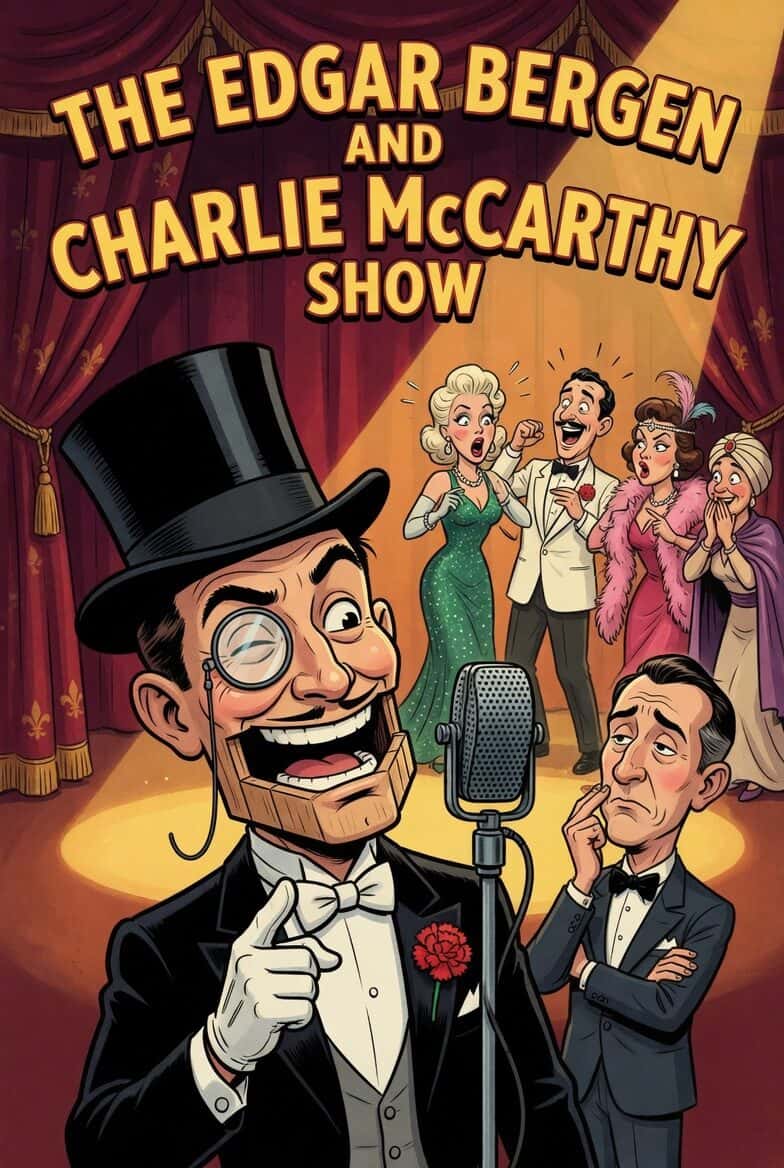
From Hollywood, it's the new Edgar Bergen Hour with Charlie McCarthy.
I'll clip you, say, help me, Bergen, I'll mow you down.
It's Sunday night, and time again transcribed for Edgar Bergen and Charlie McCarthy with Mortimer Snerd, Effie Klinker, Rudy Vallee, Carol Richards, Ray Noble, Jack Kirkwood, the Mellow Men, yours truly, John Heaston, and our special guest, cattleman, Tad Sanders. And here they are now, Edgar Bergen and Charlie McCarthy.
Charlie.
Say, Bergy, what have you got there under your arm?
Oh, that's a book.
Oh, a book, yes. Oh, you're back to reading again.
No, no. It's the story of Oliver Twist. You know Oliver Twist, don't you?
Know him? Yes. I'm the guy that straightened him out.
Oh, you are? Well, this is by Charles Dickens. Would you like to hear the story?
Well, I, uh, I, uh, no. No.
I shall tell it.
I figured you would.
Once upon a time, there was a little boy by the name of Oliver Twist, and how the boy got this name of Oliver Twist is very interesting. His mother was a pretzel.
No, no, no. Oliver was an orphan born in a workhouse. He was given this name by the beadle of the town, a Mr. Bumble.
Oh, Bumble Beetle, the bagel vendor. Oh.
Now, Mr. Bumble named the orphan children in the alphabetical order.
Oh, did he?
Yes. Yes. When he was born, Bumble had just reached the T's.
Uh, the D-T's.
No, no. The letter T.
Oh, the letter T.
Yes. The boy ahead of him was named after S, or Scubble.
That's a nice name.
Yes. And Oliver was named after T, or Twist.
Uh-huh. Yes. Now, following T, of course, the next boy will be named after U.
Yes. How did I get mixed up in this?
The letter U.
Oh, that's better.
Yes. Anyway, his name was Oliver Twist.
Yes. He grew up to be a corkscrew.
No, no. The authorities at the workhouse offered five pounds to anyone who would claim Oliver. So, finally, he was given into the custody of an undertaker.
Because he dug him the most.
All right. Yeah. And so, Oliver became an apprentice to Mr. Sowerberry.
Well, how much did he make working for old man Sourpuss?
No, not Sourpuss. Sowerberry.
Yes. Well, he didn't get any salary. Only his room and scraps of food for his board.
Uh, this is beginning to sound more and more like the life story of Charlie McCarthy.
Well, as a matter of fact, the undertaker really didn't give Oliver much of a room either.
Oh, you mean it was more of a hole?
No, it wasn't a hole. No, he made Oliver sleep in the shed in back there. Yes, where he kept the coffins and the gravestones.
Oh. Gruesome. Gruesome. Gruesome. Gruesome. Gruesome. Isn't it?
Yeah. You mean the story or the way you tell it?
No, no. Anyway, a bully by the name of Fagin.
Fagin? Yeah. Fagin was a conniving character.
Yeah. Yes. A despicable person who, for his own personal gains, would force young boys to make a living for him.
Did you say his name was Fagin or Bergen?
Oh. Oh. Fagin taught these boys how to pick pockets. And steal handkerchiefs.
Oh, I get it. He wanted them to grab the money and blow.
Yeah, that's it. Oliver refused to pick pockets. And because he was seen in the company of these boys, he was arrested.
Uh-huh. I hear Oliver's story was that he wasn't picking pockets.
That's right. He was just making change.
All right. Oliver was finally released. But one day, he got in the car. And he was in the clutches of Fagin again. One night, Fagin sent two of his henchmen to rob Mrs. Maylie's house.
Oh, now we have Mrs. Maylie with us.
Yeah. They took Oliver with them because, you see, they needed a boy, a little boy, to small through a crawl window.
What? I mean... Crawl through a small window.
Yeah. Yeah. I think you got Oliver twisted.
Yes, I did. Yeah. However... And in spite of... Yes. The burglars were discovered, and Oliver was shot halfway through the window.
That's a very painful spot.
Yes. Poor Oliver was badly hurt. Then Bill Sikes...
Bill Sikes? How did he get in?
Yes. He's one of the gang.
Oh, well, who isn't?
Yeah, yeah. Bill Sikes carried him out and left him on the roadside.
Yeah. And he decided to die.
Yeah. But Oliver didn't die.
Stubborn kid, I mean.
Yeah. I guess he didn't want to give any of that business to that mean old undertaker.
Well, the next morning, Oliver crawled back to the house of Mrs. Maylie and robbed it again.
No. No, he crawled back to explain what had happened. And what do you think happened?
He got shot in the other window.
Really? Really? I just like to heckle.
Yeah. So, um, as I was saying, uh, uh, Oliver just knocked on the door.
Yeah? Yes, he walked up to the house and he knocked at the door. And it fell in.
No, no. Mrs. Maylie opened it and said, uh, We got a vacuum cleaner, Sonny.
No, no. You keep on interrupting me and I may not finish this story.
That's the best news we've had tonight.
Yeah. Anyway, Oliver was forgiven and finally Fagin's gang was put in jail and the boy's identity was established.
What boy?
What boy? Yes. The boy I've been telling you about.
Oh, that one.
Yes. What was his name?
What was his name? Yes. Oliver.
Oh. Oliver who?
Oliver Twist.
Oh, Oliver Twist. Oh, yes. What did he do?
All right. I wouldn't brag about that. I'm ashamed of you. You're probably the only one in this whole studio who has never heard of Oliver Twist.
Oh, I don't know about that. You don't have to insinuate that I'm so dumb, Bergen. How about Ray or Ray Noble?
Yes, Charlie. Do you know Oliver Twist?
In what key?
There you are. And here is lovely Carol Richards singing her latest Victor recording, Little Mistakes.
Here's the portion of our program that appeals to the aesthetic senses, our Poet's Corner. And tonight we are highly honored in having as our guest speaker the Poet Laureate of the Sheriff's Honor Farm, Professor William Fosdick Kirkwood.
Good evening, Professor.
Good evening. I'm sorry I'm late, but I was poring over some of Shakespeare's sonnets.
Yes. And I think I poured one too many.
Oh, that's nice. Oh, I liked it.
Yes. But I'm glad you did arrive, Professor, because Ray Noble has written a poem that he wanted to read to you.
Yes, that's right, old boy. I call it, you know, the infinity of nothingness.
I stand on life's threshold unafraid. Whence goeth I, a handsome young blade? What long roads will I have to travel? Will they be steep, uphill, or lavel?
Ooh. Steady, stomach steady. What was your inspiration for that one? A migraine headache?
Do you think he should have his poetic license revoked on that last lavel?
Perhaps you could give Ray a little critique on his poem.
Well, in my opinion, I feel that his versification was weak.
Yeah? His use of the dactylic forefoot, an amphibrachic couplet, faulty, and his iambic pentameter. And polyrhythmic alliteration, intrinsically fragmentary.
Well, in other words...
It was a stinker, boy.
Now, let's be frank about this, Noble. What do you think of your verse?
Well, I'd say it stands a good chance.
Oh, no. Oh, don't you get it? I mean, verse stands a... Oh, that's a British joke.
Oh, yeah. Well, uh... And you sure did... Piccadilly.
Oh. Now he's got me doing it.
Please, please, yes, sir. Right now, we'd better get back to you, Professor Kirkwood. Many of our listeners have written in asking about your background before you became a poet. Could you oblige us?
Yeah, well, for a long time, I was a traveling salesman. But then I came out to California, and I got a very important position.
Oh, a really important job.
Yes, indeed.
Good. I was a lifeguard in a car wash.
I... Would you drag that past again? I think we lost you on the turn there.
It's all right. It doesn't make any difference. I was fired on the second day.
I see. What happened?
Well, I turned my head for a second, and an M.G. drowned.
Ah. And then what did you do for a livelihood, Professor?
Well, then I turned to my present work. I am an artist.
I see. You paint.
Well, not exactly.
Hmm. I draw bicycles on three-cent stamps and sell them as special delivery.
I said that's illegal and dishonest. Why, that's as bad as stealing.
It's easier for you to talk. You've got it a lot softer than I have.
What do you mean I got it a lot softer?
You've got a sponsor. I've got to steal from everybody.
Oh, I see. Shall we get on? Another question for many of our listeners. One of our listeners have been asking, Professor, is what are the titles of some of the poetic masterpieces that you have written?
Oh, well, I've written so many.
Yes, I believe. Let's see. There was, uh, Ah, Life, Without It, You're Dead.
Yes. Remarkable, remarkable. Then there was You and Me on a Heap of Debris.
Remarkable, remarkable. Remarkable, remarkable. Remarkable, remarkable.
But then, then there's my favorite, which I dedicated to my wife. In your Easter bonnet, you're a beautiful sight. Too bad you look like Horace Heidt.
Sounds very touching, very touching. Now, which of your lyrical creations are you going to honor us with tonight, Professor?
Well, I have just finished my latest poetic work. It's entitled Ode to a Memory.
Oh, yes.
I found them in a book last night, these withered violets, a token of that early love that no man ever forgets. Pressed carefully between the leaves, they keep their color still. I cannot look at them today without an old-time thrill. Ah, me! What tricks does memory play? The passing years have fled, and hopes that lived in, and vigor once, alas, have long been dead. And this is all that I can say when all is said and done. These flowers remind me of a wonderful girl. I wish I knew which one.
Ladies and gentlemen, every once in a while, a bright new young performer comes along who seems to have the potentialities of reaching stardom. And I feel this may be the case for the young man I'm going to introduce to you, tonight. He has the personality, looks, and voice to hit the big time. But we'll let you, our audience, be the judge. I'd like to present Rudy Whistler.
Thank you, Mr. Rudy. And what are you going to sing for us tonight, Rudy?
Don't take your love from me.
That's a beautiful song, Rudy, and the microphone is yours.
Take a sigh out the sky. It feels blue. Tear a petal from a rose. And blue.
Why do you have that string tied to your finger here?
Oh, let's see. I guess maybe I got a loose finger.
No, no. It must be there to remind you of something.
Yeah, I think you're right. Yeah, what does it remind you of?
Oh, more string?
No, no. It's to do something, I'm sure.
Yeah, that's right. Let's see. Oh, yeah, now it comes to me.
What is it?
I've got to rememberize a poem for school.
Oh, that's it?
Yeah. Oh, a poem.
Yeah, you know, I've got to have it, yeah.
You have to learn this poem by heart?
No, by Friday.
By Friday. Oh, ho, ho, ho. I see. And how are you doing?
Well, I've learned half the poem already.
Oh, that's good, yeah. That's pretty good, yeah.
Except for one thing.
What's that?
I can't remember which half.
Oh, I see. And maybe I can help you. What's the name of the poem?
Well, that's in the first half that I can't remember.
Well, if it's for school, it's probably a nursery rhyme.
Yeah, oh, yeah, probably is.
Imagine that, yo. Yeah, that's the way it goes.
Guess what it is, yo.
Mary had a little lamb.
Well, congratulations. Boy or a girl?
No, no, no, no. Maybe it's a hickory dickory dock.
Hmm? Hmm? Hickory dickory dock.
Yo, how about that?
Yeah. Well, is it Tom Tom the Piper's son?
Yo, yo, that's the one. That's the one I'm supposed to learn. That's the one. Yo, yo.
Well, let me see how much of it you know, then.
All right. Let's hear the first line.
Yo, let's... I'm waiting.
Oh, you're waiting, yeah. Oh, you mind if I wait with you?
No. I'm waiting for you.
Oh, yes. You read the first line.
Oh, let's see. Well, let's see the first line. The first line, huh?
Yes. Whereabouts in the poem is that likely to come?
Suppose I start you off.
Okay, that'll help, yes.
Tom Tom.
Hmm? Tom Tom.
Yo. Yeah. Tom Tom.
Yo. You stuck already?
No, no. You go on from there.
Oh, you want me to take it?
Yeah. Oh, see, Tom Tom.
That's right. Yo, Tom Tom.
There's a lot of cackling out there to know.
Tom Tom. That's right. Oh, see. Tom Tom Tom Tom. Tom Tom Tom Tom Tom. Those darn drums are driving me crazy. The boy's name is Tom Tom. Oh, they're twins. No. No, they're not twins. It's just one person. Oh, I got it. With two heads. No, no. The first line is Tom Tom the Piper's son. Yo. Yeah. Now, what's next? Gosh, you mean there's more? Yes. The next line is Tom Tom the Piper's son. He stole what? Oh, the wedding bell. He stole the pig and away he run. Oh, went hog wild. Yeah. Yeah, yeah. I thought that was pretty good, yes. Yeah. And the pig was eat and Tom was beat. And he couldn't sit down the whole next week, yeah. No. No. And Tom went crying down the what? Down the drain. No. What do you drive your car on? Oh, pedestrians. No. What? Yeah, I know you are. That does it. I can't remember when I've met anybody as stupid. Oh, your memory's bad too, ain't it? Yeah.
The Edgar Bergen Hour transcribed with Charlie McCarthy, Mortimer Snerd, Rudy Vallee, Carol Richards, Jack Kirkwood, the Mellow Men, and Ray Noble will be back after station identification.
It's the new Edgar Bergen Hour with Charlie McCarthy, Mortimer Snerd, Rudy Vallee, Carol Richards, Jack Kirkwood, the Mellow Men, Ray Noble, and yours truly, John Heaston. And now we bring you our woman's department. And we are proud to announce that we have as our guest speaker for today a lady who was at the Rose Bowl game and made more passes than both teams, Miss Effie Klinker.
Good evening, everybody.
Yes, good evening, Miss Klinker.
Good evening. I'm sorry I'm late.
That's all right. I was delayed at the Cucamonga Women's Culture and Cackle Club.
Yes. Of which I'm president.
I see. Yeah. Cucamonga Culture and Cackle Club. That's us.
Yes. Thank you. And it's just a nice friendly group.
Yes. A nice friendly group. Yes. Where the members can drop in and kill a little time and a few reputations.
Yes. Well, that certainly does keep you busy, doesn't it?
Oh, it does, yes. Is there anything that you haven't got your finger in?
Yes, a wedding ring.
A wedding ring. I see. Could you tell us just what your club does?
Well, we're flexible.
Yes. We're mixed up in art, and we're mixed up in culture. We're mixed up in current events.
Yes. In fact, we're about the most mixed up club in the country.
Was there a large turnout at today's meeting?
About half the girls showed up.
Half the girls? Yeah. And what did you talk about today?
The other half.
The other half. We're no good.
Well, I'm surprised at the way you love gossip.
Gossip? Gossip is just like grapefruit.
Grapefruit? Yes. It's got to be real juicy to be any good.
Yeah. Maybe. Gossip is not at all a good thing.
No, I don't suppose so. No. Do you know what the worst evil of gossip is?
Missing out on it?
No, no. Nothing much happens around our neighborhood that we don't know about, I'll tell you that.
No, I'll bet. I can believe that. We know whose check is good and whose husband isn't.
Yes, I know. Yes, I know. Yes. Now, you take Mrs. Miller.
Yes. Why, she didn't know her husband drank until one night he came home sober.
I see. Well, now, don't tell me that you talk that frankly at your club.
Yes, we do. As Lady Godiva said, sometimes it's better to let your hair down.
Yes. That's about all you do at your club, then, is gossip.
No, no, no. No, we have very inspiring lectures, too.
Lectures? Uh-huh. On what topics, for example?
Well, for example, we have, uh, we had a good one the other day.
Yes. What was it? I don't know. It was good, though.
Oh, yes. Oh, yes, I remember. Yes. It was titled, uh, Is There Life After Marriage?
I see. I see. And another one, How to Speak French in Sixteen.
Different languages. I... We got big stuff on that.
Yes. The best one, the best one we've had lately is, uh, the best one is, I think, that just touched home with us girls.
Yes. Just touched home, you know. Yes. Can a woman of 40 find happiness if she's really 55?
I... Oh! Oh! What? All right.
Well, now, did you accomplish anything at your meeting today?
Well, for one thing, we made a joint resolution to stay out of the joint on the corner.
I see. Some of the girls were getting a little too, uh, flower-like.
Too flower-like? Yes. Too flower-like?
Yes. Potted.
Oh, potted. Oh, potted.
You're president of the club.
I'm the head pop.
Yes. And I'm also on the membership committee.
That's nice. Last week, we had a membership drive.
Yes. Drove out seven members.
Drove out... Anything else?
I'm on the literary committee, too. Uh-huh. I'm supposed to read all the questionable books and report on them, you know.
Ha, ha, ha. Oh, dear, dear, dear. Yes. Mad, mad life. Yes.
Well, how many of these questionable books have you finished?
Well, none. None. No. You see, my glasses keep getting so steamed up. They get so steamed up, I can't read that cotton-picking stuff.
Well, that sounds like quite a club.
Yes, it is. Yes, it is. Mr. Bergen, you'll be happy to know that you're our president. You're our favorite pin-up boy.
No. Yes. Well, you really send us.
Is that so? I send you.
Yes. Oh, I'm glad to hear that. Of course. Most of us are so close to going, it isn't much of a trip.
Now, the fellow men get on their flying red horse as they're off to pay a visit to the Maharaja of Magador.
There's a rich Maharaja. Of Magador, who had 10,000 camels and maybe more. He had rubies and pearls and the loveliest girls, but he didn't know how to do the rumba. He could afford a big reward, so to his people one day he said, Buy rubies and take my pearls, take my camels and take my girls, from the lessons I wanted for. He had a rich Maharaja of Magador.
So a slick little chick answered, that's for me, to the ad he had placed in Variety. When she saw his expense she could tell at a glance, that he'd never learned how to do the rumba. He had his wealth. He had his health. And so he looked in her eyes and said, Please take my rubies and take my pearls. Take my camels, I'll keep my girls. From now on you'll be working for the rich Maharaja of Magador.
He was anxious to learn, so she taught him right. But she taught him the thrill of a moonlit night. He discovered a bliss of a half-promised kiss, but he never learned how to do it. And on the day she went away, you could hear all the people say, She took his rubies and took his pearls, took his camels and took his girls, took his money and what is more, she took the Maharaja of Magador.
And now, ladies and gentlemen, for our Meet the People department. And our guest tonight is a man who is interested in getting the meat to the people. Here he is, the Secretary-Treasurer of the National Beef Council and a member of the American National Council. From the Cattlemen's Association, Mr. C.T. Tad Sanders.
Thank you and good evening, everybody.
Tad Sanders, we're very happy to have you with us tonight. And I understand that the American National Cattlemen's Association has just held its 59th annual convention in New Orleans, Louisiana. Now, Tad, I don't know why exactly, but I think of cattlemen as being synonymous with the West and New Orleans as the city of Mardi Gras.
Yes, it probably does seem a bit odd. But then, you know, Edgar, there have been a great many changes in the cattle industry during the past few years. And meeting in New Orleans this year was to put emphasis on that change.
Well, my guess then would be that the cattle-raising industry has reversed Horace Greeley's advice and has moved east and perhaps south.
You'd be right on both guesses, for it has moved east and southeast. Cattle country used to be regarded as the 17 western states, including Texas.
What doesn't include Texas? Which brings me to a question. Is it true that included in the newer methods of raising cattle is lulling them to sleep with soft music? Is that exaggerated?
Well, as far as I know, music is restricted mainly to dairy cows. In fact, many dairy barns now have radios in them.
Yes. What shows do the cows listen to? What is their top ten like? I imagine it could be cream for a day. They might like that. Or maybe John's Other Pale.
Well, now, that could very well be. But as far as commercial cattle is concerned, there's only one psychological trick I know of. And what's that?
Well, there's a horn that they call the cattle caller, which the cattlemen have installed in many of their jeeps. It sounds like the lowing of cattle. And when they want to round up the herd, they blow that horn. And it seems to fool the herd.
Tooting horn fools them, then, huh?
That's right.
Well, that herd would probably feel right at home on the Hollywood freeway here.
Now, you mentioned jeeps. There's another modern method that seems a far cry from the good old cowpoke days.
Yes. Nowadays, mechanization has done away with the old concept of the cowboy. When they move cattle now, they use the jeep, pickup, and larger trucks.
Oh, that is a change. I can just see the cowboy movie of the future, with a lone ranger speeding off, shouting, Hi-ho, Pontiac!
Oh, no!
Oh, wouldn't that be awful? Then instead of stringing up the horse thieves, they'd hang a used car dealer.
No! That's a little far-fetched, I'm afraid.
Tell me something, Tad. Don't cowboys ever ride horses anymore, except on television?
Oh, sure. And in the Louisiana bayous and the Florida Everglades, they use small swamp ponies.
In addition to mechanization of the industry, I suppose there are other changes?
Yes, and many of these changes are drastic. Lots of research has gone into every phase of the cattle industry. In breeding, cross strains have been experimented with, usually to good effect. However, in some cases, Hereford and Angus breeds are running the risk of dwarfism in cattle, because they're being bred for too much compactness of the animal.
Did you say dwarfism?
Yes. Some of these cattle are tending toward all bodies and practically no legs.
The thing is sort of getting away from them a bit, then, isn't it?
That's what they're afraid of.
Well, they shouldn't be afraid. If the legs disappear, they'll just have one big round steak, and they can just roll them to the market.
I think the cattlemen would really be interested in your suggestion.
Do you really think they would?
But naturally, all this breeding is with the idea of improving the quality of the beef for food, isn't it?
Yes, and the National Beef Council was formed for the purpose of getting more people to eat more beef. Beef is a food that everybody recognizes as one of the best foods for our health. We've even formed a Beef Eaters Club and named President Eisenhower our first honorary president.
Yes, I read that he demanded breakfast beef and beef sausage.
Tad, I understand there have been many innovations in the methods of marketing cattle, too, that are new.
Yes, perhaps the biggest innovation of all is that today's cowboy not only raises cattle, in his spare moments he gets out on the streets and sells beef, too.
Well, who's fighting the Indians all day?
Well, Edgar, primarily today's cowboys are businessmen. Today's cowboy is interested in creating a market for his product. There are from 60 to 75 national organizations primarily concerned with the cattle industry, such as the feeder associations, cattle raisers, county and state livestock marketing associations.
Which brings me to the point I know many people have wondered about. What about consumer protection, such as beef processing, sanitation, and the laws and all that?
Well, the public is very well protected, Edgar. State and federal government inspection is made for all livestock diseases. Then the federal government provides by regulation a standard which the processor may avail himself of if he pays for that service.
You refer to the grading of the meat which comes to us. It's marked prime choice, good standard, and so forth. And these grades can be relied upon. They are for the public's protection and the public's information.
And speaking of information, Edgar, reminds me that in many parts of the country the cattle women have formed an organization they call the cowbells.
And they have as their objective letting the public know more about the value of beef in our national diet.
Well, that really does it. When the cowboys of the old West have as a part of their industry a group known as the Cow Belles.
Well, I see what you mean, Tad Sanders. And when you say the cattle industry has undergone drastic changes, I know that it really has. And thanks for being our guest and bringing us up to date on what's new in cattle.
Good night.
Good night, Edgar and everybody.
And now here's our new young vocal star, Rudy Whistler, singing "Adelaide" from Guys and Dolls.
Adelaide, ever-lovin' Adelaide is takin' a chance on me. Takin' a chance, I'll be respectable and nice. Give up the cards and dice and go for shoes and rice. So gentlemen, deal me out. Do not try to feel me out. I got no more evening spree. Since Adelaide, Adelaide, ever-lovin' Adelaide is takin' a chance. Talk about your long shots takin' a chance on me.
Unaccustomed as I am to bein' married, I am takin' this occasion here to say that me, Adelaide, and Dad are finally namin'. Though she knows deep in her heart I'm a phony and I'm a fake. She wants five children to start. Five's a difficult point to make. But Adelaide, Adelaide, ever-lovin' Adelaide is takin' a chance on me. Takin' a chance, I'll be respectable and nice. Give up the cards and dice and go for shoes and rice. So gentlemen, deal me out. Do not try to feel me out. I got no more evening spree. Since Adelaide, Adelaide, ever-lovin' Adelaide is takin' a chance. Talk about your long shots takin' a chance on me. A chance on me.
If you're suffering from a virus cold, hot with fever, aching with pain, miserable with sneezing and sniffling, listen. Super Anahist relieves suffering even of virus colds. Nothing you've been able to get before works like Super Anahist. With Super Anahist, fever subsides. Muscular aches are eased. Sneezing and sniffling are relieved. You feel good again fast. Only Super Anahist relieves suffering of virus colds and helps resist dangerous after-effects with its five cold-fighting wonder drugs now prescribed by doctors. If your family suffers from colds, even virus colds, be sure to have Super Anahist with concentrated vitamin C in regular and children-sized tablets. Super Anahist.
Deep-wracking bronchial cough of colds. New Super Anahist cough serum. Super Anahist cough syrup relieves that tickle, breaks up congestion fast, helps keep the cough from coming back. Super Anahist cough syrup with vitamin C actually works to check the cause of coughing spells. Mmm, boy, it's good, too. Doesn't taste like medicine. Get Super Anahist cough syrup with vitamin C.
Oh, college day. Oh, knowledge day. Midnight oil was burned. I beat home. Now for the educational portion of our program. We've heard the gentleman from the National Beef Council discuss new methods of beef production, and now our panel of intellectual titans is here to discuss methods of increasing farm production. Ladies and gentlemen, Edgar Bergen and his end table.
Thank you. And here to help us on our farm forum tonight are three prominent agricultural authorities. Your names, please?
Clem Noble, by cracky.
And you, sir?
Zeke Kirkwood, by Vigoro.
And your name, sir?
Oh, me? Yeah, well, my name is, uh... Well, it is, uh... Of course, it always has been. It's, uh... Oh, it's, it's, uh... No, that ain't it either. What was the query?
Your name.
Oh, that, yeah. You're Mortimer Snerd.
I'm who?
Mortimer Snerd.
Well, if that's the best you can do, I'm going home.
No. Now, now, now. Now, now, please, gentlemen, please, no. No, tonight's forum, we intend to discuss methods of increasing farm production. How about you, Kirkwood? I suppose you've had a lot of experience with cows.
Oh, then you've met my wife.
No, no. Now, Kirk, please, please. How could you compare your wife to a cow?
No, you're right. Yeah. It's not fair to the cow.
Oh, shucks.
Oh, I think you're exaggerating. I can't believe that it's that bad.
Well, that's what I say.
Well, that's what I say every time I look at it.
Now, let's get back to our discussion. We're talking about cows. Now, some experts have recommended that you use music to increase milk production. Do you, gentlemen, agree?
Well, I'll tell you. My cow, Bessie, just loves dreamy music played on a bull fiddle.
Any particular number?
Well, I get best results with "Let Yourself Go."
I say, how about "The Touch of Your Hand"?
Yes, of course. Or "Sixteen Tons."
Yes. And then, of course, there's "Yankee Doodle Dandy."
No, no. Oh, what about one of the new ones, "The Tender Trap"?
Yes. Something like that. Or "A Cow and a Many-Fauceted Pig."
No, no, please. Gentlemen, I think we've reached enough there. We've reached the point there. I'm sure we get the idea now. I think we've covered the dairy situation. Now, how about egg production?
Yes. Yes. Yes. Yes. Yes. Yes. Yes. Yes. Yes. Yes. Yes. Yes. Yes. Yes.
You want an egg, honey, right?
I do. I do.
How about egg production?
Say, how about that?
Yes. What have you got to say?
Nothing.
I see. All right. What I want to know is how can we increase egg production?
Well, you've laid an egg before, you do it.
Gentlemen, I simply cannot condone this abominable, abhorrent and completely reprehensible display of malicious antipathy. It's—
Ah, shut up. There are farmers listening who would like to be helped, and we must get back to our discussion. Now, Mortimer, would you like to recapitulate?
No, I feel pretty good.
Skip it on, then. If music helps cows give milk, do you think it would work for hens?
No, I don't think so. It would take a lot more than music to make hens give milk.
I think he hit the nail on the thumb.
I say, chaps, you know, I have a wonderful method of speeding up egg production on my farm. I sing to the hens.
You sing to the hens?
Uh-huh.
And that helps?
Oh, yes, when they hear me sing, they drop everything.
I think you just dropped one yourself.
Gentlemen, please. Gentlemen, gentlemen, gentlemen. Many of our listeners have written in, and we must get to our mail. Now, where is the bag?
Well, back to my office. My wife again.
No, no, no. Here we are. And the first letter is for you, Mortimer. It's from Crescent Door, Ohio. "Dear sir."
Yes?
No, I'm reading.
Oh, you're reading. Oh, you're learned, yes.
"I'm buying a farm. Do you think I should study animal husbandry?"
I think he's wasting his time. No animal would want you for a husband.
Oh, no. I'm not sure either.
No, no. Clem Noble, here's a letter for you from Drop Seat, Delaware.
Drop Seat?
Seat, Delaware.
Oh, yes, yes, yes, yes, yes, yes. "How do you keep milk from souring?"
Oh, my dear fellow, just leave it in the cow.
Yes. Zeke Kirkwood, a listener writes to you from Girdle Creek, Nebraska. "Dear sir, I'm interested in raising rabbits. Are there any problems?"
No problems. The rabbits are usually interested, too, you know.
That's for sure. That's for dang sure.
Yeah. Mr. Noble, this letter is addressed to you. This letter is addressed to you from Potbelly, Montana. "Dear sir, do you use a bug spray on your crops?"
Definitely not. My crops have all the bugs they can use.
Thank you. Mortimer Snerd, one more letter from Pantsfall, Oregon.
Where in Oregon?
I missed that place. Must be a pretty drafty place around there.
"Dear sir, what is the best way to prevent infection caused by biting insects?"
Insects. Just don't bite them, guys.
Here's the last letter.
Oh, at last, yeah.
It's from Burning Mattress, Arkansas.
Burning Mattress?
Yes, that's just above Hot Springs, you know.
Oh, I hate him.
This listener has a very unusual request. He's holding a barn dance next week, and he'd like us to show him how to call a square dance. Now, how about it, fellas?
Oh, sure, we'll have him out.
Yeah, I'd love to call him.
Professor Noble, may we have some music?
Right. All join hands and circle round. Keep those muscles from dragging the ground. Loosen your girdle and swing your spine. And now Mortimer Snerd is next in line. Oh, swing your... Oh, now let me see. Chef, stop laughing at me. I forgot what I was supposed to say. So, Mr. Noble, take it away.
Oh, Robert. Pip, pip. Let's swing. Sashay left and all that sort of thing. Embrace your companions. Oh, I say, that's jolly. Now, will someone relieve me? I'm absolutely exhausted. Oh, swing your partner with all your might. I really swung my wife last night. She landed in the creek. Ain't that nice? She went down three times and just came up twice.
You know, folks, there's nothing like a brand new TV set to brighten up your home. Especially when that new set is a CBS. Because when it comes to the very finest in home entertainment, nothing compares with those great new CBS TV sets. They're the first luxury sets in the popular price field. CBS sets are made by a division of the Columbia Broadcasting System to satisfy the tough standards of broadcast engineers. That's why you can depend on them to deliver the finest performance you ever got from a TV set. Now and for years to come. Yet, CBS TV sets, both the 21-inch and giant 24-inch models, are amazingly low-priced. You can own a beautiful 21-inch CBS set for as little as $169.95. So if you're in the market for a new TV set, don't make a move till you've seen CBS. Don't you agree, Edgar?
My sentiment's exactly, John Hiestand.
About all I can add is, friends, make that next set a better set. Make it a CBS.
Now, here is Edgar Bergen.
And now it's time for another bit of sage advice from our rural philosopher, Mortimer. And here he is with Snerd's words for the birds.
Oh, who does you the most good when, uh, taken internally?
Thank you. Thank you, Mortimer. And until next Sunday, good night, everyone.
You're listening to Edgar Bergen with Charlie McCarthy, Mortimer Snerd, Ray Noble, and the entire ensemble next Sunday at the same time. Tonight's Edgar Bergen show with Jack Kirkwood, Carol Richards, Rudy Whistler, and the Mellow Men was produced and transcribed in Hollywood by Sam Pearce. Script by Si Rose, Hilda Black, and Zeno Clinker. This is John Hiestand speaking.