
The written record
Read the transcript
Read along with the recording · About 21 min to read
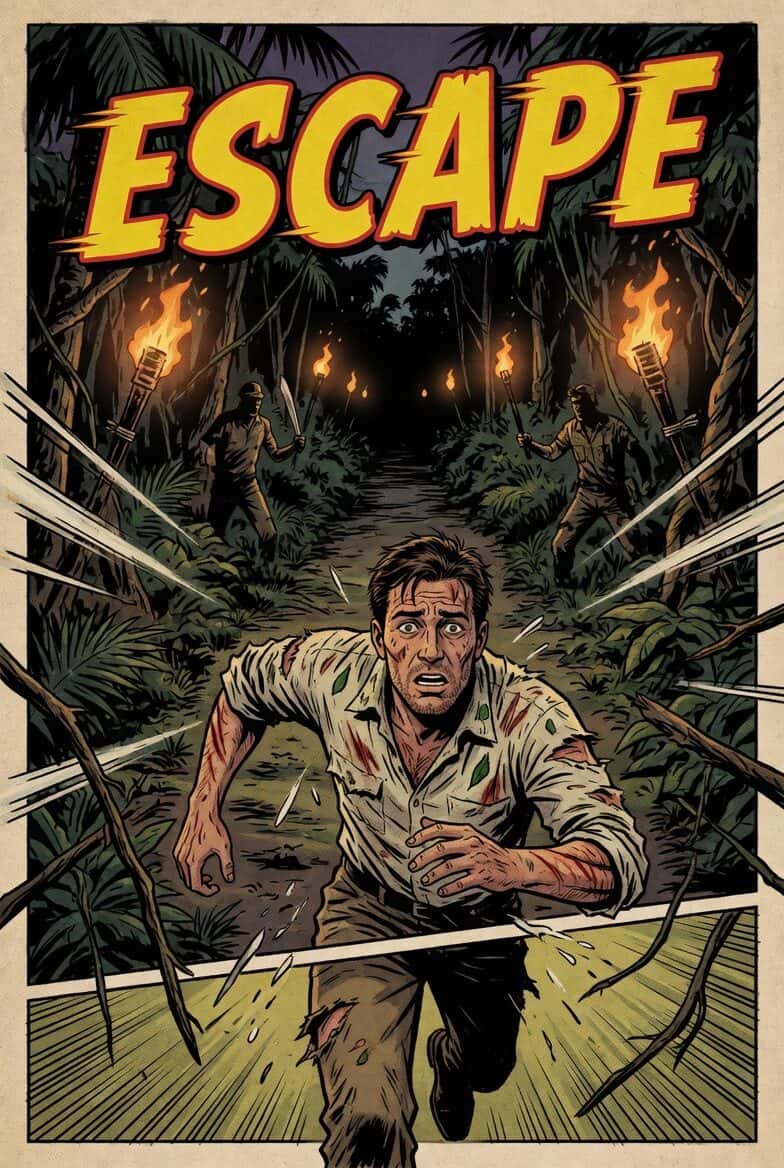
You are standing on a bridge over Owl Creek, a noose around your neck. You have but a few seconds left to live, a few seconds left to plan your escape. Escape, produced and directed by William N. Robeson, and carefully contrived to free you from the four walls of today for a half hour of high adventure. Tonight, we escape to the war between the states and a muddy stream in Alabama as we recall one of the great short stories in American literature, An Occurrence at Owl Creek Bridge by Ambrose Bierce.
A man stood upon a railroad bridge in northern Alabama, looking down through the ties at the swift water twenty feet below. The man's hands were behind his back, the wrists bound with a cord. A rope closely encircled his neck. It was attached to a stout cross-timber above his head, and the slack fell to the level of his knees. He watched a piece of dancing driftwood racing down the current beneath his feet. He thought, if I could just free my hands, I might throw off this noose and dive into the creek. If I swam underwater, I'd be safe from their bullets. If my wind held out, I could make the southern bank, take to the woods and get away home.
Peyton Farquhar, Alabama planter, stood at the end of a plank. A captain of the Union Army and a sergeant stood at the other end. When they stepped aside, the plank would tip upward, and Peyton Farquhar, Confederate spy, would slip between the ties to hang above the muddy water of Owl Creek until dead.
Even in this far outpost of Sherman's march to the sea, the formalities of death are observed by these men who are most familiar with him. The captain's company is drawn up stiffly at attention along the tracks on the northern side of the bridge. The lieutenant stands erect on the bank of the stream, the point of his bared saber scraping the gravel on the roadbed. Peyton Farquhar is being ushered into the Confederate beyond with every Union amenity. The captain stands aside. Now only the weight of the bulky sergeant counterbalances Peyton Farquhar at the end of his thin board.
They say that this is a moment when all the past events of your life tumble into your memory. But how could anyone know? Who has come back from the dead to tell what dying is like? I don't recall any childhood memories now. The past does not engulf me in this naked moment. I'm only aware of what's here, now. Those Yankees lined up on the bank. This captain's tired eyes. That turkey buzzard circling up there, waiting for me. And that noise. That beat. That beating, driving sound like a distant engine. A pump. The roll of thunder on a summer evening. It's closer. It's getting louder. Choking me.
It's your heart, of course, that you hear, stepping up its cadence, pounding under the forced draft of fear. Now you see nothing, remember nothing, sense nothing, but this strangling, suffocating beat of your own heart, throbbing its final protest. You stand there, erect.
The work is nearly at an end, now. The captain draws his sword, flourishes it to a carry, sings out a command. The bank smartly spread their legs, thrust hands forward over the rifle barrels. The sergeant on the end of the plank takes one step to the left. The plank dips forward. And Peyton Farquhar drops between the timbers of Owl Creek Bridge.
It takes longer to tell it. As you drop downward, you lose consciousness. You are as one already dead. Then, you awaken sharply in pain to feel, not to think, just to feel. The cutting pressure on your throat, the agonies of pulsating fire shooting from your neck downward, to feel the fullness, the congestion, the head bursting with suffocation. Distantly, beyond, outside of yourself, you hear a splash. Remotely, you sense cool, wet, green darkness. The rope has broken. You have fallen into the stream. No thinking returns. Slowly. You know for the moment you are safe from drowning, because the rope around your neck tightly keeps the water from your lungs.
Then I shall die hanging at the bottom of a river. And that's absurd. If I could get my hands free. I must get my hands free. Come, Peyton. They can't lick you. Try again. Once more. Good boy, the rope's giving. Again. Try once more. That does it, my boy. Now, the rope around your neck. You must breathe when you come to the surface. You must breathe quickly. Or if they haven't hanged you and they fail to drown you, you can't let them shoot you. Loosen that rope around your neck. You must get it loose. Now.
It takes so much longer to tell. You are now in the fullest possession of your senses. And again, time stops. You feel the ripples of the water upon your face, and hear their separate sounds as they strike. You see the trees on the bank and the leaves and the veining of each leaf and the very insects on them. The locusts, the brilliant-bodied flies, the gray spiders stretching their webs from twig to twig. The prismatic colors of the dewdrops upon a million blades of grass. You hear the humming of the gnats, the beating of the dragonfly's wings, the strokes of the water spider's legs. A fish slides beneath your eyes and you hear the rush of its breath, its body parting the water. All this you see and hear in an incalculably infinite instant of time.
Then you hear something else. You dive deeply but above the ringing in your ears you hear the volley of the rifles. And as you rise toward the surface you meet shining bits of metal singularly flattened, the distorted and spent bullets oscillating slowly downward past you. One catches in your collar and it feels uncomfortably warm. You snatch it out. And this gray piece of Yankee lead reminds you of the gray uniform of the soldier who was responsible for you being here.
You recall that it was only night before last when the soldier had ridden up the driveway as you and your wife sat under the magnolia trees in the cool twilight.
"Good evening, sir."
"Good evening, Corporal. I wonder if I might trouble you for a glass of water, sir."
"Why, of course, I'll—"
"Don't disturb yourself, Peyton. I'll go fetch it."
"Most kind, ma'am. If you'll just indicate the well—"
"Nonsense. You just sit a spell with my husband. You look as if you could do with some rest."
"Yes, ma'am. Reckon I could."
"I'll be back in a jiffy."
"Thank you, ma'am. Uh, whose command are you with, Corporal?"
"Colonel Tolliver, sir. Thirteenth North Carolina."
"We get so little news down here. How are things going at the front?"
"Not good, sir. The Yankees are going to be getting ready for another advance. They're repairing the railroad. Got it in shape almost to Owl Creek Bridge. And they got an outpost there. Once they can run the trains beyond the bridge, there's nothing to stop them between here and Atlanta."
"Then why hasn't the bridge been destroyed?"
"The military couldn't get near it. A civilian might."
"Owl Creek Bridge? That's not far from here, is it?"
"Less than twenty miles. They have an outpost there."
"On which side?"
"The other side. Nothing on this side but a couple of pickets half a mile out on the railroad. And a single sentinel at this end of the bridge."
"And that bridge is important?"
"Sure is."
"What if it were destroyed?"
"Hold up the Yankees for several weeks."
"Suppose a man, a civilian like myself, should elude the picket post and get the better of the sentinel. What could he accomplish?"
"Well, I was there a week ago just before we had to pull out. There's a heap of driftwood come down in last winter's flood and caught on the trestle at this end. Looked mighty dry and tindery to me."
"I see. A fellow with enough gumption might get through and set fire to it."
"It ought to burn like tow."
"Yes, it should. It ought to have plenty of gumption. The Union commander's promised to hang any civilian caught fooling around the railroad."
"Here's your water, Corporal. Right out of the spring house."
"Thank you kindly, ma'am. My, that's cool and nice."
"And here's a smidgen of cornbread. I thought you might be hungry."
"I'm mighty grateful, ma'am. It's ladies like you that keeps us out here fighting these days."
"My, what a nice compliment."
"It certainly is. I got a lot of riding ahead of me tonight."
"Good luck to you, Corporal, and thank you for the information."
"You'd be taking a chance, sir, but you couldn't do a greater service for your country."
"I'll remember that, Corporal. Goodbye, ma'am."
"Goodbye, Corporal."
"Goodbye, sir. Many thanks."
"Goodbye."
"Peyton, what was he talking about?"
"What, my dear?"
"The Corporal. What did he mean by service to your country?"
"There was nothing, really, my dear."
"Peyton Farquhar, if you're fixing to take any chances for our country, I want to know about it. Now you just speak your piece."
"There's nothing to say except I'll be going away for a day or two on a little trip."
"Is it dangerous, Peyton?"
"Not very."
"You'll be back?"
"Yes, my dear. I promise you, I'll be back."
You'll break the surface of Owl Creek for a second time, and now you're much further downstream, further away from the Union soldiers on the bridge reloading their guns, the ramrods flashing in the morning sun. That captain won't make the same mistake again. He'll order them to fire at will. Heaven help me, I cannot dodge them. Another, more terrible sound. Cannon. They've trained a cannon on you. Then close. Next time they'll use a charge of grape. Rifles and grape covering the water from bank to bank. I'm done for then.
Then something seemed to grab you, and you're whirled round and round, spinning like a waterlogged top. You're caught in a vortex, a whirlpool. The water, the banks, the distant bridge, the soldiers become indistinct blurs, and again you're helpless. You feel dizzy and sick to your stomach. Just as you felt last night when you crept up the bank toward the lone sentinel on the south end of the bridge and discovered that the sentinel was not alone.
"There he is, boys. Grab him up."
"Well, Mr. Peyton Farquhar, we've been expecting you."
"But look here, I'm a civilian."
"Save your breath and thank your maker we didn't shoot you in the back. We don't do things that way up north. You'll get a trial, everything fair and square. Bring him along, men."
The whirlpool spins faster and faster. A sharp piece of driftwood tears at your coat. The churning brown water chokes you. You know there is nothing you can do. As you had known it last night when they shoved you into a tent near the bridge to face the infantry captain with the tired eyes.
"There he is, sir. Right on schedule."
"Good work, Sergeant. Is this the man, Lieutenant?"
"That's him."
"What? You're the corporal who stopped at my plantation last night."
"That's right, Mr. Farquhar. But I'm not with the 13th North Carolina Volunteers. Mr. Farquhar, this is Lieutenant Saltonstall, intelligence officer, 5th Massachusetts Regulars."
"You've trapped me. You deliberately led me into a trap. I'm a civilian and a planter."
"Yes, and also a southern patriot caught in the act of espionage."
"You can't prove it."
"We don't have to."
"This is the most despicable, the most— This proves once more that honor is a stranger in the North."
"I'm too tired to listen to a recital of the code of a southern gentleman, Mr. Farquhar. I'm afraid the distinction between your ethics and my lack of them would escape me this evening."
"But why have you done this? Why have you deliberately trapped me?"
"The best way to eliminate civilian resistance is to lure it into the open. You fell for the bait. Too bad."
"Now look here. It's my constitutional right to—"
"The Constitution of the United States or Jeff Davis's?"
"You insulting Yankees. Remember your manners, sir."
"I demand a trial."
"You've just had it. Post a guard over him, Sergeant. We'll hang him in the morning."
Something tears at your face, scratching, and you realize that the whirling has stopped. You open your eyes. You're lying on the southern bank of the stream out of sight of your enemies. Safe. And your cheek now seems soft as new-picked cotton. The forest around you is a garden of luscious beauty reeking with the heavy perfume of freedom.
Even the whiz and rattle of the final charge of grapeshot screaming through the treetops seems a benediction from the baffled cannoneer. You leap to your feet and run into the woods south, towards home. Your neck is swollen and throbbing with pain. You carry it cocked toward your left shoulder as you push through the matted brush. All morning you tear your way into the grove. Your jacket is tattered and your face criss-crossed with bloody scratches from the brambles. Every few moments you stop. You stop to listen for the sound of dogs. But all you hear is the sleepy buzz of the forest. And the blood throbbing through your heated brain brings another thought, which is an insult. No dogs. You are not even important enough to the Yankees for dogs.
It's nearly noon now, and for half an hour you've been plunging through a swamp, your neck hurts constantly. Your head throbs and your tongue is thick. It tastes like brown cotton. Gnats swarm before your eyes, catching in your eyelids. Mosquitoes buzz in your ears, drill deep in your hands and swollen neck. You cannot go any longer. You slow down. You stop. You reach toward a palmetto root for support and it slithers from your grasp and slides softly into the water. Water moccasin. Fear finds you at last. Which stood aloof when you fled the executioner's bullets, now embraces you with clammy unction. A water moccasin. The deadly cottonmouth. Now each branch and root seems to writhe under your glance. The swamp is undulating with certain death. You plunge on through the dark, stinking ooze, on and on, tripping, stumbling, never stopping, for terror rides your back, flogging you with a whiplash of fear.
You just drink this here yop tea, Master Peyton.
Thank you. Thank you.
Jethro! What are you doing here?
I live here. Where am I? What happened?
I was paddling my dugout home through the swamp with a mess of catfish. I sees you lying out there on a bank in front of my cabin.
Jethro, I heard... I thought you were dead.
Of course you thought Jethro was dead. You knew he had consumption when you sold him. You knew he couldn't last long and he wasn't earning his keep. His wife and his daughter had carried on some at first, but after a while they calmed down. At last you'd heard. Jethro was dead.
You thought I was dead, Master Peyton? Why, sir, don't you know what's happened to me? I'm free. I'm free at last.
So, news travels fast. Even in the middle of this backward swamp, this lonely black has heard of Abe Lincoln's traitorous Emancipation Proclamation. And they believe it with the faith of children.
Yes, sir, I'm free. I expect pretty soon my woman, my little gal, come along and join me.
Yes, yes, of course they will, Jethro.
Aye, say, Master Peyton, say well.
Yes, yes, indeed, they're both fine. Your daughter's growing into a young beauty. Miss Farquhar's brought her into the kitchen, beginning to train her for the house. Well, well, what do you think of that?
Mm-hmm. And my woman, she's still seeing as pretty.
Yes, Jethro, Sundays at meeting time we can hear all the way up to the big house. That woman's voice is prettier than all the angels.
Jethro, I don't know how to say this, but I really was sorry about having to sell you, but there wasn't anything else...
I understand, Master Peyton. Don't pay it no mind. I done forgive you long ago.
You have?
Sure. Don't the Lord tell us to forgive those who trespass against us? Don't the Lord promise us we shall be free? Ah, don't you worry none about it, Master Peyton. You know, quiet that spot, quiet, chicken, quiet, you. Must have heard Razorback in the brush. No siree. Look, Master Peyton, there's a horse coming down the road.
A horse? Look there, soldier. One our soldier's corporal look like.
Jethro, you got to hide me. Don't ask so many questions, you insolence.
Master Peyton, you forget I'm free now.
Well, then, as an old friend of mine, please don't ask any questions. Just hide me. Don't tell that soldier anything.
Well, sure, I reckon I can do that for an old friend, Master Peyton. Here, here, you get down on the dish here a bit. That's it. Put the covers over the side. There you are. Snug as a tick in a rabbit's ear.
Remember, don't tell him anything. Have you come this far just to be turned in by a wool-gathering black who talks crazy? If Jethro knew this gray-clad corporal was really a Union lieutenant, he'd guarantee his freedom by turning you in. Even so, he bears you a big enough grudge to turn you in anyway. Unless, of course, he's planning to dispose of you himself. Yes, that's it. That's why he talks so silly about the Lord and forgiveness. He's gonna do you in himself.
Well, if you run into him, don't tell him I was looking for him.
Yes, I'll remember not telling.
You'll have to live longer.
Yes, I sure will.
He can come out now, Mars Peyton. I declare I don't understand none of this. You says not tell him you're here. He says not tell you he's been here. What's this all about, Mars Peyton?
Oh, it's nothing, Jethro. Nothing. I owe the man some money. I'm not ready to pay it yet.
Oh, I see. I wouldn't know about that. Money's never bothered me like it bothers some. Money and me's always been strangers.
What's he mean by that? Money's never bothered me like it's bothered some. What's he picking up that knife for?
Jethro, what are you going to do with that knife?
Oh, I was just fixing to slit up some of them catfish I got in the dugout. Looked like you could do with a little food, Mars Peyton.
Oh, no. No, thank you, Jethro. I really gotta be on my way. I wouldn't be no bother to cut up a couple of calves.
No, thank you, old friend. If you'll just tell me which way I should go to get home.
Well, I don't rightly know, Mars Peyton. I reckon from the way the sun's reclining be down the road that-a-way. Quite a tolerable piece.
Yeah, that should be about right. I never been back, you know. I never tried to go back since I been free.
Yes, I know. But I reckon it won't be long till my woman, my little gal, comes here to me.
Of course. Now, if you get back, Mars Peyton, if and you see him, you tell him I'm here waiting for him, you hear?
Yeah, I'll do that, Jethro. I'll do that.
You get away from there fast, the shells of the road crunching under your muddy boots. That grinning savage standing in the doorway of the shack, the knife in his hands. And each moment until the road bends and cuts off the cabin from view, you fear he'll come after you, the knife poised to plunge in your back, to pay you for the thrust you gave him when you sent him away to die. But he's still standing, grinning foolishly and waving as you turn the bend.
Now you feel safe, but only for a moment. Then you hear a sound. The sound of a horse. It must be the Corporal in Gray from the 5th Massachusetts Regulars. He's coming back down the road searching for you, hounding you, coming to take you back to Owl Creek Bridge, back to a rope that won't break under your weight. You walk faster and faster, and always the sound is there, growing louder and louder. And you run as fast as you can down the shell road, which stretches clear to the horizon between the green walls of scrubby pines. How long have you been running down this endless road?
It's dark now. Is it night? Or has the blood trapped in your head by the suffocating rope at last burst into your congested eyeballs and blinded you? Will it next pour from your swollen and bruised neck into your brain stopping all sensation, instantly bringing to a welcome end this day of agony and flight? Ridiculous fantasies of fatigue and fear. You can see the darkness is the black of a sudden summer storm. That lightning flash clearly shows the white road ahead, and the black silhouettes of trees along the sides. And since you're sure that you can see, the other senses return. You hear the rumble of the thunder. You feel the insupportable ache of your straining lungs, the leaden weight of your tired feet, and now the patter of rain, first washing the stinging sweat from your scratched and bitten face, now pounding harder, flowing down across your hatless head, matting your hair, slowing your headlong gait to a dog trot.
Another flash of lightning directly overhead. For an instant, you see the soldiers of Owl Creek Bridge standing at the side of the road, rifles leveled, their eyes boring down the sights, aiming at your heart. Again, you're running, and the rain has turned to hail. Pellets as big as hickory nuts beat down on you, pound your swollen, bruised neck, hammer at your countless cuts. Again, the lightning. And on the other side of the road, the gray-clad corporal sits astride his horse, waiting for you.
No! No, you can't get me now! No!
This bolt of lightning strikes a tree ahead of you, and in the white blinding light stands Jethro, black and grinning, knife raised in the air.
No! No, Jethro! Forgive me! Forgive me!
He's gone. And now you see, dangling from each tree along the road, a noose swinging in the wind. Wherever you turn, wherever you look, a noose waiting for you. A noose which wriggles like a water moccasin. No!
You are standing on the green lawn of your plantation before the high-columned entrance. The storm is over. The clouds are black and menacing all around the horizon. But through a break in the sky overhead, glorious sunlight streams down, bathing your garden and your house in heavenly light. You are home. And now you hear a rustle of crinoline, and down from the wide portico steps your beloved wife. She walks across the wide lawn, arms outstretched.
Peyton, my dear, you're back, just as you promised you'd be.
For this moment, you have endured the agonies of this day. And were those agonies multiplied a thousand times, they would be small price for the benison of this breast, the sanctuary of these arms, the security of these lips. You step forward to fold your wife in your embrace.
The rope stretched tight, sang like a bowstring. Peyton Farquhar was dead. His body, with a broken neck, swung gently from side to side beneath the timbers of Owl Creek Bridge.
Escape is produced and directed by William N. Robeson and tonight brought you An Occurrence at Owl Creek Bridge by Ambrose Bierce in a radio adaptation written by Mr. Robeson. The part of Peyton Farquhar was played by Harry Bartell. The narrators were Bill Conrad and Bill Johnstone. Jethro was played by Louis Van Rooten. The special musical score was conceived and conducted by Cy Fuhr. Next week, you are trapped in the pitch darkness of a ruined mansion and groping for you, stalking you, is a homicidal maniac armed with a knife from whom you must escape. Next week, we escape with Joseph Hergesheimer's gripping story, Wild Oranges. Good night then until this same time next week when we again offer you Escape. This is CBS, the Columbia Broadcasting System.